Hamilton County Public Health Point of Dispensing (POD) POD Manager Training
Point of Dispensing (POD) POD Manager Training Carter Pittman, BS, EMT-P HCPH Emergency Response Coordinator  Cincinnati-Hamilton Co. MRC Coordinator
Point of Dispensing A Point of Dispensing (POD) is a special location that is established to allow medication and/or vaccines to be distributed very rapidly to the public in the event of an emergency.
Purpose To provide POD Managers with the knowledge and information necessary to carry out tasks assigned at the point of dispensing (POD).
Objectives To define the qualifications and the role of the POD Manager  To describe the POD Management Structure (Incident Command System – ICS) To describe POD activation and maintain POD operations To understand the function Components of POD Operations
Contents POD Manager POD Site Information POD Activation  POD Components POD Operations General Considerations Demobilization
POD Manager   Da’ BOSS!!!
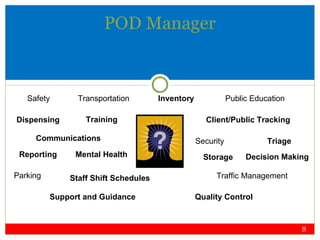
POD Manager Public Education Transportation Client/Public Tracking Triage Decision Making Inventory Reporting Traffic Management Communications Safety Support and Guidance Security Quality Control Dispensing Staff Shift Schedules Training Storage Mental Health Parking
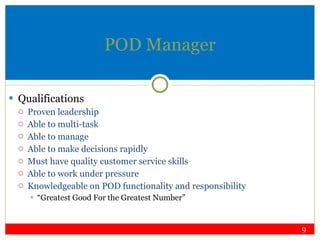
POD Manager Qualifications Proven leadership Able to multi-task Able to manage Able to make decisions rapidly Must have quality customer service skills Able to work under pressure Knowledgeable on POD functionality and responsibility “ Greatest Good For the Greatest Number”
POD Manager POD Manager Absolute on site authority Responsibility for meeting the safety and productivity expectations for a a single POD during a specific shift Will be the overseer of the basic POD functionality
POD Manager POD Manager Check on status of POD activities such as: Indivudual throughput Medication inventory status provide hourly status to DOC Supplies status Medications dispensed Personnel and volunteer resources
POD Manager Ideally, the individuals pre-assigned to given PODs should be involved in designing the POD so they will have buy-in to the plan  POD design really cannot be done in a vacuum by planners at “Higher Levels” and dumped on the POD manager.  No buy-in and no confidence in the plan. By pre-designating who the POD manager and supporting leaders will be at a given site, that POD manager can begin to  develop their team.
INCIDENT COMMAND STRUCTURE (ICS)
Incident Command Structure (ICS) An organization structure used to manage incidents both  large and small.  This system provides: Standardized management concepts Flexibility for a variety of incidents Provides common framework for Incident response
Incident Command Structure (ICS) Basic features: Common terminology in “plain talk” Modular organization (easy to grow or shrink) Management by objectives Chain of Command Manageable span of control
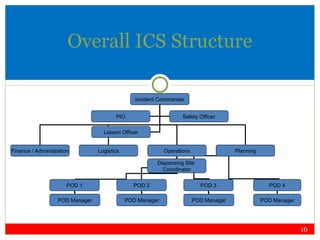
Overall ICS Structure Incident Commander Finance / Administration Logistics Operations Planning PIO Safety Officer Liaison Officer POD 1 POD 2 POD 3 POD 4 POD Manager POD Manager POD Manager POD Manager Dispensing Site  Coordinator
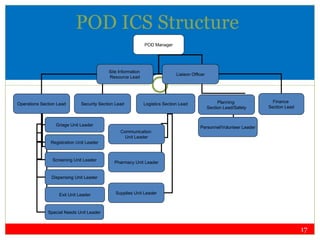
POD ICS Structure POD Manager Operations Section Lead Security Section Lead Logistics Section Lead Planning  Section Lead/Safety Site Information  Resource Lead Liaison Officer Griage Unit Leader Registration Unit Leader Screening Unit Leader Dispensing Unit Leader Communication  Unit Leader Pharmacy Unit Leader Personnel/Volunteer Leader Supplies Unit Leader Finance  Section Lead Exit Unit Leader Special Needs Unit Leader
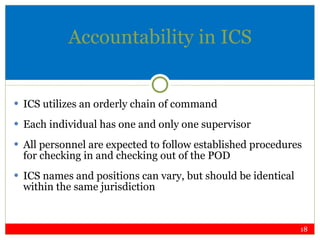
Accountability in ICS ICS utilizes an orderly chain of command Each individual has one and only one supervisor All personnel are expected to follow established procedures for checking in and checking out of the POD ICS names and positions can vary, but should be identical within the same jurisdiction
POD Site Information
POD Site Information Proficient in the use of the POD notebook and indicate how   it is laid out Comprehend the POD Plan including security, volunteer, communication and site lay out Identify Standing Orders in reference to medications
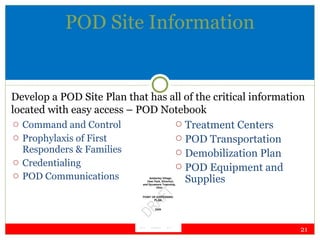
POD Site Information Command and Control Prophylaxis of First Responders & Families  Credentialing  POD Communications   Treatment Centers POD Transportation Demobilization Plan POD Equipment and Supplies Develop a POD Site Plan that has all of the critical information located with easy access – POD Notebook
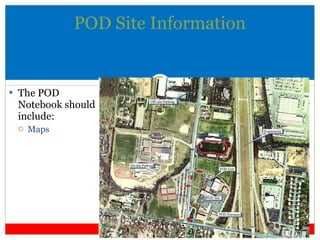
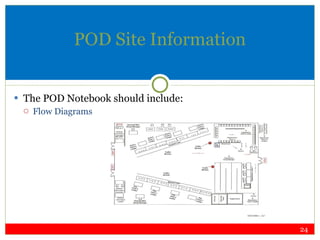
POD Site Information The POD Notebook should include: Maps
POD Site Information
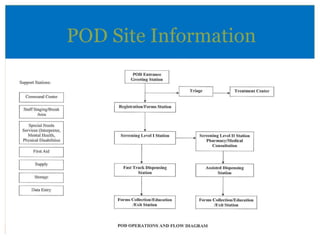
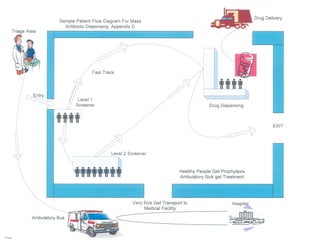
POD Site Information The POD Notebook should include: Flow Diagrams
 
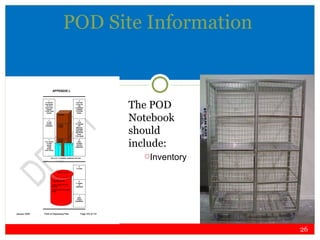
POD Site Information   The POD Notebook should include: Inventory
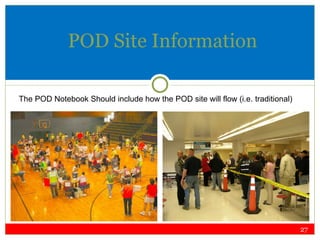
POD Site Information The POD Notebook Should include how the POD site will flow (i.e. traditional)
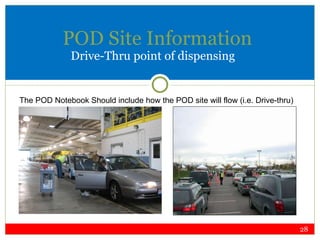
POD Site Information Drive-Thru point of dispensing The POD Notebook Should include how the POD site will flow (i.e. Drive-thru)
POD Site Activation Here we go!!!
POD Site Activation Three Points to remember: Triaged Educated Medicated
POD Site Activation Notification: POD staff  Political Officials Partners and Stakeholders Include POD facility
POD Site Activation Prepare to Operate POD Use pre-occupation checklist for facility Review standing orders, individual education, forms Make sure necessary copies are made Set-up ICS structure Designate one person to begin logging all supplies and personnel arriving Assign arriving POD staff general/command positions Assess need for any additional equipment
POD Site Activation Set-Up POD Site Delineate traffic patterns with barriers, cones, signs Obtain walkers and wheelchairs for use in POD Label all rooms at POD including rest rooms Mark entrance and exits with large clear signs
POD Site Activation SNS Arrival Delineate a location specifically for SNS arrival POD Manager and Logistics prepare to receive supplies POD Manager sign for supplies Logistics verifies orders/quantity POD Manager makes sure supplies are inventoried, secured and placed out to the proper stations.
POD Site Activation Prepare stations Griage, Registration, Screening, Dispensing, Individual Education and Exit (including supplies and equipment)­­ Arrange for EMT/EMS support Obtain facility support including janitorial support as necessary Prepare refrigerator and/or space for receipt of prophylaxis Check electrical power, water, HVAC systems Establish communications (HAM Radio Operators, etc) ICS 205 Prepare to Operate POD
POD Site Activation Staffing Prepare staff organizational chart  Sign-in Staff/Volunteers (ICS 211) Planning (Personnel/volunteer lead) should take over responsibility of volunteers/staff Dispense ID Badges/Vests  Review credentials of licensed staff Assign staff/volunteers Pass-out Job Action Sheets
POD Site Activation Staffing POD Manager will provide briefing (ICS 201) Objectives of the shift Latest event information and environmental conditions Hazards or threats to staff safety and health Communication protocol Informational flow and reporting requirements Conduct Just-in-Time Training Staff in place at stations
POD Site Activation Pre-Operational POD Security Assign Security Staff to POD exterior, interior and medications Review security procedures with staff Walk Through Take all staff through the POD steps for familiarity and to check for potential bottlenecks Notification Notify DOC that POD is ready to open when all items are checked off
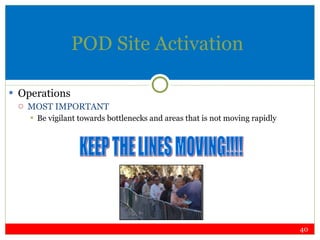
POD Site Activation Operations Begin Operations Be vigilant towards bottlenecks and areas that is not moving rapidly Work with Pharmacy Tech/Logistics to verify hourly count Relay hourly count to DOC as requested Respond to any areas of concern – utilize the Liaison as a resource Make sure breaks are given as needed Tend to the needs of the staff if needed
POD Site Activation Operations MOST IMPORTANT  Be vigilant towards bottlenecks and areas that is not moving rapidly KEEP THE LINES MOVING!!!!
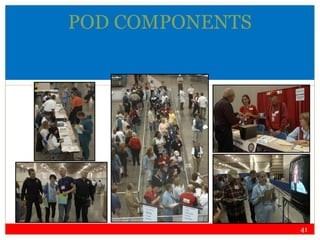
POD COMPONENTS
POD Inventory Management Systems A patient/inventory tracking system will be used throughout POD operations (this can be paper/electronic or both) This system will: Register individuals Screen individuals  Track dispensing to individuals  Track staff access to the site Monitor inventory amounts Perform other dispensing related operations
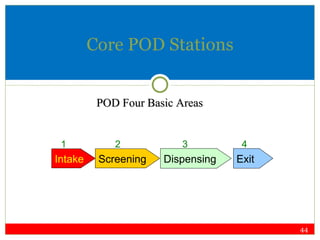
Core POD Stations Entrance Area/Griage Station Registration/Public Education Medical Assessment (Screening) Dispensing Exit/Public Education
Core POD Stations POD Four Basic Areas Intake Screening Exit Dispensing 1 2 3 4
Entrance Area/Griage Station One entrance provided for the general public Security at entrance checking identity (driver’s license, social security card, etc.) Signs posted (multilingual) Initial screening occurs here to determine movement
Entrance Area/Griage Station   Station serves to immediately screen symptomatic, sick or known exposed individuals. Transportation to treatment center or alternative care center. Medical staff needed Personnel Protective Equipment (PPE) needed
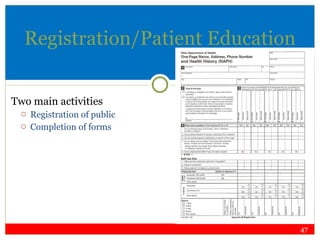
Registration/Patient Education Two main activities Registration of public Completion of forms
Medical Assessment Level I - Screening (Drug/Clinical Review Station) Medical staff to screen forms Contraindications for further assistance   (move to Level II Screening) If no assistance needed    (move to dispensing station)
Medical Assessment Level II - Screening (Pharmacy/Medical Consulting Station) Medical staff to determine appropriate medication Educational materials may be provided Directed to Dispensing Station
Dispensing Dispensing of medications/vaccinations May have various modes of dispensing stations to handle fast track, pediatric, alternative medications, etc. Forms checked for proper receipt of medications Directed to Forms Collection and Exit Education Station
Exit – Collection of Forms/Patient Education All forms and documentation collected Staff insures completeness of forms Final instructions provided and/or literature distributed by health educators Answer last-minute questions If vaccination conducted, observe the individuals condition prior to exit.
Supplementary Stations Special Services/Interpreter Station Mental/Physical Disabilities Station Mental Health Station First Aid Station Respite Area for POD Staff
Communications Radio, cell phone, whistles, bullhorn, walkie-talkie, fax POD Manager ensures internal communications are tested prior to opening POD Make sure you know how to use any communication equipment assigned to you prior to shift
POD Security Measures Provide a safe environment during all phases of POD operations Identification of staff, volunteers and public entering the POD Secure SNS Material at PODs Control entrance and exit Maintain crowd control Maintain perimeters around specific areas
Other Considerations Signs posted (multilingual) Public Education materials (biological agents, prophylaxis information [multilingual]) Assistance provided through Special Service’s Station or Physical Disabilities Station (i.e., wheelchair, interpreter, etc.)
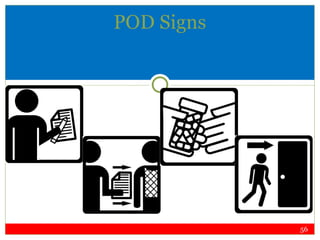
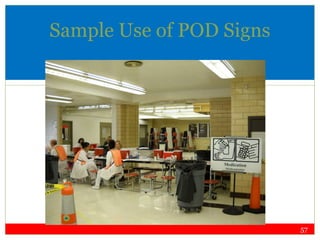
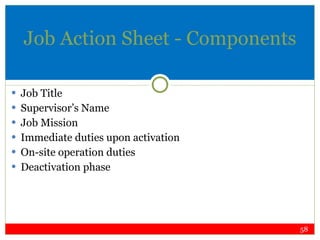
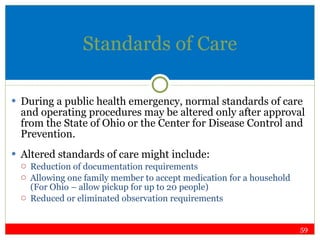
POD Signs
Sample Use of POD Signs
Job Action Sheet - Components Job Title Supervisor’s Name Job Mission Immediate duties upon activation On-site operation duties Deactivation phase
Standards of Care During a public health emergency, normal standards of care and operating procedures may be altered only after approval from the State of Ohio or the Center for Disease Control and Prevention. Altered standards of care might include: Reduction of documentation requirements Allowing one family member to accept medication for a household (For Ohio – allow pickup for up to 20 people) Reduced or eliminated observation requirements
General Considerations No one communicates with media unless directed Staff will be given and overall message to share with the population Observe for signs of stress and inappropriate behavior (staff and public) Set code phrase for staff to use indicating potential problem Keep a log (ICS Form 214) End of Shift –remember to brief on coming crew
Communicating Beyond the POD All media inquiries should be sent to the PIO Respect privacy of people working and attending POD Dispel any rumors immediately Follow your protocol on communication with friends and family
Signs of Stress and Fatigue in Self and Others Lack of concentration Increasing number of non-critical errors Critical errors Irritability Worry Feeling ill
End of Shift Debriefing with your oncoming position coverage Turn in all reports (logs) and equipment Sign-out through staging area Have a cold one and relax!!!!
DEMOBILIZATION
Demobilization of POD Informing the public is vital Breakdown activities to pre-event status Use Checklists Post-occupation Inventory and supply Personnel resources Debrief staff – use Debriefing Form/Log Collect all other forms and documentation
Demobilization of POD Prepare After Action Report which includes: Background to what occurred Summary of Events Operational Period Number of Public treated List of all personnel involved Evaluation of process Description of Operations Challenges/Problems identified Results/Outcomes
Demobilization of POD POD command staff will dismiss as necessary POD command staff and property representative will conduct a joint inspection of facility to assess conditions documenting by post-occupation checklist and photos
Questions????
Contact Information Carter Pittman Emergency Response Coordinator Hamilton County Public Health 250 William H. Taft, 2 nd  Floor Cincinnati, Ohio  45219 Phone:  513-946-7889 [email_address]

POD Manager Training

  • 1.
    Hamilton County PublicHealth Point of Dispensing (POD) POD Manager Training
  • 2.
    Point of Dispensing(POD) POD Manager Training Carter Pittman, BS, EMT-P HCPH Emergency Response Coordinator Cincinnati-Hamilton Co. MRC Coordinator
  • 3.
    Point of DispensingA Point of Dispensing (POD) is a special location that is established to allow medication and/or vaccines to be distributed very rapidly to the public in the event of an emergency.
  • 4.
    Purpose To providePOD Managers with the knowledge and information necessary to carry out tasks assigned at the point of dispensing (POD).
  • 5.
    Objectives To definethe qualifications and the role of the POD Manager To describe the POD Management Structure (Incident Command System – ICS) To describe POD activation and maintain POD operations To understand the function Components of POD Operations
  • 6.
    Contents POD ManagerPOD Site Information POD Activation POD Components POD Operations General Considerations Demobilization
  • 7.
    POD Manager Da’ BOSS!!!
  • 8.
    POD Manager PublicEducation Transportation Client/Public Tracking Triage Decision Making Inventory Reporting Traffic Management Communications Safety Support and Guidance Security Quality Control Dispensing Staff Shift Schedules Training Storage Mental Health Parking
  • 9.
    POD Manager QualificationsProven leadership Able to multi-task Able to manage Able to make decisions rapidly Must have quality customer service skills Able to work under pressure Knowledgeable on POD functionality and responsibility “ Greatest Good For the Greatest Number”
  • 10.
    POD Manager PODManager Absolute on site authority Responsibility for meeting the safety and productivity expectations for a a single POD during a specific shift Will be the overseer of the basic POD functionality
  • 11.
    POD Manager PODManager Check on status of POD activities such as: Indivudual throughput Medication inventory status provide hourly status to DOC Supplies status Medications dispensed Personnel and volunteer resources
  • 12.
    POD Manager Ideally,the individuals pre-assigned to given PODs should be involved in designing the POD so they will have buy-in to the plan POD design really cannot be done in a vacuum by planners at “Higher Levels” and dumped on the POD manager. No buy-in and no confidence in the plan. By pre-designating who the POD manager and supporting leaders will be at a given site, that POD manager can begin to develop their team.
  • 13.
  • 14.
    Incident Command Structure(ICS) An organization structure used to manage incidents both large and small. This system provides: Standardized management concepts Flexibility for a variety of incidents Provides common framework for Incident response
  • 15.
    Incident Command Structure(ICS) Basic features: Common terminology in “plain talk” Modular organization (easy to grow or shrink) Management by objectives Chain of Command Manageable span of control
  • 16.
    Overall ICS StructureIncident Commander Finance / Administration Logistics Operations Planning PIO Safety Officer Liaison Officer POD 1 POD 2 POD 3 POD 4 POD Manager POD Manager POD Manager POD Manager Dispensing Site Coordinator
  • 17.
    POD ICS StructurePOD Manager Operations Section Lead Security Section Lead Logistics Section Lead Planning Section Lead/Safety Site Information Resource Lead Liaison Officer Griage Unit Leader Registration Unit Leader Screening Unit Leader Dispensing Unit Leader Communication Unit Leader Pharmacy Unit Leader Personnel/Volunteer Leader Supplies Unit Leader Finance Section Lead Exit Unit Leader Special Needs Unit Leader
  • 18.
    Accountability in ICSICS utilizes an orderly chain of command Each individual has one and only one supervisor All personnel are expected to follow established procedures for checking in and checking out of the POD ICS names and positions can vary, but should be identical within the same jurisdiction
  • 19.
  • 20.
    POD Site InformationProficient in the use of the POD notebook and indicate how it is laid out Comprehend the POD Plan including security, volunteer, communication and site lay out Identify Standing Orders in reference to medications
  • 21.
    POD Site InformationCommand and Control Prophylaxis of First Responders & Families Credentialing POD Communications Treatment Centers POD Transportation Demobilization Plan POD Equipment and Supplies Develop a POD Site Plan that has all of the critical information located with easy access – POD Notebook
  • 22.
    POD Site InformationThe POD Notebook should include: Maps
  • 23.
  • 24.
    POD Site InformationThe POD Notebook should include: Flow Diagrams
  • 25.
  • 26.
    POD Site Information The POD Notebook should include: Inventory
  • 27.
    POD Site InformationThe POD Notebook Should include how the POD site will flow (i.e. traditional)
  • 28.
    POD Site InformationDrive-Thru point of dispensing The POD Notebook Should include how the POD site will flow (i.e. Drive-thru)
  • 29.
    POD Site ActivationHere we go!!!
  • 30.
    POD Site ActivationThree Points to remember: Triaged Educated Medicated
  • 31.
    POD Site ActivationNotification: POD staff Political Officials Partners and Stakeholders Include POD facility
  • 32.
    POD Site ActivationPrepare to Operate POD Use pre-occupation checklist for facility Review standing orders, individual education, forms Make sure necessary copies are made Set-up ICS structure Designate one person to begin logging all supplies and personnel arriving Assign arriving POD staff general/command positions Assess need for any additional equipment
  • 33.
    POD Site ActivationSet-Up POD Site Delineate traffic patterns with barriers, cones, signs Obtain walkers and wheelchairs for use in POD Label all rooms at POD including rest rooms Mark entrance and exits with large clear signs
  • 34.
    POD Site ActivationSNS Arrival Delineate a location specifically for SNS arrival POD Manager and Logistics prepare to receive supplies POD Manager sign for supplies Logistics verifies orders/quantity POD Manager makes sure supplies are inventoried, secured and placed out to the proper stations.
  • 35.
    POD Site ActivationPrepare stations Griage, Registration, Screening, Dispensing, Individual Education and Exit (including supplies and equipment)­­ Arrange for EMT/EMS support Obtain facility support including janitorial support as necessary Prepare refrigerator and/or space for receipt of prophylaxis Check electrical power, water, HVAC systems Establish communications (HAM Radio Operators, etc) ICS 205 Prepare to Operate POD
  • 36.
    POD Site ActivationStaffing Prepare staff organizational chart Sign-in Staff/Volunteers (ICS 211) Planning (Personnel/volunteer lead) should take over responsibility of volunteers/staff Dispense ID Badges/Vests Review credentials of licensed staff Assign staff/volunteers Pass-out Job Action Sheets
  • 37.
    POD Site ActivationStaffing POD Manager will provide briefing (ICS 201) Objectives of the shift Latest event information and environmental conditions Hazards or threats to staff safety and health Communication protocol Informational flow and reporting requirements Conduct Just-in-Time Training Staff in place at stations
  • 38.
    POD Site ActivationPre-Operational POD Security Assign Security Staff to POD exterior, interior and medications Review security procedures with staff Walk Through Take all staff through the POD steps for familiarity and to check for potential bottlenecks Notification Notify DOC that POD is ready to open when all items are checked off
  • 39.
    POD Site ActivationOperations Begin Operations Be vigilant towards bottlenecks and areas that is not moving rapidly Work with Pharmacy Tech/Logistics to verify hourly count Relay hourly count to DOC as requested Respond to any areas of concern – utilize the Liaison as a resource Make sure breaks are given as needed Tend to the needs of the staff if needed
  • 40.
    POD Site ActivationOperations MOST IMPORTANT Be vigilant towards bottlenecks and areas that is not moving rapidly KEEP THE LINES MOVING!!!!
  • 41.
  • 42.
    POD Inventory ManagementSystems A patient/inventory tracking system will be used throughout POD operations (this can be paper/electronic or both) This system will: Register individuals Screen individuals Track dispensing to individuals Track staff access to the site Monitor inventory amounts Perform other dispensing related operations
  • 43.
    Core POD StationsEntrance Area/Griage Station Registration/Public Education Medical Assessment (Screening) Dispensing Exit/Public Education
  • 44.
    Core POD StationsPOD Four Basic Areas Intake Screening Exit Dispensing 1 2 3 4
  • 45.
    Entrance Area/Griage StationOne entrance provided for the general public Security at entrance checking identity (driver’s license, social security card, etc.) Signs posted (multilingual) Initial screening occurs here to determine movement
  • 46.
    Entrance Area/Griage Station Station serves to immediately screen symptomatic, sick or known exposed individuals. Transportation to treatment center or alternative care center. Medical staff needed Personnel Protective Equipment (PPE) needed
  • 47.
    Registration/Patient Education Twomain activities Registration of public Completion of forms
  • 48.
    Medical Assessment LevelI - Screening (Drug/Clinical Review Station) Medical staff to screen forms Contraindications for further assistance (move to Level II Screening) If no assistance needed (move to dispensing station)
  • 49.
    Medical Assessment LevelII - Screening (Pharmacy/Medical Consulting Station) Medical staff to determine appropriate medication Educational materials may be provided Directed to Dispensing Station
  • 50.
    Dispensing Dispensing ofmedications/vaccinations May have various modes of dispensing stations to handle fast track, pediatric, alternative medications, etc. Forms checked for proper receipt of medications Directed to Forms Collection and Exit Education Station
  • 51.
    Exit – Collectionof Forms/Patient Education All forms and documentation collected Staff insures completeness of forms Final instructions provided and/or literature distributed by health educators Answer last-minute questions If vaccination conducted, observe the individuals condition prior to exit.
  • 52.
    Supplementary Stations SpecialServices/Interpreter Station Mental/Physical Disabilities Station Mental Health Station First Aid Station Respite Area for POD Staff
  • 53.
    Communications Radio, cellphone, whistles, bullhorn, walkie-talkie, fax POD Manager ensures internal communications are tested prior to opening POD Make sure you know how to use any communication equipment assigned to you prior to shift
  • 54.
    POD Security MeasuresProvide a safe environment during all phases of POD operations Identification of staff, volunteers and public entering the POD Secure SNS Material at PODs Control entrance and exit Maintain crowd control Maintain perimeters around specific areas
  • 55.
    Other Considerations Signsposted (multilingual) Public Education materials (biological agents, prophylaxis information [multilingual]) Assistance provided through Special Service’s Station or Physical Disabilities Station (i.e., wheelchair, interpreter, etc.)
  • 56.
  • 57.
    Sample Use ofPOD Signs
  • 58.
    Job Action Sheet- Components Job Title Supervisor’s Name Job Mission Immediate duties upon activation On-site operation duties Deactivation phase
  • 59.
    Standards of CareDuring a public health emergency, normal standards of care and operating procedures may be altered only after approval from the State of Ohio or the Center for Disease Control and Prevention. Altered standards of care might include: Reduction of documentation requirements Allowing one family member to accept medication for a household (For Ohio – allow pickup for up to 20 people) Reduced or eliminated observation requirements
  • 60.
    General Considerations Noone communicates with media unless directed Staff will be given and overall message to share with the population Observe for signs of stress and inappropriate behavior (staff and public) Set code phrase for staff to use indicating potential problem Keep a log (ICS Form 214) End of Shift –remember to brief on coming crew
  • 61.
    Communicating Beyond thePOD All media inquiries should be sent to the PIO Respect privacy of people working and attending POD Dispel any rumors immediately Follow your protocol on communication with friends and family
  • 62.
    Signs of Stressand Fatigue in Self and Others Lack of concentration Increasing number of non-critical errors Critical errors Irritability Worry Feeling ill
  • 63.
    End of ShiftDebriefing with your oncoming position coverage Turn in all reports (logs) and equipment Sign-out through staging area Have a cold one and relax!!!!
  • 64.
  • 65.
    Demobilization of PODInforming the public is vital Breakdown activities to pre-event status Use Checklists Post-occupation Inventory and supply Personnel resources Debrief staff – use Debriefing Form/Log Collect all other forms and documentation
  • 66.
    Demobilization of PODPrepare After Action Report which includes: Background to what occurred Summary of Events Operational Period Number of Public treated List of all personnel involved Evaluation of process Description of Operations Challenges/Problems identified Results/Outcomes
  • 67.
    Demobilization of PODPOD command staff will dismiss as necessary POD command staff and property representative will conduct a joint inspection of facility to assess conditions documenting by post-occupation checklist and photos
  • 68.
  • 69.
    Contact Information CarterPittman Emergency Response Coordinator Hamilton County Public Health 250 William H. Taft, 2 nd Floor Cincinnati, Ohio 45219 Phone: 513-946-7889 [email_address]

Editor's Notes

  • #4 Hamilton County has established 35 PODs within the 44 jurisdictions it covers in the county. Some communities have joined together to host a POD. Some communities have sited as many as two PODs per community because of the density of the population.
  • #15 Standardized Mgmt. Concept – Note: allows personnel from a variety of agencies to meld rapidly into a common management structure
  • #16 Management by Objectives – Note: Step by step process IAP – Note: specifies objectives; state activities to be completed; sets timeframe; may be oral or written (What, Who, How, What if) Chain of Command – Note: orderly line of authority and transfer of command Unified Command – Note: agencies work together to make decisions Manageable span of control – Note: ratio 1:5
  • #24 Discuss general flow diagram
  • #28 One of two examples of interior floor plan flow and supporting functions; discuss features
  • #29 Need example
  • #44 Describe functions of each station per below; final set-up may vary by site. Exit includes collection of forms/also may provide additional patient education
  • #46 Note: those individuals exhibiting symptoms, having known exposure, or who are sick will be directed immediately to the triage station for further evaluation from the main flow of patients. Those patients exhibiting no symptoms and/or unexposed will be directed to the registration station.
  • #53 Mental Health Station – for both staff and public First Aid Station – for both staff and public Respite Area for POD Staff – provide food and rest area
  • #54 Communication flow should follow the chain of command Communications Unit Leader is responsible for set up of communications support Communications Procedures: Listen to make sure your transmission won’t interfere with another communication and to be aware of other things going on Think about what you will say before you transmit. This will help you communicate your idea effectively and to use only the air time needed and no more. When making call, give the call sign or identification of the station called. Communicate by speaking clearly, use plain English/no codes and repeat back critical items for confirmation. Finish your communications ASAP so others can communicate if using two way radios such as MARC radios Use Phonetics for spelling words and names that are not easily understood. (i.e., A=alpha, B=bravo, etc.) Report any communication problems to your immediate supervisor.
  • #55 Maintain order of POD flow operations (Note: internally and externally) Maintain perimeters around specific areas (Note: i.e., staff only areas, supply storage areas, etc.)
  • #61 (3) Note: Observe for signs of stress and inappropriate behavior (staff and public) – Contact supervisor as issue arises (4) Note: Set code phrase for staff to use indicating potential problem – i.e., dealing with a person exhibiting inappropriate