Pointer in C and its significance, Relationship between pointers and memory addresses.pptx
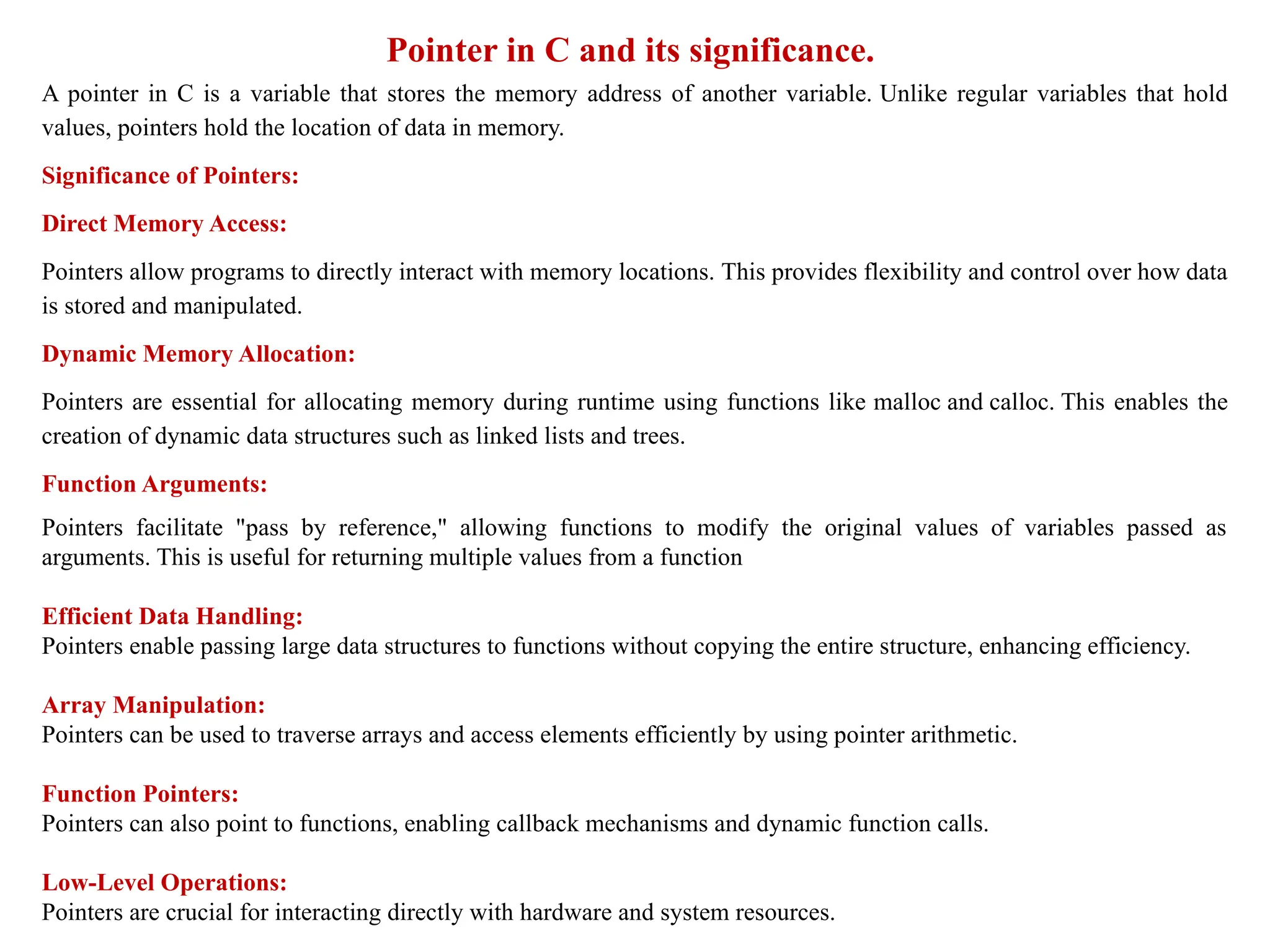
A pointer in C is a variable that stores the memory address of another variable. Unlike regular variables that hold values, pointers hold the location of data in memory.
A pointer inC is a variable that stores the memory address of another variable. Unlike regular variables that hold
values, pointers hold the location of data in memory.
Significance of Pointers:
Direct Memory Access:
Pointers allow programs to directly interact with memory locations. This provides flexibility and control over how data
is stored and manipulated.
Dynamic Memory Allocation:
Pointers are essential for allocating memory during runtime using functions like malloc and calloc. This enables the
creation of dynamic data structures such as linked lists and trees.
Function Arguments:
Pointers facilitate "pass by reference," allowing functions to modify the original values of variables passed as
arguments. This is useful for returning multiple values from a function
Efficient Data Handling:
Pointers enable passing large data structures to functions without copying the entire structure, enhancing efficiency.
Array Manipulation:
Pointers can be used to traverse arrays and access elements efficiently by using pointer arithmetic.
Function Pointers:
Pointers can also point to functions, enabling callback mechanisms and dynamic function calls.
Low-Level Operations:
Pointers are crucial for interacting directly with hardware and system resources.
Pointer in C and its significance.
3.
Relationship between pointersand memory addresses
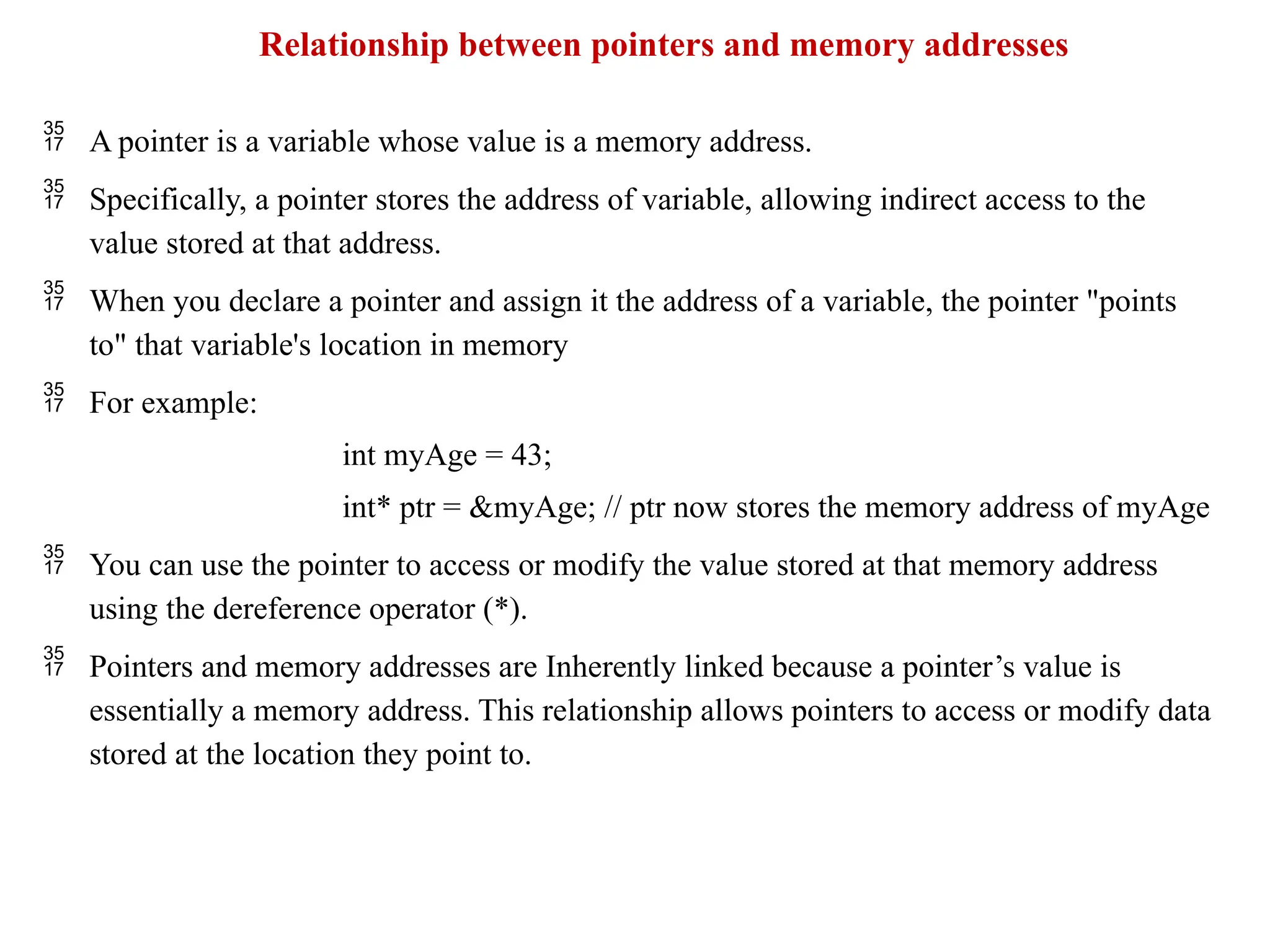
A pointer is a variable whose value is a memory address.
Specifically, a pointer stores the address of variable, allowing indirect access to the
value stored at that address.
When you declare a pointer and assign it the address of a variable, the pointer "points
to" that variable's location in memory
For example:
int myAge = 43;
int* ptr = &myAge; // ptr now stores the memory address of myAge
You can use the pointer to access or modify the value stored at that memory address
using the dereference operator (*).
Pointers and memory addresses are Inherently linked because a pointer’s value is
essentially a memory address. This relationship allows pointers to access or modify data
stored at the location they point to.
4.
Advantages of usingpointers
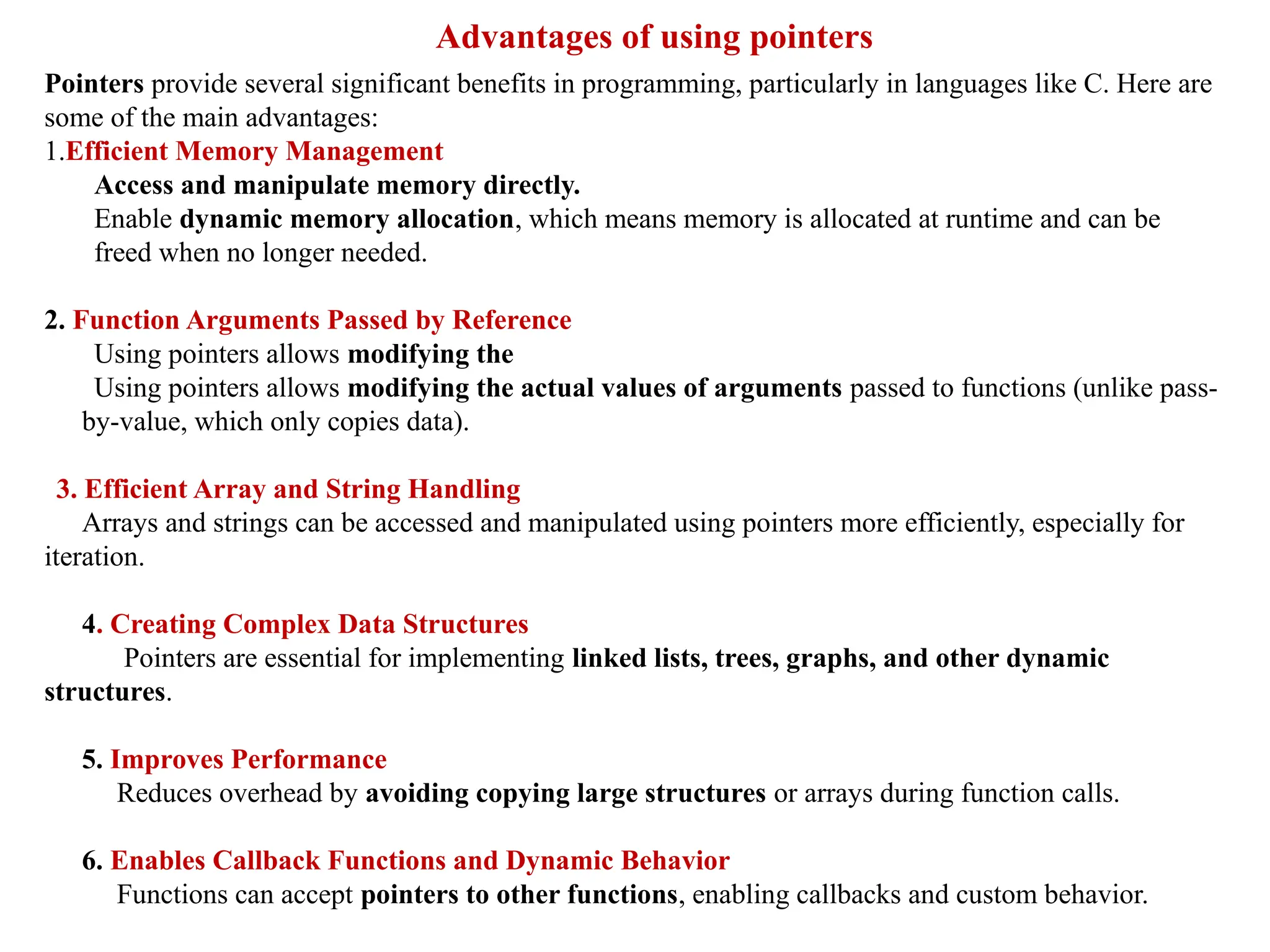
Pointers provide several significant benefits in programming, particularly in languages like C. Here are
some of the main advantages:
1.Efficient Memory Management
Access and manipulate memory directly.
Enable dynamic memory allocation, which means memory is allocated at runtime and can be
freed when no longer needed.
2. Function Arguments Passed by Reference
Using pointers allows modifying the
Using pointers allows modifying the actual values of arguments passed to functions (unlike pass-
by-value, which only copies data).
3. Efficient Array and String Handling
Arrays and strings can be accessed and manipulated using pointers more efficiently, especially for
iteration.
4. Creating Complex Data Structures
Pointers are essential for implementing linked lists, trees, graphs, and other dynamic
structures.
5. Improves Performance
Reduces overhead by avoiding copying large structures or arrays during function calls.
6. Enables Callback Functions and Dynamic Behavior
Functions can accept pointers to other functions, enabling callbacks and custom behavior.
5.
Declaring a pointervariable
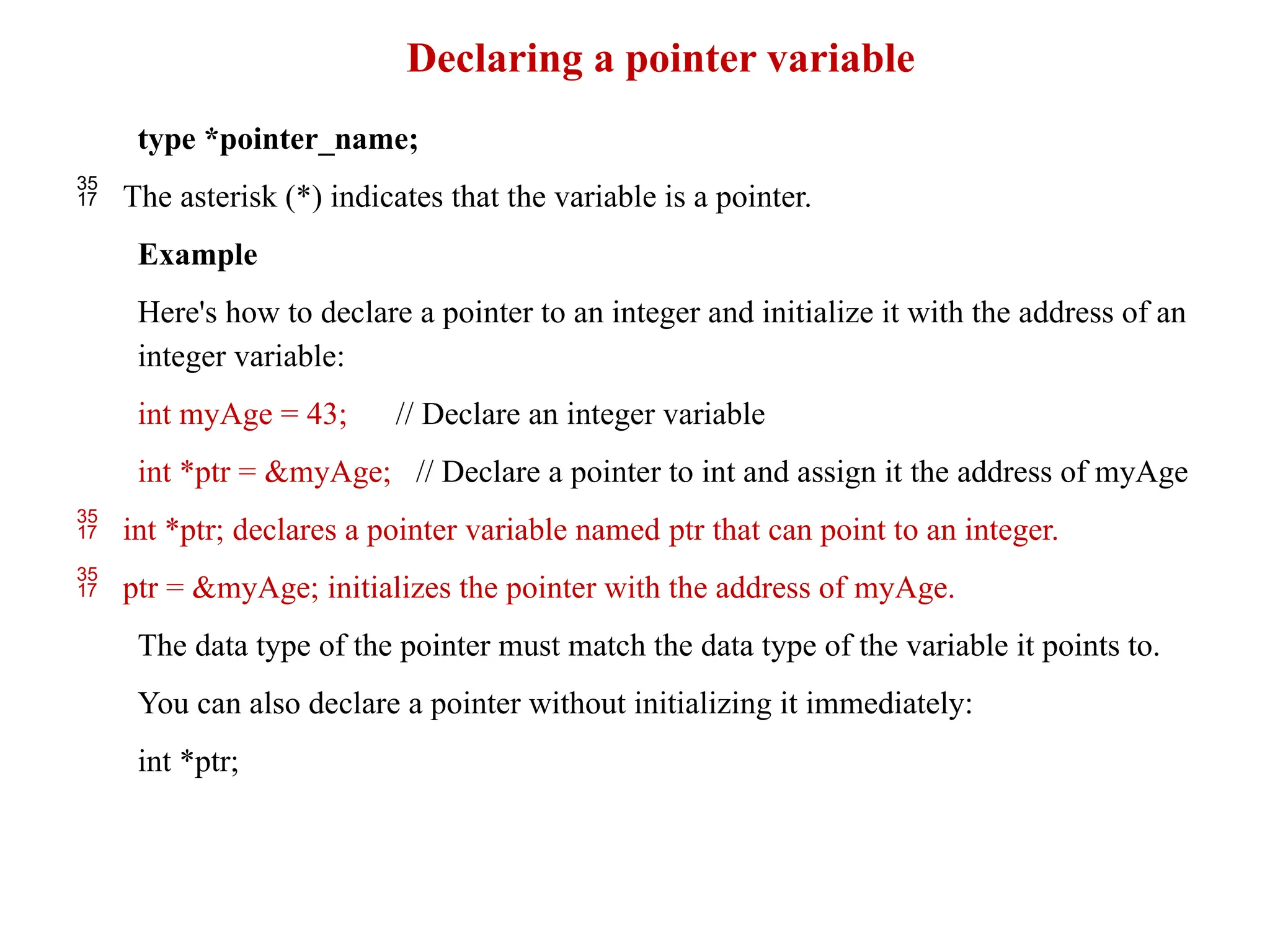
type *pointer_name;
The asterisk (*) indicates that the variable is a pointer.
Example
Here's how to declare a pointer to an integer and initialize it with the address of an
integer variable:
int myAge = 43; // Declare an integer variable
int *ptr = &myAge; // Declare a pointer to int and assign it the address of myAge
int *ptr; declares a pointer variable named ptr that can point to an integer.
ptr = &myAge; initializes the pointer with the address of myAge.
The data type of the pointer must match the data type of the variable it points to.
You can also declare a pointer without initializing it immediately:
int *ptr;
6.
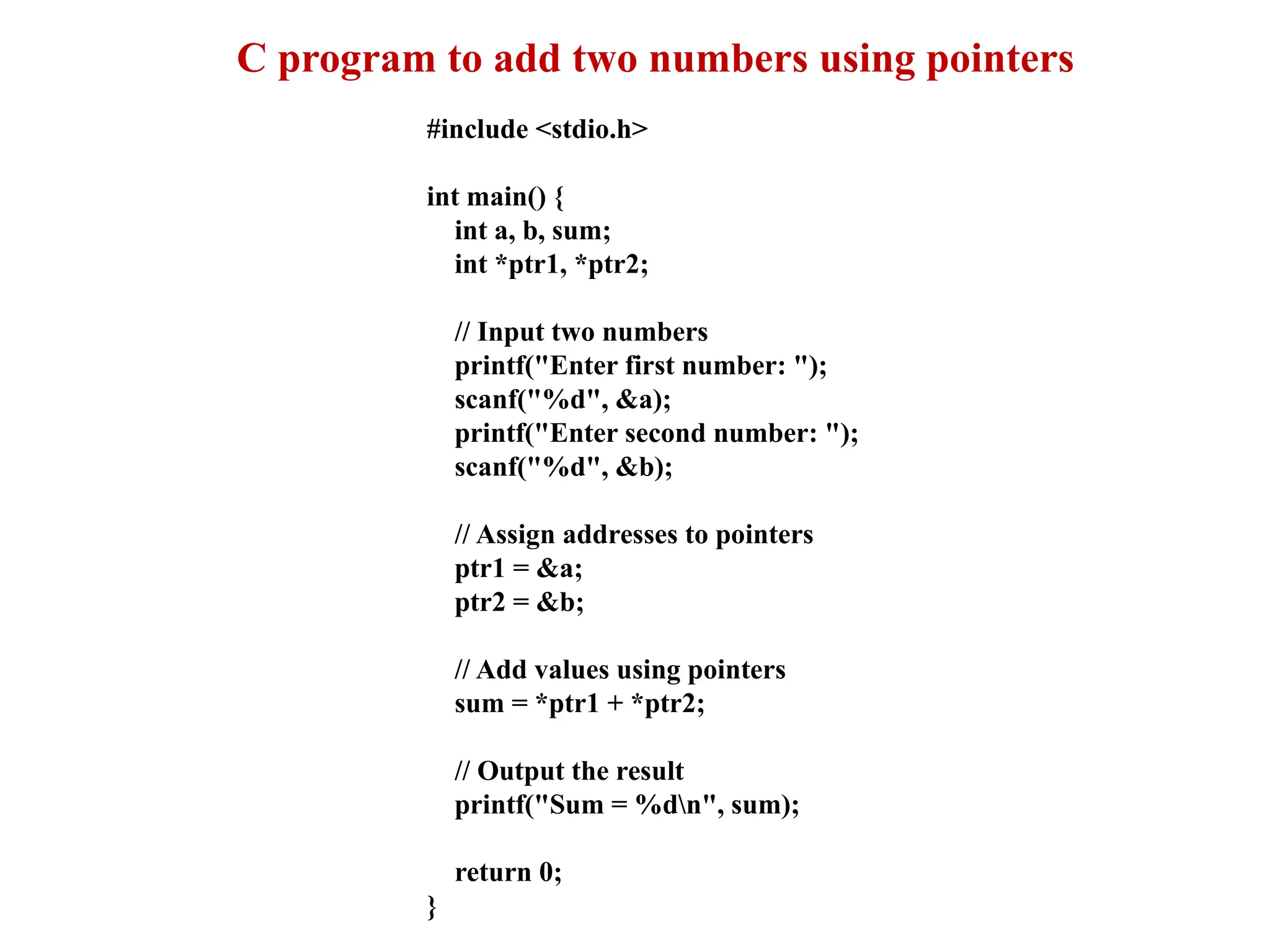
C program toadd two numbers using pointers
#include <stdio.h>
int main() {
int a, b, sum;
int *ptr1, *ptr2;
// Input two numbers
printf("Enter first number: ");
scanf("%d", &a);
printf("Enter second number: ");
scanf("%d", &b);
// Assign addresses to pointers
ptr1 = &a;
ptr2 = &b;
// Add values using pointers
sum = *ptr1 + *ptr2;
// Output the result
printf("Sum = %dn", sum);
return 0;
}