POINTER
PRESENTED BY-
NEELAM SINGH
DEPARTMENT OF COMPUTER SCIENCE
C++ Pointers
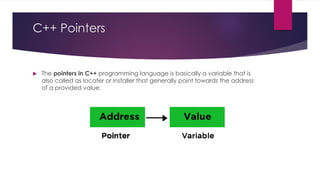
 The pointers in C++ programming language is basically a variable that is
also called as locater or installer that generally point towards the address
of a provided value.
What are Pointers?
 In C++, a pointer refers to a variable that holds the address of another
variable. Like regular variables, pointers have a data type. For example, a
pointer of type integer can hold the address of a variable of type integer.
A pointer of character type can hold the address of a variable of
character type.
 You should see a pointer as a symbolic representation of a memory
address. With pointers, programs can simulate call-by-reference. They can
also create and manipulate dynamic data structures. In C++, a pointer
variable refers to a variable pointing to a specific address in a memory
pointed by another variable.
Addresses in C++
 To understand C++ pointers, you must understand how computers store
data.
 When you create a variable in your C++ program, it is assigned some
space the computer memory. The value of this variable is stored in the
assigned location.
 To know the location in the computer memory where the data is stored,
C++ provides the & (reference) operator. The operator returns the address
that a variable occupies.
For example, if x is a variable, &x returns the address of the variable.
Pointer Declaration Syntax
The declaration of C++ takes the following syntax:
datatype *variable_name;
 The datatype is the base type of the pointer which must be a valid C++ data type.
 The variable_name is should be the name of the pointer variable.
 Asterisk used above for pointer declaration is similar to asterisk used to perform multiplication operation.
It is the asterisk that marks the variable as a pointer.
Here is an example of valid pointer declarations in C++:
int *x; // a pointer to integer
double *x; // a pointer to double
float *x; // a pointer to float
char *ch // a pointer to a character
Reference operator (&) and Deference
operator (*)
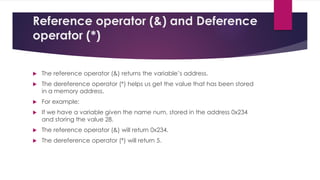
 The reference operator (&) returns the variable’s address.
 The dereference operator (*) helps us get the value that has been stored
in a memory address.
 For example:
 If we have a variable given the name num, stored in the address 0x234
and storing the value 28.
 The reference operator (&) will return 0x234.
 The dereference operator (*) will return 5.
EXAMPLE
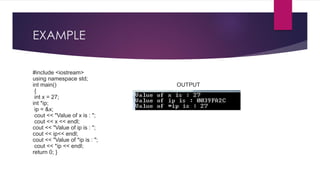
#include <iostream>
using namespace std;
int main() OUTPUT
{
int x = 27;
int *ip;
ip = &x;
cout << "Value of x is : ";
cout << x << endl;
cout << "Value of ip is : ";
cout << ip<< endl;
cout << "Value of *ip is : ";
cout << *ip << endl;
return 0; }
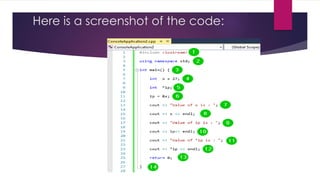
Here is a screenshot of the code:
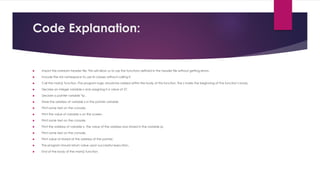
Code Explanation:
 Import the iostream header file. This will allow us to use the functions defined in the header file without getting errors.
 Include the std namespace to use its classes without calling it.
 Call the main() function. The program logic should be added within the body of this function. The { marks the beginning of the function’s body.
 Declare an integer variable x and assigning it a value of 27.
 Declare a pointer variable *ip.
 Store the address of variable x in the pointer variable.
 Print some text on the console.
 Print the value of variable x on the screen.
 Print some text on the console.
 Print the address of variable x. The value of the address was stored in the variable ip.
 Print some text on the console.
 Print value of stored at the address of the pointer.
 The program should return value upon successful execution.
 End of the body of the main() function.
Advantages of Pointer
 Less time in program execution.
 Working on the original variable.
 With the help of pointers, we can create data structures (linked-list, stack,
queue).
 Returning more than one values from functions.
 Searching and sorting large data very easily.
 Dynamically memory allocation.
Uses of Pointers
 To pass arguments by reference.
 For accessing array elements.
 To return multiple values.
 Dynamic memory allocation.
 To implement data structures.
 To do system level programming where memory addresses are useful.
THANK YOU

C++ Pointers , Basic to advanced Concept

  • 1.
  • 2.
    C++ Pointers  Thepointers in C++ programming language is basically a variable that is also called as locater or installer that generally point towards the address of a provided value.
  • 3.
    What are Pointers? In C++, a pointer refers to a variable that holds the address of another variable. Like regular variables, pointers have a data type. For example, a pointer of type integer can hold the address of a variable of type integer. A pointer of character type can hold the address of a variable of character type.  You should see a pointer as a symbolic representation of a memory address. With pointers, programs can simulate call-by-reference. They can also create and manipulate dynamic data structures. In C++, a pointer variable refers to a variable pointing to a specific address in a memory pointed by another variable.
  • 4.
    Addresses in C++ To understand C++ pointers, you must understand how computers store data.  When you create a variable in your C++ program, it is assigned some space the computer memory. The value of this variable is stored in the assigned location.  To know the location in the computer memory where the data is stored, C++ provides the & (reference) operator. The operator returns the address that a variable occupies. For example, if x is a variable, &x returns the address of the variable.
  • 5.
    Pointer Declaration Syntax Thedeclaration of C++ takes the following syntax: datatype *variable_name;  The datatype is the base type of the pointer which must be a valid C++ data type.  The variable_name is should be the name of the pointer variable.  Asterisk used above for pointer declaration is similar to asterisk used to perform multiplication operation. It is the asterisk that marks the variable as a pointer. Here is an example of valid pointer declarations in C++: int *x; // a pointer to integer double *x; // a pointer to double float *x; // a pointer to float char *ch // a pointer to a character
  • 6.
    Reference operator (&)and Deference operator (*)  The reference operator (&) returns the variable’s address.  The dereference operator (*) helps us get the value that has been stored in a memory address.  For example:  If we have a variable given the name num, stored in the address 0x234 and storing the value 28.  The reference operator (&) will return 0x234.  The dereference operator (*) will return 5.
  • 7.
    EXAMPLE #include <iostream> using namespacestd; int main() OUTPUT { int x = 27; int *ip; ip = &x; cout << "Value of x is : "; cout << x << endl; cout << "Value of ip is : "; cout << ip<< endl; cout << "Value of *ip is : "; cout << *ip << endl; return 0; }
  • 8.
    Here is ascreenshot of the code:
  • 9.
    Code Explanation:  Importthe iostream header file. This will allow us to use the functions defined in the header file without getting errors.  Include the std namespace to use its classes without calling it.  Call the main() function. The program logic should be added within the body of this function. The { marks the beginning of the function’s body.  Declare an integer variable x and assigning it a value of 27.  Declare a pointer variable *ip.  Store the address of variable x in the pointer variable.  Print some text on the console.  Print the value of variable x on the screen.  Print some text on the console.  Print the address of variable x. The value of the address was stored in the variable ip.  Print some text on the console.  Print value of stored at the address of the pointer.  The program should return value upon successful execution.  End of the body of the main() function.
  • 10.
    Advantages of Pointer Less time in program execution.  Working on the original variable.  With the help of pointers, we can create data structures (linked-list, stack, queue).  Returning more than one values from functions.  Searching and sorting large data very easily.  Dynamically memory allocation.
  • 11.
    Uses of Pointers To pass arguments by reference.  For accessing array elements.  To return multiple values.  Dynamic memory allocation.  To implement data structures.  To do system level programming where memory addresses are useful.
  • 12.