CHAPTER 7
The sublime and the ridiculous
are often so nearly related that
it is difficult to class them separately.
̶ Tom Paine
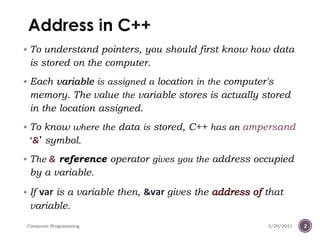
▪ To understand pointers, you should first know how data
is stored on the computer.
▪ Each variable is assigned a location in the computer's
memory. The value the variable stores is actually stored
in the location assigned.
▪ To know where the data is stored, C++ has an ampersand
‘&’ symbol.
▪ The & reference operator gives you the address occupied
by a variable.
▪ If var is a variable then, &var gives the that
variable.
3/20/2021
Computer Programming 2
3/20/2021
Computer Programming 3
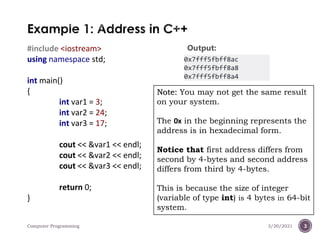
#include <iostream>
using namespace std;
int main()
{
int var1 = 3;
int var2 = 24;
int var3 = 17;
cout << &var1 << endl;
cout << &var2 << endl;
cout << &var3 << endl;
return 0;
}
0x7fff5fbff8ac
0x7fff5fbff8a8
0x7fff5fbff8a4
Output:
Note: You may not get the same result
on your system.
The 0x in the beginning represents the
address is in hexadecimal form.
Notice that first address differs from
second by 4-bytes and second address
differs from third by 4-bytes.
This is because the size of integer
(variable of type int) is 4 bytes in 64-bit
system.
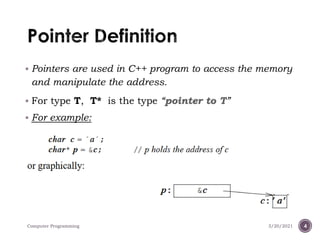
▪ Pointers are used in C++ program to access the memory
and manipulate the address.
▪ For type T, T* is the type “ ”
▪ For example:
3/20/2021
Computer Programming 4
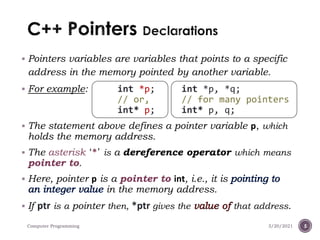
▪ Pointers variables are variables that points to a specific
address in the memory pointed by another variable.
▪ For example: int *p; int *p, *q;
// or, // for many pointers
int* p; int* p, q;
▪ The statement above defines a pointer variable p, which
holds the memory address.
▪ The asterisk ‘*’ is a dereference operator which means
pointer to.
▪ Here, pointer p is a pointer to int, i.e., it is
in the memory address.
▪ If ptr is a pointer then, *ptr gives the that address.
3/20/2021
Computer Programming 5
3/20/2021
Computer Programming 6
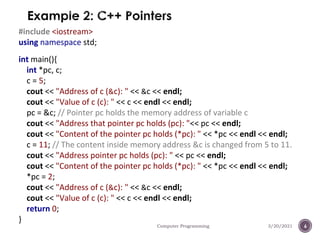
#include <iostream>
using namespace std;
int main(){
int *pc, c;
c = 5;
cout << "Address of c (&c): " << &c << endl;
cout << "Value of c (c): " << c << endl << endl;
pc = &c; // Pointer pc holds the memory address of variable c
cout << "Address that pointer pc holds (pc): "<< pc << endl;
cout << "Content of the pointer pc holds (*pc): " << *pc << endl << endl;
c = 11; // The content inside memory address &c is changed from 5 to 11.
cout << "Address pointer pc holds (pc): " << pc << endl;
cout << "Content of the pointer pc holds (*pc): " << *pc << endl << endl;
*pc = 2;
cout << "Address of c (&c): " << &c << endl;
cout << "Value of c (c): " << c << endl << endl;
return 0;
}
3/20/2021
Computer Programming
7
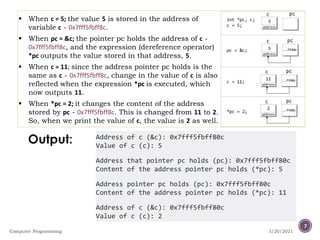
Address of c (&c): 0x7fff5fbff80c
Value of c (c): 5
Address that pointer pc holds (pc): 0x7fff5fbff80c
Content of the address pointer pc holds (*pc): 5
Address pointer pc holds (pc): 0x7fff5fbff80c
Content of the address pointer pc holds (*pc): 11
Address of c (&c): 0x7fff5fbff80c
Value of c (c): 2
▪ When c = 5; the value 5 is stored in the address of
variable c - 0x7fff5fbff8c.
▪ When pc = &c; the pointer pc holds the address of c -
0x7fff5fbff8c, and the expression (dereference operator)
*pc outputs the value stored in that address, 5.
▪ When c = 11; since the address pointer pc holds is the
same as c - 0x7fff5fbff8c, change in the value of c is also
reflected when the expression *pc is executed, which
now outputs 11.
▪ When *pc = 2; it changes the content of the address
stored by pc - 0x7fff5fbff8c. This is changed from 11 to 2.
So, when we print the value of c, the value is 2 as well.
3/20/2021
Computer Programming 8
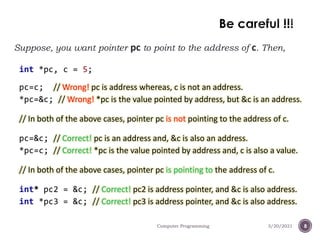
int *pc, c = 5;
pc=c; // Wrong! pc is address whereas, c is not an address.
*pc=&c; // Wrong! *pc is the value pointed by address, but &c is an address.
// In both of the above cases, pointer pc is not pointing to the address of c.
pc=&c; // Correct! pc is an address and, &c is also an address.
*pc=c; // Correct! *pc is the value pointed by address and, c is also a value.
// In both of the above cases, pointer pc is pointing to the address of c.
int* pc2 = &c; // Correct! pc2 is address pointer, and &c is also address.
int *pc3 = &c; // Correct! pc3 is address pointer, and &c is also address.
Suppose, you want pointer pc to point to the address of c. Then,
3/20/2021
Computer Programming 9
▪ Pointers are the variables that hold address.
▪ Not only can pointers store address of a single variable,
it can also store address of cells of an array.
▪ For example: int* ptr;
int a[5] = {2,4,6,8,10};
// &a[2] is the address of third element of a[5].
ptr = &a[2];
// ptr + 1 increases by the size of int (4B in 64-bit)
// ptr + 1 will point to the fourth element.
cout<< *ptr + 1; // displays: 8
char *ptr2 = &a; // char is 1B,
// ptr2 is pointing to a[0]
cout<< *ptr2 + 4; // displays: 8
4 6 8
2 10
a[0] a[1] a[2] a[3] a[4]
ptr ptr + 1
ptr2
3/20/2021
Computer Programming 10
#include <iostream>
using namespace std;
#define SIZE 3
int main(){
float arr[SIZE];
float *ptr;
int i;
cout << "Displaying address using arrays: " << endl;
for (i = 0; i < SIZE; ++i)
cout << "&arr[" << i << "] = " << &arr[i] << endl;
// ptr = &arr[0]
ptr = arr;
cout<<"nDisplaying address using pointers: "<< endl;
for (i = 0; i < SIZE; ++i)
cout << "ptr + " << i << " = "<< ptr + i << endl;
return 0;
}
Displaying address using arrays:
&arr[0] = 0x7fff5fbff880
&arr[1] = 0x7fff5fbff884
&arr[2] = 0x7fff5fbff888
Displaying address using pointers:
ptr + 0 = 0x7fff5fbff880
ptr + 1 = 0x7fff5fbff884
ptr + 2 = 0x7fff5fbff888

Computer programming course(c++ pointer))

  • 1.
    CHAPTER 7 The sublimeand the ridiculous are often so nearly related that it is difficult to class them separately. ̶ Tom Paine
  • 2.
    ▪ To understandpointers, you should first know how data is stored on the computer. ▪ Each variable is assigned a location in the computer's memory. The value the variable stores is actually stored in the location assigned. ▪ To know where the data is stored, C++ has an ampersand ‘&’ symbol. ▪ The & reference operator gives you the address occupied by a variable. ▪ If var is a variable then, &var gives the that variable. 3/20/2021 Computer Programming 2
  • 3.
    3/20/2021 Computer Programming 3 #include<iostream> using namespace std; int main() { int var1 = 3; int var2 = 24; int var3 = 17; cout << &var1 << endl; cout << &var2 << endl; cout << &var3 << endl; return 0; } 0x7fff5fbff8ac 0x7fff5fbff8a8 0x7fff5fbff8a4 Output: Note: You may not get the same result on your system. The 0x in the beginning represents the address is in hexadecimal form. Notice that first address differs from second by 4-bytes and second address differs from third by 4-bytes. This is because the size of integer (variable of type int) is 4 bytes in 64-bit system.
  • 4.
    ▪ Pointers areused in C++ program to access the memory and manipulate the address. ▪ For type T, T* is the type “ ” ▪ For example: 3/20/2021 Computer Programming 4
  • 5.
    ▪ Pointers variablesare variables that points to a specific address in the memory pointed by another variable. ▪ For example: int *p; int *p, *q; // or, // for many pointers int* p; int* p, q; ▪ The statement above defines a pointer variable p, which holds the memory address. ▪ The asterisk ‘*’ is a dereference operator which means pointer to. ▪ Here, pointer p is a pointer to int, i.e., it is in the memory address. ▪ If ptr is a pointer then, *ptr gives the that address. 3/20/2021 Computer Programming 5
  • 6.
    3/20/2021 Computer Programming 6 #include<iostream> using namespace std; int main(){ int *pc, c; c = 5; cout << "Address of c (&c): " << &c << endl; cout << "Value of c (c): " << c << endl << endl; pc = &c; // Pointer pc holds the memory address of variable c cout << "Address that pointer pc holds (pc): "<< pc << endl; cout << "Content of the pointer pc holds (*pc): " << *pc << endl << endl; c = 11; // The content inside memory address &c is changed from 5 to 11. cout << "Address pointer pc holds (pc): " << pc << endl; cout << "Content of the pointer pc holds (*pc): " << *pc << endl << endl; *pc = 2; cout << "Address of c (&c): " << &c << endl; cout << "Value of c (c): " << c << endl << endl; return 0; }
  • 7.
    3/20/2021 Computer Programming 7 Address ofc (&c): 0x7fff5fbff80c Value of c (c): 5 Address that pointer pc holds (pc): 0x7fff5fbff80c Content of the address pointer pc holds (*pc): 5 Address pointer pc holds (pc): 0x7fff5fbff80c Content of the address pointer pc holds (*pc): 11 Address of c (&c): 0x7fff5fbff80c Value of c (c): 2 ▪ When c = 5; the value 5 is stored in the address of variable c - 0x7fff5fbff8c. ▪ When pc = &c; the pointer pc holds the address of c - 0x7fff5fbff8c, and the expression (dereference operator) *pc outputs the value stored in that address, 5. ▪ When c = 11; since the address pointer pc holds is the same as c - 0x7fff5fbff8c, change in the value of c is also reflected when the expression *pc is executed, which now outputs 11. ▪ When *pc = 2; it changes the content of the address stored by pc - 0x7fff5fbff8c. This is changed from 11 to 2. So, when we print the value of c, the value is 2 as well.
  • 8.
    3/20/2021 Computer Programming 8 int*pc, c = 5; pc=c; // Wrong! pc is address whereas, c is not an address. *pc=&c; // Wrong! *pc is the value pointed by address, but &c is an address. // In both of the above cases, pointer pc is not pointing to the address of c. pc=&c; // Correct! pc is an address and, &c is also an address. *pc=c; // Correct! *pc is the value pointed by address and, c is also a value. // In both of the above cases, pointer pc is pointing to the address of c. int* pc2 = &c; // Correct! pc2 is address pointer, and &c is also address. int *pc3 = &c; // Correct! pc3 is address pointer, and &c is also address. Suppose, you want pointer pc to point to the address of c. Then,
  • 9.
    3/20/2021 Computer Programming 9 ▪Pointers are the variables that hold address. ▪ Not only can pointers store address of a single variable, it can also store address of cells of an array. ▪ For example: int* ptr; int a[5] = {2,4,6,8,10}; // &a[2] is the address of third element of a[5]. ptr = &a[2]; // ptr + 1 increases by the size of int (4B in 64-bit) // ptr + 1 will point to the fourth element. cout<< *ptr + 1; // displays: 8 char *ptr2 = &a; // char is 1B, // ptr2 is pointing to a[0] cout<< *ptr2 + 4; // displays: 8 4 6 8 2 10 a[0] a[1] a[2] a[3] a[4] ptr ptr + 1 ptr2
  • 10.
    3/20/2021 Computer Programming 10 #include<iostream> using namespace std; #define SIZE 3 int main(){ float arr[SIZE]; float *ptr; int i; cout << "Displaying address using arrays: " << endl; for (i = 0; i < SIZE; ++i) cout << "&arr[" << i << "] = " << &arr[i] << endl; // ptr = &arr[0] ptr = arr; cout<<"nDisplaying address using pointers: "<< endl; for (i = 0; i < SIZE; ++i) cout << "ptr + " << i << " = "<< ptr + i << endl; return 0; } Displaying address using arrays: &arr[0] = 0x7fff5fbff880 &arr[1] = 0x7fff5fbff884 &arr[2] = 0x7fff5fbff888 Displaying address using pointers: ptr + 0 = 0x7fff5fbff880 ptr + 1 = 0x7fff5fbff884 ptr + 2 = 0x7fff5fbff888