© ABCC Australia 2015 www.new-physics.com
ENERGY OF LINEAR MOTION
© ABCC Australia 2015 www.new-physics.com
Newton’s First Law of
Motion
Newton’s First Law of
Motion states that:
“A particle in rest will remain
forever at rest, and a particle in
uniform rectilinear motion will
continue to move on forever at
constant speed in the same
direction.
It will change its state of motion
only and only when it is
compelled to do so by forces
impressed on it.”
I
© ABCC Australia 2015 www.new-physics.com
First Law of Motion
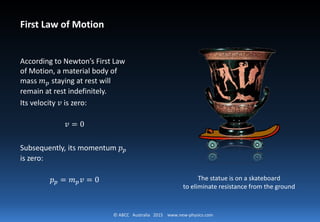
According to Newton’s First Law
of Motion, a material body of
mass 𝑚𝑚𝑝𝑝 staying at rest will
remain at rest indefinitely.
Its velocity 𝑣𝑣 is zero:
𝑣𝑣 = 0
Subsequently, its momentum 𝑝𝑝𝑝𝑝
is zero:
𝑝𝑝𝑝𝑝 = 𝑚𝑚𝑝𝑝 𝑣𝑣 = 0 The statue is on a skateboard
to eliminate resistance from the ground
© ABCC Australia 2015 www.new-physics.com
Body in Motion
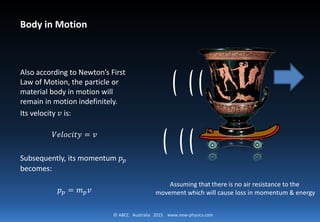
Also according to Newton’s First
Law of Motion, the particle or
material body in motion will
remain in motion indefinitely.
Its velocity 𝑣𝑣 is:
𝑉𝑉𝑉𝑉𝑉𝑉𝑉𝑉𝑉𝑉𝑉𝑉𝑉𝑉𝑉𝑉 = 𝑣𝑣
Subsequently, its momentum 𝑝𝑝𝑝𝑝
becomes:
𝑝𝑝𝑝𝑝 = 𝑚𝑚𝑝𝑝 𝑣𝑣
Assuming that there is no air resistance to the
movement which will cause loss in momentum & energy
© ABCC Australia 2015 www.new-physics.com
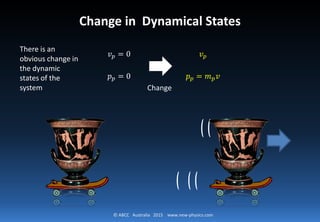
Change in Dynamical States
𝑣𝑣𝑝𝑝 = 0
𝑝𝑝𝑝𝑝 = 0
𝑣𝑣𝑝𝑝
𝑝𝑝𝑝𝑝 = 𝑚𝑚𝑝𝑝 𝑣𝑣
There is an
obvious change in
the dynamic
states of the
system Change
© ABCC Australia 2015 www.new-physics.com
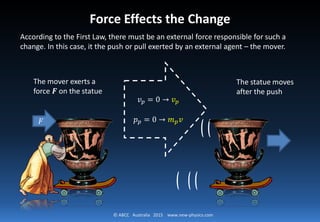
Force Effects the Change
According to the First Law, there must be an external force responsible for such a
change. In this case, it the push or pull exerted by an external agent – the mover.
𝑣𝑣𝑝𝑝 = 0 → 𝑣𝑣𝑝𝑝
𝑝𝑝𝑝𝑝 = 0 → 𝑚𝑚𝑝𝑝 𝑣𝑣
The mover exerts a
force 𝑭𝑭 on the statue
The statue moves
after the push
𝐹𝐹
© ABCC Australia 2015 www.new-physics.com
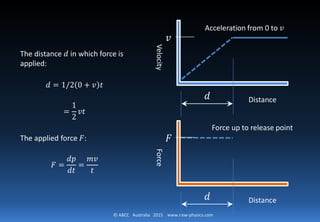
The distance 𝑑𝑑 in which force is
applied:
𝑑𝑑 = 1/2 0 + 𝑣𝑣 𝑡𝑡
=
1
2
𝑣𝑣𝑡𝑡
The applied force 𝐹𝐹:
𝐹𝐹 =
𝑑𝑑𝑑𝑑
𝑑𝑑𝑑𝑑
=
𝑚𝑚𝑚𝑚
𝑡𝑡
Acceleration from 0 to 𝑣𝑣
Velocity
Distance
𝑣𝑣
𝑑𝑑
Force
Distance
𝐹𝐹
𝑑𝑑
Force up to release point
© ABCC Australia 2015 www.new-physics.com
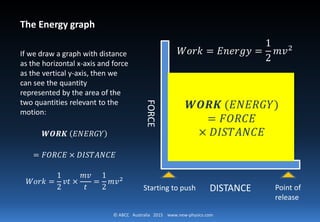
The Energy graph
If we draw a graph with distance
as the horizontal x-axis and force
as the vertical y-axis, then we
can see the quantity
represented by the area of the
two quantities relevant to the
motion:
𝑾𝑾𝑾𝑾𝑾𝑾𝑾𝑾 𝐸𝐸𝐸𝐸𝐸𝐸𝐸𝐸𝐸𝐸𝐸𝐸
= 𝐹𝐹𝐹𝐹𝐹𝐹𝐹𝐹𝐹𝐹 × 𝐷𝐷𝐷𝐷𝐷𝐷𝐷𝐷𝐷𝐷𝐷𝐷𝐷𝐷𝐷𝐷
𝑊𝑊𝑊𝑊𝑊𝑊𝑊𝑊 =
1
2
𝑣𝑣𝑣𝑣 ×
𝑚𝑚𝑚𝑚
𝑡𝑡
=
1
2
𝑚𝑚𝑣𝑣2
FORCE
DISTANCE
𝑾𝑾𝑾𝑾𝑾𝑾𝑾𝑾 (𝐸𝐸𝐸𝐸𝐸𝐸𝐸𝐸𝐸𝐸𝐸𝐸)
= 𝐹𝐹𝐹𝐹𝐹𝐹𝐹𝐹𝐹𝐹
× 𝐷𝐷𝐷𝐷𝐷𝐷𝐷𝐷𝐷𝐷𝐷𝐷𝐷𝐷𝐷𝐷
Starting to push Point of
release
𝑊𝑊𝑊𝑊𝑊𝑊𝑊𝑊 = 𝐸𝐸𝐸𝐸𝐸𝐸𝐸𝐸𝐸𝐸𝐸𝐸 =
1
2
𝑚𝑚𝑣𝑣2
© ABCC Australia 2015 www.new-physics.com
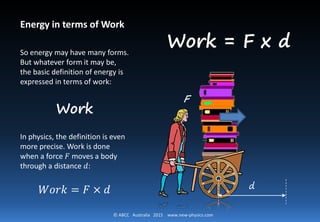
Energy in terms of Work
So energy may have many forms.
But whatever form it may be,
the basic definition of energy is
expressed in terms of work:
Work
In physics, the definition is even
more precise. Work is done
when a force 𝐹𝐹 moves a body
through a distance 𝑑𝑑:
𝑊𝑊𝑊𝑊𝑊𝑊𝑊𝑊 = 𝐹𝐹 × 𝑑𝑑 d
F
Work = F x d
© ABCC Australia 2015 www.new-physics.com
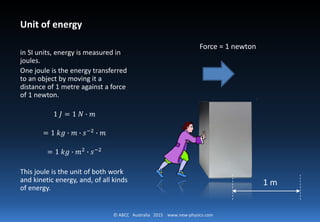
Unit of energy
in SI units, energy is measured in
joules.
One joule is the energy transferred
to an object by moving it a
distance of 1 metre against a force
of 1 newton.
1 𝐽𝐽 = 1 𝑁𝑁 ∙ 𝑚𝑚
= 1 𝑘𝑘𝑘𝑘 ∙ 𝑚𝑚 ∙ 𝑠𝑠−2
∙ 𝑚𝑚
= 1 𝑘𝑘𝑘𝑘 ∙ 𝑚𝑚2
∙ 𝑠𝑠−2
This joule is the unit of both work
and kinetic energy, and, of all kinds
of energy.
1 m
Force = 1 newton
© ABCC Australia 2015 www.new-physics.com
Transfer of energy =
transfer of phonon
As we have established in our
previous discussions, the
application of force is equivalent
to the injection of phonons from
one object to another. Since
phonons are the carriers of
energy, they will be transferred
from one body to another
whenever a force is applied. If
the force is continuous over a
distance, the quantity of phonon
will build up until the force
stops. Then the energy of the
body is equal to the total
amount of phonons injected and
retained by the body..
Force MotionPhonons
transferred
© ABCC Australia 2015 www.new-physics.com
Energy-Phonon
Equivalence
The interpretation of energy by
phonons is therefore even
simpler.
Since energy is conserved:
1
2
𝑚𝑚𝛾𝛾 𝑐𝑐2
=
1
2
𝑚𝑚𝑝𝑝 𝑣𝑣2
Or:
𝑚𝑚𝛾𝛾 𝑐𝑐2
= 𝑚𝑚𝑝𝑝 𝑣𝑣2
We can see that the work done is
actually the transfer of phonons
from the mover to the moved.
The movedThe phononsThe mover
© ABCC Australia 2015 www.new-physics.com
TRANSFER TO OTHER ENERGY FORMS
To be continued on:
ABCC

PM [10] Energy in Motion

  • 1.
    © ABCC Australia2015 www.new-physics.com ENERGY OF LINEAR MOTION
  • 2.
    © ABCC Australia2015 www.new-physics.com Newton’s First Law of Motion Newton’s First Law of Motion states that: “A particle in rest will remain forever at rest, and a particle in uniform rectilinear motion will continue to move on forever at constant speed in the same direction. It will change its state of motion only and only when it is compelled to do so by forces impressed on it.” I
  • 3.
    © ABCC Australia2015 www.new-physics.com First Law of Motion According to Newton’s First Law of Motion, a material body of mass 𝑚𝑚𝑝𝑝 staying at rest will remain at rest indefinitely. Its velocity 𝑣𝑣 is zero: 𝑣𝑣 = 0 Subsequently, its momentum 𝑝𝑝𝑝𝑝 is zero: 𝑝𝑝𝑝𝑝 = 𝑚𝑚𝑝𝑝 𝑣𝑣 = 0 The statue is on a skateboard to eliminate resistance from the ground
  • 4.
    © ABCC Australia2015 www.new-physics.com Body in Motion Also according to Newton’s First Law of Motion, the particle or material body in motion will remain in motion indefinitely. Its velocity 𝑣𝑣 is: 𝑉𝑉𝑉𝑉𝑉𝑉𝑉𝑉𝑉𝑉𝑉𝑉𝑉𝑉𝑉𝑉 = 𝑣𝑣 Subsequently, its momentum 𝑝𝑝𝑝𝑝 becomes: 𝑝𝑝𝑝𝑝 = 𝑚𝑚𝑝𝑝 𝑣𝑣 Assuming that there is no air resistance to the movement which will cause loss in momentum & energy
  • 5.
    © ABCC Australia2015 www.new-physics.com Change in Dynamical States 𝑣𝑣𝑝𝑝 = 0 𝑝𝑝𝑝𝑝 = 0 𝑣𝑣𝑝𝑝 𝑝𝑝𝑝𝑝 = 𝑚𝑚𝑝𝑝 𝑣𝑣 There is an obvious change in the dynamic states of the system Change
  • 6.
    © ABCC Australia2015 www.new-physics.com Force Effects the Change According to the First Law, there must be an external force responsible for such a change. In this case, it the push or pull exerted by an external agent – the mover. 𝑣𝑣𝑝𝑝 = 0 → 𝑣𝑣𝑝𝑝 𝑝𝑝𝑝𝑝 = 0 → 𝑚𝑚𝑝𝑝 𝑣𝑣 The mover exerts a force 𝑭𝑭 on the statue The statue moves after the push 𝐹𝐹
  • 7.
    © ABCC Australia2015 www.new-physics.com The distance 𝑑𝑑 in which force is applied: 𝑑𝑑 = 1/2 0 + 𝑣𝑣 𝑡𝑡 = 1 2 𝑣𝑣𝑡𝑡 The applied force 𝐹𝐹: 𝐹𝐹 = 𝑑𝑑𝑑𝑑 𝑑𝑑𝑑𝑑 = 𝑚𝑚𝑚𝑚 𝑡𝑡 Acceleration from 0 to 𝑣𝑣 Velocity Distance 𝑣𝑣 𝑑𝑑 Force Distance 𝐹𝐹 𝑑𝑑 Force up to release point
  • 8.
    © ABCC Australia2015 www.new-physics.com The Energy graph If we draw a graph with distance as the horizontal x-axis and force as the vertical y-axis, then we can see the quantity represented by the area of the two quantities relevant to the motion: 𝑾𝑾𝑾𝑾𝑾𝑾𝑾𝑾 𝐸𝐸𝐸𝐸𝐸𝐸𝐸𝐸𝐸𝐸𝐸𝐸 = 𝐹𝐹𝐹𝐹𝐹𝐹𝐹𝐹𝐹𝐹 × 𝐷𝐷𝐷𝐷𝐷𝐷𝐷𝐷𝐷𝐷𝐷𝐷𝐷𝐷𝐷𝐷 𝑊𝑊𝑊𝑊𝑊𝑊𝑊𝑊 = 1 2 𝑣𝑣𝑣𝑣 × 𝑚𝑚𝑚𝑚 𝑡𝑡 = 1 2 𝑚𝑚𝑣𝑣2 FORCE DISTANCE 𝑾𝑾𝑾𝑾𝑾𝑾𝑾𝑾 (𝐸𝐸𝐸𝐸𝐸𝐸𝐸𝐸𝐸𝐸𝐸𝐸) = 𝐹𝐹𝐹𝐹𝐹𝐹𝐹𝐹𝐹𝐹 × 𝐷𝐷𝐷𝐷𝐷𝐷𝐷𝐷𝐷𝐷𝐷𝐷𝐷𝐷𝐷𝐷 Starting to push Point of release 𝑊𝑊𝑊𝑊𝑊𝑊𝑊𝑊 = 𝐸𝐸𝐸𝐸𝐸𝐸𝐸𝐸𝐸𝐸𝐸𝐸 = 1 2 𝑚𝑚𝑣𝑣2
  • 9.
    © ABCC Australia2015 www.new-physics.com Energy in terms of Work So energy may have many forms. But whatever form it may be, the basic definition of energy is expressed in terms of work: Work In physics, the definition is even more precise. Work is done when a force 𝐹𝐹 moves a body through a distance 𝑑𝑑: 𝑊𝑊𝑊𝑊𝑊𝑊𝑊𝑊 = 𝐹𝐹 × 𝑑𝑑 d F Work = F x d
  • 10.
    © ABCC Australia2015 www.new-physics.com Unit of energy in SI units, energy is measured in joules. One joule is the energy transferred to an object by moving it a distance of 1 metre against a force of 1 newton. 1 𝐽𝐽 = 1 𝑁𝑁 ∙ 𝑚𝑚 = 1 𝑘𝑘𝑘𝑘 ∙ 𝑚𝑚 ∙ 𝑠𝑠−2 ∙ 𝑚𝑚 = 1 𝑘𝑘𝑘𝑘 ∙ 𝑚𝑚2 ∙ 𝑠𝑠−2 This joule is the unit of both work and kinetic energy, and, of all kinds of energy. 1 m Force = 1 newton
  • 11.
    © ABCC Australia2015 www.new-physics.com Transfer of energy = transfer of phonon As we have established in our previous discussions, the application of force is equivalent to the injection of phonons from one object to another. Since phonons are the carriers of energy, they will be transferred from one body to another whenever a force is applied. If the force is continuous over a distance, the quantity of phonon will build up until the force stops. Then the energy of the body is equal to the total amount of phonons injected and retained by the body.. Force MotionPhonons transferred
  • 12.
    © ABCC Australia2015 www.new-physics.com Energy-Phonon Equivalence The interpretation of energy by phonons is therefore even simpler. Since energy is conserved: 1 2 𝑚𝑚𝛾𝛾 𝑐𝑐2 = 1 2 𝑚𝑚𝑝𝑝 𝑣𝑣2 Or: 𝑚𝑚𝛾𝛾 𝑐𝑐2 = 𝑚𝑚𝑝𝑝 𝑣𝑣2 We can see that the work done is actually the transfer of phonons from the mover to the moved. The movedThe phononsThe mover
  • 13.
    © ABCC Australia2015 www.new-physics.com TRANSFER TO OTHER ENERGY FORMS To be continued on: ABCC