17-1
Physics
17-2
Physics is a science that deals with the behavior of matter
and the forces that govern everything in the universe. It
extends from the unimaginably small subatomic particles
to the vastness of galaxies.
Section Introduction
17-3
In this section you will learn to:
- Define common physics terms and identify their units
of measurement
- Match Newton's Laws of Motion with their definitions
- List several types of energy
- Define kinetic energy, potential energy, and work
- Identify the relationship between energy and work.
Section objectives
Outline: two sections
- Laws of Motion and Energy and Work.
- Provide instruction physics principles and applications.
17-4
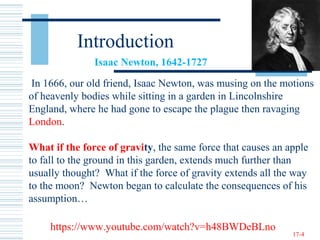
In 1666, our old friend, Isaac Newton, was musing on the motions
of heavenly bodies while sitting in a garden in Lincolnshire
England, where he had gone to escape the plague then ravaging
London.
What if the force of gravity, the same force that causes an apple
to fall to the ground in this garden, extends much further than
usually thought? What if the force of gravity extends all the way
to the moon? Newton began to calculate the consequences of his
assumption…
Introduction
https://www.youtube.com/watch?v=h48BWDeBLno
Isaac Newton, 1642-1727
17-5
Mass and Force
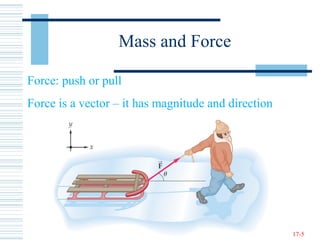
Force: push or pull
Force is a vector – it has magnitude and direction
17-6
Mass and Force
Force: push or pull
Force is a vector – it has magnitude and direction
Mass is the measure of how hard it is to change an
object’s velocity.
Mass can also be thought of as a measure of the
quantity of matter in an object.
17-7
Velocity and Acceleration
Velocity is the speed at which an object moves in a specified
direction. v (m/s).
Acceleration is the rate of change of the velocity.
Video:https://www.yo
utube.com/watch?
v=4dCrkp8qgLU
17-8
Forces and Torque
Force is the amount of "push" or "pull" that an object experiences when
it is being accelerated. A force of 1 N will accelerate a 1 kg object at 1
m/s2. In fact, a Newton is equivalent to a kg·m/s2.
A force that turns an object through an angle is called a torque. Torque
is usually abbreviated as t and has units of Newton·meters (N·m).
Video Torque: https://www.youtube.com/watch?v=DPTC1Txa9Wo
Force https://www.youtube.com/watch?v=5Zrphnd_0VI
17-9
Work and Energy
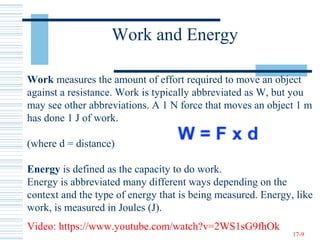
Work measures the amount of effort required to move an object
against a resistance. Work is typically abbreviated as W, but you
may see other abbreviations. A 1 N force that moves an object 1 m
has done 1 J of work.
(where d = distance)
Energy is defined as the capacity to do work.
Energy is abbreviated many different ways depending on the
context and the type of energy that is being measured. Energy, like
work, is measured in Joules (J).
Video: https://www.youtube.com/watch?v=2WS1sG9fhOk
17-10
Work and Energy
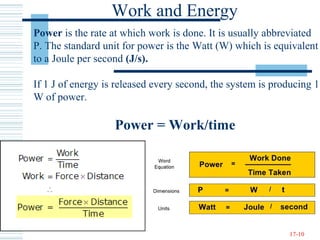
Power is the rate at which work is done. It is usually abbreviated
P. The standard unit for power is the Watt (W) which is equivalent
to a Joule per second (J/s).
If 1 J of energy is released every second, the system is producing 1
W of power.
Power = Work/time
17-11
Newton’s Laws of MotionNewton’s Laws of Motion
1st Law – An object at rest will stay at rest, and an object
in motion will stay in motion at constant velocity, unless
acted upon by an unbalanced force.
2nd Law – Force equals mass times acceleration.
3rd Law – For every action there is an equal and opposite
reaction.
17-12
Newton's First Law of Motion
An object at rest will stay at rest, and an object in
motion will stay in motion at constant velocity, unless
acted upon by an unbalanced force.
Inertia is the tendency of
an object to resist changes
in its velocity: whether in
motion or motionless.
These pumpkins will not move unless acted
on by an unbalanced force.
Video
17-13
Newton's First Law of Motion
 Once airborne, unless
acted on by an unbalanced
force (gravity and air –
fluid friction), it would
never stop!
 Unless acted upon by
an unbalanced force,
this golf ball would
sit on the tee forever.
17-14
Newton’s Second Law
Force equals
mass times
acceleration.
F = ma
17-15
Newton’s Second Law
Force = Mass x Acceleration
Force is measured in Newtons
ACCELERATION of GRAVITY(Earth) = 9.8 m/s2
Weight (force) = mass x gravity (Earth)
Video
17-16
Newton’s Second Law
An object may have several forces acting on it; the acceleration is
due to the net force:
17-17
Newton’s 3rd
Law
 For every force, there is an equal and opposite force
 every “action” has a “back-reaction”
 these are precisely equal and precisely opposite
 You can’t push without being pushed back just as hard
 in tug-of-war, each side experiences the same force (opposite direction)
 when you push on a brick wall, it pushes back on you!
Force on box by floor (normal force)
Force on box by gravity
box
floor
Video
17-18
Newton’s 3rd
Law
Some action-reaction pairs:
17-19
Newton’s 3rd
Law
Although the forces are the same, the accelerations will not
be unless the objects have the same mass.
Contact forces:
The force exerted by one box
on the other is different
depending on which one you
push.
17-20
Weight
The weight of an object on the Earth’s surface is the
gravitational force exerted on it by the Earth.
17-21
Weight
Apparent weight:
Your perception of your weight is based on the contact forces
between your body and your surroundings.
If your surroundings are
accelerating, your apparent
weight may be more or less
than your actual weight.
17-22
Normal Force
The normal force is the force
exerted by a surface on an
object.
17-23
Normal Force
The normal force may be equal to, greater than, or less than the
weight.
17-24
Quick Quiz
17-25
Question
1. Acceleration is a measure of:
A. Your speed as you travel in a straight line.
B. The force due to gravity
C. The rate of change of the velocity.
D. The amount of inertia in a system.
2. Work is measured in units of:
A. Joules (J)
B. Torque (N.m )
C. Newtons (N)
D. Meters per second squared
17-26
Question
3. Density is a measure of:
A. The quantity of matter in an object
B. How much space an object takes up
C. How much an object weighs
D. Mass per unit volume
4.True or False: Energy and Work are measured in the same
units.
True
False
17-27
Question
5. Newton's First Law implies which of the following principles? Select all answers
that apply.
A. A body at rest stays at rest if no force acts on it.
B. A body in motion stays in motion if no force acts on it.
C. A body maintains a constant velocity if no force acts on it.
D. When an object starts to move, there must have been a force acting on it.
E. In order to change directions, an object must have a larger mass than the velocity.
6.True or False: Newton's Second Law states that work equals force times distance.
True
False
17-28
Energy and work are closely related. You have learned that they have
the same units and they are defined in terms of each other.
Energy and work
17-29
Types of energy
Energy comes in many forms.
Kinetic Energy
Kinetic energy is the energy of movement. The formula for calculating
kinetic energy is:
K = ½mv2
where m and v are the mass and velocity of the object.
Energy and work
17-30
Potential Energy
Potential energy is "stored" energy that is contained inside the object
and can be used to do work.
For an object of mass m experiencing a gravitational acceleration g at a
height h above the ground, the potential energy U is
U = mgh
Energy and work
17-31
Quick Quiz
17-32
We noted earlier that energy and work are both expressed in Joules.
But to many scientists, the relationship between work and energy is more
basic than that-work and energy are the same thing!
That is, energy is just the amount of work that theoretically can be
done to an object and work is just the amount of energy that can be
added to an object.
Saying that the total energy in a system equals the total work the
system can do is an alternate way of expressing the First Law of
Thermodynamics
Equivalence of Energy and
Work
17-33
As an object does work, it must lose energy. There is no way to do
work without expending energy in some form. This is why
semiconductor factories have such high electricity bills.
The equipment converts the electrical energy into useful forms of
work in order to implant ions, etch films, attach chips to substrates
or load packages into carriers. Every operation in the factories is an
example of converting energy into work.
Converting Energy to Work
17-34
- In the simple brick example, all of the potential energy was converted into
kinetic energy and could be used to do work. But in reality, no system is
capable of converting 100% of its energy into usable work. Any machine
will lose energy to the environment in the form of heat or friction. Because
the total energy of any system is conserved, the energy lost to the
environment is not converted to work.
- - For example, let us assume that a diffusion furnace loses 20% of
its electrical energy to heat or friction losses. That means only 80% of the
energy is converted to work inside the furnace. We say that the furnace has
an efficiency of 80%.
If you can design a more efficient machine, it will require less
energy to do the same amount of work.
Efficiency of Machines
17-35
1. Kinetic energy is:
A. Stored energy available for work.
B. The energy of movement
C. Always conserved when objects collide.
D. The energy that runs electrical appliances
2. Potential energy is:
A. Stored energy available for work.
B. The energy of movement
C. Always conserved when objects collide
D. The energy that runs electrical appliances
Question
17-36
3. Select the true statement(s) about energy and work from the list
below
A. Work cannot be converted into energy, but energy can be converted
into work
B. Work can be converted into energy and energy can be converted into
work.
C. The total energy in a system is the same as the amount of work it is
theoretically capable of
doing.
D. Some machines are 100% efficient because they have no loss of
energy to heat or friction.
E. In a closed system, the total energy must be conserved.
Question
17-37
In this section you learned to:
- Define common physics terms and identify their units
of measurement
- Match Newton's Laws of Motion with their
definitions
- List several types of energy
- Define kinetic energy, potential energy, and work
- Identify the relationship between energy and work
Review
Summary of Chapter
• Force: a push or pull
• Mass: measures the difficulty in accelerating an object
• Newton’s first law: if the net force on an object is zero, its
velocity is constant
• Inertial frame of reference: one in which the first law holds
• Newton’s second law:
• Free-body diagram: a sketch showing all the forces on an
object
Summary of Chapter
• Newton’s third law: If object 1 exerts a force on object 2, then
object 2 exerts a force – on object 1.
• Contact forces: an action-reaction pair of forces produced by two
objects in physical contact
• Forces are vectors
• Newton’s laws can be applied to each component of the forces
independently
• Weight: gravitational force exerted by the Earth on an object
F
r F
r
Summary of Chapter
• On the surface of the Earth, W = mg
• Apparent weight: force felt from contact with a floor or scale
• Normal force: force exerted perpendicular to a surface by that
surface
• Normal force may be equal to, lesser than, or greater than the
object’s weight

Physics

  • 1.
  • 2.
    17-2 Physics is ascience that deals with the behavior of matter and the forces that govern everything in the universe. It extends from the unimaginably small subatomic particles to the vastness of galaxies. Section Introduction
  • 3.
    17-3 In this sectionyou will learn to: - Define common physics terms and identify their units of measurement - Match Newton's Laws of Motion with their definitions - List several types of energy - Define kinetic energy, potential energy, and work - Identify the relationship between energy and work. Section objectives Outline: two sections - Laws of Motion and Energy and Work. - Provide instruction physics principles and applications.
  • 4.
    17-4 In 1666, ourold friend, Isaac Newton, was musing on the motions of heavenly bodies while sitting in a garden in Lincolnshire England, where he had gone to escape the plague then ravaging London. What if the force of gravity, the same force that causes an apple to fall to the ground in this garden, extends much further than usually thought? What if the force of gravity extends all the way to the moon? Newton began to calculate the consequences of his assumption… Introduction https://www.youtube.com/watch?v=h48BWDeBLno Isaac Newton, 1642-1727
  • 5.
    17-5 Mass and Force Force:push or pull Force is a vector – it has magnitude and direction
  • 6.
    17-6 Mass and Force Force:push or pull Force is a vector – it has magnitude and direction Mass is the measure of how hard it is to change an object’s velocity. Mass can also be thought of as a measure of the quantity of matter in an object.
  • 7.
    17-7 Velocity and Acceleration Velocityis the speed at which an object moves in a specified direction. v (m/s). Acceleration is the rate of change of the velocity. Video:https://www.yo utube.com/watch? v=4dCrkp8qgLU
  • 8.
    17-8 Forces and Torque Forceis the amount of "push" or "pull" that an object experiences when it is being accelerated. A force of 1 N will accelerate a 1 kg object at 1 m/s2. In fact, a Newton is equivalent to a kg·m/s2. A force that turns an object through an angle is called a torque. Torque is usually abbreviated as t and has units of Newton·meters (N·m). Video Torque: https://www.youtube.com/watch?v=DPTC1Txa9Wo Force https://www.youtube.com/watch?v=5Zrphnd_0VI
  • 9.
    17-9 Work and Energy Workmeasures the amount of effort required to move an object against a resistance. Work is typically abbreviated as W, but you may see other abbreviations. A 1 N force that moves an object 1 m has done 1 J of work. (where d = distance) Energy is defined as the capacity to do work. Energy is abbreviated many different ways depending on the context and the type of energy that is being measured. Energy, like work, is measured in Joules (J). Video: https://www.youtube.com/watch?v=2WS1sG9fhOk
  • 10.
    17-10 Work and Energy Poweris the rate at which work is done. It is usually abbreviated P. The standard unit for power is the Watt (W) which is equivalent to a Joule per second (J/s). If 1 J of energy is released every second, the system is producing 1 W of power. Power = Work/time
  • 11.
    17-11 Newton’s Laws ofMotionNewton’s Laws of Motion 1st Law – An object at rest will stay at rest, and an object in motion will stay in motion at constant velocity, unless acted upon by an unbalanced force. 2nd Law – Force equals mass times acceleration. 3rd Law – For every action there is an equal and opposite reaction.
  • 12.
    17-12 Newton's First Lawof Motion An object at rest will stay at rest, and an object in motion will stay in motion at constant velocity, unless acted upon by an unbalanced force. Inertia is the tendency of an object to resist changes in its velocity: whether in motion or motionless. These pumpkins will not move unless acted on by an unbalanced force. Video
  • 13.
    17-13 Newton's First Lawof Motion  Once airborne, unless acted on by an unbalanced force (gravity and air – fluid friction), it would never stop!  Unless acted upon by an unbalanced force, this golf ball would sit on the tee forever.
  • 14.
    17-14 Newton’s Second Law Forceequals mass times acceleration. F = ma
  • 15.
    17-15 Newton’s Second Law Force= Mass x Acceleration Force is measured in Newtons ACCELERATION of GRAVITY(Earth) = 9.8 m/s2 Weight (force) = mass x gravity (Earth) Video
  • 16.
    17-16 Newton’s Second Law Anobject may have several forces acting on it; the acceleration is due to the net force:
  • 17.
    17-17 Newton’s 3rd Law  Forevery force, there is an equal and opposite force  every “action” has a “back-reaction”  these are precisely equal and precisely opposite  You can’t push without being pushed back just as hard  in tug-of-war, each side experiences the same force (opposite direction)  when you push on a brick wall, it pushes back on you! Force on box by floor (normal force) Force on box by gravity box floor Video
  • 18.
  • 19.
    17-19 Newton’s 3rd Law Although theforces are the same, the accelerations will not be unless the objects have the same mass. Contact forces: The force exerted by one box on the other is different depending on which one you push.
  • 20.
    17-20 Weight The weight ofan object on the Earth’s surface is the gravitational force exerted on it by the Earth.
  • 21.
    17-21 Weight Apparent weight: Your perceptionof your weight is based on the contact forces between your body and your surroundings. If your surroundings are accelerating, your apparent weight may be more or less than your actual weight.
  • 22.
    17-22 Normal Force The normalforce is the force exerted by a surface on an object.
  • 23.
    17-23 Normal Force The normalforce may be equal to, greater than, or less than the weight.
  • 24.
  • 25.
    17-25 Question 1. Acceleration isa measure of: A. Your speed as you travel in a straight line. B. The force due to gravity C. The rate of change of the velocity. D. The amount of inertia in a system. 2. Work is measured in units of: A. Joules (J) B. Torque (N.m ) C. Newtons (N) D. Meters per second squared
  • 26.
    17-26 Question 3. Density isa measure of: A. The quantity of matter in an object B. How much space an object takes up C. How much an object weighs D. Mass per unit volume 4.True or False: Energy and Work are measured in the same units. True False
  • 27.
    17-27 Question 5. Newton's FirstLaw implies which of the following principles? Select all answers that apply. A. A body at rest stays at rest if no force acts on it. B. A body in motion stays in motion if no force acts on it. C. A body maintains a constant velocity if no force acts on it. D. When an object starts to move, there must have been a force acting on it. E. In order to change directions, an object must have a larger mass than the velocity. 6.True or False: Newton's Second Law states that work equals force times distance. True False
  • 28.
    17-28 Energy and workare closely related. You have learned that they have the same units and they are defined in terms of each other. Energy and work
  • 29.
    17-29 Types of energy Energycomes in many forms. Kinetic Energy Kinetic energy is the energy of movement. The formula for calculating kinetic energy is: K = ½mv2 where m and v are the mass and velocity of the object. Energy and work
  • 30.
    17-30 Potential Energy Potential energyis "stored" energy that is contained inside the object and can be used to do work. For an object of mass m experiencing a gravitational acceleration g at a height h above the ground, the potential energy U is U = mgh Energy and work
  • 31.
  • 32.
    17-32 We noted earlierthat energy and work are both expressed in Joules. But to many scientists, the relationship between work and energy is more basic than that-work and energy are the same thing! That is, energy is just the amount of work that theoretically can be done to an object and work is just the amount of energy that can be added to an object. Saying that the total energy in a system equals the total work the system can do is an alternate way of expressing the First Law of Thermodynamics Equivalence of Energy and Work
  • 33.
    17-33 As an objectdoes work, it must lose energy. There is no way to do work without expending energy in some form. This is why semiconductor factories have such high electricity bills. The equipment converts the electrical energy into useful forms of work in order to implant ions, etch films, attach chips to substrates or load packages into carriers. Every operation in the factories is an example of converting energy into work. Converting Energy to Work
  • 34.
    17-34 - In thesimple brick example, all of the potential energy was converted into kinetic energy and could be used to do work. But in reality, no system is capable of converting 100% of its energy into usable work. Any machine will lose energy to the environment in the form of heat or friction. Because the total energy of any system is conserved, the energy lost to the environment is not converted to work. - - For example, let us assume that a diffusion furnace loses 20% of its electrical energy to heat or friction losses. That means only 80% of the energy is converted to work inside the furnace. We say that the furnace has an efficiency of 80%. If you can design a more efficient machine, it will require less energy to do the same amount of work. Efficiency of Machines
  • 35.
    17-35 1. Kinetic energyis: A. Stored energy available for work. B. The energy of movement C. Always conserved when objects collide. D. The energy that runs electrical appliances 2. Potential energy is: A. Stored energy available for work. B. The energy of movement C. Always conserved when objects collide D. The energy that runs electrical appliances Question
  • 36.
    17-36 3. Select thetrue statement(s) about energy and work from the list below A. Work cannot be converted into energy, but energy can be converted into work B. Work can be converted into energy and energy can be converted into work. C. The total energy in a system is the same as the amount of work it is theoretically capable of doing. D. Some machines are 100% efficient because they have no loss of energy to heat or friction. E. In a closed system, the total energy must be conserved. Question
  • 37.
    17-37 In this sectionyou learned to: - Define common physics terms and identify their units of measurement - Match Newton's Laws of Motion with their definitions - List several types of energy - Define kinetic energy, potential energy, and work - Identify the relationship between energy and work Review
  • 38.
    Summary of Chapter •Force: a push or pull • Mass: measures the difficulty in accelerating an object • Newton’s first law: if the net force on an object is zero, its velocity is constant • Inertial frame of reference: one in which the first law holds • Newton’s second law: • Free-body diagram: a sketch showing all the forces on an object
  • 39.
    Summary of Chapter •Newton’s third law: If object 1 exerts a force on object 2, then object 2 exerts a force – on object 1. • Contact forces: an action-reaction pair of forces produced by two objects in physical contact • Forces are vectors • Newton’s laws can be applied to each component of the forces independently • Weight: gravitational force exerted by the Earth on an object F r F r
  • 40.
    Summary of Chapter •On the surface of the Earth, W = mg • Apparent weight: force felt from contact with a floor or scale • Normal force: force exerted perpendicular to a surface by that surface • Normal force may be equal to, lesser than, or greater than the object’s weight