Plugging the Holes:
Security and Compatibility
       Owen O’Malley
    Yahoo! Hadoop Team
    owen@yahoo-inc.com
Who Am I?

  •  Software Architect working on Hadoop since Jan 2006
     –  Before Hadoop worked on Yahoo Search’s WebMap
     –  My first patch on Hadoop was Nutch-197
     –  First Yahoo Hadoop committer
     –  Most prolific contributor to Hadoop (by patch count)
     –  Won the 2008 1TB and 2009 Minute and 100TB Sort
        Benchmarks
  •  Apache VP of Hadoop
     –  Chair of the Hadoop Project Management Committee
     –  Quarterly reports on the state of Hadoop for Apache Board


Hadoop World NYC - 2009
What are the Problems?

  •  Our shared clusters increase:
     –  Developer and operations productivity
     –  Hardware utilization
     –  Access to data
  •  Yahoo! wants to put customer and financial data on our
     Hadoop clusters.
     –  Great for providing access to all of the parts of Yahoo!
     –  Need to make sure that only the authorized people have
        access.
  •  Rolling out new versions of Hadoop is painful
     –  Clients need to change and recompile their code

Hadoop World NYC - 2009
Hadoop Security

  •  Currently, the Hadoop servers trust the users to declare
     who they are.
     –  It is very easy to spoof, especially with open source.
     –  For private clusters, we will leave non-security as option
  •  We need to ensure that users are who they claim to be.
  •  All access to HDFS (and therefore MapReduce) must
     be authenticated.
  •  The standard distributed authentication service is
     Kerberos (including ActiveDirectory).
  •  User code isn’t affected, since the security happens in
     the RPC layer.
Hadoop World NYC - 2009
HDFS Security

  •  Hadoop security is grounded in HDFS security.
     –  Other services such as MapReduce store their state in HDFS.
  •  Use of Kerberos allows a single sign on where the
     Hadoop commands pick up and use the user’s tickets.
  •  The framework authenticates the user to the Name
     Node using Kerberos before any operations.
  •  The Name Node is also authenticated to the user.
  •  Client can request an HDFS Access Token to get
     access later without going through Kerberos again.
     –  Prevents authorization storms as MapReduce jobs launch!


Hadoop World NYC - 2009
Accessing a File

  •  User uses Kerberos (or a HDFS Access Token) to
     authenticate to the Name Node.
  •  They request to open a file X.
  •  If they have permission to file X, the Name Node
     returns a token for reading the blocks of X.
  •  The user uses these tokens when communicating with
     the Data Nodes to show they have access.
  •  There are also tokens for writing blocks when the file is
     being created.


Hadoop World NYC - 2009
MapReduce Security

  •  Framework authenticates user to Job Tracker before
     they can submit, modify, or kill jobs.
  •  The Job Tracker authenticates itself to the user.
  •  Job’s logs (including stdout) are only visible to the user.
  •  Map and Reduce tasks actually run as the user.
  •  Tasks’ working directories are protected from others.
  •  The Job Tracker’s system directory is no longer
     readable and writable by everyone.
  •  Only the reduce tasks can get the map outputs.


Hadoop World NYC - 2009
Interactions with HDFS

  •  MapReduce jobs need to read and write HDFS files as
     the user.
  •  Currently, we store the user name in the job.
  •  With security enabled, we will store HDFS Access
     Tokens in the job.
  •  The job needs a token for each HDFS cluster.
  •  The tokens will be renewed by the Job Tracker so they
     don’t expire for long running jobs.
  •  When the job completes, the tokens will be cancelled.


Hadoop World NYC - 2009
Interactions with Higher Layers

  •  Yahoo uses a workflow manager named Oozie to
     submits MapReduce jobs on behalf of the user.
  •  We could store the user’s credentials with a modifier
     (oom/oozie) in Oozie to access Hadoop as the user.
  •  Or we could create Token granting Tokens for HDFS
     and MapReduce and store those in Oozie.
  •  In either case, such proxies are a potential source of
     security problems, since they are storing large number
     of user’s access credentials.


Hadoop World NYC - 2009
Web UIs

  •  Hadoop and especially MapReduce make heavy use of
     the Web Uis.
  •  These need to be authenticated also…
  •  Fortunately, there is a standard solution for Kerberos
     and HTTP, named SPNEGO.
  •  SPNEGO is supported by all of the major browsers.
  •  All of the servlets will use SPNEGO to authenticate the
     user and enforce permissions appropriately.


Hadoop World NYC - 2009
Remaining Security Issues

  •  We are not encrypting on the wire.
     –  It will be possible within the framework, but not in 0.22.
  •  We are not encrypting on disk.
     –  For either HDFS or MapReduce.
  •  Encryption is expensive in terms of CPU and IO speed.
  •  Our current threat model is that the attacker has access
     to a user account, but not root.
     –  They can’t sniff the packets on the network.


Hadoop World NYC - 2009
Backwards Compatibility

  •  API
  •  Protocols
  •  File Formats
  •  Configuration


Hadoop World NYC - 2009
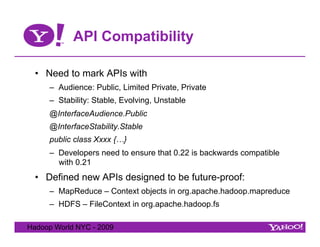
API Compatibility

  •  Need to mark APIs with
     –  Audience: Public, Limited Private, Private
     –  Stability: Stable, Evolving, Unstable
     @InterfaceAudience.Public
     @InterfaceStability.Stable
     public class Xxxx {…}
     –  Developers need to ensure that 0.22 is backwards compatible
        with 0.21
  •  Defined new APIs designed to be future-proof:
     –  MapReduce – Context objects in org.apache.hadoop.mapreduce
     –  HDFS – FileContext in org.apache.hadoop.fs

Hadoop World NYC - 2009
Protocol Compatibility

  •  Currently all clients of a server must be the same
     version (0.18, 0.19, 0.20, 0.21).
  •  Want to enable forward and backward compatibility
  •  Started work on Avro
     –  Includes the schema of the information as well as the data
     –  Can support different schemas on the client and server
     –  Still need to make the code tolerant of version differences
     –  Avro provides the mechanisms
  •  Avro will be used for file version compatibility too


Hadoop World NYC - 2009
Configuration

  •  Configuration in Hadoop is a string to string map.
  •  Maintaining backwards compatibility of configuration
     knobs was done case by case.
  •  Now we have standard infrastructure for declaring old
     knobs deprecated.
  •  Also have cleaned up a lot of the names in 0.21.


Hadoop World NYC - 2009
Questions?

  •  Thanks for coming!
  •  Mailing lists:
     –  common-user@hadoop.apache.org
     –  hdfs-user@hadoop.apache.org
     –  mapreduce-user@hadoop.apache.org
  •  Slides posted on the Hadoop wiki page
     –  http://wiki.apache.org/hadoop/HadoopPresentations


Hadoop World NYC - 2009

Plugging the Holes: Security and Compatability in Hadoop

  • 1.
    Plugging the Holes: Securityand Compatibility Owen O’Malley Yahoo! Hadoop Team owen@yahoo-inc.com
  • 2.
    Who Am I? •  Software Architect working on Hadoop since Jan 2006 –  Before Hadoop worked on Yahoo Search’s WebMap –  My first patch on Hadoop was Nutch-197 –  First Yahoo Hadoop committer –  Most prolific contributor to Hadoop (by patch count) –  Won the 2008 1TB and 2009 Minute and 100TB Sort Benchmarks •  Apache VP of Hadoop –  Chair of the Hadoop Project Management Committee –  Quarterly reports on the state of Hadoop for Apache Board Hadoop World NYC - 2009
  • 3.
    What are theProblems? •  Our shared clusters increase: –  Developer and operations productivity –  Hardware utilization –  Access to data •  Yahoo! wants to put customer and financial data on our Hadoop clusters. –  Great for providing access to all of the parts of Yahoo! –  Need to make sure that only the authorized people have access. •  Rolling out new versions of Hadoop is painful –  Clients need to change and recompile their code Hadoop World NYC - 2009
  • 4.
    Hadoop Security •  Currently, the Hadoop servers trust the users to declare who they are. –  It is very easy to spoof, especially with open source. –  For private clusters, we will leave non-security as option •  We need to ensure that users are who they claim to be. •  All access to HDFS (and therefore MapReduce) must be authenticated. •  The standard distributed authentication service is Kerberos (including ActiveDirectory). •  User code isn’t affected, since the security happens in the RPC layer. Hadoop World NYC - 2009
  • 5.
    HDFS Security •  Hadoop security is grounded in HDFS security. –  Other services such as MapReduce store their state in HDFS. •  Use of Kerberos allows a single sign on where the Hadoop commands pick up and use the user’s tickets. •  The framework authenticates the user to the Name Node using Kerberos before any operations. •  The Name Node is also authenticated to the user. •  Client can request an HDFS Access Token to get access later without going through Kerberos again. –  Prevents authorization storms as MapReduce jobs launch! Hadoop World NYC - 2009
  • 6.
    Accessing a File •  User uses Kerberos (or a HDFS Access Token) to authenticate to the Name Node. •  They request to open a file X. •  If they have permission to file X, the Name Node returns a token for reading the blocks of X. •  The user uses these tokens when communicating with the Data Nodes to show they have access. •  There are also tokens for writing blocks when the file is being created. Hadoop World NYC - 2009
  • 7.
    MapReduce Security •  Framework authenticates user to Job Tracker before they can submit, modify, or kill jobs. •  The Job Tracker authenticates itself to the user. •  Job’s logs (including stdout) are only visible to the user. •  Map and Reduce tasks actually run as the user. •  Tasks’ working directories are protected from others. •  The Job Tracker’s system directory is no longer readable and writable by everyone. •  Only the reduce tasks can get the map outputs. Hadoop World NYC - 2009
  • 8.
    Interactions with HDFS •  MapReduce jobs need to read and write HDFS files as the user. •  Currently, we store the user name in the job. •  With security enabled, we will store HDFS Access Tokens in the job. •  The job needs a token for each HDFS cluster. •  The tokens will be renewed by the Job Tracker so they don’t expire for long running jobs. •  When the job completes, the tokens will be cancelled. Hadoop World NYC - 2009
  • 9.
    Interactions with HigherLayers •  Yahoo uses a workflow manager named Oozie to submits MapReduce jobs on behalf of the user. •  We could store the user’s credentials with a modifier (oom/oozie) in Oozie to access Hadoop as the user. •  Or we could create Token granting Tokens for HDFS and MapReduce and store those in Oozie. •  In either case, such proxies are a potential source of security problems, since they are storing large number of user’s access credentials. Hadoop World NYC - 2009
  • 10.
    Web UIs •  Hadoop and especially MapReduce make heavy use of the Web Uis. •  These need to be authenticated also… •  Fortunately, there is a standard solution for Kerberos and HTTP, named SPNEGO. •  SPNEGO is supported by all of the major browsers. •  All of the servlets will use SPNEGO to authenticate the user and enforce permissions appropriately. Hadoop World NYC - 2009
  • 11.
    Remaining Security Issues •  We are not encrypting on the wire. –  It will be possible within the framework, but not in 0.22. •  We are not encrypting on disk. –  For either HDFS or MapReduce. •  Encryption is expensive in terms of CPU and IO speed. •  Our current threat model is that the attacker has access to a user account, but not root. –  They can’t sniff the packets on the network. Hadoop World NYC - 2009
  • 12.
    Backwards Compatibility •  API •  Protocols •  File Formats •  Configuration Hadoop World NYC - 2009
  • 13.
    API Compatibility •  Need to mark APIs with –  Audience: Public, Limited Private, Private –  Stability: Stable, Evolving, Unstable @InterfaceAudience.Public @InterfaceStability.Stable public class Xxxx {…} –  Developers need to ensure that 0.22 is backwards compatible with 0.21 •  Defined new APIs designed to be future-proof: –  MapReduce – Context objects in org.apache.hadoop.mapreduce –  HDFS – FileContext in org.apache.hadoop.fs Hadoop World NYC - 2009
  • 14.
    Protocol Compatibility •  Currently all clients of a server must be the same version (0.18, 0.19, 0.20, 0.21). •  Want to enable forward and backward compatibility •  Started work on Avro –  Includes the schema of the information as well as the data –  Can support different schemas on the client and server –  Still need to make the code tolerant of version differences –  Avro provides the mechanisms •  Avro will be used for file version compatibility too Hadoop World NYC - 2009
  • 15.
    Configuration • Configuration in Hadoop is a string to string map. •  Maintaining backwards compatibility of configuration knobs was done case by case. •  Now we have standard infrastructure for declaring old knobs deprecated. •  Also have cleaned up a lot of the names in 0.21. Hadoop World NYC - 2009
  • 16.
    Questions? • Thanks for coming! •  Mailing lists: –  common-user@hadoop.apache.org –  hdfs-user@hadoop.apache.org –  mapreduce-user@hadoop.apache.org •  Slides posted on the Hadoop wiki page –  http://wiki.apache.org/hadoop/HadoopPresentations Hadoop World NYC - 2009