Ananthakrishnan MR ,Anagha K R ,Aisha Farha S,
D K Devadathan, Saara Salim, Karthik R
PLASTIC AS A CONSTRUCTION MATERIAL
CONTENT
INTRODUCTION
Plastics are a wide range of synthetic or semi-synthetic materials that use polymers as a main
ingredient. Their plasticity makes it possible for plastics to be moulded, extruded or pressed into solid
objects of various shapes. This adaptability, plus a wide range of other properties, such as being
lightweight, durable, flexible, and inexpensive to produce, has led to its widespread use
Plastic can be simply defined as a material that contains an essential ingredient as organic substance
of large molecular weight. It is also defined as polymers of long carbon chains.
The word, plastic, was derived from the word ‘Plastikos’ meaning ‘to mould’ in Greek
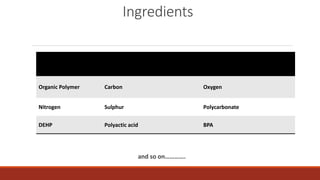
Ingredients
and so on………….
Organic Polymer Carbon Oxygen
Nitrogen Sulphur Polycarbonate
DEHP Polyactic acid BPA
USE OF PLASTICS IN DIFFERENT ASPECTS OF THE CONSTRUCTION INDUSTRY
•Wall
•Pipes
•Windows
•Doors
•Flooring
•Roads
•Roofing
•Insulation
Production graph for plastics
REASON WHY PLASTIC IS PREFERRED
 Durability
When compared with their metal counterparts, plastic materials are way stronger and durable. Plastic
hardware is also resistant to harsh weather and corrosion, thereby, increasing its longevity and
enhancing its usability.
Cost-Effectiveness
Regardless of the type of industry, cost-effectiveness is a vital factor, and the construction industry is
no different. Plastic materials are extremely economical compared to metal, wood, and other
counterparts, making them a preferred choice by builders and construction professionals.
 Recycling
Unlike metals, plastics can be used and even recycled over and over again without losing their
chemical properties.
Energy Saving
Compared to metals, plastics consume less heat. The insulating properties of plastics can also
reduce sound pollution levels.
Safety
The lightness of plastic materials makes it comfortable and easy to carry/lift to different places.
Metals on the other hand are much heavier and can cause injuries if not handled properly.
Easy to Install
Since plastic materials are lightweight, they can be easily installed.
PLASTICS IN FLOORING ASPECTS
PVC or vinyl flooring is durable and stands up well to heavy foot traffic. It is comfortable to
walk on, reduces noise, and is easy to install and maintain. PVC flooring is 100% recyclable. It
is less prone to wear and tear.
USE OF PLASTIC FOR ROAD CONSTRUCTION
Plastic roads were first developed by Rajagopalan
Vasudevan in 2001, consisting of an asphalt mix
incorporating plastic waste. The incorporation of
plastics in roads could open an additional option for
recycling post-consumer plastics. Many countries
have trialed technologies that can incorporate plastic
waste into an asphalt mix.
ADVANTAGES DISADVANTAGES
•While asphalt roads last for three years, roads
with plastic have longevity of seven years.
(Increased Marshall Stability Value)
•Water does not seep through – hence less
stripping and potholes
•Road does not crack or melt, so maintenance cost
of the road decreases.
•Increased load withstanding property
(Withstanding increased load transport)
•No leaching of plastics and no effect of radiation
like UV.
•Pure plastic roads require use of compatible
plastics because, when melted, plastics of different
types may phase-separate and cause structural
weaknesses, which can lead to premature failure.
•Plastics in the road can break down into
microplastics and can find their way into the soil
and bodies of water. These microplastics can also
absorb other pollutants.
•Every time maintenance is performed on these
modular roads the flow of power, water, and
internet that has been installed within will be
interrupted.
India has built one lakh kilometres of roads in at least 11 states using discarded
plastic . The front runners have been following cities:
•Chennai
•Pune
•Surat
•Indore
•OTHERS COUNTRIES ARE
•United States
•Pakistan
•The United kingdom
•Australia
•Netherlands
Plastic Roofing Sheets or PVC sheets, as they are
better known, are sheets used for roofing in domestic
and commercial buildings.
•They are well known for their flexibility, durability,
and protection against UV rays and adverse weather
conditions.
•PVC Sheets have come across as a replacement
to the old and boring roofing patterns
•The light weighted and flexible sheets can be customized
according to use and are must more cost-effective than
the regular concrete roofs
PLASTIC ROOFING SHEETS
 Polycarbonate:
They are strong and light weighted thermoplastic material. It is
known for its ability to withstand extreme heat, cold, or any
other severe weather conditions.
 Acrylic:
Acrylic Roofing Sheets come with similar properties as
Polycarbonate sheets, but with a little difference. They transmit
more light, are much shinier, are heat bent, and can be recycled
and used as recycled plastic roofing sheets.
 Polystyrene:
Polystyrene sheets are a bit for cushioning. They have similar
properties like the other sheets but are known for their good
insulating properties.
TYPES OF PLASTIC ROOFING SHEETING
 PVC:
PVC sheets with similar properties like the polycarbonate
sheets are low cost and easy to install sheets. They allow the
maximum amount of light to get transmitted through the
plastic roof sheets.
 Regenerated plastic sheets:
The specialty of these sheets is that they are manufactured
by using plastics that are considered as garbage. It is made
up of rags.
 Paver block-stacking sheet:
recycled plastic sheet
BENEFITS OF USING PLASTIC ROOFING SHEETS
1. Less Cost Incurring
2. Extreme Weather Resistant
3. Stabilization against UV Light.
4. A Step towards a Sustainable Future.
5. Great Insulation Power.
6. Easy to Clean.
1. In Animal Farms.
2. In The Factories.
3. In Nurseries and Plantations
USES OF PLASTIC ROOF SHEETS IN VARIOUS AREAS
PLASTIC IN WINDOWS AND DOOR
Unplasticised polyvinyl chloride (uPVC) is a hard plastic
material commonly used in windows and doors. Pollution,
moisture, rust, and mould all have no impact on the
products. As a result, they are more durable than wood and
aluminium windows. uPVC windows and doors have a
distinct beauty and are available in beautiful colours.
 Plastic is resistant to all weather conditions. It does not
crack from the impact of changes in temperature, not
afraid of extreme cold, impervious to heat. uPVC is a non-
conductor of heat, which means it does not absorb heat
and maintains a cool and comfortable environment. They
are also sound insulators, providing a noise-cancelling
effect in your home.
 Resistance to moisture
The main advantage of plastic designs compared to wood
is its resistance to moisture . The material does not
absorb it completely and does not deteriorate. uPVC does
not rot, It does not require any treatment against
parasites and pests, it does not form rust, as metal doors.
 Thermal Efficiency
Standard natural wooden doors have a poor insulation capacity, letting the heat escape.
uPVC doors improve on this, so combining the two materials creates the perfect blend of
stylish design and thermal efficiency.
 Styles and Finishes
Because of the singular material being used, wooden doors come in limited grain variants
and styles, with uPVC in standard flat finishes and colours.
 Cleaning
Having the plastic aspect within the door allows for easy cleaning as these can be wiped
down without damaging the door. Wooden doors can’t be cleaned as easily as plastic doors
due to the grain and their lower resistance to chemicals and weathering.
 Termite infestation is the single greatest threat to any piece of furniture in our
household. Termites eat away at the infested area, causing irreparable harm. They can
also easily spread to other furniture and cause damage to it. Unlike others, they are fully
termite-free and easy to clean.
 reliable protection of your home, shop or office and from intruders. There are
special anti-burglary accessories, glasses of high strength construction becomes
practically inaccessible for burglars, open it from the street will not work, even using
special tools, such, as scrap and Bulgarian.
 In terms of reliability, no other material can compete with uPVC windows and
doors. When compared to different styles, these are the finest and most durable. Unlike their
wooden analogs, uPVC windows and doors are not affected by severe weather conditions.
The uPVC coating also protects against UV rays, which can cause materials to fade and wither
when exposed for a prolonged time. Thus, uPVC windows and doors not only save you from
the sun’s harmful UV rays but also keep the beauty of your home for a long time.
Exterior Walls
Warm air inside the home will produce condensation inside the exterior walls
wherever it comes into contact with the colder outside air.
A continuous plastic vapor barrier prevents condensation from forming on the
internal surfaces of the exterior wall.
Any condensation on a properly installed continuous plastic vapor barrier will
eventually be reabsorbed into the ambient air of the home’s interior and not
produce any damage to the wall components.
Interior Walls
Normally interior walls do not require a vapor barrier, Bathrooms and kitchens
produce an enormous amount of water vapor daily.
That is why the standard practice is to paint the walls in these areas with
semigloss paint. The paint acts as a vapor barrier as well.
A continuous plastic vapor barrier behind the drywall will protect the interior
walls of these areas from water damage.
PLASTIC IN WALLS
Sound within buildings may be general noise transmitted through walls and floors or a specific
noise from vibrating machinery. As buildings have become lighter, other methods of sound
reduction have become necessary. As a general principle, sound insulation can be provided by
rubber and plastics materials.
There are three types of plastic sheets that homeowners can use to make soundproof windows:
 Polycarbonate
 Acrylic
 PVC
PLASTIC FOR SOUND INSULATION
Miniwiz Sustainable Energy Development Co. Ltd.
Byfusion, Conceptos plasticos and many more
They make factories, entertainment facility, theatres, and
exhibition areas in countries like Taiwan, Malaysia, and China.
One of their recent additions is the EcoARK Pavilion in Taipei.
Plastic bottles called Polli-bricks are used to make the walls of
this building that fit together perfectly, resembling pieces of
play house. Their raw materials mainly include recycled plastic
water bottles.
COMPANIES USING INNOVATIVE WAYS
FUTURE SCOPE OF USING PLASTIC IN CONSTRUCTION
Constructing homes using plastic is nowadays becoming an increasing trend.
Recycled plastic bricks are coming into use, which have many advantages like –
• Low environmental impact.
• Reduced energy consumption
• Thinner and lighter than conventional bricks
• Low-cost modular housing
• Building structurally sound to withstand an earthquake
• Excellent insulation properties (about 5 times more than conventional bricks)
• Very good noise insulation.

PLASTIC NEWWWW.pptx

  • 1.
    Ananthakrishnan MR ,AnaghaK R ,Aisha Farha S, D K Devadathan, Saara Salim, Karthik R PLASTIC AS A CONSTRUCTION MATERIAL
  • 2.
  • 3.
    INTRODUCTION Plastics are awide range of synthetic or semi-synthetic materials that use polymers as a main ingredient. Their plasticity makes it possible for plastics to be moulded, extruded or pressed into solid objects of various shapes. This adaptability, plus a wide range of other properties, such as being lightweight, durable, flexible, and inexpensive to produce, has led to its widespread use Plastic can be simply defined as a material that contains an essential ingredient as organic substance of large molecular weight. It is also defined as polymers of long carbon chains. The word, plastic, was derived from the word ‘Plastikos’ meaning ‘to mould’ in Greek
  • 4.
    Ingredients and so on…………. OrganicPolymer Carbon Oxygen Nitrogen Sulphur Polycarbonate DEHP Polyactic acid BPA
  • 5.
    USE OF PLASTICSIN DIFFERENT ASPECTS OF THE CONSTRUCTION INDUSTRY •Wall •Pipes •Windows •Doors •Flooring •Roads •Roofing •Insulation Production graph for plastics
  • 6.
    REASON WHY PLASTICIS PREFERRED  Durability When compared with their metal counterparts, plastic materials are way stronger and durable. Plastic hardware is also resistant to harsh weather and corrosion, thereby, increasing its longevity and enhancing its usability. Cost-Effectiveness Regardless of the type of industry, cost-effectiveness is a vital factor, and the construction industry is no different. Plastic materials are extremely economical compared to metal, wood, and other counterparts, making them a preferred choice by builders and construction professionals.  Recycling Unlike metals, plastics can be used and even recycled over and over again without losing their chemical properties.
  • 7.
    Energy Saving Compared tometals, plastics consume less heat. The insulating properties of plastics can also reduce sound pollution levels. Safety The lightness of plastic materials makes it comfortable and easy to carry/lift to different places. Metals on the other hand are much heavier and can cause injuries if not handled properly. Easy to Install Since plastic materials are lightweight, they can be easily installed.
  • 8.
    PLASTICS IN FLOORINGASPECTS PVC or vinyl flooring is durable and stands up well to heavy foot traffic. It is comfortable to walk on, reduces noise, and is easy to install and maintain. PVC flooring is 100% recyclable. It is less prone to wear and tear.
  • 9.
    USE OF PLASTICFOR ROAD CONSTRUCTION Plastic roads were first developed by Rajagopalan Vasudevan in 2001, consisting of an asphalt mix incorporating plastic waste. The incorporation of plastics in roads could open an additional option for recycling post-consumer plastics. Many countries have trialed technologies that can incorporate plastic waste into an asphalt mix.
  • 10.
    ADVANTAGES DISADVANTAGES •While asphaltroads last for three years, roads with plastic have longevity of seven years. (Increased Marshall Stability Value) •Water does not seep through – hence less stripping and potholes •Road does not crack or melt, so maintenance cost of the road decreases. •Increased load withstanding property (Withstanding increased load transport) •No leaching of plastics and no effect of radiation like UV. •Pure plastic roads require use of compatible plastics because, when melted, plastics of different types may phase-separate and cause structural weaknesses, which can lead to premature failure. •Plastics in the road can break down into microplastics and can find their way into the soil and bodies of water. These microplastics can also absorb other pollutants. •Every time maintenance is performed on these modular roads the flow of power, water, and internet that has been installed within will be interrupted.
  • 11.
    India has builtone lakh kilometres of roads in at least 11 states using discarded plastic . The front runners have been following cities: •Chennai •Pune •Surat •Indore •OTHERS COUNTRIES ARE •United States •Pakistan •The United kingdom •Australia •Netherlands
  • 12.
    Plastic Roofing Sheetsor PVC sheets, as they are better known, are sheets used for roofing in domestic and commercial buildings. •They are well known for their flexibility, durability, and protection against UV rays and adverse weather conditions. •PVC Sheets have come across as a replacement to the old and boring roofing patterns •The light weighted and flexible sheets can be customized according to use and are must more cost-effective than the regular concrete roofs PLASTIC ROOFING SHEETS
  • 13.
     Polycarbonate: They arestrong and light weighted thermoplastic material. It is known for its ability to withstand extreme heat, cold, or any other severe weather conditions.  Acrylic: Acrylic Roofing Sheets come with similar properties as Polycarbonate sheets, but with a little difference. They transmit more light, are much shinier, are heat bent, and can be recycled and used as recycled plastic roofing sheets.  Polystyrene: Polystyrene sheets are a bit for cushioning. They have similar properties like the other sheets but are known for their good insulating properties. TYPES OF PLASTIC ROOFING SHEETING
  • 14.
     PVC: PVC sheetswith similar properties like the polycarbonate sheets are low cost and easy to install sheets. They allow the maximum amount of light to get transmitted through the plastic roof sheets.  Regenerated plastic sheets: The specialty of these sheets is that they are manufactured by using plastics that are considered as garbage. It is made up of rags.  Paver block-stacking sheet: recycled plastic sheet
  • 15.
    BENEFITS OF USINGPLASTIC ROOFING SHEETS 1. Less Cost Incurring 2. Extreme Weather Resistant 3. Stabilization against UV Light. 4. A Step towards a Sustainable Future. 5. Great Insulation Power. 6. Easy to Clean. 1. In Animal Farms. 2. In The Factories. 3. In Nurseries and Plantations USES OF PLASTIC ROOF SHEETS IN VARIOUS AREAS
  • 16.
    PLASTIC IN WINDOWSAND DOOR Unplasticised polyvinyl chloride (uPVC) is a hard plastic material commonly used in windows and doors. Pollution, moisture, rust, and mould all have no impact on the products. As a result, they are more durable than wood and aluminium windows. uPVC windows and doors have a distinct beauty and are available in beautiful colours.
  • 17.
     Plastic isresistant to all weather conditions. It does not crack from the impact of changes in temperature, not afraid of extreme cold, impervious to heat. uPVC is a non- conductor of heat, which means it does not absorb heat and maintains a cool and comfortable environment. They are also sound insulators, providing a noise-cancelling effect in your home.  Resistance to moisture The main advantage of plastic designs compared to wood is its resistance to moisture . The material does not absorb it completely and does not deteriorate. uPVC does not rot, It does not require any treatment against parasites and pests, it does not form rust, as metal doors.
  • 18.
     Thermal Efficiency Standardnatural wooden doors have a poor insulation capacity, letting the heat escape. uPVC doors improve on this, so combining the two materials creates the perfect blend of stylish design and thermal efficiency.  Styles and Finishes Because of the singular material being used, wooden doors come in limited grain variants and styles, with uPVC in standard flat finishes and colours.  Cleaning Having the plastic aspect within the door allows for easy cleaning as these can be wiped down without damaging the door. Wooden doors can’t be cleaned as easily as plastic doors due to the grain and their lower resistance to chemicals and weathering.
  • 19.
     Termite infestationis the single greatest threat to any piece of furniture in our household. Termites eat away at the infested area, causing irreparable harm. They can also easily spread to other furniture and cause damage to it. Unlike others, they are fully termite-free and easy to clean.  reliable protection of your home, shop or office and from intruders. There are special anti-burglary accessories, glasses of high strength construction becomes practically inaccessible for burglars, open it from the street will not work, even using special tools, such, as scrap and Bulgarian.
  • 20.
     In termsof reliability, no other material can compete with uPVC windows and doors. When compared to different styles, these are the finest and most durable. Unlike their wooden analogs, uPVC windows and doors are not affected by severe weather conditions. The uPVC coating also protects against UV rays, which can cause materials to fade and wither when exposed for a prolonged time. Thus, uPVC windows and doors not only save you from the sun’s harmful UV rays but also keep the beauty of your home for a long time.
  • 21.
    Exterior Walls Warm airinside the home will produce condensation inside the exterior walls wherever it comes into contact with the colder outside air. A continuous plastic vapor barrier prevents condensation from forming on the internal surfaces of the exterior wall. Any condensation on a properly installed continuous plastic vapor barrier will eventually be reabsorbed into the ambient air of the home’s interior and not produce any damage to the wall components. Interior Walls Normally interior walls do not require a vapor barrier, Bathrooms and kitchens produce an enormous amount of water vapor daily. That is why the standard practice is to paint the walls in these areas with semigloss paint. The paint acts as a vapor barrier as well. A continuous plastic vapor barrier behind the drywall will protect the interior walls of these areas from water damage. PLASTIC IN WALLS
  • 22.
    Sound within buildingsmay be general noise transmitted through walls and floors or a specific noise from vibrating machinery. As buildings have become lighter, other methods of sound reduction have become necessary. As a general principle, sound insulation can be provided by rubber and plastics materials. There are three types of plastic sheets that homeowners can use to make soundproof windows:  Polycarbonate  Acrylic  PVC PLASTIC FOR SOUND INSULATION
  • 23.
    Miniwiz Sustainable EnergyDevelopment Co. Ltd. Byfusion, Conceptos plasticos and many more They make factories, entertainment facility, theatres, and exhibition areas in countries like Taiwan, Malaysia, and China. One of their recent additions is the EcoARK Pavilion in Taipei. Plastic bottles called Polli-bricks are used to make the walls of this building that fit together perfectly, resembling pieces of play house. Their raw materials mainly include recycled plastic water bottles. COMPANIES USING INNOVATIVE WAYS
  • 24.
    FUTURE SCOPE OFUSING PLASTIC IN CONSTRUCTION Constructing homes using plastic is nowadays becoming an increasing trend. Recycled plastic bricks are coming into use, which have many advantages like – • Low environmental impact. • Reduced energy consumption • Thinner and lighter than conventional bricks • Low-cost modular housing • Building structurally sound to withstand an earthquake • Excellent insulation properties (about 5 times more than conventional bricks) • Very good noise insulation.