Diagnostic Surgical Pathology
Lecture 4. Handling surgical Specimens II
Objectives
• Explain the process of tissue fixation
• Describe the tissue processing, embedding ,
cutting and staining
•
Gross examination
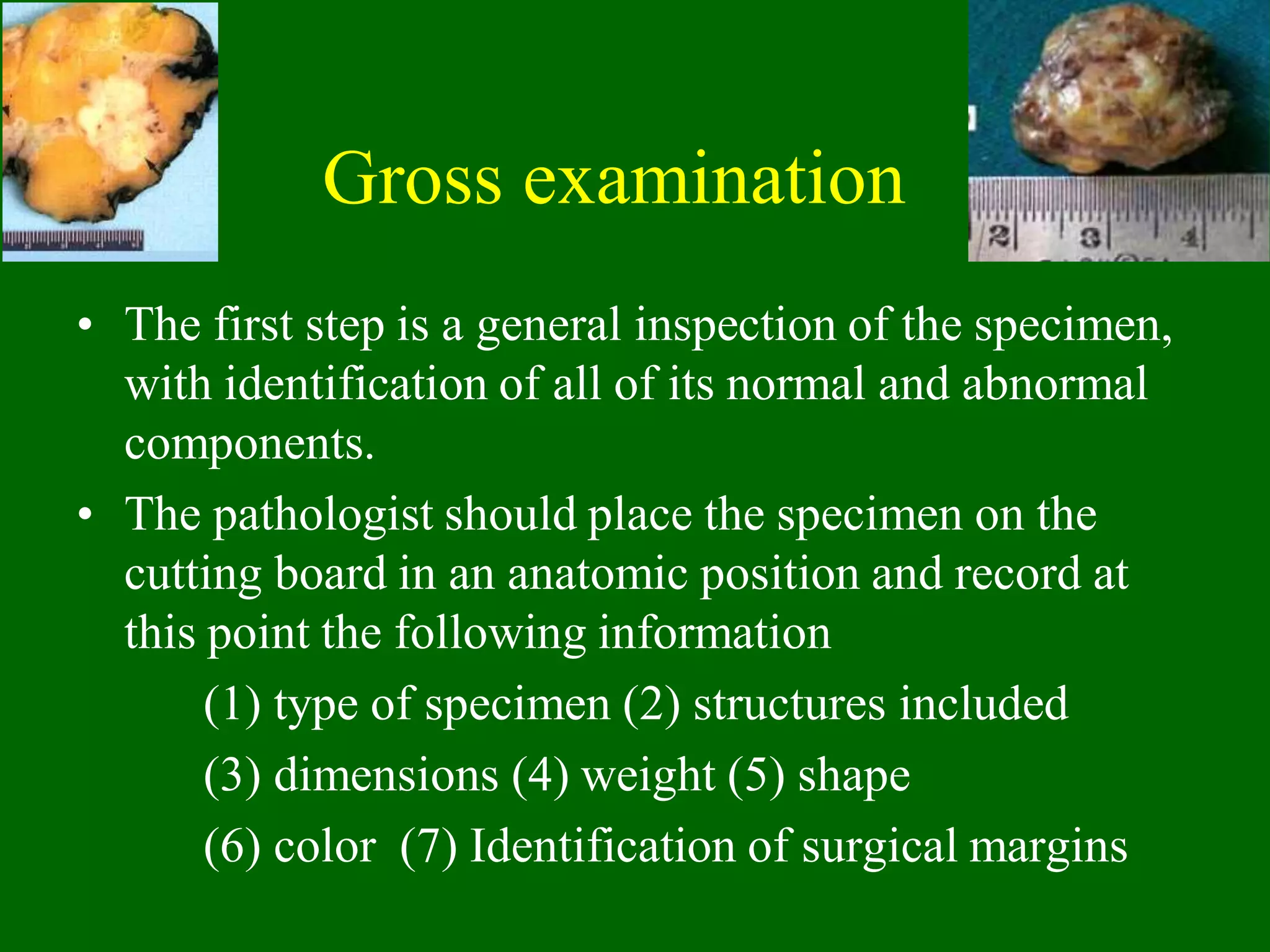
• The first step is a general inspection of the specimen,
with identification of all of its normal and abnormal
components.
• The pathologist should place the specimen on the
cutting board in an anatomic position and record at
this point the following information
(1) type of specimen (2) structures included
(3) dimensions (4) weight (5) shape
(6) color (7) Identification of surgical margins
• The specimen, especially if small, should be
handled on a clean cutting board, using
spotless, clean instruments.
• The problem of contamination of a
specimen with a fragment from another (the
‘floater’ or ‘cutting board metastasis’) is
one of the major catastrophes which may
occur in the pathology laboratory and it can
lead to dangerous mistakes
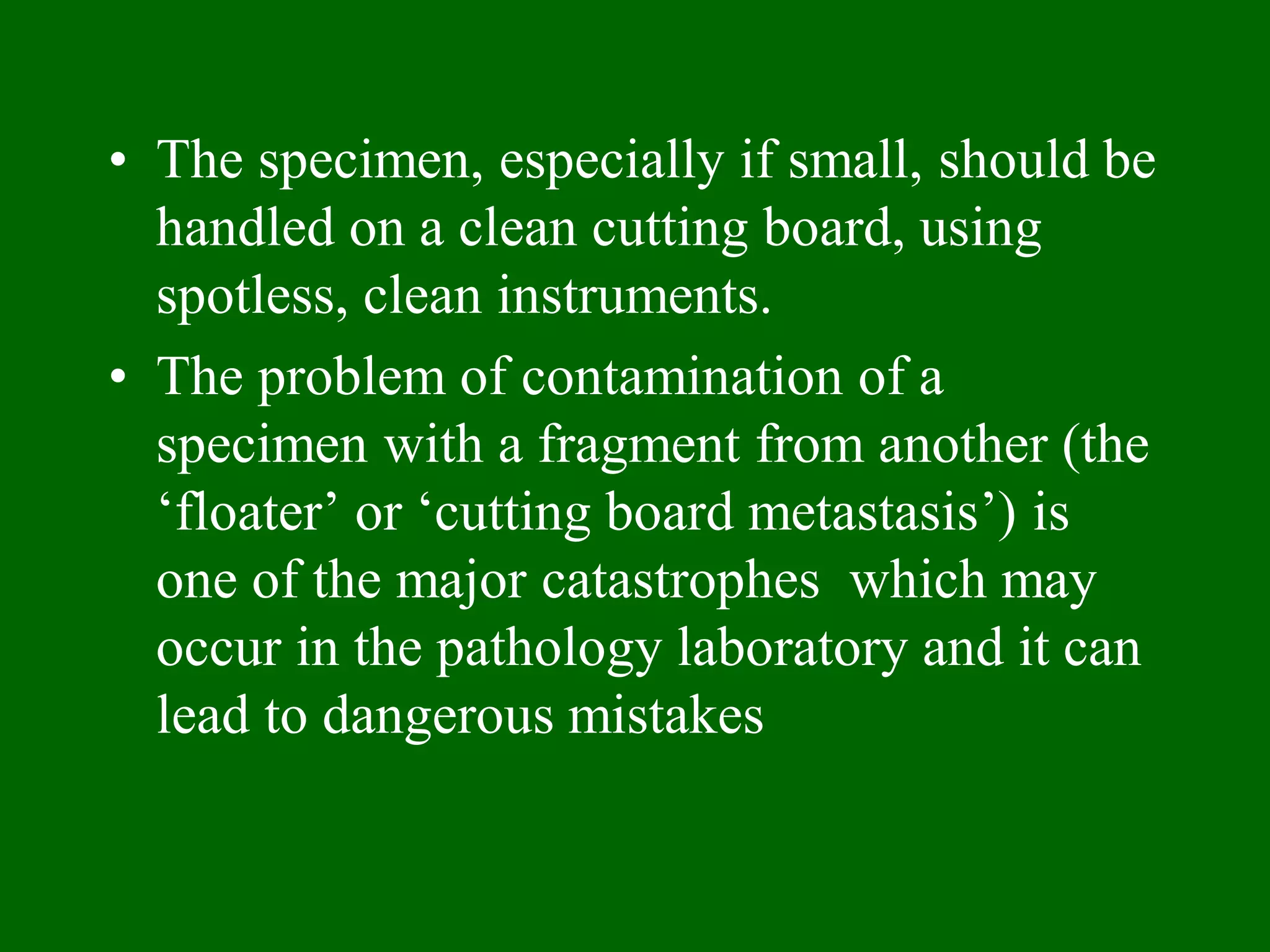
• The surgical margins should be painted with
India ink.
• Fragments of tissue that are small enough to
go through the cassette perforations must be
wrapped in thin paper (such as tea bag
paper).
Fixation & Fixatives
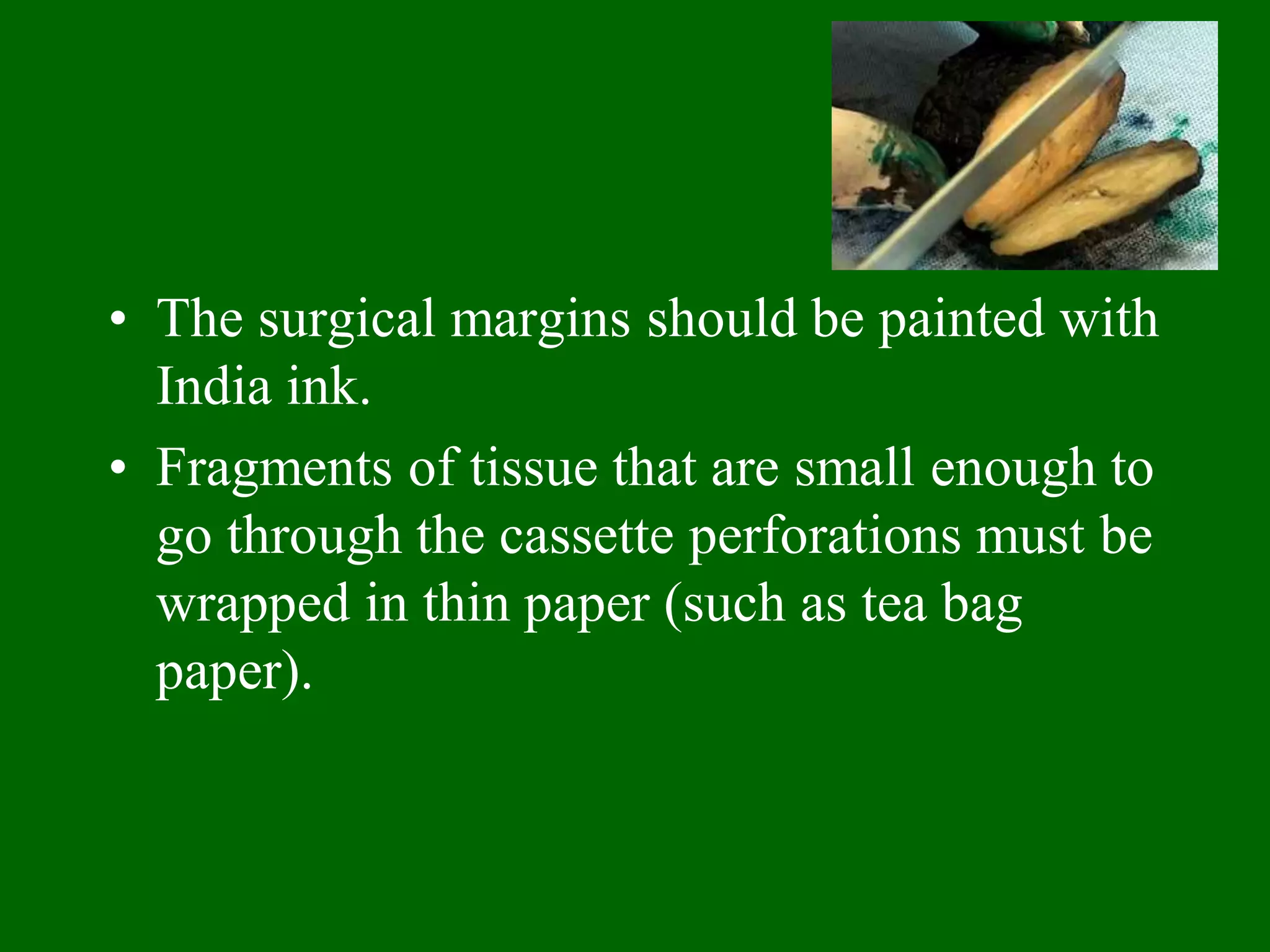
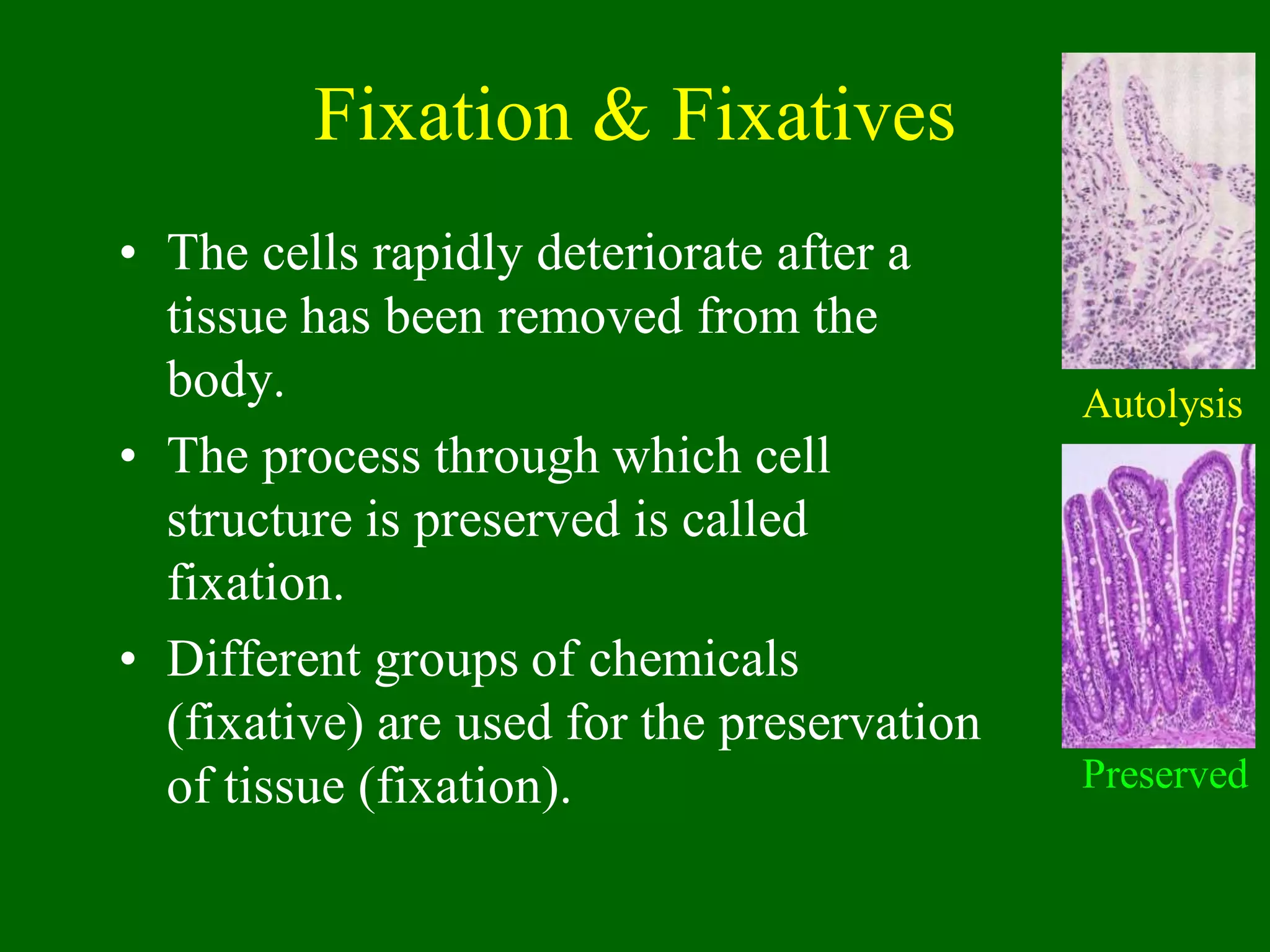
• The cells rapidly deteriorate after a
tissue has been removed from the
body.
• The process through which cell
structure is preserved is called
fixation.
• Different groups of chemicals
(fixative) are used for the preservation
of tissue (fixation).
Autolysis
Preserved
Main Aims Of Fixation
• The Main Aims Of Fixation are
1. Prevention of autolysis
2. Prevention of bacterial attack
3. Hardening the tissue
4. Clear staining of section
Fixation
• The fixative should surround the specimen on all
sides. Large specimens that float on a fixative
should be covered by a thick layer of gauze.
• In cases of large, flat, heavy specimens that rest
on the bottom of the containers, the gauze should
be placed between the container bottom and the
specimen.
Fixative
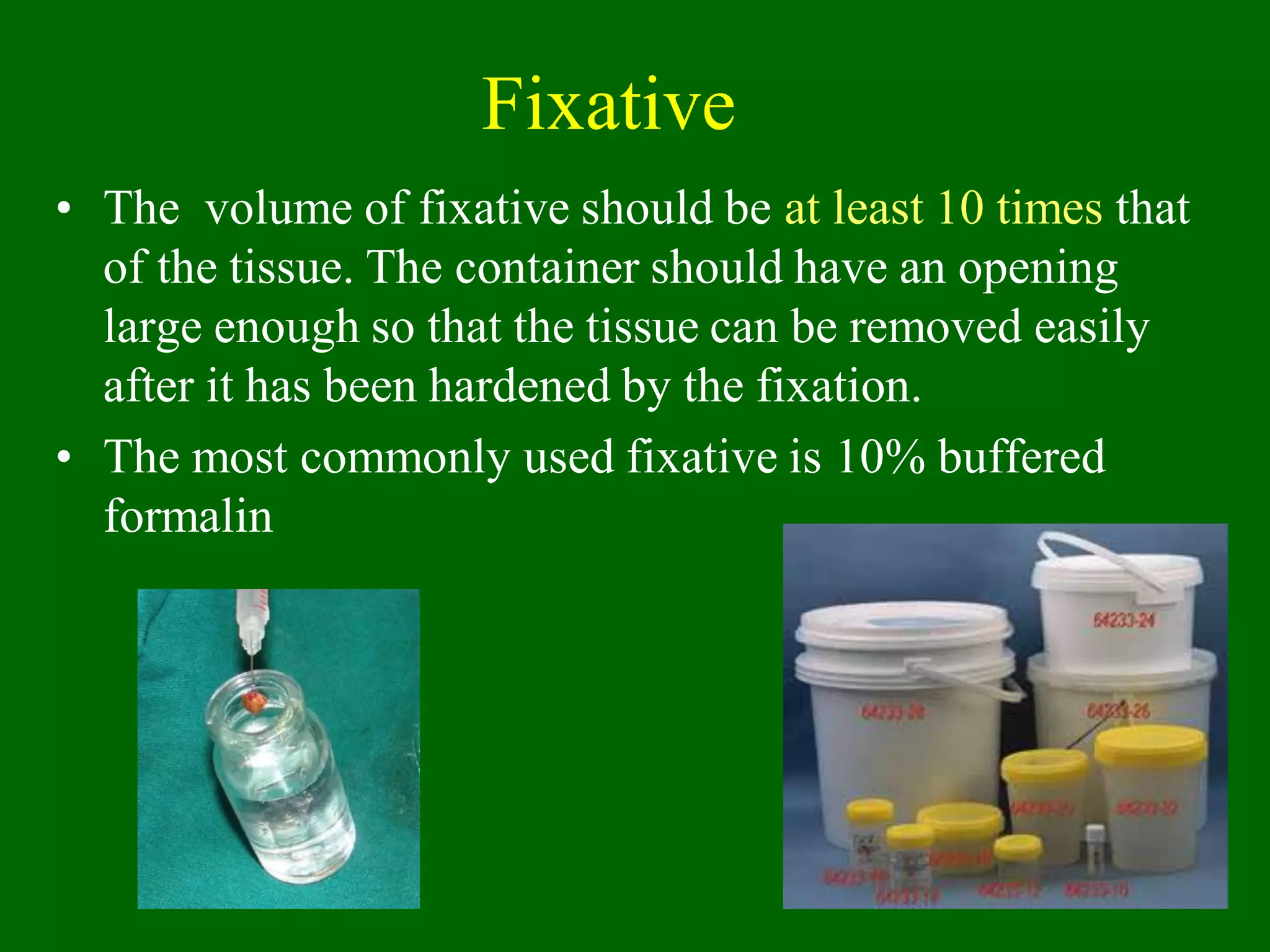
• The volume of fixative should be at least 10 times that
of the tissue. The container should have an opening
large enough so that the tissue can be removed easily
after it has been hardened by the fixation.
• The most commonly used fixative is 10% buffered
formalin
Merits of 10% buffered formalin
1. 10% buffered formalin is the best under most
circumstances.
2. It is inexpensive
3. The tissue can remain in it for prolonged
periods without deterioration
4. It is compatible with most special stains,
including immunohistochemical techniques {as
long as the tissue is placed in fixative shortly (<30 min)
after surgical removal, and overfixation (>24–48 hours)
is avoided}
Formalin
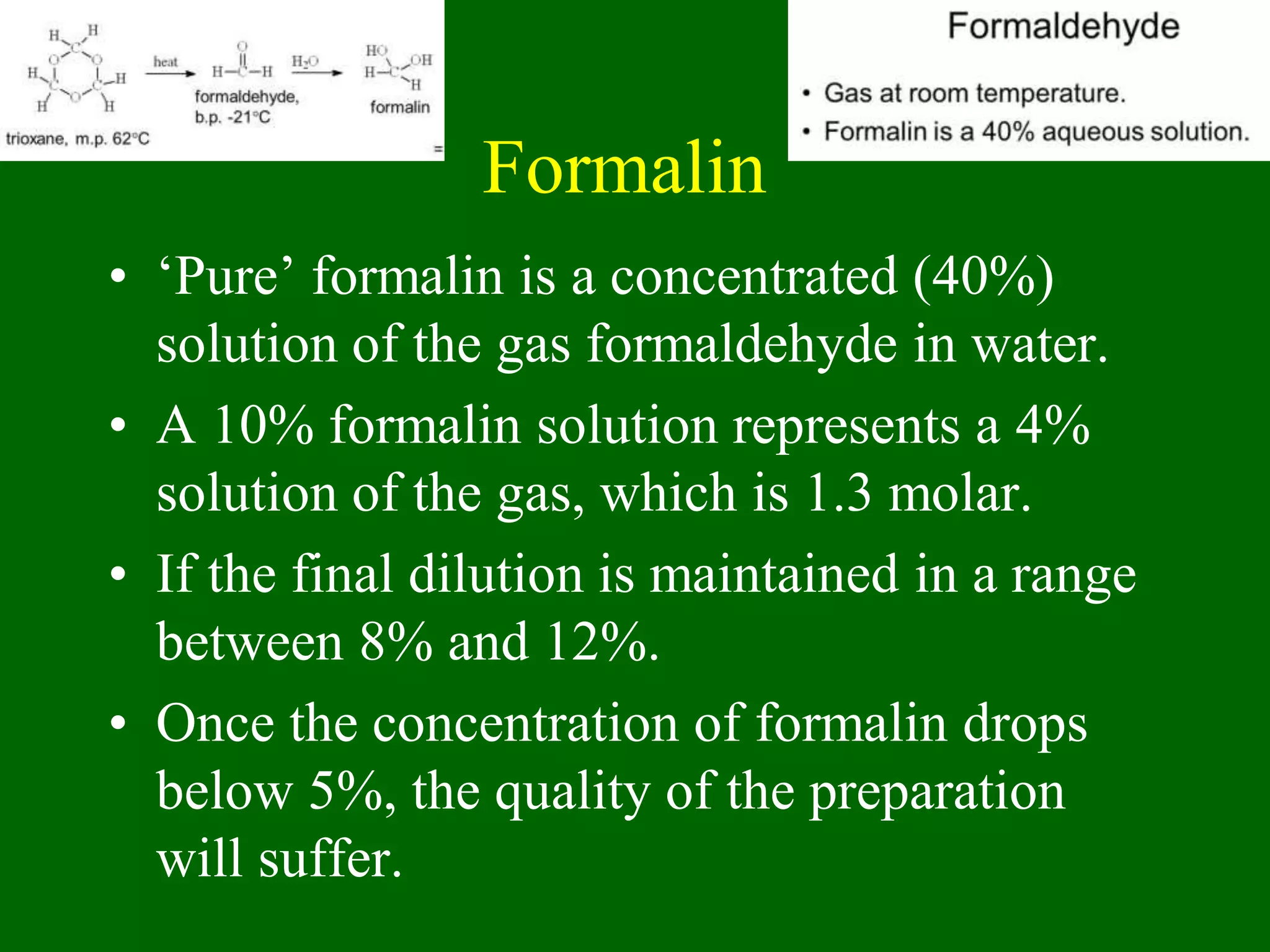
• ‘Pure’ formalin is a concentrated (40%)
solution of the gas formaldehyde in water.
• A 10% formalin solution represents a 4%
solution of the gas, which is 1.3 molar.
• If the final dilution is maintained in a range
between 8% and 12%.
• Once the concentration of formalin drops
below 5%, the quality of the preparation
will suffer.
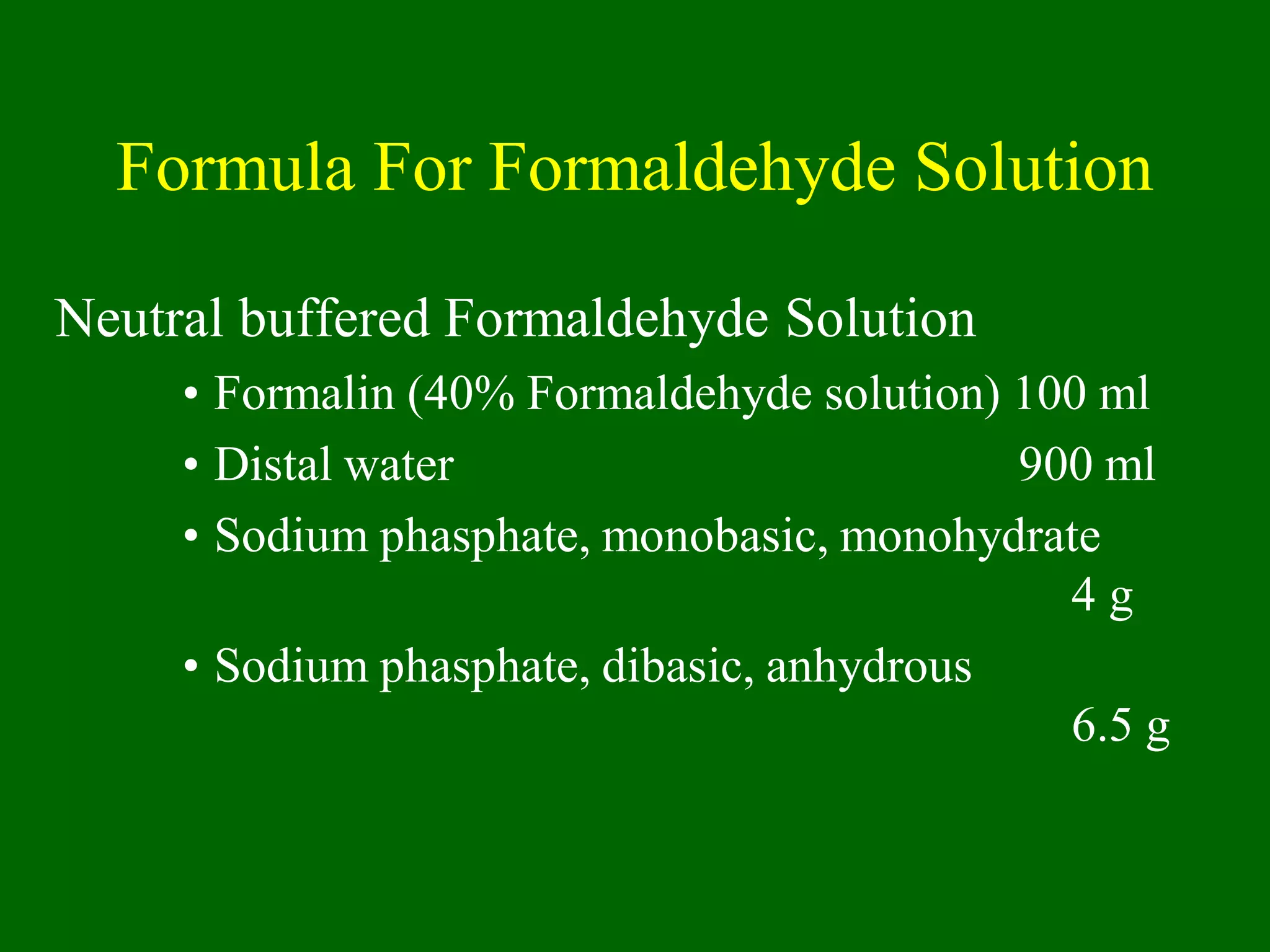
Formula For Formaldehyde Solution
Neutral buffered Formaldehyde Solution
• Formalin (40% Formaldehyde solution) 100 ml
• Distal water 900 ml
• Sodium phasphate, monobasic, monohydrate
4 g
• Sodium phasphate, dibasic, anhydrous
6.5 g
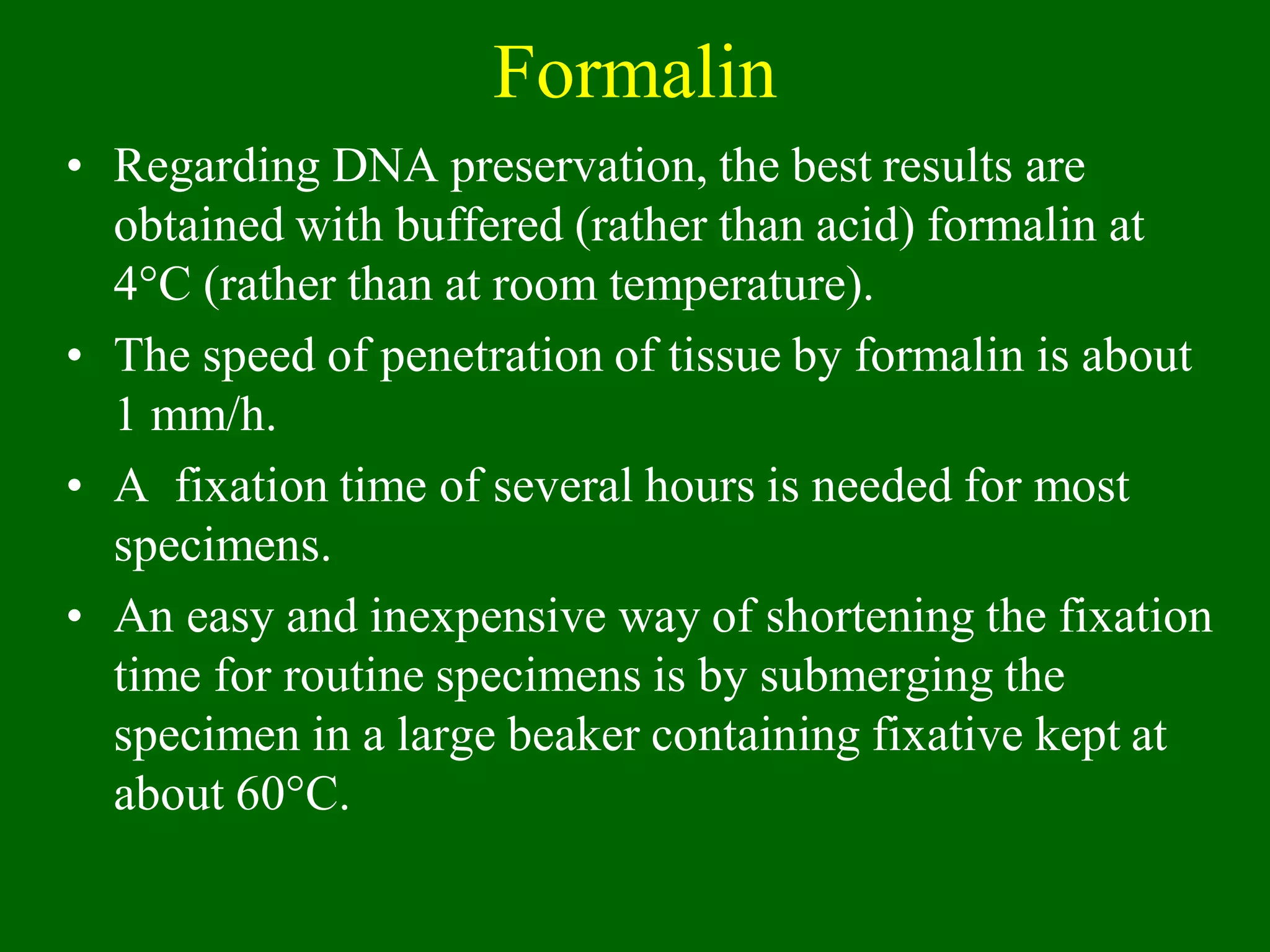
Formalin
• Regarding DNA preservation, the best results are
obtained with buffered (rather than acid) formalin at
4°C (rather than at room temperature).
• The speed of penetration of tissue by formalin is about
1 mm/h.
• A fixation time of several hours is needed for most
specimens.
• An easy and inexpensive way of shortening the fixation
time for routine specimens is by submerging the
specimen in a large beaker containing fixative kept at
about 60°C.
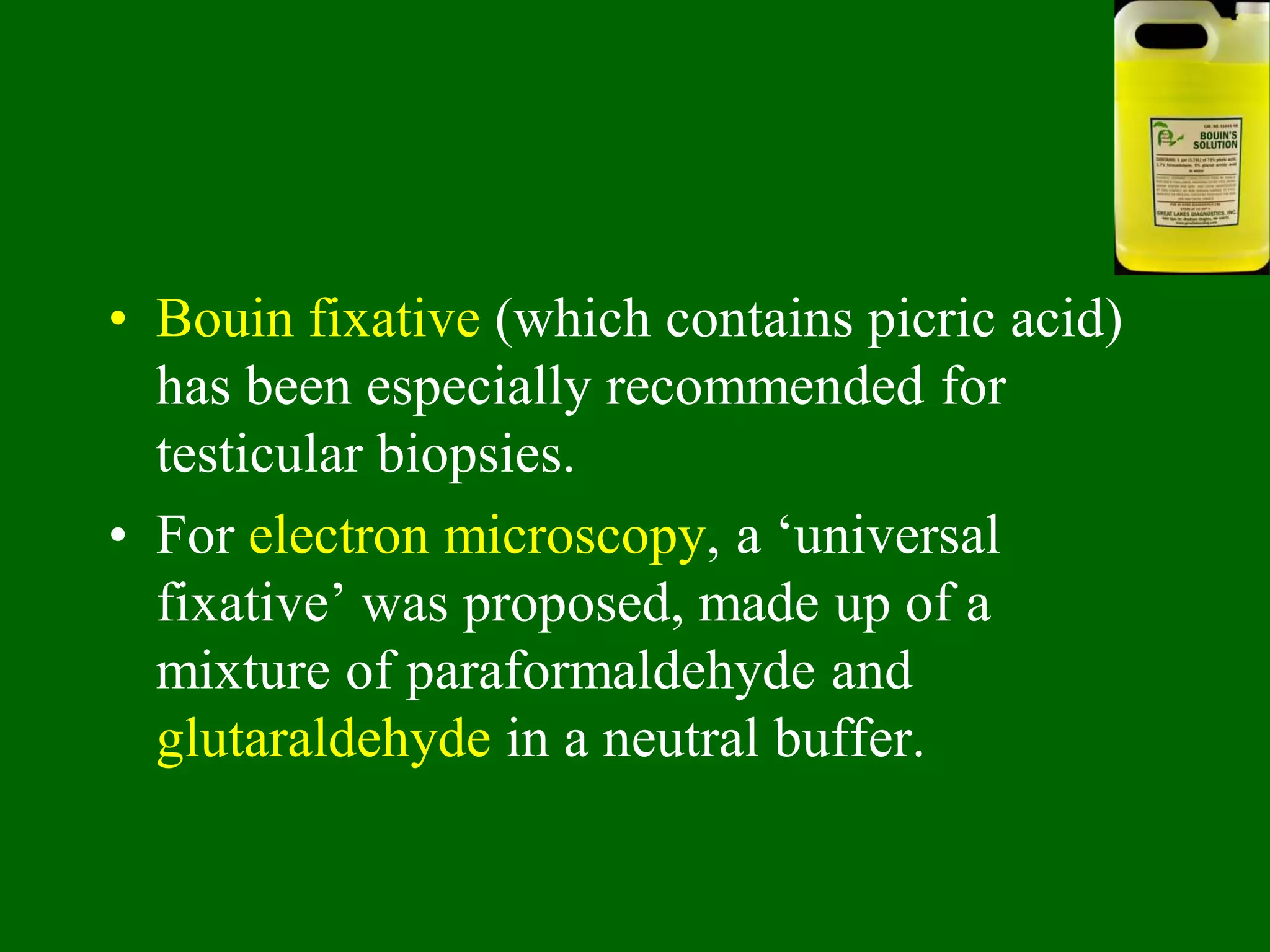
• Bouin fixative (which contains picric acid)
has been especially recommended for
testicular biopsies.
• For electron microscopy, a ‘universal
fixative’ was proposed, made up of a
mixture of paraformaldehyde and
glutaraldehyde in a neutral buffer.
Zenker Fluid
• Zenker fluid (which incorporates mercuric
chloride) is an excellent fixative
• It is expensive, requires careful disposal of the
mercury, and necessitates meticulous attention
to fixation times and washing procedures to
remove the precipitates of mercury.
• This fixative or sublimate sodium acetate
formalin (‘B-5’) is often used for biopsies of
the kidney, bone marrow, lymph node, and
testicle.
Carnoy Fixative
• Carnoy fixative is a mixture of ethanol,
chloroform, and glacial acetic acid.
• At the same time that it fixes the tissues, it
dissolves most of the fat. This property has
been found useful for the identification of
lymph nodes in radical resection specimens.
Fixation with Microwaves
• Fixation can also be achieved with
microwaves, which are defined as
electromagnetic waves with a frequency
between 300 MHz and 300 GHz.
• The decreased fixation time achievable with
microwaves is an obvious advantage, but this
is upset by the artifacts introduced, which
include tissue shrinkage and breakdown of red
blood cells.
Decalcification
• Decalcification is removal of inorganic calcium from the
organic collagen matrix (bone).
• This process is done with the help of Decalcifying agents.
• Major types of Decalcifying agents
• Nitric acid Strong acids
• Hydrocholoric Acid Strong acids
• Formic acid Weak acids
• Acetic acid Weak acids
• Picric acid Weak acids
• Ethylene diamine tetracetic acid - EDTA Chelating agents
Factors Influencing the Rate of Decalcification
• Concentration of decalcifying agent
 More concentrated the solution more rapid
decalcification but it may be more harmful to the tissue
as well.
• Temperature
• Increased temperature accelerates the decalcification
• Agitation
• Mechanical agitation speeds up the decalcification
• Suspension
• Bone samples may be suspended with the thread are separated
each other with the help of piece of cloth. It increases contact of
fluid with the bone samples
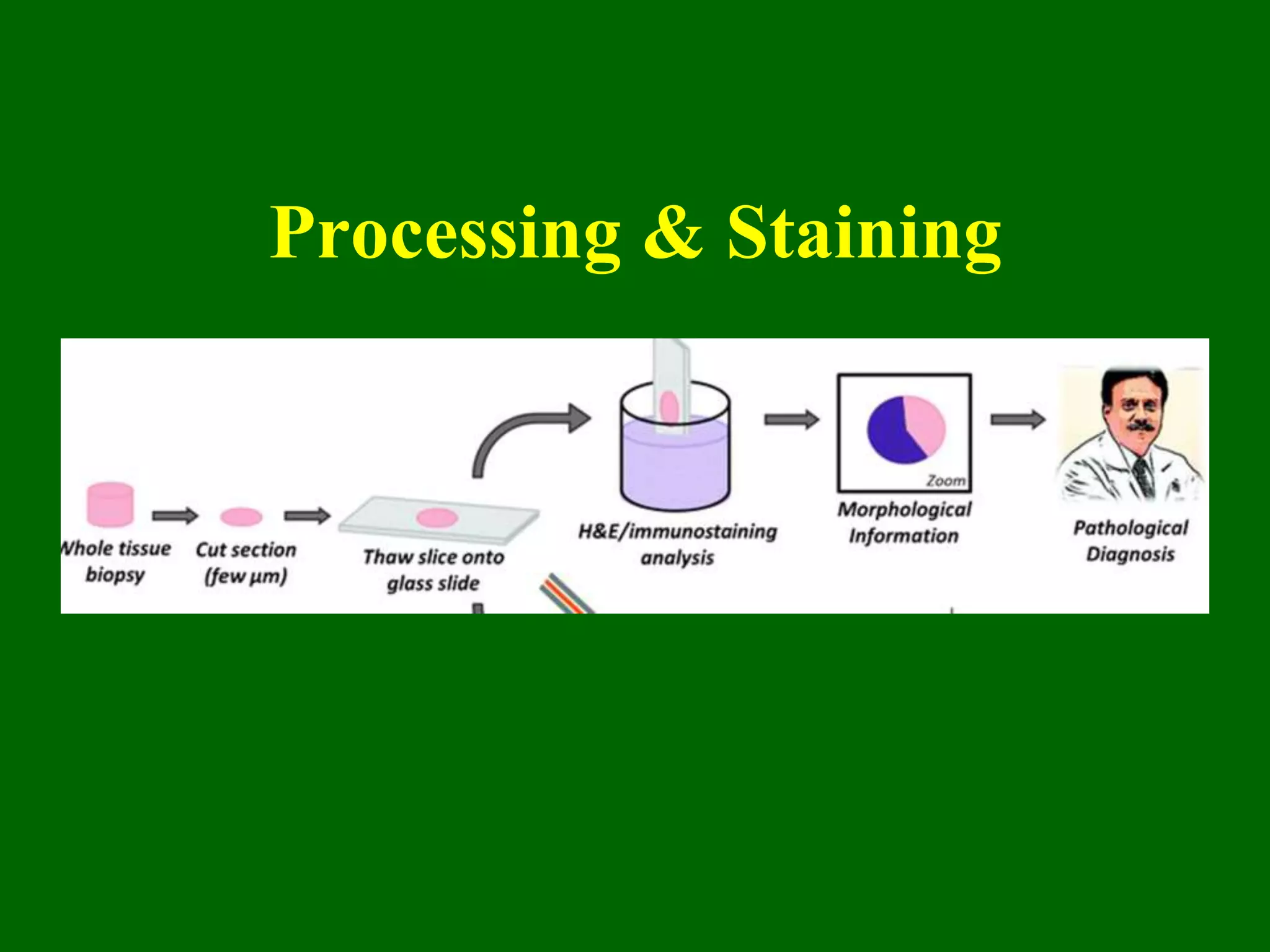
Processing & Staining
Sampling for histologic
examination
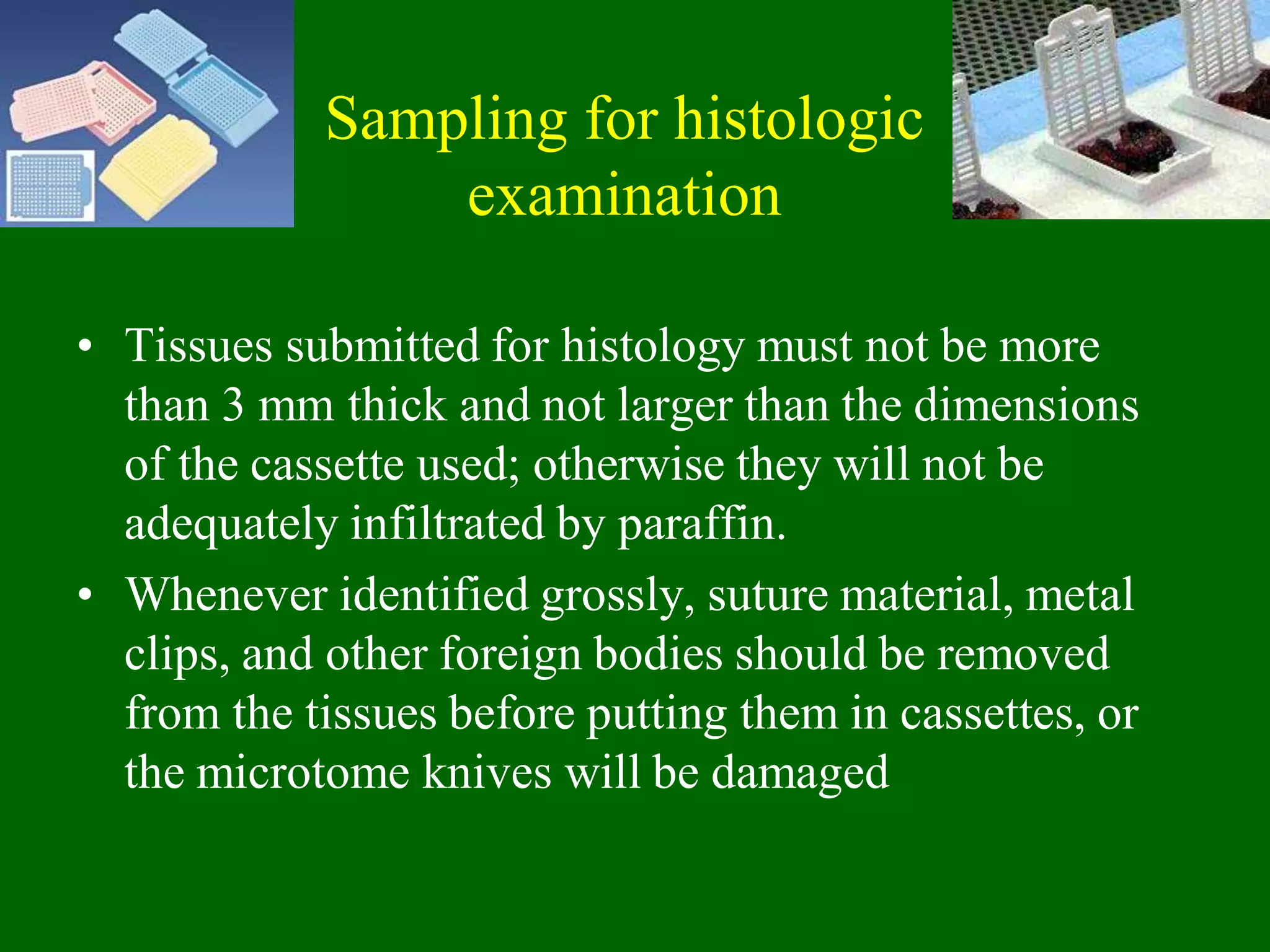
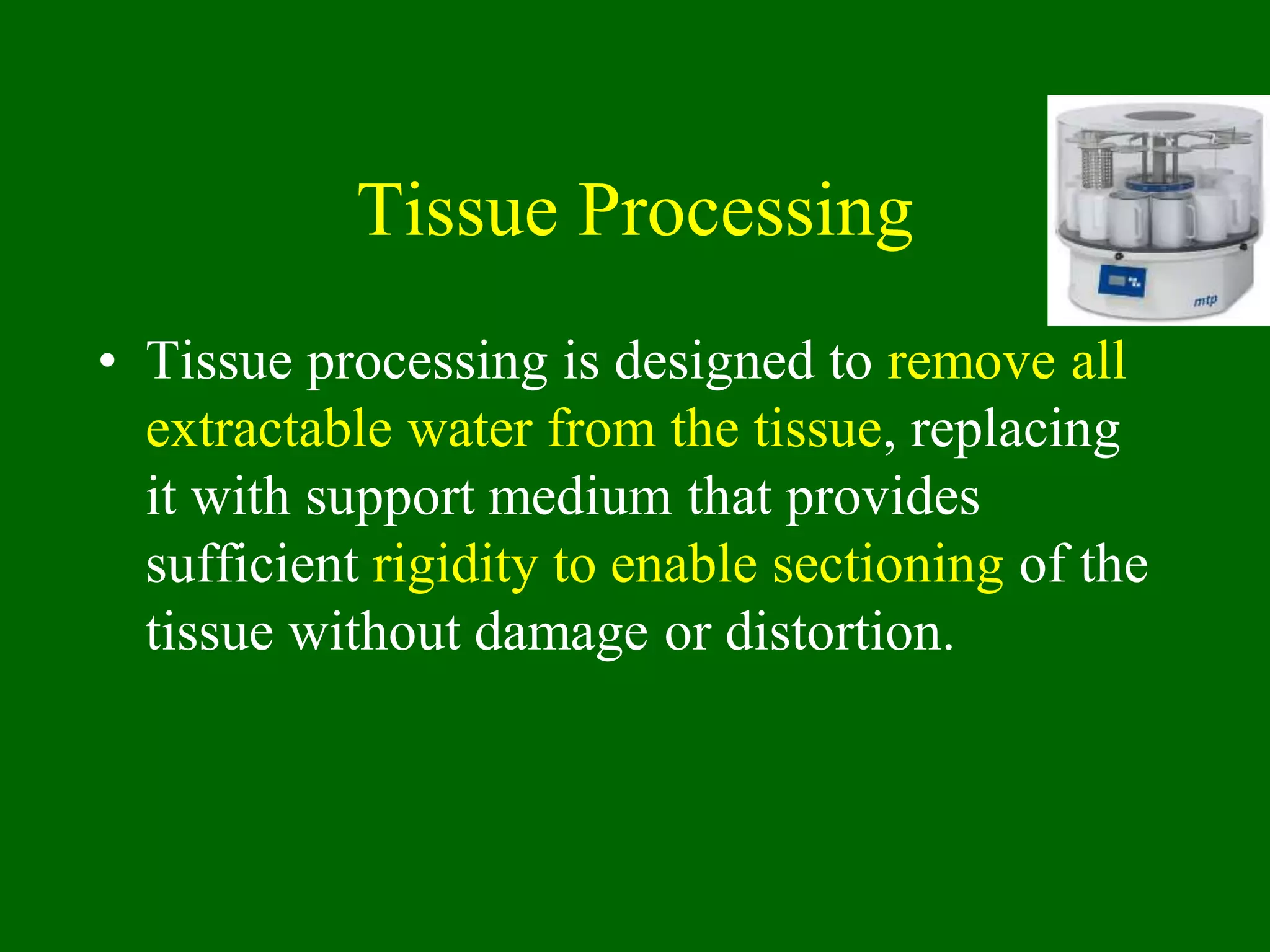
• Tissues submitted for histology must not be more
than 3 mm thick and not larger than the dimensions
of the cassette used; otherwise they will not be
adequately infiltrated by paraffin.
• Whenever identified grossly, suture material, metal
clips, and other foreign bodies should be removed
from the tissues before putting them in cassettes, or
the microtome knives will be damaged
Tissue Processing
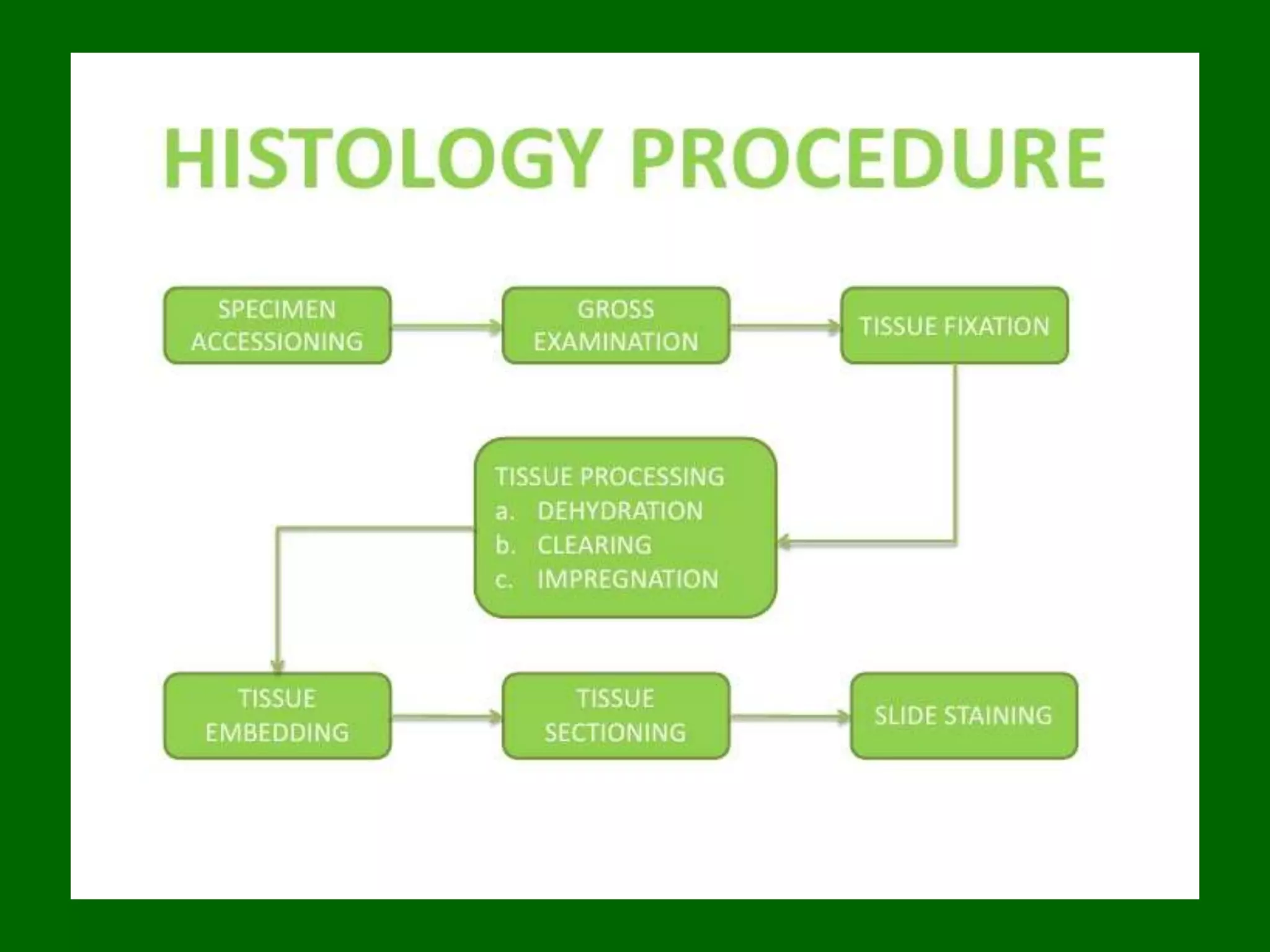
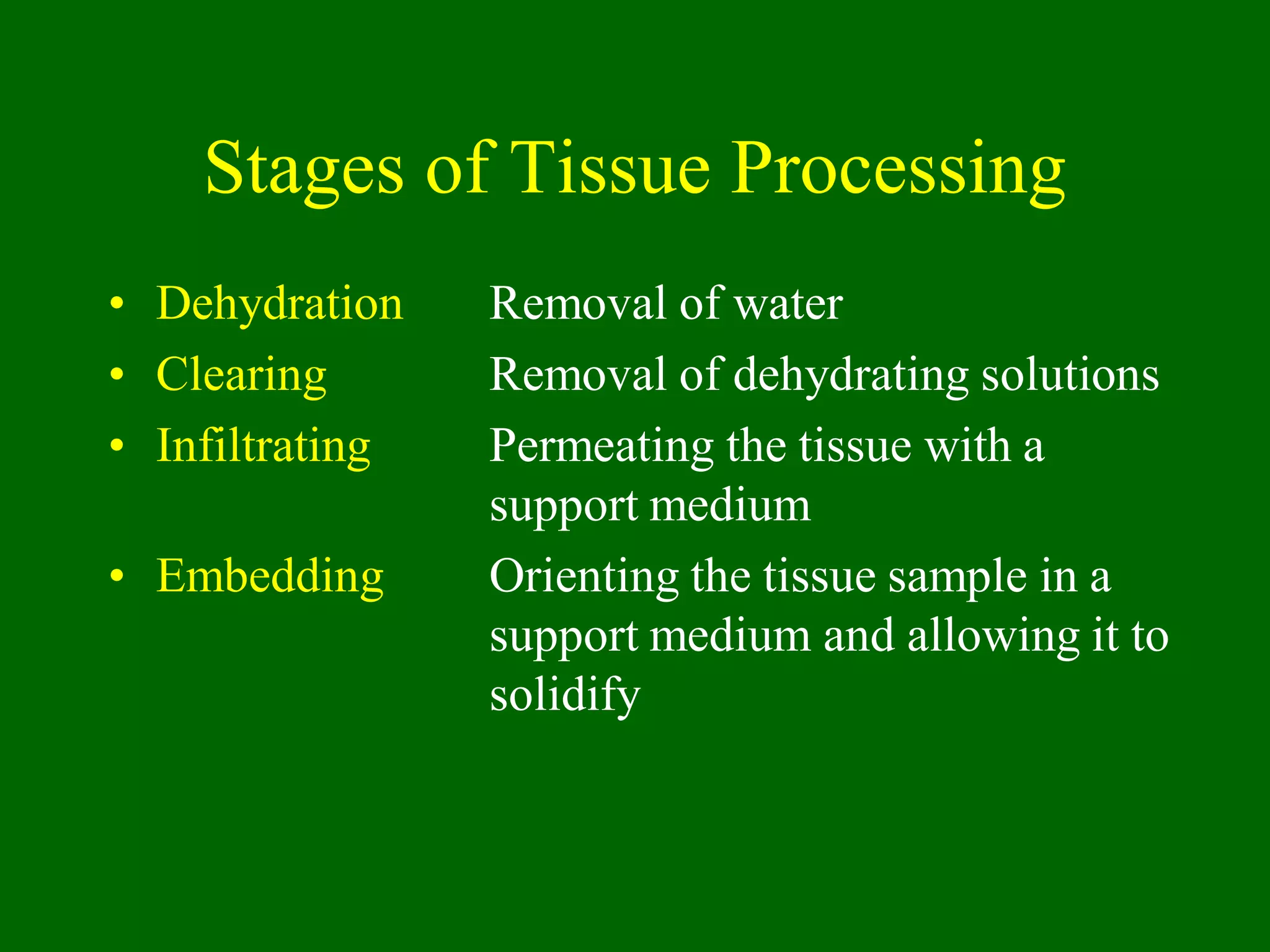
• Tissue processing is designed to remove all
extractable water from the tissue, replacing
it with support medium that provides
sufficient rigidity to enable sectioning of the
tissue without damage or distortion.
Stages of Tissue Processing
• Dehydration Removal of water
• Clearing Removal of dehydrating solutions
• Infiltrating Permeating the tissue with a
support medium
• Embedding Orienting the tissue sample in a
support medium and allowing it to
solidify
Dehydration
• Removal of water from the tissue
• Graded concentration of ethanol are used
for dehydration
• 70% ethanol
• 95% ethanol
• 100 % ethanol
Clearing
• Removal of dehydrating solutions
• Xylene is most commonly used as clearing
agent
• It is an inflammable colorless fluid
Infiltration
• After clearing with clearing agent, the tissue
is infiltrated with the embedding agent with
the paraffin wax.
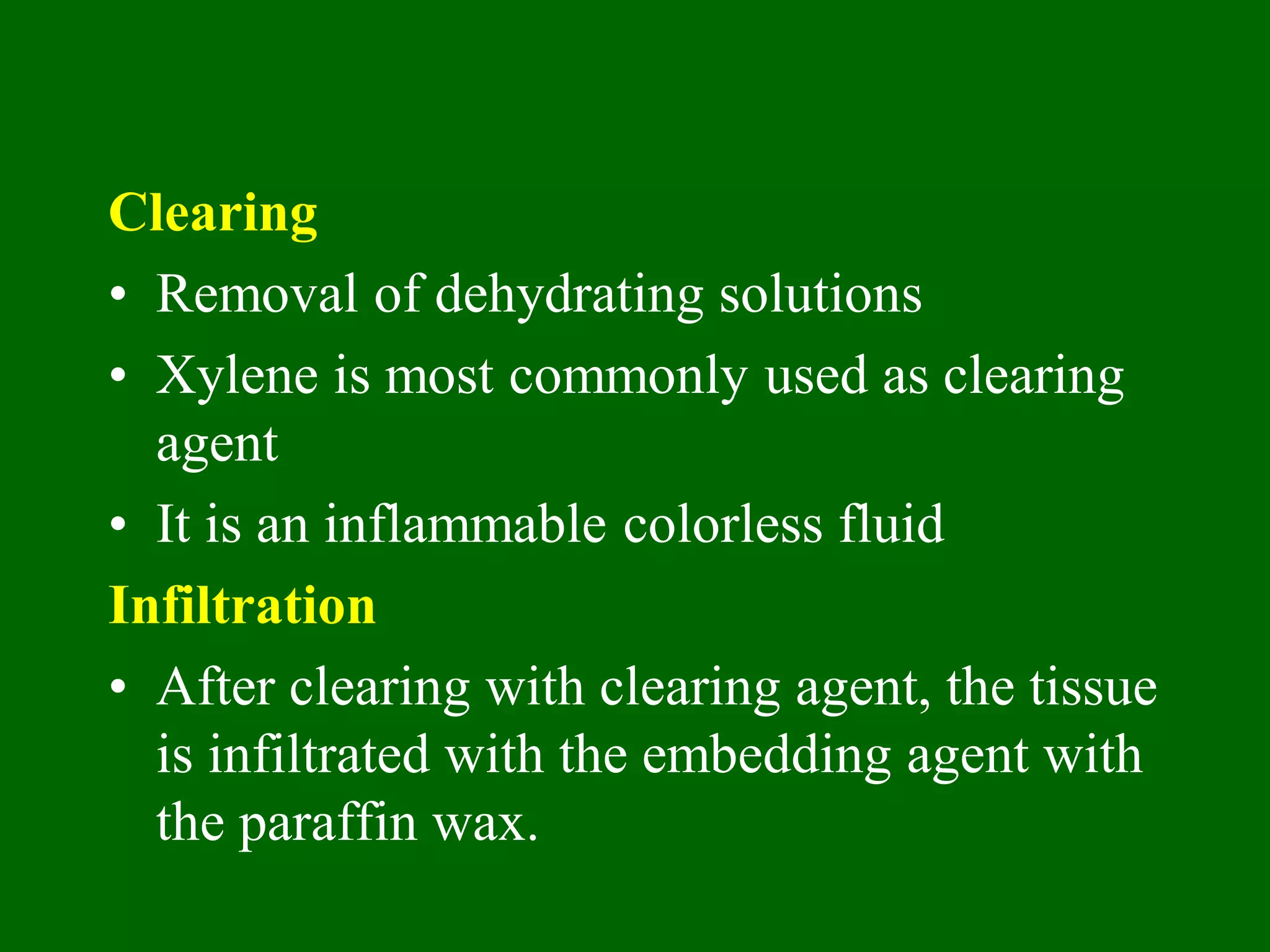
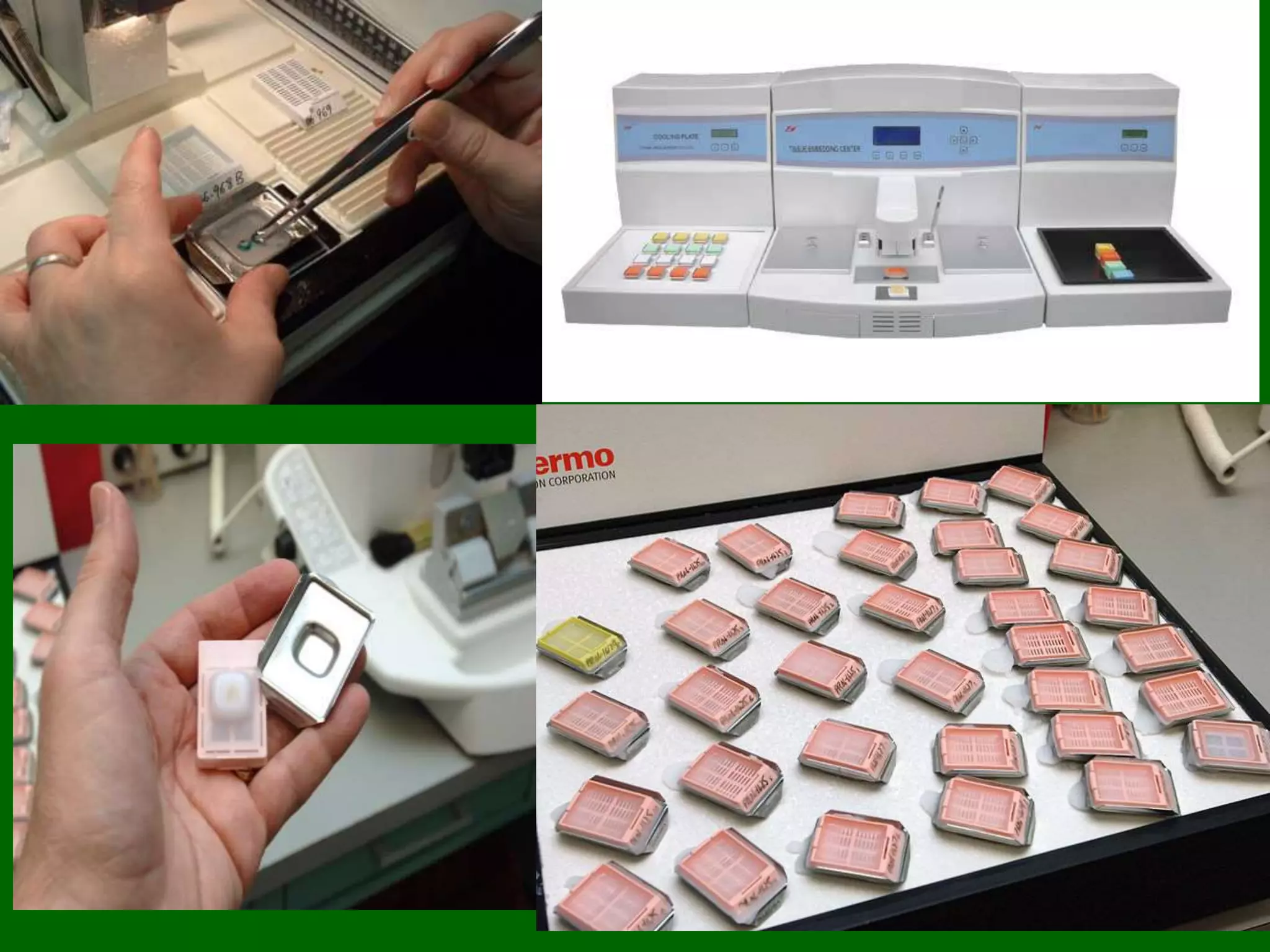
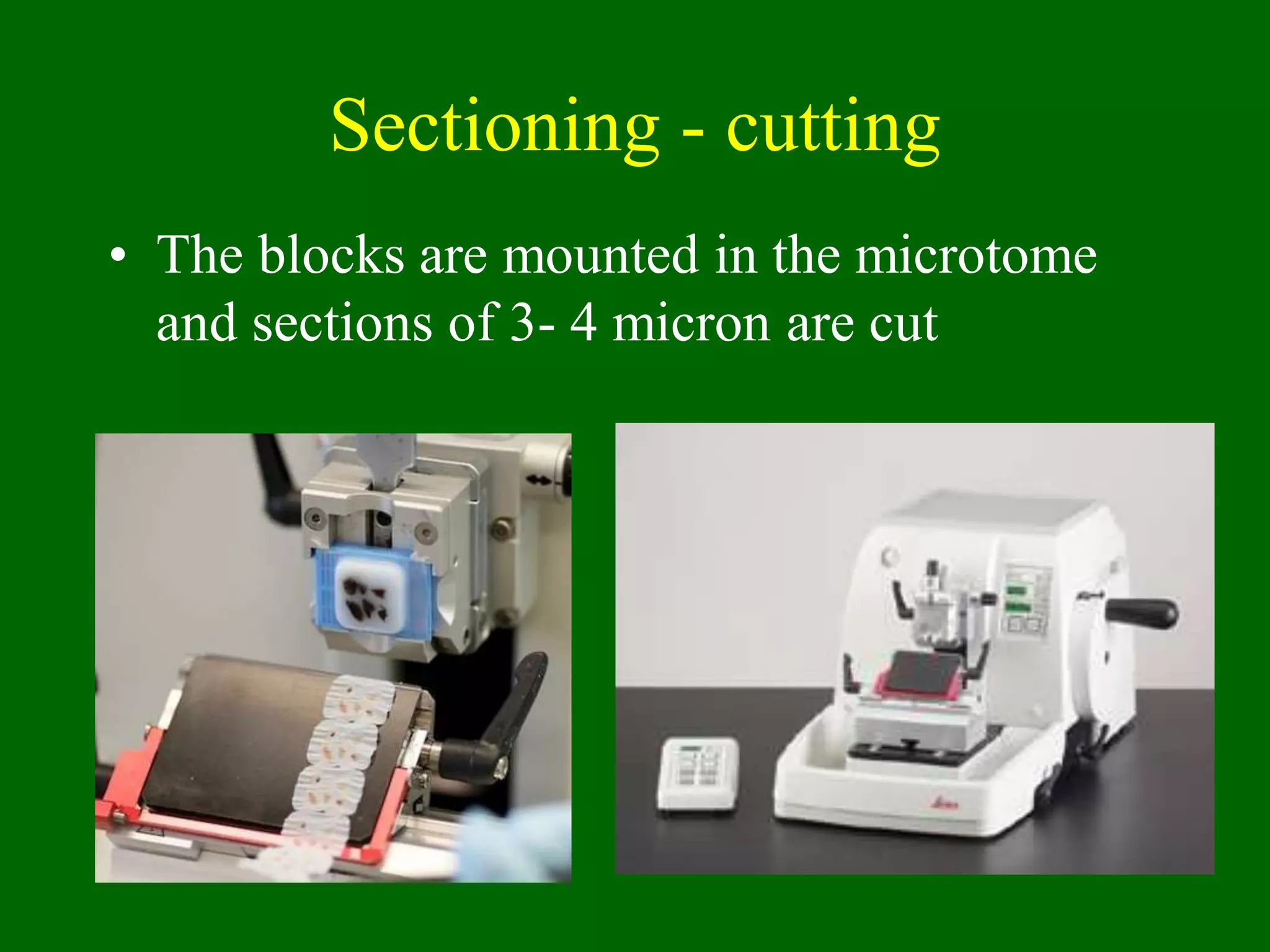
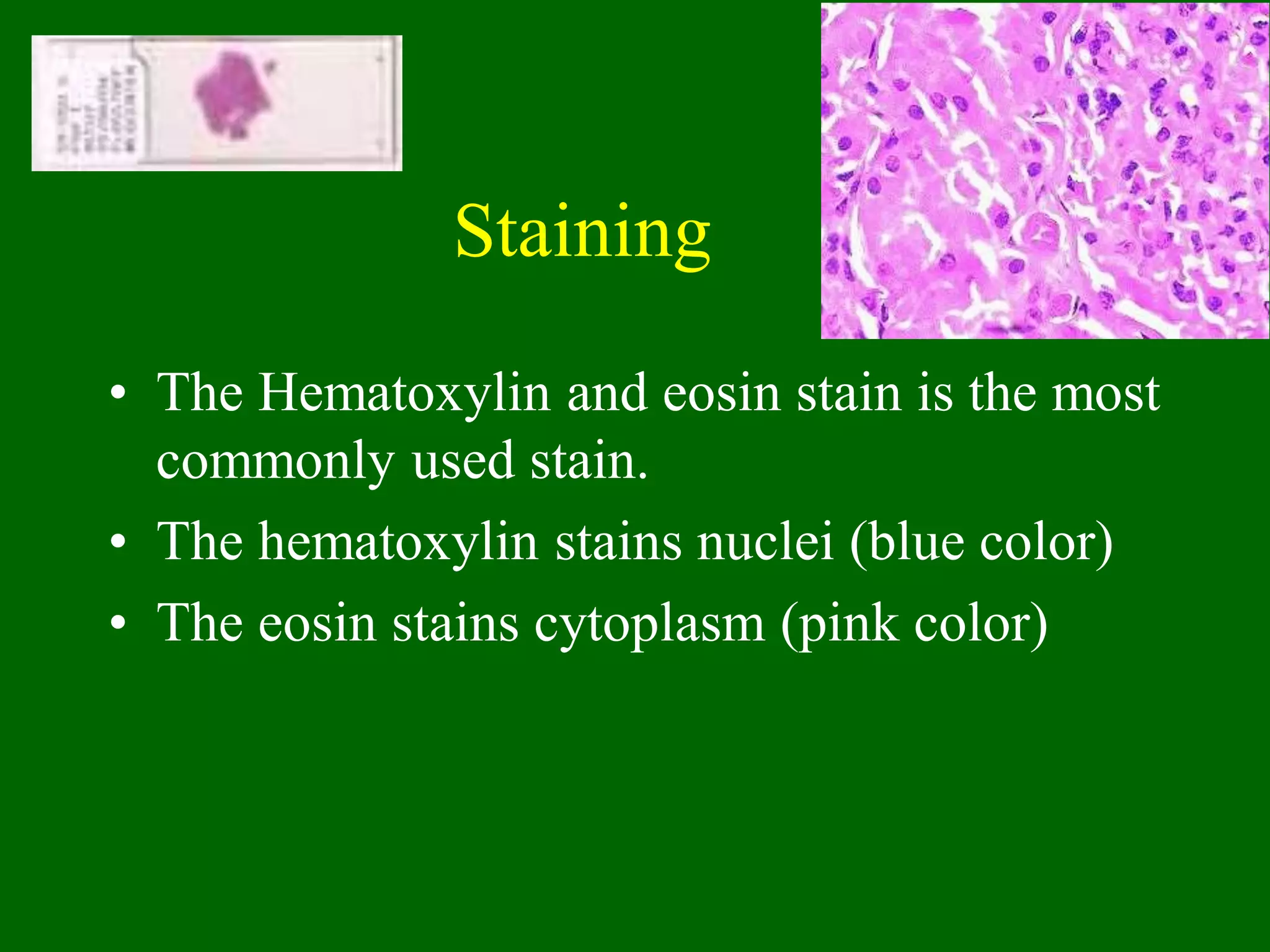
Embedding
• Orienting the tissue sample in a support
medium and allowing it to solidify
• The melted hard paraffin is put in a mold
• The tissue embedded a selected position
• The block is placed on cold plate
• After cooling, the molds are removed and
blocks are used for cutting
Sectioning - cutting
• The blocks are mounted in the microtome
and sections of 3- 4 micron are cut
Staining
• The Hematoxylin and eosin stain is the most
commonly used stain.
• The hematoxylin stains nuclei (blue color)
• The eosin stains cytoplasm (pink color)

4. Handling of surgical Specimens - II.pdf

  • 1.
    Diagnostic Surgical Pathology Lecture4. Handling surgical Specimens II
  • 2.
    Objectives • Explain theprocess of tissue fixation • Describe the tissue processing, embedding , cutting and staining •
  • 4.
    Gross examination • Thefirst step is a general inspection of the specimen, with identification of all of its normal and abnormal components. • The pathologist should place the specimen on the cutting board in an anatomic position and record at this point the following information (1) type of specimen (2) structures included (3) dimensions (4) weight (5) shape (6) color (7) Identification of surgical margins
  • 5.
    • The specimen,especially if small, should be handled on a clean cutting board, using spotless, clean instruments. • The problem of contamination of a specimen with a fragment from another (the ‘floater’ or ‘cutting board metastasis’) is one of the major catastrophes which may occur in the pathology laboratory and it can lead to dangerous mistakes
  • 6.
    • The surgicalmargins should be painted with India ink. • Fragments of tissue that are small enough to go through the cassette perforations must be wrapped in thin paper (such as tea bag paper).
  • 7.
    Fixation & Fixatives •The cells rapidly deteriorate after a tissue has been removed from the body. • The process through which cell structure is preserved is called fixation. • Different groups of chemicals (fixative) are used for the preservation of tissue (fixation). Autolysis Preserved
  • 8.
    Main Aims OfFixation • The Main Aims Of Fixation are 1. Prevention of autolysis 2. Prevention of bacterial attack 3. Hardening the tissue 4. Clear staining of section
  • 9.
    Fixation • The fixativeshould surround the specimen on all sides. Large specimens that float on a fixative should be covered by a thick layer of gauze. • In cases of large, flat, heavy specimens that rest on the bottom of the containers, the gauze should be placed between the container bottom and the specimen.
  • 10.
    Fixative • The volumeof fixative should be at least 10 times that of the tissue. The container should have an opening large enough so that the tissue can be removed easily after it has been hardened by the fixation. • The most commonly used fixative is 10% buffered formalin
  • 11.
    Merits of 10%buffered formalin 1. 10% buffered formalin is the best under most circumstances. 2. It is inexpensive 3. The tissue can remain in it for prolonged periods without deterioration 4. It is compatible with most special stains, including immunohistochemical techniques {as long as the tissue is placed in fixative shortly (<30 min) after surgical removal, and overfixation (>24–48 hours) is avoided}
  • 12.
    Formalin • ‘Pure’ formalinis a concentrated (40%) solution of the gas formaldehyde in water. • A 10% formalin solution represents a 4% solution of the gas, which is 1.3 molar. • If the final dilution is maintained in a range between 8% and 12%. • Once the concentration of formalin drops below 5%, the quality of the preparation will suffer.
  • 13.
    Formula For FormaldehydeSolution Neutral buffered Formaldehyde Solution • Formalin (40% Formaldehyde solution) 100 ml • Distal water 900 ml • Sodium phasphate, monobasic, monohydrate 4 g • Sodium phasphate, dibasic, anhydrous 6.5 g
  • 14.
    Formalin • Regarding DNApreservation, the best results are obtained with buffered (rather than acid) formalin at 4°C (rather than at room temperature). • The speed of penetration of tissue by formalin is about 1 mm/h. • A fixation time of several hours is needed for most specimens. • An easy and inexpensive way of shortening the fixation time for routine specimens is by submerging the specimen in a large beaker containing fixative kept at about 60°C.
  • 15.
    • Bouin fixative(which contains picric acid) has been especially recommended for testicular biopsies. • For electron microscopy, a ‘universal fixative’ was proposed, made up of a mixture of paraformaldehyde and glutaraldehyde in a neutral buffer.
  • 16.
    Zenker Fluid • Zenkerfluid (which incorporates mercuric chloride) is an excellent fixative • It is expensive, requires careful disposal of the mercury, and necessitates meticulous attention to fixation times and washing procedures to remove the precipitates of mercury. • This fixative or sublimate sodium acetate formalin (‘B-5’) is often used for biopsies of the kidney, bone marrow, lymph node, and testicle.
  • 17.
    Carnoy Fixative • Carnoyfixative is a mixture of ethanol, chloroform, and glacial acetic acid. • At the same time that it fixes the tissues, it dissolves most of the fat. This property has been found useful for the identification of lymph nodes in radical resection specimens.
  • 18.
    Fixation with Microwaves •Fixation can also be achieved with microwaves, which are defined as electromagnetic waves with a frequency between 300 MHz and 300 GHz. • The decreased fixation time achievable with microwaves is an obvious advantage, but this is upset by the artifacts introduced, which include tissue shrinkage and breakdown of red blood cells.
  • 19.
    Decalcification • Decalcification isremoval of inorganic calcium from the organic collagen matrix (bone). • This process is done with the help of Decalcifying agents. • Major types of Decalcifying agents • Nitric acid Strong acids • Hydrocholoric Acid Strong acids • Formic acid Weak acids • Acetic acid Weak acids • Picric acid Weak acids • Ethylene diamine tetracetic acid - EDTA Chelating agents
  • 20.
    Factors Influencing theRate of Decalcification • Concentration of decalcifying agent  More concentrated the solution more rapid decalcification but it may be more harmful to the tissue as well. • Temperature • Increased temperature accelerates the decalcification • Agitation • Mechanical agitation speeds up the decalcification • Suspension • Bone samples may be suspended with the thread are separated each other with the help of piece of cloth. It increases contact of fluid with the bone samples
  • 21.
  • 22.
    Sampling for histologic examination •Tissues submitted for histology must not be more than 3 mm thick and not larger than the dimensions of the cassette used; otherwise they will not be adequately infiltrated by paraffin. • Whenever identified grossly, suture material, metal clips, and other foreign bodies should be removed from the tissues before putting them in cassettes, or the microtome knives will be damaged
  • 23.
    Tissue Processing • Tissueprocessing is designed to remove all extractable water from the tissue, replacing it with support medium that provides sufficient rigidity to enable sectioning of the tissue without damage or distortion.
  • 24.
    Stages of TissueProcessing • Dehydration Removal of water • Clearing Removal of dehydrating solutions • Infiltrating Permeating the tissue with a support medium • Embedding Orienting the tissue sample in a support medium and allowing it to solidify
  • 25.
    Dehydration • Removal ofwater from the tissue • Graded concentration of ethanol are used for dehydration • 70% ethanol • 95% ethanol • 100 % ethanol
  • 26.
    Clearing • Removal ofdehydrating solutions • Xylene is most commonly used as clearing agent • It is an inflammable colorless fluid Infiltration • After clearing with clearing agent, the tissue is infiltrated with the embedding agent with the paraffin wax.
  • 27.
    Embedding • Orienting thetissue sample in a support medium and allowing it to solidify • The melted hard paraffin is put in a mold • The tissue embedded a selected position • The block is placed on cold plate • After cooling, the molds are removed and blocks are used for cutting
  • 29.
    Sectioning - cutting •The blocks are mounted in the microtome and sections of 3- 4 micron are cut
  • 30.
    Staining • The Hematoxylinand eosin stain is the most commonly used stain. • The hematoxylin stains nuclei (blue color) • The eosin stains cytoplasm (pink color)