29-01-2021 POLYPORUS SADHNA PANDEY
POLYPORUS
VEGETATIVESTRUCTURE
REPRODUCTION
BADIOCARP
SADHNA PANDEY
POLYPORUS
29-01-2021
CLASSIFICATION
Ainsworth (1971)
Fungi
Eumycota
Basidiomycotina
Hymenomycetes
Holobasidiomycetidae
Polyporaceae
Polyporus
29-01-2021 POLYPORUS SADHNA PANDEY
Polyporus is known as wood rotters
cause wood rot of s timber trees
conifers, oak, apple, maple walnut, pear,
Acacia etc. P. sulphureus, (sulphur mushroom,)
causes wood rot of oak and other trees and
has large sulphur yellow fruiting bodies
P. betulinus causes the heart rot of birch and
some other coniferous trees. P. squamosus
causes heart rot of Ulmus.
29-01-2021 POLYPORUS SADHNA PANDEY
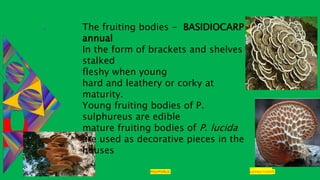
The fruiting bodies - BASIDIOCARP
annual
In the form of brackets and shelves
stalked
fleshy when young
hard and leathery or corky at
maturity.
Young fruiting bodies of P.
sulphureus are edible
mature fruiting bodies of P. lucida
are used as decorative pieces in the
houses
29-01-2021 POLYPORUS SADHNA PANDEY
Vegetative Mycelium :
Exists in two phases
a) Primary Mycelium
b) Secondary Mycelium
29-01-2021 POLYPORUS SADHNA PANDEY
Primary Mycelium:
originates by the germination of the
uninucleate and haploid basidiospores.
It consists of many white, slender,
branched and septate hyphae.
The cells are uninucleate i.e.
monokaryotic
It is short lived and soon becomes bi-
nucleate (dikaryotic)
by hyphal fusion occurring between
cells of the hyphae of two apposite
(compatible) strains
29-01-2021 POLYPORUS SADHNA PANDEY
Secondary Mycelium:
It is subterranean, perennating,
and originates by the fusion of
two cells of the monokaryotic
mycelium.
The bi-nucleate or dikaryotic
cells by divisions and by clamp
connection form the secondary
or dikaryotic mycelium
29-01-2021 POLYPORUS SADHNA PANDEY
It ramifies in the bark tissues and
outer portions of the woody
cylinder.
The hyphae secrete enzymes which
digest the lignin of walls of the
wood cells.
Later it develops into the fruiting
bodies called basidiocarps.
29-01-2021 POLYPORUS SADHNA PANDEY
Basidiocarp:
The secondary mycelium collects in
hyphal knots
forms a small button like strand in the
bark of the wood.
these hyphal strands grow in size,
bursts through the bark surface of f
the tree and develops into basidocarps
(fruiting bodies.)
The basidiocarps may be sessile or
stalked
29-01-2021 POLYPORUS SADHNA PANDEY
stalk may be lateral or central
. height (stalk) -2-6″ , diameter -1/2
Black/Brown in colour
Stalks bear an umbrella shaped cap or pileus.
The pilues bracket or shelf like body with brown colour.
upper surface smooth /ridged surface.
undulating in concentric manner.
The concentric rings with alternate brown and white in
colour prominent in the peripheral regions of the pileus.
The lower surface of the pileus is without gills ,smooth
and flat,.
The pileus contains numerous small pores on under-
surface(characteristic feature ,therefore named as
polypore’s)
pores run deep into the tissues as hollow tubular canals.
29-01-2021 POLYPORUS SADHNA PANDEY
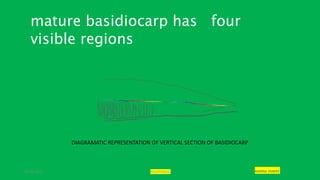
DIAGRAMATIC REPRESENTATION OF VERTICAL SECTION OF BASIDIOCARP
mature basidiocarp has four
visible regions
29-01-2021 POLYPORUS SADHNA PANDEY
i) Pileus Surface:
It is the upper surface of the
basidiocarp. smooth / incrusted.
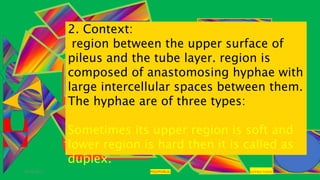
29-01-2021 POLYPORUS SADHNA PANDEY
2. Context:
region between the upper surface of
pileus and the tube layer. region is
composed of anastomosing hyphae with
large intercellular spaces between them.
The hyphae are of three types:
Sometimes its upper region is soft and
lower region is hard then it is called as
duplex.
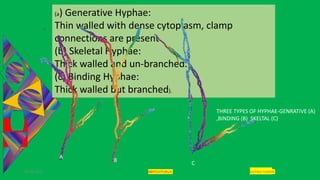
(a) Generative Hyphae:
Thin walled with dense cytoplasm, clamp
connections are present.
(b) Skeletal Hyphae:
Thick walled and un-branched.
(c) Binding Hyphae:
Thick walled but branched).
29-01-2021 BBPOLYPORUS SADHNA PANDEY
THREE TYPES OF HYPHAE-GENRATIVE (A)
,BINDING (B) SKELTAL (C)
A
B
C
29-01-2021 POLYPORUS SADHNA PANDEY
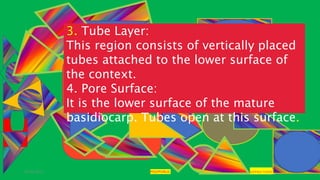
3. Tube Layer:
This region consists of vertically placed
tubes attached to the lower surface of
the context.
4. Pore Surface:
It is the lower surface of the mature
basidiocarp. Tubes open at this surface.
29-01-2021 POLYPORUS SADHNA PANDEY
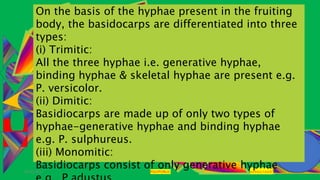
On the basis of the hyphae present in the fruiting
body, the basidocarps are differentiated into three
types:
(i) Trimitic:
All the three hyphae i.e. generative hyphae,
binding hyphae & skeletal hyphae are present e.g.
P. versicolor.
(ii) Dimitic:
Basidiocarps are made up of only two types of
hyphae-generative hyphae and binding hyphae
e.g. P. sulphureus.
(iii) Monomitic:
Basidiocarps consist of only generative hyphae
29-01-2021 POLYPORUS SADHNA PANDEY
Reproduction in Polyporus:
heterothallic.
Sex organs are absent.
In tube layer of basidiocarp in between the tubes
the tissue is made up of generative and skeletal
hyphae. It is called dissepiment.
From these hyphae arise short branches at right
angles at the length.
These branches develop into fertile basidia single
celled calavate and sterile paraphysis, cystidia and
setae also develope
These fertile and sterile structures form the inner
lining of the pores and collectively known as
29-01-2021 POLYPORUS SADHNA PANDEY
basidium is club shaped bi-nucleate sterigmata.
At maturity it projects slightly into the cavity of the pore
. The two nuclei of the basidium fuse to form the
synkaryon (karyogamy).
The diploid nucleus undergoes meiosis to form four
haploid nuclei.
Four short sterigmata develop from each basidium from
small.
basidiospores Oval and uninucleate ,borne on
sterigmata..
basidiospores are released from pores
after falling
on suitable substratum each basidiospore germinates
into a primary mycelium of plus or minus strain.
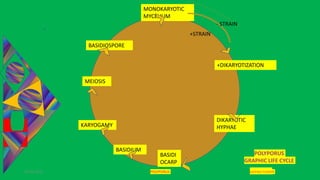
DIKARYOTIC
HYPHAE
29-01-2021 POLYPORUS SADHNA PANDEY
BASIDI
OCARP
BASIDIOSPORE
BASIDIUM
MEIOSIS
KARYOGAMY
MONOKARYOTIC
MYCELIUM
+STRAIN
+DIKARYOTIZATION
- STRAIN
POLYPORUS
GRAPHIC LIFE CYCLE
29-01-2021 POLYPORUS SADHNA PANDEY
THANK U
POLYPORUS 21
29-01-2021

Polyporus

  • 1.
    29-01-2021 POLYPORUS SADHNAPANDEY POLYPORUS VEGETATIVESTRUCTURE REPRODUCTION BADIOCARP
  • 2.
  • 3.
    29-01-2021 POLYPORUS SADHNAPANDEY Polyporus is known as wood rotters cause wood rot of s timber trees conifers, oak, apple, maple walnut, pear, Acacia etc. P. sulphureus, (sulphur mushroom,) causes wood rot of oak and other trees and has large sulphur yellow fruiting bodies P. betulinus causes the heart rot of birch and some other coniferous trees. P. squamosus causes heart rot of Ulmus.
  • 4.
    29-01-2021 POLYPORUS SADHNAPANDEY The fruiting bodies - BASIDIOCARP annual In the form of brackets and shelves stalked fleshy when young hard and leathery or corky at maturity. Young fruiting bodies of P. sulphureus are edible mature fruiting bodies of P. lucida are used as decorative pieces in the houses
  • 5.
    29-01-2021 POLYPORUS SADHNAPANDEY Vegetative Mycelium : Exists in two phases a) Primary Mycelium b) Secondary Mycelium
  • 6.
    29-01-2021 POLYPORUS SADHNAPANDEY Primary Mycelium: originates by the germination of the uninucleate and haploid basidiospores. It consists of many white, slender, branched and septate hyphae. The cells are uninucleate i.e. monokaryotic It is short lived and soon becomes bi- nucleate (dikaryotic) by hyphal fusion occurring between cells of the hyphae of two apposite (compatible) strains
  • 7.
    29-01-2021 POLYPORUS SADHNAPANDEY Secondary Mycelium: It is subterranean, perennating, and originates by the fusion of two cells of the monokaryotic mycelium. The bi-nucleate or dikaryotic cells by divisions and by clamp connection form the secondary or dikaryotic mycelium
  • 8.
    29-01-2021 POLYPORUS SADHNAPANDEY It ramifies in the bark tissues and outer portions of the woody cylinder. The hyphae secrete enzymes which digest the lignin of walls of the wood cells. Later it develops into the fruiting bodies called basidiocarps.
  • 9.
    29-01-2021 POLYPORUS SADHNAPANDEY Basidiocarp: The secondary mycelium collects in hyphal knots forms a small button like strand in the bark of the wood. these hyphal strands grow in size, bursts through the bark surface of f the tree and develops into basidocarps (fruiting bodies.) The basidiocarps may be sessile or stalked
  • 10.
    29-01-2021 POLYPORUS SADHNAPANDEY stalk may be lateral or central . height (stalk) -2-6″ , diameter -1/2 Black/Brown in colour Stalks bear an umbrella shaped cap or pileus. The pilues bracket or shelf like body with brown colour. upper surface smooth /ridged surface. undulating in concentric manner. The concentric rings with alternate brown and white in colour prominent in the peripheral regions of the pileus. The lower surface of the pileus is without gills ,smooth and flat,. The pileus contains numerous small pores on under- surface(characteristic feature ,therefore named as polypore’s) pores run deep into the tissues as hollow tubular canals.
  • 11.
    29-01-2021 POLYPORUS SADHNAPANDEY DIAGRAMATIC REPRESENTATION OF VERTICAL SECTION OF BASIDIOCARP mature basidiocarp has four visible regions
  • 12.
    29-01-2021 POLYPORUS SADHNAPANDEY i) Pileus Surface: It is the upper surface of the basidiocarp. smooth / incrusted.
  • 13.
    29-01-2021 POLYPORUS SADHNAPANDEY 2. Context: region between the upper surface of pileus and the tube layer. region is composed of anastomosing hyphae with large intercellular spaces between them. The hyphae are of three types: Sometimes its upper region is soft and lower region is hard then it is called as duplex.
  • 14.
    (a) Generative Hyphae: Thinwalled with dense cytoplasm, clamp connections are present. (b) Skeletal Hyphae: Thick walled and un-branched. (c) Binding Hyphae: Thick walled but branched). 29-01-2021 BBPOLYPORUS SADHNA PANDEY THREE TYPES OF HYPHAE-GENRATIVE (A) ,BINDING (B) SKELTAL (C) A B C
  • 15.
    29-01-2021 POLYPORUS SADHNAPANDEY 3. Tube Layer: This region consists of vertically placed tubes attached to the lower surface of the context. 4. Pore Surface: It is the lower surface of the mature basidiocarp. Tubes open at this surface.
  • 16.
    29-01-2021 POLYPORUS SADHNAPANDEY On the basis of the hyphae present in the fruiting body, the basidocarps are differentiated into three types: (i) Trimitic: All the three hyphae i.e. generative hyphae, binding hyphae & skeletal hyphae are present e.g. P. versicolor. (ii) Dimitic: Basidiocarps are made up of only two types of hyphae-generative hyphae and binding hyphae e.g. P. sulphureus. (iii) Monomitic: Basidiocarps consist of only generative hyphae
  • 17.
    29-01-2021 POLYPORUS SADHNAPANDEY Reproduction in Polyporus: heterothallic. Sex organs are absent. In tube layer of basidiocarp in between the tubes the tissue is made up of generative and skeletal hyphae. It is called dissepiment. From these hyphae arise short branches at right angles at the length. These branches develop into fertile basidia single celled calavate and sterile paraphysis, cystidia and setae also develope These fertile and sterile structures form the inner lining of the pores and collectively known as
  • 18.
    29-01-2021 POLYPORUS SADHNAPANDEY basidium is club shaped bi-nucleate sterigmata. At maturity it projects slightly into the cavity of the pore . The two nuclei of the basidium fuse to form the synkaryon (karyogamy). The diploid nucleus undergoes meiosis to form four haploid nuclei. Four short sterigmata develop from each basidium from small. basidiospores Oval and uninucleate ,borne on sterigmata.. basidiospores are released from pores after falling on suitable substratum each basidiospore germinates into a primary mycelium of plus or minus strain.
  • 19.
    DIKARYOTIC HYPHAE 29-01-2021 POLYPORUS SADHNAPANDEY BASIDI OCARP BASIDIOSPORE BASIDIUM MEIOSIS KARYOGAMY MONOKARYOTIC MYCELIUM +STRAIN +DIKARYOTIZATION - STRAIN POLYPORUS GRAPHIC LIFE CYCLE
  • 20.
  • 21.