Business Environment
 Topic:- Using Plastic Money :
Not suitable for Indian mindsets.
By:- Vaibhav Jain
Gurpreet Singh
Zahabia Africawala
What is plastic money ?
 The "plastic" portion of this term refers to
the plastic construction of credit cards, as
opposed to paper and metal of currency.
 The "money" portion is an erroneous
reference to credit cards as a form
of money, which they are not.
Vaibhav jain
Using Plastic Money :
Not suitable for Indian mindsets
Introduction :
•Plastic money or polymer money, made out of plastic, is a
new and easier way of paying for goods and services.
•It includes debit cards, ATMs, smart cards, etc.
Vaibhav jain
BIRTH OF PLASTIC MONEY
 Credit cards were invented 60 years back.
 After the Second World War, the first plastic
charge card was invented.
 The Diners’ Club card, Introduced in New York
City in 1950, the card allowed Diners’ Club
members to eat at 27 restaurants in New York
City on credit.
Vaibhav jain
Types of plastic money :
 Credit cards
 Debit cards
 Master cards & Visa
 Charge cards
 Smart cards
 Photo cards
 Co-branded cards
 Global cards
 Diners Club cards
Vaibhav jain
Credit Cards
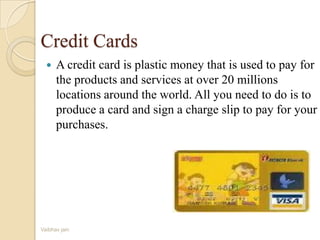
 A credit card is plastic money that is used to pay for
the products and services at over 20 millions
locations around the world. All you need to do is to
produce a card and sign a charge slip to pay for your
purchases.
Vaibhav jain
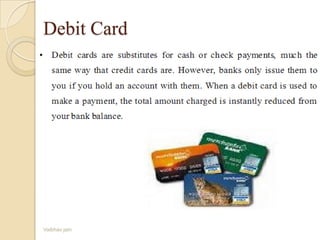
Debit Card
Vaibhav jain
Master cards & Visa
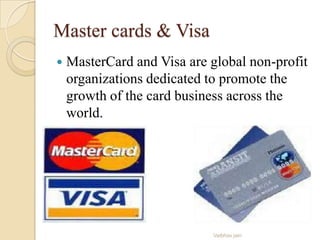
 MasterCard and Visa are global non-profit
organizations dedicated to promote the
growth of the card business across the
world.
Vaibhav jain
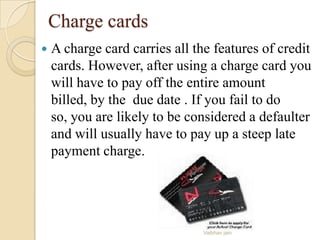
Charge cards
 A charge card carries all the features of credit
cards. However, after using a charge card you
will have to pay off the entire amount
billed, by the due date . If you fail to do
so, you are likely to be considered a defaulter
and will usually have to pay up a steep late
payment charge.
Vaibhav jain
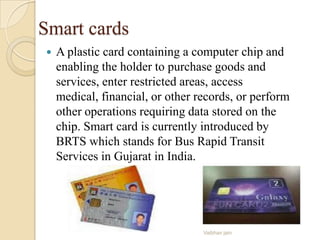
Smart cards
 A plastic card containing a computer chip and
enabling the holder to purchase goods and
services, enter restricted areas, access
medical, financial, or other records, or perform
other operations requiring data stored on the
chip. Smart card is currently introduced by
BRTS which stands for Bus Rapid Transit
Services in Gujarat in India.
Vaibhav jain
Photo cards
Vaibhav jain
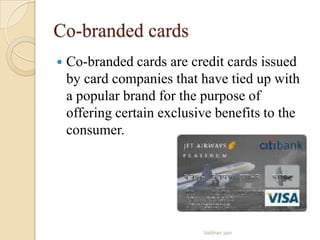
Co-branded cards
 Co-branded cards are credit cards issued
by card companies that have tied up with
a popular brand for the purpose of
offering certain exclusive benefits to the
consumer.
Vaibhav jain
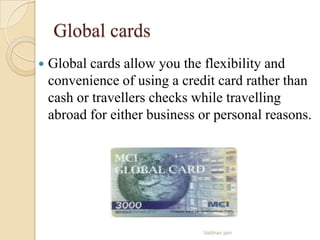
Global cards
 Global cards allow you the flexibility and
convenience of using a credit card rather than
cash or travellers checks while travelling
abroad for either business or personal reasons.
Vaibhav jain
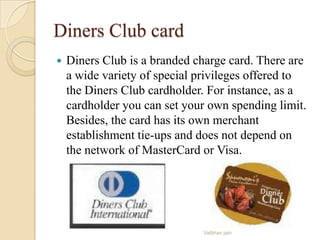
Diners Club card
 Diners Club is a branded charge card. There are
a wide variety of special privileges offered to
the Diners Club cardholder. For instance, as a
cardholder you can set your own spending limit.
Besides, the card has its own merchant
establishment tie-ups and does not depend on
the network of MasterCard or Visa.
Vaibhav jain
Advantages of Plastic Money :
 Purchasing Power
 Time Saving
 Extra Safety
 Credit Limits
 A need of emergencies
 Additional features
Gurpreet Singh
Disadvantages of Plastic Money :
 Shops using other vendors
 Less Global availability
 Worn out Magnetic strip
 Increased Debt and High Interest Rates
 Fraud
 Over Budget
Gurpreet Singh
Comparison with foreign countries.
 India is still lacking in terms of :
- Infrastructure
- Networking
- Professionals
 Lack of support from government.
 Plastic money gets scanned through the tax
scanner due to E-transaction.
Zahabia Africawala
 Implementing rules without corruption.
 Lower literacy rates compared to other
developed and developing countries.
 Educating customers.
 Language barriers breaking the channel of
communication.
Zahabia Africawala
 21st Century, its time for
Liberalisation, Privatisation and Globalisation.
 In banking sector there is a challenge for
Indians in terms of coping up with new
technologies.
 No matter, innovation is the key to success in
any organisation but it doesn’t responds the way
customers should.
 According to Credit Card Management
Consultancy, Indian are still averse to
credit and there has been no change in
mindset.
Zahabia Africawala
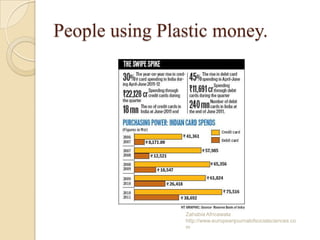
People using Plastic money.
Zahabia Africawala
http://www.europeanjournalofsocialsciences.co
m
http://www.europeanjournalofsocialsciences.com
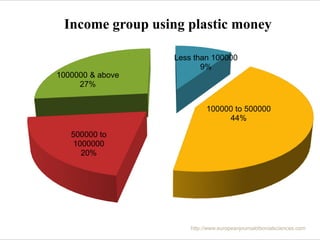
Less than 100000
9%
100000 to 500000
44%
500000 to
1000000
20%
1000000 & above
27%
Income group using plastic money
http://www.europeanjournalofsocialsciences.com
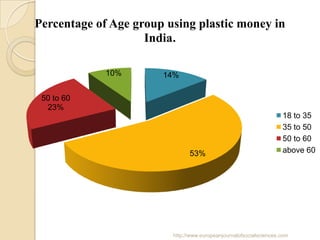
14%
53%
50 to 60
23%
10%
Percentage of Age group using plastic money in
India.
18 to 35
35 to 50
50 to 60
above 60
http://www.europeanjournalofsocialsciences.com
Conclusion
21st Century
banking has become wholly customer-
driven &technology driven by
challenges of competition, rising customer
expectations & shrinking margins, banks
have been using technology to reduce cost
enhance efficiency, productivity &
customer convenience.
Zahabia Africawala

Plastic+money+ 3 .1

  • 1.
    Business Environment  Topic:-Using Plastic Money : Not suitable for Indian mindsets. By:- Vaibhav Jain Gurpreet Singh Zahabia Africawala
  • 2.
    What is plasticmoney ?  The "plastic" portion of this term refers to the plastic construction of credit cards, as opposed to paper and metal of currency.  The "money" portion is an erroneous reference to credit cards as a form of money, which they are not. Vaibhav jain
  • 3.
    Using Plastic Money: Not suitable for Indian mindsets Introduction : •Plastic money or polymer money, made out of plastic, is a new and easier way of paying for goods and services. •It includes debit cards, ATMs, smart cards, etc. Vaibhav jain
  • 4.
    BIRTH OF PLASTICMONEY  Credit cards were invented 60 years back.  After the Second World War, the first plastic charge card was invented.  The Diners’ Club card, Introduced in New York City in 1950, the card allowed Diners’ Club members to eat at 27 restaurants in New York City on credit. Vaibhav jain
  • 5.
    Types of plasticmoney :  Credit cards  Debit cards  Master cards & Visa  Charge cards  Smart cards  Photo cards  Co-branded cards  Global cards  Diners Club cards Vaibhav jain
  • 6.
    Credit Cards  Acredit card is plastic money that is used to pay for the products and services at over 20 millions locations around the world. All you need to do is to produce a card and sign a charge slip to pay for your purchases. Vaibhav jain
  • 7.
  • 8.
    Master cards &Visa  MasterCard and Visa are global non-profit organizations dedicated to promote the growth of the card business across the world. Vaibhav jain
  • 9.
    Charge cards  Acharge card carries all the features of credit cards. However, after using a charge card you will have to pay off the entire amount billed, by the due date . If you fail to do so, you are likely to be considered a defaulter and will usually have to pay up a steep late payment charge. Vaibhav jain
  • 10.
    Smart cards  Aplastic card containing a computer chip and enabling the holder to purchase goods and services, enter restricted areas, access medical, financial, or other records, or perform other operations requiring data stored on the chip. Smart card is currently introduced by BRTS which stands for Bus Rapid Transit Services in Gujarat in India. Vaibhav jain
  • 11.
  • 12.
    Co-branded cards  Co-brandedcards are credit cards issued by card companies that have tied up with a popular brand for the purpose of offering certain exclusive benefits to the consumer. Vaibhav jain
  • 13.
    Global cards  Globalcards allow you the flexibility and convenience of using a credit card rather than cash or travellers checks while travelling abroad for either business or personal reasons. Vaibhav jain
  • 14.
    Diners Club card Diners Club is a branded charge card. There are a wide variety of special privileges offered to the Diners Club cardholder. For instance, as a cardholder you can set your own spending limit. Besides, the card has its own merchant establishment tie-ups and does not depend on the network of MasterCard or Visa. Vaibhav jain
  • 15.
    Advantages of PlasticMoney :  Purchasing Power  Time Saving  Extra Safety  Credit Limits  A need of emergencies  Additional features Gurpreet Singh
  • 16.
    Disadvantages of PlasticMoney :  Shops using other vendors  Less Global availability  Worn out Magnetic strip  Increased Debt and High Interest Rates  Fraud  Over Budget Gurpreet Singh
  • 17.
    Comparison with foreigncountries.  India is still lacking in terms of : - Infrastructure - Networking - Professionals  Lack of support from government.  Plastic money gets scanned through the tax scanner due to E-transaction. Zahabia Africawala
  • 18.
     Implementing ruleswithout corruption.  Lower literacy rates compared to other developed and developing countries.  Educating customers.  Language barriers breaking the channel of communication. Zahabia Africawala
  • 19.
     21st Century,its time for Liberalisation, Privatisation and Globalisation.  In banking sector there is a challenge for Indians in terms of coping up with new technologies.  No matter, innovation is the key to success in any organisation but it doesn’t responds the way customers should.  According to Credit Card Management Consultancy, Indian are still averse to credit and there has been no change in mindset. Zahabia Africawala
  • 20.
    People using Plasticmoney. Zahabia Africawala http://www.europeanjournalofsocialsciences.co m
  • 21.
  • 22.
    Less than 100000 9% 100000to 500000 44% 500000 to 1000000 20% 1000000 & above 27% Income group using plastic money http://www.europeanjournalofsocialsciences.com
  • 23.
    14% 53% 50 to 60 23% 10% Percentageof Age group using plastic money in India. 18 to 35 35 to 50 50 to 60 above 60 http://www.europeanjournalofsocialsciences.com
  • 24.
    Conclusion 21st Century banking hasbecome wholly customer- driven &technology driven by challenges of competition, rising customer expectations & shrinking margins, banks have been using technology to reduce cost enhance efficiency, productivity & customer convenience. Zahabia Africawala

Editor's Notes

  • #22 Source:- europeanjournalofsocialsciences.com
  • #23 Source:- europeanjournalofsocialsciences.com
  • #24 Source:- europeanjournalofsocialsciences.com