Fee based Retail
Financial Services
Fee-based Retail Financial
Services
 The financial institutions derive income by way of
fees instead of interest from these services
 No funds are involved, hence no interest charges
 These services are offered to retail customers
 They only facilitate or mediate to create assets.
2
Types of Services
 Personal Tax Counseling
 Credit Card, Debit Card and Smart Cards
 Barter Cards
 ATMs
 Foreign Inward Remittance
 Foreign Outward Remittance
 Fund Transfer Facilities
 Safe Deposit Locker
 Safe Custody Facilities
 Certifications
 Portfolio Management
 Bankcassurance
3
Services
 Tax advice
 Preparation of tax return and filing
 Attending to hearing representing the
assessee
 Filing necessary clarification with the income
tax department
 Helping the assessee to avail of tax benefits
4
Credit Cards
 The term credit originated about 3000 years ago
 The first credit card was the Charge Card launched by Diners
Club in 1950 in USA
 In 1970, the magnetic strip was introduced on the credit
cards
 Credit cards have three functions:
 A means of paying for goods and services;
 A means of obtaining cash;
 A source of revolving credit.
 At present, Visa and Mastercard are the organizations issuing
credit cards.
5
Credit Cards
 Types of cards:
 Bank-issued cards
 Charge cards(American Express & Diners)
 JCB Cards(Japan Credit Bureau)
 Gold cards
 Co-branded cards
 Affinity cards(5000 people to 2 million)
 Store cards
 Electronic Debit Cards
 Telephone cards
 Fuel cards
 Add-on-cards 6
Credit Cards
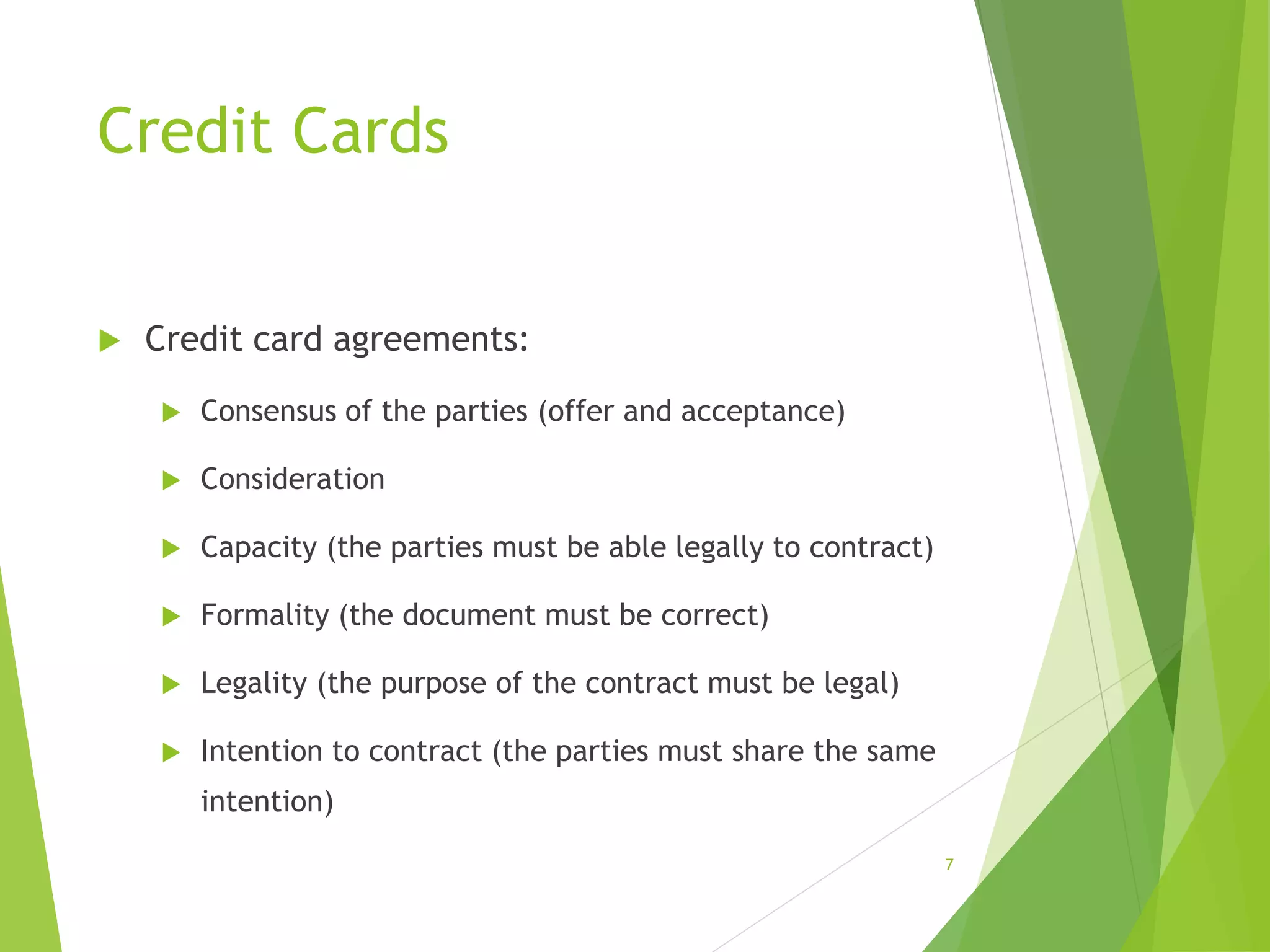
 Credit card agreements:
 Consensus of the parties (offer and acceptance)
 Consideration
 Capacity (the parties must be able legally to contract)
 Formality (the document must be correct)
 Legality (the purpose of the contract must be legal)
 Intention to contract (the parties must share the same
intention)
7
Credit Cards
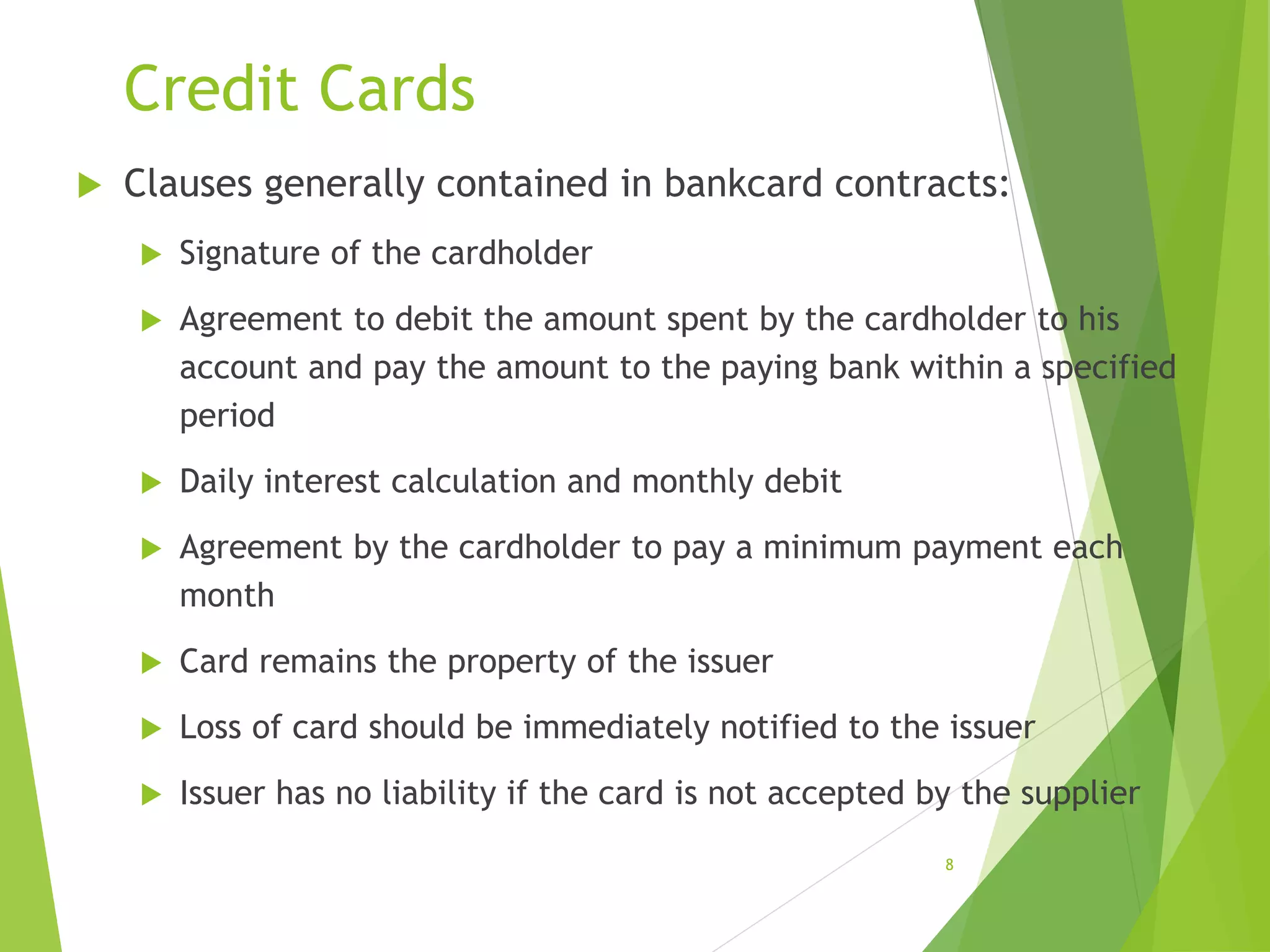
 Clauses generally contained in bankcard contracts:
 Signature of the cardholder
 Agreement to debit the amount spent by the cardholder to his
account and pay the amount to the paying bank within a specified
period
 Daily interest calculation and monthly debit
 Agreement by the cardholder to pay a minimum payment each
month
 Card remains the property of the issuer
 Loss of card should be immediately notified to the issuer
 Issuer has no liability if the card is not accepted by the supplier
8
Debit Card
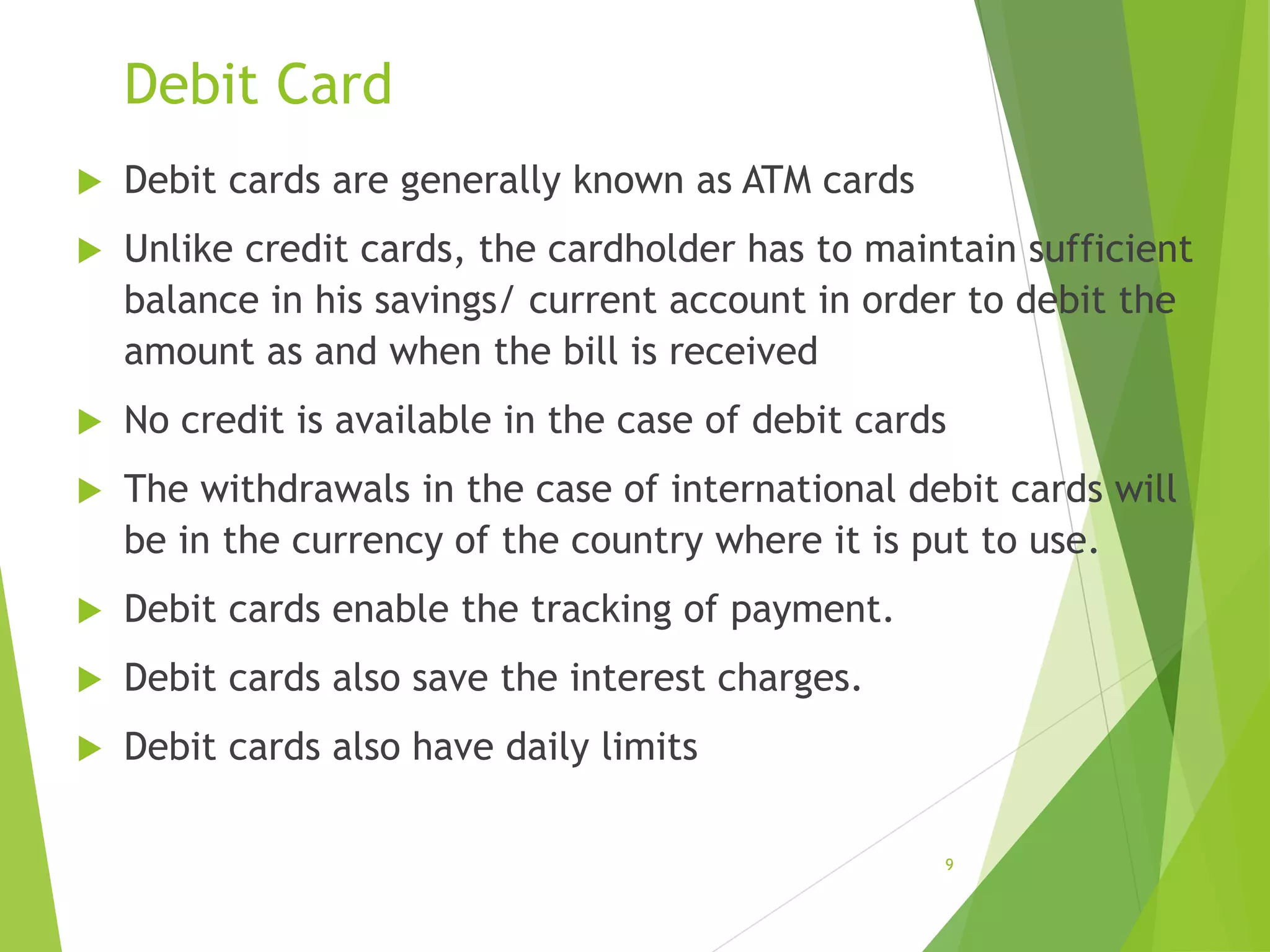
 Debit cards are generally known as ATM cards
 Unlike credit cards, the cardholder has to maintain sufficient
balance in his savings/ current account in order to debit the
amount as and when the bill is received
 No credit is available in the case of debit cards
 The withdrawals in the case of international debit cards will
be in the currency of the country where it is put to use.
 Debit cards enable the tracking of payment.
 Debit cards also save the interest charges.
 Debit cards also have daily limits
9
Debit Card
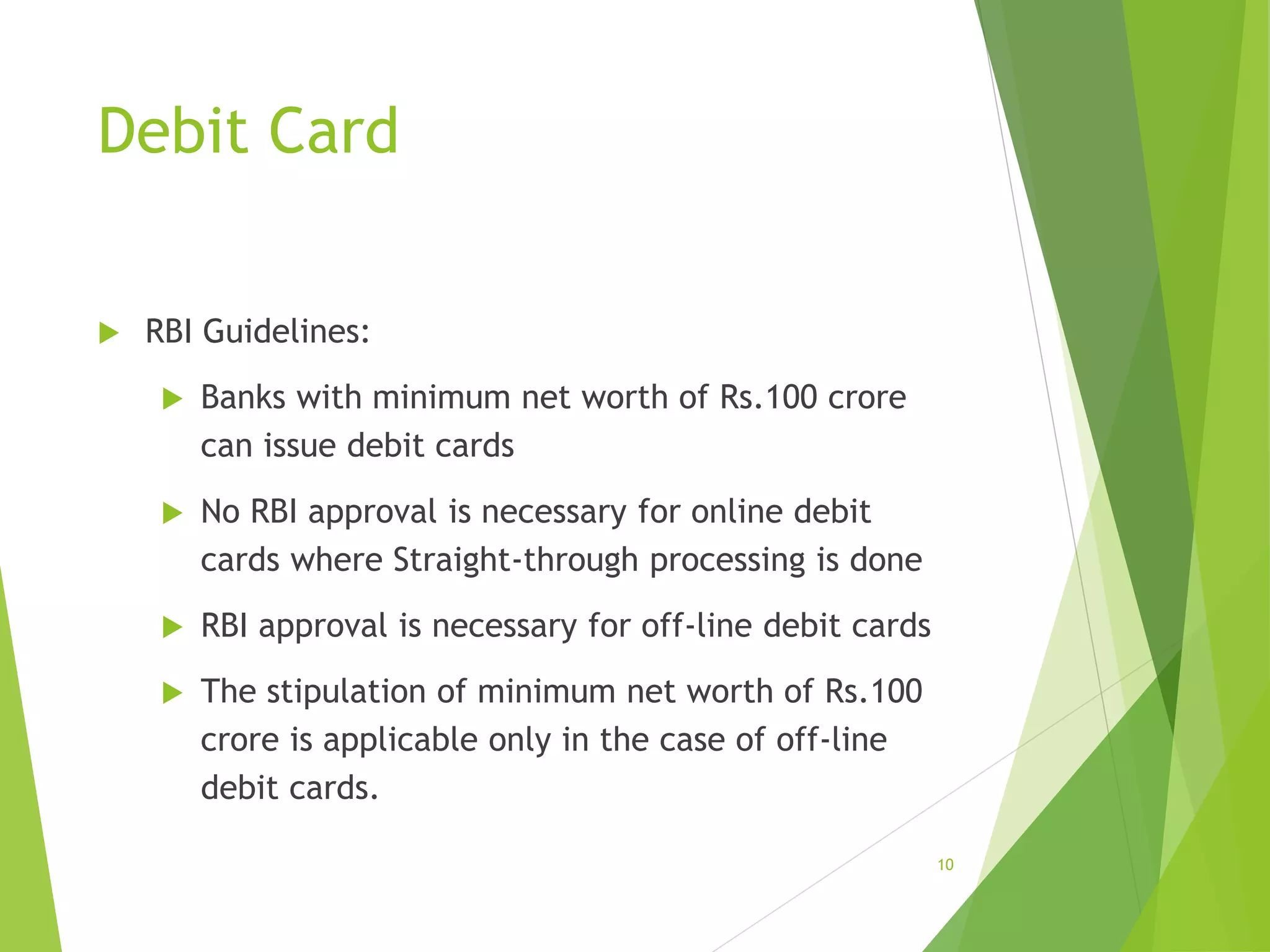
 RBI Guidelines:
 Banks with minimum net worth of Rs.100 crore
can issue debit cards
 No RBI approval is necessary for online debit
cards where Straight-through processing is done
 RBI approval is necessary for off-line debit cards
 The stipulation of minimum net worth of Rs.100
crore is applicable only in the case of off-line
debit cards.
10
Smart Cards
 Plastic card embedded with microchip
 Data can be stored
 Unlike credit/debit cards, the credit balance is
transferred to the card
 The merchant establishment can debit the
payment to the card using a chip reader
 The balance will be reduced as and when
payments are effected
 Recharge is possible through card encoders
11
Smart Cards
 Petro cards/ Loyalty cards are smart cards
 Multiple currencies carried in a smart card
 Smart card enables multiple uses through a single card
 Smart card is extensively used for payment of utilities
 Smart cards offer confidentiality and security
12
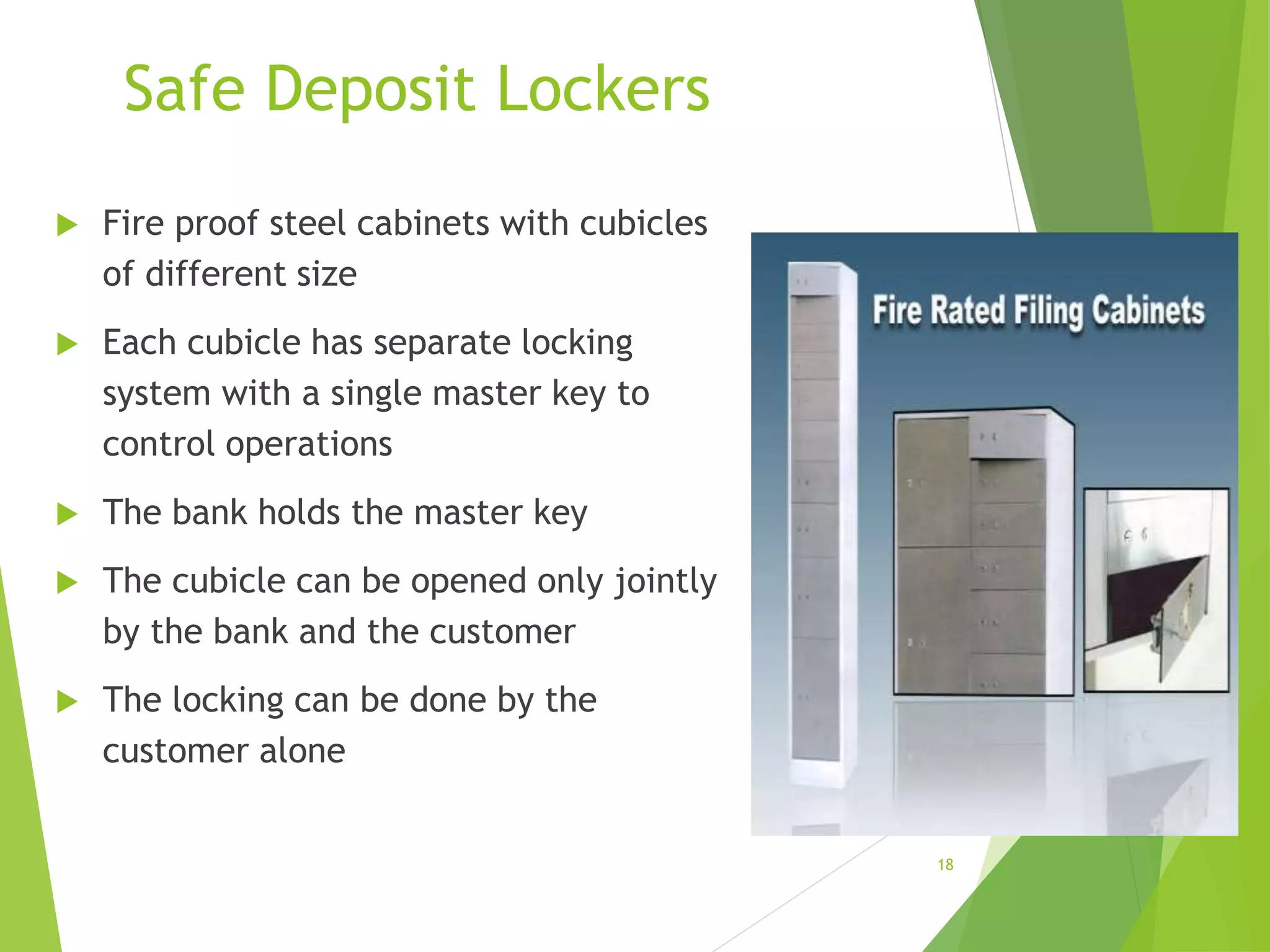
Barter Cards
 Cards issued for exchange of
commodities
 Barter Card International (BCI) is
providing the Barter Card service
 BCI was established in Australia in 1991
and in UK in 1996
 Medium of exchange is Trading Pound
 Barter card acts as a clearing house
 Barter card is operated through
franchisees who get a commission
 Barter card system is not common in
India
13
ATM Features
 Off-site banking
 Customer can operate his account from any where at any time
 No need of visiting bank branch for drawing cash or depositing cheques
and cash
 The ATM operations are controlled through ATM cards
 ATM card is a debit card containing a PIN code and a security password
 Less risk and lowest cost
 First ATM was installed in Mumbai in 1993 by Citi Bank
 Now ATM with biometric features are available.
 ATMs are installed in public places like Railway Stations, Airports,
Universities, Bus terminals etc.
14
Benefits of ATM
 Benefit to Customers
 Customer can access to his account from any place
 ATM works 24 hours on 7 days
 Convenience
 Cash withdrawal from any branch
 Benefit to Bank
 Innovative, secure and competitive
 Reduce of rush of customers at the counter
 Immediate inter-branch reconciliation
 Value addition to customers
15
Demerits
 Less personal interaction with bank staff
 ATMs are also not free from frauds. Mass withdrawal
of cash from stolen ATMs are now common
 Banks charge fee for withdrawal using another bank’s
card
 Statement for the full month cannot be extracted
 In India, maintaining ATM is costly on account of
security reasons.
16
Safe Custody-Type of
Services
 Banks generally offer the following types of safe
custody facilities:
 Safe deposit lockers
 Safe custody of valuables
 They charge commission for this service
 The advantage of this service that the asset will be safe
in the bank’s premises
 However, banks do not guarantee the safety of the
contents of the packets entrusted to them for safe custody
 Generally these facilities are offered to the customers
whom they know well
17
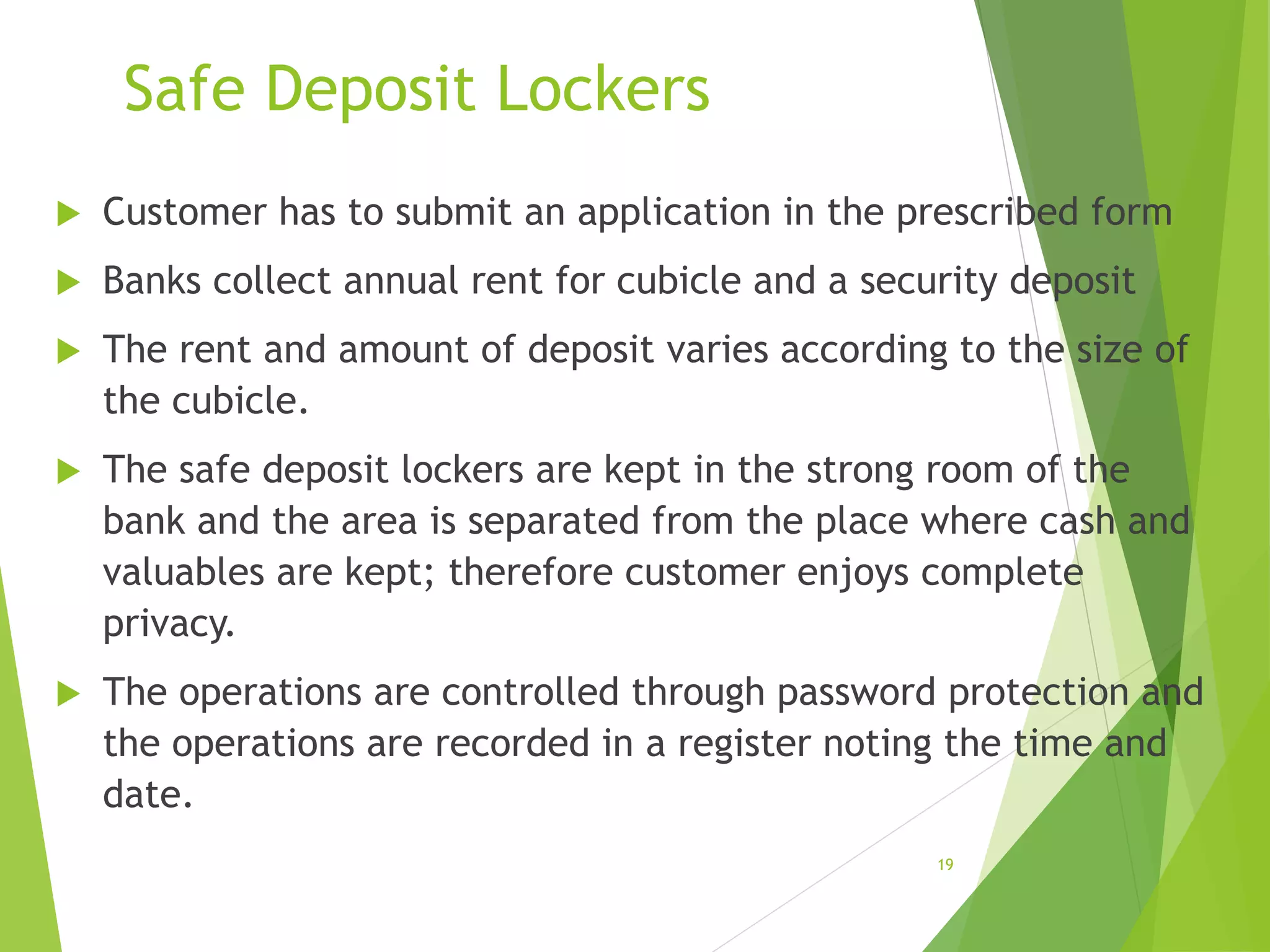
Safe Deposit Lockers
 Fire proof steel cabinets with cubicles
of different size
 Each cubicle has separate locking
system with a single master key to
control operations
 The bank holds the master key
 The cubicle can be opened only jointly
by the bank and the customer
 The locking can be done by the
customer alone
18
Safe Deposit Lockers
 Customer has to submit an application in the prescribed form
 Banks collect annual rent for cubicle and a security deposit
 The rent and amount of deposit varies according to the size of
the cubicle.
 The safe deposit lockers are kept in the strong room of the
bank and the area is separated from the place where cash and
valuables are kept; therefore customer enjoys complete
privacy.
 The operations are controlled through password protection and
the operations are recorded in a register noting the time and
date.
19
Safe Deposit Lockers
 If the key is lost the customer has to meet the cost of
replacement of the lock.
 Banks break open the cubicles which are remaining inoperative
for a long time after issuing notice to the customer
 The breaking open operation is done in the presence of two
witnesses and the contents in the cubicle are listed and certified
by the witnesses
 Using safe depositor locker for keeping drugs, explosives, stolen
articles etc. are prohibited and punishable under the law.
 Nomination facility is available for safe deposit lockers
20
Safe Custody Facility
 Banks undertake to keep under their safe custody
articles such as land documents, share certificates,
deposit receipts, insurance policies etc.
 The articles are entered in the safe custody register
and a receipt is issued.
 The receipt has to be produced for release of the
articles
 Banks charge fees for safe custody of articles
 The facility is offered to only customers known to
the bank.
21
RBI Guidelines
 RBI has issued the following guidelines regarding safe
deposit lockers/ safe custody of articles by banks:
 Banks are required to periodically review their operational systems
and procedures with regard to access to lockers/ return of safe
custody articles belonging to the deceases .
 Banks are required to give wide publicity and provide guidance to
locker hirers/ depositors of safe custody articles on the benefits of
nomination
 Such details should also be placed in the website of the bank.
22

Fee_based_financial_services.pptx

  • 1.
  • 2.
    Fee-based Retail Financial Services The financial institutions derive income by way of fees instead of interest from these services  No funds are involved, hence no interest charges  These services are offered to retail customers  They only facilitate or mediate to create assets. 2
  • 3.
    Types of Services Personal Tax Counseling  Credit Card, Debit Card and Smart Cards  Barter Cards  ATMs  Foreign Inward Remittance  Foreign Outward Remittance  Fund Transfer Facilities  Safe Deposit Locker  Safe Custody Facilities  Certifications  Portfolio Management  Bankcassurance 3
  • 4.
    Services  Tax advice Preparation of tax return and filing  Attending to hearing representing the assessee  Filing necessary clarification with the income tax department  Helping the assessee to avail of tax benefits 4
  • 5.
    Credit Cards  Theterm credit originated about 3000 years ago  The first credit card was the Charge Card launched by Diners Club in 1950 in USA  In 1970, the magnetic strip was introduced on the credit cards  Credit cards have three functions:  A means of paying for goods and services;  A means of obtaining cash;  A source of revolving credit.  At present, Visa and Mastercard are the organizations issuing credit cards. 5
  • 6.
    Credit Cards  Typesof cards:  Bank-issued cards  Charge cards(American Express & Diners)  JCB Cards(Japan Credit Bureau)  Gold cards  Co-branded cards  Affinity cards(5000 people to 2 million)  Store cards  Electronic Debit Cards  Telephone cards  Fuel cards  Add-on-cards 6
  • 7.
    Credit Cards  Creditcard agreements:  Consensus of the parties (offer and acceptance)  Consideration  Capacity (the parties must be able legally to contract)  Formality (the document must be correct)  Legality (the purpose of the contract must be legal)  Intention to contract (the parties must share the same intention) 7
  • 8.
    Credit Cards  Clausesgenerally contained in bankcard contracts:  Signature of the cardholder  Agreement to debit the amount spent by the cardholder to his account and pay the amount to the paying bank within a specified period  Daily interest calculation and monthly debit  Agreement by the cardholder to pay a minimum payment each month  Card remains the property of the issuer  Loss of card should be immediately notified to the issuer  Issuer has no liability if the card is not accepted by the supplier 8
  • 9.
    Debit Card  Debitcards are generally known as ATM cards  Unlike credit cards, the cardholder has to maintain sufficient balance in his savings/ current account in order to debit the amount as and when the bill is received  No credit is available in the case of debit cards  The withdrawals in the case of international debit cards will be in the currency of the country where it is put to use.  Debit cards enable the tracking of payment.  Debit cards also save the interest charges.  Debit cards also have daily limits 9
  • 10.
    Debit Card  RBIGuidelines:  Banks with minimum net worth of Rs.100 crore can issue debit cards  No RBI approval is necessary for online debit cards where Straight-through processing is done  RBI approval is necessary for off-line debit cards  The stipulation of minimum net worth of Rs.100 crore is applicable only in the case of off-line debit cards. 10
  • 11.
    Smart Cards  Plasticcard embedded with microchip  Data can be stored  Unlike credit/debit cards, the credit balance is transferred to the card  The merchant establishment can debit the payment to the card using a chip reader  The balance will be reduced as and when payments are effected  Recharge is possible through card encoders 11
  • 12.
    Smart Cards  Petrocards/ Loyalty cards are smart cards  Multiple currencies carried in a smart card  Smart card enables multiple uses through a single card  Smart card is extensively used for payment of utilities  Smart cards offer confidentiality and security 12
  • 13.
    Barter Cards  Cardsissued for exchange of commodities  Barter Card International (BCI) is providing the Barter Card service  BCI was established in Australia in 1991 and in UK in 1996  Medium of exchange is Trading Pound  Barter card acts as a clearing house  Barter card is operated through franchisees who get a commission  Barter card system is not common in India 13
  • 14.
    ATM Features  Off-sitebanking  Customer can operate his account from any where at any time  No need of visiting bank branch for drawing cash or depositing cheques and cash  The ATM operations are controlled through ATM cards  ATM card is a debit card containing a PIN code and a security password  Less risk and lowest cost  First ATM was installed in Mumbai in 1993 by Citi Bank  Now ATM with biometric features are available.  ATMs are installed in public places like Railway Stations, Airports, Universities, Bus terminals etc. 14
  • 15.
    Benefits of ATM Benefit to Customers  Customer can access to his account from any place  ATM works 24 hours on 7 days  Convenience  Cash withdrawal from any branch  Benefit to Bank  Innovative, secure and competitive  Reduce of rush of customers at the counter  Immediate inter-branch reconciliation  Value addition to customers 15
  • 16.
    Demerits  Less personalinteraction with bank staff  ATMs are also not free from frauds. Mass withdrawal of cash from stolen ATMs are now common  Banks charge fee for withdrawal using another bank’s card  Statement for the full month cannot be extracted  In India, maintaining ATM is costly on account of security reasons. 16
  • 17.
    Safe Custody-Type of Services Banks generally offer the following types of safe custody facilities:  Safe deposit lockers  Safe custody of valuables  They charge commission for this service  The advantage of this service that the asset will be safe in the bank’s premises  However, banks do not guarantee the safety of the contents of the packets entrusted to them for safe custody  Generally these facilities are offered to the customers whom they know well 17
  • 18.
    Safe Deposit Lockers Fire proof steel cabinets with cubicles of different size  Each cubicle has separate locking system with a single master key to control operations  The bank holds the master key  The cubicle can be opened only jointly by the bank and the customer  The locking can be done by the customer alone 18
  • 19.
    Safe Deposit Lockers Customer has to submit an application in the prescribed form  Banks collect annual rent for cubicle and a security deposit  The rent and amount of deposit varies according to the size of the cubicle.  The safe deposit lockers are kept in the strong room of the bank and the area is separated from the place where cash and valuables are kept; therefore customer enjoys complete privacy.  The operations are controlled through password protection and the operations are recorded in a register noting the time and date. 19
  • 20.
    Safe Deposit Lockers If the key is lost the customer has to meet the cost of replacement of the lock.  Banks break open the cubicles which are remaining inoperative for a long time after issuing notice to the customer  The breaking open operation is done in the presence of two witnesses and the contents in the cubicle are listed and certified by the witnesses  Using safe depositor locker for keeping drugs, explosives, stolen articles etc. are prohibited and punishable under the law.  Nomination facility is available for safe deposit lockers 20
  • 21.
    Safe Custody Facility Banks undertake to keep under their safe custody articles such as land documents, share certificates, deposit receipts, insurance policies etc.  The articles are entered in the safe custody register and a receipt is issued.  The receipt has to be produced for release of the articles  Banks charge fees for safe custody of articles  The facility is offered to only customers known to the bank. 21
  • 22.
    RBI Guidelines  RBIhas issued the following guidelines regarding safe deposit lockers/ safe custody of articles by banks:  Banks are required to periodically review their operational systems and procedures with regard to access to lockers/ return of safe custody articles belonging to the deceases .  Banks are required to give wide publicity and provide guidance to locker hirers/ depositors of safe custody articles on the benefits of nomination  Such details should also be placed in the website of the bank. 22