Presentation on
Debit
And Credit Card
CSE 413
Group – A
Bangladesh University
Submitted by :
Md. Sadiqur Rahman Id: 201531043092
Abu Jaher Rabbe (Mahir) Id: 201531043138
Submitted to :
Khan Md. Hasib
Lecturer,
Department of Computer Science and Engineering,
Bangladesh University
Debit Card
Key Points
• What is Debit Card ?
• Short history of Debit Card
• Structure of a Debit Card
• Types of debit card systems
• How do debit cards work?
• Benefits or advantages of Debit Card
• Disadvantages of Debit Card
What is Debit Card ?
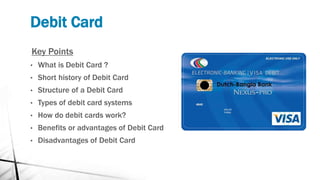
• A Debit Card (also known as a Bank Card, Plastic Card or Check Card)
is a plastic payment card that can be used instead of cash when
making purchases.
• It is similar to a credit card but unlike a credit card, the money comes
directly from the user's bank account when performing a transaction.
• It can be called an electronic check, as the funds are withdrawn
directly from either the bank account, or from the remaining balance
on the card.
Short history of Debit card
Debit Card
• The first debit card may have hit the market as early as 1966
• The Bank of Delaware (USA) first piloted the card
• It started to be popular In '90s when more and more ATMs are started
• In 1990, debit cards were used in about 300 million transactions.
• In 2009, prepaid and debit cards were used in 37.6 billion transactions.
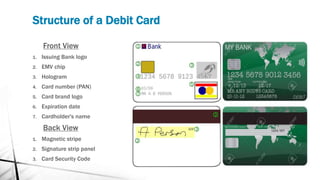
Structure of a Debit Card
Front View
1. Issuing Bank logo
2. EMV chip
3. Hologram
4. Card number (PAN)
5. Card brand logo
6. Expiration date
7. Cardholder's name
Back View
1. Magnetic stripe
2. Signature strip panel
3. Card Security Code
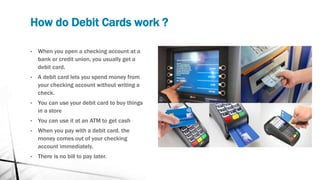
How do Debit Cards work ?
• When you open a checking account at a
bank or credit union, you usually get a
debit card.
• A debit card lets you spend money from
your checking account without writing a
check.
• You can use your debit card to buy things
in a store
• You can use it at an ATM to get cash
• When you pay with a debit card, the
money comes out of your checking
account immediately.
• There is no bill to pay later.
Types of debit card systems
There are three ways of debit card transactions
1. EFTPOS (also known as online debit or PIN debit)
2. Offline debit (also known as signature debit)
3. Electronic Purse Card System
Online debit system
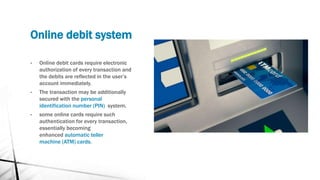
• Online debit cards require electronic
authorization of every transaction and
the debits are reflected in the user’s
account immediately.
• The transaction may be additionally
secured with the personal
identification number (PIN) system.
• some online cards require such
authentication for every transaction,
essentially becoming
enhanced automatic teller
machine (ATM) cards.
Offline Debit system
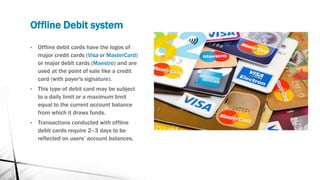
• Offline debit cards have the logos of
major credit cards (Visa or MasterCard)
or major debit cards (Maestro) and are
used at the point of sale like a credit
card (with payer's signature).
• This type of debit card may be subject
to a daily limit or a maximum limit
equal to the current account balance
from which it draws funds.
• Transactions conducted with offline
debit cards require 2–3 days to be
reflected on users’ account balances.
Electronic purse card
system
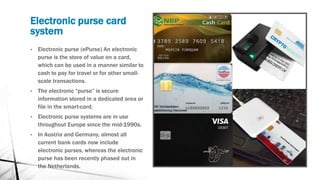
• Electronic purse (ePurse) An electronic
purse is the store of value on a card,
which can be used in a manner similar to
cash to pay for travel or for other small-
scale transactions.
• The electronic “purse” is secure
information stored in a dedicated area or
file in the smart-card.
• Electronic purse systems are in use
throughout Europe since the mid-1990s.
• In Austria and Germany, almost all
current bank cards now include
electronic purses, whereas the electronic
purse has been recently phased out in
the Netherlands.
Advantages of Debit Card
• Able to reduce the risk of getting in to credit card debt, by ensuring you’re
spending your own money, and not over-extending yourself by getting a
credit card balance you may not be able to repay.
• Any purchase that you make on your card is covered and protected by
VISA’s Zero Liability policy .
• It’s a lot more convenient, easier and safer than carrying cash or using your
EFTPOS card.
• Access your transaction records for your card online instantly through
internet banking.
• You don’t need a good credit history. When applying for a VISA Debit Card,
the banks don’t do a credit check, making the application process fast (and
painless!)
Disadvantages of Debit Card
• If the card provider offers an insecure website for letting you check the
card's balance, this could give an attacker access to the card information.
• If you lose the card, and have not somehow registered it, you likely lose the
money.
• If a provider has technical issues, the money might not be accessible when
you need it.
• Some companies' payment systems do not appear to accept prepaid debit
cards.
• And there is a risk that prolific use of prepaid debit cards could lead data
provider companies to miscategorize you in unfortunate ways.
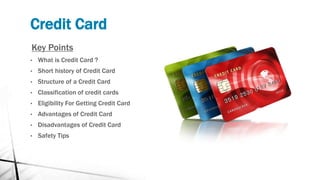
Credit Card
Key Points
• What is Credit Card ?
• Short history of Credit Card
• Structure of a Credit Card
• Classification of credit cards
• Eligibility For Getting Credit Card
• Advantages of Credit Card
• Disadvantages of Credit Card
• Safety Tips
What is Credit Card ?
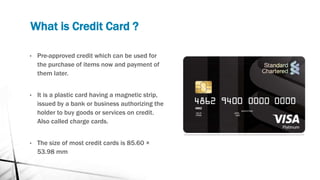
• Pre-approved credit which can be used for
the purchase of items now and payment of
them later.
• It is a plastic card having a magnetic strip,
issued by a bank or business authorizing the
holder to buy goods or services on credit.
Also called charge cards.
• The size of most credit cards is 85.60 ×
53.98 mm
Short history of Credit card
Credit Card
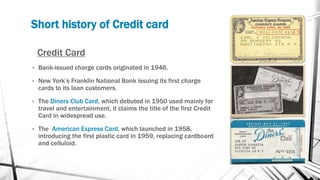
• Bank-issued charge cards originated in 1946.
• New York’s Franklin National Bank issuing its first charge
cards to its loan customers.
• The Diners Club Card, which debuted in 1950 used mainly for
travel and entertainment, it claims the title of the first Credit
Card in widespread use.
• The American Express Card, which launched in 1958,
introducing the first plastic card in 1959, replacing cardboard
and celluloid.
Short history of Credit card
Credit Card
• Bank of America was first out of the gate in 1958. In 1966,
BankAmericard went national to become the nation’s first
licensed general-purpose credit card.
• Also in 1966, a group of California banks formed the Interbank
Card Association (ITC), which would soon issue the nation’s
second major bank card, MasterCard.
• In 1976, BankAmericard, Barclaycard, Carte Bleue, Chargex,
Sumitomo Card, and all other licensees united under the new
name, VISA.
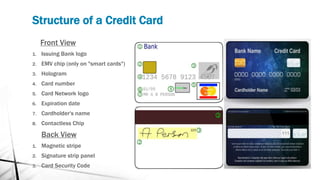
Structure of a Credit Card
Front View
1. Issuing Bank logo
2. EMV chip (only on "smart cards")
3. Hologram
4. Card number
5. Card Network logo
6. Expiration date
7. Cardholder's name
8. Contactless Chip
Back View
1. Magnetic stripe
2. Signature strip panel
3. Card Security Code
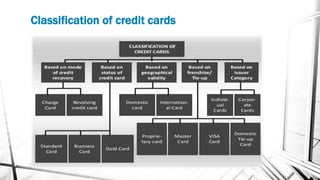
Classification of credit cards
Eligibility for getting Credit Card
• Person should have a savings current account in the bank.
• His assets and liabilities on a particular date are reported to
bank.
• A statement of annual or monthly income.
• He is considered credit worthy up to certain limit depending
upon his income, assets and expenditure.
Advantages of Credit Card
To Cardholders :
• Simple, convenient and can be substituted for cash
• Convenient method of payment
• He need not approach a bank for taking credit
• Credit cards issued by leading banks are acceptable in many countries
• Holders can withdraw cash from any branch of major banks worldwide.
• Issuer of card provides 24 hrs customer helpline available across the world
in case of any emergency.
Advantages of Credit Card
To Merchants/ Shopkeepers :
• Guaranteed payment
• Lessens the security risk of holding the cash
• Overseas visitors may purchase more, providing new market for retailer
To credit card companies/ Banks :
• Source of revenue
- Joining fee
- card renew fee
- services charges from retailers
- Interest charged to customer
Disadvantage of Credit Card
To cardholders :
• Loss or stealing of card
To Merchants/ Shopkeepers :
• Retailers are required to pay a certain fee and service
charges at an agreed percentage of their credit card
sales.
To credit card companies :
• Risk of bad debt
• Risk of fraud
Safety Tips
• Sign card with signature
• Do not leave cards lying around
• Close unused accounts in writing and by phone, then cut up the card
• Do not give out account number unless making purchases
• Keep a list of all cards, account numbers, and phone numbers separate
from cards
• Report lost or stolen cards promptly
Thank You . . .

Presentation on Debit and credit card

  • 1.
    Presentation on Debit And CreditCard CSE 413 Group – A Bangladesh University
  • 2.
    Submitted by : Md.Sadiqur Rahman Id: 201531043092 Abu Jaher Rabbe (Mahir) Id: 201531043138 Submitted to : Khan Md. Hasib Lecturer, Department of Computer Science and Engineering, Bangladesh University
  • 3.
    Debit Card Key Points •What is Debit Card ? • Short history of Debit Card • Structure of a Debit Card • Types of debit card systems • How do debit cards work? • Benefits or advantages of Debit Card • Disadvantages of Debit Card
  • 4.
    What is DebitCard ? • A Debit Card (also known as a Bank Card, Plastic Card or Check Card) is a plastic payment card that can be used instead of cash when making purchases. • It is similar to a credit card but unlike a credit card, the money comes directly from the user's bank account when performing a transaction. • It can be called an electronic check, as the funds are withdrawn directly from either the bank account, or from the remaining balance on the card.
  • 5.
    Short history ofDebit card Debit Card • The first debit card may have hit the market as early as 1966 • The Bank of Delaware (USA) first piloted the card • It started to be popular In '90s when more and more ATMs are started • In 1990, debit cards were used in about 300 million transactions. • In 2009, prepaid and debit cards were used in 37.6 billion transactions.
  • 6.
    Structure of aDebit Card Front View 1. Issuing Bank logo 2. EMV chip 3. Hologram 4. Card number (PAN) 5. Card brand logo 6. Expiration date 7. Cardholder's name Back View 1. Magnetic stripe 2. Signature strip panel 3. Card Security Code
  • 7.
    How do DebitCards work ? • When you open a checking account at a bank or credit union, you usually get a debit card. • A debit card lets you spend money from your checking account without writing a check. • You can use your debit card to buy things in a store • You can use it at an ATM to get cash • When you pay with a debit card, the money comes out of your checking account immediately. • There is no bill to pay later.
  • 8.
    Types of debitcard systems There are three ways of debit card transactions 1. EFTPOS (also known as online debit or PIN debit) 2. Offline debit (also known as signature debit) 3. Electronic Purse Card System
  • 9.
    Online debit system •Online debit cards require electronic authorization of every transaction and the debits are reflected in the user’s account immediately. • The transaction may be additionally secured with the personal identification number (PIN) system. • some online cards require such authentication for every transaction, essentially becoming enhanced automatic teller machine (ATM) cards.
  • 10.
    Offline Debit system •Offline debit cards have the logos of major credit cards (Visa or MasterCard) or major debit cards (Maestro) and are used at the point of sale like a credit card (with payer's signature). • This type of debit card may be subject to a daily limit or a maximum limit equal to the current account balance from which it draws funds. • Transactions conducted with offline debit cards require 2–3 days to be reflected on users’ account balances.
  • 11.
    Electronic purse card system •Electronic purse (ePurse) An electronic purse is the store of value on a card, which can be used in a manner similar to cash to pay for travel or for other small- scale transactions. • The electronic “purse” is secure information stored in a dedicated area or file in the smart-card. • Electronic purse systems are in use throughout Europe since the mid-1990s. • In Austria and Germany, almost all current bank cards now include electronic purses, whereas the electronic purse has been recently phased out in the Netherlands.
  • 12.
    Advantages of DebitCard • Able to reduce the risk of getting in to credit card debt, by ensuring you’re spending your own money, and not over-extending yourself by getting a credit card balance you may not be able to repay. • Any purchase that you make on your card is covered and protected by VISA’s Zero Liability policy . • It’s a lot more convenient, easier and safer than carrying cash or using your EFTPOS card. • Access your transaction records for your card online instantly through internet banking. • You don’t need a good credit history. When applying for a VISA Debit Card, the banks don’t do a credit check, making the application process fast (and painless!)
  • 13.
    Disadvantages of DebitCard • If the card provider offers an insecure website for letting you check the card's balance, this could give an attacker access to the card information. • If you lose the card, and have not somehow registered it, you likely lose the money. • If a provider has technical issues, the money might not be accessible when you need it. • Some companies' payment systems do not appear to accept prepaid debit cards. • And there is a risk that prolific use of prepaid debit cards could lead data provider companies to miscategorize you in unfortunate ways.
  • 14.
    Credit Card Key Points •What is Credit Card ? • Short history of Credit Card • Structure of a Credit Card • Classification of credit cards • Eligibility For Getting Credit Card • Advantages of Credit Card • Disadvantages of Credit Card • Safety Tips
  • 15.
    What is CreditCard ? • Pre-approved credit which can be used for the purchase of items now and payment of them later. • It is a plastic card having a magnetic strip, issued by a bank or business authorizing the holder to buy goods or services on credit. Also called charge cards. • The size of most credit cards is 85.60 × 53.98 mm
  • 16.
    Short history ofCredit card Credit Card • Bank-issued charge cards originated in 1946. • New York’s Franklin National Bank issuing its first charge cards to its loan customers. • The Diners Club Card, which debuted in 1950 used mainly for travel and entertainment, it claims the title of the first Credit Card in widespread use. • The American Express Card, which launched in 1958, introducing the first plastic card in 1959, replacing cardboard and celluloid.
  • 17.
    Short history ofCredit card Credit Card • Bank of America was first out of the gate in 1958. In 1966, BankAmericard went national to become the nation’s first licensed general-purpose credit card. • Also in 1966, a group of California banks formed the Interbank Card Association (ITC), which would soon issue the nation’s second major bank card, MasterCard. • In 1976, BankAmericard, Barclaycard, Carte Bleue, Chargex, Sumitomo Card, and all other licensees united under the new name, VISA.
  • 18.
    Structure of aCredit Card Front View 1. Issuing Bank logo 2. EMV chip (only on "smart cards") 3. Hologram 4. Card number 5. Card Network logo 6. Expiration date 7. Cardholder's name 8. Contactless Chip Back View 1. Magnetic stripe 2. Signature strip panel 3. Card Security Code
  • 19.
  • 20.
    Eligibility for gettingCredit Card • Person should have a savings current account in the bank. • His assets and liabilities on a particular date are reported to bank. • A statement of annual or monthly income. • He is considered credit worthy up to certain limit depending upon his income, assets and expenditure.
  • 21.
    Advantages of CreditCard To Cardholders : • Simple, convenient and can be substituted for cash • Convenient method of payment • He need not approach a bank for taking credit • Credit cards issued by leading banks are acceptable in many countries • Holders can withdraw cash from any branch of major banks worldwide. • Issuer of card provides 24 hrs customer helpline available across the world in case of any emergency.
  • 22.
    Advantages of CreditCard To Merchants/ Shopkeepers : • Guaranteed payment • Lessens the security risk of holding the cash • Overseas visitors may purchase more, providing new market for retailer To credit card companies/ Banks : • Source of revenue - Joining fee - card renew fee - services charges from retailers - Interest charged to customer
  • 23.
    Disadvantage of CreditCard To cardholders : • Loss or stealing of card To Merchants/ Shopkeepers : • Retailers are required to pay a certain fee and service charges at an agreed percentage of their credit card sales. To credit card companies : • Risk of bad debt • Risk of fraud
  • 24.
    Safety Tips • Signcard with signature • Do not leave cards lying around • Close unused accounts in writing and by phone, then cut up the card • Do not give out account number unless making purchases • Keep a list of all cards, account numbers, and phone numbers separate from cards • Report lost or stolen cards promptly
  • 25.