Colloids
Presenter - Dr Harshit Jain
Moderator - Dr Akanksha Dutt
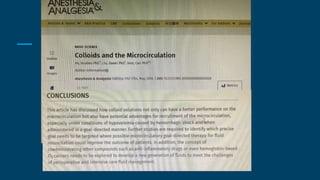
Colloid is defined as large molecules or ultramicroscopic particles of a
homogeneous noncrystalline substance dispersed in a second substance,
typically isotonic saline, or a balanced crystalloid. These particles cannot be
separated out by filtration or centrifugation.
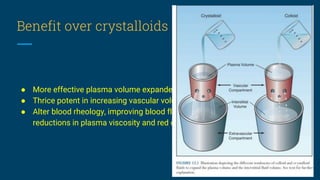
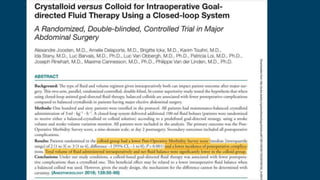
Benefit over crystalloids
â—Ź More effective plasma volume expander
â—Ź Thrice potent in increasing vascular volume & supporting Cardiac Output.
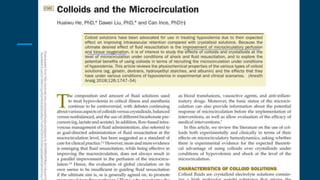
â—Ź Alter blood rheology, improving blood flow by hemodilution which leads to
reductions in plasma viscosity and red cell aggregation.
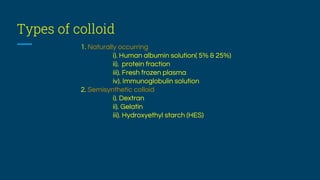
Types of colloid
1. Naturally occurring
i). Human albumin solution( 5% & 25%)
ii). protein fraction
iii). Fresh frozen plasma
iv). Immunoglobulin solution
2. Semisynthetic colloid
i). Dextran
ii). Gelatin
iii). Hydroxyethyl starch (HES)
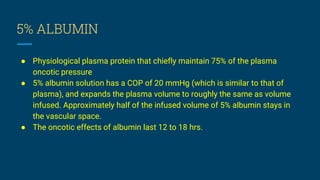
5% ALBUMIN
â—Ź Physiological plasma protein that chiefly maintain 75% of the plasma
oncotic pressure
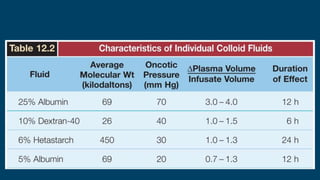
â—Ź 5% albumin solution has a COP of 20 mmHg (which is similar to that of
plasma), and expands the plasma volume to roughly the same as volume
infused. Approximately half of the infused volume of 5% albumin stays in
the vascular space.
â—Ź The oncotic effects of albumin last 12 to 18 hrs.
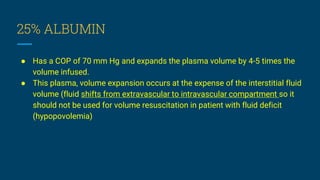
25% ALBUMIN
â—Ź Has a COP of 70 mm Hg and expands the plasma volume by 4-5 times the
volume infused.
â—Ź This plasma, volume expansion occurs at the expense of the interstitial fluid
volume (fluid shifts from extravascular to intravascular compartment so it
should not be used for volume resuscitation in patient with fluid deficit
(hypopovolemia)
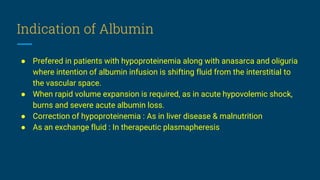
Indication of Albumin
â—Ź Prefered in patients with hypoproteinemia along with anasarca and oliguria
where intention of albumin infusion is shifting fluid from the interstitial to
the vascular space.
â—Ź When rapid volume expansion is required, as in acute hypovolemic shock,
burns and severe acute albumin loss.
â—Ź Correction of hypoproteinemia : As in liver disease & malnutrition
â—Ź As an exchange fluid : In therapeutic plasmapheresis
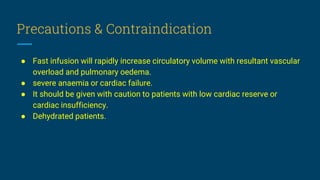
Precautions & Contraindication
â—Ź Fast infusion will rapidly increase circulatory volume with resultant vascular
overload and pulmonary oedema.
â—Ź severe anaemia or cardiac failure.
â—Ź It should be given with caution to patients with low cardiac reserve or
cardiac insufficiency.
â—Ź Dehydrated patients.
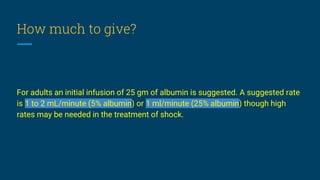
How much to give?
For adults an initial infusion of 25 gm of albumin is suggested. A suggested rate
is 1 to 2 mL/minute (5% albumin) or 1 ml/minute (25% albumin) though high
rates may be needed in the treatment of shock.
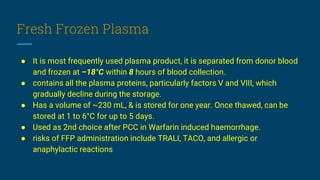
Fresh Frozen Plasma
â—Ź It is most frequently used plasma product, it is separated from donor blood
and frozen at –18°C within 8 hours of blood collection.
â—Ź contains all the plasma proteins, particularly factors V and VIII, which
gradually decline during the storage.
â—Ź Has a volume of ~230 mL, & is stored for one year. Once thawed, can be
stored at 1 to 6°C for up to 5 days.
â—Ź Used as 2nd choice after PCC in Warfarin induced haemorrhage.
â—Ź risks of FFP administration include TRALI, TACO, and allergic or
anaphylactic reactions
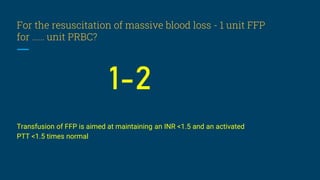
For the resuscitation of massive blood loss - 1 unit FFP
for …… unit PRBC?
Transfusion of FFP is aimed at maintaining an INR <1.5 and an activated
PTT <1.5 times normal
1-2
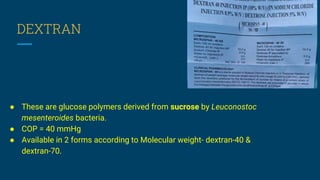
â—Ź These are glucose polymers derived from sucrose by Leuconostoc
mesenteroides bacteria.
â—Ź COP = 40 mmHg
â—Ź Available in 2 forms according to Molecular weight- dextran-40 &
dextran-70.
DEXTRAN
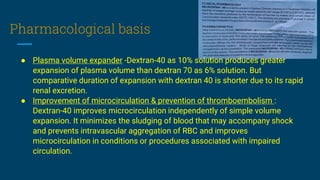
Pharmacological basis
â—Ź Plasma volume expander -Dextran-40 as 10% solution produces greater
expansion of plasma volume than dextran 70 as 6% solution. But
comparative duration of expansion with dextran 40 is shorter due to its rapid
renal excretion.
â—Ź Improvement of microcirculation & prevention of thromboembolism :
Dextran-40 improves microcirculation independently of simple volume
expansion. It minimizes the sludging of blood that may accompany shock
and prevents intravascular aggregation of RBC and improves
microcirculation in conditions or procedures associated with impaired
circulation.
Indications
â—Ź Correction of hypovolemia : For short term rapid expansion of plasma
volume in conditions such as shock or impending shock from burns,
surgery, haemorrhage or trauma.
â—Ź Prophylaxis of DVT and postoperative and post traumatic
thromboembolism.
â—Ź To improve blood flow and microcirculation in threatened vascular
gangrene.
Side effects
â—Ź Acute renal failure : Rapid renal excretion of dextran 40 in patients with
reduced urine flow can cause high urinary concentration which increases
urinary viscosity & cause oliguria/ARF.
â—Ź Hypersensitivity reaction
â—Ź Dextran may interfere with blood grouping and cross matching
â—Ź Avoid if
â—Ź Caution if
Caution
1. Severe oligo-anuria and renal failure.
2. Known hypersensitivity to dextran.
3. CHF or circulatory overload.
4. Bleeding disorders
5. Severe dehydration
1. lmpaired renal function or oliguria
2. Active haemorrhage.
3. Chronic liver disease
4. risk of developing pulmonary oedema or CHF
5. HCT< 30
6. Using with heparin
Administation
DEXTRAN-40 : Given by l.V. infusion as 10% solution in 0.9% NaCl or 5% glucose.
Adult person with shock usually requires 500 ml of rapid I.V. infusion. In the first
24 hours total dose should not exceed 20 ml/kg.
DEXTRAN-70 : Given l.V. as 6% solution. The total dose should not exceed 20
ml/kg in the first 24 hrs and 10 ml/kg on subsequent days.
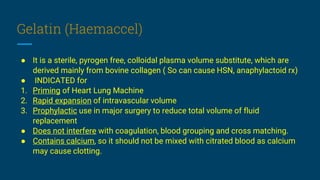
Gelatin (Haemaccel)
â—Ź It is a sterile, pyrogen free, colloidal plasma volume substitute, which are
derived mainly from bovine collagen ( So can cause HSN, anaphylactoid rx)
â—Ź INDICATED for
1. Priming of Heart Lung Machine
2. Rapid expansion of intravascular volume
3. Prophylactic use in major surgery to reduce total volume of fluid
replacement
â—Ź Does not interfere with coagulation, blood grouping and cross matching.
â—Ź Contains calcium, so it should not be mixed with citrated blood as calcium
may cause clotting.
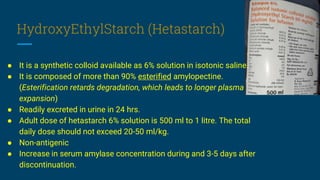
HydroxyEthylStarch (Hetastarch)
â—Ź It is a synthetic colloid available as 6% solution in isotonic saline.
â—Ź It is composed of more than 90% esterified amylopectine.
(Esterification retards degradation, which leads to longer plasma
expansion)
â—Ź Readily excreted in urine in 24 hrs.
â—Ź Adult dose of hetastarch 6% solution is 500 ml to 1 litre. The total
daily dose should not exceed 20-50 ml/kg.
â—Ź Non-antigenic
â—Ź Increase in serum amylase concentration during and 3-5 days after
discontinuation.
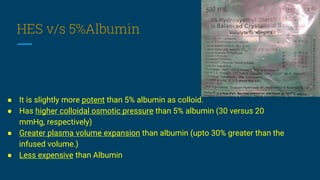
HES v/s 5%Albumin
â—Ź It is slightly more potent than 5% albumin as colloid.
â—Ź Has higher colloidal osmotic pressure than 5% albumin (30 versus 20
mmHg, respectively)
â—Ź Greater plasma volume expansion than albumin (upto 30% greater than the
infused volume.)
â—Ź Less expensive than Albumin
Thankyou
REFERENCES
• Miller 9e
• The ICU book by Paul L. Marino
• Guidelines of Fluid therapy by Dr Sanjay Pandya
Sir Henry Tizard’s quote- the secret of selecting the appropriate
resuscitation fluid is to ask the question- what is the cause and
severity of the hypovolemia in this patient ?