Plasma Volume Expanders
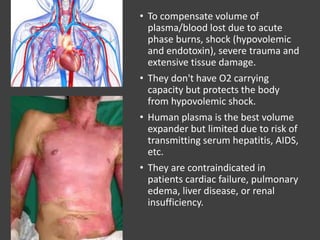
• To compensate volume of
plasma/blood lost due to acute
phase burns, shock (hypovolemic
and endotoxin), severe trauma and
extensive tissue damage.
• They don't have O2 carrying
capacity but protects the body
from hypovolemic shock.
• Human plasma is the best volume
expander but limited due to risk of
transmitting serum hepatitis, AIDS,
etc.
• They are contraindicated in
patients cardiac failure, pulmonary
edema, liver disease, or renal
insufficiency.
Desirable
properties
Should exert oncotic pressure
comparable to plasma.
Should remain in circulation and not leak
out in tissues, or be too rapidly disposed.
Should be pharmacodynamically inert.
Should not be pyrogenic or antigenic.
Should not interfere with grouping and
crossmatching of blood.
Should be stable, easily sterilizable and
cheap.
Human Albumin
Dextran
Polygeline
Hetastarch
Human
albumin
• Obtained from pooled human plasma
• 100 ml of 20% human albumin solution is
the osmotic equivalent of about 400 ml of
fresh frozen plasma or 800 ml of whole
blood.
• Can be used without regard to patient’s
blood group.
• Free of risk of transmitting serum
hepatitis because the preparation is heat
treated.
• Apart from burns, hypovolemia, shock,
etc., it has been used in acute
hypoproteinaemia, acute liver failure and
dialysis.
• Febrile reaction to human albumin occurs
occasionally. It is expensive.
Dextran
• A polysaccharide obtained from sugar
beat, available in 2 forms and most
commonly used.
• Dextran-70 - Longer acting and
commonly used.
• May interfere with blood grouping
and cross-matching.
• Urticaria, itching, bronchospasm, fall
in BP occur occasionally.
• May interfere with coagulation and
platelet function, and thus prolong
bleeding time; should not be used in
hypofibrinogenaemia,
thrombocytopenia or in presence of
bleeding.
• Dextran-40 It acts more rapidly than
D-70
• Improve microcirculation by reducing
blood viscosity and prevents RBC
sludging by coating them and
maintaining their electronegative
charge.
• Rapidly filtered at the glomerulus,
therefore acts shorter.
• The total dose should not exceed 20
ml/kg in 24 hr as it is highly
concentrated in the tubule if oliguria
develops, tubular obstruction may
occur.
• Can be stored for 10 years and are
cheap.
Dextran
Polygeline
(Degraded
gelatin
polymer)
• A polypeptide with average MW
30,000 which exerts albumin but
not antigenic.
• Does not interfere with grouping
and cross-matching of blood and
remains stable for 3 years.
• Action lasts for 12 hrs as it is
excreted slowly by the kidney
• It can also be used for priming of
heart-lung (ECMO) and dialysis
machines.
• Expensive than dextran.
Hetastarch
• A complex mixture of ethoxylated
amylopectin of various molecular
sizes; average MW 4.5 lac (range
10,000 to 1 million).
• Expands PV slightly in excess of the
volume infused.
• Hetastarch is incompatible with many
drugs; no injectable drug should be
added to the infusion. Blood grouping
and cross matching may be vitiated.
• Adverse effects are vomiting, mild
fever, itching, chills, flu like symptoms,
swelling of salivary glands.
Thank you