“GROUPE MEMBER”
Md. Shamim Hossain
ID:16172107035
SHAHRUKH HOSSEN
ID:13172107036
MD. MOSHIUR RAHMAN
ID:16172107030
ADIBUL HASAN ADIB
ID:16172107011
MD. NAFIZUR RAHMAN
ID:16172107031
Mahfujur Rahman Tipu
ID:16172107005
Introduction
Waterless dyeing is the process by which
dyeing is perform without water. It is the
process that used no water and requires less
energy than traditional methods of dyeing,
while still achieving impressive colors in
solids and prints. Waterless dyeing process
required less process, time, chemicals, &
auxiliaries. As a result production cost is also
less.
Water in textile processing
The textile industries is one of the biggest
consumer of water. On average 100- 150
liters of water is needed to process 1 kg of
textile material, with some 28 billion kilos
of textiles being dyed annually. About 2.4
trillion gallons of water are used in
synthetic dyeing. Water is used as solvent
in many pretreatment and finishing
processes, such as washing, scouring,
bleaching and dyeing.
Disadvantage of traditional Dyeing
 Dye can waste.
Chemicals and auxiliaries are
required more.
 Water hardness required to
remove.
 More energy require.
 Fabric can degrade.
 More process required.
 Water pollution occur.
 Required waste water
treatment process.
Waterless Dyeing
Waterless
Dyeing
Air dyeing
Dyecoo
waterless dyeing
Air Dyeing Technology
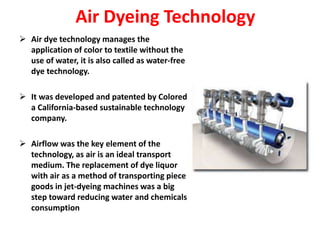
 Air dye technology manages the
application of color to textile without the
use of water, it is also called as water-free
dye technology.
 It was developed and patented by Colored ,
a California-based sustainable technology
company.
 Airflow was the key element of the
technology, as air is an ideal transport
medium. The replacement of dye liquor
with air as a method of transporting piece
goods in jet-dyeing machines was a big
step toward reducing water and chemicals
consumption
Air Dyeing Technology
 The Air Dye process
employs air instead of
water to help the dyes
penetrate fibers. Air dye
technology heats up
fabric, then injects dye
directly into the fibers in
the form of a gas. It is the
process that used no
water and requires less
energy than traditional
methods of dyeing, while
still achieving impressive
colors in solids and print
Advantage
 Unlimited flexibility with regard to all fiber except pure wool
and fabric weight classes between 30 and 800 grams per square
meter, as well as all standard market dyestuffs
The lowest liquor ratio on the market: approximately 1:2 for
man-made fibers and 1:3 to 1:4 for natural fibers, depending on
the article and structure
Energy savings of up to 40 percent, thanks to a frequency
converter, and the use of air as a transport medium, while all
other systems need water
 A reduction in the overall process time of approximately 25
percent; and
Lowest water/wastewater levels.
DyeCoo Dyeing
• DyeCoo dyeing is a waterless
dyeing process in which
Supercritical CO2 is used.
When carbon dioxide is
heated to above 31 and
pressurized to above 74 Bar, it
becomes supercritical , a state
of matter that can be seen as
an expended liquid, or a
heavily compressed gas. This
supercritical is main medium
for DyeCoo dyeing system.
History
DyeCoo dyeing with CO2 was invented in
Germany twenty-five years ago.
Developing a well-functioning machine,
however turned out to be too
expensive. DyeCoo Textile System
parent company, Feyecon , began
tackling this issue ten years ago in
partnership with the Delft University of
Technology and Stork. This ultimately
resulted in DyeCoo(which was formed in
2008), which literally means dyeing with
CO2.
Dyeing process
The dyeing takes place in following
steps :
Dissolution of dye in CO2
Transport to the fibers
Adsorption of dye on fiber surface
and finally
 Diffusion of dye into the fiber takes
place
Dyeing process
The sample to be dyed is wrapped around a
perforated stainless steel tube and mounted inside
the autoclave around the stirrer. Dyestuff powder is
placed at the bottom of the vessel and the apparatus
is sealed, purged with gaseous CO2 and preheated.
When it reaches the working temperature, CO2 is
isothermally compressed to the chosen working
pressure under constant stirring. Pressure is
maintained for a dyeing period of 60 mins and
afterwards released. The CO2 and excess dyes are
separated and recycled. After this dyeing procedure,
the dry sample is removed and rinsed with acetone if
necessary to remove the adhering residual dye
Dyeing process
Importance of supercritical co2
Prominent substances exhibiting super
critical phases are CO2, H2O and Propane, of
which CO2 is the second most abundant and
second least costly solvent. Low temperature
and pressure are needed to convert carbon
dioxide gas into super critical fluid. In the
supercritical state CO2 exhibits very low
viscosity and surface tension properties.
Supercritical CO2 is one of the most popular
fluids currently used in manufacturing
processes
DyeCoo Dyeing
Advantage
 Elimination of water treatment
and water pollution
 No need of drying textiles
 Gives good rubbing fastness
 Dyeing occurs with high degree
of levelness
 CO2 is non toxic obtained from
natural resources and can be
easily recycled in dyeing process
 Dyeing houses may be started on
sites where there is water scarcity
Disadvantage
 High pressure and high
temperature are observed
during the process.
 The system requires a lot
of money.
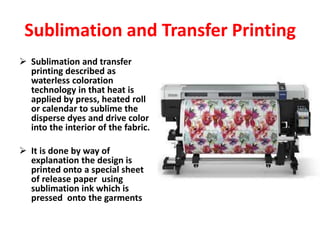
 Sublimation and transfer
printing described as
waterless coloration
technology in that heat is
applied by press, heated roll
or calendar to sublime the
disperse dyes and drive color
into the interior of the fabric.
 It is done by way of
explanation the design is
printed onto a special sheet
of release paper using
sublimation ink which is
pressed onto the garments
Sublimation and Transfer Printing
 At a very high temperate
and pressure the ink
forms a gas which then
permanently dyes the
polyester content of the
fabric.
 Sublimation technology
is almost exclusively a
polyester specific
solution.
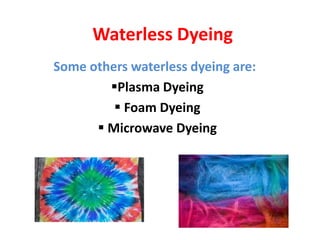
Waterless Dyeing
Some others waterless dyeing are:
Plasma Dyeing
 Foam Dyeing
 Microwave Dyeing
Conclusion
“Color the earth beautiful and kill it with sweet poison!!”
We talk about saving water every day, but have we ever
considered that this vital natural resource is vastly being
wasted and polluted in the process of textile dyeing. It is
obviously not possible to cut down the process of dyeing
altogether. The textile industry is the heaviest industrial
consumer of water. By 2030, it is estimated that the world
demand for fresh water will increase by 40 percent with the
increased population, and by 2050, an estimated billion-plus
people will also lack the water they need for daily living. Up to
26 gallons (100 liters) of water are needed to dye just two
pounds (one kilogram) of cotton fabric . so we need to
waterless dyeing . water auxiliaries less dyeing also minimize
the energy, time , chemicals and auxiliaries.
Waterless dyeing

Waterless dyeing

  • 2.
    “GROUPE MEMBER” Md. ShamimHossain ID:16172107035 SHAHRUKH HOSSEN ID:13172107036 MD. MOSHIUR RAHMAN ID:16172107030 ADIBUL HASAN ADIB ID:16172107011 MD. NAFIZUR RAHMAN ID:16172107031 Mahfujur Rahman Tipu ID:16172107005
  • 3.
    Introduction Waterless dyeing isthe process by which dyeing is perform without water. It is the process that used no water and requires less energy than traditional methods of dyeing, while still achieving impressive colors in solids and prints. Waterless dyeing process required less process, time, chemicals, & auxiliaries. As a result production cost is also less.
  • 4.
    Water in textileprocessing The textile industries is one of the biggest consumer of water. On average 100- 150 liters of water is needed to process 1 kg of textile material, with some 28 billion kilos of textiles being dyed annually. About 2.4 trillion gallons of water are used in synthetic dyeing. Water is used as solvent in many pretreatment and finishing processes, such as washing, scouring, bleaching and dyeing.
  • 5.
    Disadvantage of traditionalDyeing  Dye can waste. Chemicals and auxiliaries are required more.  Water hardness required to remove.  More energy require.  Fabric can degrade.  More process required.  Water pollution occur.  Required waste water treatment process.
  • 6.
  • 7.
    Air Dyeing Technology Air dye technology manages the application of color to textile without the use of water, it is also called as water-free dye technology.  It was developed and patented by Colored , a California-based sustainable technology company.  Airflow was the key element of the technology, as air is an ideal transport medium. The replacement of dye liquor with air as a method of transporting piece goods in jet-dyeing machines was a big step toward reducing water and chemicals consumption
  • 8.
    Air Dyeing Technology The Air Dye process employs air instead of water to help the dyes penetrate fibers. Air dye technology heats up fabric, then injects dye directly into the fibers in the form of a gas. It is the process that used no water and requires less energy than traditional methods of dyeing, while still achieving impressive colors in solids and print
  • 9.
    Advantage  Unlimited flexibilitywith regard to all fiber except pure wool and fabric weight classes between 30 and 800 grams per square meter, as well as all standard market dyestuffs The lowest liquor ratio on the market: approximately 1:2 for man-made fibers and 1:3 to 1:4 for natural fibers, depending on the article and structure Energy savings of up to 40 percent, thanks to a frequency converter, and the use of air as a transport medium, while all other systems need water  A reduction in the overall process time of approximately 25 percent; and Lowest water/wastewater levels.
  • 10.
    DyeCoo Dyeing • DyeCoodyeing is a waterless dyeing process in which Supercritical CO2 is used. When carbon dioxide is heated to above 31 and pressurized to above 74 Bar, it becomes supercritical , a state of matter that can be seen as an expended liquid, or a heavily compressed gas. This supercritical is main medium for DyeCoo dyeing system.
  • 11.
    History DyeCoo dyeing withCO2 was invented in Germany twenty-five years ago. Developing a well-functioning machine, however turned out to be too expensive. DyeCoo Textile System parent company, Feyecon , began tackling this issue ten years ago in partnership with the Delft University of Technology and Stork. This ultimately resulted in DyeCoo(which was formed in 2008), which literally means dyeing with CO2.
  • 12.
    Dyeing process The dyeingtakes place in following steps : Dissolution of dye in CO2 Transport to the fibers Adsorption of dye on fiber surface and finally  Diffusion of dye into the fiber takes place
  • 13.
    Dyeing process The sampleto be dyed is wrapped around a perforated stainless steel tube and mounted inside the autoclave around the stirrer. Dyestuff powder is placed at the bottom of the vessel and the apparatus is sealed, purged with gaseous CO2 and preheated. When it reaches the working temperature, CO2 is isothermally compressed to the chosen working pressure under constant stirring. Pressure is maintained for a dyeing period of 60 mins and afterwards released. The CO2 and excess dyes are separated and recycled. After this dyeing procedure, the dry sample is removed and rinsed with acetone if necessary to remove the adhering residual dye
  • 14.
  • 15.
    Importance of supercriticalco2 Prominent substances exhibiting super critical phases are CO2, H2O and Propane, of which CO2 is the second most abundant and second least costly solvent. Low temperature and pressure are needed to convert carbon dioxide gas into super critical fluid. In the supercritical state CO2 exhibits very low viscosity and surface tension properties. Supercritical CO2 is one of the most popular fluids currently used in manufacturing processes
  • 16.
    DyeCoo Dyeing Advantage  Eliminationof water treatment and water pollution  No need of drying textiles  Gives good rubbing fastness  Dyeing occurs with high degree of levelness  CO2 is non toxic obtained from natural resources and can be easily recycled in dyeing process  Dyeing houses may be started on sites where there is water scarcity Disadvantage  High pressure and high temperature are observed during the process.  The system requires a lot of money.
  • 17.
     Sublimation andtransfer printing described as waterless coloration technology in that heat is applied by press, heated roll or calendar to sublime the disperse dyes and drive color into the interior of the fabric.  It is done by way of explanation the design is printed onto a special sheet of release paper using sublimation ink which is pressed onto the garments Sublimation and Transfer Printing
  • 18.
    Sublimation and TransferPrinting  At a very high temperate and pressure the ink forms a gas which then permanently dyes the polyester content of the fabric.  Sublimation technology is almost exclusively a polyester specific solution.
  • 19.
    Waterless Dyeing Some otherswaterless dyeing are: Plasma Dyeing  Foam Dyeing  Microwave Dyeing
  • 20.
    Conclusion “Color the earthbeautiful and kill it with sweet poison!!” We talk about saving water every day, but have we ever considered that this vital natural resource is vastly being wasted and polluted in the process of textile dyeing. It is obviously not possible to cut down the process of dyeing altogether. The textile industry is the heaviest industrial consumer of water. By 2030, it is estimated that the world demand for fresh water will increase by 40 percent with the increased population, and by 2050, an estimated billion-plus people will also lack the water they need for daily living. Up to 26 gallons (100 liters) of water are needed to dye just two pounds (one kilogram) of cotton fabric . so we need to waterless dyeing . water auxiliaries less dyeing also minimize the energy, time , chemicals and auxiliaries.