Recent Advances in Atmospheric Plasma
                   Treatment of Textiles

                Gregory Roche, Carrie Cornelius, Wade Tyner
                                       ApJet, Inc.


INDA CAB 2012          Gregory Roche
Abstract


     Ø Atmospheric pressure plasma is a revolutionary new technology for
          surface finishing and pretreatments. Atmospheric pressure plasma
          produces no waste water, requires no ovens for curing, and at
          effective processing cost. It can be used with a wide range of
          materials, both woven and non-woven, covering a wide range of
          materials. This includes standard synthetics such as polyester, nylon,
          polypropylene, high performance fabrics such as Nomex™ and
          Kevlar™, as well as natural fibers such as silk and wool.


INDA CAB 2012               Gregory Roche
Outline


          Ø What is plasma?
          Ø Types of plasma equipment
          Ø Examples of fabric treatments
          Ø Future Possibilities


INDA CAB 2012              Gregory Roche
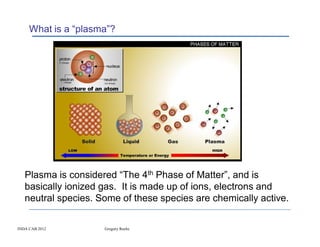
What is a “plasma”?


   Plasma is considered “The 4th Phase of Matter”, and is
   basically ionized gas. It is made up of ions, electrons and
   neutral species. Some of these species are chemically active.

INDA CAB 2012        Gregory Roche
What Type of Plasma?

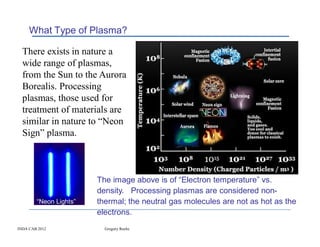
  There exists in nature a
  wide range of plasmas,
  from the Sun to the Aurora
  Borealis. Processing
  plasmas, those used for
  treatment of materials are
  similar in nature to “Neon
  Sign” plasma.


                        The image above is of “Electron temperature” vs.
                        density. Processing plasmas are considered non-
        “Neon Lights”   thermal; the neutral gas molecules are not as hot as the
                        electrons.
INDA CAB 2012             Gregory Roche
Plasma Equipment: Vacuum versus Atmospheric Pressure

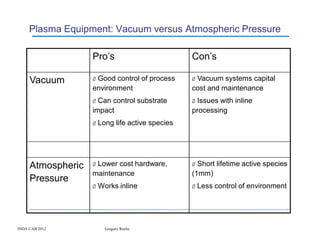
                   Pro’s                        Con’s

     Vacuum        Ø Good control of process    Ø Vacuum systems capital
                   environment                  cost and maintenance
                   Ø Can control substrate      Ø Issues with inline
                   impact                       processing
                   Ø Long life active species


     Atmospheric   Ø Lower cost hardware,       Ø Short lifetime active species
                   maintenance                  (1mm)
     Pressure
                   Ø Works inline               Ø Less control of environment


INDA CAB 2012         Gregory Roche
Plasma Equipment: Common Atmospheric Plasma Systems

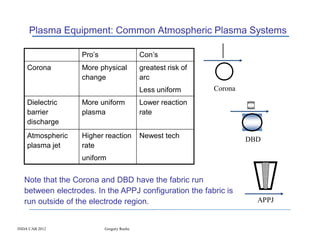
                   Pro’s                   Con’s
    Corona         More physical           greatest risk of
                   change                  arc
                                           Less uniform       Corona
    Dielectric     More uniform            Lower reaction
    barrier        plasma                  rate
    discharge
    Atmospheric    Higher reaction         Newest tech                 DBD
    plasma jet     rate
                   uniform


   Note that the Corona and DBD have the fabric run
   between electrodes. In the APPJ configuration the fabric is
   run outside of the electrode region.                                  APPJ


INDA CAB 2012              Gregory Roche
Example DBD Hardware


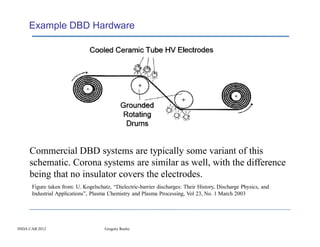
     Commercial DBD systems are typically some variant of this
     schematic. Corona systems are similar as well, with the difference
     being that no insulator covers the electrodes.
      Figure taken from: U. Kogelschatz, “Dielectric-barrier discharges: Their History, Discharge Physics, and
      Industrial Applications”, Plasma Chemistry and Plasma Processing, Vol 23, No. 1 March 2003


INDA CAB 2012                        Gregory Roche
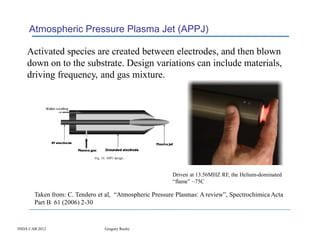
Atmospheric Pressure Plasma Jet (APPJ)

    Activated species are created between electrodes, and then blown
    down on to the substrate. Design variations can include materials,
    driving frequency, and gas mixture.


                                                         Driven at 13.56MHZ RF, the Helium-dominated
                                                         “flame” ~75C

       Taken from: C. Tendero et al, “Atmospheric Pressure Plasmas: A review”, Spectrochimica Acta
       Part B 61 (2006) 2-30


INDA CAB 2012                   Gregory Roche
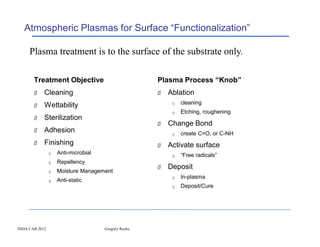
Atmospheric Plasmas for Surface “Functionalization”

     Plasma treatment is to the surface of the substrate only.

       Treatment Objective                           Plasma Process “Knob”
       Ø    Cleaning                                 Ø   Ablation
                                                          q   cleaning
       Ø    Wettability
                                                          q   Etching, roughening
       Ø    Sterilization
                                                     Ø   Change Bond
       Ø    Adhesion                                      q   create C=O, or C-NH
       Ø    Finishing                                Ø   Activate surface
                q   Anti-microbial                        q   “Free radicals”
                q   Repellency
                                                     Ø   Deposit
                q   Moisture Management
                                                          q   In-plasma
                q   Anti-static
                                                          q   Deposit/Cure


INDA CAB 2012                        Gregory Roche
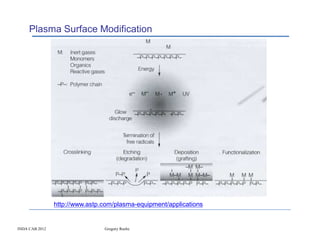
Plasma Surface Modification


                http://www.astp.com/plasma-equipment/applications


INDA CAB 2012                   Gregory Roche
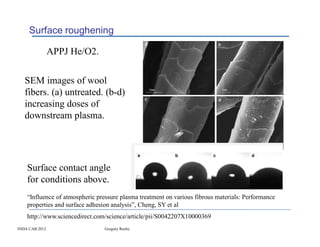
Surface roughening

                APPJ He/O2.


   SEM images of wool
   fibers. (a) untreated. (b-d)
   increasing doses of
   downstream plasma.


    Surface contact angle
    for conditions above.
    “Influence of atmospheric pressure plasma treatment on various fibrous materials: Performance
    properties and surface adhesion analysis”, Cheng, SY et al
    http://www.sciencedirect.com/science/article/pii/S0042207X10000369
INDA CAB 2012                    Gregory Roche
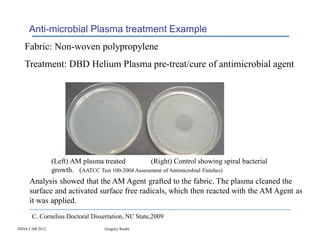
Anti-microbial Plasma treatment Example
   Fabric: Non-woven polypropylene
   Treatment: DBD Helium Plasma pre-treat/cure of antimicrobial agent


                (Left) AM plasma treated           (Right) Control showing spiral bacterial
                growth. (AATCC Test 100-2004 Assessment of Antimicrobial Finishes)
     Analysis showed that the AM Agent grafted to the fabric. The plasma cleaned the
     surface and activated surface free radicals, which then reacted with the AM Agent as
     it was applied.
      C. Cornelius Doctoral Dissertation, NC State,2009
INDA CAB 2012                     Gregory Roche
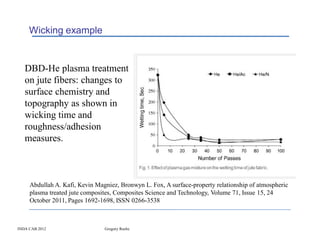
Wicking example


   DBD-He plasma treatment
   on jute fibers: changes to
   surface chemistry and
   topography as shown in
   wicking time and
   roughness/adhesion
   measures.


     Abdullah A. Kafi, Kevin Magniez, Bronwyn L. Fox, A surface-property relationship of atmospheric
     plasma treated jute composites, Composites Science and Technology, Volume 71, Issue 15, 24
     October 2011, Pages 1692-1698, ISSN 0266-3538


INDA CAB 2012                   Gregory Roche
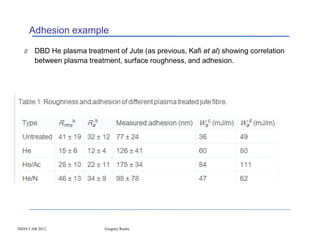
Adhesion example

   Ø    DBD He plasma treatment of Jute (as previous, Kafi et al) showing correlation
        between plasma treatment, surface roughness, and adhesion.


INDA CAB 2012                Gregory Roche
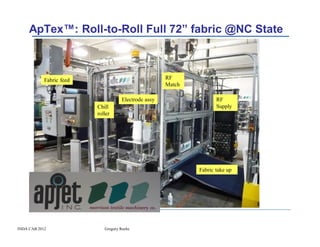
ApTex™: Roll-to-Roll Full 72” fabric @NC State


            Fabric feed                               RF
                                                      Match

                                     Electrode assy                  RF
                          Chill                                      Supply
                          roller


                                                              Fabric take up


INDA CAB 2012                Gregory Roche
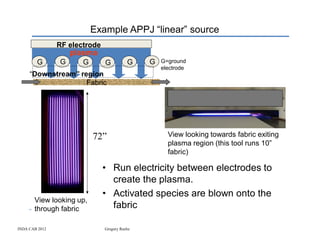
Example APPJ “linear” source
                RF electrode
                    plasma
        G       G      G       G          G    G   G=ground
                                                   electrode
     “Downstream” region
                    Fabric


                           72”                       View looking towards fabric exiting
                                                     plasma region (this tool runs 10”
                                                     fabric)

                               • Run electricity between electrodes to
                                 create the plasma.
                               • Activated species are blown onto the
       View looking up,
       through fabric            fabric
                                                                              Bottom view


INDA CAB 2012                  Gregory Roche
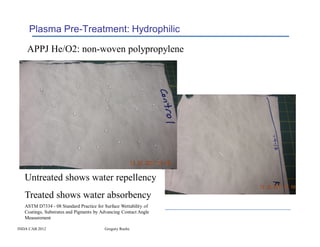
Plasma Pre-Treatment: Hydrophilic

    APPJ He/O2: non-woven polypropylene


   Untreated shows water repellency
   Treated shows water absorbency
   ASTM D7334 - 08 Standard Practice for Surface Wettability of
   Coatings, Substrates and Pigments by Advancing Contact Angle
   Measurement

INDA CAB 2012                            Gregory Roche
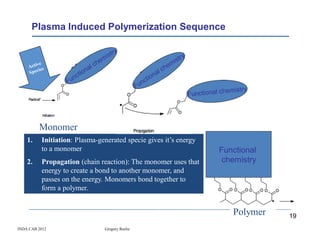
Plasma Induced Polymerization Sequence


         Monomer
    1.    Initiation: Plasma-generated specie gives it’s energy
          to a monomer                                            Functional
    2.    Propagation (chain reaction): The monomer uses that      chemistry
          energy to create a bond to another monomer, and
          passes on the energy. Monomers bond together to
          form a polymer.


                                                                     Polymer   19
INDA CAB 2012                  Gregory Roche
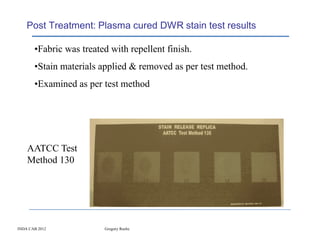
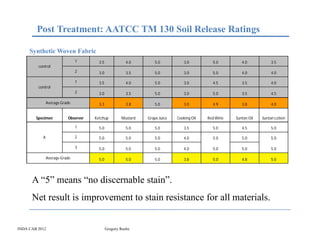
Post Treatment: Plasma cured DWR stain test results

       •Fabric was treated with repellent finish.
       •Stain materials applied & removed as per test method.
       •Examined as per test method


    AATCC Test
    Method 130


INDA CAB 2012            Gregory Roche
Post Treatment: AATCC TM 130 Soil Release Ratings

     Synthetic Woven Fabric
                               1       3.5              4.0        5.0          3.0          5.0         4.0            3.5
         control
                               2       3.0              3.5        5.0          3.0          5.0         4.0            4.0

                               1       3.5              4.0        5.0          3.0          4.5         3.5            4.0
         control
                               2       3.0              3.5        5.0          3.0          5.0         3.5            4.5

               Average Grade           3.3              3.8        5.0          3.0          4.9         3.8            4.0


        Specimen          Observer   Ketchup         Mustard   Grape Juice   Cooking Oil   Red Wine   Suntan Oil   Suntan Lotion

                               1       5.0              5.0        5.0          3.5          5.0         4.5            5.0

           A                   2       5.0              5.0        5.0          4.0          5.0         5.0            5.0

                               3       5.0              5.0        5.0          4.0          5.0         5.0            5.0

               Average Grade           5.0              5.0        5.0          3.8          5.0         4.8            5.0


      A “5” means “no discernable stain”.
      Net result is improvement to stain resistance for all materials.


INDA CAB 2012                                Gregory Roche
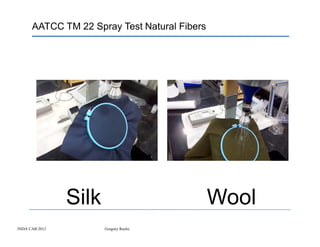
AATCC TM 22 Spray Test Natural Fibers


                Silk                          Wool
INDA CAB 2012          Gregory Roche
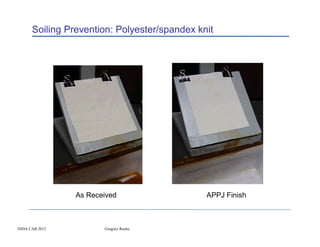
Soiling Prevention: Polyester/spandex knit


                As Received                   APPJ Finish


INDA CAB 2012          Gregory Roche
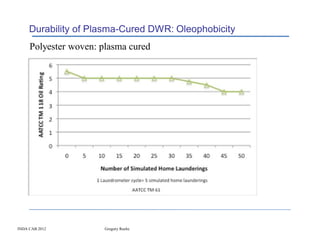
Durability of Plasma-Cured DWR: Oleophobicity
     Polyester woven: plasma cured


INDA CAB 2012          Gregory Roche
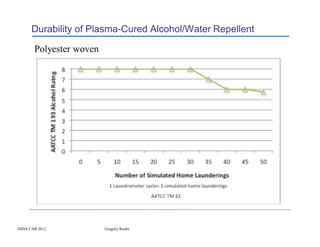
Durability of Plasma-Cured Alcohol/Water Repellent

       Polyester woven


INDA CAB 2012            Gregory Roche
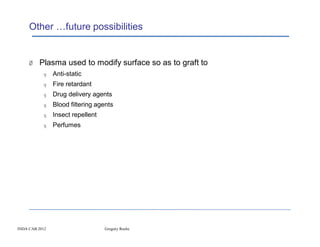
Other …future possibilities


     Ø Plasma used to modify surface so as to graft to
           q    Anti-static
           q    Fire retardant
           q    Drug delivery agents
           q    Blood filtering agents
           q    Insect repellent
           q    Perfumes


INDA CAB 2012                      Gregory Roche
END


     Ø Thank you for your attention!


        Questions or comments: greg.roche@apjet.com


INDA CAB 2012            Gregory Roche
Backup slides


INDA CAB 2012          Gregory Roche
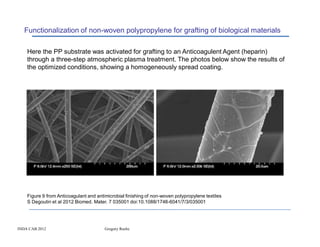
Functionalization of non-woven polypropylene for grafting of biological materials

    Here the PP substrate was activated for grafting to an Anticoagulent Agent (heparin)
    through a three-step atmospheric plasma treatment. The photos below show the results of
    the optimized conditions, showing a homogeneously spread coating.


    Figure 9 from Anticoagulant and antimicrobial finishing of non-woven polypropylene textiles
    S Degoutin et al 2012 Biomed. Mater. 7 035001 doi:10.1088/1748-6041/7/3/035001


INDA CAB 2012                           Gregory Roche
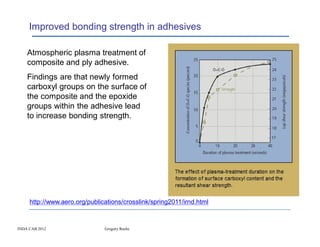
Improved bonding strength in adhesives

    Atmospheric plasma treatment of
    composite and ply adhesive.
    Findings are that newly formed
    carboxyl groups on the surface of
    the composite and the epoxide
    groups within the adhesive lead
    to increase bonding strength.


     http://www.aero.org/publications/crosslink/spring2011/irnd.html


INDA CAB 2012                  Gregory Roche

Inda Presentation Roche Final April 2012

  • 1.
    Recent Advances inAtmospheric Plasma Treatment of Textiles Gregory Roche, Carrie Cornelius, Wade Tyner ApJet, Inc. INDA CAB 2012 Gregory Roche
  • 2.
    Abstract Ø Atmospheric pressure plasma is a revolutionary new technology for surface finishing and pretreatments. Atmospheric pressure plasma produces no waste water, requires no ovens for curing, and at effective processing cost. It can be used with a wide range of materials, both woven and non-woven, covering a wide range of materials. This includes standard synthetics such as polyester, nylon, polypropylene, high performance fabrics such as Nomex™ and Kevlar™, as well as natural fibers such as silk and wool. INDA CAB 2012 Gregory Roche
  • 3.
    Outline Ø What is plasma? Ø Types of plasma equipment Ø Examples of fabric treatments Ø Future Possibilities INDA CAB 2012 Gregory Roche
  • 4.
    What is a“plasma”? Plasma is considered “The 4th Phase of Matter”, and is basically ionized gas. It is made up of ions, electrons and neutral species. Some of these species are chemically active. INDA CAB 2012 Gregory Roche
  • 5.
    What Type ofPlasma? There exists in nature a wide range of plasmas, from the Sun to the Aurora Borealis. Processing plasmas, those used for treatment of materials are similar in nature to “Neon Sign” plasma. The image above is of “Electron temperature” vs. density. Processing plasmas are considered non- “Neon Lights” thermal; the neutral gas molecules are not as hot as the electrons. INDA CAB 2012 Gregory Roche
  • 6.
    Plasma Equipment: Vacuumversus Atmospheric Pressure Pro’s Con’s Vacuum Ø Good control of process Ø Vacuum systems capital environment cost and maintenance Ø Can control substrate Ø Issues with inline impact processing Ø Long life active species Atmospheric Ø Lower cost hardware, Ø Short lifetime active species maintenance (1mm) Pressure Ø Works inline Ø Less control of environment INDA CAB 2012 Gregory Roche
  • 7.
    Plasma Equipment: CommonAtmospheric Plasma Systems Pro’s Con’s Corona More physical greatest risk of change arc Less uniform Corona Dielectric More uniform Lower reaction barrier plasma rate discharge Atmospheric Higher reaction Newest tech DBD plasma jet rate uniform Note that the Corona and DBD have the fabric run between electrodes. In the APPJ configuration the fabric is run outside of the electrode region. APPJ INDA CAB 2012 Gregory Roche
  • 8.
    Example DBD Hardware Commercial DBD systems are typically some variant of this schematic. Corona systems are similar as well, with the difference being that no insulator covers the electrodes. Figure taken from: U. Kogelschatz, “Dielectric-barrier discharges: Their History, Discharge Physics, and Industrial Applications”, Plasma Chemistry and Plasma Processing, Vol 23, No. 1 March 2003 INDA CAB 2012 Gregory Roche
  • 9.
    Atmospheric Pressure PlasmaJet (APPJ) Activated species are created between electrodes, and then blown down on to the substrate. Design variations can include materials, driving frequency, and gas mixture. Driven at 13.56MHZ RF, the Helium-dominated “flame” ~75C Taken from: C. Tendero et al, “Atmospheric Pressure Plasmas: A review”, Spectrochimica Acta Part B 61 (2006) 2-30 INDA CAB 2012 Gregory Roche
  • 10.
    Atmospheric Plasmas forSurface “Functionalization” Plasma treatment is to the surface of the substrate only. Treatment Objective Plasma Process “Knob” Ø Cleaning Ø Ablation q cleaning Ø Wettability q Etching, roughening Ø Sterilization Ø Change Bond Ø Adhesion q create C=O, or C-NH Ø Finishing Ø Activate surface q Anti-microbial q “Free radicals” q Repellency Ø Deposit q Moisture Management q In-plasma q Anti-static q Deposit/Cure INDA CAB 2012 Gregory Roche
  • 11.
    Plasma Surface Modification http://www.astp.com/plasma-equipment/applications INDA CAB 2012 Gregory Roche
  • 12.
    Surface roughening APPJ He/O2. SEM images of wool fibers. (a) untreated. (b-d) increasing doses of downstream plasma. Surface contact angle for conditions above. “Influence of atmospheric pressure plasma treatment on various fibrous materials: Performance properties and surface adhesion analysis”, Cheng, SY et al http://www.sciencedirect.com/science/article/pii/S0042207X10000369 INDA CAB 2012 Gregory Roche
  • 13.
    Anti-microbial Plasma treatmentExample Fabric: Non-woven polypropylene Treatment: DBD Helium Plasma pre-treat/cure of antimicrobial agent (Left) AM plasma treated (Right) Control showing spiral bacterial growth. (AATCC Test 100-2004 Assessment of Antimicrobial Finishes) Analysis showed that the AM Agent grafted to the fabric. The plasma cleaned the surface and activated surface free radicals, which then reacted with the AM Agent as it was applied. C. Cornelius Doctoral Dissertation, NC State,2009 INDA CAB 2012 Gregory Roche
  • 14.
    Wicking example DBD-He plasma treatment on jute fibers: changes to surface chemistry and topography as shown in wicking time and roughness/adhesion measures. Abdullah A. Kafi, Kevin Magniez, Bronwyn L. Fox, A surface-property relationship of atmospheric plasma treated jute composites, Composites Science and Technology, Volume 71, Issue 15, 24 October 2011, Pages 1692-1698, ISSN 0266-3538 INDA CAB 2012 Gregory Roche
  • 15.
    Adhesion example Ø DBD He plasma treatment of Jute (as previous, Kafi et al) showing correlation between plasma treatment, surface roughness, and adhesion. INDA CAB 2012 Gregory Roche
  • 16.
    ApTex™: Roll-to-Roll Full72” fabric @NC State Fabric feed RF Match Electrode assy RF Chill Supply roller Fabric take up INDA CAB 2012 Gregory Roche
  • 17.
    Example APPJ “linear”source RF electrode plasma G G G G G G G=ground electrode “Downstream” region Fabric 72” View looking towards fabric exiting plasma region (this tool runs 10” fabric) • Run electricity between electrodes to create the plasma. • Activated species are blown onto the View looking up, through fabric fabric Bottom view INDA CAB 2012 Gregory Roche
  • 18.
    Plasma Pre-Treatment: Hydrophilic APPJ He/O2: non-woven polypropylene Untreated shows water repellency Treated shows water absorbency ASTM D7334 - 08 Standard Practice for Surface Wettability of Coatings, Substrates and Pigments by Advancing Contact Angle Measurement INDA CAB 2012 Gregory Roche
  • 19.
    Plasma Induced PolymerizationSequence Monomer 1. Initiation: Plasma-generated specie gives it’s energy to a monomer Functional 2. Propagation (chain reaction): The monomer uses that chemistry energy to create a bond to another monomer, and passes on the energy. Monomers bond together to form a polymer. Polymer 19 INDA CAB 2012 Gregory Roche
  • 20.
    Post Treatment: Plasmacured DWR stain test results •Fabric was treated with repellent finish. •Stain materials applied & removed as per test method. •Examined as per test method AATCC Test Method 130 INDA CAB 2012 Gregory Roche
  • 21.
    Post Treatment: AATCCTM 130 Soil Release Ratings Synthetic Woven Fabric 1 3.5 4.0 5.0 3.0 5.0 4.0 3.5 control 2 3.0 3.5 5.0 3.0 5.0 4.0 4.0 1 3.5 4.0 5.0 3.0 4.5 3.5 4.0 control 2 3.0 3.5 5.0 3.0 5.0 3.5 4.5 Average Grade 3.3 3.8 5.0 3.0 4.9 3.8 4.0 Specimen Observer Ketchup Mustard Grape Juice Cooking Oil Red Wine Suntan Oil Suntan Lotion 1 5.0 5.0 5.0 3.5 5.0 4.5 5.0 A 2 5.0 5.0 5.0 4.0 5.0 5.0 5.0 3 5.0 5.0 5.0 4.0 5.0 5.0 5.0 Average Grade 5.0 5.0 5.0 3.8 5.0 4.8 5.0 A “5” means “no discernable stain”. Net result is improvement to stain resistance for all materials. INDA CAB 2012 Gregory Roche
  • 22.
    AATCC TM 22Spray Test Natural Fibers Silk Wool INDA CAB 2012 Gregory Roche
  • 23.
    Soiling Prevention: Polyester/spandexknit As Received APPJ Finish INDA CAB 2012 Gregory Roche
  • 24.
    Durability of Plasma-CuredDWR: Oleophobicity Polyester woven: plasma cured INDA CAB 2012 Gregory Roche
  • 25.
    Durability of Plasma-CuredAlcohol/Water Repellent Polyester woven INDA CAB 2012 Gregory Roche
  • 26.
    Other …future possibilities Ø Plasma used to modify surface so as to graft to q Anti-static q Fire retardant q Drug delivery agents q Blood filtering agents q Insect repellent q Perfumes INDA CAB 2012 Gregory Roche
  • 27.
    END Ø Thank you for your attention! Questions or comments: greg.roche@apjet.com INDA CAB 2012 Gregory Roche
  • 28.
    Backup slides INDA CAB2012 Gregory Roche
  • 29.
    Functionalization of non-wovenpolypropylene for grafting of biological materials Here the PP substrate was activated for grafting to an Anticoagulent Agent (heparin) through a three-step atmospheric plasma treatment. The photos below show the results of the optimized conditions, showing a homogeneously spread coating. Figure 9 from Anticoagulant and antimicrobial finishing of non-woven polypropylene textiles S Degoutin et al 2012 Biomed. Mater. 7 035001 doi:10.1088/1748-6041/7/3/035001 INDA CAB 2012 Gregory Roche
  • 30.
    Improved bonding strengthin adhesives Atmospheric plasma treatment of composite and ply adhesive. Findings are that newly formed carboxyl groups on the surface of the composite and the epoxide groups within the adhesive lead to increase bonding strength. http://www.aero.org/publications/crosslink/spring2011/irnd.html INDA CAB 2012 Gregory Roche