Stock Solution
Calculation in Dyeing
Swaraz Mollick
BSc in Textile Engineering (WPE)
Khulna University of Engineering & Technology (KUET)
Stock solution
In dyeing lab, for small amount of fabric/fabric
sample, the recipe is to be calculated. But for
small amount of fabric, the amount of dyes and
chemicals are not taken precisely due to small
quantity.
So, Stock solution is to be needed to prepare
sometimes.
What Stock solution means?
Stock solution is expressed as percentage. But
what percentage of which? There is also a term
called ‘Mother solution’. Let’s see.
x% stock solution means –
1) x gram solid particle + 100 ml water or
2) X ml liquid + (100-x) ml water
Example of stock solution
So, now how can we produce 1% stock solution of
reactive dye? It is easy.
Measure 1g of reactive dye and mix it with 100ml
water.
1% stock = 1g reactive dye + 100 ml water.
Similarly,
3% stock = 3g reactive dye + 100 ml water
NB: As the reactive dyes are in solid particle, that’s
why it is taken in gram.
Example of stock solution
But how can we produce 1% stock solution of
acetic acid. Let’s see
1% stock = 1ml acetic acid + 99ml water
Similarly,
3% stock = 3ml acetic acid + 97ml water
So, now it’s clear that for solid particle,
requirement of water is always 100ml, but for
liquid, the water required is (100-ml of liquid
taken).
Where is the problem?
We already know that how can we produce certain
percentage of stock solution. Whether it is solid or
liquid. But there is a difficulty, not a problem.
Suppose, we have to produce 1% stock solution of
solid. Then, 1g of solid can be measured accurately
by electric balance. But if we have to produce 0.1%,
0.01% or 0.001% or much less stock solution. It is
very difficult to measure 0.1g, 0.01g or 0.001g of
solid. So, then how can we produce this stock?
Well, there is the requirement of ‘Mother solution’.
Mother solution
Mother solution is basically 1% stock solution,
from which other percentage of stock solution
can be prepared. Percentage of mother solution
can vary. But 1% solution is great because other
solution can be prepared easily from this
solution.
Problem solved
Now, we will produce 0.1%, 0.01% and 0.001%
stock solution.
To produce these, at first we have to produce
Mother solution of 1%. That is,
For solid – 1g solid + 100ml water
For liquid – 1ml liquid + 99ml water
Let produce our required solution…
Problem solved
0.1% stock = 10ml of 1% stock + 90ml water
0.01% stock = 1ml of 1% stock + 99ml water
= 10ml of 0.1% stock + 90ml water
0.001% stock = 0.1ml of 1% stock + 99.9ml water
= 1ml of 0.1% stock + 99ml water
= 10ml of 0.01% stock + 90ml water
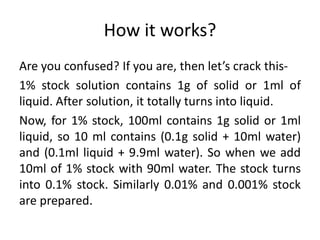
How it works?
Are you confused? If you are, then let’s crack this-
1% stock solution contains 1g of solid or 1ml of
liquid. After solution, it totally turns into liquid.
Now, for 1% stock, 100ml contains 1g solid or 1ml
liquid, so 10 ml contains (0.1g solid + 10ml water)
and (0.1ml liquid + 9.9ml water). So when we add
10ml of 1% stock with 90ml water. The stock turns
into 0.1% stock. Similarly 0.01% and 0.001% stock
are prepared.
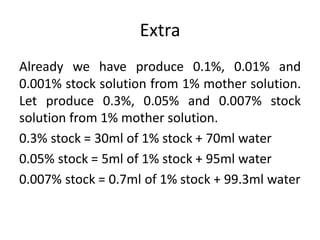
Extra
Already we have produce 0.1%, 0.01% and
0.001% stock solution from 1% mother solution.
Let produce 0.3%, 0.05% and 0.007% stock
solution from 1% mother solution.
0.3% stock = 30ml of 1% stock + 70ml water
0.05% stock = 5ml of 1% stock + 95ml water
0.007% stock = 0.7ml of 1% stock + 99.3ml water
Thanks

Stock Solution Calculation in Dyeing

  • 1.
    Stock Solution Calculation inDyeing Swaraz Mollick BSc in Textile Engineering (WPE) Khulna University of Engineering & Technology (KUET)
  • 2.
    Stock solution In dyeinglab, for small amount of fabric/fabric sample, the recipe is to be calculated. But for small amount of fabric, the amount of dyes and chemicals are not taken precisely due to small quantity. So, Stock solution is to be needed to prepare sometimes.
  • 3.
    What Stock solutionmeans? Stock solution is expressed as percentage. But what percentage of which? There is also a term called ‘Mother solution’. Let’s see. x% stock solution means – 1) x gram solid particle + 100 ml water or 2) X ml liquid + (100-x) ml water
  • 4.
    Example of stocksolution So, now how can we produce 1% stock solution of reactive dye? It is easy. Measure 1g of reactive dye and mix it with 100ml water. 1% stock = 1g reactive dye + 100 ml water. Similarly, 3% stock = 3g reactive dye + 100 ml water NB: As the reactive dyes are in solid particle, that’s why it is taken in gram.
  • 5.
    Example of stocksolution But how can we produce 1% stock solution of acetic acid. Let’s see 1% stock = 1ml acetic acid + 99ml water Similarly, 3% stock = 3ml acetic acid + 97ml water So, now it’s clear that for solid particle, requirement of water is always 100ml, but for liquid, the water required is (100-ml of liquid taken).
  • 6.
    Where is theproblem? We already know that how can we produce certain percentage of stock solution. Whether it is solid or liquid. But there is a difficulty, not a problem. Suppose, we have to produce 1% stock solution of solid. Then, 1g of solid can be measured accurately by electric balance. But if we have to produce 0.1%, 0.01% or 0.001% or much less stock solution. It is very difficult to measure 0.1g, 0.01g or 0.001g of solid. So, then how can we produce this stock? Well, there is the requirement of ‘Mother solution’.
  • 7.
    Mother solution Mother solutionis basically 1% stock solution, from which other percentage of stock solution can be prepared. Percentage of mother solution can vary. But 1% solution is great because other solution can be prepared easily from this solution.
  • 8.
    Problem solved Now, wewill produce 0.1%, 0.01% and 0.001% stock solution. To produce these, at first we have to produce Mother solution of 1%. That is, For solid – 1g solid + 100ml water For liquid – 1ml liquid + 99ml water Let produce our required solution…
  • 9.
    Problem solved 0.1% stock= 10ml of 1% stock + 90ml water 0.01% stock = 1ml of 1% stock + 99ml water = 10ml of 0.1% stock + 90ml water 0.001% stock = 0.1ml of 1% stock + 99.9ml water = 1ml of 0.1% stock + 99ml water = 10ml of 0.01% stock + 90ml water
  • 10.
    How it works? Areyou confused? If you are, then let’s crack this- 1% stock solution contains 1g of solid or 1ml of liquid. After solution, it totally turns into liquid. Now, for 1% stock, 100ml contains 1g solid or 1ml liquid, so 10 ml contains (0.1g solid + 10ml water) and (0.1ml liquid + 9.9ml water). So when we add 10ml of 1% stock with 90ml water. The stock turns into 0.1% stock. Similarly 0.01% and 0.001% stock are prepared.
  • 11.
    Extra Already we haveproduce 0.1%, 0.01% and 0.001% stock solution from 1% mother solution. Let produce 0.3%, 0.05% and 0.007% stock solution from 1% mother solution. 0.3% stock = 30ml of 1% stock + 70ml water 0.05% stock = 5ml of 1% stock + 95ml water 0.007% stock = 0.7ml of 1% stock + 99.3ml water
  • 12.