Zain-ul-Abideen
M.Sc Applied Chemistry
GC University, Fsd
Natural dyes are dyes or colorants
derived from plants, invertebrates,
or minerals. The majority of natural
dyes are vegetable dyes from plant
sources—roots, berries, bark, leaves,
and wood—and other organic sources
such as fungi and lichens.
 Substances with intense colours are often
called colorants. Colorants may be natural or
synthetic. Plants are a source of natural
colorants.
 ƒColorants used for textile and food are
often called dyes.
 ƒColorants used for inks, paints and cosmetics
are often called pigments.
 A plant usually contains a mixture of natural
dyes. This mixture is often extracted and
used to dye textiles. However, a particular
dye may be extracted from the mixture to be
used alone.
 Natural dyes may be grouped according to
their chemical structures. Here are some
important groups
 Carotenoids
1.Carotenes (orange or red-orange)
2. Xanthophylls (yellow)
 Flavonoids
1. Flavones and flavonols
2. Anthocyanidins and anthocyanins
 Anthracenes
1. Anthraquinones
2. Napthoquinones
 There are two major types of carotenoids
orange or red-orange yellow
 Carotenes are found in, for example, carrots,
red peppers, oranges and tomatoes. They are
also responsible for the colour of most yellow
and orange flowers. Xanthophylls are found
in, for example, nettles, French marigolds,
annatto and saffron.
 Most carotenes are hydrocarbons though
some also contain oxygen atoms. The most
well-known is often simply called carotene
It’s found in carrots and has the chemical
structure:
All carotenoids are based on this carotene structure.
The central carbon chain remains the same, but the
groups at either end differ slightly. The central chain
consists of 18 carbon atoms bonded alternatively with
single and double covalent bonds with four methyl
groups attached (always in the same positions). The
sequence of alternative single and double covalent
bonds is called a conjugated system.
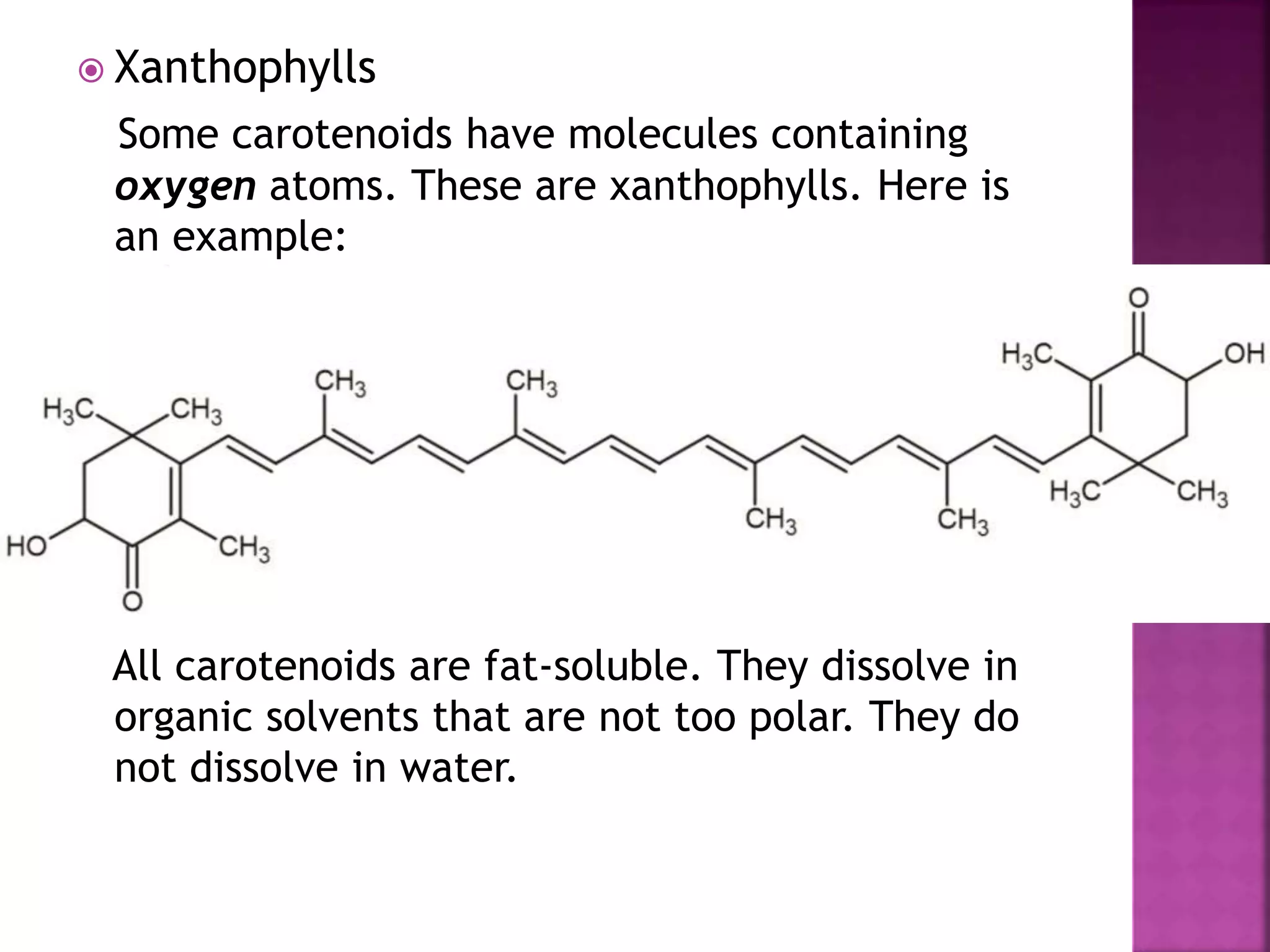
 Xanthophylls
Some carotenoids have molecules containing
oxygen atoms. These are xanthophylls. Here is
an example:
All carotenoids are fat-soluble. They dissolve in
organic solvents that are not too polar. They do
not dissolve in water.
Flavonoids are water-soluble compounds with
molecules derived from 2-phenyl-1,4-benzopyrone
 Flavones and Flavonols
have yellowish colours. The colours are sensitive to
pH. The yellow becomes much deeper in solutions of
high pH. The colours of flavones tend not to fade in
strong light as flavonols do, but they are paler.
Example: Quercetin, Kaempferol and Myricetin
(found in many families, including onions, horse
chestnuts and tea )
 Anthocyanidins and Anthocyanins
are the most highly coloured of the flavonoids.
They are responsible for the scarlets, reds, violets
and blues in many flowers, fruits and vegetables.
The general structure for an anthocyanidin
The most common anthocyanidins
R 1= OH
R 2= OH
R 3 = H
Cyanidin (Red-Purple)
When anthocyanidins bond to sugar molecules they become
anthocyanins.
 This positive charge on this cation is balanced by an anion,
e.g. chloride, Cl-.
 The chromophore (functional group responsible for color)
is:
 Occurance
 Pigmented leaves and flowers of many plants
 Fruit such as blackcurrants, aubergines, oranges,
blackberries, raspberries, cherries and redcurrants.
 Anthraquinones
Alizarin and Madder Plant (Red Shades)
 Napthoquinones
Juglone found in Walnut (Brownish shades)
 The colour of red beetroot is due to betanin, which can be
extracted easily from the vegetable. It makes up 95% of
the red pigments in the extract. Betanin is a betacyanin – a
group of red dyes once thought to be flavonoids. Like
anthocyanins they are glycosides. However, their
molecules contain nitrogen. Also, they do not change
colour reversibly when pH changes as anthocyanins do.
 Tannins are present in most plant tissues, being produced
from the flavonoids, especially the anthocyanins, when
tissues break down. They are found, for example, in the
bark of oak and willow.
 Natural dyes are known for their use in coloring of food
substrate , leather as well as natural protein fiber like
wool and silk and cotton as a major areas of application
from pre-historic times.
 Non-toxic and non-allergic effects of natural dyes instead
of synthetic dyes.
 These are biodegradable
 Natural dyes produce very soothing and soft shades as
compared to synthetic dyes
 However, natural dyes are expensive
Natural dyes

Natural dyes

  • 1.
  • 2.
    Natural dyes aredyes or colorants derived from plants, invertebrates, or minerals. The majority of natural dyes are vegetable dyes from plant sources—roots, berries, bark, leaves, and wood—and other organic sources such as fungi and lichens.
  • 3.
     Substances withintense colours are often called colorants. Colorants may be natural or synthetic. Plants are a source of natural colorants.  ƒColorants used for textile and food are often called dyes.  ƒColorants used for inks, paints and cosmetics are often called pigments.
  • 4.
     A plantusually contains a mixture of natural dyes. This mixture is often extracted and used to dye textiles. However, a particular dye may be extracted from the mixture to be used alone.
  • 5.
     Natural dyesmay be grouped according to their chemical structures. Here are some important groups  Carotenoids 1.Carotenes (orange or red-orange) 2. Xanthophylls (yellow)  Flavonoids 1. Flavones and flavonols 2. Anthocyanidins and anthocyanins  Anthracenes 1. Anthraquinones 2. Napthoquinones
  • 6.
     There aretwo major types of carotenoids orange or red-orange yellow
  • 7.
     Carotenes arefound in, for example, carrots, red peppers, oranges and tomatoes. They are also responsible for the colour of most yellow and orange flowers. Xanthophylls are found in, for example, nettles, French marigolds, annatto and saffron.  Most carotenes are hydrocarbons though some also contain oxygen atoms. The most well-known is often simply called carotene It’s found in carrots and has the chemical structure:
  • 8.
    All carotenoids arebased on this carotene structure. The central carbon chain remains the same, but the groups at either end differ slightly. The central chain consists of 18 carbon atoms bonded alternatively with single and double covalent bonds with four methyl groups attached (always in the same positions). The sequence of alternative single and double covalent bonds is called a conjugated system.
  • 9.
     Xanthophylls Some carotenoidshave molecules containing oxygen atoms. These are xanthophylls. Here is an example: All carotenoids are fat-soluble. They dissolve in organic solvents that are not too polar. They do not dissolve in water.
  • 10.
    Flavonoids are water-solublecompounds with molecules derived from 2-phenyl-1,4-benzopyrone
  • 11.
     Flavones andFlavonols have yellowish colours. The colours are sensitive to pH. The yellow becomes much deeper in solutions of high pH. The colours of flavones tend not to fade in strong light as flavonols do, but they are paler. Example: Quercetin, Kaempferol and Myricetin (found in many families, including onions, horse chestnuts and tea )
  • 12.
     Anthocyanidins andAnthocyanins are the most highly coloured of the flavonoids. They are responsible for the scarlets, reds, violets and blues in many flowers, fruits and vegetables. The general structure for an anthocyanidin The most common anthocyanidins R 1= OH R 2= OH R 3 = H Cyanidin (Red-Purple) When anthocyanidins bond to sugar molecules they become anthocyanins.
  • 13.
     This positivecharge on this cation is balanced by an anion, e.g. chloride, Cl-.  The chromophore (functional group responsible for color) is:  Occurance  Pigmented leaves and flowers of many plants  Fruit such as blackcurrants, aubergines, oranges, blackberries, raspberries, cherries and redcurrants.
  • 15.
     Anthraquinones Alizarin andMadder Plant (Red Shades)  Napthoquinones Juglone found in Walnut (Brownish shades)
  • 16.
     The colourof red beetroot is due to betanin, which can be extracted easily from the vegetable. It makes up 95% of the red pigments in the extract. Betanin is a betacyanin – a group of red dyes once thought to be flavonoids. Like anthocyanins they are glycosides. However, their molecules contain nitrogen. Also, they do not change colour reversibly when pH changes as anthocyanins do.  Tannins are present in most plant tissues, being produced from the flavonoids, especially the anthocyanins, when tissues break down. They are found, for example, in the bark of oak and willow.
  • 17.
     Natural dyesare known for their use in coloring of food substrate , leather as well as natural protein fiber like wool and silk and cotton as a major areas of application from pre-historic times.  Non-toxic and non-allergic effects of natural dyes instead of synthetic dyes.  These are biodegradable  Natural dyes produce very soothing and soft shades as compared to synthetic dyes  However, natural dyes are expensive