PRODUCTION AND
OPERATIONS MANAGEMENT
Prepared by
Prof. Jitendra Patel
Assistant Professor
Prestige Institute of Management and Research
Indore
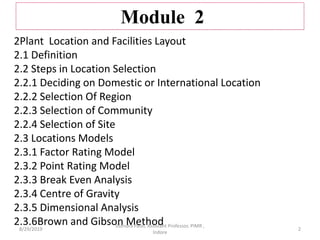
2Plant Location and Facilities Layout
2.1 Definition
2.2 Steps in Location Selection
2.2.1 Deciding on Domestic or International Location
2.2.2 Selection Of Region
2.2.3 Selection of Community
2.2.4 Selection of Site
2.3 Locations Models
2.3.1 Factor Rating Model
2.3.2 Point Rating Model
2.3.3 Break Even Analysis
2.3.4 Centre of Gravity
2.3.5 Dimensional Analysis
2.3.6Brown and Gibson Method
Module 2
8/29/2019 2
Jitendra Patel, Assistant Professor, PIMR ,
Indore
Plant location is the function of determining
location for a plant for maximum operating
economy and effectiveness.
Plant Location
8/29/2019 3
Jitendra Patel, Assistant Professor, PIMR ,
Indore
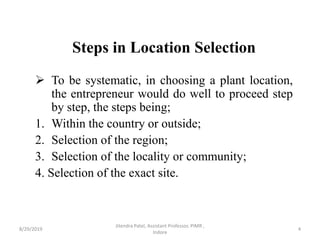
Steps in Location Selection
 To be systematic, in choosing a plant location,
the entrepreneur would do well to proceed step
by step, the steps being;
1. Within the country or outside;
2. Selection of the region;
3. Selection of the locality or community;
4. Selection of the exact site.
8/29/2019 4
Jitendra Patel, Assistant Professor, PIMR ,
Indore
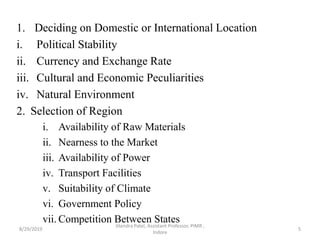
1. Deciding on Domestic or International Location
i. Political Stability
ii. Currency and Exchange Rate
iii. Cultural and Economic Peculiarities
iv. Natural Environment
2. Selection of Region
i. Availability of Raw Materials
ii. Nearness to the Market
iii. Availability of Power
iv. Transport Facilities
v. Suitability of Climate
vi. Government Policy
vii. Competition Between States
8/29/2019 5
Jitendra Patel, Assistant Professor, PIMR ,
Indore
3. Selection of Community
• Availability of Labour
• Civic Amenities for Workers
• Existence of Complementary and Competing
Industries
• Finance and Research Facilities
• Availability of Water and Fire-fighting
Facilities
• Local Taxes and Restrictions
• Momentum of an Early Start
• Personal Factors
4. Selection of the Site
i. Soil, Size and Topography
ii. Disposal of Waste
8/29/2019 6
Jitendra Patel, Assistant Professor, PIMR ,
Indore
Location Models
 Various models are available which help
identify a near ideal location. The most popular
models are:
1. Factor Rating Method
2. Point Rating Method
3. Break-even Analysis
4. Centre Of Gravity
5. Dimensional Analysis
6. Brown and Gibson Method
8/29/2019 7
Jitendra Patel, Assistant Professor, PIMR ,
Indore
Factor-Rating Method
Factor rating is used to evaluate alternative
Locations
Six steps in the method
1. Develop a list of relevant factors called critical success
factors
2. Assign a weight to each factor
3. Develop a scale for each factor
4. Score each location for each factor
5. Multiply score by weights for each factor for each
location
6. Recommend the location with the highest point score
8/29/2019 8
Jitendra Patel, Assistant Professor, PIMR ,
Indore
Advantage of Factor Rating
• Simplicity which facilitates communication
about why one location/site is better than
another
• Enables bringing diverse location
considerations into evaluation alternatives
• Foster consistency of Judgment about
location alternatives
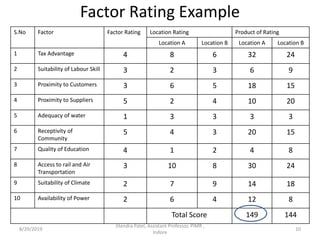
Factor Rating Example
S.No Factor Factor Rating Location Rating Product of Rating
Location A Location B Location A Location B
1 Tax Advantage 4 8 6 32 24
2 Suitability of Labour Skill 3 2 3 6 9
3 Proximity to Customers 3 6 5 18 15
4 Proximity to Suppliers 5 2 4 10 20
5 Adequacy of water 1 3 3 3 3
6 Receptivity of
Community
5 4 3 20 15
7 Quality of Education 4 1 2 4 8
8 Access to rail and Air
Transportation
3 10 8 30 24
9 Suitability of Climate 2 7 9 14 18
10 Availability of Power 2 6 4 12 8
Total Score 149 144
8/29/2019 10
Jitendra Patel, Assistant Professor, PIMR ,
Indore
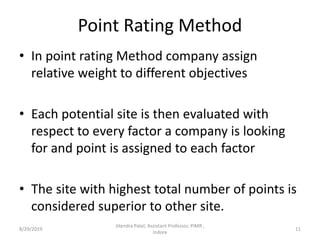
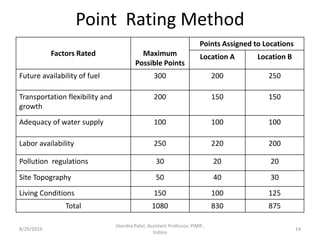
Point Rating Method
• In point rating Method company assign
relative weight to different objectives
• Each potential site is then evaluated with
respect to every factor a company is looking
for and point is assigned to each factor
• The site with highest total number of points is
considered superior to other site.
8/29/2019 11
Jitendra Patel, Assistant Professor, PIMR ,
Indore
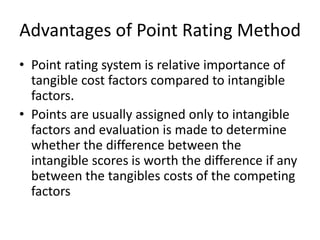
Advantages of Point Rating Method
• Point rating system is relative importance of
tangible cost factors compared to intangible
factors.
• Points are usually assigned only to intangible
factors and evaluation is made to determine
whether the difference between the
intangible scores is worth the difference if any
between the tangibles costs of the competing
factors
Drawback of Point Rating Method
• The drawback of Point Rating Method is that
high score in any factor can overcome a low
score in any other factor.
Point Rating Method
Factors Rated Maximum
Possible Points
Points Assigned to Locations
Location A Location B
Future availability of fuel 300 200 250
Transportation flexibility and
growth
200 150 150
Adequacy of water supply 100 100 100
Labor availability 250 220 200
Pollution regulations 30 20 20
Site Topography 50 40 30
Living Conditions 150 100 125
Total 1080 830 875
8/29/2019 14
Jitendra Patel, Assistant Professor, PIMR ,
Indore
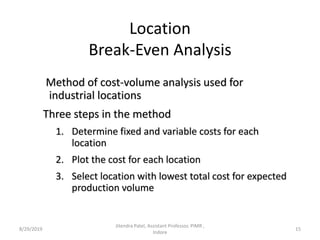
Location
Break-Even Analysis
Method of cost-volume analysis used for
industrial locations
Three steps in the method
1. Determine fixed and variable costs for each
location
2. Plot the cost for each location
3. Select location with lowest total cost for expected
production volume
8/29/2019 15
Jitendra Patel, Assistant Professor, PIMR ,
Indore
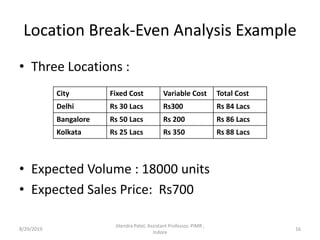
Location Break-Even Analysis Example
• Three Locations :
• Expected Volume : 18000 units
• Expected Sales Price: Rs700
City Fixed Cost Variable Cost Total Cost
Delhi Rs 30 Lacs Rs300 Rs 84 Lacs
Bangalore Rs 50 Lacs Rs 200 Rs 86 Lacs
Kolkata Rs 25 Lacs Rs 350 Rs 88 Lacs
8/29/2019 16
Jitendra Patel, Assistant Professor, PIMR ,
Indore
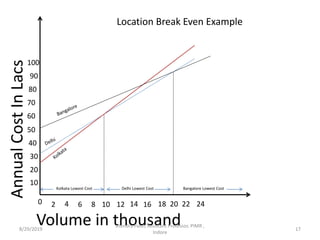
10
20
30
40
50
60
70
80
90
100
AnnualCostInLacs
0 2 4 6 8 10 12 14 16 18 20 22 24
Volume in thousand
Kolkata Lowest Cost Delhi Lowest Cost Bangalore Lowest Cost
Location Break Even Example
8/29/2019 17
Jitendra Patel, Assistant Professor, PIMR ,
Indore
Center-of-Gravity Method
Finds location of distribution center that
minimizes distribution costs
Consideration for Center of Gravity
Method
• Location of markets
• Volume of goods shipped to those
markets
• Shipping cost (or distance)
8/29/2019 18
Jitendra Patel, Assistant Professor, PIMR ,
Indore
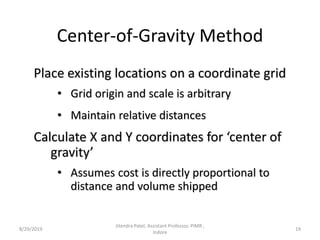
Center-of-Gravity Method
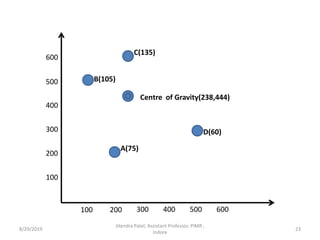
Place existing locations on a coordinate grid
• Grid origin and scale is arbitrary
• Maintain relative distances
Calculate X and Y coordinates for ‘center of
gravity’
• Assumes cost is directly proportional to
distance and volume shipped
8/29/2019 19
Jitendra Patel, Assistant Professor, PIMR ,
Indore
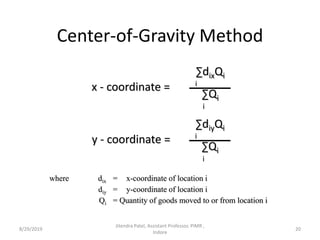
Center-of-Gravity Method
x - coordinate =
∑dixQi
∑Qi
i
i
∑diyQi
∑Qi
i
i
y - coordinate =
where dix = x-coordinate of location i
diy = y-coordinate of location i
Qi = Quantity of goods moved to or from location i
8/29/2019 20
Jitendra Patel, Assistant Professor, PIMR ,
Indore
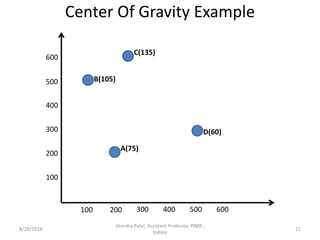
Center Of Gravity Example
100
200
300
400
500
600
400300 500200100 600
A(75)
C(135)
D(60)
B(105)
8/29/2019 21
Jitendra Patel, Assistant Professor, PIMR ,
Indore
Centre Of Gravity Example
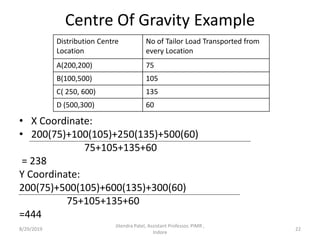
• X Coordinate:
• 200(75)+100(105)+250(135)+500(60)
75+105+135+60
= 238
Y Coordinate:
200(75)+500(105)+600(135)+300(60)
75+105+135+60
=444
Distribution Centre
Location
No of Tailor Load Transported from
every Location
A(200,200) 75
B(100,500) 105
C( 250, 600) 135
D (500,300) 60
8/29/2019 22
Jitendra Patel, Assistant Professor, PIMR ,
Indore
100
200
300
400
500
600
400300 500200100 600
A(75)
C(135)
D(60)
B(105)
Centre of Gravity(238,444)
8/29/2019 23
Jitendra Patel, Assistant Professor, PIMR ,
Indore
Dimension Analysis
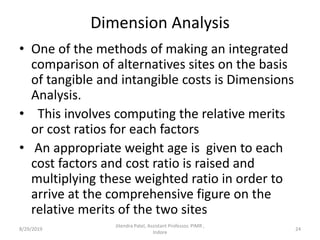
• One of the methods of making an integrated
comparison of alternatives sites on the basis
of tangible and intangible costs is Dimensions
Analysis.
• This involves computing the relative merits
or cost ratios for each factors
• An appropriate weight age is given to each
cost factors and cost ratio is raised and
multiplying these weighted ratio in order to
arrive at the comprehensive figure on the
relative merits of the two sites
8/29/2019 24
Jitendra Patel, Assistant Professor, PIMR ,
Indore
Dimension Analysis
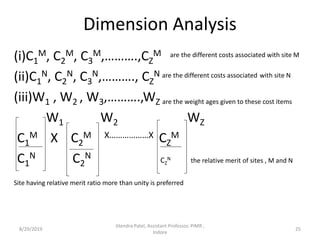
(i)C1
M, C2
M, C3
M,……….,CZ
M are the different costs associated with site M
(ii)C1
N, C2
N, C3
N,………., CZ
N are the different costs associated with site N
(iii)W1 , W2 , W3,……….,WZ are the weight ages given to these cost items
W1 W2 WZ
C1
M X C2
M X………………X CZ
M
C1
N C2
N CZ
N the relative merit of sites , M and N
Site having relative merit ratio more than unity is preferred
8/29/2019 25
Jitendra Patel, Assistant Professor, PIMR ,
Indore
Merit of Dimension Analysis
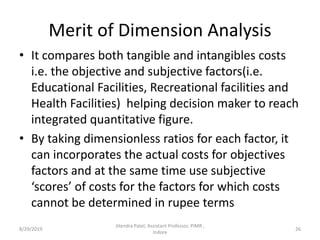
• It compares both tangible and intangibles costs
i.e. the objective and subjective factors(i.e.
Educational Facilities, Recreational facilities and
Health Facilities) helping decision maker to reach
integrated quantitative figure.
• By taking dimensionless ratios for each factor, it
can incorporates the actual costs for objectives
factors and at the same time use subjective
‘scores’ of costs for the factors for which costs
cannot be determined in rupee terms
8/29/2019 26
Jitendra Patel, Assistant Professor, PIMR ,
Indore
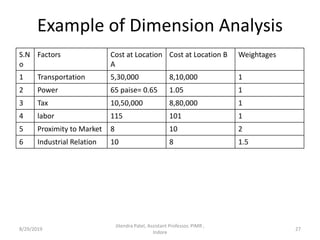
Example of Dimension Analysis
S.N
o
Factors Cost at Location
A
Cost at Location B Weightages
1 Transportation 5,30,000 8,10,000 1
2 Power 65 paise= 0.65 1.05 1
3 Tax 10,50,000 8,80,000 1
4 labor 115 101 1
5 Proximity to Market 8 10 2
6 Industrial Relation 10 8 1.5
8/29/2019 27
Jitendra Patel, Assistant Professor, PIMR ,
Indore
Solution
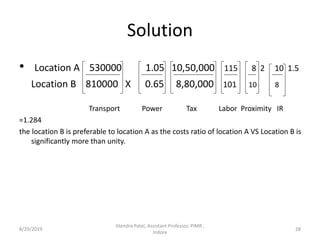
• Location A 530000 1.05 10,50,000 115 8 2 10 1.5
Location B 810000 X 0.65 8,80,000 101 10 8
Transport Power Tax Labor Proximity IR
=1.284
the location B is preferable to location A as the costs ratio of location A VS Location B is
significantly more than unity.
8/29/2019 28
Jitendra Patel, Assistant Professor, PIMR ,
Indore
BROWN AND GIBSON’S METHOD
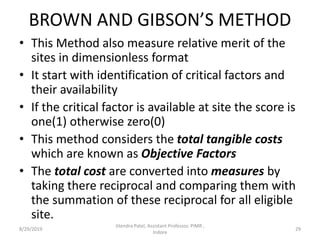
• This Method also measure relative merit of the
sites in dimensionless format
• It start with identification of critical factors and
their availability
• If the critical factor is available at site the score is
one(1) otherwise zero(0)
• This method considers the total tangible costs
which are known as Objective Factors
• The total cost are converted into measures by
taking there reciprocal and comparing them with
the summation of these reciprocal for all eligible
site.
8/29/2019 29
Jitendra Patel, Assistant Professor, PIMR ,
Indore
Objective Factor Cost Formula
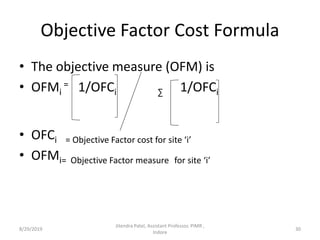
• The objective measure (OFM) is
• OFMi
= 1/OFCi ∑ 1/OFCi
• OFCi = Objective Factor cost for site ‘i’
• OFMi= Objective Factor measure for site ‘i’
8/29/2019 30
Jitendra Patel, Assistant Professor, PIMR ,
Indore
Subjective Factor Measure Formula
• This method also consider subjective factors such as
industrial relation, climate , recreational facilities and
educational facilities , proximity to the large city
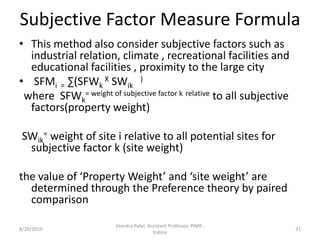
• SFMi = ∑(SFWk
X SWik
)
where SFWk
= weight of subjective factor k relative to all subjective
factors(property weight)
SWik
= weight of site i relative to all potential sites for
subjective factor k (site weight)
the value of ‘Property Weight’ and ‘site weight’ are
determined through the Preference theory by paired
comparison
8/29/2019 31
Jitendra Patel, Assistant Professor, PIMR ,
Indore
Location Measure Formula
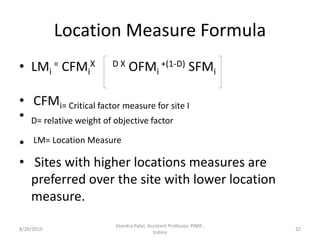
• LMi
= CFMi
X D X OFMi
+(1-D) SFMi
• CFMi= Critical factor measure for site I
• D= relative weight of objective factor
• LM= Location Measure
• Sites with higher locations measures are
preferred over the site with lower location
measure.
8/29/2019 32
Jitendra Patel, Assistant Professor, PIMR ,
Indore
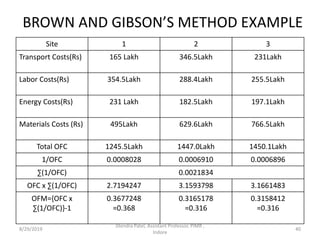
BROWN AND GIBSON’S METHOD EXAMPLE
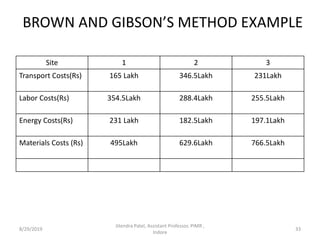
Site 1 2 3
Transport Costs(Rs) 165 Lakh 346.5Lakh 231Lakh
Labor Costs(Rs) 354.5Lakh 288.4Lakh 255.5Lakh
Energy Costs(Rs) 231 Lakh 182.5Lakh 197.1Lakh
Materials Costs (Rs) 495Lakh 629.6Lakh 766.5Lakh
8/29/2019 33
Jitendra Patel, Assistant Professor, PIMR ,
Indore
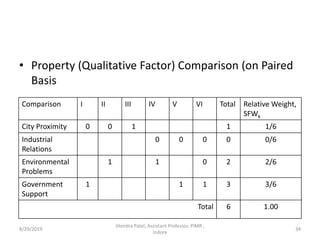
• Property (Qualitative Factor) Comparison (on Paired
Basis
Comparison I II III IV V VI Total Relative Weight,
SFWk
City Proximity 0 0 1 1 1/6
Industrial
Relations
0 0 0 0 0/6
Environmental
Problems
1 1 0 2 2/6
Government
Support
1 1 1 3 3/6
Total 6 1.00
8/29/2019 34
Jitendra Patel, Assistant Professor, PIMR ,
Indore
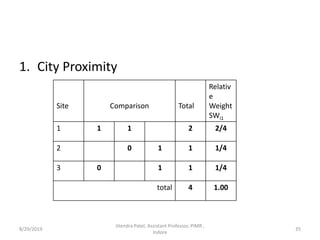
1. City Proximity
Site Comparison Total
Relativ
e
Weight
SWi1
1 1 1 2 2/4
2 0 1 1 1/4
3 0 1 1 1/4
total 4 1.00
8/29/2019 35
Jitendra Patel, Assistant Professor, PIMR ,
Indore
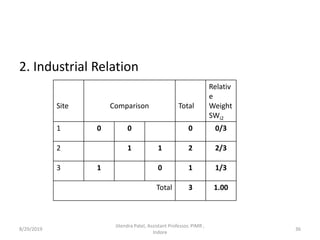
2. Industrial Relation
Site Comparison Total
Relativ
e
Weight
SWi2
1 0 0 0 0/3
2 1 1 2 2/3
3 1 0 1 1/3
Total 3 1.00
8/29/2019 36
Jitendra Patel, Assistant Professor, PIMR ,
Indore
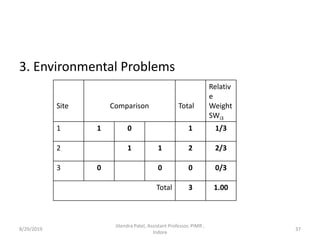
3. Environmental Problems
Site Comparison Total
Relativ
e
Weight
SWi3
1 1 0 1 1/3
2 1 1 2 2/3
3 0 0 0 0/3
Total 3 1.00
8/29/2019 37
Jitendra Patel, Assistant Professor, PIMR ,
Indore
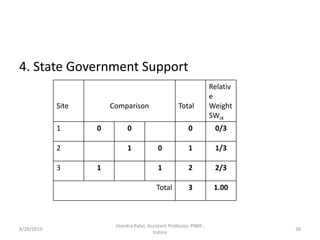
4. State Government Support
Site Comparison Total
Relativ
e
Weight
SWi4
1 0 0 0 0/3
2 1 0 1 1/3
3 1 1 2 2/3
Total 3 1.00
8/29/2019 38
Jitendra Patel, Assistant Professor, PIMR ,
Indore
• Location Measure
• LM= CFM x [D x OFM+ (1-D)x SFM]
• D(objective Factor Decision weight) =1- 0.40=0.60
8/29/2019 39
Jitendra Patel, Assistant Professor, PIMR ,
Indore
BROWN AND GIBSON’S METHOD EXAMPLE
Site 1 2 3
Transport Costs(Rs) 165 Lakh 346.5Lakh 231Lakh
Labor Costs(Rs) 354.5Lakh 288.4Lakh 255.5Lakh
Energy Costs(Rs) 231 Lakh 182.5Lakh 197.1Lakh
Materials Costs (Rs) 495Lakh 629.6Lakh 766.5Lakh
Total OFC 1245.5Lakh 1447.0Lakh 1450.1Lakh
1/OFC 0.0008028 0.0006910 0.0006896
∑(1/OFC) 0.0021834
OFC x ∑(1/OFC) 2.7194247 3.1593798 3.1661483
OFM={OFC x
∑(1/OFC)}-1
0.3677248
=0.368
0.3165178
=0.316
0.3158412
=0.316
8/29/2019 40
Jitendra Patel, Assistant Professor, PIMR ,
Indore
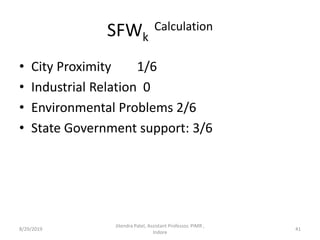
SFWk
Calculation
• City Proximity 1/6
• Industrial Relation 0
• Environmental Problems 2/6
• State Government support: 3/6
8/29/2019 41
Jitendra Patel, Assistant Professor, PIMR ,
Indore
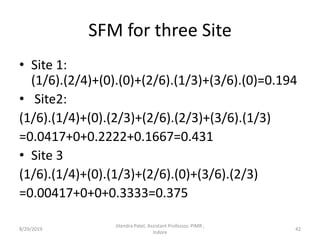
SFM for three Site
• Site 1:
(1/6).(2/4)+(0).(0)+(2/6).(1/3)+(3/6).(0)=0.194
• Site2:
(1/6).(1/4)+(0).(2/3)+(2/6).(2/3)+(3/6).(1/3)
=0.0417+0+0.2222+0.1667=0.431
• Site 3
(1/6).(1/4)+(0).(1/3)+(2/6).(0)+(3/6).(2/3)
=0.00417+0+0+0.3333=0.375
8/29/2019 42
Jitendra Patel, Assistant Professor, PIMR ,
Indore
LM Calculation for three Site
• Site 1
• LM= CFM x [D x OFM+ (1-D)x SFM]
= 1x[.60x 0.368+0.40 x0.194]
=0.2984
Site 2
= 1x[.60x 0.316+0.40 x0.431]
=0.3620
Site 3
=1x[.60x 0.316+0.40 x0.375]
=0.3396
Site 2 having highest Location Measure is preferred over other
two site.
8/29/2019 43
Jitendra Patel, Assistant Professor, PIMR ,
Indore
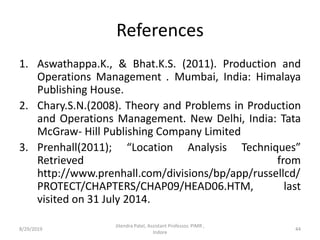
References
1. Aswathappa.K., & Bhat.K.S. (2011). Production and
Operations Management . Mumbai, India: Himalaya
Publishing House.
2. Chary.S.N.(2008). Theory and Problems in Production
and Operations Management. New Delhi, India: Tata
McGraw- Hill Publishing Company Limited
3. Prenhall(2011); “Location Analysis Techniques”
Retrieved from
http://www.prenhall.com/divisions/bp/app/russellcd/
PROTECT/CHAPTERS/CHAP09/HEAD06.HTM, last
visited on 31 July 2014.
8/29/2019 44
Jitendra Patel, Assistant Professor, PIMR ,
Indore
8/29/2019 45
Jitendra Patel, Assistant Professor, PIMR ,
Indore

Plant location

  • 1.
    PRODUCTION AND OPERATIONS MANAGEMENT Preparedby Prof. Jitendra Patel Assistant Professor Prestige Institute of Management and Research Indore
  • 2.
    2Plant Location andFacilities Layout 2.1 Definition 2.2 Steps in Location Selection 2.2.1 Deciding on Domestic or International Location 2.2.2 Selection Of Region 2.2.3 Selection of Community 2.2.4 Selection of Site 2.3 Locations Models 2.3.1 Factor Rating Model 2.3.2 Point Rating Model 2.3.3 Break Even Analysis 2.3.4 Centre of Gravity 2.3.5 Dimensional Analysis 2.3.6Brown and Gibson Method Module 2 8/29/2019 2 Jitendra Patel, Assistant Professor, PIMR , Indore
  • 3.
    Plant location isthe function of determining location for a plant for maximum operating economy and effectiveness. Plant Location 8/29/2019 3 Jitendra Patel, Assistant Professor, PIMR , Indore
  • 4.
    Steps in LocationSelection  To be systematic, in choosing a plant location, the entrepreneur would do well to proceed step by step, the steps being; 1. Within the country or outside; 2. Selection of the region; 3. Selection of the locality or community; 4. Selection of the exact site. 8/29/2019 4 Jitendra Patel, Assistant Professor, PIMR , Indore
  • 5.
    1. Deciding onDomestic or International Location i. Political Stability ii. Currency and Exchange Rate iii. Cultural and Economic Peculiarities iv. Natural Environment 2. Selection of Region i. Availability of Raw Materials ii. Nearness to the Market iii. Availability of Power iv. Transport Facilities v. Suitability of Climate vi. Government Policy vii. Competition Between States 8/29/2019 5 Jitendra Patel, Assistant Professor, PIMR , Indore
  • 6.
    3. Selection ofCommunity • Availability of Labour • Civic Amenities for Workers • Existence of Complementary and Competing Industries • Finance and Research Facilities • Availability of Water and Fire-fighting Facilities • Local Taxes and Restrictions • Momentum of an Early Start • Personal Factors 4. Selection of the Site i. Soil, Size and Topography ii. Disposal of Waste 8/29/2019 6 Jitendra Patel, Assistant Professor, PIMR , Indore
  • 7.
    Location Models  Variousmodels are available which help identify a near ideal location. The most popular models are: 1. Factor Rating Method 2. Point Rating Method 3. Break-even Analysis 4. Centre Of Gravity 5. Dimensional Analysis 6. Brown and Gibson Method 8/29/2019 7 Jitendra Patel, Assistant Professor, PIMR , Indore
  • 8.
    Factor-Rating Method Factor ratingis used to evaluate alternative Locations Six steps in the method 1. Develop a list of relevant factors called critical success factors 2. Assign a weight to each factor 3. Develop a scale for each factor 4. Score each location for each factor 5. Multiply score by weights for each factor for each location 6. Recommend the location with the highest point score 8/29/2019 8 Jitendra Patel, Assistant Professor, PIMR , Indore
  • 9.
    Advantage of FactorRating • Simplicity which facilitates communication about why one location/site is better than another • Enables bringing diverse location considerations into evaluation alternatives • Foster consistency of Judgment about location alternatives
  • 10.
    Factor Rating Example S.NoFactor Factor Rating Location Rating Product of Rating Location A Location B Location A Location B 1 Tax Advantage 4 8 6 32 24 2 Suitability of Labour Skill 3 2 3 6 9 3 Proximity to Customers 3 6 5 18 15 4 Proximity to Suppliers 5 2 4 10 20 5 Adequacy of water 1 3 3 3 3 6 Receptivity of Community 5 4 3 20 15 7 Quality of Education 4 1 2 4 8 8 Access to rail and Air Transportation 3 10 8 30 24 9 Suitability of Climate 2 7 9 14 18 10 Availability of Power 2 6 4 12 8 Total Score 149 144 8/29/2019 10 Jitendra Patel, Assistant Professor, PIMR , Indore
  • 11.
    Point Rating Method •In point rating Method company assign relative weight to different objectives • Each potential site is then evaluated with respect to every factor a company is looking for and point is assigned to each factor • The site with highest total number of points is considered superior to other site. 8/29/2019 11 Jitendra Patel, Assistant Professor, PIMR , Indore
  • 12.
    Advantages of PointRating Method • Point rating system is relative importance of tangible cost factors compared to intangible factors. • Points are usually assigned only to intangible factors and evaluation is made to determine whether the difference between the intangible scores is worth the difference if any between the tangibles costs of the competing factors
  • 13.
    Drawback of PointRating Method • The drawback of Point Rating Method is that high score in any factor can overcome a low score in any other factor.
  • 14.
    Point Rating Method FactorsRated Maximum Possible Points Points Assigned to Locations Location A Location B Future availability of fuel 300 200 250 Transportation flexibility and growth 200 150 150 Adequacy of water supply 100 100 100 Labor availability 250 220 200 Pollution regulations 30 20 20 Site Topography 50 40 30 Living Conditions 150 100 125 Total 1080 830 875 8/29/2019 14 Jitendra Patel, Assistant Professor, PIMR , Indore
  • 15.
    Location Break-Even Analysis Method ofcost-volume analysis used for industrial locations Three steps in the method 1. Determine fixed and variable costs for each location 2. Plot the cost for each location 3. Select location with lowest total cost for expected production volume 8/29/2019 15 Jitendra Patel, Assistant Professor, PIMR , Indore
  • 16.
    Location Break-Even AnalysisExample • Three Locations : • Expected Volume : 18000 units • Expected Sales Price: Rs700 City Fixed Cost Variable Cost Total Cost Delhi Rs 30 Lacs Rs300 Rs 84 Lacs Bangalore Rs 50 Lacs Rs 200 Rs 86 Lacs Kolkata Rs 25 Lacs Rs 350 Rs 88 Lacs 8/29/2019 16 Jitendra Patel, Assistant Professor, PIMR , Indore
  • 17.
    10 20 30 40 50 60 70 80 90 100 AnnualCostInLacs 0 2 46 8 10 12 14 16 18 20 22 24 Volume in thousand Kolkata Lowest Cost Delhi Lowest Cost Bangalore Lowest Cost Location Break Even Example 8/29/2019 17 Jitendra Patel, Assistant Professor, PIMR , Indore
  • 18.
    Center-of-Gravity Method Finds locationof distribution center that minimizes distribution costs Consideration for Center of Gravity Method • Location of markets • Volume of goods shipped to those markets • Shipping cost (or distance) 8/29/2019 18 Jitendra Patel, Assistant Professor, PIMR , Indore
  • 19.
    Center-of-Gravity Method Place existinglocations on a coordinate grid • Grid origin and scale is arbitrary • Maintain relative distances Calculate X and Y coordinates for ‘center of gravity’ • Assumes cost is directly proportional to distance and volume shipped 8/29/2019 19 Jitendra Patel, Assistant Professor, PIMR , Indore
  • 20.
    Center-of-Gravity Method x -coordinate = ∑dixQi ∑Qi i i ∑diyQi ∑Qi i i y - coordinate = where dix = x-coordinate of location i diy = y-coordinate of location i Qi = Quantity of goods moved to or from location i 8/29/2019 20 Jitendra Patel, Assistant Professor, PIMR , Indore
  • 21.
    Center Of GravityExample 100 200 300 400 500 600 400300 500200100 600 A(75) C(135) D(60) B(105) 8/29/2019 21 Jitendra Patel, Assistant Professor, PIMR , Indore
  • 22.
    Centre Of GravityExample • X Coordinate: • 200(75)+100(105)+250(135)+500(60) 75+105+135+60 = 238 Y Coordinate: 200(75)+500(105)+600(135)+300(60) 75+105+135+60 =444 Distribution Centre Location No of Tailor Load Transported from every Location A(200,200) 75 B(100,500) 105 C( 250, 600) 135 D (500,300) 60 8/29/2019 22 Jitendra Patel, Assistant Professor, PIMR , Indore
  • 23.
    100 200 300 400 500 600 400300 500200100 600 A(75) C(135) D(60) B(105) Centreof Gravity(238,444) 8/29/2019 23 Jitendra Patel, Assistant Professor, PIMR , Indore
  • 24.
    Dimension Analysis • Oneof the methods of making an integrated comparison of alternatives sites on the basis of tangible and intangible costs is Dimensions Analysis. • This involves computing the relative merits or cost ratios for each factors • An appropriate weight age is given to each cost factors and cost ratio is raised and multiplying these weighted ratio in order to arrive at the comprehensive figure on the relative merits of the two sites 8/29/2019 24 Jitendra Patel, Assistant Professor, PIMR , Indore
  • 25.
    Dimension Analysis (i)C1 M, C2 M,C3 M,……….,CZ M are the different costs associated with site M (ii)C1 N, C2 N, C3 N,………., CZ N are the different costs associated with site N (iii)W1 , W2 , W3,……….,WZ are the weight ages given to these cost items W1 W2 WZ C1 M X C2 M X………………X CZ M C1 N C2 N CZ N the relative merit of sites , M and N Site having relative merit ratio more than unity is preferred 8/29/2019 25 Jitendra Patel, Assistant Professor, PIMR , Indore
  • 26.
    Merit of DimensionAnalysis • It compares both tangible and intangibles costs i.e. the objective and subjective factors(i.e. Educational Facilities, Recreational facilities and Health Facilities) helping decision maker to reach integrated quantitative figure. • By taking dimensionless ratios for each factor, it can incorporates the actual costs for objectives factors and at the same time use subjective ‘scores’ of costs for the factors for which costs cannot be determined in rupee terms 8/29/2019 26 Jitendra Patel, Assistant Professor, PIMR , Indore
  • 27.
    Example of DimensionAnalysis S.N o Factors Cost at Location A Cost at Location B Weightages 1 Transportation 5,30,000 8,10,000 1 2 Power 65 paise= 0.65 1.05 1 3 Tax 10,50,000 8,80,000 1 4 labor 115 101 1 5 Proximity to Market 8 10 2 6 Industrial Relation 10 8 1.5 8/29/2019 27 Jitendra Patel, Assistant Professor, PIMR , Indore
  • 28.
    Solution • Location A530000 1.05 10,50,000 115 8 2 10 1.5 Location B 810000 X 0.65 8,80,000 101 10 8 Transport Power Tax Labor Proximity IR =1.284 the location B is preferable to location A as the costs ratio of location A VS Location B is significantly more than unity. 8/29/2019 28 Jitendra Patel, Assistant Professor, PIMR , Indore
  • 29.
    BROWN AND GIBSON’SMETHOD • This Method also measure relative merit of the sites in dimensionless format • It start with identification of critical factors and their availability • If the critical factor is available at site the score is one(1) otherwise zero(0) • This method considers the total tangible costs which are known as Objective Factors • The total cost are converted into measures by taking there reciprocal and comparing them with the summation of these reciprocal for all eligible site. 8/29/2019 29 Jitendra Patel, Assistant Professor, PIMR , Indore
  • 30.
    Objective Factor CostFormula • The objective measure (OFM) is • OFMi = 1/OFCi ∑ 1/OFCi • OFCi = Objective Factor cost for site ‘i’ • OFMi= Objective Factor measure for site ‘i’ 8/29/2019 30 Jitendra Patel, Assistant Professor, PIMR , Indore
  • 31.
    Subjective Factor MeasureFormula • This method also consider subjective factors such as industrial relation, climate , recreational facilities and educational facilities , proximity to the large city • SFMi = ∑(SFWk X SWik ) where SFWk = weight of subjective factor k relative to all subjective factors(property weight) SWik = weight of site i relative to all potential sites for subjective factor k (site weight) the value of ‘Property Weight’ and ‘site weight’ are determined through the Preference theory by paired comparison 8/29/2019 31 Jitendra Patel, Assistant Professor, PIMR , Indore
  • 32.
    Location Measure Formula •LMi = CFMi X D X OFMi +(1-D) SFMi • CFMi= Critical factor measure for site I • D= relative weight of objective factor • LM= Location Measure • Sites with higher locations measures are preferred over the site with lower location measure. 8/29/2019 32 Jitendra Patel, Assistant Professor, PIMR , Indore
  • 33.
    BROWN AND GIBSON’SMETHOD EXAMPLE Site 1 2 3 Transport Costs(Rs) 165 Lakh 346.5Lakh 231Lakh Labor Costs(Rs) 354.5Lakh 288.4Lakh 255.5Lakh Energy Costs(Rs) 231 Lakh 182.5Lakh 197.1Lakh Materials Costs (Rs) 495Lakh 629.6Lakh 766.5Lakh 8/29/2019 33 Jitendra Patel, Assistant Professor, PIMR , Indore
  • 34.
    • Property (QualitativeFactor) Comparison (on Paired Basis Comparison I II III IV V VI Total Relative Weight, SFWk City Proximity 0 0 1 1 1/6 Industrial Relations 0 0 0 0 0/6 Environmental Problems 1 1 0 2 2/6 Government Support 1 1 1 3 3/6 Total 6 1.00 8/29/2019 34 Jitendra Patel, Assistant Professor, PIMR , Indore
  • 35.
    1. City Proximity SiteComparison Total Relativ e Weight SWi1 1 1 1 2 2/4 2 0 1 1 1/4 3 0 1 1 1/4 total 4 1.00 8/29/2019 35 Jitendra Patel, Assistant Professor, PIMR , Indore
  • 36.
    2. Industrial Relation SiteComparison Total Relativ e Weight SWi2 1 0 0 0 0/3 2 1 1 2 2/3 3 1 0 1 1/3 Total 3 1.00 8/29/2019 36 Jitendra Patel, Assistant Professor, PIMR , Indore
  • 37.
    3. Environmental Problems SiteComparison Total Relativ e Weight SWi3 1 1 0 1 1/3 2 1 1 2 2/3 3 0 0 0 0/3 Total 3 1.00 8/29/2019 37 Jitendra Patel, Assistant Professor, PIMR , Indore
  • 38.
    4. State GovernmentSupport Site Comparison Total Relativ e Weight SWi4 1 0 0 0 0/3 2 1 0 1 1/3 3 1 1 2 2/3 Total 3 1.00 8/29/2019 38 Jitendra Patel, Assistant Professor, PIMR , Indore
  • 39.
    • Location Measure •LM= CFM x [D x OFM+ (1-D)x SFM] • D(objective Factor Decision weight) =1- 0.40=0.60 8/29/2019 39 Jitendra Patel, Assistant Professor, PIMR , Indore
  • 40.
    BROWN AND GIBSON’SMETHOD EXAMPLE Site 1 2 3 Transport Costs(Rs) 165 Lakh 346.5Lakh 231Lakh Labor Costs(Rs) 354.5Lakh 288.4Lakh 255.5Lakh Energy Costs(Rs) 231 Lakh 182.5Lakh 197.1Lakh Materials Costs (Rs) 495Lakh 629.6Lakh 766.5Lakh Total OFC 1245.5Lakh 1447.0Lakh 1450.1Lakh 1/OFC 0.0008028 0.0006910 0.0006896 ∑(1/OFC) 0.0021834 OFC x ∑(1/OFC) 2.7194247 3.1593798 3.1661483 OFM={OFC x ∑(1/OFC)}-1 0.3677248 =0.368 0.3165178 =0.316 0.3158412 =0.316 8/29/2019 40 Jitendra Patel, Assistant Professor, PIMR , Indore
  • 41.
    SFWk Calculation • City Proximity1/6 • Industrial Relation 0 • Environmental Problems 2/6 • State Government support: 3/6 8/29/2019 41 Jitendra Patel, Assistant Professor, PIMR , Indore
  • 42.
    SFM for threeSite • Site 1: (1/6).(2/4)+(0).(0)+(2/6).(1/3)+(3/6).(0)=0.194 • Site2: (1/6).(1/4)+(0).(2/3)+(2/6).(2/3)+(3/6).(1/3) =0.0417+0+0.2222+0.1667=0.431 • Site 3 (1/6).(1/4)+(0).(1/3)+(2/6).(0)+(3/6).(2/3) =0.00417+0+0+0.3333=0.375 8/29/2019 42 Jitendra Patel, Assistant Professor, PIMR , Indore
  • 43.
    LM Calculation forthree Site • Site 1 • LM= CFM x [D x OFM+ (1-D)x SFM] = 1x[.60x 0.368+0.40 x0.194] =0.2984 Site 2 = 1x[.60x 0.316+0.40 x0.431] =0.3620 Site 3 =1x[.60x 0.316+0.40 x0.375] =0.3396 Site 2 having highest Location Measure is preferred over other two site. 8/29/2019 43 Jitendra Patel, Assistant Professor, PIMR , Indore
  • 44.
    References 1. Aswathappa.K., &Bhat.K.S. (2011). Production and Operations Management . Mumbai, India: Himalaya Publishing House. 2. Chary.S.N.(2008). Theory and Problems in Production and Operations Management. New Delhi, India: Tata McGraw- Hill Publishing Company Limited 3. Prenhall(2011); “Location Analysis Techniques” Retrieved from http://www.prenhall.com/divisions/bp/app/russellcd/ PROTECT/CHAPTERS/CHAP09/HEAD06.HTM, last visited on 31 July 2014. 8/29/2019 44 Jitendra Patel, Assistant Professor, PIMR , Indore
  • 45.
    8/29/2019 45 Jitendra Patel,Assistant Professor, PIMR , Indore