

Strategic Management
Evaluation and Control
Prepared By
Prof. Jitendra Patel
Assistant Professor
Prestige Institute of Management
and Research. Indore.
Module Description
1. Strategic Control Definition
2.Strategic Control Process
3.Different Controlling Techniques –
3.1Premise Control
3.2 Implementation Control,
3.3 Special Alert Control
3.4Strategic Surveillance
4. Operational Control-Budgeting,
5. Scheduling
6. KSF
7. Benchmarking.
8. Essentials of Effective Control System
4/1/2020
Jitendra Patel, Assistant Professor, PIMR,
Indore
2
3
What is Strategic Control?
Tracks a strategy as it is implemented, detects
problems or changes in its underlying
premises, and makes necessary adjustments.
Strategic Control Process
• Although control systems must be tailored to
specific situations, such systems generally
follow the same basic process.
4/1/2020
Jitendra Patel, Assistant Professor, PIMR,
Indore
4
Steps in Strategic Control/Strategic
Control Process
1. Determine what to control. What are the objectives the
organization hopes to accomplish?
2. Set control standards. What are the targets and
tolerances?
3. Measure performance. What are the actual standards?
4. Compare the performance the performance to the
standards. How well does the actual match the plan?
5. Determine the reasons for the deviations. Are the
deviations due to internal shortcomings or due to external
changes beyond the control of the organization?
6. Take corrective action. Are corrections needed in internal
activities to correct organizational shortcomings, or are
changes needed in objectives due to external events?
4/1/2020
Jitendra Patel, Assistant Professor, PIMR,
Indore
5
Types Of Controlling Techniques
Premise Control
Every strategy is based on certain planning premises or
predictions. Premise control is designed to check methodically
and constantly whether the premises on which a strategy is
grounded on are still valid. If you discover that an important
premise is no longer valid, the strategy may have to be
changed. The sooner you recognize and reject an invalid
premise, the better. This is because the strategy can be
adjusted to reflect the reality.
Special Alert Control
A special alert control is the rigorous and rapid reassessment of
an organization's strategy because of the occurrence of an
immediate, unforeseen event. An example of such event is
the acquisition of your competitor by an outsider. Such an
event will trigger an immediate and intense reassessment of
the firm's strategy. Form crisis teams to handle your
company's initial response to the unforeseen events.4/1/2020
Jitendra Patel, Assistant Professor, PIMR,
Indore
6
Implementation Control
Implementing a strategy takes place as a series of steps, activities, investments
and acts that occur over a lengthy period. As a manager, you'll mobilize resources,
carry out special projects and employ or reassign staff. Implementation control is
the type of strategic control that must be carried out as events unfold. There are
two types of implementation controls: strategic thrusts or projects, and milestone
reviews. Strategic thrusts provide you with information that helps you determine
whether the overall strategy is shaping up as planned. With milestone reviews, you
monitor the progress of the strategy at various intervals or milestones.
Strategic Surveillance
Strategic surveillance is designed to observe a wide range of events within and outside
your organization that are likely to affect the track of your organization's strategy.
It's based on the idea that you can uncover important yet unanticipated
information by monitoring multiple information sources. Such sources include
trade magazines, journals such as The Wall Street Journal, trade conferences,
conversations and observations.
4/1/2020
Jitendra Patel, Assistant Professor, PIMR,
Indore
7
Types Of Controlling Techniques
8
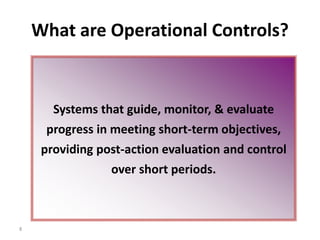
What are Operational Controls?
Systems that guide, monitor, & evaluate
progress in meeting short-term objectives,
providing post-action evaluation and control
over short periods.
9
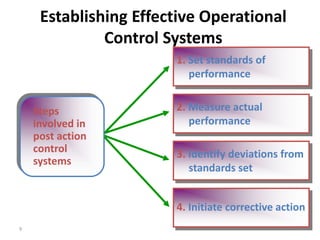
Establishing Effective Operational
Control Systems
1. Set standards of
performance
2. Measure actual
performance
3. Identify deviations from
standards set
4. Initiate corrective action
Steps
involved in
post action
control
systems
10
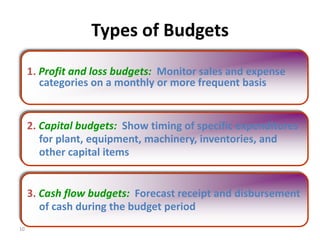
Types of Budgets
1. Profit and loss budgets: Monitor sales and expense
categories on a monthly or more frequent basis
2. Capital budgets: Show timing of specific expenditures
for plant, equipment, machinery, inventories, and
other capital items
3. Cash flow budgets: Forecast receipt and disbursement
of cash during the budget period
11
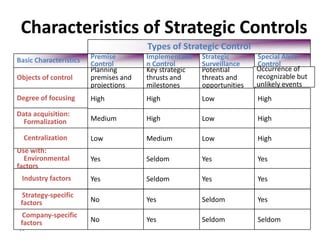
Characteristics of Strategic Controls
LowHighMedium
Types of Strategic Control
Strategic
Surveillance
Implementatio
n Control
Premise
ControlBasic Characteristics
Potential
threats and
opportunities
Low
Key strategic
thrusts and
milestones
High
Planning
premises and
projections
High
Objects of control
Degree of focusing
Data acquisition:
Formalization
LowMediumLowCentralization
YesSeldomYes
Use with:
Environmental
factors
YesSeldomYesIndustry factors
SeldomYesNo
Strategy-specific
factors
Seldom
High
Special Alert
Control
Occurrence of
recognizable but
unlikely events
High
High
Yes
Yes
Yes
SeldomYesNo
Company-specific
factors
Scheduling
• Scheduling is the process of arranging,
controlling and optimizing work and
workloads in a production process or
manufacturing process. Scheduling is used to
allocate plant and machinery resources, plan
human resources, plan production processes
and purchase materials.
4/1/2020
Jitendra Patel, Assistant Professor, PIMR,
Indore
12
Scheduling
• Is the mechanism, part of the process manager, that
handles the removal of the running process from the
CPU and the selection of another process
• The selection of another process is based on a
particular strategy
• It is responsible for multiplexing processes on the
CPU; when is the time for the running process to be
removed from the CPU (in a ready or suspended
state), a different process is selected from the set of
process in the ready state
– Policy – determines when the process is removed and
what next process takes the control of the CPU
– Mechanism – how the process manager knows it is the
time to remove the current process and how a process is
allocated/de-allocated from the CPU
Selection Strategies
• Non preemptive strategies
– Allow any process to run to completion once it has been
allocated the control of the CPU
– A process that gets the control of the CPU, releases the
CPU whenever it ends or when it voluntarily give the
control of the CPU
• Preemptive strategies
– The highest priority process among all ready processes is
allocated the CPU
– All lower priority processes are made to yield to the
highest priority process whenever requests the CPU
• The scheduler is called every time a process enters the ready
queue as well as when an interval timer expires and a time
quantum has elapsed
– It allows for equitable resource sharing among processes
at the expense of overloading the system
KSF
• The combination of important facts that
is required in order to accomplish one or more
desirable business goals.
• For example, one of the key
success factors in promoting animal food prod
ucts might be to advertise them in a way
that appeals to those consumers who love
animals.
4/1/2020
Jitendra Patel, Assistant Professor, PIMR,
Indore
15
PINPOINTING INDUSTRY
KEY SUCCESS FACTORS
• KEY SUCCESS FACTORS (KSFs) spell difference
between
– Profit & loss
– Competitive success or failure
• A KEY SUCCESS FACTOR can be
– Specific skill or talent
– Competitive capability
– Something a firm must do to satisfy customers
PINPOINTING INDUSTRY KEY SUCCESS
FACTORS
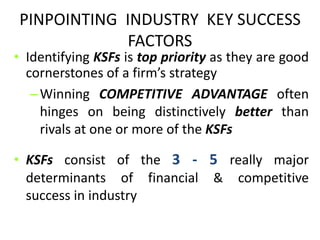
• Identifying KSFs is top priority as they are good
cornerstones of a firm’s strategy
–Winning COMPETITIVE ADVANTAGE often
hinges on being distinctively better than
rivals at one or more of the KSFs
• KSFs consist of the 3 - 5 really major
determinants of financial & competitive
success in industry
18
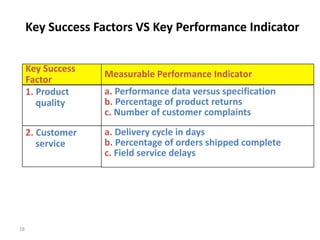
Key Success Factors VS Key Performance Indicator
Key Success
Factor
1. Product
quality
2. Customer
service
Measurable Performance Indicator
a. Performance data versus specification
b. Percentage of product returns
c. Number of customer complaints
a. Delivery cycle in days
b. Percentage of orders shipped complete
c. Field service delays
19
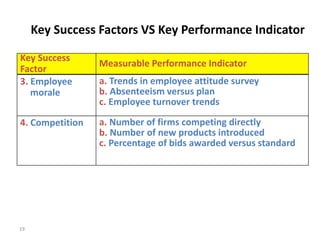
.
Key Success
Factor
3. Employee
morale
4. Competition
Measurable Performance Indicator
a. Trends in employee attitude survey
b. Absenteeism versus plan
c. Employee turnover trends
a. Number of firms competing directly
b. Number of new products introduced
c. Percentage of bids awarded versus standard
Key Success Factors VS Key Performance Indicator
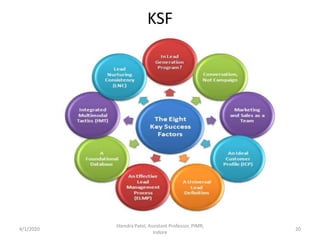
KSF
4/1/2020
Jitendra Patel, Assistant Professor, PIMR,
Indore
20
Benchmarking
• Benchmarking is the process of determining who
is the very best, who sets the standard, and what
that standard is.
• Bench marking is a comparative method where a
firm finds the best practices in an area and then
attempts to bring its own performance in that
area in line with the best practice. In order to
excel, a firm shall have to exceed the
benchmarks. In this manner, benchmarking offers
firms a tangible method to evaluate performance.
4/1/2020
Jitendra Patel, Assistant Professor, PIMR,
Indore
21
Essentials of Effective Control System
• Suitable: The control system should be appropriate to the nature and needs of the activity. A large
firm calls for controls different from those needed for a small firm.
• In other words, control should be tailored to fit the needs of the organisation. The flow of
information concerning current performance should correspond with the organizational structure
employed. If a superior is to be able to control overall operations, he must find a pattern that will
provide control for individual parts. Budgets, quotas and other techniques may be useful in
controlling separate departments.
• Timely and Forward Looking: The control system should be such as to enable the subordinates to
inform their superiors expeditiously about the threatened deviations and failures. The feedback
system should be as short and quick as possible. If the control reports are not directed at future,
they are of no use as they will not be able to suggest the types of measures to be taken to rectify
the past deviations. A proper system of control should enable the manager concerned to think of
and plan for future also.
• Objective and Comprehensive: The control system should be both, objective and understandable.
Objective controls specify the expected results in clear and definite terms and leave little room for
argument by the employees. This is necessary both for the smooth working and the effectiveness of
the system.
• Flexible: The control system should be flexible so that it can be adjusted to suit the needs of any
change in the environment. A sound control system will remain workable even when the plans
change or fail outright. It must be responsive to changing conditions. It should be adaptable to new
developments including the failure of the control system itself. Plans may call for an automatic
system to be backed up by a human system that would operate in an emergency.
4/1/2020
Jitendra Patel, Assistant Professor, PIMR,
Indore
22
• Economical: Economy is another requirement of every control. The benefit derived from a control system should
be more than the cost involved in implementing it. A small company cannot afford the elaborate control system
used by a large company. A control system is justifiable if the savings anticipated from it exceed the expected costs
in its working.
• Acceptable to Organization Members: The system should be acceptable to organisation members. When
standards are set unilaterally by upper level managers, there is a danger that employees will regard those
standards as unreasonable or unrealistic.
• Motivate People to High Performance: A control system is most effective when it motivates people to high
performance. Since most people respond to a challenge, successfully meeting to tough standard may well provide
a greater sense of accomplishment than meeting an easy standard. However, if a target is so tough that it seems
impossible to meet, it will be more likely to discourage than to motivate effort.
• Corrective Action: Merely pointing of deviations is not sufficient in a good control system. It must lead to
corrective action to be taken to check deviations from standard through appropriate planning, organizing and
directing. In the words of Koontz and O'Donnell, "An adequate control system should disclose where failures
occurring, who is responsible for them and what should be done about them." A control system will be of little use
unless it can generate the solution to the problem responsible for deviation from standards.
• Reflection of Organization Pattern: Organization is not merely a structure of duties and function, it is also an
important vehicle of control. In enforcing control the efficiency and the effectiveness of the organisation must be
clearly brought out.
• Human Factor: A good system of control should find the persons accountable for results, whenever large
deviations take place. They must be guided and directed if necessary.
• Direct Control: Any control system should be designed to maintain direct contact between the controller and
controlled. Even when there are a number of control systems provided by staff specialists, the foreman at the first
level is still important because he has direct knowledge of performance.
• Focus on Strategic Points: A good system of control not only points out the deviations or exceptions but also
pinpoints them where they are important or strategic to his operations.
4/1/2020
Jitendra Patel, Assistant Professor, PIMR,
Indore
23
References
1. Anonymous,(2010), “ The Role of Budgeting in Management
Planning and Control” How to plan and manage your company
budget, 1-26.
2. David, F.D. (2011), “Strategic Management Concept And Cases”,
Thirteenth Edition, Prentice Hall, South Carolina, USA.
3. Dess, G.G., Lumpkin, G.T. and Marilyn, L. T. (2005), “Strategic
Management”. 2 ed. New York: McGraw-Hill Irwin.
4. Gates, L.P. (2010), “Strategic Planning with Critical Success Factors
and Future Scenarios: An Integrated Strategic Planning
Framework”, Technical Report, CMU/SEI-2010-TR-037, Software
Engineering Institute.
5. Hitt, M. A. , Ireland, R.D., and Hoskissen, R.E. (2007), “Strategic
Management Competitiveness and Globalization: Concepts and
Cases”, Seventh Edition, Thomson South Western.
References
6. Kazmi, A. (2008),“Strategic Management & Business Policy, Tata
McGraw-Hill Publishing Company Limited, New Delhi.
7. Klaus G. Grunert, K. G., and Ellegaard, C. (1992), The Concept of
Key Success Factors: Theory and Method, MAPP working paper
no 4, 1-33.
8. O. C. Ferrell, Michael Hartline (2014), Marketing Strategy, Text and
Cases Sixth Edition South-Western Cengage Learning.
9. Olsen, E (2009), “Strategic Planning Kit For Dummies”, 2nd Edition,
Willey Publication.
10. Operating Systems – A modern perspective, Garry Nutt, ISBN 0-
8053-1295-1
11. Sushil (2000), “Strategic Control, Continuous Improvement and E-
business” Department of Management Studies Indian Institute of
Technology, Delhi. India.
Strategic evaluation and control

Strategic evaluation and control

  • 1.
    Strategic Management Evaluation andControl Prepared By Prof. Jitendra Patel Assistant Professor Prestige Institute of Management and Research. Indore.
  • 2.
    Module Description 1. StrategicControl Definition 2.Strategic Control Process 3.Different Controlling Techniques – 3.1Premise Control 3.2 Implementation Control, 3.3 Special Alert Control 3.4Strategic Surveillance 4. Operational Control-Budgeting, 5. Scheduling 6. KSF 7. Benchmarking. 8. Essentials of Effective Control System 4/1/2020 Jitendra Patel, Assistant Professor, PIMR, Indore 2
  • 3.
    3 What is StrategicControl? Tracks a strategy as it is implemented, detects problems or changes in its underlying premises, and makes necessary adjustments.
  • 4.
    Strategic Control Process •Although control systems must be tailored to specific situations, such systems generally follow the same basic process. 4/1/2020 Jitendra Patel, Assistant Professor, PIMR, Indore 4
  • 5.
    Steps in StrategicControl/Strategic Control Process 1. Determine what to control. What are the objectives the organization hopes to accomplish? 2. Set control standards. What are the targets and tolerances? 3. Measure performance. What are the actual standards? 4. Compare the performance the performance to the standards. How well does the actual match the plan? 5. Determine the reasons for the deviations. Are the deviations due to internal shortcomings or due to external changes beyond the control of the organization? 6. Take corrective action. Are corrections needed in internal activities to correct organizational shortcomings, or are changes needed in objectives due to external events? 4/1/2020 Jitendra Patel, Assistant Professor, PIMR, Indore 5
  • 6.
    Types Of ControllingTechniques Premise Control Every strategy is based on certain planning premises or predictions. Premise control is designed to check methodically and constantly whether the premises on which a strategy is grounded on are still valid. If you discover that an important premise is no longer valid, the strategy may have to be changed. The sooner you recognize and reject an invalid premise, the better. This is because the strategy can be adjusted to reflect the reality. Special Alert Control A special alert control is the rigorous and rapid reassessment of an organization's strategy because of the occurrence of an immediate, unforeseen event. An example of such event is the acquisition of your competitor by an outsider. Such an event will trigger an immediate and intense reassessment of the firm's strategy. Form crisis teams to handle your company's initial response to the unforeseen events.4/1/2020 Jitendra Patel, Assistant Professor, PIMR, Indore 6
  • 7.
    Implementation Control Implementing astrategy takes place as a series of steps, activities, investments and acts that occur over a lengthy period. As a manager, you'll mobilize resources, carry out special projects and employ or reassign staff. Implementation control is the type of strategic control that must be carried out as events unfold. There are two types of implementation controls: strategic thrusts or projects, and milestone reviews. Strategic thrusts provide you with information that helps you determine whether the overall strategy is shaping up as planned. With milestone reviews, you monitor the progress of the strategy at various intervals or milestones. Strategic Surveillance Strategic surveillance is designed to observe a wide range of events within and outside your organization that are likely to affect the track of your organization's strategy. It's based on the idea that you can uncover important yet unanticipated information by monitoring multiple information sources. Such sources include trade magazines, journals such as The Wall Street Journal, trade conferences, conversations and observations. 4/1/2020 Jitendra Patel, Assistant Professor, PIMR, Indore 7 Types Of Controlling Techniques
  • 8.
    8 What are OperationalControls? Systems that guide, monitor, & evaluate progress in meeting short-term objectives, providing post-action evaluation and control over short periods.
  • 9.
    9 Establishing Effective Operational ControlSystems 1. Set standards of performance 2. Measure actual performance 3. Identify deviations from standards set 4. Initiate corrective action Steps involved in post action control systems
  • 10.
    10 Types of Budgets 1.Profit and loss budgets: Monitor sales and expense categories on a monthly or more frequent basis 2. Capital budgets: Show timing of specific expenditures for plant, equipment, machinery, inventories, and other capital items 3. Cash flow budgets: Forecast receipt and disbursement of cash during the budget period
  • 11.
    11 Characteristics of StrategicControls LowHighMedium Types of Strategic Control Strategic Surveillance Implementatio n Control Premise ControlBasic Characteristics Potential threats and opportunities Low Key strategic thrusts and milestones High Planning premises and projections High Objects of control Degree of focusing Data acquisition: Formalization LowMediumLowCentralization YesSeldomYes Use with: Environmental factors YesSeldomYesIndustry factors SeldomYesNo Strategy-specific factors Seldom High Special Alert Control Occurrence of recognizable but unlikely events High High Yes Yes Yes SeldomYesNo Company-specific factors
  • 12.
    Scheduling • Scheduling isthe process of arranging, controlling and optimizing work and workloads in a production process or manufacturing process. Scheduling is used to allocate plant and machinery resources, plan human resources, plan production processes and purchase materials. 4/1/2020 Jitendra Patel, Assistant Professor, PIMR, Indore 12
  • 13.
    Scheduling • Is themechanism, part of the process manager, that handles the removal of the running process from the CPU and the selection of another process • The selection of another process is based on a particular strategy • It is responsible for multiplexing processes on the CPU; when is the time for the running process to be removed from the CPU (in a ready or suspended state), a different process is selected from the set of process in the ready state – Policy – determines when the process is removed and what next process takes the control of the CPU – Mechanism – how the process manager knows it is the time to remove the current process and how a process is allocated/de-allocated from the CPU
  • 14.
    Selection Strategies • Nonpreemptive strategies – Allow any process to run to completion once it has been allocated the control of the CPU – A process that gets the control of the CPU, releases the CPU whenever it ends or when it voluntarily give the control of the CPU • Preemptive strategies – The highest priority process among all ready processes is allocated the CPU – All lower priority processes are made to yield to the highest priority process whenever requests the CPU • The scheduler is called every time a process enters the ready queue as well as when an interval timer expires and a time quantum has elapsed – It allows for equitable resource sharing among processes at the expense of overloading the system
  • 15.
    KSF • The combinationof important facts that is required in order to accomplish one or more desirable business goals. • For example, one of the key success factors in promoting animal food prod ucts might be to advertise them in a way that appeals to those consumers who love animals. 4/1/2020 Jitendra Patel, Assistant Professor, PIMR, Indore 15
  • 16.
    PINPOINTING INDUSTRY KEY SUCCESSFACTORS • KEY SUCCESS FACTORS (KSFs) spell difference between – Profit & loss – Competitive success or failure • A KEY SUCCESS FACTOR can be – Specific skill or talent – Competitive capability – Something a firm must do to satisfy customers
  • 17.
    PINPOINTING INDUSTRY KEYSUCCESS FACTORS • Identifying KSFs is top priority as they are good cornerstones of a firm’s strategy –Winning COMPETITIVE ADVANTAGE often hinges on being distinctively better than rivals at one or more of the KSFs • KSFs consist of the 3 - 5 really major determinants of financial & competitive success in industry
  • 18.
    18 Key Success FactorsVS Key Performance Indicator Key Success Factor 1. Product quality 2. Customer service Measurable Performance Indicator a. Performance data versus specification b. Percentage of product returns c. Number of customer complaints a. Delivery cycle in days b. Percentage of orders shipped complete c. Field service delays
  • 19.
    19 . Key Success Factor 3. Employee morale 4.Competition Measurable Performance Indicator a. Trends in employee attitude survey b. Absenteeism versus plan c. Employee turnover trends a. Number of firms competing directly b. Number of new products introduced c. Percentage of bids awarded versus standard Key Success Factors VS Key Performance Indicator
  • 20.
    KSF 4/1/2020 Jitendra Patel, AssistantProfessor, PIMR, Indore 20
  • 21.
    Benchmarking • Benchmarking isthe process of determining who is the very best, who sets the standard, and what that standard is. • Bench marking is a comparative method where a firm finds the best practices in an area and then attempts to bring its own performance in that area in line with the best practice. In order to excel, a firm shall have to exceed the benchmarks. In this manner, benchmarking offers firms a tangible method to evaluate performance. 4/1/2020 Jitendra Patel, Assistant Professor, PIMR, Indore 21
  • 22.
    Essentials of EffectiveControl System • Suitable: The control system should be appropriate to the nature and needs of the activity. A large firm calls for controls different from those needed for a small firm. • In other words, control should be tailored to fit the needs of the organisation. The flow of information concerning current performance should correspond with the organizational structure employed. If a superior is to be able to control overall operations, he must find a pattern that will provide control for individual parts. Budgets, quotas and other techniques may be useful in controlling separate departments. • Timely and Forward Looking: The control system should be such as to enable the subordinates to inform their superiors expeditiously about the threatened deviations and failures. The feedback system should be as short and quick as possible. If the control reports are not directed at future, they are of no use as they will not be able to suggest the types of measures to be taken to rectify the past deviations. A proper system of control should enable the manager concerned to think of and plan for future also. • Objective and Comprehensive: The control system should be both, objective and understandable. Objective controls specify the expected results in clear and definite terms and leave little room for argument by the employees. This is necessary both for the smooth working and the effectiveness of the system. • Flexible: The control system should be flexible so that it can be adjusted to suit the needs of any change in the environment. A sound control system will remain workable even when the plans change or fail outright. It must be responsive to changing conditions. It should be adaptable to new developments including the failure of the control system itself. Plans may call for an automatic system to be backed up by a human system that would operate in an emergency. 4/1/2020 Jitendra Patel, Assistant Professor, PIMR, Indore 22
  • 23.
    • Economical: Economyis another requirement of every control. The benefit derived from a control system should be more than the cost involved in implementing it. A small company cannot afford the elaborate control system used by a large company. A control system is justifiable if the savings anticipated from it exceed the expected costs in its working. • Acceptable to Organization Members: The system should be acceptable to organisation members. When standards are set unilaterally by upper level managers, there is a danger that employees will regard those standards as unreasonable or unrealistic. • Motivate People to High Performance: A control system is most effective when it motivates people to high performance. Since most people respond to a challenge, successfully meeting to tough standard may well provide a greater sense of accomplishment than meeting an easy standard. However, if a target is so tough that it seems impossible to meet, it will be more likely to discourage than to motivate effort. • Corrective Action: Merely pointing of deviations is not sufficient in a good control system. It must lead to corrective action to be taken to check deviations from standard through appropriate planning, organizing and directing. In the words of Koontz and O'Donnell, "An adequate control system should disclose where failures occurring, who is responsible for them and what should be done about them." A control system will be of little use unless it can generate the solution to the problem responsible for deviation from standards. • Reflection of Organization Pattern: Organization is not merely a structure of duties and function, it is also an important vehicle of control. In enforcing control the efficiency and the effectiveness of the organisation must be clearly brought out. • Human Factor: A good system of control should find the persons accountable for results, whenever large deviations take place. They must be guided and directed if necessary. • Direct Control: Any control system should be designed to maintain direct contact between the controller and controlled. Even when there are a number of control systems provided by staff specialists, the foreman at the first level is still important because he has direct knowledge of performance. • Focus on Strategic Points: A good system of control not only points out the deviations or exceptions but also pinpoints them where they are important or strategic to his operations. 4/1/2020 Jitendra Patel, Assistant Professor, PIMR, Indore 23
  • 24.
    References 1. Anonymous,(2010), “The Role of Budgeting in Management Planning and Control” How to plan and manage your company budget, 1-26. 2. David, F.D. (2011), “Strategic Management Concept And Cases”, Thirteenth Edition, Prentice Hall, South Carolina, USA. 3. Dess, G.G., Lumpkin, G.T. and Marilyn, L. T. (2005), “Strategic Management”. 2 ed. New York: McGraw-Hill Irwin. 4. Gates, L.P. (2010), “Strategic Planning with Critical Success Factors and Future Scenarios: An Integrated Strategic Planning Framework”, Technical Report, CMU/SEI-2010-TR-037, Software Engineering Institute. 5. Hitt, M. A. , Ireland, R.D., and Hoskissen, R.E. (2007), “Strategic Management Competitiveness and Globalization: Concepts and Cases”, Seventh Edition, Thomson South Western.
  • 25.
    References 6. Kazmi, A.(2008),“Strategic Management & Business Policy, Tata McGraw-Hill Publishing Company Limited, New Delhi. 7. Klaus G. Grunert, K. G., and Ellegaard, C. (1992), The Concept of Key Success Factors: Theory and Method, MAPP working paper no 4, 1-33. 8. O. C. Ferrell, Michael Hartline (2014), Marketing Strategy, Text and Cases Sixth Edition South-Western Cengage Learning. 9. Olsen, E (2009), “Strategic Planning Kit For Dummies”, 2nd Edition, Willey Publication. 10. Operating Systems – A modern perspective, Garry Nutt, ISBN 0- 8053-1295-1 11. Sushil (2000), “Strategic Control, Continuous Improvement and E- business” Department of Management Studies Indian Institute of Technology, Delhi. India.

Editor's Notes