
Developing CRM Strategy
Prepared By
Jitendra Patel
Assistant Professor,
Prestige Institute of
Management and
Research, Indore
12/14/2020 1JITENDRA PATEL, PIMR, INDORE
Module III
3.1 Customer Loyalty
3.1.1 Understanding Customer Loyalty
3.1.2 Loyalty Status
3.1.3 Switching Reason by the Customer
3.1.4 Firm Response to Customer
3.1.5 Customer Satisfaction with Timeliness of
Firm Response to Service Failure
3.1.6 Complaining Customers Statics
3.1.7 Customer Complaint Actions Following
3.1.8 Excellent Recovery to Complaining Customer
12/14/2020 2JITENDRA PATEL, PIMR, INDORE
Module III
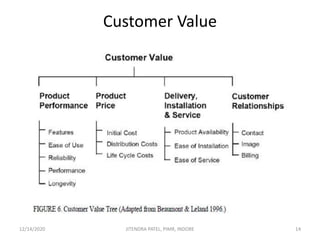
3. 2 Customer Value
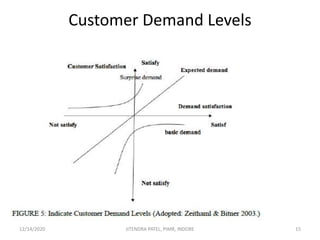
3.3 Customer Demand Levels
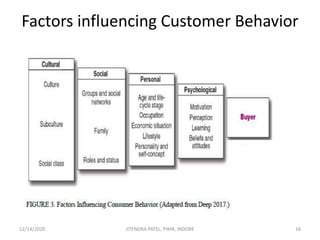
3.4 Factors influencing Customer Behavior
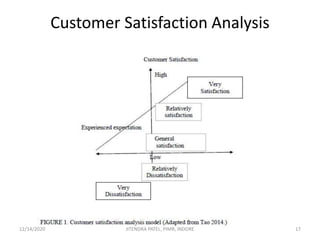
3.5 Customer Satisfaction Analysis
3.6 Relationship between Customer Satisfaction and
Loyalty
3.7 Advantage of Brand Loyalty
3.8 Advantage of Customer loyalty Affecting Brand
3.9 Types of Customer Loyalty
3.10 Various Loyalty Programs
12/14/2020 3JITENDRA PATEL, PIMR, INDORE
Module III
3.11 Linking Profitability with loyalty
3.12 Case on Profitability and Loyalty
3.13 MEASUREMENT OF CUSTOMER LOYALTY
3.14 LEVEL OF CUSTOMER LOYALTY
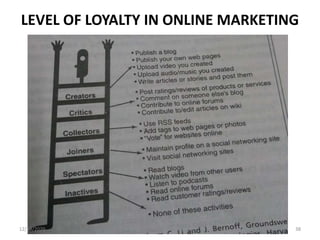
3.15 LEVEL OF LOYALTY IN ONLINE MARKETING
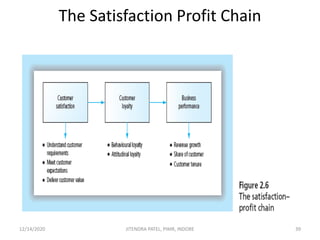
3.16 The Satisfaction Profit Chain
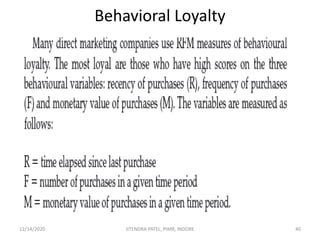
3.17 Behavioral Loyalty
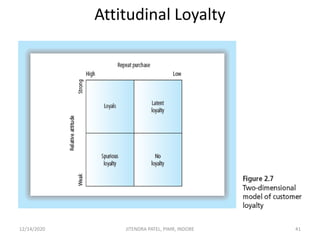
31.8 Attitudinal Loyalty
3.19 CRM KPI
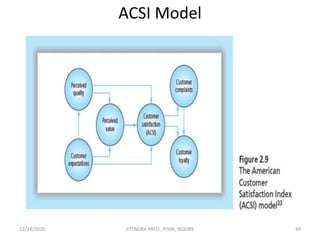
3.20 THE AMERCIAN CUSTOMER SATISFACTION INDEX Model
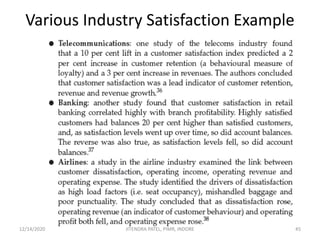
3.21 Various Industry Satisfaction Example
3.22 Relationship between customer satisfaction and repeat purchase
3.23 Measuring Customer Satisfaction
3.23.1 Design and Use of a CSM Program
3.23.2 Benefits of CSM
3.23.3. What else should CSM Measure
12/14/2020 4JITENDRA PATEL, PIMR, INDORE
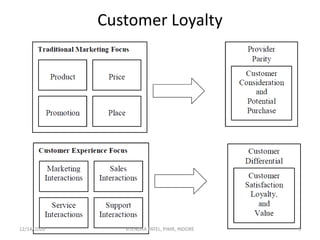
Customer Loyalty
12/14/2020 5JITENDRA PATEL, PIMR, INDORE
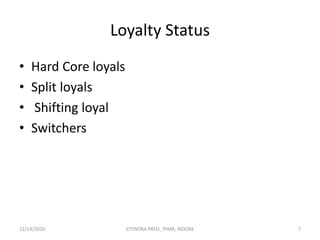
Loyalty Status
• Hard Core loyals
• Split loyals
• Shifting loyal
• Switchers
12/14/2020 7JITENDRA PATEL, PIMR, INDORE
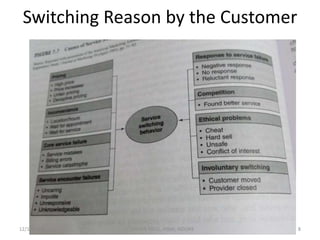
Switching Reason by the Customer
12/14/2020 8JITENDRA PATEL, PIMR, INDORE
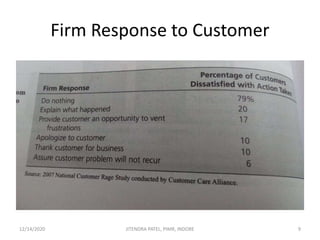
Firm Response to Customer
12/14/2020 9JITENDRA PATEL, PIMR, INDORE
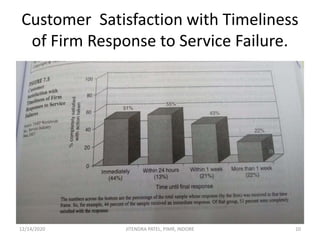
Customer Satisfaction with Timeliness
of Firm Response to Service Failure.
12/14/2020 10JITENDRA PATEL, PIMR, INDORE
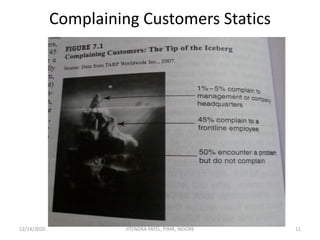
Complaining Customers Statics
12/14/2020 11JITENDRA PATEL, PIMR, INDORE
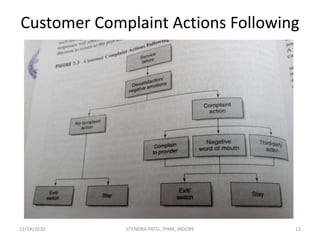
Customer Complaint Actions Following
12/14/2020 12JITENDRA PATEL, PIMR, INDORE
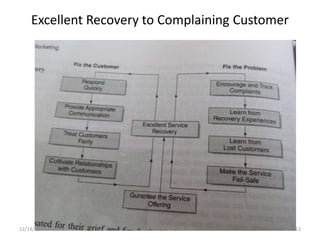
Excellent Recovery to Complaining Customer
12/14/2020 13JITENDRA PATEL, PIMR, INDORE
Customer Value
12/14/2020 14JITENDRA PATEL, PIMR, INDORE
Customer Demand Levels
12/14/2020 15JITENDRA PATEL, PIMR, INDORE
Factors influencing Customer Behavior
12/14/2020 16JITENDRA PATEL, PIMR, INDORE
Customer Satisfaction Analysis
12/14/2020 17JITENDRA PATEL, PIMR, INDORE
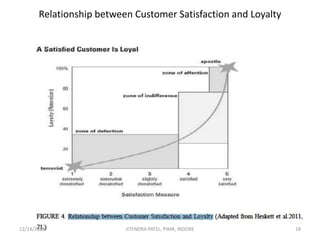
Relationship between Customer Satisfaction and Loyalty
12/14/2020 18JITENDRA PATEL, PIMR, INDORE
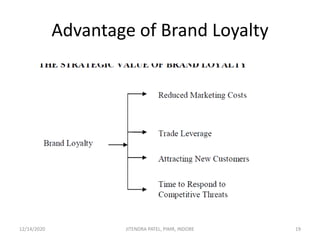
Advantage of Brand Loyalty
12/14/2020 19JITENDRA PATEL, PIMR, INDORE
Advantage of Brand Loyalty
• Loyalty is at the heart of equity and is one of important
brand assets.
• Brand loyalty is a conscious or unconscious decision
expressed through intention or behavior to repurchase
a brand continually.
• When the consumer buys with respect to product
features, price and convenience, with little concern to
the brand there is likely little equity.
• But, if the consumers prefer the brand even at the face
of competitors with superior features and offers, then
brand is said to have high brand equity.
12/14/2020 20JITENDRA PATEL, PIMR, INDORE
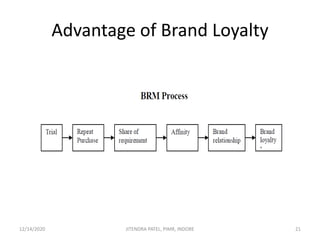
Advantage of Brand Loyalty
12/14/2020 21JITENDRA PATEL, PIMR, INDORE
Advantage of Customer loyalty Affecting Brand
• Reduced Marketing Cost
• Loyal customers minimize the cost of running business
because the amount spent on getting new customers is
far more than retaining present customers. The higher
the loyalty, the easier it is to keep customers happy.
Loyal customer becomes an advocate for the brand,
without any incentive.
• Trade Leverage
• A brand having strong loyalty base force retailers to
maintain adequate stock and allot enough shelf space
to accommodate the brand. At the extreme,
customer‘s shop choice depends on where their
preferred brand is available. So, at the retail brands
enjoy special recognition and treatment.
12/14/2020 22JITENDRA PATEL, PIMR, INDORE
• Attracting New Customers
• Existing loyal customers help marketers to get more
business through prospective customers. They create
awareness of the brand among friends and colleagues,
who develop positive attitude towards the brand by
actually seeing the brand in action. Brand image is
projected by these customers especially when the
product requires after sales service or, prospective
customers require assurance of product performance.
• Time to Respond to the Competitive Threats
• Loyalty base also supports marketers against
competitor‘s innovation by providing sufficient time for
them to retaliate.
12/14/2020 23JITENDRA PATEL, PIMR, INDORE
• Understanding customer completely
• Aligning organizational capability in order to
better deliver what its customers may
perceive as high value. Facilitating the
information available both inside and outside
the organization.
12/14/2020 24JITENDRA PATEL, PIMR, INDORE
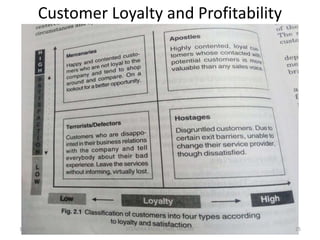
Customer Loyalty and Profitability
12/14/2020 25JITENDRA PATEL, PIMR, INDORE
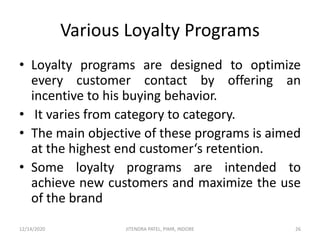
Various Loyalty Programs
• Loyalty programs are designed to optimize
every customer contact by offering an
incentive to his buying behavior.
• It varies from category to category.
• The main objective of these programs is aimed
at the highest end customer‘s retention.
• Some loyalty programs are intended to
achieve new customers and maximize the use
of the brand
12/14/2020 26JITENDRA PATEL, PIMR, INDORE
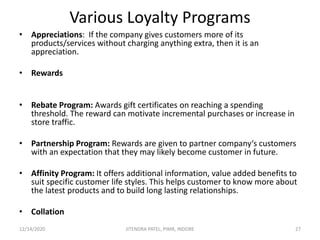
Various Loyalty Programs
• Appreciations: If the company gives customers more of its
products/services without charging anything extra, then it is an
appreciation.
• Rewards
• Rebate Program: Awards gift certificates on reaching a spending
threshold. The reward can motivate incremental purchases or increase in
store traffic.
• Partnership Program: Rewards are given to partner company‘s customers
with an expectation that they may likely become customer in future.
• Affinity Program: It offers additional information, value added benefits to
suit specific customer life styles. This helps customer to know more about
the latest products and to build long lasting relationships.
• Collation
12/14/2020 27JITENDRA PATEL, PIMR, INDORE
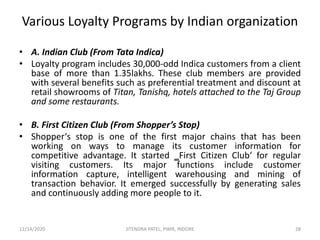
Various Loyalty Programs by Indian organization
• A. Indian Club (From Tata Indica)
• Loyalty program includes 30,000-odd Indica customers from a client
base of more than 1.35lakhs. These club members are provided
with several benefits such as preferential treatment and discount at
retail showrooms of Titan, Tanishq, hotels attached to the Taj Group
and some restaurants.
• B. First Citizen Club (From Shopper’s Stop)
• Shopper‘s stop is one of the first major chains that has been
working on ways to manage its customer information for
competitive advantage. It started ‗First Citizen Club‘ for regular
visiting customers. Its major functions include customer
information capture, intelligent warehousing and mining of
transaction behavior. It emerged successfully by generating sales
and continuously adding more people to it.
12/14/2020 28JITENDRA PATEL, PIMR, INDORE
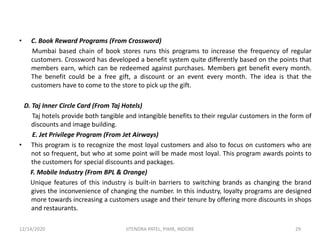
• C. Book Reward Programs (From Crossword)
Mumbai based chain of book stores runs this programs to increase the frequency of regular
customers. Crossword has developed a benefit system quite differently based on the points that
members earn, which can be redeemed against purchases. Members get benefit every month.
The benefit could be a free gift, a discount or an event every month. The idea is that the
customers have to come to the store to pick up the gift.
D. Taj Inner Circle Card (From Taj Hotels)
Taj hotels provide both tangible and intangible benefits to their regular customers in the form of
discounts and image building.
E. Jet Privilege Program (From Jet Airways)
• This program is to recognize the most loyal customers and also to focus on customers who are
not so frequent, but who at some point will be made most loyal. This program awards points to
the customers for special discounts and packages.
F. Mobile Industry (From BPL & Orange)
Unique features of this industry is built-in barriers to switching brands as changing the brand
gives the inconvenience of changing the number. In this industry, loyalty programs are designed
more towards increasing a customers usage and their tenure by offering more discounts in shops
and restaurants.
12/14/2020 29JITENDRA PATEL, PIMR, INDORE
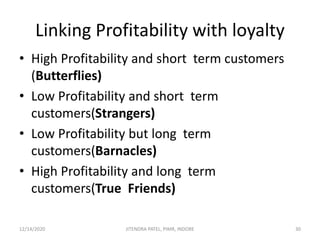
Linking Profitability with loyalty
• High Profitability and short term customers
(Butterflies)
• Low Profitability and short term
customers(Strangers)
• Low Profitability but long term
customers(Barnacles)
• High Profitability and long term
customers(True Friends)
12/14/2020 30JITENDRA PATEL, PIMR, INDORE
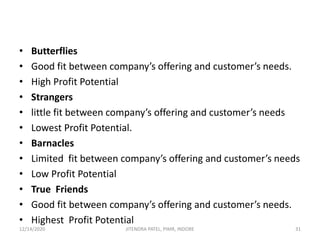
• Butterflies
• Good fit between company’s offering and customer’s needs.
• High Profit Potential
• Strangers
• little fit between company’s offering and customer’s needs
• Lowest Profit Potential.
• Barnacles
• Limited fit between company’s offering and customer’s needs
• Low Profit Potential
• True Friends
• Good fit between company’s offering and customer’s needs.
• Highest Profit Potential
12/14/2020 31JITENDRA PATEL, PIMR, INDORE
12/14/2020 32JITENDRA PATEL, PIMR, INDORE
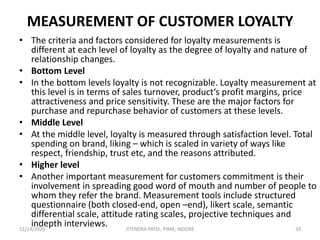
MEASUREMENT OF CUSTOMER LOYALTY
• The criteria and factors considered for loyalty measurements is
different at each level of loyalty as the degree of loyalty and nature of
relationship changes.
• Bottom Level
• In the bottom levels loyalty is not recognizable. Loyalty measurement at
this level is in terms of sales turnover, product‘s profit margins, price
attractiveness and price sensitivity. These are the major factors for
purchase and repurchase behavior of customers at these levels.
• Middle Level
• At the middle level, loyalty is measured through satisfaction level. Total
spending on brand, liking – which is scaled in variety of ways like
respect, friendship, trust etc, and the reasons attributed.
• Higher level
• Another important measurement for customers commitment is their
involvement in spreading good word of mouth and number of people to
whom they refer the brand. Measurement tools include structured
questionnaire (both closed-end, open –end), likert scale, semantic
differential scale, attitude rating scales, projective techniques and
indepth interviews.12/14/2020 33JITENDRA PATEL, PIMR, INDORE
LEVEL OF CUSTOMER LOYALTY
12/14/2020 34JITENDRA PATEL, PIMR, INDORE
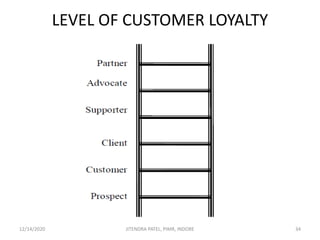
• Prospect: The prospect is an individual in a retail market
or an organization in the business market, which fulfils the
requirement of the marketer‘s definition of target. For
example, a cellular service provider may segment the
market and target executives in blue chip companies with
a special offer.
• Customer: The prospect becomes a customer when s/he
gets attracted by the offering of the marketer and buys
the product / service.
• Client: A customer becomes a client when s/he purchases
the product or service more than once. While a customer
may make the initial purchase as a trial or test, the client
is one who does a repeat purchase. It is likely that the trial
was a satisfactory experience for the client.
12/14/2020 35JITENDRA PATEL, PIMR, INDORE
• Supporter: A client becomes a supporter when he satisfies
with the offering and recommends it to his friend, relatives
and acquaintances. This positive Word – Of – Mouth (WOM)
has tremendous positive impact as it helps the company get
new customer. WOM is a most influential source of
information in converting prospects into customer.
• Advocate: An advocate is a supporter who, in addition to
referrals that gives increases sales, proactively works with
the company to improve its product and services. While
developing new products software companies regularly
depend on the feedback from the lead users of their clients
during the Beta test phase. So is a case in new product
development situation in several industrial firms, who set up
the prototype in their client‘s premises for usage and
feedback, which helps in improvement. In these situation,12/14/2020 36JITENDRA PATEL, PIMR, INDORE
• Partner: An advocate becomes a partner
when they become actively involve in the
decisions of the company. Any relationship
that attempts to develop customer value
through partnering activities is likely to
create greater bonding between customers
and marketers. In many cases, there are joint
investments resulting in a structural bonding.
12/14/2020 37JITENDRA PATEL, PIMR, INDORE
LEVEL OF LOYALTY IN ONLINE MARKETING
12/14/2020 38JITENDRA PATEL, PIMR, INDORE
The Satisfaction Profit Chain
12/14/2020 39JITENDRA PATEL, PIMR, INDORE
Behavioral Loyalty
12/14/2020 40JITENDRA PATEL, PIMR, INDORE
Attitudinal Loyalty
12/14/2020 41JITENDRA PATEL, PIMR, INDORE
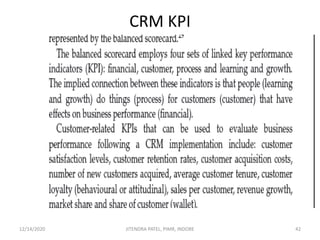
CRM KPI
12/14/2020 42JITENDRA PATEL, PIMR, INDORE
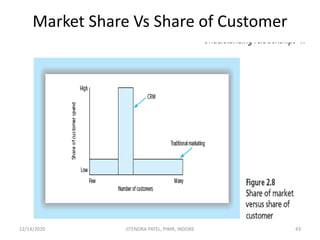
Market Share Vs Share of Customer
12/14/2020 43JITENDRA PATEL, PIMR, INDORE
ACSI Model
12/14/2020 44JITENDRA PATEL, PIMR, INDORE
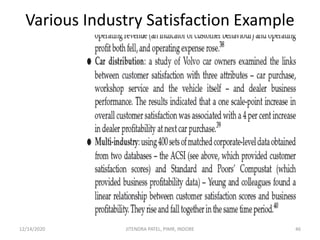
Various Industry Satisfaction Example
12/14/2020 45JITENDRA PATEL, PIMR, INDORE
Various Industry Satisfaction Example
12/14/2020 46JITENDRA PATEL, PIMR, INDORE
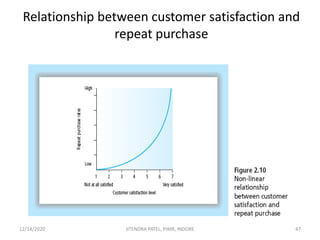
Relationship between customer satisfaction and
repeat purchase
12/14/2020 47JITENDRA PATEL, PIMR, INDORE
Measuring Customer Satisfaction
• Customer satisfaction is the customer's perception
that a supplier has completely satisfied their
expectations.
• Why Measure Customer Satisfaction ?
• The average business loses between 10% and 30%
of its customers each year, often without knowing:
• Which customers they have lost
• When they were lost
• Why there were lost
• How much sales and profit customer decay has
cost them
12/14/2020 48JITENDRA PATEL, PIMR, INDORE
Measuring Customer Satisfaction
• Measure customer satisfaction, and acting appropriately on the
results, will increase profitability
• NOT taking action allows your customer base to decay while
permitting your competition to gain market share
• Consider these statistics:
• Only 4% of all customers with problems complain
• The average person with a problem eventually tells 9 other
people
• Satisfied customers tell 5 other people about their good
treatment
• Cost of acquiring a new customer is 5 to 7 times greater than
retaining current ones
• Cost of hiring and training a new employee is up to 10 times greater
than retaining current ones
12/14/2020 49JITENDRA PATEL, PIMR, INDORE
• Your customer's perception of the value of
your company provides is based on the
following attribute foundation:
• Organizational
• Product
• Service
• Future behaviour
12/14/2020 50JITENDRA PATEL, PIMR, INDORE
Design and Use of a CSM Program
• The typical CSM (Customer Satisfaction measurement)
program would be having the following steps -
• 1. Defining the objectives
• Identify customer's priorities
• Learn customer's tolerance band
• Receive first-hand input on your company's
performance
• Obtain performance ratings relative to your
customer's priorities
• Learn performance ratings relative to your
competitors' performance
• Establish priorities for improvement
12/14/2020 51JITENDRA PATEL, PIMR, INDORE
• Develop the Research Design
• Research design flows directly from the
stated objectives
• Must be developed to ensure reliability
• Ability to provide consistent results
• Measures the original intent
• Eliminates bias
• Meaningful questions to the customer
12/14/2020 52JITENDRA PATEL, PIMR, INDORE
• Questionnaire Design
• Product attributes
• Service attributes
• Organizational attributes
• Future behavior attributes
12/14/2020 53JITENDRA PATEL, PIMR, INDORE
• Improve customer, client, or employee
loyalty
• React quickly to changes in the market
• Identify and capitalize on opportunities
• Beat the competition
• True "customer satisfaction" is an
organization's ability to attract & retain
customers and enhance the customer
relationship over time.
12/14/2020 54JITENDRA PATEL, PIMR, INDORE
Benefits of CSM
• It is not simple and the answer cannot be collapsed into a
single "customer satisfaction index."
• Every interaction a customer has with a company‘s
products & services is a reflection on quality.
• Customer satisfaction measurement (CSM) is a
management information system that continuously
captures the voice of the customer through the assessment
of performance from the customer's point of view.
• This information provides a platform for the strategic
alignment of organizational resources to deliver whatever is
most important to customers.
• Customer satisfaction measurement is an evolving tool that
is moving beyond early, basic measures of satisfaction
toward approaches that enable a business to compete
more effectively in its targeted market
12/14/2020 55JITENDRA PATEL, PIMR, INDORE
What else should CSM Measure
• 1. Perceptions of non-customers
• 2. Performance relative to competitors
• Seek out features that are both unique and worth a lot to
customers
• Differentiate their product/service offerings to meet differing
segment needs better than their competitors
• Actively communicate these benefits, building a conviction by the
customer that they are better off continuing their relationship
• In contrast, market-perceived quality versus competitors involves
a dramatic shift in focus — from satisfying your current customers
to beating competitors through customer value management.
12/14/2020 56JITENDRA PATEL, PIMR, INDORE
• Customer satisfaction measurement and
quality impact profits by:
• Reducing costs
• Preventing erosion in revenues over time
• Increasing market share
• Increasing gross margins
12/14/2020 57JITENDRA PATEL, PIMR, INDORE
Reference
• Alok Kumar, Chhabi Sinha and Rakesh Sharma ‘Customer Relationship Management Concept
& Application’ Biztanra, New Delhi. 2018.
• Antony Lawerence, Customer Relationship Management, Himalaya Publishing House, 2010.
• Boone and Kurtz , Contemporary Marketing, 16th edition, Cengage Learning, 2014
• Buttle, F. “Relationship Management Concepts and Technologies” Second edition, Elsevier,
Burlington, MA Great Britain (2009)
• Mallika Srivastava ‘Customer Relationship Management ‘ Vikas Publication ,Noida UP India
.2016.
• Payne, A. “HANDBOOK OF CRM: Achieving Excellence in Customer Management” Elsevier,
Burlington, MA Great Britain (2005)
• Philip Kotler and Gary Armstrong “Principles of Marketing”, New Delhi, Prentice Hall of
India, 15th Edition, 2013.
• Philip Kotler, Kelvin Lane, Keller, Abraham Koshi, Mitihlesh Jha, Principles of Marketing
Management, South Asian Perspective, Pearson Education, 14th Edition 2011.
• Preact CRM, “The Insider Guide to Success with CRM”, Microsoft Partners.
• Sales Force, “Deciding which crm solution is right for you Part of the Crm success series”,
Sales Force Sales Cloud.
• Shainesh,G Sneth and Jagdish N, Customer Relationship Management, MacMillan India
Ltd,2005
• Tech Target, Battle of CRM Tools, Search CRM, PRO+Content.
12/14/2020 JITENDRA PATEL, PIMR, INDORE 58
12/14/2020 JITENDRA PATEL, PIMR, INDORE 59

Developing Crm Strategy

  • 1.
    Developing CRM Strategy PreparedBy Jitendra Patel Assistant Professor, Prestige Institute of Management and Research, Indore 12/14/2020 1JITENDRA PATEL, PIMR, INDORE
  • 2.
    Module III 3.1 CustomerLoyalty 3.1.1 Understanding Customer Loyalty 3.1.2 Loyalty Status 3.1.3 Switching Reason by the Customer 3.1.4 Firm Response to Customer 3.1.5 Customer Satisfaction with Timeliness of Firm Response to Service Failure 3.1.6 Complaining Customers Statics 3.1.7 Customer Complaint Actions Following 3.1.8 Excellent Recovery to Complaining Customer 12/14/2020 2JITENDRA PATEL, PIMR, INDORE
  • 3.
    Module III 3. 2Customer Value 3.3 Customer Demand Levels 3.4 Factors influencing Customer Behavior 3.5 Customer Satisfaction Analysis 3.6 Relationship between Customer Satisfaction and Loyalty 3.7 Advantage of Brand Loyalty 3.8 Advantage of Customer loyalty Affecting Brand 3.9 Types of Customer Loyalty 3.10 Various Loyalty Programs 12/14/2020 3JITENDRA PATEL, PIMR, INDORE
  • 4.
    Module III 3.11 LinkingProfitability with loyalty 3.12 Case on Profitability and Loyalty 3.13 MEASUREMENT OF CUSTOMER LOYALTY 3.14 LEVEL OF CUSTOMER LOYALTY 3.15 LEVEL OF LOYALTY IN ONLINE MARKETING 3.16 The Satisfaction Profit Chain 3.17 Behavioral Loyalty 31.8 Attitudinal Loyalty 3.19 CRM KPI 3.20 THE AMERCIAN CUSTOMER SATISFACTION INDEX Model 3.21 Various Industry Satisfaction Example 3.22 Relationship between customer satisfaction and repeat purchase 3.23 Measuring Customer Satisfaction 3.23.1 Design and Use of a CSM Program 3.23.2 Benefits of CSM 3.23.3. What else should CSM Measure 12/14/2020 4JITENDRA PATEL, PIMR, INDORE
  • 5.
  • 6.
    Loyalty Status • HardCore loyals • Split loyals • Shifting loyal • Switchers 12/14/2020 7JITENDRA PATEL, PIMR, INDORE
  • 7.
    Switching Reason bythe Customer 12/14/2020 8JITENDRA PATEL, PIMR, INDORE
  • 8.
    Firm Response toCustomer 12/14/2020 9JITENDRA PATEL, PIMR, INDORE
  • 9.
    Customer Satisfaction withTimeliness of Firm Response to Service Failure. 12/14/2020 10JITENDRA PATEL, PIMR, INDORE
  • 10.
    Complaining Customers Statics 12/14/202011JITENDRA PATEL, PIMR, INDORE
  • 11.
    Customer Complaint ActionsFollowing 12/14/2020 12JITENDRA PATEL, PIMR, INDORE
  • 12.
    Excellent Recovery toComplaining Customer 12/14/2020 13JITENDRA PATEL, PIMR, INDORE
  • 13.
  • 14.
    Customer Demand Levels 12/14/202015JITENDRA PATEL, PIMR, INDORE
  • 15.
    Factors influencing CustomerBehavior 12/14/2020 16JITENDRA PATEL, PIMR, INDORE
  • 16.
    Customer Satisfaction Analysis 12/14/202017JITENDRA PATEL, PIMR, INDORE
  • 17.
    Relationship between CustomerSatisfaction and Loyalty 12/14/2020 18JITENDRA PATEL, PIMR, INDORE
  • 18.
    Advantage of BrandLoyalty 12/14/2020 19JITENDRA PATEL, PIMR, INDORE
  • 19.
    Advantage of BrandLoyalty • Loyalty is at the heart of equity and is one of important brand assets. • Brand loyalty is a conscious or unconscious decision expressed through intention or behavior to repurchase a brand continually. • When the consumer buys with respect to product features, price and convenience, with little concern to the brand there is likely little equity. • But, if the consumers prefer the brand even at the face of competitors with superior features and offers, then brand is said to have high brand equity. 12/14/2020 20JITENDRA PATEL, PIMR, INDORE
  • 20.
    Advantage of BrandLoyalty 12/14/2020 21JITENDRA PATEL, PIMR, INDORE
  • 21.
    Advantage of Customerloyalty Affecting Brand • Reduced Marketing Cost • Loyal customers minimize the cost of running business because the amount spent on getting new customers is far more than retaining present customers. The higher the loyalty, the easier it is to keep customers happy. Loyal customer becomes an advocate for the brand, without any incentive. • Trade Leverage • A brand having strong loyalty base force retailers to maintain adequate stock and allot enough shelf space to accommodate the brand. At the extreme, customer‘s shop choice depends on where their preferred brand is available. So, at the retail brands enjoy special recognition and treatment. 12/14/2020 22JITENDRA PATEL, PIMR, INDORE
  • 22.
    • Attracting NewCustomers • Existing loyal customers help marketers to get more business through prospective customers. They create awareness of the brand among friends and colleagues, who develop positive attitude towards the brand by actually seeing the brand in action. Brand image is projected by these customers especially when the product requires after sales service or, prospective customers require assurance of product performance. • Time to Respond to the Competitive Threats • Loyalty base also supports marketers against competitor‘s innovation by providing sufficient time for them to retaliate. 12/14/2020 23JITENDRA PATEL, PIMR, INDORE
  • 23.
    • Understanding customercompletely • Aligning organizational capability in order to better deliver what its customers may perceive as high value. Facilitating the information available both inside and outside the organization. 12/14/2020 24JITENDRA PATEL, PIMR, INDORE
  • 24.
    Customer Loyalty andProfitability 12/14/2020 25JITENDRA PATEL, PIMR, INDORE
  • 25.
    Various Loyalty Programs •Loyalty programs are designed to optimize every customer contact by offering an incentive to his buying behavior. • It varies from category to category. • The main objective of these programs is aimed at the highest end customer‘s retention. • Some loyalty programs are intended to achieve new customers and maximize the use of the brand 12/14/2020 26JITENDRA PATEL, PIMR, INDORE
  • 26.
    Various Loyalty Programs •Appreciations: If the company gives customers more of its products/services without charging anything extra, then it is an appreciation. • Rewards • Rebate Program: Awards gift certificates on reaching a spending threshold. The reward can motivate incremental purchases or increase in store traffic. • Partnership Program: Rewards are given to partner company‘s customers with an expectation that they may likely become customer in future. • Affinity Program: It offers additional information, value added benefits to suit specific customer life styles. This helps customer to know more about the latest products and to build long lasting relationships. • Collation 12/14/2020 27JITENDRA PATEL, PIMR, INDORE
  • 27.
    Various Loyalty Programsby Indian organization • A. Indian Club (From Tata Indica) • Loyalty program includes 30,000-odd Indica customers from a client base of more than 1.35lakhs. These club members are provided with several benefits such as preferential treatment and discount at retail showrooms of Titan, Tanishq, hotels attached to the Taj Group and some restaurants. • B. First Citizen Club (From Shopper’s Stop) • Shopper‘s stop is one of the first major chains that has been working on ways to manage its customer information for competitive advantage. It started ‗First Citizen Club‘ for regular visiting customers. Its major functions include customer information capture, intelligent warehousing and mining of transaction behavior. It emerged successfully by generating sales and continuously adding more people to it. 12/14/2020 28JITENDRA PATEL, PIMR, INDORE
  • 28.
    • C. BookReward Programs (From Crossword) Mumbai based chain of book stores runs this programs to increase the frequency of regular customers. Crossword has developed a benefit system quite differently based on the points that members earn, which can be redeemed against purchases. Members get benefit every month. The benefit could be a free gift, a discount or an event every month. The idea is that the customers have to come to the store to pick up the gift. D. Taj Inner Circle Card (From Taj Hotels) Taj hotels provide both tangible and intangible benefits to their regular customers in the form of discounts and image building. E. Jet Privilege Program (From Jet Airways) • This program is to recognize the most loyal customers and also to focus on customers who are not so frequent, but who at some point will be made most loyal. This program awards points to the customers for special discounts and packages. F. Mobile Industry (From BPL & Orange) Unique features of this industry is built-in barriers to switching brands as changing the brand gives the inconvenience of changing the number. In this industry, loyalty programs are designed more towards increasing a customers usage and their tenure by offering more discounts in shops and restaurants. 12/14/2020 29JITENDRA PATEL, PIMR, INDORE
  • 29.
    Linking Profitability withloyalty • High Profitability and short term customers (Butterflies) • Low Profitability and short term customers(Strangers) • Low Profitability but long term customers(Barnacles) • High Profitability and long term customers(True Friends) 12/14/2020 30JITENDRA PATEL, PIMR, INDORE
  • 30.
    • Butterflies • Goodfit between company’s offering and customer’s needs. • High Profit Potential • Strangers • little fit between company’s offering and customer’s needs • Lowest Profit Potential. • Barnacles • Limited fit between company’s offering and customer’s needs • Low Profit Potential • True Friends • Good fit between company’s offering and customer’s needs. • Highest Profit Potential 12/14/2020 31JITENDRA PATEL, PIMR, INDORE
  • 31.
  • 32.
    MEASUREMENT OF CUSTOMERLOYALTY • The criteria and factors considered for loyalty measurements is different at each level of loyalty as the degree of loyalty and nature of relationship changes. • Bottom Level • In the bottom levels loyalty is not recognizable. Loyalty measurement at this level is in terms of sales turnover, product‘s profit margins, price attractiveness and price sensitivity. These are the major factors for purchase and repurchase behavior of customers at these levels. • Middle Level • At the middle level, loyalty is measured through satisfaction level. Total spending on brand, liking – which is scaled in variety of ways like respect, friendship, trust etc, and the reasons attributed. • Higher level • Another important measurement for customers commitment is their involvement in spreading good word of mouth and number of people to whom they refer the brand. Measurement tools include structured questionnaire (both closed-end, open –end), likert scale, semantic differential scale, attitude rating scales, projective techniques and indepth interviews.12/14/2020 33JITENDRA PATEL, PIMR, INDORE
  • 33.
    LEVEL OF CUSTOMERLOYALTY 12/14/2020 34JITENDRA PATEL, PIMR, INDORE
  • 34.
    • Prospect: Theprospect is an individual in a retail market or an organization in the business market, which fulfils the requirement of the marketer‘s definition of target. For example, a cellular service provider may segment the market and target executives in blue chip companies with a special offer. • Customer: The prospect becomes a customer when s/he gets attracted by the offering of the marketer and buys the product / service. • Client: A customer becomes a client when s/he purchases the product or service more than once. While a customer may make the initial purchase as a trial or test, the client is one who does a repeat purchase. It is likely that the trial was a satisfactory experience for the client. 12/14/2020 35JITENDRA PATEL, PIMR, INDORE
  • 35.
    • Supporter: Aclient becomes a supporter when he satisfies with the offering and recommends it to his friend, relatives and acquaintances. This positive Word – Of – Mouth (WOM) has tremendous positive impact as it helps the company get new customer. WOM is a most influential source of information in converting prospects into customer. • Advocate: An advocate is a supporter who, in addition to referrals that gives increases sales, proactively works with the company to improve its product and services. While developing new products software companies regularly depend on the feedback from the lead users of their clients during the Beta test phase. So is a case in new product development situation in several industrial firms, who set up the prototype in their client‘s premises for usage and feedback, which helps in improvement. In these situation,12/14/2020 36JITENDRA PATEL, PIMR, INDORE
  • 36.
    • Partner: Anadvocate becomes a partner when they become actively involve in the decisions of the company. Any relationship that attempts to develop customer value through partnering activities is likely to create greater bonding between customers and marketers. In many cases, there are joint investments resulting in a structural bonding. 12/14/2020 37JITENDRA PATEL, PIMR, INDORE
  • 37.
    LEVEL OF LOYALTYIN ONLINE MARKETING 12/14/2020 38JITENDRA PATEL, PIMR, INDORE
  • 38.
    The Satisfaction ProfitChain 12/14/2020 39JITENDRA PATEL, PIMR, INDORE
  • 39.
  • 40.
  • 41.
    CRM KPI 12/14/2020 42JITENDRAPATEL, PIMR, INDORE
  • 42.
    Market Share VsShare of Customer 12/14/2020 43JITENDRA PATEL, PIMR, INDORE
  • 43.
  • 44.
    Various Industry SatisfactionExample 12/14/2020 45JITENDRA PATEL, PIMR, INDORE
  • 45.
    Various Industry SatisfactionExample 12/14/2020 46JITENDRA PATEL, PIMR, INDORE
  • 46.
    Relationship between customersatisfaction and repeat purchase 12/14/2020 47JITENDRA PATEL, PIMR, INDORE
  • 47.
    Measuring Customer Satisfaction •Customer satisfaction is the customer's perception that a supplier has completely satisfied their expectations. • Why Measure Customer Satisfaction ? • The average business loses between 10% and 30% of its customers each year, often without knowing: • Which customers they have lost • When they were lost • Why there were lost • How much sales and profit customer decay has cost them 12/14/2020 48JITENDRA PATEL, PIMR, INDORE
  • 48.
    Measuring Customer Satisfaction •Measure customer satisfaction, and acting appropriately on the results, will increase profitability • NOT taking action allows your customer base to decay while permitting your competition to gain market share • Consider these statistics: • Only 4% of all customers with problems complain • The average person with a problem eventually tells 9 other people • Satisfied customers tell 5 other people about their good treatment • Cost of acquiring a new customer is 5 to 7 times greater than retaining current ones • Cost of hiring and training a new employee is up to 10 times greater than retaining current ones 12/14/2020 49JITENDRA PATEL, PIMR, INDORE
  • 49.
    • Your customer'sperception of the value of your company provides is based on the following attribute foundation: • Organizational • Product • Service • Future behaviour 12/14/2020 50JITENDRA PATEL, PIMR, INDORE
  • 50.
    Design and Useof a CSM Program • The typical CSM (Customer Satisfaction measurement) program would be having the following steps - • 1. Defining the objectives • Identify customer's priorities • Learn customer's tolerance band • Receive first-hand input on your company's performance • Obtain performance ratings relative to your customer's priorities • Learn performance ratings relative to your competitors' performance • Establish priorities for improvement 12/14/2020 51JITENDRA PATEL, PIMR, INDORE
  • 51.
    • Develop theResearch Design • Research design flows directly from the stated objectives • Must be developed to ensure reliability • Ability to provide consistent results • Measures the original intent • Eliminates bias • Meaningful questions to the customer 12/14/2020 52JITENDRA PATEL, PIMR, INDORE
  • 52.
    • Questionnaire Design •Product attributes • Service attributes • Organizational attributes • Future behavior attributes 12/14/2020 53JITENDRA PATEL, PIMR, INDORE
  • 53.
    • Improve customer,client, or employee loyalty • React quickly to changes in the market • Identify and capitalize on opportunities • Beat the competition • True "customer satisfaction" is an organization's ability to attract & retain customers and enhance the customer relationship over time. 12/14/2020 54JITENDRA PATEL, PIMR, INDORE
  • 54.
    Benefits of CSM •It is not simple and the answer cannot be collapsed into a single "customer satisfaction index." • Every interaction a customer has with a company‘s products & services is a reflection on quality. • Customer satisfaction measurement (CSM) is a management information system that continuously captures the voice of the customer through the assessment of performance from the customer's point of view. • This information provides a platform for the strategic alignment of organizational resources to deliver whatever is most important to customers. • Customer satisfaction measurement is an evolving tool that is moving beyond early, basic measures of satisfaction toward approaches that enable a business to compete more effectively in its targeted market 12/14/2020 55JITENDRA PATEL, PIMR, INDORE
  • 55.
    What else shouldCSM Measure • 1. Perceptions of non-customers • 2. Performance relative to competitors • Seek out features that are both unique and worth a lot to customers • Differentiate their product/service offerings to meet differing segment needs better than their competitors • Actively communicate these benefits, building a conviction by the customer that they are better off continuing their relationship • In contrast, market-perceived quality versus competitors involves a dramatic shift in focus — from satisfying your current customers to beating competitors through customer value management. 12/14/2020 56JITENDRA PATEL, PIMR, INDORE
  • 56.
    • Customer satisfactionmeasurement and quality impact profits by: • Reducing costs • Preventing erosion in revenues over time • Increasing market share • Increasing gross margins 12/14/2020 57JITENDRA PATEL, PIMR, INDORE
  • 57.
    Reference • Alok Kumar,Chhabi Sinha and Rakesh Sharma ‘Customer Relationship Management Concept & Application’ Biztanra, New Delhi. 2018. • Antony Lawerence, Customer Relationship Management, Himalaya Publishing House, 2010. • Boone and Kurtz , Contemporary Marketing, 16th edition, Cengage Learning, 2014 • Buttle, F. “Relationship Management Concepts and Technologies” Second edition, Elsevier, Burlington, MA Great Britain (2009) • Mallika Srivastava ‘Customer Relationship Management ‘ Vikas Publication ,Noida UP India .2016. • Payne, A. “HANDBOOK OF CRM: Achieving Excellence in Customer Management” Elsevier, Burlington, MA Great Britain (2005) • Philip Kotler and Gary Armstrong “Principles of Marketing”, New Delhi, Prentice Hall of India, 15th Edition, 2013. • Philip Kotler, Kelvin Lane, Keller, Abraham Koshi, Mitihlesh Jha, Principles of Marketing Management, South Asian Perspective, Pearson Education, 14th Edition 2011. • Preact CRM, “The Insider Guide to Success with CRM”, Microsoft Partners. • Sales Force, “Deciding which crm solution is right for you Part of the Crm success series”, Sales Force Sales Cloud. • Shainesh,G Sneth and Jagdish N, Customer Relationship Management, MacMillan India Ltd,2005 • Tech Target, Battle of CRM Tools, Search CRM, PRO+Content. 12/14/2020 JITENDRA PATEL, PIMR, INDORE 58
  • 58.