
CHAPTER
III:
TOPI
C:
An Overview of
Vascular Plant Organs
BY :
Patricia Clariza Santos MLS-1D (
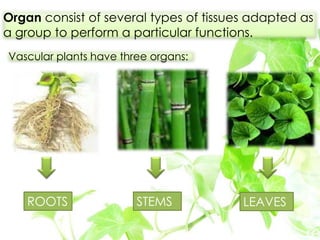
Organ consist of several types of tissues adapted as
a group to perform a particular functions.
Vascular plants have three organs:
ROOTS STEMS LEAVES
Bryophytes and some
seedless vascular
plants have structures
that can be called:
-“stemlike”
-“leaflike”
-“rootlike”
But not considered to
be true stems, leaves
and roots.
The list of plants is much shorter than the list of
animal organs. While some botanists refer to
reproductive structures such as :
- SEEDS
- CONES
- FLOWER as (organs)
Most reserve the term solely for stems, leaves
and roots.
Photosynthesis – is the process by which plants
certain other organisms use solar energy to
make their own food by transforming carbon
dioxide and water into sugars that store
chemical energy.
Stem is any part of a plant
that supports leaves or
reproductive structures.
BRANCHES
Leaf or a leaves – is the
main photosynthetic organ
of modern plants.
Cacti – most
photosynthetic plant that
occurs in the thick stems,
which stores water.
Some pressure is a “push” from the roots,
but a “pull” from the leaves that is the
main force that moves water in most
plant. This “pull” come from the loss of
water through the pores in leaves.
Transpiration – the
evaporation of
water from the
plants, pulls water
and mineral
nutrients up from
the roots to the
leaves.
- The chemistry of
water helps
explain how
transpiration
moves large
amounts of water
through the plants.
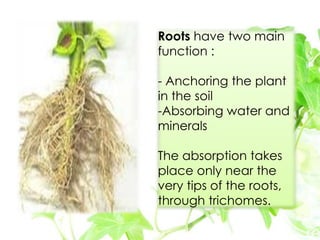
Roots have two main
function :
- Anchoring the plant
in the soil
-Absorbing water and
minerals
The absorption takes
place only near the
very tips of the roots,
through trichomes.
Root Hairs
Which means the tiny extensions of root
epidermal cells that greatly increase the
amount of root surface area.
- In addition to anchorage and absorption,
many roots store food for the plant.
Even though roots frequently store food,
they do not actually produce it. Because
they are usually NON-PHOTOSYNTHETIC
and in fact usually grow away from the
light.
Vascular tissue system
continues between :
Roots
Stem
Leaves
Needs sugar
and other
organic
nutrients
produced in
leaves.
While leaves and
stem needs water
and minerals
obtained by the
roots.
Xylem carries water and
minerals from the roots.
Phloem carries
food from the
leaves to the rest
of the plant.
overview of plant structure

overview of plant structure

  • 1.
  • 2.
    TOPI C: An Overview of VascularPlant Organs BY : Patricia Clariza Santos MLS-1D (
  • 3.
    Organ consist ofseveral types of tissues adapted as a group to perform a particular functions. Vascular plants have three organs: ROOTS STEMS LEAVES
  • 4.
    Bryophytes and some seedlessvascular plants have structures that can be called: -“stemlike” -“leaflike” -“rootlike” But not considered to be true stems, leaves and roots.
  • 5.
    The list ofplants is much shorter than the list of animal organs. While some botanists refer to reproductive structures such as : - SEEDS - CONES - FLOWER as (organs) Most reserve the term solely for stems, leaves and roots.
  • 7.
    Photosynthesis – isthe process by which plants certain other organisms use solar energy to make their own food by transforming carbon dioxide and water into sugars that store chemical energy. Stem is any part of a plant that supports leaves or reproductive structures.
  • 9.
  • 11.
    Leaf or aleaves – is the main photosynthetic organ of modern plants. Cacti – most photosynthetic plant that occurs in the thick stems, which stores water.
  • 13.
    Some pressure isa “push” from the roots, but a “pull” from the leaves that is the main force that moves water in most plant. This “pull” come from the loss of water through the pores in leaves.
  • 14.
    Transpiration – the evaporationof water from the plants, pulls water and mineral nutrients up from the roots to the leaves. - The chemistry of water helps explain how transpiration moves large amounts of water through the plants.
  • 16.
    Roots have twomain function : - Anchoring the plant in the soil -Absorbing water and minerals The absorption takes place only near the very tips of the roots, through trichomes.
  • 17.
    Root Hairs Which meansthe tiny extensions of root epidermal cells that greatly increase the amount of root surface area. - In addition to anchorage and absorption, many roots store food for the plant.
  • 18.
    Even though rootsfrequently store food, they do not actually produce it. Because they are usually NON-PHOTOSYNTHETIC and in fact usually grow away from the light.
  • 19.
    Vascular tissue system continuesbetween : Roots Stem Leaves Needs sugar and other organic nutrients produced in leaves. While leaves and stem needs water and minerals obtained by the roots. Xylem carries water and minerals from the roots. Phloem carries food from the leaves to the rest of the plant.