PLANT LAYOUT
Manish Kumar
manishatmarketing@gmail.com
TYPESOF
LAYOUT
 PRODUCT BASED LAYOUT
 PROCESS BASED LAYOUT
 FIXED POSITION LAYOUT
 FLEXIBLE MANUFACTURING SYSTEM
 GROUP TECHNOLOGY/CELLULAR
MANUFACTURING LAYOUT
 COMBINED BASED LAYOUT
PRODUCT
LAYOUT
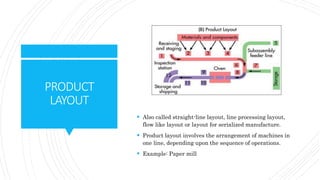
 Also called straight-line layout, line processing layout,
flow like layout or layout for serialized manufacture.
 Product layout involves the arrangement of machines in
one line, depending upon the sequence of operations.
 Example: Paper mill
Advantagesof
ProductLayout
 Regulation of production
 Scientific materials handling
 Mo bottleneck in production
 Lesser supervision
 Greater possibility of space utilization
Disadvantages
ofProduct
Layout
 Heavy capital expenditure
 High overhead charges
 Demerits of breakdown
 Inflexibility
 Additional output not possible
 Lack of specialised supervisors
ProcessLayout
 Also called the functional layout or job shop layout.
 In process layout, machines and services are grouped
on a functional basis and operations of the same type
are performed in the same area.
Usageareasof
ProcessLayout
 Expensive machinery is required
 Production involves a large variety of items having
limited volume in each type
 Operations are not balanced in time
 When the demand is small and intermittent.
Advantagesof
processlayout
 Lower capital investment
 Greater flexibility
 Specialization
 Effective supervision
 No disruption in work schedules
 Lower overhead costs
Disadvantages
ofProcess
Layout
 Complexity of production planning and control.
 Frequency of inspection.
 Difficulty of materials handling.
 Greater floor area.
 Longer processing time.
 Larger stock of materials in process.
Fixedposition
layout
 Fixed position layout involves moment of men and
machines to the product which remains stationery.
 This type is followed in the manufacture of bulky and
heavy products such as locomotives, ships, boilers
aircraft
Advantage
 Men and machines can be used for variety of
operations producing different products.
 The investment on layout is small.
 The worker identifies himself with the product and
takes pride in it when the worker is complete.
 The high cost of and difficulty in transporting a bulky
product are avoided.
Disadvantage
 It usually involves a low content of work-in progress.
 There appears to be low utilisation of labour and
equipment
 It involves high equipment handling costs.
Flexible
Manufacturing
System
 FMS is a computer-controlled system.
 It contains several work stations, each geared to
different operations.
 Workstations machines are automated and
programmable.
 Automated materials-handling equipment move
components to the appropriate workstations.
 Then, it is moved onto the pre-programmed machines
that slect, position, and activate the specific tools for
each job.
 Once the machines has finished one batch, the
computer signals the next quantity or component, and
the machine automatically transferred to the next
workstation in its routing.
Advantages
 FMS are regarded as one of the most efficient methods
to employ in reducing or eliminating in manufacturing
industries.
 FMS brings flexibility and responsiveness to the
manufacturing floor.
 Lower work in process inventerories
 Reduced throughput time and its variability
 Improved manufacturing control.
 Improved quality and reduced scrap rate.
 Reduction of floor space used.
 Better status monitor of machines, tools and material
handling devices.
Disadvantage
 Limited ability to adapt to changes in product.
 Substantial preplanning and capital.
 Tooling and fixture requirement.
Cellular
Manufacturing
(CM) Layout
 In Cellular manufacturing, machines are gropuped into
cells and the cells function somewhat like a product
layout within a larger shop or process out. Each cell in
the cm layout is formed to produce a single parts
family- a few parts, all with common characterstics,
which usually means that they require the same
machines and have similar machine settings.
Advantagesof
group
technology
 Reduced flow times.
 Process time saves
 Inventory reduction
 Produce variety of products
 Rush order can be purchased
 Job satisfaction
Disadvantage
 High cost
 Not suitable for large variety of products
 Impractical
 Difficult to conceive
Combined
layout
 The application of the principles of prodyct latout,
process layout, or fixed location layout in their strict
meanings is difficult to come across. A combination of
the product and process layouts, with an emphasis on
either, is noticed in most industrial establishments.
Criteriaofgood
layout
 Maximum flexibility
 Maximum coordination
 Maximum use of volume
 Maximum visibility
 Maximum distance
 Minimum handling
 Inherent safety
Promotion
 “Promotion may be defined as the process of organising
and planning the finance of a business enterprise
under the corporate form”
L.H. Haney
 “Promotion may be defined as the discovery of business
opportinities, and the subsequent organisation of
funds, property and managerial ability into a business
concern for the purpose of making profits therefrom. “
Aspectsof
promotion
 Promotion of a business involves two types of decisions.
 The entrepreneur will have to select a business idea
after evaulating it properly and then making efforts to
procure various inputs needed to start the business.
 Second aspects involves the completition of various
formalities which may be required under various laws
or states.
Entrepreneurial
decisions
regarding
promotion
 Discovery of business idea
 Evaulating the idea
 Selection of idea
 Assembling of various inputs
Promotionof a
company
 A joint stock company requires a number of legal
formalities before it can be set up. It has to deal with
the following aspects:
 Registration or incorporation
 Capital subscription
 Commencement of business.
Registrationor
incorporation
 Application for approval of name
 Prepartion of memorandum of association
 Preparation of article of association
 Preparation of other documents
Capital
subscription
 After going therough the incorporation formalities, the
next stage will be to raise funds.
 A public company cannot commence business unless
minimum subscription as stated in the prosepctus has
been subscribed. The amount of minimum subscription
is fixed by taking into account the following
requirements:
 Amount required for purchase of property
 Amount needed for payment of prliminary expenses
 Repayment of money borrowed by the company
 Requirement for working capital
 Amoiunt required for any other expenditure stating the
nature and purpose thereof and estimated ampount in
each case.
Plantlocation
 Plant location decision includes to choose an ideal
plant location is one where the cost of the product is
kept to mimimum with a large market share, the least
risk and maximum social gain.
Importanceof
PlantLocation
 Accessibility
 Economies of scope
 Aid to technology and cost
 Competitive advantage
 Static nature
Factors
infleucing
location
 Raw materials availability
 Nearness to market
 Availability of labour
 Fuel and power
 Transport facilities
 Soil and climate
 Personal factors
 Government policy
 Financial facilities
 Industrial atmosphere
 Political and economic conditions
 Taste and prefernce of people

Plant layout

  • 1.
  • 2.
    TYPESOF LAYOUT  PRODUCT BASEDLAYOUT  PROCESS BASED LAYOUT  FIXED POSITION LAYOUT  FLEXIBLE MANUFACTURING SYSTEM  GROUP TECHNOLOGY/CELLULAR MANUFACTURING LAYOUT  COMBINED BASED LAYOUT
  • 3.
    PRODUCT LAYOUT  Also calledstraight-line layout, line processing layout, flow like layout or layout for serialized manufacture.  Product layout involves the arrangement of machines in one line, depending upon the sequence of operations.  Example: Paper mill
  • 4.
    Advantagesof ProductLayout  Regulation ofproduction  Scientific materials handling  Mo bottleneck in production  Lesser supervision  Greater possibility of space utilization
  • 5.
    Disadvantages ofProduct Layout  Heavy capitalexpenditure  High overhead charges  Demerits of breakdown  Inflexibility  Additional output not possible  Lack of specialised supervisors
  • 6.
    ProcessLayout  Also calledthe functional layout or job shop layout.  In process layout, machines and services are grouped on a functional basis and operations of the same type are performed in the same area.
  • 7.
    Usageareasof ProcessLayout  Expensive machineryis required  Production involves a large variety of items having limited volume in each type  Operations are not balanced in time  When the demand is small and intermittent.
  • 8.
    Advantagesof processlayout  Lower capitalinvestment  Greater flexibility  Specialization  Effective supervision  No disruption in work schedules  Lower overhead costs
  • 9.
    Disadvantages ofProcess Layout  Complexity ofproduction planning and control.  Frequency of inspection.  Difficulty of materials handling.  Greater floor area.  Longer processing time.  Larger stock of materials in process.
  • 10.
    Fixedposition layout  Fixed positionlayout involves moment of men and machines to the product which remains stationery.  This type is followed in the manufacture of bulky and heavy products such as locomotives, ships, boilers aircraft
  • 11.
    Advantage  Men andmachines can be used for variety of operations producing different products.  The investment on layout is small.  The worker identifies himself with the product and takes pride in it when the worker is complete.  The high cost of and difficulty in transporting a bulky product are avoided.
  • 12.
    Disadvantage  It usuallyinvolves a low content of work-in progress.  There appears to be low utilisation of labour and equipment  It involves high equipment handling costs.
  • 13.
    Flexible Manufacturing System  FMS isa computer-controlled system.  It contains several work stations, each geared to different operations.  Workstations machines are automated and programmable.  Automated materials-handling equipment move components to the appropriate workstations.  Then, it is moved onto the pre-programmed machines that slect, position, and activate the specific tools for each job.  Once the machines has finished one batch, the computer signals the next quantity or component, and the machine automatically transferred to the next workstation in its routing.
  • 14.
    Advantages  FMS areregarded as one of the most efficient methods to employ in reducing or eliminating in manufacturing industries.  FMS brings flexibility and responsiveness to the manufacturing floor.  Lower work in process inventerories  Reduced throughput time and its variability  Improved manufacturing control.  Improved quality and reduced scrap rate.  Reduction of floor space used.  Better status monitor of machines, tools and material handling devices.
  • 15.
    Disadvantage  Limited abilityto adapt to changes in product.  Substantial preplanning and capital.  Tooling and fixture requirement.
  • 16.
    Cellular Manufacturing (CM) Layout  InCellular manufacturing, machines are gropuped into cells and the cells function somewhat like a product layout within a larger shop or process out. Each cell in the cm layout is formed to produce a single parts family- a few parts, all with common characterstics, which usually means that they require the same machines and have similar machine settings.
  • 17.
    Advantagesof group technology  Reduced flowtimes.  Process time saves  Inventory reduction  Produce variety of products  Rush order can be purchased  Job satisfaction
  • 18.
    Disadvantage  High cost Not suitable for large variety of products  Impractical  Difficult to conceive
  • 19.
    Combined layout  The applicationof the principles of prodyct latout, process layout, or fixed location layout in their strict meanings is difficult to come across. A combination of the product and process layouts, with an emphasis on either, is noticed in most industrial establishments.
  • 20.
    Criteriaofgood layout  Maximum flexibility Maximum coordination  Maximum use of volume  Maximum visibility  Maximum distance  Minimum handling  Inherent safety
  • 21.
    Promotion  “Promotion maybe defined as the process of organising and planning the finance of a business enterprise under the corporate form” L.H. Haney  “Promotion may be defined as the discovery of business opportinities, and the subsequent organisation of funds, property and managerial ability into a business concern for the purpose of making profits therefrom. “
  • 22.
    Aspectsof promotion  Promotion ofa business involves two types of decisions.  The entrepreneur will have to select a business idea after evaulating it properly and then making efforts to procure various inputs needed to start the business.  Second aspects involves the completition of various formalities which may be required under various laws or states.
  • 23.
    Entrepreneurial decisions regarding promotion  Discovery ofbusiness idea  Evaulating the idea  Selection of idea  Assembling of various inputs
  • 24.
    Promotionof a company  Ajoint stock company requires a number of legal formalities before it can be set up. It has to deal with the following aspects:  Registration or incorporation  Capital subscription  Commencement of business.
  • 25.
    Registrationor incorporation  Application forapproval of name  Prepartion of memorandum of association  Preparation of article of association  Preparation of other documents
  • 26.
    Capital subscription  After goingtherough the incorporation formalities, the next stage will be to raise funds.  A public company cannot commence business unless minimum subscription as stated in the prosepctus has been subscribed. The amount of minimum subscription is fixed by taking into account the following requirements:  Amount required for purchase of property  Amount needed for payment of prliminary expenses  Repayment of money borrowed by the company  Requirement for working capital  Amoiunt required for any other expenditure stating the nature and purpose thereof and estimated ampount in each case.
  • 27.
    Plantlocation  Plant locationdecision includes to choose an ideal plant location is one where the cost of the product is kept to mimimum with a large market share, the least risk and maximum social gain.
  • 28.
    Importanceof PlantLocation  Accessibility  Economiesof scope  Aid to technology and cost  Competitive advantage  Static nature
  • 29.
    Factors infleucing location  Raw materialsavailability  Nearness to market  Availability of labour  Fuel and power  Transport facilities  Soil and climate  Personal factors  Government policy  Financial facilities  Industrial atmosphere  Political and economic conditions  Taste and prefernce of people