JOINT STOCK
COMPANY
MANISH KUMAR
ASSISTANT PROFESSOR
IAMR GROUP OF INSTITUTIONS
MEANING
Joint stock company is a voluntary association of individuals for profit,
having a capital divided into transferable shares, the ownership of which
is the condition of membership.
FEATURES OF COMPANY
• Artificial person with a separate legal entity
• Voluntary association
• Legal sanction
• Perpetual nature
• Shares are freely transferable
• Common seal
• Limited liability
• Management by elected representatives
• Business
• Ownership
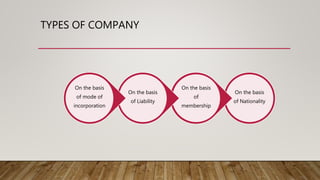
TYPES OF COMPANY
On the basis
of Nationality
On the basis
of
membership
On the basis
of Liability
On the basis
of mode of
incorporation
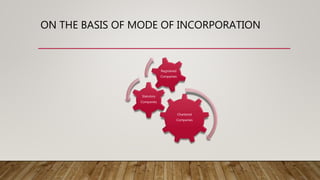
ON THE BASIS OF MODE OF INCORPORATION
Chartered
Companies
Statutory
Companies
Registered
Companies
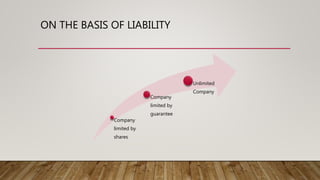
ON THE BASIS OF LIABILITY
Company
limited by
shares
Company
limited by
guarantee
Unlimited
Company
ON THE BASIS OF MEMBERSHIP
Private
Company
Public
Company
Government
Company
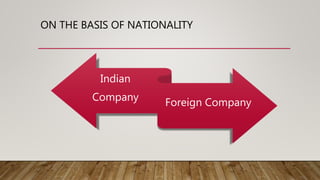
ON THE BASIS OF NATIONALITY
Indian
Company Foreign Company
MERITS OF COMPANY
• Perpetual existence
• Large funds
• Transferability of shares
• Limited liability
• Spreading out of risk
• Democratic organisation
• Efficient and economical management
• Suitable for large enterprise
• Effective control by the government
DEMERITS OF COMPANY
• Complication in formation
• Democratic only in theory
• Lack of motivation
• Limited liability
• Delay in decision
• No personal touch with employees
• Lack of secrecy
• Concentration of wealth and power in few hands
SUITABLE OF JOINT STOCK COMPANIES
• Large capital
• High degree of managerial skills
• Global business operations
• Risk factors
• Large-scale production and distribution
COOPERATIVES
MEANING
• A cooperative is a business organisation owned and operated by a group of
individuals for their mutual benefit. A cooperative is a legal entity with several
corporate features, such as limited liability, an unlimited life span, an elected
Board of Directors, and an administrative staff, member-owners pay annual fees
to the cooperative and share in the profits, which are distributed to members in
proportion to their contributions. Because they do not retain any profits,
cooperatives are not subject to taxes.
FEATURES OF COPERATIVES
• Voluntary association
• Legal entity
• Equal voting right
• Service motive
• Disposal of profits
• Open membership
• Economic motive
• Distributive justices
• Mutual help and welfare
TYPES OF COOPERATIVES
• Consumers’ cooperative Societies: These societies are formed by ordinary people
for obtaining their day to day requirements of goods at cheaper prices.
• Producers’ cooperatives: Also called industrial cooperatives, these societies are
voluntary associations of small producers formed with the object of eliminating
the capitalist class from the system of industrial production.
• Marketing Cooperatives: The marketing cooperatives or the cooperative sales
societies are voluntary associations of independent producers organised for the
purpose of arranging the sale of their output.
• Housing cooperatives: These are associations of person who are interested either
in securing the ownership of a house OR OBTAINING ACCOMODATION AT FAIR
AND REASONABLE RENT.
• Credit Cooperative: The cooperative societies are basically agricultural
cooperatives formed with the object of achieving the benefits of large sale
farming and maximizing agriculture output.
MERITS
• Easy formation
• Open membership
• Democratic control
• Limited liability
• State assistance
• Stable life

Joint Stock Company & Cooperatives

  • 1.
    JOINT STOCK COMPANY MANISH KUMAR ASSISTANTPROFESSOR IAMR GROUP OF INSTITUTIONS
  • 2.
    MEANING Joint stock companyis a voluntary association of individuals for profit, having a capital divided into transferable shares, the ownership of which is the condition of membership.
  • 3.
    FEATURES OF COMPANY •Artificial person with a separate legal entity • Voluntary association • Legal sanction • Perpetual nature • Shares are freely transferable • Common seal • Limited liability • Management by elected representatives • Business • Ownership
  • 4.
    TYPES OF COMPANY Onthe basis of Nationality On the basis of membership On the basis of Liability On the basis of mode of incorporation
  • 5.
    ON THE BASISOF MODE OF INCORPORATION Chartered Companies Statutory Companies Registered Companies
  • 6.
    ON THE BASISOF LIABILITY Company limited by shares Company limited by guarantee Unlimited Company
  • 7.
    ON THE BASISOF MEMBERSHIP Private Company Public Company Government Company
  • 8.
    ON THE BASISOF NATIONALITY Indian Company Foreign Company
  • 9.
    MERITS OF COMPANY •Perpetual existence • Large funds • Transferability of shares • Limited liability • Spreading out of risk • Democratic organisation • Efficient and economical management • Suitable for large enterprise • Effective control by the government
  • 10.
    DEMERITS OF COMPANY •Complication in formation • Democratic only in theory • Lack of motivation • Limited liability • Delay in decision • No personal touch with employees • Lack of secrecy • Concentration of wealth and power in few hands
  • 11.
    SUITABLE OF JOINTSTOCK COMPANIES • Large capital • High degree of managerial skills • Global business operations • Risk factors • Large-scale production and distribution
  • 12.
  • 13.
    MEANING • A cooperativeis a business organisation owned and operated by a group of individuals for their mutual benefit. A cooperative is a legal entity with several corporate features, such as limited liability, an unlimited life span, an elected Board of Directors, and an administrative staff, member-owners pay annual fees to the cooperative and share in the profits, which are distributed to members in proportion to their contributions. Because they do not retain any profits, cooperatives are not subject to taxes.
  • 14.
    FEATURES OF COPERATIVES •Voluntary association • Legal entity • Equal voting right • Service motive • Disposal of profits • Open membership • Economic motive • Distributive justices • Mutual help and welfare
  • 15.
    TYPES OF COOPERATIVES •Consumers’ cooperative Societies: These societies are formed by ordinary people for obtaining their day to day requirements of goods at cheaper prices. • Producers’ cooperatives: Also called industrial cooperatives, these societies are voluntary associations of small producers formed with the object of eliminating the capitalist class from the system of industrial production. • Marketing Cooperatives: The marketing cooperatives or the cooperative sales societies are voluntary associations of independent producers organised for the purpose of arranging the sale of their output.
  • 16.
    • Housing cooperatives:These are associations of person who are interested either in securing the ownership of a house OR OBTAINING ACCOMODATION AT FAIR AND REASONABLE RENT. • Credit Cooperative: The cooperative societies are basically agricultural cooperatives formed with the object of achieving the benefits of large sale farming and maximizing agriculture output.
  • 17.
    MERITS • Easy formation •Open membership • Democratic control • Limited liability • State assistance • Stable life

Editor's Notes

  • #6 A chartered Company is established by the royal Charter or special sanction granted by the head of state. It is granted certain exclusive privileges and power. A statutory company is established by a special Act of the central or state legislature. Its objectives, powers, and activities are defined by the special law under which it is created.