Plant Genetic
Resources
What are plant genetic resources?
Plant genetic resources (PGR), also known as genetic materials or
germplasm, refer to the diverse genetic variability present in plant
species. This includes seeds, tissues, and other plant parts that contain
genetic information crucial for plant breeding, research, and
conservation efforts. Plant genetic resources encompass both cultivated
varieties and their wild relatives.
 Aimed at developing new varieties for increased crop productions.
 Comprises native landraces , local selections , elite cultivars and wild
relatives of crop plants.
PLANT GENETIC RESOURCES?
The sum of all hereditary material/ allelic
sources of various genes present in a crop
species and its wild relatives.
OR
It is the genetic wealth of a crop over a
period of evolution. It is the raw material
for further crop improvement
Plant genetic resources
24,000 plant species – described
3000 – human use
30 plant species – 95% basic needs
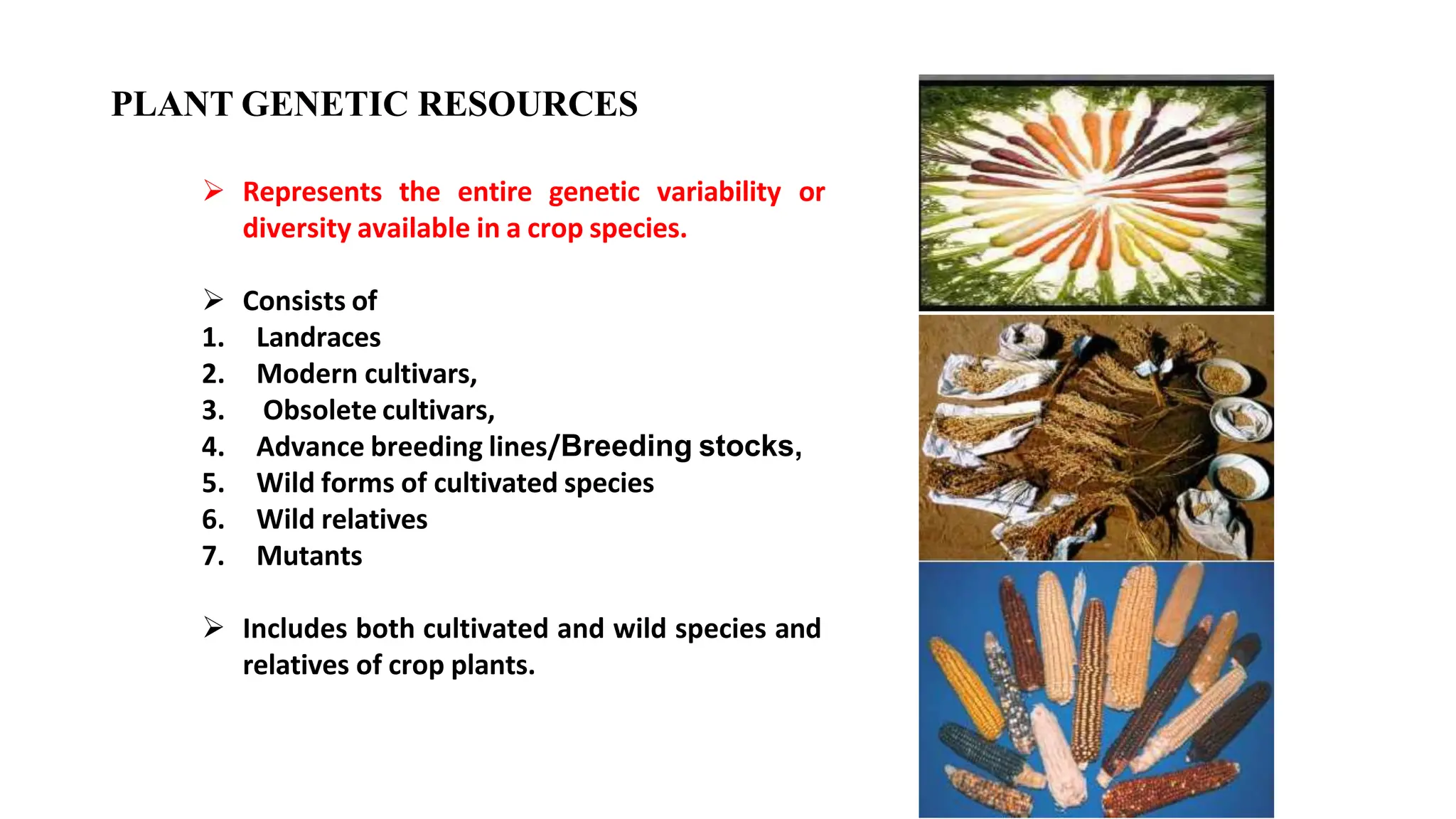
PLANT GENETIC RESOURCES
 Represents the entire genetic variability or
diversity available in a crop species.
 Consists of
1. Landraces
2. Modern cultivars,
3. Obsolete cultivars,
4. Advance breeding lines/Breeding stocks,
5. Wild forms of cultivated species
6. Wild relatives
7. Mutants
 Includes both cultivated and wild species and
relatives of crop plants.
Landraces
Primitive cultivars selected and cultivated
by the farmers from many generations. ex:
Features of land races:
Land races were not deliberately bred
like modern cultivars.
Land races have high level of genetic
diversity with resistance to biotic and
abiotic stresses.
Land races have broad genetic base for
wider adaptability.
Components of Genetic
Resources
• (1) Land races,
• (2) Obsolete
cultivars,
• (3) Modern cultivars,
• (4) Advanced
breeding materials,
• (5) Wild forms of
cultivated species,
• (6) Wild relatives and
• (7) Mutants.
 They differ in adaptation to type, time of seeding, date
of maturity, height, nutritive value and other properties.
 Little response to selection for high yield
 They are less uniform and low yielders.
Obsolete cultivars
• They are the varieties which were popular earlier and now have been
replaced by new varieties.
• These varieties have several desirable characters & constitute an
important part of genepool.
• Ex: wheat varieties of K68, K65, Pb591
• Improved varieties of recent past are known
as obsolete cultivars.
Components of Genetic
Resources
• (1) Land races,
• (2) Obsolete
cultivars,
• (3) Modern cultivars,
• (4) Advanced
breeding materials,
• (5) Wild forms of
cultivated species,
• (6) Wild relatives and
• (7) Mutants.
Modern cultivars
 Currently cultivated high yielding varieties
 Also known as improved cultivars or advance
cultivars.
 Used as parents in the breeding programmes
 High yield potential and uniformity as compared
to obsolete varieties and land races.
 Modern cultivars have narrow genetic base and
low adaptability compared to land races.
Components of Genetic
Resources
• (1) Land races,
• (2) Obsolete
cultivars,
• (3) Modern cultivars,
• (4) Advanced
breeding materials,
• (5) Wild forms of
cultivated species,
• (6) Wild relatives and
• (7) Mutants.
Advanced breeding lines
• advanced cultures which are not yet ready for release to farmers
• Sometimes they are not very much productive, but valuable for various
economic characters.
• Advanced breeding lines or breeding stocks are populations of plants that
are developed by plant breeders through controlled crosses and selection
processes aimed at combining desirable traits from different parents. These
lines serve as the starting material for developing new cultivars through
further breeding and selection.
Components of Genetic
Resources
• (1) Land races,
• (2) Obsolete
cultivars,
• (3) Modern cultivars,
• (4) Advanced
breeding materials,
• (5) Wild forms of
cultivated species,
• (6) Wild relatives and
• (7) Mutants.
Wild forms of cultivated species
High degree of resistance to biotic and
abiotic stresses
Wild forms of cultivated species refer to
the original, undomesticated ancestors
or closely related species of cultivated
crops.
They can easily cross with cultivated
species.
Wild forms of many crop species are
extinct.
They constitute small part of gene pool.
Components of Genetic
Resources
• (1) Land races,
• (2) Obsolete
cultivars,
• (3) Modern cultivars,
• (4) Advanced
breeding materials,
• (5) Wild forms of
cultivated species,
• (6) Wild relatives and
• (7) Mutants.
• Those naturally occurring plant species which have
common ancestry with crops
• Wild relatives are plant species that are closely related to
cultivated crops but have not been subjected to
domestication. These species often grow in natural
habitats and possess genetic traits that can be valuable
for improving cultivated crops.
• important sources of resistance to biotic
abiotic stresses
• It is used as last resort in crop improvement
programmes,
– (1) hybrid sterility
– (2) hybrid viability and
– (3) transfer of several undesirable genes to the
cultivated species along with desirable alleles.
Components of Genetic
Resources
• (1) Land races,
• (2) Obsolete
cultivars,
• (3) Modern cultivars,
• (4) Advanced
breeding materials,
• (5) Wild forms of
cultivated species,
• (6) Wild relatives and
• (7) Mutants.
Wild relatives
Mutants
 Natural and induced mutations
 Mutants are plants that exhibit spontaneous or
induced genetic changes, resulting in
alterations in their phenotype or traits. These
genetic variations can be beneficial, such as
increased disease resistance or improved yield,
and may be utilized in breeding programs to
develop new crop varieties with desirable
characteristics. Mutants are valuable genetic
resources for studying gene function and trait
inheritance in plants.
Components of Genetic
Resources
• (1) Land races,
• (2) Obsolete
cultivars,
• (3) Modern cultivars,
• (4) Advanced
breeding materials,
• (5) Wild forms of
cultivated species,
• (6) Wild relatives and
• (7) Mutants.
GENE POOL
 The concept of gene pools was proposed by
Harlan and DeWet (1971)
 Gene pool consist of all the genes and their alleles present in
all such individuals which hybridize or can hybridize with
each other.
The gene pool classified into 4 groups
1. Primary gene pool : (GP1)
easy to cross, fertile hybrids, useful for breeding
2. Secondary gene pool : (GP2)
partial fertile hybrids with primary gene pool
3. Tertiary gene pool: (GP3)
sterile hybrids with primary pool
4. QUATRANAY gene pool: (GP4): GMOs
The sum total of all hereditary material/ allelic sources of various genes
present in a crop species and its wild relatives.
The germplasm is a collection of large number of genotypes of a crop
species and its wild relatives.
Features:
 It represents the entire genetic variability
 It includes land races, modern cultivars, obsolete cultivars, breeding
lines , special genetic stocks, wild forms and wild relatives
 Collected from centers of diversity, gene bank, gene sanctuaries,
farmers field, market and seed companies
GERMPLASM
The terms "gene pool" and "germplasm" are related concepts in genetics and plant breeding, but they have
distinct meanings and applications:
1.Gene Pool:
1. The gene pool refers to the total collection of genetic variation within a population or species.
2. It encompasses all the alleles (different forms of genes) present in the individuals of a population or
species.
3. The gene pool includes genetic diversity resulting from mutation, recombination, and genetic drift.
4. It represents the raw material from which individuals are selected for breeding programs or evolutionary
processes.
5. Gene pools are conceptual frameworks used in population genetics and evolutionary biology to study
patterns of genetic variation and change over time within and among populations
2. Germplasm:
1. Germplasm refers to the genetic material (seeds, tissues, or other plant parts) that contains the
hereditary information of an organism.
2. It represents the tangible repository of genetic diversity available for use in breeding, research, and
conservation.
3. Germplasm collections typically include seeds, cuttings, tissue cultures, or living plants that are stored
in gene banks, botanical gardens, or research institutes.
4. Germplasm collections are curated and maintained to preserve genetic diversity, facilitate breeding
programs, and support research efforts aimed at improving crops, conserving endangered species, or
studying genetic resources.
Germplasm Conservation Strategies
– Ex situ conservation
Conservation of Germplasm away from its natural
habitat.
– In situ conservation
The conservation of germplasm in its natural habitat or in
the area where it grows naturally.
Conservation Strategies
Ex situ
In situ
•Seed gene bank
•In vitro storage
•DNA storage
•Pollen storage
•Field gene bank
•Botanical garden
•Natural park
•biosphere reserve
•Gene sanctuary
•On- farm
•Home gardens
1. Seed gene bank : Germplasm is stored as Seeds.
1. Easy, relatively safe and requires minimum space
Based on storability classified into two types
a) Orthodox seeds:
- Dried to low moisture content 5%
- Stored at low temperature
- No loss in viability
Ex: Corn, Wheat, Rice, Carrot, Cotton, Sunflower
b) Recalcitrant seeds
- The term "recalcitrant seeds" refers to a specific type of seed that does not survive drying or freezing
very well. This makes them difficult to store for long periods of time, unlike other types of seeds known
as "orthodox seeds"Decrease in moisture below 12-30% - drastic loss in variability
- It is very difficult to store this kind of seeds
Ex: Citrus, Cocoa, Coffee, rubber, oil palm, mango, jackfruit, etc.
Ex situ techniques
Ex situ techniques
1. Seed storage conservation
• Collection of seed samples at one location and their transfer to a gene
bank for storage.
•The samples are usually dried to a suitable low moisture content and
then kept a sub-zero temperatures.
Ex situ techniques
1. Seed storage conservation
Advantages:
1. Efficient and reproducible
2. Feasible for medium and long-term secure storage
3. Wide diversity of each target taxon conserved
4. Easy access for characterization, evaluation and utilization.
5. Little maintenance once the material is conserved.
Disadvantages:
1. Problems storing seeds of recalcitrant species
2. Freezes evolutionary development
3. Genetic diversity may be lost with each regeneration cycle
Ex situ techniques
2. Field gene bank
• Collection of seed or living material from one location and its
transfer and planting at second site.
• Large numbers of accessions of a few species are usually conserved.
Ex situ techniques
2. Field gene bank
Advantages:
1. Suitable for conserving recalcitrant species
2. Easy access for characterization, evaluation and utilization
Disadvantages:
1. Material is susceptible to pests, diseases and vandalism
2. Involves large areas of land, but even then genetic diversity
3. is likely to be restricted
4. High maintenance cost
Ex situ techniques
3. In vitro storage
• Collection and maintenance of explants (tissue samples) in a
sterile, pathogen-free environment.
CIP, in vitro gene bank
(www.cipotato.org)
In vitro culture of banana
germplasm
Ex situ techniques
3. In vitro storage
Advantages:
1. Relatively easy long-term conservation for large number of
recalcitrant, sterile or clonal species
2. Easy access to evaluation and utilization
Disadvantages:
1. Risk of somaclonal variation
2. Need to develop individual maintenance protocols for most
species
3. Relatively high level technology and maintenance costs
Ex situ techniques
4. DNA/ Pollen storage
Collection of DNA or pollen and storage in appropriate
condition, usually refrigerated conditions.
Advantages:
Relatively easy, low cost of conservation
Disadvantages:
Pollen
DNA -Regeneration of entire plants from DNA can not be imagined at
present
- Problem with subsequent gene isolation, cloning and transfer
-Need to develop individual regeneration protocols to produce
haploids plants; further research needed to produce diploid
plants.
- Only paternal material conserved but mixtures from many
individuals could be predicted.
In situ techniques
• These techniques involve maintenance of
genetic variation at location where it is normally
grown, either in wild or traditional farming
systems.
In situ techniques
1. Natural park and biosphere reserve
• Location, management, and monitoring of genetic diversity in
natural wild populations within defined areas designated for
active, long-term conservation.
Natural protected area management zone in Turkey where crop wild relatives are
found
(www.ipgri.cgiar.org; International Plant Genetic Resources Institute)
In situ techniques
1. Natural park and biosphere reserve
Advantages:
1. Dynamic conservation in relation with environmental changes, pest and
diseases
2. Appropriate method to recalcitrant species
3. Possibility of multiple target taxa reserves and conservation of a diverse
range of wild relatives
Disadvantages:
1. Materials not easily available for utilization
2. Vulnerable to natural and man-directed disasters
3. Appropriate management regimes poorly understood
4. Requires high level of active supervision and monitoring
In situ techniques
2. On-farm
• Sustainable management of genetic diversity of locally developed
traditional crop varieties with associated wild and weedy species
or forms by farmers within traditional agricultural, horticultural or
agrisilvicultural cultivation systems.
CIP, on-farm conservation of potato germplasm
(www.cipotato.org)
In situ techniques
2. On-farm
Advantages:
1. Dynamic conservation in relation to environmental changes, pest and diseases
2. Ensures the conservation of traditional land races of field crops
3. Ensures the conservation of weedy crop relatives and ancestral forms.
Disadvantages:
1. Vulnerable to changes in farming practices
2. Requires maintenance of traditional cultural systems and possible payment of
premiums to farmers
3. Restricted to field crops
4. Only limited diversity can be maintained on each farm, so multiple farms in diverse
regions are required to ensure the conservation of genetic diversity.
In situ techniques
3. Home garden
• Similar to on-farm conservation, involves smaller scale but more
species-diverse genetic conservation in home, kitchen, backyard or
door-yard gardens.
In situ techniques
3. Home garden
•Advantages:
- Dynamic conservation
- Ensures conservation of traditional land races of minor crops, fruit and
vegetables, medicinal plants, culinary herbs, etc.
- Ensures the conservation of weedy relatives and ancestral forms.
Disadvantages:
- Vulnerable to changes in farming practices
- Appropriate management regimes poorly understood
- Requires maintenance of traditional cultural systems, and possible
subsidization of farmers
Utilization of Germplasm
The germplasm can be used in a breeding programme in the
following 3 ways:
1. Direct release as a variety
2. It may be subjected to selection for developing a variety
3. It may be used as parent in hybridization programme
Utilization of
Germplasm Resources
Release of New
Improved Variety
Development of
Genetically Diverse Populations
Vigorous Yield Testing

plant genetic resource conservation techniques .pptx

  • 1.
  • 2.
    What are plantgenetic resources? Plant genetic resources (PGR), also known as genetic materials or germplasm, refer to the diverse genetic variability present in plant species. This includes seeds, tissues, and other plant parts that contain genetic information crucial for plant breeding, research, and conservation efforts. Plant genetic resources encompass both cultivated varieties and their wild relatives.  Aimed at developing new varieties for increased crop productions.  Comprises native landraces , local selections , elite cultivars and wild relatives of crop plants.
  • 3.
    PLANT GENETIC RESOURCES? Thesum of all hereditary material/ allelic sources of various genes present in a crop species and its wild relatives. OR It is the genetic wealth of a crop over a period of evolution. It is the raw material for further crop improvement Plant genetic resources 24,000 plant species – described 3000 – human use 30 plant species – 95% basic needs
  • 4.
    PLANT GENETIC RESOURCES Represents the entire genetic variability or diversity available in a crop species.  Consists of 1. Landraces 2. Modern cultivars, 3. Obsolete cultivars, 4. Advance breeding lines/Breeding stocks, 5. Wild forms of cultivated species 6. Wild relatives 7. Mutants  Includes both cultivated and wild species and relatives of crop plants.
  • 5.
    Landraces Primitive cultivars selectedand cultivated by the farmers from many generations. ex: Features of land races: Land races were not deliberately bred like modern cultivars. Land races have high level of genetic diversity with resistance to biotic and abiotic stresses. Land races have broad genetic base for wider adaptability. Components of Genetic Resources • (1) Land races, • (2) Obsolete cultivars, • (3) Modern cultivars, • (4) Advanced breeding materials, • (5) Wild forms of cultivated species, • (6) Wild relatives and • (7) Mutants.
  • 6.
     They differin adaptation to type, time of seeding, date of maturity, height, nutritive value and other properties.  Little response to selection for high yield  They are less uniform and low yielders.
  • 7.
    Obsolete cultivars • Theyare the varieties which were popular earlier and now have been replaced by new varieties. • These varieties have several desirable characters & constitute an important part of genepool. • Ex: wheat varieties of K68, K65, Pb591 • Improved varieties of recent past are known as obsolete cultivars. Components of Genetic Resources • (1) Land races, • (2) Obsolete cultivars, • (3) Modern cultivars, • (4) Advanced breeding materials, • (5) Wild forms of cultivated species, • (6) Wild relatives and • (7) Mutants.
  • 8.
    Modern cultivars  Currentlycultivated high yielding varieties  Also known as improved cultivars or advance cultivars.  Used as parents in the breeding programmes  High yield potential and uniformity as compared to obsolete varieties and land races.  Modern cultivars have narrow genetic base and low adaptability compared to land races. Components of Genetic Resources • (1) Land races, • (2) Obsolete cultivars, • (3) Modern cultivars, • (4) Advanced breeding materials, • (5) Wild forms of cultivated species, • (6) Wild relatives and • (7) Mutants.
  • 9.
    Advanced breeding lines •advanced cultures which are not yet ready for release to farmers • Sometimes they are not very much productive, but valuable for various economic characters. • Advanced breeding lines or breeding stocks are populations of plants that are developed by plant breeders through controlled crosses and selection processes aimed at combining desirable traits from different parents. These lines serve as the starting material for developing new cultivars through further breeding and selection. Components of Genetic Resources • (1) Land races, • (2) Obsolete cultivars, • (3) Modern cultivars, • (4) Advanced breeding materials, • (5) Wild forms of cultivated species, • (6) Wild relatives and • (7) Mutants.
  • 10.
    Wild forms ofcultivated species High degree of resistance to biotic and abiotic stresses Wild forms of cultivated species refer to the original, undomesticated ancestors or closely related species of cultivated crops. They can easily cross with cultivated species. Wild forms of many crop species are extinct. They constitute small part of gene pool. Components of Genetic Resources • (1) Land races, • (2) Obsolete cultivars, • (3) Modern cultivars, • (4) Advanced breeding materials, • (5) Wild forms of cultivated species, • (6) Wild relatives and • (7) Mutants.
  • 11.
    • Those naturallyoccurring plant species which have common ancestry with crops • Wild relatives are plant species that are closely related to cultivated crops but have not been subjected to domestication. These species often grow in natural habitats and possess genetic traits that can be valuable for improving cultivated crops. • important sources of resistance to biotic abiotic stresses • It is used as last resort in crop improvement programmes, – (1) hybrid sterility – (2) hybrid viability and – (3) transfer of several undesirable genes to the cultivated species along with desirable alleles. Components of Genetic Resources • (1) Land races, • (2) Obsolete cultivars, • (3) Modern cultivars, • (4) Advanced breeding materials, • (5) Wild forms of cultivated species, • (6) Wild relatives and • (7) Mutants. Wild relatives
  • 12.
    Mutants  Natural andinduced mutations  Mutants are plants that exhibit spontaneous or induced genetic changes, resulting in alterations in their phenotype or traits. These genetic variations can be beneficial, such as increased disease resistance or improved yield, and may be utilized in breeding programs to develop new crop varieties with desirable characteristics. Mutants are valuable genetic resources for studying gene function and trait inheritance in plants. Components of Genetic Resources • (1) Land races, • (2) Obsolete cultivars, • (3) Modern cultivars, • (4) Advanced breeding materials, • (5) Wild forms of cultivated species, • (6) Wild relatives and • (7) Mutants.
  • 13.
    GENE POOL  Theconcept of gene pools was proposed by Harlan and DeWet (1971)  Gene pool consist of all the genes and their alleles present in all such individuals which hybridize or can hybridize with each other. The gene pool classified into 4 groups 1. Primary gene pool : (GP1) easy to cross, fertile hybrids, useful for breeding 2. Secondary gene pool : (GP2) partial fertile hybrids with primary gene pool 3. Tertiary gene pool: (GP3) sterile hybrids with primary pool 4. QUATRANAY gene pool: (GP4): GMOs
  • 14.
    The sum totalof all hereditary material/ allelic sources of various genes present in a crop species and its wild relatives. The germplasm is a collection of large number of genotypes of a crop species and its wild relatives. Features:  It represents the entire genetic variability  It includes land races, modern cultivars, obsolete cultivars, breeding lines , special genetic stocks, wild forms and wild relatives  Collected from centers of diversity, gene bank, gene sanctuaries, farmers field, market and seed companies GERMPLASM
  • 15.
    The terms "genepool" and "germplasm" are related concepts in genetics and plant breeding, but they have distinct meanings and applications: 1.Gene Pool: 1. The gene pool refers to the total collection of genetic variation within a population or species. 2. It encompasses all the alleles (different forms of genes) present in the individuals of a population or species. 3. The gene pool includes genetic diversity resulting from mutation, recombination, and genetic drift. 4. It represents the raw material from which individuals are selected for breeding programs or evolutionary processes. 5. Gene pools are conceptual frameworks used in population genetics and evolutionary biology to study patterns of genetic variation and change over time within and among populations 2. Germplasm: 1. Germplasm refers to the genetic material (seeds, tissues, or other plant parts) that contains the hereditary information of an organism. 2. It represents the tangible repository of genetic diversity available for use in breeding, research, and conservation. 3. Germplasm collections typically include seeds, cuttings, tissue cultures, or living plants that are stored in gene banks, botanical gardens, or research institutes. 4. Germplasm collections are curated and maintained to preserve genetic diversity, facilitate breeding programs, and support research efforts aimed at improving crops, conserving endangered species, or studying genetic resources.
  • 16.
    Germplasm Conservation Strategies –Ex situ conservation Conservation of Germplasm away from its natural habitat. – In situ conservation The conservation of germplasm in its natural habitat or in the area where it grows naturally.
  • 17.
    Conservation Strategies Ex situ Insitu •Seed gene bank •In vitro storage •DNA storage •Pollen storage •Field gene bank •Botanical garden •Natural park •biosphere reserve •Gene sanctuary •On- farm •Home gardens
  • 18.
    1. Seed genebank : Germplasm is stored as Seeds. 1. Easy, relatively safe and requires minimum space Based on storability classified into two types a) Orthodox seeds: - Dried to low moisture content 5% - Stored at low temperature - No loss in viability Ex: Corn, Wheat, Rice, Carrot, Cotton, Sunflower b) Recalcitrant seeds - The term "recalcitrant seeds" refers to a specific type of seed that does not survive drying or freezing very well. This makes them difficult to store for long periods of time, unlike other types of seeds known as "orthodox seeds"Decrease in moisture below 12-30% - drastic loss in variability - It is very difficult to store this kind of seeds Ex: Citrus, Cocoa, Coffee, rubber, oil palm, mango, jackfruit, etc. Ex situ techniques
  • 19.
    Ex situ techniques 1.Seed storage conservation • Collection of seed samples at one location and their transfer to a gene bank for storage. •The samples are usually dried to a suitable low moisture content and then kept a sub-zero temperatures.
  • 21.
    Ex situ techniques 1.Seed storage conservation Advantages: 1. Efficient and reproducible 2. Feasible for medium and long-term secure storage 3. Wide diversity of each target taxon conserved 4. Easy access for characterization, evaluation and utilization. 5. Little maintenance once the material is conserved. Disadvantages: 1. Problems storing seeds of recalcitrant species 2. Freezes evolutionary development 3. Genetic diversity may be lost with each regeneration cycle
  • 22.
    Ex situ techniques 2.Field gene bank • Collection of seed or living material from one location and its transfer and planting at second site. • Large numbers of accessions of a few species are usually conserved.
  • 23.
    Ex situ techniques 2.Field gene bank Advantages: 1. Suitable for conserving recalcitrant species 2. Easy access for characterization, evaluation and utilization Disadvantages: 1. Material is susceptible to pests, diseases and vandalism 2. Involves large areas of land, but even then genetic diversity 3. is likely to be restricted 4. High maintenance cost
  • 24.
    Ex situ techniques 3.In vitro storage • Collection and maintenance of explants (tissue samples) in a sterile, pathogen-free environment. CIP, in vitro gene bank (www.cipotato.org) In vitro culture of banana germplasm
  • 25.
    Ex situ techniques 3.In vitro storage Advantages: 1. Relatively easy long-term conservation for large number of recalcitrant, sterile or clonal species 2. Easy access to evaluation and utilization Disadvantages: 1. Risk of somaclonal variation 2. Need to develop individual maintenance protocols for most species 3. Relatively high level technology and maintenance costs
  • 26.
    Ex situ techniques 4.DNA/ Pollen storage Collection of DNA or pollen and storage in appropriate condition, usually refrigerated conditions. Advantages: Relatively easy, low cost of conservation Disadvantages: Pollen DNA -Regeneration of entire plants from DNA can not be imagined at present - Problem with subsequent gene isolation, cloning and transfer -Need to develop individual regeneration protocols to produce haploids plants; further research needed to produce diploid plants. - Only paternal material conserved but mixtures from many individuals could be predicted.
  • 27.
    In situ techniques •These techniques involve maintenance of genetic variation at location where it is normally grown, either in wild or traditional farming systems.
  • 28.
    In situ techniques 1.Natural park and biosphere reserve • Location, management, and monitoring of genetic diversity in natural wild populations within defined areas designated for active, long-term conservation. Natural protected area management zone in Turkey where crop wild relatives are found (www.ipgri.cgiar.org; International Plant Genetic Resources Institute)
  • 29.
    In situ techniques 1.Natural park and biosphere reserve Advantages: 1. Dynamic conservation in relation with environmental changes, pest and diseases 2. Appropriate method to recalcitrant species 3. Possibility of multiple target taxa reserves and conservation of a diverse range of wild relatives Disadvantages: 1. Materials not easily available for utilization 2. Vulnerable to natural and man-directed disasters 3. Appropriate management regimes poorly understood 4. Requires high level of active supervision and monitoring
  • 30.
    In situ techniques 2.On-farm • Sustainable management of genetic diversity of locally developed traditional crop varieties with associated wild and weedy species or forms by farmers within traditional agricultural, horticultural or agrisilvicultural cultivation systems. CIP, on-farm conservation of potato germplasm (www.cipotato.org)
  • 31.
    In situ techniques 2.On-farm Advantages: 1. Dynamic conservation in relation to environmental changes, pest and diseases 2. Ensures the conservation of traditional land races of field crops 3. Ensures the conservation of weedy crop relatives and ancestral forms. Disadvantages: 1. Vulnerable to changes in farming practices 2. Requires maintenance of traditional cultural systems and possible payment of premiums to farmers 3. Restricted to field crops 4. Only limited diversity can be maintained on each farm, so multiple farms in diverse regions are required to ensure the conservation of genetic diversity.
  • 32.
    In situ techniques 3.Home garden • Similar to on-farm conservation, involves smaller scale but more species-diverse genetic conservation in home, kitchen, backyard or door-yard gardens.
  • 33.
    In situ techniques 3.Home garden •Advantages: - Dynamic conservation - Ensures conservation of traditional land races of minor crops, fruit and vegetables, medicinal plants, culinary herbs, etc. - Ensures the conservation of weedy relatives and ancestral forms. Disadvantages: - Vulnerable to changes in farming practices - Appropriate management regimes poorly understood - Requires maintenance of traditional cultural systems, and possible subsidization of farmers
  • 34.
    Utilization of Germplasm Thegermplasm can be used in a breeding programme in the following 3 ways: 1. Direct release as a variety 2. It may be subjected to selection for developing a variety 3. It may be used as parent in hybridization programme
  • 35.
    Utilization of Germplasm Resources Releaseof New Improved Variety Development of Genetically Diverse Populations Vigorous Yield Testing