Plant Genetic Resources
Thesum total of hereditary material i.e. all the
alleles of various genes, present in a crop
species and its wild relatives is referred to as
germplasm/genetic resources/gene pool/genetic
stock
● consists of land races, modern cultivars,
obsolete cultivars, breeding stocks, wild
forms and wild species of cultivated
crops.
● Germplasm is collected from centres of
diversity, gene banks, gene sanctuaries,
farmer’s fields, markers and seed
companies.
● It is the basic material for launching a crop
improvement programme.
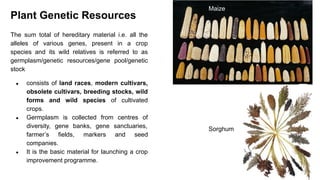
Maize
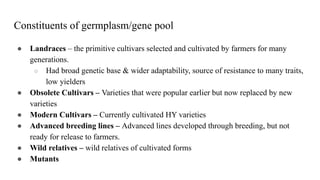
Sorghum
4.
Constituents of germplasm/genepool
● Landraces – the primitive cultivars selected and cultivated by farmers for many
generations.
○ Had broad genetic base & wider adaptability, source of resistance to many traits,
low yielders
● Obsolete Cultivars – Varieties that were popular earlier but now replaced by new
varieties
● Modern Cultivars – Currently cultivated HY varieties
● Advanced breeding lines – Advanced lines developed through breeding, but not
ready for release to farmers.
● Wild relatives – wild relatives of cultivated forms
● Mutants
5.
Gene pool
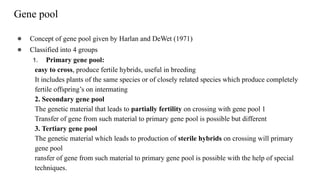
● Conceptof gene pool given by Harlan and DeWet (1971)
● Classified into 4 groups
1. Primary gene pool:
easy to cross, produce fertile hybrids, useful in breeding
It includes plants of the same species or of closely related species which produce completely
fertile offspring’s on intermating
2. Secondary gene pool
The genetic material that leads to partially fertility on crossing with gene pool 1
Transfer of gene from such material to primary gene pool is possible but different
3. Tertiary gene pool
The genetic material which leads to production of sterile hybrids on crossing will primary
gene pool
ransfer of gene from such material to primary gene pool is possible with the help of special
techniques.
6.
Germplasm Conservation
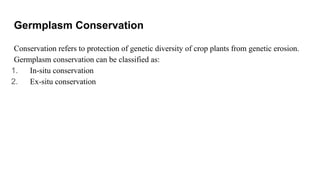
Conservation refersto protection of genetic diversity of crop plants from genetic erosion.
Germplasm conservation can be classified as:
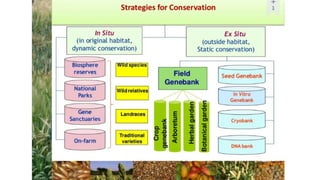
1. In-situ conservation
2. Ex-situ conservation
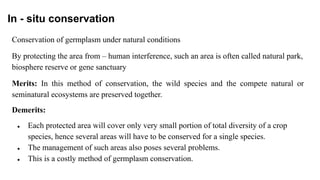
In - situconservation
Conservation of germplasm under natural conditions
By protecting the area from – human interference, such an area is often called natural park,
biosphere reserve or gene sanctuary
Merits: In this method of conservation, the wild species and the compete natural or
seminatural ecosystems are preserved together.
Demerits:
● Each protected area will cover only very small portion of total diversity of a crop
species, hence several areas will have to be conserved for a single species.
● The management of such areas also poses several problems.
● This is a costly method of germplasm conservation.
10.
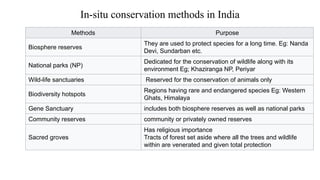
In-situ conservation methodsin India
Methods Purpose
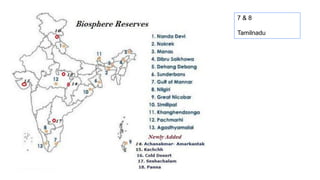
Biosphere reserves
They are used to protect species for a long time. Eg: Nanda
Devi, Sundarban etc.
National parks (NP)
Dedicated for the conservation of wildlife along with its
environment Eg; Khaziranga NP, Periyar
Wild-life sanctuaries Reserved for the conservation of animals only
Biodiversity hotspots
Regions having rare and endangered species Eg: Western
Ghats, Himalaya
Gene Sanctuary includes both biosphere reserves as well as national parks
Community reserves community or privately owned reserves
Sacred groves
Has religious importance
Tracts of forest set aside where all the trees and wildlife
within are venerated and given total protection
11.
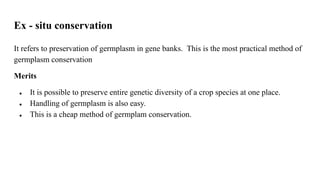
Ex - situconservation
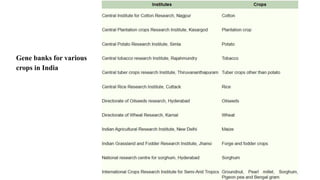
It refers to preservation of germplasm in gene banks. This is the most practical method of
germplasm conservation
Merits
● It is possible to preserve entire genetic diversity of a crop species at one place.
● Handling of germplasm is also easy.
● This is a cheap method of germplam conservation.
Seed banks
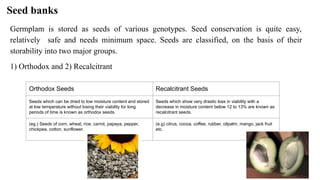
Germplam isstored as seeds of various genotypes. Seed conservation is quite easy,
relatively safe and needs minimum space. Seeds are classified, on the basis of their
storability into two major groups.
1) Orthodox and 2) Recalcitrant
Orthodox Seeds Recalcitrant Seeds
Seeds which can be dried to low moisture content and stored
at low temperature without losing their viability for long
periods of time is known as orthodox seeds.
Seeds which show very drastic loss in viability with a
decrease in moisture content below 12 to 13% are known as
recalcitrant seeds.
(eg.) Seeds of corn, wheat, rice, carrot, papaya, pepper,
chickpea, cotton, sunflower.
(e.g) citrus, cocoa, coffee, rubber, oilpalm, mango, jack fruit
etc.
14.
Based on durationof storage, seed bank collects are classified into three groups.
1. Base collections: Seeds can be conserved for long term (50 to 100 years), at about
-20 degree C with 5% moisture content. They are disturbed only for regeneration.
2. Active collection: Seeds are stored at 0 degree C and the seed moisture is between 5
and 8%. The storage is for medium duration, i.e., 10-15 years. These collections are
used for evaluation, multiplication, and distribution of the accessions.
3. Working collections: Seeds are stored for 3-5 years at 5-10 degree C and the
usually contain about 10% moisture. Such materials are regularly used in crop
improvement programmes.
15.
Field or plantbank
It is an orchard or a field in which accessions of fruit trees or vegetatively propagated
crops are grown and maintained.
Limitations: 1. Require large areas
2. Expensive to establish and maintain
3. Prone to damage from disease and insect attacks
4. Man – made
5. Natural disasters can destroy
6. Human errors in handling
16.
Shoot tip banks
Germplasmis conserved as slow growth cultures of shoot-tips and node segments.
Merits
● Each genotype can be conserved indefinitely free from virus or other pathogens.
● It is advantageous for vegetatively propagated crops like potato, sweet potato, cassava
etc., because seed production in these crops is poor
● Vegetatively propagated material can be saved from natural disasters or pathogen
attack.
● Long regeneration cycle can be envisaged from meristem cultures.
● Regeneration of meristems is extremely easy.
● Plant species having recalcitrant seeds can be easily conserved by meristem cultures.
17.
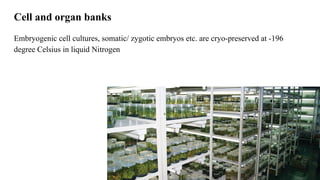
Cell and organbanks
Embryogenic cell cultures, somatic/ zygotic embryos etc. are cryo-preserved at -196
degree Celsius in liquid Nitrogen
18.
DNA banks
DNA segmentsfrom the genomes of germplasm accessions are maintained and conserved.
19.
Germplasm evaluation
Evaluation refersto screening of gemplasms in respect of morphological, genetical,
economic, biochemical, physiological, pathological and entomological attributes.
Evaluation of germplasm is essential from following angles.
● To identify gene sources for resistance to biotic and abiotic stresses, earliness,
dwarfness, productivity and quality characters.
● To classify the germplasm into various groups
● To get a clear pictures about the significance of individual germplasm line.
The evaluation of germplasm is done in three different places viz., (1) in the field (2) in
green house a) 3) in the laboratory.
20.
Germplasm cataloguing, Datastorage and Retrieval.
Each germplasm accession is given an accession number. This number is pre fixed in
India, with either IC (Indigenous collection), EC (exotic collection) or IW (Indigenous
wild).
Information on the species and variety names, place of origin, adaptation and on its various
feature or descriptors is also recorded in the germplasm maintenance records.
21.
National Bureau ofPlant Genetic Resources (NBPGR)
NBPGR established in 1976 is the nodal organisation in India for planning, conducting, promoting,
coordinating and lending all activities concerning plant.
Objectives
■ To plan, organize, conduct and coordinate exploration and collection of indigenous and exotic plant
genetic resources.
■ To undertake introduction, exchange and quarantine of plant genetic resources.
■ To characterize, evaluate, document and conserve crop genetic resources and promote their use, in
collaboration with other national organizations.
■ To develop information network on plant genetic resources.
■ To conduct research, undertake teaching and training, develop guidelines and create public
awareness on plant genetic resources.
22.
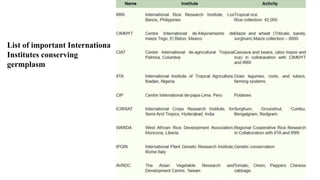
IPGRI (International PlantGenetic Resources Institute)
● Headquarters is based in Rome, Italy
● (IPGRI) is an autonomous international scientific organization, supported by the Consultative Group on International
Agricultural Research (CGIAR).
Svalbard Global SeedVault
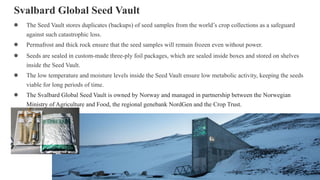
● The Seed Vault stores duplicates (backups) of seed samples from the world’s crop collections as a safeguard
against such catastrophic loss.
● Permafrost and thick rock ensure that the seed samples will remain frozen even without power.
● Seeds are sealed in custom-made three-ply foil packages, which are sealed inside boxes and stored on shelves
inside the Seed Vault.
● The low temperature and moisture levels inside the Seed Vault ensure low metabolic activity, keeping the seeds
viable for long periods of time.
● The Svalbard Global Seed Vault is owned by Norway and managed in partnership between the Norwegian
Ministry of Agriculture and Food, the regional genebank NordGen and the Crop Trust.