
Plant Genetic Resources
• Submitted to:
Dr. D.A. Patel
Head and Prof.
Department of Genetics and Plant Breeding.
• Submitted by:
Swapnil Baraskar
Reg.no. 2010119009
CONTENTS:
• Introduction
• Germplasm and conservation
• Concept of Gene Pool
• Centres of Origin
• Gene Banks
• NBPGR
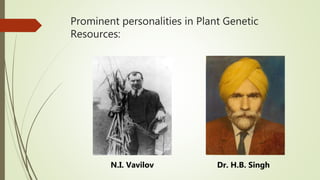
Prominent personalities in Plant Genetic
Resources:
N.I. Vavilov Dr. H.B. Singh
Introduction:
• It took millions of years to modify the plants for survival under natural conditions
but plant breeding aims toward changing plants as per human needs within short
period of time.
• Due to the action of evolution as well as human selection, genetic differences
were created among the individuals in course of time.
• The sum of all allelic sources influencing the wide range of characters constitutes
the Plant Genetic Resources of a crop.
• The term “Genetic Resources” was coined by Sir Otto Frankel in 1986
• All the aspects of plant genetic resources can be described as following
interrelated activities:
a) Origin and spread of crop.
b) Collection, evaluation and conservation.
c) Utilization of germplasm.
Germplasm:
• The genes required for crop improvement are present in different lines or varieties
of crop and some critical genes are contributed by their wild relatives.
• Germplasm can be defined as, “The sum total of hereditary material i.e. all alleles
of various genes present in a crop species and its wild relatives”.
• Germplasm of a crop consists of following types of materials-
a) Land Races.
b) Obsolete Varieties.
c) Varieties in Cultivation.
d) Breeding Lines.
e) Special Genetic Stock.
f) Wild Forms and Relatives.
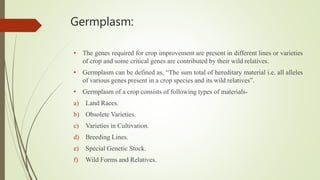
a) Land Races
• These are primitive varieties evolved over the time through the process of natural
as well as artificial selection but without any plant breeding effort.
• They are the great source of genetic variability and many valuable genes.
• They can survive under unfavorable conditions and have low and stable yields.
Fig. Land races of Wheat in Afghanistan.
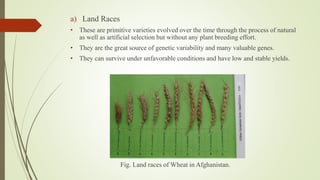
b) Obsolete varieties
• These are the varieties which were once commercially cultivated but now are no
more grown.
• These varieties also carry some useful genes hence they are conserved.
Fig. Obsolete wheat variety- Sonalika.
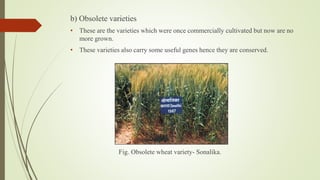
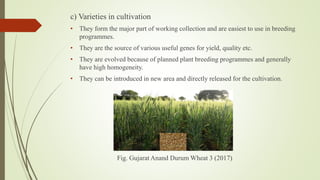
c) Varieties in cultivation
• They form the major part of working collection and are easiest to use in breeding
programmes.
• They are the source of various useful genes for yield, quality etc.
• They are evolved because of planned plant breeding programmes and generally
have high homogeneity.
• They can be introduced in new area and directly released for the cultivation.
Fig. Gujarat Anand Durum Wheat 3 (2017)
d) Breeding lines
• These lines developed in breeding programmes have narrow genetic base but have
valuable gens.
• It includes nearly homozygous lines, mutant lines, transgenic lines etc.
e) Special genetic stocks
• These contains lines carrying gene mutations, chromosomal aberrations, markers,
monosomics, trisomics etc.
• They can be searched in nature or can be produced artificially.
• They are useful in gene analysis as well as sometimes in breeding programmes
also.
f) Wild forms and wild relatives
• Wild forms are the wild species from which the crop species were directly
derived.
• Wild relatives include species which are related to the crop species by descent
during evolution.
• Wild forms are easy to cross with crop species but wild relatives are difficult to
hybridize.
• This group is the source of many valuable genes for resistance to pest and diseases
and even also for abiotic stresses.
Germplasm Conservation:
A) In Situ Germplasm Conservation-
• Conservation of germplasm in its natural habitat or in the area where it naturally
grows is called In situ germplasm conservation.
• Area is protected from human interference. Hence such populations continue to
grow by broadening the genetic base via natural selection.
• It is well suited for wild types and wild relatives but not applicable for
conservation of land races and primitive cultivars.
• Currently in India there are 14 Biosphere Reserves and 104 Natural Parks.
B) Ex Situ Germplasm Conservation-
• Conservation of germplasm away from its natural habitat is called Ex situ
Conservation.
• It involves one or other form of human interference in specialized areas outside
the place of origin where a sample of genetic variability is maintained.
• This conservation can be achieved in following ways:
a) Seed gene banks.
b) Plant or field gene banks.
c) Shoot-tip gene banks.
d) Cell and organ gene banks.
e) DNA gene banks.
a) Seed gene bank
• Here the germplasm is stored as seeds. Mostly the gene banks are the seed banks.
• It is easy, safer and space required is also very less. They can be stored up to 50-
100 years as per the moisture level of seed.
• As proposed by Roberts (1973), seeds are classified as Orthodox and Recalcitrant.
• Seed bank collections are categorised into three groups:
1. Base collection: Stored at -20℃ with 5% moisture. Stored up to 100 years.
2. Active collection: Stored at 0℃ with 5% moisture. Stored up to 10-15 years.
3. Working collection: Stored at <15℃ with 10% moisture. Stored up to 3-5 years.
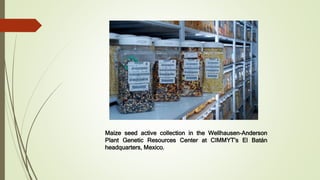
Maize seed active collection in the Wellhausen-Anderson
Plant Genetic Resources Center at CIMMYT's El Batán
headquarters, Mexico.
b) Plant or field gene banks
• It is an orchard or a field in which accessions of germplasm are grown and
maintained.
• It requires large area and good management. It is prone to pest and disease attack.
Hence it is not much used.
c) Shoot-tip gene banks
• Germplasm is conserved as culture of shoot-tips and nodal segments.
• It is quite useful for vegetatively propagated crops and tree species.
• Subculture is done after relatively long periods.
• Free from pest and disease attack.
d) Cell and organ gene banks
• This is based on cryopreserved cell cultures, shoot-tips and/or somatic and/or
zygotic embryos.
• Accessions are stored at -196℃ in liquid nitrogen.
e) DNA banks
• DNA segments from the genomes are maintained as Cosmid clones or pure DNA.
• It can be used to produce transgenic plants.
• It is very expensive and highly sophisticated.
Concept of Gene Pool:
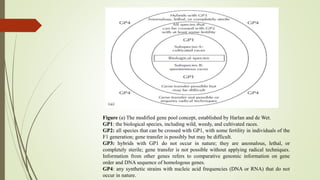
• Concept given by Harlan and de Wet in 1971.
• It consists of all the genes and their alleles present in all such individuals which can
hybridize with each other.
• Classified into following groups:
a) Primary Gene Pool (GP1)- Crossing is easy and gives normal meiotic chromosome
pairing and seed set.
b) Secondary Gene Pool (GP2)- Crossing is somewhat difficult due to barriers like
ploidy differences, chromosomal alterations. Gives partial fertile crosses.
c) Tertiary Gene Pool (GP3)- Crossing is very difficult and if hybrid is produced, are
lethal or completely sterile.
d) Gene Ocean (GP4)- This is the new type of gene pool made available by the
advanced technologies of genetic engineering. Common example is transfer of Bt
gene from bacteria to cotton. However it is a matter of speculation with tremendous
expectations.
Figure (a) The modified gene pool concept, established by Harlan and de Wet.
GP1: the biological species, including wild, weedy, and cultivated races.
GP2: all species that can be crossed with GP1, with some fertility in individuals of the
F1 generation; gene transfer is possibly but may be difficult.
GP3: hybrids with GP1 do not occur in nature; they are anomalous, lethal, or
completely sterile; gene transfer is not possible without applying radical techniques.
Information from other genes refers to comparative genomic information on gene
order and DNA sequence of homologous genes.
GP4: any synthetic strains with nucleic acid frequencies (DNA or RNA) that do not
occur in nature.
Centres of Origin:
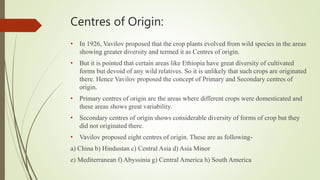
• In 1926, Vavilov proposed that the crop plants evolved from wild species in the areas
showing greater diversity and termed it as Centres of origin.
• But it is pointed that certain areas like Ethiopia have great diversity of cultivated
forms but devoid of any wild relatives. So it is unlikely that such crops are originated
there. Hence Vavilov proposed the concept of Primary and Secondary centres of
origin.
• Primary centres of origin are the areas where different crops were domesticated and
these areas shows great variability.
• Secondary centres of origin shows considerable diversity of forms of crop but they
did not originated there.
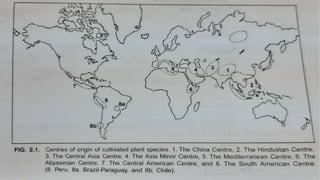
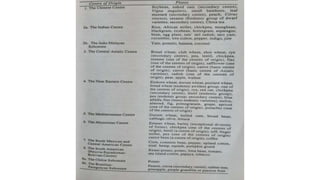
• Vavilov proposed eight centres of origin. These are as following-
a) China b) Hindustan c) Central Asia d) Asia Minor
e) Mediterranean f) Abyssinia g) Central America h) South America
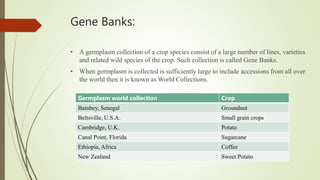
Gene Banks:
• A germplasm collection of a crop species consist of a large number of lines, varieties
and related wild species of the crop. Such collection is called Gene Banks.
• When germplasm is collected is sufficiently large to include accessions from all over
the world then it is known as World Collections.
Germplasm world collection Crop
Bambey, Senegal Groundnut
Beltsville, U.S.A. Small grain crops
Cambridge, U.K. Potato
Canal Point, Florida Sugarcane
Ethiopia, Africa Coffee
New Zealand Sweet Potato
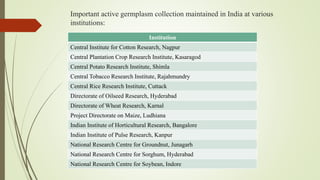
Important active germplasm collection maintained in India at various
institutions:
Institution
Central Institute for Cotton Research, Nagpur
Central Plantation Crop Research Institute, Kasaragod
Central Potato Research Institute, Shimla
Central Tobacco Research Institute, Rajahmundry
Central Rice Research Institute, Cuttack
Directorate of Oilseed Research, Hyderabad
Directorate of Wheat Research, Karnal
Project Directorate on Maize, Ludhiana
Indian Institute of Horticultural Research, Bangalore
Indian Institute of Pulse Research, Kanpur
National Research Centre for Groundnut, Junagarh
National Research Centre for Sorghum, Hyderabad
National Research Centre for Soybean, Indore
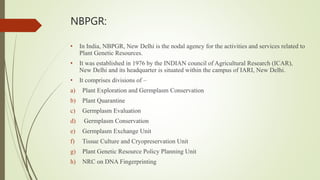
NBPGR:
• In India, NBPGR, New Delhi is the nodal agency for the activities and services related to
Plant Genetic Resources.
• It was established in 1976 by the INDIAN council of Agricultural Research (ICAR),
New Delhi and its headquarter is situated within the campus of IARI, New Delhi.
• It comprises divisions of –
a) Plant Exploration and Germplasm Conservation
b) Plant Quarantine
c) Germplasm Evaluation
d) Germplasm Conservation
e) Germplasm Exchange Unit
f) Tissue Culture and Cryopreservation Unit
g) Plant Genetic Resource Policy Planning Unit
h) NRC on DNA Fingerprinting
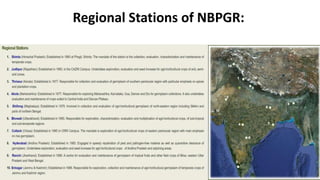
Regional Stations of NBPGR:
આભાર

Plant genetic resources

  • 1.
    Plant Genetic Resources •Submitted to: Dr. D.A. Patel Head and Prof. Department of Genetics and Plant Breeding. • Submitted by: Swapnil Baraskar Reg.no. 2010119009
  • 2.
    CONTENTS: • Introduction • Germplasmand conservation • Concept of Gene Pool • Centres of Origin • Gene Banks • NBPGR
  • 3.
    Prominent personalities inPlant Genetic Resources: N.I. Vavilov Dr. H.B. Singh
  • 4.
    Introduction: • It tookmillions of years to modify the plants for survival under natural conditions but plant breeding aims toward changing plants as per human needs within short period of time. • Due to the action of evolution as well as human selection, genetic differences were created among the individuals in course of time. • The sum of all allelic sources influencing the wide range of characters constitutes the Plant Genetic Resources of a crop. • The term “Genetic Resources” was coined by Sir Otto Frankel in 1986 • All the aspects of plant genetic resources can be described as following interrelated activities: a) Origin and spread of crop. b) Collection, evaluation and conservation. c) Utilization of germplasm.
  • 5.
    Germplasm: • The genesrequired for crop improvement are present in different lines or varieties of crop and some critical genes are contributed by their wild relatives. • Germplasm can be defined as, “The sum total of hereditary material i.e. all alleles of various genes present in a crop species and its wild relatives”. • Germplasm of a crop consists of following types of materials- a) Land Races. b) Obsolete Varieties. c) Varieties in Cultivation. d) Breeding Lines. e) Special Genetic Stock. f) Wild Forms and Relatives.
  • 6.
    a) Land Races •These are primitive varieties evolved over the time through the process of natural as well as artificial selection but without any plant breeding effort. • They are the great source of genetic variability and many valuable genes. • They can survive under unfavorable conditions and have low and stable yields. Fig. Land races of Wheat in Afghanistan.
  • 7.
    b) Obsolete varieties •These are the varieties which were once commercially cultivated but now are no more grown. • These varieties also carry some useful genes hence they are conserved. Fig. Obsolete wheat variety- Sonalika.
  • 8.
    c) Varieties incultivation • They form the major part of working collection and are easiest to use in breeding programmes. • They are the source of various useful genes for yield, quality etc. • They are evolved because of planned plant breeding programmes and generally have high homogeneity. • They can be introduced in new area and directly released for the cultivation. Fig. Gujarat Anand Durum Wheat 3 (2017)
  • 9.
    d) Breeding lines •These lines developed in breeding programmes have narrow genetic base but have valuable gens. • It includes nearly homozygous lines, mutant lines, transgenic lines etc. e) Special genetic stocks • These contains lines carrying gene mutations, chromosomal aberrations, markers, monosomics, trisomics etc. • They can be searched in nature or can be produced artificially. • They are useful in gene analysis as well as sometimes in breeding programmes also.
  • 10.
    f) Wild formsand wild relatives • Wild forms are the wild species from which the crop species were directly derived. • Wild relatives include species which are related to the crop species by descent during evolution. • Wild forms are easy to cross with crop species but wild relatives are difficult to hybridize. • This group is the source of many valuable genes for resistance to pest and diseases and even also for abiotic stresses.
  • 11.
    Germplasm Conservation: A) InSitu Germplasm Conservation- • Conservation of germplasm in its natural habitat or in the area where it naturally grows is called In situ germplasm conservation. • Area is protected from human interference. Hence such populations continue to grow by broadening the genetic base via natural selection. • It is well suited for wild types and wild relatives but not applicable for conservation of land races and primitive cultivars. • Currently in India there are 14 Biosphere Reserves and 104 Natural Parks.
  • 12.
    B) Ex SituGermplasm Conservation- • Conservation of germplasm away from its natural habitat is called Ex situ Conservation. • It involves one or other form of human interference in specialized areas outside the place of origin where a sample of genetic variability is maintained. • This conservation can be achieved in following ways: a) Seed gene banks. b) Plant or field gene banks. c) Shoot-tip gene banks. d) Cell and organ gene banks. e) DNA gene banks.
  • 13.
    a) Seed genebank • Here the germplasm is stored as seeds. Mostly the gene banks are the seed banks. • It is easy, safer and space required is also very less. They can be stored up to 50- 100 years as per the moisture level of seed. • As proposed by Roberts (1973), seeds are classified as Orthodox and Recalcitrant. • Seed bank collections are categorised into three groups: 1. Base collection: Stored at -20℃ with 5% moisture. Stored up to 100 years. 2. Active collection: Stored at 0℃ with 5% moisture. Stored up to 10-15 years. 3. Working collection: Stored at <15℃ with 10% moisture. Stored up to 3-5 years.
  • 14.
    Maize seed activecollection in the Wellhausen-Anderson Plant Genetic Resources Center at CIMMYT's El Batán headquarters, Mexico.
  • 15.
    b) Plant orfield gene banks • It is an orchard or a field in which accessions of germplasm are grown and maintained. • It requires large area and good management. It is prone to pest and disease attack. Hence it is not much used. c) Shoot-tip gene banks • Germplasm is conserved as culture of shoot-tips and nodal segments. • It is quite useful for vegetatively propagated crops and tree species. • Subculture is done after relatively long periods. • Free from pest and disease attack.
  • 16.
    d) Cell andorgan gene banks • This is based on cryopreserved cell cultures, shoot-tips and/or somatic and/or zygotic embryos. • Accessions are stored at -196℃ in liquid nitrogen. e) DNA banks • DNA segments from the genomes are maintained as Cosmid clones or pure DNA. • It can be used to produce transgenic plants. • It is very expensive and highly sophisticated.
  • 17.
    Concept of GenePool: • Concept given by Harlan and de Wet in 1971. • It consists of all the genes and their alleles present in all such individuals which can hybridize with each other. • Classified into following groups: a) Primary Gene Pool (GP1)- Crossing is easy and gives normal meiotic chromosome pairing and seed set. b) Secondary Gene Pool (GP2)- Crossing is somewhat difficult due to barriers like ploidy differences, chromosomal alterations. Gives partial fertile crosses. c) Tertiary Gene Pool (GP3)- Crossing is very difficult and if hybrid is produced, are lethal or completely sterile. d) Gene Ocean (GP4)- This is the new type of gene pool made available by the advanced technologies of genetic engineering. Common example is transfer of Bt gene from bacteria to cotton. However it is a matter of speculation with tremendous expectations.
  • 18.
    Figure (a) Themodified gene pool concept, established by Harlan and de Wet. GP1: the biological species, including wild, weedy, and cultivated races. GP2: all species that can be crossed with GP1, with some fertility in individuals of the F1 generation; gene transfer is possibly but may be difficult. GP3: hybrids with GP1 do not occur in nature; they are anomalous, lethal, or completely sterile; gene transfer is not possible without applying radical techniques. Information from other genes refers to comparative genomic information on gene order and DNA sequence of homologous genes. GP4: any synthetic strains with nucleic acid frequencies (DNA or RNA) that do not occur in nature.
  • 19.
    Centres of Origin: •In 1926, Vavilov proposed that the crop plants evolved from wild species in the areas showing greater diversity and termed it as Centres of origin. • But it is pointed that certain areas like Ethiopia have great diversity of cultivated forms but devoid of any wild relatives. So it is unlikely that such crops are originated there. Hence Vavilov proposed the concept of Primary and Secondary centres of origin. • Primary centres of origin are the areas where different crops were domesticated and these areas shows great variability. • Secondary centres of origin shows considerable diversity of forms of crop but they did not originated there. • Vavilov proposed eight centres of origin. These are as following- a) China b) Hindustan c) Central Asia d) Asia Minor e) Mediterranean f) Abyssinia g) Central America h) South America
  • 22.
    Gene Banks: • Agermplasm collection of a crop species consist of a large number of lines, varieties and related wild species of the crop. Such collection is called Gene Banks. • When germplasm is collected is sufficiently large to include accessions from all over the world then it is known as World Collections. Germplasm world collection Crop Bambey, Senegal Groundnut Beltsville, U.S.A. Small grain crops Cambridge, U.K. Potato Canal Point, Florida Sugarcane Ethiopia, Africa Coffee New Zealand Sweet Potato
  • 23.
    Important active germplasmcollection maintained in India at various institutions: Institution Central Institute for Cotton Research, Nagpur Central Plantation Crop Research Institute, Kasaragod Central Potato Research Institute, Shimla Central Tobacco Research Institute, Rajahmundry Central Rice Research Institute, Cuttack Directorate of Oilseed Research, Hyderabad Directorate of Wheat Research, Karnal Project Directorate on Maize, Ludhiana Indian Institute of Horticultural Research, Bangalore Indian Institute of Pulse Research, Kanpur National Research Centre for Groundnut, Junagarh National Research Centre for Sorghum, Hyderabad National Research Centre for Soybean, Indore
  • 24.
    NBPGR: • In India,NBPGR, New Delhi is the nodal agency for the activities and services related to Plant Genetic Resources. • It was established in 1976 by the INDIAN council of Agricultural Research (ICAR), New Delhi and its headquarter is situated within the campus of IARI, New Delhi. • It comprises divisions of – a) Plant Exploration and Germplasm Conservation b) Plant Quarantine c) Germplasm Evaluation d) Germplasm Conservation e) Germplasm Exchange Unit f) Tissue Culture and Cryopreservation Unit g) Plant Genetic Resource Policy Planning Unit h) NRC on DNA Fingerprinting
  • 25.
  • 26.