MALT EXTRACT
BY
Dr. Jitendra Patel
Associate Professor
AIPS, Hyderabad, India.
Synonyms
1. Diastase,
2. Malt extract.
Biological Source
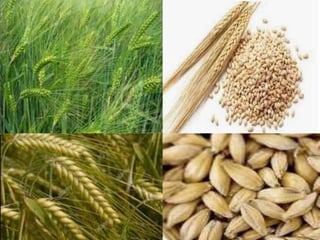
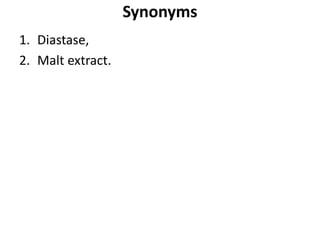
• Malt extract is the extract obtained from
the dried barley grains of one or more
varieties of Hordeum vulgare Linne, family
Poaceae.
Geographical Source
• Barley is widely cultivated throughout the
world. The major producers are United States,
Russia, Canada, India, and Turkey. It is also
cultivated in highlands of China and Tibet.
Cultivation, Collection, and Preparation
• Barley is one of the oldest cultivated cereals.
• It is an annual erect stout herb resembling
wheat.
• The crop becomes ready for harvest in about
four months after sowing.
• The grains are threshed out by beating with
sticks or trampling by oxen.
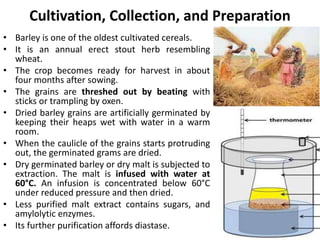
• Dried barley grains are artificially germinated by
keeping their heaps wet with water in a warm
room.
• When the caulicle of the grains starts protruding
out, the germinated grams are dried.
• Dry germinated barley or dry malt is subjected to
extraction. The malt is infused with water at
60°C. An infusion is concentrated below 60°C
under reduced pressure and then dried.
• Less purified malt extract contains sugars, and
amylolytic enzymes.
• Its further purification affords diastase.
Characteristics
• Malt extract contains enzymes, which are most
active in neutral solution.
• The acidic conditions destroy the activity. It
converts starch into disaccharide maltose.
• The enzyme is destroyed by heat.
• Many heat sterilized malt extracts do not contain
diastase.
• It is completely soluble in cold water, more
readily in warm water.
• The aqueous solution shows flocculant
precipitate on standing.
• Limit for arsenic should not exceed one part per
million.
Chemical constituents
• Malt extract contains dextrin, maltose, traces of
glucose and about 8% of amylolytic enzyme
diastase.
Uses
• Malt extract and purified diastase, both are
used as amylolytic enzymes and as an aid in
digesting starch.
• They are used as bulk producing laxatives.
Thank You

MALT EXTRACT- Barley cereals

  • 1.
    MALT EXTRACT BY Dr. JitendraPatel Associate Professor AIPS, Hyderabad, India.
  • 3.
  • 4.
    Biological Source • Maltextract is the extract obtained from the dried barley grains of one or more varieties of Hordeum vulgare Linne, family Poaceae.
  • 5.
    Geographical Source • Barleyis widely cultivated throughout the world. The major producers are United States, Russia, Canada, India, and Turkey. It is also cultivated in highlands of China and Tibet.
  • 6.
    Cultivation, Collection, andPreparation • Barley is one of the oldest cultivated cereals. • It is an annual erect stout herb resembling wheat. • The crop becomes ready for harvest in about four months after sowing. • The grains are threshed out by beating with sticks or trampling by oxen. • Dried barley grains are artificially germinated by keeping their heaps wet with water in a warm room. • When the caulicle of the grains starts protruding out, the germinated grams are dried. • Dry germinated barley or dry malt is subjected to extraction. The malt is infused with water at 60°C. An infusion is concentrated below 60°C under reduced pressure and then dried. • Less purified malt extract contains sugars, and amylolytic enzymes. • Its further purification affords diastase.
  • 7.
    Characteristics • Malt extractcontains enzymes, which are most active in neutral solution. • The acidic conditions destroy the activity. It converts starch into disaccharide maltose. • The enzyme is destroyed by heat. • Many heat sterilized malt extracts do not contain diastase. • It is completely soluble in cold water, more readily in warm water. • The aqueous solution shows flocculant precipitate on standing. • Limit for arsenic should not exceed one part per million.
  • 8.
    Chemical constituents • Maltextract contains dextrin, maltose, traces of glucose and about 8% of amylolytic enzyme diastase.
  • 9.
    Uses • Malt extractand purified diastase, both are used as amylolytic enzymes and as an aid in digesting starch. • They are used as bulk producing laxatives.
  • 10.