Case Study: Effectively Planning for an Enterprise-Scale CMDB Implementation Antonio RolleVP of Professional Services
ObjectivesReview why a CMDB is essential to and is the foundation of your BSM strategyOutline the known challenges that require planning at the outset of a CMDB initiativeDrill down into the approach and lessons learned in the initial stages of a CMDB rollout for one of the largest financial institutions in North America
AgendaBrief Review: The CMDBKnown Pitfalls in CMDB DeploymentsCase Study: Leading Financial Services Enterprise
Brief Review: The CMDB
The Configuration Management Database (CMDB) is at the heart of aligning business with IT.
“”The CMDB should -... (1.) Hold the (a.)relationships between all system components, including incidents, problems, known errors, changes and releases… (b.)information about incidents, known errors and problems, and corporate data about employees, locations and business units... often… (c.)details of servicesand to (2.) relate them to the underlying IT components…and               (3.) store inventory details… such as suppliers, cost, purchase date, and renewal date for a license..SOURCE:Office of Government Commerce
“”The CMDB should -... (1.) Hold the (a.)relationships between all system components, including incidents, problems, known errors, changes and releases… (b.)information about incidents, known errors and problems, and corporate data about employees, locations and business units... often… (c.)details of services and to(2.)relate them to the underlying IT components…and              (3.) store inventory details… such as suppliers, cost, purchase date, and renewal date for a license..SOURCE:Office of Government Commerce
“”The CMDB should -... (1.) Hold the (a.)relationships between all system components, including incidents, problems, known errors, changes and releases… (b.)information about incidents, known errors and problems, and corporate data about employees, locations and business units... often… (c.)details of services and to (2.) relate them to the underlying IT components…and(3.) store inventory details… such as suppliers, cost, purchase date, and renewal date for a license..SOURCE:Office of Government Commerce
“”The CMDB should -... (1.) Hold the (a.)relationships between all system components, including incidents, problems, known errors, changes and releases… (b.)information about incidents, known errors and problems, and corporate data about employees, locations and business units... often… (c.)details of services and to (2.)relate them to the underlying IT components…and              (3.) store inventory details… such as suppliers, cost, purchase date, and renewal date for a license..SOURCE:Office of Government Commerce
Why use a CMDB to do this?1. Control2. Integration3. Decision Support
Reality CheckExternal Factors are Driving our Clients to a CMDB-centric Service Management ArchitectureSoftware Providers Are Moving to a CMDB-centric Software Architecture- You Will Soon Have a CMDB Platform, probably more than 1IT “Supply Chain” Efficiency RequirementsThis is not a Process & Tool initiative, it’s an enterprise wide shift
Known Pitfalls in CMDB Deployments
“”Understanding the relationship between ITIL, IT asset management, and CMDB management will help IT construct and align infrastructure services to business needs.Thomas Mendel, PhD - Forrester Research
5 Common QuestionsHow wide and how deep should the CMDB be?How should I define a configuration item?How do I decide if I need to federate information? If I do federate, how do I integrate? What is the first step I need to take?
The Big Question   What level of effort and resources will be involved with implementing a CMDB in terms of: 	People?	Processes?	Technology?
Common CMDB Implementation PitfallsUnclear business focusUnrealistic expectationsAn all-or-nothing approachRunning the implementation as an IT projectImproper balance between strategic efforts and short-term winsTreating implementation as a one-time projectLack of organizational commitment
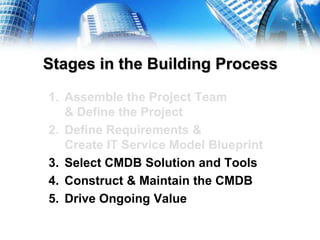
Stages in the Building ProcessAssemble the Project Team & Define the ProjectDefine Requirements & Create IT Service Model BlueprintSelect CMDB Solution and ToolsConstruct & Maintain the CMDBDrive Ongoing Value
Case Study: Leading Financial Services Enterprise
Case StudyCompany Profile:
Fortune 100 Banking Institution
Over 20 million individual, business and institutional clients served at more than 6,000 retail branches
Reported more than $440 billion in assets managedand administered
150,000+ employees
Environment:
Remedy Asset Management v5.5
13+ Remedy Developers
Over 20 Federated Data SourcesStage 1: Assemble the Project Team & Define the ProjectCreate Project Executive BoardSelect Project ManagerScope Key ActivitiesSelect Project TeamFinalize Project Plan
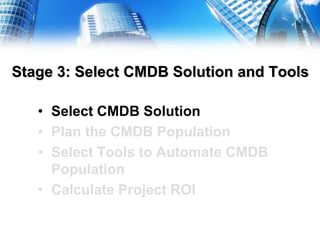
Stage 3: Select CMDB Solution and ToolsSelect CMDB SolutionPlan the CMDB PopulationSelect Tools to Automate CMDB SolutionCalculate Project ROI
Stage 3: Select CMDB Solution and ToolsSelect CMDB SolutionPlan the CMDB PopulationSelect Tools to Automate CMDB PopulationCalculate Project ROI
Stage 1: Assemble the Project Team & Re-Define the ProjectCreate Project Executive BoardSelect Project ManagerScope Key ActivitiesSelect Project TeamFinalize Project PlanOur clients like to bring us in as a neutral party when projects cross functional lines
Defining the Activities is Easy…… Building the timelines is a different challenge.You have to get fairly deep, both functionally and technically to accurately establish timelines: build in plenty of time to deal with unknownsDon’t underestimate how badly your timelines can get hosed if you don’t closely gauge (and manage) personnel availability
Internal ResourcesYour stakeholder list will be larger than you thought possible(!)Obtaining the Information you need and the consensus required is half the battle
External ResourcesConsider bringing in a firm to partner with you if… You can’t dedicate the right resources to the projectYou think an outside party might be able to navigate the functional areas more effectively
Stage 2: Defining CMDB RequirementsIdentify & Review Governance RequirementsReview and Select Supporting Best PracticesIdentify Requirements to Address Potential ProblemsIdentify Inventory & Asset Management RequirementsDefine Service Catalog Requirements Define CMDB Requirements to Support Other ProcessesDefine CI Level & IT Service ModelDefine CI RelationshipsDefine CI AttributesDesign IT Service Model Blueprint
Identify & Review Governance RequirementsIdentify Key Governance & Regulatory Stakeholders (SOx, Gramm-Leach-Bliley, FFIEC, Internal/External Auditors)Scope Potential Use of a CMDB (Identify CI’s, Relationships, Fixed Asset Register)Collect and Document RequirementsGet Approvals
Review and Select Supporting Best PracticesResearch Relevant Best Practice FrameworksSelect Appropriate Best Practice FrameworksDocument Best PracticesCheck Current Levels of AdherencePublish and Distribute Best Practices
Identify Requirements to Address Potential ProblemsReview Knowledge SourcesDocument Potential ProblemsIdentify Root CausesIdentify Potential SolutionsDocument Project Requirements
Identify Inventory & Asset Management RequirementsDetermine Asset DefinitionList Asset CategoriesIdentify Owners of Listed AssetsIdentify Data Inventory Data RequirementsIdentify Asset Data RequirementsCompile Inventory Asset Requirements
Drill Down - Inventory and AssetThis project was driven by the Asset Management process area with a focus on:IdentificationControlVerification & Audit
Define Service Catalog RequirementsIdentify Key Service Catalog StakeholdersScope Service Catalog CMDB UseCollect & Document RequirementsPublish Approved CMDB Requirements
Define CMDB Requirements to Support Other ProcessesIdentify StakeholdersDiscover & Distill Requirements to Support Other ProcessesReview and Agree on CMDB Requirements to Support Other ProcessesPublish CMDB Requirements
Drill Down - Process IntegrationIncident & Problem ManagementChange ManagementAsset ManagementService Continuity Management20 Federated Data Sources
Define CI Level & IT Service ModelEstablish Working GroupCreate A Straw Model StructureValidate Straw Model StructureDocument the Structure, Guidelines & Criteria
BMC Atrium CMDB 2.0- Common Data Model
Define CI RelationshipsDefine CI Relationship TypesReview & AgreeDocument Relationship Design
Define CI AttributesConsider Management & MaintenanceReviewDocument

Effectively Planning for an Enterprise-Scale CMDB Implementation

  • 1.
    Case Study: EffectivelyPlanning for an Enterprise-Scale CMDB Implementation Antonio RolleVP of Professional Services
  • 2.
    ObjectivesReview why aCMDB is essential to and is the foundation of your BSM strategyOutline the known challenges that require planning at the outset of a CMDB initiativeDrill down into the approach and lessons learned in the initial stages of a CMDB rollout for one of the largest financial institutions in North America
  • 3.
    AgendaBrief Review: TheCMDBKnown Pitfalls in CMDB DeploymentsCase Study: Leading Financial Services Enterprise
  • 4.
  • 5.
    The Configuration ManagementDatabase (CMDB) is at the heart of aligning business with IT.
  • 6.
    “”The CMDB should-... (1.) Hold the (a.)relationships between all system components, including incidents, problems, known errors, changes and releases… (b.)information about incidents, known errors and problems, and corporate data about employees, locations and business units... often… (c.)details of servicesand to (2.) relate them to the underlying IT components…and (3.) store inventory details… such as suppliers, cost, purchase date, and renewal date for a license..SOURCE:Office of Government Commerce
  • 7.
    “”The CMDB should-... (1.) Hold the (a.)relationships between all system components, including incidents, problems, known errors, changes and releases… (b.)information about incidents, known errors and problems, and corporate data about employees, locations and business units... often… (c.)details of services and to(2.)relate them to the underlying IT components…and (3.) store inventory details… such as suppliers, cost, purchase date, and renewal date for a license..SOURCE:Office of Government Commerce
  • 8.
    “”The CMDB should-... (1.) Hold the (a.)relationships between all system components, including incidents, problems, known errors, changes and releases… (b.)information about incidents, known errors and problems, and corporate data about employees, locations and business units... often… (c.)details of services and to (2.) relate them to the underlying IT components…and(3.) store inventory details… such as suppliers, cost, purchase date, and renewal date for a license..SOURCE:Office of Government Commerce
  • 9.
    “”The CMDB should-... (1.) Hold the (a.)relationships between all system components, including incidents, problems, known errors, changes and releases… (b.)information about incidents, known errors and problems, and corporate data about employees, locations and business units... often… (c.)details of services and to (2.)relate them to the underlying IT components…and (3.) store inventory details… such as suppliers, cost, purchase date, and renewal date for a license..SOURCE:Office of Government Commerce
  • 10.
    Why use aCMDB to do this?1. Control2. Integration3. Decision Support
  • 11.
    Reality CheckExternal Factorsare Driving our Clients to a CMDB-centric Service Management ArchitectureSoftware Providers Are Moving to a CMDB-centric Software Architecture- You Will Soon Have a CMDB Platform, probably more than 1IT “Supply Chain” Efficiency RequirementsThis is not a Process & Tool initiative, it’s an enterprise wide shift
  • 12.
    Known Pitfalls inCMDB Deployments
  • 13.
    “”Understanding the relationshipbetween ITIL, IT asset management, and CMDB management will help IT construct and align infrastructure services to business needs.Thomas Mendel, PhD - Forrester Research
  • 14.
    5 Common QuestionsHowwide and how deep should the CMDB be?How should I define a configuration item?How do I decide if I need to federate information? If I do federate, how do I integrate? What is the first step I need to take?
  • 15.
    The Big Question What level of effort and resources will be involved with implementing a CMDB in terms of: People? Processes? Technology?
  • 16.
    Common CMDB ImplementationPitfallsUnclear business focusUnrealistic expectationsAn all-or-nothing approachRunning the implementation as an IT projectImproper balance between strategic efforts and short-term winsTreating implementation as a one-time projectLack of organizational commitment
  • 17.
    Stages in theBuilding ProcessAssemble the Project Team & Define the ProjectDefine Requirements & Create IT Service Model BlueprintSelect CMDB Solution and ToolsConstruct & Maintain the CMDBDrive Ongoing Value
  • 18.
    Stages in theBuilding ProcessAssemble the Project Team & Define the ProjectDefine Requirements & Create IT Service Model BlueprintSelect CMDB Solution and ToolsConstruct & Maintain the CMDBDrive Ongoing Value
  • 19.
    Case Study: LeadingFinancial Services Enterprise
  • 20.
  • 21.
  • 22.
    Over 20 millionindividual, business and institutional clients served at more than 6,000 retail branches
  • 23.
    Reported more than$440 billion in assets managedand administered
  • 24.
  • 25.
  • 26.
  • 27.
  • 28.
    Over 20 FederatedData SourcesStage 1: Assemble the Project Team & Define the ProjectCreate Project Executive BoardSelect Project ManagerScope Key ActivitiesSelect Project TeamFinalize Project Plan
  • 29.
    Stage 3: SelectCMDB Solution and ToolsSelect CMDB SolutionPlan the CMDB PopulationSelect Tools to Automate CMDB SolutionCalculate Project ROI
  • 30.
    Stage 3: SelectCMDB Solution and ToolsSelect CMDB SolutionPlan the CMDB PopulationSelect Tools to Automate CMDB PopulationCalculate Project ROI
  • 31.
    Stage 1: Assemblethe Project Team & Re-Define the ProjectCreate Project Executive BoardSelect Project ManagerScope Key ActivitiesSelect Project TeamFinalize Project PlanOur clients like to bring us in as a neutral party when projects cross functional lines
  • 32.
    Defining the Activitiesis Easy…… Building the timelines is a different challenge.You have to get fairly deep, both functionally and technically to accurately establish timelines: build in plenty of time to deal with unknownsDon’t underestimate how badly your timelines can get hosed if you don’t closely gauge (and manage) personnel availability
  • 33.
    Internal ResourcesYour stakeholderlist will be larger than you thought possible(!)Obtaining the Information you need and the consensus required is half the battle
  • 34.
    External ResourcesConsider bringingin a firm to partner with you if… You can’t dedicate the right resources to the projectYou think an outside party might be able to navigate the functional areas more effectively
  • 35.
    Stage 2: DefiningCMDB RequirementsIdentify & Review Governance RequirementsReview and Select Supporting Best PracticesIdentify Requirements to Address Potential ProblemsIdentify Inventory & Asset Management RequirementsDefine Service Catalog Requirements Define CMDB Requirements to Support Other ProcessesDefine CI Level & IT Service ModelDefine CI RelationshipsDefine CI AttributesDesign IT Service Model Blueprint
  • 36.
    Identify & ReviewGovernance RequirementsIdentify Key Governance & Regulatory Stakeholders (SOx, Gramm-Leach-Bliley, FFIEC, Internal/External Auditors)Scope Potential Use of a CMDB (Identify CI’s, Relationships, Fixed Asset Register)Collect and Document RequirementsGet Approvals
  • 37.
    Review and SelectSupporting Best PracticesResearch Relevant Best Practice FrameworksSelect Appropriate Best Practice FrameworksDocument Best PracticesCheck Current Levels of AdherencePublish and Distribute Best Practices
  • 38.
    Identify Requirements toAddress Potential ProblemsReview Knowledge SourcesDocument Potential ProblemsIdentify Root CausesIdentify Potential SolutionsDocument Project Requirements
  • 39.
    Identify Inventory &Asset Management RequirementsDetermine Asset DefinitionList Asset CategoriesIdentify Owners of Listed AssetsIdentify Data Inventory Data RequirementsIdentify Asset Data RequirementsCompile Inventory Asset Requirements
  • 40.
    Drill Down -Inventory and AssetThis project was driven by the Asset Management process area with a focus on:IdentificationControlVerification & Audit
  • 41.
    Define Service CatalogRequirementsIdentify Key Service Catalog StakeholdersScope Service Catalog CMDB UseCollect & Document RequirementsPublish Approved CMDB Requirements
  • 42.
    Define Service CatalogRequirementsIdentify Key Service Catalog StakeholdersScope Service Catalog CMDB UseCollect & Document RequirementsPublish Approved CMDB Requirements
  • 43.
    Define CMDB Requirementsto Support Other ProcessesIdentify StakeholdersDiscover & Distill Requirements to Support Other ProcessesReview and Agree on CMDB Requirements to Support Other ProcessesPublish CMDB Requirements
  • 44.
    Drill Down -Process IntegrationIncident & Problem ManagementChange ManagementAsset ManagementService Continuity Management20 Federated Data Sources
  • 45.
    Define CI Level& IT Service ModelEstablish Working GroupCreate A Straw Model StructureValidate Straw Model StructureDocument the Structure, Guidelines & Criteria
  • 46.
    BMC Atrium CMDB2.0- Common Data Model
  • 47.
    Define CI RelationshipsDefineCI Relationship TypesReview & AgreeDocument Relationship Design
  • 48.
    Define CI AttributesConsiderManagement & MaintenanceReviewDocument