
CMDB
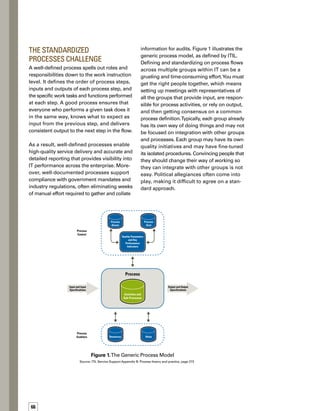
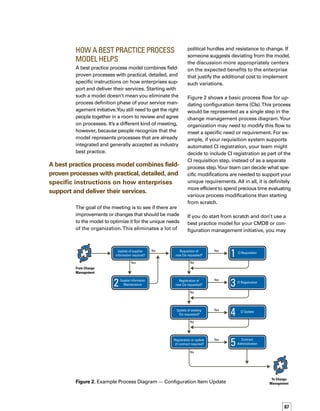
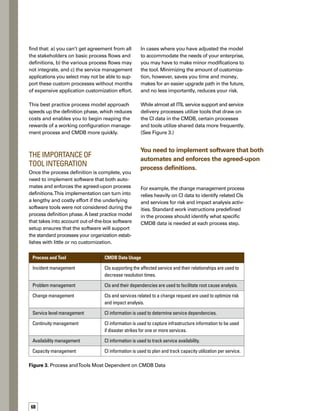
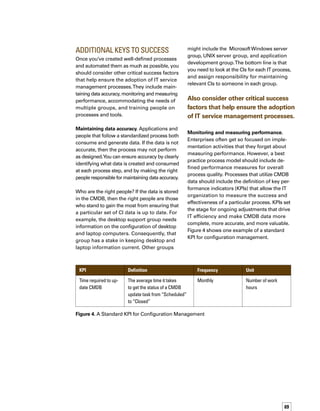
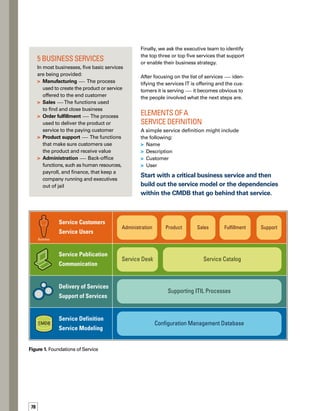
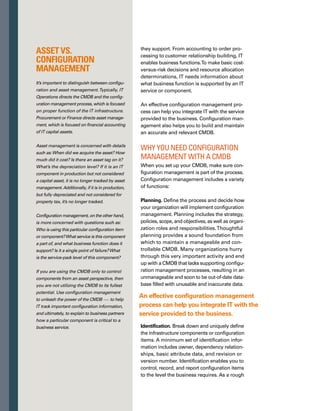
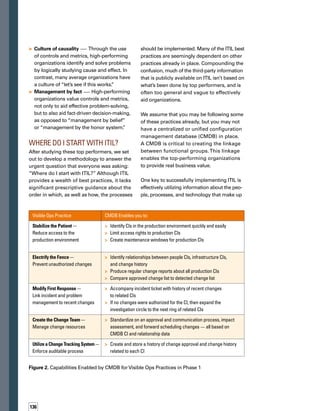
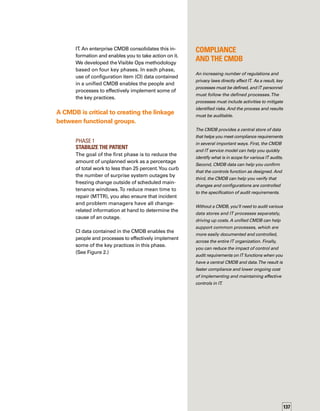
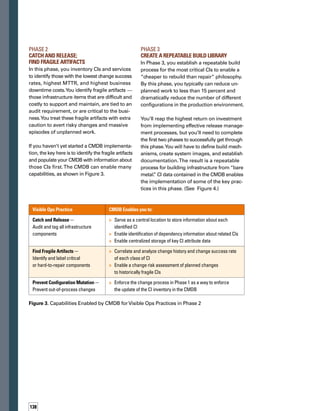
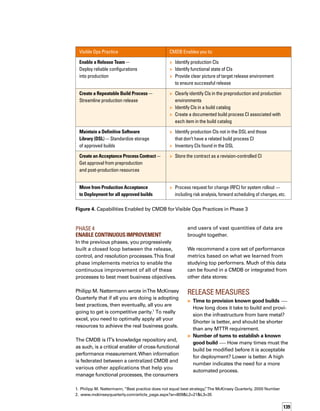
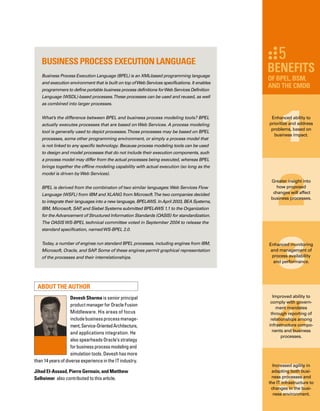
Business
Value
A Planning
Checklist
for CMDB
Success
Demystifying
Configuration
Items
Implementing a
CMDB-based
IT Service
Structure
6Tips for
Managing the
“People” Factor
Published by
BMC Software
Published by
BMC Software
A Compilation of Articles by Industry ExpertsA Compilation of Articles by Industry Experts
VIEWPOINTFocuson:CMDBLeadershipVOLUMETWO
About BMC Software
BMC Software helps IT organizations drive greater
business value through better management of
technology. Our industry-leading Business Service
Management solutions ensure that everything IT
doesisprioritized according to business impact, so
IT can proactively address business requirements
to lower costs, drive revenue and mitigate risk.
BMC solutions share BMC Atrium™ technologies
to enable IT to manage across the complexity of
diverse systems and processes — from mainframe
to distributed, databases to applications, service
to security. Founded in 1980, BMC has offices
worldwide and fiscal 2005 revenues of more than
$1.46 billion. BMC Software. Activate your business
with the power of IT. For more information, visit
www.bmc.com.
This publication was created by BMC Software.
Focus on CMDB LeadershipFocus on CMDB Leadership
CONTRIBUTORS
We greatly appreciate the contributions of the following people and companies:
Ahmad Abdel-Wahed, Microsoft
Alexandre Avelar, CSC BRASIL
Kia Behnia, BMC Software
Kevin Behr, IT Process Institute
Charles Betz
Tom Bishop, BMC Software
David Chiu, BMO Financial Group
Linda Donovan, BMC Software
Dennis Drogseth, Enterprise Management Associates
Troy DuMoulin, Pink Elephant
V’Ali Ford, EMS
Jeff Gibson, Voyence
Gene Kim, IT Process Institute
Joe Lord, Aliant
Julie Manis, Accenture
Jonathan Markworth, CompuCom
Tim Mason, TRM Associates
Troy McAlpin, Invoq Systems
Javier Leyva Novoa, Quitze Tecnología
Jason Odden, Wipro
Brady Orand, Column Technologies
Craig Piercey, Aliant
Frederieke C.M. Winkler Prins, Service Management Partners
Val Sanford, Singlestep
Perry Sellars, Strategic Technologies
Devesh Sharma, Oracle
George Spafford, IT Process Institute
Selma Turki, IBM
Kyle Ward, Aliant
Hans-Heinz Wisotzky, MATERNA GmbH Information & Communication
Bob Worner, BMC Software
Editor-in-Chief: Elaine Korn
Senior Editor: Leanne Bantsari
Technical Editor: Kurt Milne
Technical Reviewers: Brian Emerson, Dave Wilt
Editorial Team: Wendy Assatourian, Linda Donovan, Elizabeth Ferrarini,
Paul Mangione, Sheila Mangione, Suszi McFadden
Creative Design: Liora Blum Graphic Design
Cover Photograph and Design: Della Calfee
Creative Direction: Michele Floriani, Della Calfee
Special Thanks: Kim Bigler, Kelly Blice, Kimberly Chihaoui, Michael Cotignola,
Jihad El-Assaad, Karl-Anders Falk, Pierre Germain, Ali Ghazanfari, Jan Hagge,
Rhonda Hagstedt, Margaret Henry, Dan Hoffmann, Eric Holliday, Susana
Landeira, Maggie McLening, Paul Peissner, Faye Rukstales, Matthew Selheimer,
Tanya Solomon, Molly Thiel, Andy Walker
Call 800-841-2031. Learn how BMC Software BSM solutions can help your business.
©2006 BMC Software Inc. All rights reserved.
ACKNOWLEDGEMENTS
Industry luminary Malcolm Fry and a team of experts, including David Chiu,
Troy DuMoulin, Brian Emerson, Jeanne Morain, Michael Nicoletti, Maria
Ritchie, Michael Os, Angie Massicotte, and Ken Turbitt, will guide you in the
forthcoming book, Step-by-Step Guide to Building a CMDB. Filled with best
practice examples and practical advice, the book details 25 steps for deliver-
ing a CMDB:
1. Obtain CMDB knowledge
2. Review and agree on CMDB goals
3. Create a CMDB mission statement
4. Review and identify governance requirements
5. Review and select supporting best practices
6. Identify inventory and asset requirements
7. Identify and address potential problems
8. Review and define benefits
9. Final scoping objective and expansion planning
10. Define service catalog CMDB requirements
11. Define requirements for other processes, including non-ITIL processes
12. Define configuration item level — IT service model
13. Define configuration item relationships
14. Define configuration item attributes
15. Design IT model blueprint
16. Select technologies for your CMDB
17. Calculate and present ROI
18. Construct your CMDB
19. Create configuration item lifecycle management process
20. Identify and install metrics — KPIs, CSFs, and reporting
21. Build supporting processes
22. Select tool to automate CMDB population
23. Populate your CMDB
24. Train the CMDB configuration management team
25. Create a continuous service improvement program
Malcolm Fry is a recognized IT industry luminary with more than 35 years
experience in information technology. He serves as an independent executive
advisor to BMC Software. Malcolm is the author of four best-selling books on
IT service and support, he has had many articles and papers published, and he
is regularly contacted as a source of information by technology journalists. In
addition, he is the solo performer in a highly successful, best-selling video and
DVD series made for the Help Desk Institute. He is an original contributor to IT
Infrastructure Library (ITIL®
) and has Masters-level ITIL certification.
The other contributors are respected subject matter experts.
Step-by-Step Guide to Building a CMDB is scheduled to be available in Sep-
tember 2006. For more information about this book, and to register for a free
copy, please go to www.BMC.com/StepByStep.
COMING SOON
STEP-BY-STEP GUIDE TO BUILDING A CMDB
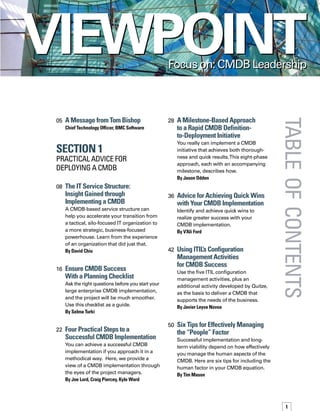
05	 A Message from Tom Bishop 	
Chief Technology Officer, BMC Software
Section 1
PRACTICAL Advice for
DEPLOYING A CMDB
08	 The IT Service Structure: 	
Insight Gained through
Implementing a CMDB
A CMDB-based service structure can
help you accelerate your transition from
a tactical, silo-focused IT organization to
a more strategic, business-focused
powerhouse. Learn from the experience
of an organization that did just that.
By David Chiu
16	 Ensure CMDB Success 	
With a Planning Checklist
Ask the right questions before you start your
large enterprise CMDB implementation,
and the project will be much smoother.
Use this checklist as a guide.
By Selma Turki
22	 Four Practical Steps to a
Successful CMDB Implementation
You can achieve a successful CMDB
implementation if you approach it in a
methodical way. Here, we provide a
view of a CMDB implementation through
the eyes of the project managers.
By Joe Lord, Craig Piercey, Kyle Ward
28	 A Milestone-Based Approach 	
to a Rapid CMDB Definition-	
to-Deployment Initiative
You really can implement a CMDB
initiative that achieves both thorough-
ness and quick results.This eight-phase
approach, each with an accompanying
milestone, describes how.
By Jason Odden
36	 Advice for Achieving Quick Wins
with Your CMDB Implementation
Identify and achieve quick wins to
realize greater success with your
CMDB implementation.
By V’Ali Ford
42	 Using ITIL’s Configuration
Management Activities 	
for CMDB Success
Use the five ITIL configuration
management activities, plus an
additional activity developed by Quitze,
as the basis to deliver a CMDB that
supports the needs of the business.
By Javier Leyva Novoa
50	 Six Tips for Effectively Managing
the “People” Factor
Successful implementation and long-
term viability depend on how effectively
you manage the human aspects of the
CMDB. Here are six tips for including the
human factor in your CMDB equation.
By Tim Mason
tableofcontents
Focus on: CMDB LeadershipFocus on: CMDB Leadership
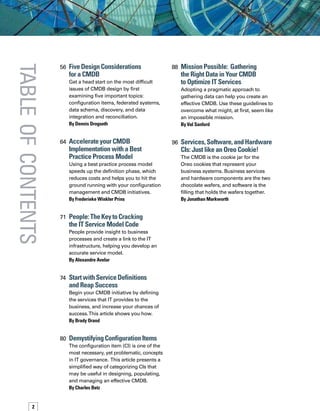
56	 FiveDesignConsiderations 	
for a CMDB
Get a head start on the most difficult
issues of CMDB design by first
examining five important topics:
configuration items, federated systems,
data schema, discovery, and data
integration and reconciliation.
By Dennis Drogseth
64	 AccelerateyourCMDB
Implementation with a Best
Practice Process Model
Using a best practice process model
speeds up the definition phase, which
reduces costs and helps you to hit the
ground running with your configuration
management and CMDB initiatives.
By Frederieke Winkler Prins
71	 People:TheKeytoCracking 	
the IT Service Model Code
People provide insight to business
processes and create a link to the IT
infrastructure, helping you develop an
accurate service model.
By Alexandre Avelar
74	 StartwithServiceDefinitions 	
and Reap Success
Begin your CMDB initiative by defining
the services that IT provides to the
business, and increase your chances of
success.This article shows you how.
By Brady Orand
80	 DemystifyingConfiguration Items
The configuration item (CI) is one of the
most necessary, yet problematic, concepts
in IT governance. This article presents a
simplified way of categorizing CIs that
may be useful in designing, populating,
and managing an effective CMDB.
By Charles Betz
88	 MissionPossible:  Gathering 	
the Right Data in Your CMDB 	
to Optimize IT Services
Adopting a pragmatic approach to
gathering data can help you create an
effective CMDB. Use these guidelines to
overcome what might, at first, seem like
an impossible mission.
By Val Sanford
96	 Services,Software,andHardware
CIs: Just like an Oreo Cookie!
The CMDB is the cookie jar for the
Oreo cookies that represent your
business systems. Business services
and hardware components are the two
chocolate wafers, and software is the
filling that holds the wafers together.
By Jonathan Markworth
tableofcontents
tableofcontents
Section 2
Capabilities enabled
by A CMDB
102	Change Management:  The Key 	
to a Picture Perfect Infrastructure
When a CMDB is the centerpiece of your
change management process, you can
more efficiently and accurately change your
IT infrastructure to meet business needs.
By Hans-Heinz Wisotzky
108	Rememberthe“CM”inCMDB
The CMDB is more than a static repository
of information. It is an integral part of the
configuration management (CM) process,
providing the foundation for other IT
processes that enable the delivery of
business services. When you start your
CMDB project, make sure CM is part of
the equation.
By Perry Sellars
116	Facilitating Effective ITAsset
Management with the CMDB: 	
A Nine-Step Approach
Designing a CMDB that also functions
as an asset repository requires broader
definitions of the configuration items
included in a traditional CMDB. Follow
these steps to successfully scope and
manage the asset management aspects
of a CMDB initiative.
By Julie Manis
124	CMDBBusinessValue
Unfortunately, IT decisions are not always
made based on a high standard of data
integrity. Perhaps this is because many
people are unaware of the power of a CMDB.
By Kia Behnia
128	Leveraging Identity Information
Through the CMDB
By leveraging identity management, you
can achieve a comprehensive, accurate,
and up-to-date source of people information
for the CMDB.
By Ahmad Abdel-Wahed, Bob Worner
134	CMDB:  TheKeytoJump-Starting
ITIL Success
Three experts discuss theVisible Ops
methodology, which offers a simple
approach to implementing ITIL in four
practical steps. In this methodology, the
CMDB is a key factor in driving quick wins.
By Kevin Behr, Gene Kim, George Spafford
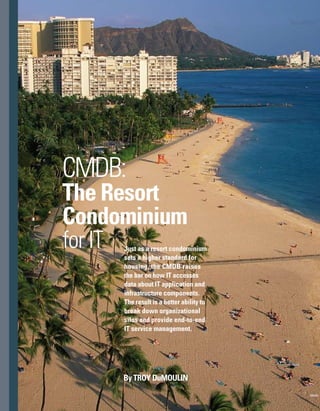
142	CMDB:TheResort 	
Condominium for IT
Just as a resort condominium can
streamline a housing complex, the
CMDB can improve access to data
about IT application and infrastructure
components.The result is a better
ability to break down organizational
silos and provide end-to-end service
management.
By Troy DuMoulin
150	Don’tForgetthe Network
Follow a three-step approach for populating
the CMDB with network data and using
purpose-built network configuration
management tools for a successful
CMDB initiative.
By Jeff Gibson
156	CanPeopleBeConfiguration Items?
Get more out of your CMDB and stream-
line your IT service support by maintaining
a dynamic repository of information about
the people involved in, and affected by,
the incident management process.
By Troy McAlpin
160	UsingBPEL,BSM,andthe 	
CMDB to Manage IT from the
Business Perspective
When CMDB information links a BPEL-
designed business process toWeb Services
and underlying IT services, you can drama-
tically improve the alignment of IT with
the goals of the business.
By Devesh Sharma
postscript
164 	Dr. Henry
CMDB implementations keeping you
up at night? Just ask Dr. Henry…
By Linda Donovan
tableofcontents
Welcome to the second edition
ofVIEWPOINT.Ourfirstedition
focused on the value of a configurat-
tion management database (CMDB)
and provided expert advice on how
to achieve a successful CMDB implem-
mentation.We received a very posit-
tive response to the first edition and
our readers have asked for more.
In addition, companies are embracing
the CMDB at a tremendous rate, and
as a result, we bring you this second
edition, which again includes a broad
rangeofarticlesfromBMCcustomers,
partners, and industry experts.
This publication has two sections.
Section One, “Practical Advice for
Deploying a CMDB,” is designed to
help organizations jump-start their
implementations, make the process
a smooth one, and get the most value
out of it. In our lead article, David
Chiu of BMO Financial Group talks
about how you can use a CMDB-
based service structure to accelerate
yourtransitiontoastrategic,business-
focused IT organization.
SelmaTurki of IBM identifies the quest-
tions to ask before you start a large
enterprise CMDB implementation
and provides a checklist that you can
use as a guide.AlexandreAvelar of
CSC BRASIL discusses how people
are the key to cracking the IT service
model code.Additional articles in this
section include design recommend-
ations, incorporating best practices
from the IT Infrastructure Library
(ITIL®
), and a variety of other guidel-
lines for success.
Section Two, “Capabilities Enabled
by a CMDB,” includes a number of
articles describing the capabilities
the CMDB facilitates. For example,
Julie Manis ofAccenture discusses
a nine-step approach for using the
CMDB to facilitate effective IT asset
management. Perry Sellars of Strat-
tegic Technologies explains how
the CMDB is an integral part of the
configuration management (CM)
process, providing the foundation
for other IT processes that enable
the delivery of business services.
Be sure to read the article by Devesh
Sharma of Oracle, which discusses
using Business Process Execution
Language (BPEL), BSM, and the
CMDB to manage IT from the busin-
ness perspective. Section Two also
includes articles providing insight
into such areas as the benefit of
categorizing people as configuration
items in the CMDB, using the CMDB
to jump-start ITIL implementations,
and other compelling topics.
Although I’ve just mentioned a handf-
ful of articles above, this edition of
VIEWPOINT contains many other
interesting and informative articles.
I’d like to personally thank all of the
contributors for helping to make this
book practical, educational, and usef-
ful. As you can see from the breadth
of companies contributing articles
to this edition, the CMDB has truly
become an industry phenomenon,
and we look forward to future cont-
tributions from many of you now
reading this.
You may also be interested to know
the CMDB has become such an imp-
portantresourcethatBMCandseveral
other leading companies have joined
together to create a new interopera-
abilityspecificationdesignedtoenable
customers to federate and access
informationfromtheircomplex,multi-
vendor IT infrastructures.Working
together, we will develop an open,
industry-wide specification for sharing
information between CMDBs and
other data repositories.We plan to
submit a draft specification to an
industry standards organization later
this year.
Best regards,and good luck on those
CMDB implementations,
Tom Bishop
ChiefTechnology Officer, BMC Software
ABOUT TOM BISHOP
Tom Bishop was named one of the
top 25 CTOs by InfoWorld Magazine
in 2004. A well-known technology
innovator, he holds nine patents in
fault tolerant computing and has
been involved in leading the develop­
ment of industry standards such as
the Distributed Management Task
Force (DMTF) and POSIX. For more
than 20 years, he has served in senior
technology and strategy roles at leadi-
ing organizations including UNIX
International, Tandem Computers,
and CompuCare Management Syst-
tems. Tom was an early employee
of Tivoli Systems and rose quickly
through the organization, serving
first in key development roles before
being named Chief Technology
Officer and General Manager for
IBMTivoli’s Embedded Solutions
business unit.
A Message from tom bishop 	
Chief Technology Officer,
bmc software
PRACTICALAdvice
forDEPLOYINGACMDB
“The power of a CMDB lies in its ability
to provide a structured way to identify the
relationships between IT resources, also
known as CIs, and the business functions
they support.”
—	David Chiu, BMO Financial Group
“A CMDB cannot be built in isolation.
It is at the heart of the ITIL framework
and is what keeps ITIL best practices
alive and kicking.”
—	Selma Turki, IBM
“The CMDB is enabling us to deliver
improved service and availability to
the business that depends on us.”
—	Joe Lord, Craig Piercey, 	
and Kyle Ward, Aliant
“The key is to prioritize and start with
those processes that have the greatest
expected improvement from integration
with the CMDB.”
—	Jason Odden, Wipro
“Achieving a quick win can help you
establish greater efficiencies and increase
your pace toward reaching your ultimate
CMDB goal.”
—	V’Ali Ford, EMS
“Providing accurate and consistent
information about CIs and their relevance
to the business ultimately will enable the
business to meet its goals.”
—	Javier Leyva Novoa, Quitze Tecnologia
“To a large degree, successful implemen-
tation and long-term viability depend on
how effectively you manage the human
aspects of the CMDB.”
—	Tim Mason, TRM Associates
“Your CMDB can significantly empower
your organization — once it is a consistent,
dynamic and trusted data source.”
—	Dennis Drogseth, 	
Enterprise Management Associates
“A best practice process model is a time-
saving and money-saving shortcut to
successful service management.”
—	Frederieke C.M. Winkler Prins, 	
Service Management Partners
“The people in your enterprise are the
key to creating business relevance and
cracking the service model code.”
—	Alexandre Avelar, CSC BRASIL
“Start with a critical business service and
then build out the service model or the
dependencies within the CMDB that go
behind that service.”
—	Brady Orand, Column Technologies
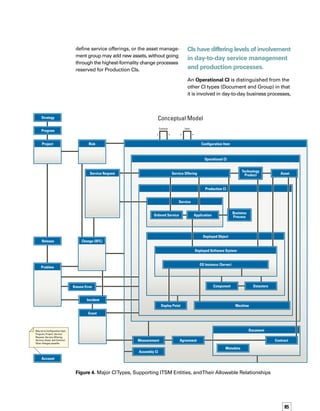
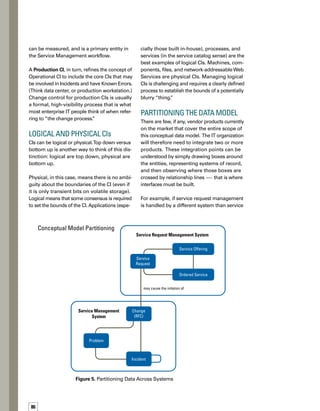
“CIs have differing levels of involvement
in day-to-day service management and
production processes.”
—	Charles Betz
“The ultimate goal of any CMDB imple-
mentation is to utilize the data in a way
that optimizes your organization’s IT
infrastructure and decision-making
capabilities, and thus optimizes the
services you provide to the business.”
—	Val Sanford, Singlestep
“A CMDB implementation is successful
when all interested parties consider your
CMDB the single source of truth for the
IT infrastructure.”
—	Jonathan Markworth, CompuCom
Section 1  PRACTICAL Advice for DEPLOYING A CMDB
64
16
71
22
28
36
42
50
74
80
88
96
8 56
a  CMDB
A CMDB-based service structure can
help you accelerate your transition
from a tactical, silo-focused IT 	
organization to a more strategic, 	
business-focused powerhouse. 	
Learn from the experience of an 	
organization that did just that.
By David Chiu
InsightGained
through
Implementing
The I.T. Service
Structure:
10
T
he power of a configuration managem-
ment database (CMDB) lies in its ability
to provide a structured way to identify
the relationship between IT resources, also
known as configuration items (CIs), and the
business functions they support. By consolid-
dating and structuring the data with information
about various types of CI relationships and
dependencies, you can create a structured
representation of IT that enables a broad range
of service management capabilities that are
otherwise not possible.The relationship inform-
mation that is stored in the CMDB provides
a common language and awareness that allows
you to manage IT from a business perspective.
The concepts and practices enabled by an IT
service structure are powerful and drive bottom
line value both within IT and to the business.
As your IT organization increases its maturity
level of IT service management practices, you
reach a point where further increases in service
levels are not feasible without a way to identify
and communicate dependency relationships.
If you can’t identify the link between the service
you deliver and the people, processes, applic-
cations, servers, databases, and networks that
enable that service, you really can’t manage
and deliver IT services with the level of quality
the business expects.You must transition from
managing IT resources in technology silos to
managing them in the context of a broad serv-
vice picture. An IT service structure enables
this powerful leap forward in capability.
This article shares insight gained through im­
plementing a CMDB-based service structure
at BMO Financial Group, and shows you how
to leverage the CI relationships managed by
a CMDB to build an IT service structure that
will help you accelerate your transition from
a tactical, silo-focused IT organization to a more
strategic, business-focused powerhouse.
The goal is to help you understand a whole
new set of questions and the broad range of
powerful new capabilities that emerge when
you see the pieces of the IT infrastructure,
people, and processes as a collective whole.
ServiceManagementevolution
Let’s start with the obvious. IT has become very
complex. It is impossible for one individual
to understand how everything works together.
It’s difficult to determine how a business transa-
action flows across the IT infrastructure, and
complicated to figure out how different techn-
nology components depend on each other.
If you’ve ever been involved in a data center
consolidation, you know how hard it is to pred-
dict the impact of pulling the plug on a server
and moving it to a new location.
Now combine that increased complexity with
an ever-increasing set of expectations from the
clients and users of IT within your organization,
and you have a recipe for high expectations
that are more and more difficult to meet.
To more effectively manage the complexity,
and to better meet the expectations of the users,
you first need to recognize that you have to
start managing IT as a service. But moving
toward managing IT as a service is complex.You
also need a parallel transition in tools and infor­
mation to manage IT from a new perspective.
It’s easier to make this transition if you develop
a way to structure data about the IT infrastruc­
ture and its relationships.The first step is to
create an accurate inventory of the pieces of
your IT infrastructure.Then, identify the relat-
tionships between those various pieces and
the IT services they deliver to the business.
Finally, put the people and processes in place
to update and maintain that information on an
ongoing basis.
Creating this set of structured data gives you
an accurate picture and subpictures of various
IT systems.This picture of how everything is
related and how it fits together to enable the
delivery of IT services is your IT service structure.
You must transition from managing IT resources
in technology silos to managing them in the
context of a broad service picture.
11
This IT service structure opens up a whole new
set of possibilities in managing IT.
With the IT service structure in place, you can
relate IT resources to the business and manage
them from a business perspective. How? By
“walking the structure.” Analyze and use
information in the CMDB to answer key busin-
ness questions such as:
What is the real cost of delivering a business
service — not just the cost of the technology
assets that provide the service, but also the
associated support and maintenance costs
absorbed by the IT organization?
What is the impact of an IT failure, change
implementation, or other infrastructure
event on the delivery of business services?
What is the capacity of technology assets
required to support a particular business
service today and in the future, and what is
the current capacity utilization of that service?
What is the quality of a particular business
service provided by IT with respect to such
factors as availability, reliability, perform-
mance, and incidents reported by users?
By answering these questions, you can gain
insight that will enable you to better align IT
with your business goals.
Defining the Structure
You’ll need to really think through your IT
service structure to portray the highly complex
IT environment in a form that can be easily
managed and communicated to a business
audience. Creating such a structure in the
CMDB involves:


Establishing CIs
Defining the hierarchical relationships
among the CIs
Defining the functional relationships
among the CIs
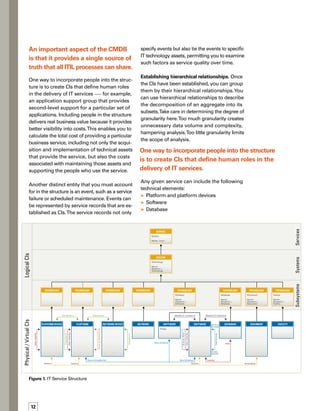
A graphical representation of a generic IT
service structure is illustrated in Figure 1.
Establishing CIs.The CMDB is vital if you are
implementing IT Infrastructure Library (ITIL®
)
best practices, because it provides a centralized
access point for a wealth of information about
all IT resources (or CIs). CIs are physical assets
such as servers, PCs, and network equipment,
as well as logical assets such as software,
documentation, and contracts. CIs can also be
attribute information such as the configuration,
cost, and location of hardware CIs.An important
aspect of the CMDB is that it provides a single
source of truth that all ITIL processes can share.
Consequently, the CMDB provides a point of
integration across IT service management
processes — integration that is essential for
a successful ITIL implementation.
You may have already established your techn-
nology assets as CIs in a CMDB.To have a comp-
plete picture, however, you should include
additional CIs depicting other vital IT resources,
such as people and services.Technical support
and change implementation personnel provide
IT services, making it essential that, in addition
to hardware and software, you include people
in the definition of the IT service structure.
12
An important aspect of the CMDB
is that it provides a single source of
truth that all ITIL processes can share.
One way to incorporate people into the struc­
ture is to create CIs that define human roles
in the delivery of IT services — for example,
an application support group that provides
second-level support for a particular set of
applications. Including people in the structure
delivers real business value because it provides
better visibility into costs.This enables you to
calculate the total cost of providing a particular
business service, including not only the acquis-
sition and implementation of technical assets
that provide the service, but also the costs
associated with maintaining those assets and
supporting the people who use the service.
Another distinct entity that you must account
for in the structure is an event, such as a service
failure or scheduled maintenance. Events can
be represented by service records that are es­
tablished as CIs.The service records not only
specify events but also tie the events to specific
IT technology assets, permitting you to examine
such factors as service quality over time.
Establishing hierarchical relationships. Once
the CIs have been established, you can group
them by their hierarchical relationships.You
can use hierarchical relationships to describe
the decomposition of an aggregate into its
subsets.Take care in determining the degree of
granularity here.Too much granularity creates
unnecessary data volume and complexity,
hampering analysis.Too little granularity limits
the scope of analysis.
Any given service can include the following
technical elements:
Platform and platform devices
Software
Database


Figure 1. IT Service Structure
One way to incorporate people into the structure
is to create CIs that define human roles in the
delivery of IT services.
Connected to
Uses/UsedBy
Used By
Uses
Uses/UsedBy
Connected to
Runs on (Installed on) Runs (Contains)
Runs (Contains)
Member of / Consists of Member of / Consists of
Governs Governs Governs Governed by
Connectedto
DataExchange
Creates
Datafeed
Receives
Datafeed
Backsup/Backedupby
Connectedto
Uses/UsedBy
Runson/Runs
System
Name: xyz
SERVICE
Technology
Name:
[System] +
Technology
SYSTEM
TECHNOLOGY
PLATFORM DEVICE PLATFORM NETWORK DEVICE SOFTWARE DOCUMENTNETWORK
Image
SOFTWARE DATABASE FACILITY
TECHNOLOGY TECHNOLOGY TECHNOLOGY
Software
Name:
[System] +
Software
TECHNOLOGY
Database
Name:
[System] +
Database
TECHNOLOGY
Document
Name:
[System] +
Document
TECHNOLOGY
Facility
Name:
[System] +
Facility
TECHNOLOGY
LogicalCIs
SubsystemsSystemsServices
Physical/VirtualCIs
13
Network and network devices
Documentation
Facilities
Establishing functional relationships. The next
step is to establish the functional relationships
and interdependencies among CIs, including:
The physical relationships, such as which
servers connect to which network nodes or
which applications run on which servers
The logical relationships, such as which
virtual servers are hosted on which physic-
cal servers
The relationships of the technology assets
to the business services they support; for
example, the IT infrastructure components
that support an online bill payment service
In this step, a major issue that you’ll need to
address is controlling the number and comple­xity
of functional relationships to be defined and
managed.The situation is similar to the comp-
plex relationships among people. Some are
familial or social, while others are health
related or service oriented.The list is long and
varied. When people discuss relationships,
however, they typically do so in a particular
context that narrows the relationships to be
considered. For example, in the context of
patient admission to a hospital, only health-
related and familial relationships are relevant.
Likewise, in the world of IT, the context det-
termines the type of relationships that are of
interest to you. Consider an example in which
a server failure occurs. If you’re the technician
troubleshooting the problem, you may be int-
terested in the physical and logical relationships
of the server to other technology assets. If you’re
service desk personnel, on the other hand, you
probably are interested in the relationships
between the failed server and the business
services it supports.


Including people in the structure delivers
real business value because it provides
better visibility into costs.
14
Categorization enables you to deal with the
volume and complexity of relationships and
present data in a straightforward, understanda-
able manner.You only look at the relationship
types that are of interest to you.To categorize
relationships by type, you need an IT service
structure that provides a formal method to
define and name relationship types. For exa-
ample, the term “runs on” may be established
to define a type of relationship between an
application and a server. Conversely, the term
“run” defines the relationship between a server
and an application.
The Payoff
With the IT service structure defined and maint-
tained in the CMDB, you have a comprehensive,
manageable, and easily accessible source of
information about IT resources, which creates
more efficient and effective IT processes.The
service structure provides a “book of record”
of all dependencies.That enables a real unders-
standing of the picture of the IT systems as
a whole.With that information, the possibilities
of improving basic IT functions are exciting,
and they are virtually limitless. Here are just
a few examples of how you can use the IT
service structure to improve existing processes
and functions:
Service costing — It is nearly impossible to
determine the cost of services if you can’t
roll up the costs of underlying IT compon-
nents related to particular services. With
a service structure, you can calculate the
total cost of delivering a particular service
that IT provides, including not only the ope­
rating cost of the technology assets, but
also the associated maintenance and support
costs as indicated by the service records.
Service restoration — When a server fails,
restoration of service is difficult unless you


know what infrastructure components are
dependent on that server. With a service
structure, you can determine all business
services supported by the server and quickly
notify the users affected by the problem,
informing them of any known workarounds
and advising them of what to expect in
terms of problem resolution.
Incident management — Incident managem-
ment often becomes complicated when
multiple incidents simultaneously are subm-
mitted to the service desk. With a service
structure, you can quickly and easily prio­
ritize responses based on business impact,
facilitating the most efficient use of limited
IT resources.
Problem management — Without a service
structure, much of your time spent on probl-
lem management is determining the cause
of the failure. With a service structure in
place, you can quickly determine which
systems are impacted, along with any
recent changes to all related systems, signi­
ficantly reducing the time spent on root
cause analysis.
Change impact management — Change
impact management is most effective
when it includes analysis of the impact
of a change on upstream and downstream
systems.With a service structure in place,
you can easily analyze each change request
to identify the business systems that will be
affected by a planned infrastructure change,
ensuring that you can execute the change
with minimal or no business disruption.
With a service structure, you can quickly
and easily prioritize responses based on
business impact.
5tips
for 	
implementing 	
a cmdb
Capacity management — Capacity managem-
ment is typically done at the infrastructure
component level.With a service structure
in place, you can conduct capacity mana-
agement at the service level. Capacity for
a service can be planned, monitored, and
managed.You can have a holistic view of
all the components that make up the service.
A capacity index number can be calculated
and monitored for the whole instead of via
each component.
Service level management — Service level
management is difficult if you don’t cons-
sider the combined performance of all
components that deliver the service. If five
major components contribute to the proper
function of a critical business application,
the combined service level is dependent
on each of those components.With a serv-
vice structure in place, end-to-end service
management can include nested service
levels, as related to the overall service level
agreement, for each component.
Redefine the Role of I.T.
If you don’t have a service structure, you won’t
have a standard way of representing the picture
as a whole.With a service structure, you can
quickly gauge the delivery quality of a parti­
cular business service and determine where
improvements are required, ensuring the
continuing delivery of business services at
agreed-upon levels.With the ability to perform
these functions, you can redefine the role of IT
from managing technology to maximizing the
value contribution of IT resources to the busin-
ness of the enterprise. Bottom line: IT no longer
just supports business operations; it becomes
a key player in advancing business goals. n


DavidChiuisaseniorbusinesstech­
nology specialist at BMO Financial
Group. David was one of the proc­
cess architects for many of the ITIL
processes implemented in BMO
duringthelastfiveyears,including
release,change,configuration,and
service level management. He now
provides leadership and subject
matter expertise for the continual improvement of
the established ITIL processes through the use of
statisticalprocesscontroltechniquesandotherquality
improvementmethodology.Davidwon“BestITILCase
Study”awardsatthe7thand8thAnnualInternational
ITServiceManagementConferences.Heisalsoacon­
tributingauthorforHDI’sbook,ImplementingService
andSupportManagementProcesses:APracticalGuide.
ABOUT THE AUTHOR
Establish techno­logy CIs
in the CMDB, including
physical assets (servers,
PCs, network equip­ment),
logical assets (software,
documen­tation, contracts)
and attribute infor­mation
(configuration, cost, and
location of hardware CIs).
Group CIs by their
hierarchical relations-
ships, and carefully
determine the degree
of granularity.
Include events, such
as a service failure
or scheduled main­
tenance, in the CMDB.
Events can be repres-
sented by service
records that are
established as CIs.
Incorporate people
into the CMDB by
creating CIs that define
human roles in the
delivery of IT services.
Control the number
and complexity
of functional
relationships to be
defined and managed.
16
Ask the right
questions before
you start your
CMDB, and your
implementation
will be smoother.
Use this checklist
as a guide.
By Selma Turki
   CMDB Success	
withaPlanning Checklist
Ensure
17
I
f you are thinking about implementing
a configuration management database
(CMDB), you are probably wondering,
“How do I get started in a way that will ens-
sure success?”The answer is, “By asking
the right questions up front.” In particular,
for large, geographically dispersed organizat-
tions, it’s better to undergo rigorous planning
up front. Spending time at the outset to obtain
buy-in from the project’s multiple stakeholders,
as well as to attain consensus on approach, will
save you time and headaches in the long run.
As an IT architect responsible for service
management and asset management implem-
mentations for IBM clients, I have assisted
a number of organizations in implementing
a CMDB. Over time, I’ve developed a set of
questions that help uncover the right inform-
mation before an IBM team begins a CMDB
engagement. Posing these questions to our
clients drives up our success rate because
the questions encourage clients to think about
requirements and help set expectations for
the project.The answers to these questions
help us avoid surprises as we travel down the
road toward a CMDB. Asking these questions
also assists us in staying within the client’s
schedule and budget.
If you are looking to implement a CMDB, you
need to understand that building a successful
CMDB takes time.You have to use a rigorous
methodology and have a strong commitment
if you’re going to incorporate all relevant IT
components into a consolidated CMDB.The
IT Infrastructure Library (ITIL®
) framework
serves as an excellent guide.
For large, geographically dispersed
organizations, it’s better to undergo
rigorous planning upfront.
Below, I will present in a checklist format the
set of questions that you should ask before
you start your CMDB implementation.The
goal is to help you get all potential issues on
the table so you can prepare for any obstacles
that may arise, and accelerate your progress
toward a fully functional CMDB.
Defining Scope
Implementing a CMDB is an ambitious effort.
Ambition is a good thing, but it needs to be
tempered with an understanding that, in large
environments, a phased approach will probably
be best.You have to consider not only the overa-
all scope, but also your short-term, midterm,
and long-term view and vision.The following
questions will help:
	 Are we going to build a single CMDB for the
entire enterprise or one for each data center?
	 How can we maintain existing data sources,
if appropriate, and how can we eliminate
the need for sources that must be maint-
tained manually?
	 How should we approach, review, and
analyze the many disparate data sources
that are collecting configuration item (CI)
data throughout the enterprise?
18
	 What is the scope of the existing service
desk?Will it be expanded?
	 What is the scope of the existing change
process, if any?
	 Which service level agreements (SLAs)
do we want to implement?
	 Should we start with the most willing
department or the most reluctant one?
	 Which data source will become master
and which will become slaves?
	 Should we incorporate only those comp-
ponents that are the most expensive to
maintain and support, or should we
follow financial rules and guidelines?
	 Should we limit the CMDB to only those
components involved in supporting the
most critical business applications?
	 Should we try to map CIs based on busin-
ness impact from the start or save this
effort for a future project?
	 Should we take over all elements that will
be part of an automated update procedure
up front or leave them for a second phase?
(Keep in mind that incorporating them into
an automated process may mean building
an integration point.)
People, processes, technology, and
information all come into play in
the CMDB.
When I asked an executive at a major telec-
communications company about how much
of the enterprise he wanted to address with
the CMDB, he initially drew out a large and
complex organizational chart. As we went
through the scoping questions, he began
to see he needed a realistic rollout plan.We
talked about which groups would be reluctant
to embrace the CMDB and which groups
already had tools and processes in place.
When we sat down again a week later, the
executive had identified three groups for a
phased implementation.The first group was
the one least likely to resist the CMDB and that
had the most to gain.We consolidated five or
six existing databases, put processes in place,
and demonstrated success within about three
months.This initial phase paved the way for
a successful rollout to the other two groups,
each of which took about three months.
This executive’s decision to start with a group
most willing and enthusiastic was based on
his insight into the nature of his enterprise.
The opposite approach can work equally well
in some organizations because demonstrating
success in a reluctant group can have a sign-
nificant impact on getting others to buy in.
correlatingPeople,Processes,
TECHNOLOGY, AND Information
People, processes, technology, and informat-
tion all come into play in the CMDB. For that
reason, I find that adopting a model and
approach correlated to all four — and reflecti-
ing that model in your plan — will increase
your success rate. I’ve proven this in many
engagements. Here are the questions I ask:
	 What are the processes behind the CMDB?
	 Which kind of actions and/or processes
will keep the CMDB alive and relevant?
	 Which components and their related
attributes are used by the service desk,
the analysts, the change managers, and
existing SLAs?
	 Who are the main players, stakeholders,
and users of the different processes —
in particular, those around configuration
management?
	 Which SLAs do you already have in place
or want to implement?
	 Which changes will you be managing and
tracking in the CMDB?
	 Is your organization ready from a role/
profile perspective?
	 Have you thought about the people impact
of implementing an ITIL process-based app-
proach? (People will either have more or
less to do, depending on the situation.)
	 Have you explained to those affected how
their job and role will change as a result
of the CMDB implementation?
19
	 Have you thought about the technology
aspect?Technology is also important,
considering that it needs to be acquired,
mastered, and maintained.
Reducing the number of data
sources is an essential step.
One of our government clients was outsourci-
ing its IT function, but wanted to bring the
effort back in-house.The organization had
nothing in place — no staff, no processes,
no tools.The client was working on ISO certif-
fication, so a process-driven approach with
proven processes and supporting technology
was important. Our adopted approach, which
focuses on people, processes, information,
and technology, was the perfect match. It
helped the agency structure the organization,
hire the right people, put best practices in place,
train staff, and identify data needs and rep-
porting requirements.
Limiting the Number of
Data Sources
When enterprises start looking at the amount
of data that various individuals and groups
are keeping, they are often overwhelmed.The
reality is that much of this information doesn’t
belong in a CMDB. Moreover, there’s a lot of
duplicate and redundant information. If you
don’t whittle it down before you begin buildi-
ing your central repository, you’ll end up with
a CMDB that is large and unwieldy.
It takes a lot of time and effort to examine the
data and determine what data should go and
what should stay, but reducing the number of
data sources is an essential step. Here are a
few questions that will help you identify the
right information, so that you end up with a
CMDB that is relevant, accurate, consistent,
and business driven:
	 What processes will be integrated with
the CMDB? Change management? Asset
management?
	 Which CIs are needed by those processes?
	 Who will be using these CIs as part of their
normal activities?
	 Do CIs need to be physically consolidated
into the CMDB or could/will they be seen
through a federated view?
	 How will existing CIs be integrated?
Through a complete move or by using an
integration point into the target CMDB?
	 Are the CIs part of any SLAs?
	 Have CI relationships been created?
If so, how? Do these relationships need
to be maintained?
One of our clients, a company that had gone
through a number of mergers and acquisitions,
found that it had nearly 65 different databases
scattered among various groups.The company
was trying to consolidate several business
applications and infrastructure components
to achieve greater efficiency and reduce costs.
We explained that they needed to closely exa-
amine all the data sources, check the relevance
of each one, and determine which ones were
within the scope of the CMDB and which ones
were not.
The effort delayed the CMDB project for nearly
a year.Was it worth it? Absolutely.Without this
effort, obstacles would have materialized at
every step. It would have cost the company
much more in terms of time, money, and eff-
fort because it would have been necessary to
build integration points to all the disparate
data sources. Maintaining those integration
points would have been a major headache.
Instead, the various groups weeded out unn-
necessary data, consolidated where they could,
and ultimately ended up with six data sources
that were relevant to the CMDB.
20
Strong leadership and
ITIL Expertise
Strong leadership is essential, not only in the
client organization but also from the external
consulting team. Moreover, the stronger the
ties between the teams, the more effective
they become at driving the project forward
and keeping the key stakeholders involved
and motivated. Strong leadership drives the
project ahead despite obstacles, political iss-
sues, and resistance to change.Without strong
leadership, you can count on delays, cost
overruns, and a high risk of failure.
A CMDB cannot be built in isolation. It is at
the heart of the ITIL framework and is what
keeps ITIL best practices alive and kicking.
That makes a keen knowledge of ITIL ext-
tremely important — because ITIL provides
the framework for efficient service support
and delivery.
Questions aren’t really applicable in this case,
so I’m listing several important characteristics
of a strong leader and some thoughts on what
is expected of someone in this role:
	 Has the confidence and support of senior
management and the respect of peers
	 Demonstrates leadership abilities in
other projects
	 Displays good listening and
negotiating skills
	 Is knowledgeable in multiple IT service
management disciplines
	 Possesses a good working knowledge
of ITIL guidelines
	 Has a solid understanding of the business
drivers and requirements
The client featured in the previous section had
enormous obstacles to overcome. Mergers
and acquisitions had resulted in a complex
environment. Political issues sometimes made
reaching agreement a grueling task. People felt
ownership in their own data and processes. It
took a strong leader to bring everyone together
and ultimately reduce the number of data
sources to a manageable number and create
a CMDB that delivers value to the business.
CommunicatingforBuy-inandCommitment
Communication is vital at every step of the
project, from early planning through piloting
and rollout. Communication helps people
understand the “why” and the “how” of the
CMDB project — that is, why the enterprise
needs the CMDB and the value it will deliver.
It keeps them informed of the project’s progress
and lets them know when the project will affect
specific groups.
The CMDB is the heart of the ITIL framework and
is what keeps ITIL best practices alive and kicking.
Bear in mind that most of the key players have
already built their own homegrown methods
of maintaining data that is relevant to their job
functions and technical requirements. Switchi-
ing from their familiar spreadsheets, databases,
and paper-based systems is unsettling at best.
Effective communication explains how elimin-
nating their obsolete, manual processes and
replacing them with a CMDB and ITIL best
practices will make their jobs easier and ensure
greater success for the enterprise as a whole.
Communicating the added value for the busin-
ness, including its benefits from a user point
of view, has a major impact on people’s buy-in.
Executive sponsorship is also required and
should be highlighted throughout the project
lifecycle.Without effective communication, you
can expect to experience resistance to change,
project delays, and a slow adoption rate.
Questions aren’t applicable here either, so I’m
providing a checklist of communication activities
that will help instill enthusiasm in everyone
involved in the CMDB project, as well as
everyone who participates in IT service mana-
agement processes:
	 Strong executive sponsorship and
communication from executives
displaying support
5tips
for success
	 E-mail campaigns announcing the project,
with regular and repeated communication
of plans and status to people whose jobs
will be impacted by the project
	 A section on the corporate intranet
describing the mission and goals of the
project, key players, benefits to the
business, road maps, and schedules
	 Focus groups — initially to gain input
from all affected areas of the business
and then on an ongoing basis to validate
plans, road maps, and schedules
	 Consulting workshops around organization
changes and communication
	 Meetings, meetings, meetings — but be
sure to keep them productive, to the point,
and fun, if possible, to avoid meeting burnout
	 Workshops to train people on software
tools and processes
Occasionally, we have a client that for one
reason or another doesn’t do a good job of
communication.At one company in particular,
people had become frustrated and concerned
as the project progressed.They knew they
would be forced to change their way of worki-
ing, but hadn’t been convinced of the value
of making that change.
The IBM team had to come in after the fact
and launch a major communication campaign
to sell the project.We used a combination of
e-mail messages, meetings, workshops, and
other channels to disseminate key messages
about the project.These efforts alleviated a lot
of concerns that key stakeholders had, and
ultimately, turned around a bad situation.
ACHIEVING SUCCESS
Building a CMDB is the beginning of a journey
that requires consistency, commitment, good
communication, and a process-driven business
focus. By asking the right questions before you
embark on your journey, you can avoid many
roadblocks. Use the questions and recommend-
dations presented here as a starting point, but
feel free to add your own. n
Selma Turki has ten years of
experience working in computer
technology. She has been with
IBM for seven years, starting at
IBMCanadaLtd.asanITspecialist.
In 2000, Selma transferred to IBM
Belgium as an IT architect. Selma
concentrates on assisting clients
in the consulting, planning, design,
andimplementationofservicemanagementandasset
management solutions, based on the ITIL framework
and the Worldwide IBM IRMa best practices.
ABOUT THE AUTHOR
Carefully scope out
the project and
come up with a
well-defined plan.
Consider people,
process, information,
and techno­logy
when building
your approach.
Weed out
un­necessary data
and reduce the
number of data
sources involved.
Select a strong leader
with a thorough
knowledge of service
management and
ITIL, as well as good
listening and
negotiating skills.
Use a variety
of means to
communicate your
message and gain
buy-in across
the enterprise.
Strong leadership drives the project ahead
despite obstacles, political issues, and
resistance to change.
22
23
M
anaging a configuration managem-
ment database (CMDB) implement-
tation is like rock climbing.You don’t
just blindly race up the wall to the top — in
fact, that would be impossible. Instead, you
move methodically, one step at a time, to avoid
stumbling or falling. Both rock climbing and
a CMDB implementation are challenging, but
the end goal of each is attainable if you take
a systematic approach and understand and
analyze the requirements before moving forward.
And when you achieve that end result —
whether it be reaching the top of the rock wall
or successfully implementing a CMDB —
you’ll have a great sense of accomplishment.
In November 2005, we initiated our CMDB
implementation at xwave, an Aliant Company.
The project included integrating mainframe
data into our CMDB, since both our Infrastructure
Services (IS) team and our business stakeh-
holders prioritized a business process that
included applications based on the mainframe.
Our goal was to achieve the maximum benefit
with minimal additional data.
The incremental approach we adopted enabled
us to effectively meet our implementation goals
and avoid scope creep, which could have der-
railed our project.We successfully completed
the implementation in less than 90 days. Based
on our experience, we recommend a four-
step approach to a CMDB implementation.
We wanted to ensure we included
enough data on CIs and attributes
in the CMDB, and that the data
would be useful.
Step 1	
Identify the Requirements 
The requirements phase involved defining the
project scope; that is, detailing and documenti-
ing the business requirements and obtaining
stakeholder and IS agreement on what was
to be initially encompassed by this initiative.
We wanted to ensure we included enough data
on configuration items (CIs) and attributes in
the CMDB, and that the data would be useful
to the support teams and the business. We
By Joe Lord, Craig Piercey, and Kyle Ward
You can achieve a successful
CMDB implementation if you
approach it in a methodical way.
Here, we provide a view of a
CMDB implementation through 	
the eyes of the project managers.
SuccessfulCMDB
Implementation
Practical
Steps4 toa
24
also wanted to avoid going too wide or deep
with the scope, while keeping in mind how
the project affected our current processes and
how we would deal with the fairly static nature
of the mainframe environment.
We ensured that each CI we planned to include
in the CMDB was either already utilizing, or
going to utilize, our change management proc-
cess, so that moving forward, any changes
to the infrastructure would be captured in
the CMDB.We were adamant about this app-
proach, because to maintain the integrity of
the CI data in the CMDB, we’d need to track
any changes to CIs.
Stakeholder satisfaction and involvement was
also a key priority. Applicable teams from
support, metrics, and management assisted
us to ensure we would meet the business
needs with the initiative.We explained to them
the benefits they would derive by having cert-
tain information captured within the CMDB.
We finalized the requirements phase with the
completion of a requirements document, which
we made sure was approved by all involved
stakeholders.
Below are some of the key questions we
posed to our stakeholders to help determine
requirements:
How much detailed information do
you want to track for each CI?
Are you tracking that data today?
Where are you keeping it?
How is it tracked?
What value does it add to the business
or the support team?
If you are giving us a requirement, how
are you going to keep that requirement
current in the CMDB?
One of the biggest challenges at this phase
was identifying the actual stakeholders who
needed to be involved in the project or who
would need to consume CMDB data. We
addressed this challenge through discovery
discussions with client contacts from the


support team and service managers to ensure
we had the right people at the table.
The other major challenge was keeping the
scope manageable.We accomplished this by
relentlessly focusing on our objective —
maximum benefit with minimum additional
data collection — and ensured that all stakeh-
holders understood the importance of conc-
centrating on this objective.
The potential content of the mainframe CIs
and their attributes was extensive, and we
wanted this information to be kept at a mana-
ageable level to ensure data accuracy would
be maintained.We started small, and then let
the project grow only as needed.The “nice
to have” requirements that did not provide
business value were dismissed, so that we
could focus on the business need and mana-
ageability of the data.
We ensured that each CI we planned to include in
the CMDB was either already utilizing, or going to
utilize, our change management process.
Step 2
Design
In the design phase, we took the requirements
document and asked ourselves, “Where do
these requirements fit in?”We began this phase
by identifying how we would use the CMDB,
as well as how the previously defined required
data would be captured. We then examined
our processes. For example, we looked at our
change and incident management processes
to determine how we would ensure that any
changes in the infrastructure were flagged,
and how cases related to any of the CIs would
be associated properly back to those CIs.We
then documented these processes in a stand-
dard operating procedure document.
We also defined and built compliance reports
to ensure that the outlined processes for conf-
figuration management would be followed.
25
These compliance reports also would serve
as a method of auditing the recorded data.
Finally, we used the specified requirements
for gathering the CIs and their attributes as the
basis for building the templates and the reports
needed for post-implementation.
We clearly communicated to all stakeholders
how we were going to capture information and
how the data would be populated in the CMDB.
Once the requirements document was finalized
and approved by the stakeholders, we built
an import template for the support team to
populate with their CI information.We also
used the template to:
Identify any compliance reports we would
need to build to ensure that we would be
documenting and training our support
teams on these processes
Ensure that the processes would be
followed on a continual basis
Verify that any required post-implementation
reports would be built and ready
Our biggest challenge at this phase was ens-
suring that the requirements were clearly
defined before we began the design. In a few
cases, stakeholders were adamant that they
needed data that wasn’t identified in the
requirements phase. We evaluated each
request to include additional CI data in the
defined scope.We expanded upon the requirem-
ments document in cases where we determined
the business need was critical.
Step 3
Build
In the build phase, we gathered data to popu-
ulate the CMDB based on information from
all stakeholders.We used the templates that
we had created in the design phase to gather
the data.The key stakeholders verified that the
information in the templates was complete
and accurate data.We checked to make sure
that the CI data would actually fit in the places
in the CMDB that we had identified the data
would reside.


We clearly communicated to all stakeholders
how we were going to capture information and
how the data would be populated in the CMDB.
We also conducted training sessions with the
support teams and stakeholders to ensure that
they clearly understood their requirements
and responsibilities related to how the CMDB
would be used and how the configuration
management process would be managed.
We explained how the CMDB was related to
other service management procedures, and
how it would benefit support individuals as
well as the business.This communication
was essential in attaining buy-in from everyo-
one affected by this project.
The biggest challenge at this stage was getting
all of the stakeholders together at one time so
that they could understand the collective value
of the CMDB implementation and how their
needs affected or tied in with other areas of
the business.
Step 4
Implement
During the implementation phase, we took
what we had defined and built and put it in
place. Since we had been very methodical in
the requirements, design, and build phases,
our implementation phase was very straightf-
forward.
In this phase, we first finalized a standard
operating procedure for configuration mana-
agement for the mainframe from a service
delivery perspective.We wrote this document
with input from all the groups, taking informat-
tion from the requirements phase; incorporating
processes we already had defined for the
configuration management service itself and
breaking it down to a mainframe level; and
having that document approved and published.
We then imported the approved data into
the CMDB.
The biggest challenge we encountered at this
phase was ensuring that the scope was kept
in line with our initially defined parameters.
We had to convince stakeholders that this
26
wasn’t the time to expand the scope of the
project, but agreed that these needs would
be considered for a subsequent phase.
Results
The CMDB is enabling us to deliver improved
service and availability to the business that
depends on us.We conduct quarterly custome-
er value index measurements and the level of
client satisfaction is improving.We attribute
this to our CMDB implementation. In addition,
while the implementation has been in place
for only three months, our compliance reports
show that the support teams have embraced
and are following the defined processes.
Finally, the CMDB is already providing us with
initial lifecycle data of the CIs from infrastructure
changes and incidents associated with them —
information that wasn’t available prior to this
implementation.This view provides valuable
historical data that can be used by both the
business and other service management
processes. For example, we use historical data
to help us analyze problems reported with
infrastructure items.
Three Key Takeaways
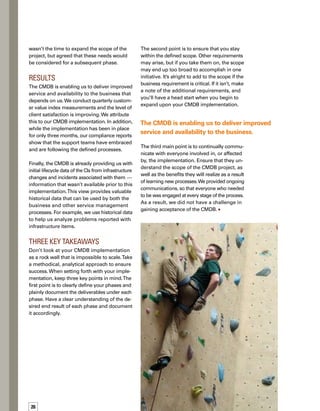
Don’t look at your CMDB implementation
as a rock wall that is impossible to scale.Take
a methodical, analytical approach to ensure
success.When setting forth with your implem-
mentation, keep three key points in mind.The
first point is to clearly define your phases and
plainly document the deliverables under each
phase. Have a clear understanding of the des-
sired end result of each phase and document
it accordingly.
The second point is to ensure that you stay
within the defined scope. Other requirements
may arise, but if you take them on, the scope
may end up too broad to accomplish in one
initiative. It’s alright to add to the scope if the
business requirement is critical. If it isn’t, make
a note of the additional requirements, and
you’ll have a head start when you begin to
expand upon your CMDB implementation.
The third main point is to continually commun-
nicate with everyone involved in, or affected
by, the implementation. Ensure that they und-
derstand the scope of the CMDB project, as
well as the benefits they will realize as a result
of learning new processes.We provided ongoing
communications, so that everyone who needed
to be was engaged at every stage of the process.
As a result, we did not have a challenge in
gaining acceptance of the CMDB. n
The CMDB is enabling us to deliver improved
service and availability to the business.
5tips
for 	
a smooth 	
implementation
Keep the scope
manageable by
relentlessly focusing
on your objective.
Keep in mind how the
CMDB project affects
your current processes.
Involve applicable
teams to ensure that
the CMDB initiative
meets business needs.
Define requirements
clearly before beginn-
ning the design.
Communicate the
scope and benefits
with everyone involv­ed
in, or affected by, the
implementation.
Joe Lord is the team lead for the
Configuration Management team
and the Configuration Managem­
ment process owner within Aliant.
Hisresponsibilitiesinvolveproviding
guidance to, and overseeing his
team’s involvement in, several ITIL
processinitiatives.Joehasworked
in IT for six years and is currently
certified as an ITIL Practitioner.
ABOUT THE AUTHORS
Craig Piercey is a senior technical
analyst with Aliant and is team
lead of the Mainframe Technical 
Database Support Team. In his 23-
year IT career, Craig has performed
many roles. His primary area of
expertiseiswithsystems-managed
storageandvirtualization.Histeam
supports the ICT environment and
delivers ICT solutions. Craig has been a key contribut­
tor to ISO certifications and ITIL implementations.
Kyle Ward is a business process
analyst with Atlantic Canadian-
based Aliant. Kyle is part of the
Configuration Management team,
and is currently heavily involved
in several ITIL process initiatives
within the organization. Kyle has
worked in IT for seven years and
is ITIL certified.
28
M
ost IT departments have taken one
of two distinct approaches in deplo­
ying a configuration management
database (CMDB). One approach is to focus on
thoroughness, and the team spends months,
if not years, planning the solution.This approach
may make sense in certain situations, such as
a complex deployment in a large enterprise.
However, the delay in actually implementing
the CMDB causes functional groups to become
impatient because they see no signs of progr-
ress. Many times, the functional groups will
move forward with disparate solutions.These
disparate solutions are hard to integrate once
the overall CMDB solution implementation is
under way.
The other approach is to focus on quick results.
Organizations taking this approach jump right to
implementation without much, if any, planning.
A Milestone-Based
Rapid CMDB
Approach to a
Definition-to-Deployment
       Initiative
29
They load the CMDB with as much data as they
can access. However, functional processes
rely on accurate, reliable CMDB data.The result
of this sort of implementation is that the CMDB
data does not support the functional processes
that depend on it.
You need to identify the providers,
consumers, and data sources that
the CMDB will impact.
While these approaches attack the challenge in
different ways, they both often fail for the same
reason: It is difficult to determine ahead of time the
entire size and scope of the CMDB implementation.
At Wipro, we have devised an innovative ap-
p­roach that is thorough, yet drives quick results.
Through working with numerous customers on
CMDB deployments, we have created an iterative
eight-phase CMDB implementation approach.
You really can implement a CMDB initiative that
achieves both thoroughness and quick results. This
eight-phase approach, each with an accompanying
milestone, describes how.
By Jason Odden
30
This approach provides a complete definition-
to-deployment plan for a rapid CMDB implem-
mentation at a reasonable cost.The output
of each phase is a milestone that represents
a significant achievement and value, empoweri-
ing the organization following this methodology
to make informed decisions regarding the
implementation of a CMDB.
Achieve these milestones in order, and you can
scope and plan your CMDB implementation
in real time.This approach is designed to work
with any out-of-the-box CMDB solution. Each
milestone can act as a checkpoint for the previo-
ous milestones.That allows you to take a holistic,
flexible approach toward your CMDB initiative.
Phase 1	
Identify CMDB Providers, Consumers, 	
and Processes 
To reach the milestone in this phase, you must
be able to provide the right configuration data
to the people and processes that need it. First,
you need to identify the providers, consumers,
and data sources that the CMDB will impact.
We recommend you use a best practices framew-
work, such as the IT Infrastructure Library (ITIL®
),
to accomplish this.
Next, you’ll need to identify the touch points
in each of the processes the CMDB crosses.
Best practices frameworks touch a number of
different processes, and not every organization
will be at the same maturity level for every
process.The key is to prioritize and start with
those processes that have the greatest expected
improvement from integration with the CMDB.
The scope of the CMDB is also considered
during this stage. Identify a reasonable and
limited scope for the initial deployment of the
CMDB — a reasonable, conservative scope
that can be implemented well, learned from,
and repeated to broaden and deepen the CMDB
over time. Consider the following questions:
What processes, such as change managem-
ment, would consume data from the CMDB?

What other applications, such as network
discovery tools and applications, would
provide data to the CMDB?
What specific roles of people will provide
data to the CMDB or query from it?
How important is each application that
consumes data from the CMDB?
Prioritize and start with those processes that
have the greatest expected improvement from
integration with the CMDB.
Milestone for phase 1
CMDB providers, consumers, and processes
are identified.
Checkpoint. Providers, consumers, and proc-
cesses should align with each other. Another
useful activity is to prioritize processes and
scope areas, keeping them reasonable, cons-
servative, and repeatable. Project phases should
be sensible and align with external depend-
dencies. Note: Initial scope may be limited
to achieve quick wins. If you have identified
multiple CMDB releases, you will need to keep
future phases and milestones carefully aligned
with each release.
Risk factors. Providers and consumers not only
need to be identified, but also put in the cont-
text of the processes that rely on the CMDB.
If something is missing from this broad picture,
the CMDB is at risk of not satisfying all the
needs of business and IT processes.Without
clearly defined dependencies among providers,
consumers, and processes, project phases
could be defined that do not have all the nece-
essary prerequisites in place. Similarly, CMDB
elements could be implemented before the
processes are in place to maintain or take
advantage of these CMDB elements.
31
Phase 2	
Quantify the Number of CIs and Their 	
Relationships (Sizing)
Phase 2 is intended, within the scope identified
as milestone 1, to define and quantify the
configuration items (CIs) and relationships.
You’ll want to consider the following:
How many records will you be storing
in the CMDB?
How are CIs going to be related to
each other?
How will you populate or discover
those relationships?
How will you maintain the accuracy
of the data?
Milestone for phase 2
The number of CIs and their relationships
are effectively quantified.
Checkpoint.You’ll need to manage the trade-
off between the benefit of having the data
versus the cost of maintaining the data. If
you find yourself with too much manual adm-
ministration, you might want to go back to
phase 1 and refine the scope. Again, if you
have multiple releases of the CMDB identif-
fied, these releases can be realigned to bala-
ance sizing requirements.
You’ll need to manage the trade-off between
the benefit of having the data versus the cost
of maintaining the data.
Risk factors. If you don’t achieve accurate sizing
in this milestone, you might have dozens of
manual links that never get updated (leading
to an out-of-date CMDB).You might also end
up with a database that’s either too small or
too big. As a result, you might install the CMDB
on insufficient hardware that provides poor
performance.You may also find that you don’t
have the right staff for the amount of manual
maintenance or data administration you’re
setting up.


Phase 3	
Define a High-Level Data Model 
The purpose of this phase is ensure that you
perform a gap analysis between the CMDB
technology that you plan to implement and
the data you defined in phase 1. Map the data
that each of the providers has to offer, along
with the data consumers will need. If you’re
going to build a CMDB tool, then the process of
achieving this milestone will include a complete
design phase.
The gap analysis helps you to look at the list of
fields to be included in the solution, and comp-
pare them against the data sources you already
have. Ask yourself the following questions:
Based on the prioritized processes, what
data do we need?
What data do we already have?Where is
it located?
What data fields are already included in
the solution?
Where is the gap and what fields are missing
in these areas?
Can we make everything fit with our CMDB
solution, or do we need some custom work
or development?
32
Milestone for phase 3
A high-level data model is defined
and documented.
Checkpoint. If you discover that a required data
source isn’t included in the planned CMDB
solution, you may need to customize the sol-
lution. Make sure the benefit of having the
data justifies the cost of customization.You
might want to change the phasing of the integ-
gration to start with an initial scope that utilizes
what is included in the solution. Likewise, if
you find yourself with more processes than
you can handle, or with data sources that
aren’t going to provide much value, then you
might return to phase 1 and refocus on a couple
of them.
Risk factors. If you don’t realize this milestone,
you may end up with a CMDB that won’t be
able to accommodate all of the data provided
to it. Similarly, the CMDB won’t be able to
provide data that’s asked of it. Furthermore, if
you don’t perform a gap analysis, you’ll have
a large list of fields and a very complex struct-
ture. As a result, you’ll have trouble tying the
data to the tool later in the implementation.
Make sure the benefit of having the
data justifies the cost of customization.
By starting with a list of attributes (fields) and
comparing what is available from the providers
and needed by the consumers, you avoid
getting mired in the technology itself. This
comparison will lead to the set of fields actua-
ally required — a much smaller set of data
than every­thing all providers have to offer.
This required set of attributes can then be
compared to the technology in a simple gap
analysis exercise.
Phase 4	
Define the Relational Class Model 
The purpose of this phase is to determine
the relational hierarchy necessary to define
and store the attributes and relationships that
make up the CMDB. To this end, you’ll want
to make sure the fields are in the right place
with the right structure.Your detailed design
diagrams should show all of the relationships
between entities. During this phase, remember
these guidelines:
If tools or technologies rely on the data
structure, try to stay within that structure.
Avoid unnecessary complexity in the
data structure.
If using an object-oriented model, take care
to put attributes in the right level, especially
where there are potentially many layers
of subclasses.
A complete, out-of-box solution can save you
time and money in designing a model that
can define and extend to all of those classes.
Milestone for phase 4
The relational class model is clearly defined.
Checkpoint.The level of customization of the
tool still allows for reasonable performance,
maintenance, and upgrade capability. Phases
still make sense within the context of the data
model and structure. Precedence of data from
the provider systems should also be understood
at this point, since it must be reconciled into the
CMDB (else the data be incorrect or inconsistent).
Risk factors. If you skip this phase and don’t
achieve this milestone, you will either have
not enough or too much segregation between
the different types of records in the CMDB.
Also, you might end up with records that are
too big or too unmanageable.
33
Phase 5	
Model the Data Reconciliation
The purpose of this phase is to start the transition
from design to implementation by modeling
data reconciliation. Milestone 1 identified all
of the different data users and providers. Now,
you’re ready to create those integrations by
mapping how data will be reconciled when it
comes from two different sources.The goal is
to have one single data set. You’ll need to
know the following:
What are the rules for data precedence?
What are the compare rules for any two
data sets?
How do you compare and merge
those records?
How often do you need to collect, compare,
and merge data into the published CMDB?
What is the frequency of discovery?
What are the data set requirements for
how the data maps into the system?
What sorts of jobs will continue ad hoc
versus a scheduled or automated reconc-
ciliation process within the CMDB?
How do you identify each record?
Milestone for phase 5
A process has been defined for reconciling data
when you have more than one data source.
Checkpoint. Overall complexity is a key point
here. It is entirely possible to architect reconc-
ciliation rules that are unrealistic to create and
maintain. Implementation phasing and stages
should also be in line with provider data availa-
ability, process maturity, and consumer tool
and process readiness.


Risk factors. If you don’t achieve this milestone,
your CMDB might have duplicate records —
either in the same place or in different places.
In other words, your CMDB has bad data.
Phase 6	
Extend CMDB Attributes and Structure
In this phase you will perform the CMDB attrib-
bute and class-level implementation of the
data model you’ve created.You’ll want to add
any needed fields, classes, and relationship
types, as well as any workflow to link the prov-
vider and consumer systems and processes
together. If any attributes have been identified
without at least one provider or one consumer
(remember, these can be manual), you can
add them later.
The goal is to have one
single data set.
The end result should look like a well-structured
CMDB (what’s in it and what fields are there)
ready to have CIs plugged into it. Now you know
it’s the right time to create those integrations.
Milestone for phase 6
CMDB attributes and class-level implementation
of the data model are complete.
Checkpoint. If you skip phase 5, or casually
outline the process in milestone 5, you’ll have
a poorly structured CMDB.Verify your implem-
mentation in milestone 6 against the design
from milestone 5 to ensure completeness.
Risk factors. If you do not meet this milestone,
you might not find the fields you need when
you are ready to import data or to integrate
data from other tools. In other words, failure
to perform this phase could result in your
inability to load or to integrate all of the data.
34
Phase 7	
Migrate and Convert Data 
This phase has two purposes: to conduct one-
time loads of data into the CMDB from your
legacy sources, and to create the integrations
you’ve prioritized. Make sure you include cons-
sumers’ integrations.Also, don’t forget to create
any federated links. If you have data that is not
stored in the CMDB, but would be referenced,
you’ll need to create those links.
You can perform both phase 7 and phase 8
iteratively when you start an integration, by
creating the reconciliation rules for the data
source and then executing them.
Milestone for phase 7
Data is migrated and converted and integrat-
tions are created.
Checkpoint.Training, testing, and user accept-
tance will reveal whether you have successf-
fully accomplished this milestone. Failure to
complete testing and training will lead to poor
acceptance of the CMDB as it is deployed.
Risk factors. If you don’t complete this phase,
you’ll have an empty or an incomplete CMDB.
Phase 8	
Deploy the CMDB
The purpose of this phase is to complete all of
the activities needed to get your system ready
for production.This includes the following:
Test the system and user acceptance
in preproduction.
Migrate any preproduction systems to full
production systems.
Train personnel to use the CMDB.
Inform key audiences about the CMDB.
Test all integrations.
Validate that everyone knows how to use
the CMDB.
If people don’t know how to use the CMDB,
then its value goes untapped and the
organization gets shortchanged.
Before you go into production, you might
want to have several iterations where you
import other data feeds or data sources, test
them, and deploy them.
5tips
for defining 
and deploying 
a cmdb
Milestone for phase 8
CMDB is successfully in production.
Checkpoint. Production system is live and int-
tegrations are functioning. Users are trained
and using the system appropriately. Processes
are interacting with the CMDB and keeping
it up to date.
Risk factors. If you don’t thoroughly complete
the tasks in this phase, the resulting CMDB
may have incomplete data, insufficient data,
or data loaded with bugs. If people don’t know
how to use the CMDB, then its value goes unt-
tapped and the organization gets shortchanged.
Successful Definition
to Deployment
This eight-phase approach answers the often-
conflicting needs for both thoroughness and
quick results. By following this approach,
meeting the milestone in each phase, watching
the checkpoints, and knowing the risk factors,
you can rapidly progress from definition to
deployment of your CMDB. n
Jason Odden is a principal solutions
architect at Wipro. He is a certified
RemedyApprovedConsultant(RAC)
and has more than nine years of
Remedy®
experienceanddozens
of successful implementations
in a wide array of environments.
In ad­dition to his customer focus,
Jason has been an active member
of the Remedy community, participating in alpha and
beta programs, and has been a presenter at numerous
national Remedy User Groups (RUGs). Jason is ITIL
Foundation Certified.
ABOUT THE AUTHOR
Know what delivers
value to your custome-
ers and providers of
CMDB data.
Define the appro­
priate scope and
depth of the project.
Make sure that
you’ve completely
thought through the
design of the CMDB.
Plan for the future.
In your efforts to get
something up and
running quickly, make
sure you don’t hinder
the future functionality
of your CMDB.
Go back and refine as
needed, and have a
flexible attitude so
you can build the best
CMDB possible for
your organization.
36
D
o you embrace the idea and promise
of the configuration management datab-
base (CMDB), but feel overwhelmed
by the details? Do you have a lot of asset data
and configuration items (CIs) that you’d like
to put into the CMDB, but have no idea where
or how to start — or how to identify the inform-
mation you need to gather?
Breaking down your CMDB project into smaller
pieces will enable you to really wrap your arms
around it. By identifying and achieving quick
wins, you can make significant progress toward
a successful CMDB implementation. Here is
some guidance for this “quick win” approach.
Identify the Most Mature
Data Collection Method
Populating the CMDB with CI data is a quick
win. I usually start by asking the client: How do
you currently collect data, how often, and in
what database do you store that information?
And then I recommend that we start building
the CMDB using the client’s most mature
method for data collection.
37
Identify and achieve quick wins to realize greater	
success with your CMDB implementation.	
Here’s how.
Advice for	
Achieving Quick Wins
with Your CMDB	
Implementation
By v’ali ford
38
Your most mature method might be a discovery
tool. Or, you might have a well-defined manual
auditing process, where you walk the floors
to take an inventory of your assets.Whatever
your most mature method is, start there.
Define a List of I.T. Services
In addition to identifying your most mature
data collection method, create a service catal-
log, or list of services that IT provides to end
users. Creating the service catalog is critical,
because it allows you to go to the business
stakeholders to determine the services that
the business sees IT providing for them.
For example, the service could be the ability
to take online orders or the capability to prov-
vide outstanding customer service through
a customer support application that is always
available. It might also be access to the Intern-
net, network services, or printing services.
Once you know what services IT provides to
the business, you’ll usually have a good idea
of what you’ll need to build, as well as the CI
information you’ll need to gather to populate
the CMDB.
Focus on a Well-Defined
Service That I.T. Provides
to the Business
If you already have a service catalog, determine
the business service that has the most well-
defined processes. Some organizations decide
to start with their pain points. However, we’ve
found that in many cases, the areas with major
pain points usually lack a sound process to
gather the necessary information to populate
the CMDB.You would need to engineer a new
process and then collect the data to populate
the CMDB, and this would result in a longer
time frame for implementation.
To achieve a quick win, start where the proc-
cesses are already defined. If the processes
are defined and you’re already collecting the
data, then that can lead to an even quicker win.
You can demonstrate the power of the CMDB
with this quick win, and at the same time, you
can use your initial success to begin to address
one of the processes that has pain points.
Create a Topology Tree for
Each Service Catalog Item
After you define your list of services and
populate your most mature data into the
CMDB, you can identify the CIs that support
each service that IT provides to the business.
Add the application databases that reside on
those CIs, and on top of that, add the service.
Eventually, you will have a full topology tree,
so you’ll be able to see the assets that support
each service catalog item.
To achieve a quick win, start where the
processes are already defined.
Typically, your most mature method of gathe-
ering data covers an entire asset class, so you’re
probably discovering a large majority of a
system, such as desktops or servers. In some
cases, your topology representation might
need to have a generic item that represents
the network infrastructure, for example. At
least you’ll have a placeholder, so you know
that you will need a discovery method to fill
in the unknown cloud of network services,
including routers, switches, hubs, Ethernet
cables — everything that makes up that netw-
work infrastructure.The key is gathering that
information, developing the service catalog,
and then filling in the unknown areas on the
topology tree.
Keep in mind that today, discovery tools are
best suited to identify the assets that support
the services that IT provides to the business.
You should have discussions with the business
stakeholders to define the services themselves
and the assets that support those services. In the
future, I expect that discovery solutions will be
enhanced to provide service discovery as well.
39
Reconcile Multiple Data Sets
If you have created a topology tree for each
service, you need to pull in other data sources
so you can create a more accurate represent-
tation to attach to the service catalog.
Start with a pen and paper exercise of building
a matrix.Think about all of your data sources;
what can you discover?Then, think about the
asset classes that you want to bring into the
CMDB, such as desktops, servers, or printers.
Next, match the discovery tool to the asset
class.Then rank their attributes; which source
do you use when there is conflicting data?
For example, if you have three data sources
for printer information (and thus, three sets
of data) — and you need to determine the
amount of memory in the printer — then
which data set do you use?
After you define your list of services and
populate your most mature data into the
CMDB, you can identify the CIs that support
each service that IT provides to the business.
Completing this exercise allows you to begin
building out your reconciliation and rules.You
will have multiple data sets coming into the
CMDB, so you must determine how you will
reconcile into your production data set. Having
this matrix helps you decide what the authori-
itative data source will be.
During this exercise, we also work with our
clients to bring an IT Infrastructure Library
(ITIL®
) perspective to the assets, relating incid-
dents and problems and changes through the
discovered items in the CMDB. It’s at this point
that organizations really start to see improvem-
ment in IT infrastructure management.
Success Story: Convert Data
and Establish Discovery Feed
We have worked with several organizations
that achieved quick wins upon which they can
continue to build. One client, a large pharmac-
ceutical company, needed to convert its current
repository of asset data into data suitable
for the CMDB.The company wanted to retire
a fixed asset system that contained information
about the entire infrastructure: databases,
applications — everything in the IT environm-
ment — as well as contract information.
However, the company’s discovery tool found
only desktop data.
To meet the company’s needs, we began by
converting the fixed asset data from the lega-
acy system and bringing that data into the
CMDB. Next, we adjusted the desktop data
discovery feed so it could populate the CMDB.
Once the desktop data was feeding the CMDB,
we set up a process to reconcile the discovery
data versus the CMDB data.
The quick win was to get rid of the legacy
system, populate the CMDB with this data,
and create a discovery feed into the CMDB.
Then, when the data was in the CMDB, we
began work on tying it to the appropriate
business services.
You will have multiple data sets
coming into the CMDB, so you must
determine how you will reconcile
into your production data set.
This company already had a list of services,
along with service level agreements that dict-
40
tated when a service would be available and
when it could be taken down for maintenance.
We brought the list of services directly into the
CMDB, and placed the repository of asset data
within the topology map.Then, we took the
organization’s IT service catalog and determined
the business services below each item in the
service catalog. Underneath that, we determ-
mined the applications supporting the business
services, and then the databases that support
the applications and servers that support the
database. In this case, we had a good reposit-
tory for data. In essence, we completed the
topology tree.
Achieving a quick win can help you
establish greater efficiencies and
increase your pace towards reaching
your ultimate CMDB goal.
The greatest benefit to our client was a reposi-
itory directly tied to its help desk ticketing
system.The company had an external asset
repository for reference purposes. Previously,
the help desk solution didn’t feed into the rep-
pository, so there was no way to capture the
data that related assets to an incident, or ass-
sets to a problem. Now that the asset data is
tied to the help desk system, the company can
see exactly how many changes have been made
to a particular asset or how many incidents
have been reported against an asset.That was
a big win for this client.
Quick Win for
Greater Efficiency
Achieving a quick win can help you establish
greater efficiencies and increase your pace
toward reaching your ultimate CMDB goal.
For example, time management and product-
tivity experts encourage you to consolidate
your data from a handwritten address book,
a PDA address book, a Microsoft Outlook
address book, and a calendar down to one
place, so that you quickly and efficiently know
the true source of your data.The same thing
is true for your CIs and a CMDB. If you have
CI information scattered in multiple databases,
you don’t know which one is accurate.You
have to take more time just to find out which
database to query.
The quick win is achieved when the data is in
a central location, and everyone knows where
to find the information they need.When you
need to update that data, add new data, or find
another source, you know where you will be
consolidating that information — in the CMDB.
Then you will have a starting point for your
CMDB on which to continue building.You can
identify other data sources that will make this
view even more comprehensive than it was
before, and therefore increase your efficiency
even further.  n
The quick win is achieved when the data is in
a central location, and everyone knows where
to find the information they need.
5tips
for A QUICK WIN 
APPROACH TO A
CMDB INITIATIVE
V’Ali Ford is a Remedy application
architect and developer with EMS.
He is a Remedy Approved Consult­
tant (RAC) and has seven years of
experience developing solutions
in the BMC®
Remedy®
IT Service
Management Suite and BMC®
Remedy®
Customer Service and
Supportapp­lications. V’Alihasapp­
liedprovenmethodologiestoanalyze,design,develop,
and document systems for EMS’s clients. V’Ali has
successfully led teams to integrate various products
with BMC®
Remedy®
products. He is well-versed in
industry standard best practices such as ITIL.
ABOUT THE AUTHOR
Identify your most
mature data
collection method.
Meet with business
stakeholders and
develop a list of
services that IT
provides to
the business.
Create a topology
map that illustrates
how your assets
support the services
you provide.
Use a matrix to help
determine which
data set is the authorit-
tative data set, and
establish your data
reconciliation rules.
Leverage the quick
win for further
improvements
to your IT
infrastructure
processes.
42
Configuration
Management
Activities
Using ITIL’s
for CMDB Success
Use the five ITIL configuration management
activities, plus an additional activity developed
by Quitze, as the basis to deliver a CMDB that
supports the needs of the business. This article
explains how.
By Javier Leyva Novoa
43
T
he configuration management database
(CMDB) is essential for effective conf-
figuration management. Moreover, it
is the key element in the entire IT Infrastructure
Library (ITIL®
) best practices service model.
The ITIL book, Best Practices for Service Support,
discusses and defines five specific configuration
management activities, ranging from planning
to verification and audit.At Quitze, we use these
five activities, plus one additional activity, as
a framework for CMDB implementations.
In this article, I’ll expand upon the ITIL configu-
uration management recommendations by
providing specific guidance for effectively evolvi-
ing through the six activities, which will set the
stage for a successful CMDB implementation.
44
Activity 1	
Planning 
ITIL’s Best Practices for Service Support book states
that this first activity includes“planning and def-
fining the purpose, scope, objectives, policies
and procedures, and the organizational and techn-
nical context, for Configuration Management.”1
Activities in planning a configuration
management process include:
Assigning a person to be responsible
for the process and systems
Analyzing existing configuration managem-
ment systems, data, and processes
Gaining agreement on the purpose,
objectives, scope, priorities, and
implementation approach for the
configuration management process
Planning for and obtaining funding for
configuration management tools
Attaining commitment for extra resources
The important tasks in this activity are defining
the depth and breadth of the CMDB as well as
the business policies and rules surrounding the
CMDB. Defining the borders helps to focus the
implementation so you don’t try to accomplish
too much in the first phase. It’s fine to save some
of the less business-critical requirements for a
future phase.
Tips for effective planning include the following:
Get management support, starting from
the top.
Gain commitment from everyone —
in all parts of the organization — who
needs to be involved in the project.
Clearly define your business idea and
be able to succinctly articulate it. Know
your mission.
Examine your motives. Make sure you
have a passion for owning a configurat-
tion management process.
Be willing to commit to the hours,
discipline, continual learning, and the
possible frustrations of owning your
own business IT process.


Conduct a competitive analysis of the
configuration management market,
including products, prices, promotions,
advertising, distribution, quality, and
service. Also be aware of the outside
influences that affect your business.
Seek help from other organizations,
vendors, professionals, government
agencies, employees, trade associations,
and trade shows. Be alert, and ask lots
of questions.
If you don’t plan effectively, it will take much
longer to deploy the initial phase of the conf-
figuration management process and the CMDB.
The staff responsible for the deployment may
become disinterested.You’ll end up gathering
information that is not aligned with business
objectives, or acquiring tools that are unnecess-
sary. Finally, you will not address and resolve
external influences that inhibit or change the
scope of the initiative.
Activity 2	
Identification
Once you’ve defined the breadth and depth
of your CMDB, you will need to identify each
of the configuration items (CIs) that will be
stored in the CMDB. According to ITIL, this
activity includes “selecting and identifying
the configuration structures for all the infras-
structure’s CIs, including their ‘owner,’ their
interrelationships and configuration docum-
mentation. It includes allocating identifiers
and version numbers for CIs, labeling each
item, and entering it on the Configuration
Management Database (CMDB).”2
You’ll need to have a working knowledge of
the common data model (CDM) of the CMDB.
Understanding the CDM will enable you to:
Determine the attributes of each class, so
you can find out if your CDM attributes
are sufficient for the business requirements


1.	 ITIL Best Practices for Service Support, p 121, Her Majesty’s Stationery Office, 2000
Defining the borders helps to focus the
implementation so you don’t try to
accomplish too much in the first phase.
45
Know which types of configuration items
are not included within the CDM scope
and which will be created later as classes
within the CMDB
Next, you’ll need to identify the external data
sources from which the CI information will be
obtained — either automatically or manually.
You’ll also need to identify the data sources that
you’ll only point to, to obtain the CI information.
Tips for effective identification of CIs include
the following:
Conduct a workshop with everyone involved
in the process to prioritize services and rel-
lated CIs to put in the CMDB, how they rel-
late to each other, and how data is captured.
Use a service catalog, or a list of services
that IT offers, to define the initial depth
and breadth of the CMDB by completing
the following steps:
Identify the critical services that affect
critical business functions.
Analyze each critical service to pinpoint
every IT component that supports it.
Catalog all components that support
critical services into families, so the cate-
egorization will be easier.
Identify key attributes of each family
so you can more easily support
the components.
Use the basic relationships between
components, such as “component of”
or “impacts directly on.”
Acquire the assistance of a technical
writer or a documentation analyst.
Evaluate the quality and value of existing
configuration documentation.
Involve appropriate hardware/
software suppliers.


1.
2.
3.
4.
5.


If you don’t effectively prioritize CIs, you will
find that you are storing a lot of useless inform-
mation in your CMDB, resulting in excessive
storage and search costs, confusion when
searching information, and an abundance of
problems in managing and maintaining CMDB
data.You will also likely discover that you are
not storing critical information that people
need, and people will be less likely to use
CMDB data.
Activity 3	
Control
ITIL states that this activity entails “ensuring
that only authorized and identifiable CIs are
accepted and recorded, from receipt to disposal.
It ensures that no CI is added, modified, rep-
placed or removed without appropriate cont-
trolling documentation, e.g. an approved
Change request, and an updated specification.”3
The CMDB permission schema plays a crucial
role in this activity. If you don’t have an inform-
mation security schema, you cannot be assured
that you are providing truthful and timely inf-
formation about the CI to the right process.
Figure 1 is an example of a permission schema.
You will also need to identify which processes,
applications, and users rely on CMDB data, and
codify any business rules that are going to
be put in the CMDB.These tasks will require
you to do the following:
Define the role of people accessing
the CMDB.
Define what type of data is associated
with every role.
Provide a means for disaster recovery.
Define permissions to control retrieval
of a copy of the controlled master for
software, data, and documentation.
Define the method for determining
whether the configuration data matches
the minimal requirements.


2,3.	 Ibid
If you don’t effectively prioritize CIs,
you will find that you are storing a lot
of useless information in your CMDB.
46
Tips for effective control of the CMDB
include the following:
Implement a robust tool that allows you
to store and manage information about
CIs so that anyone can see the status of
every CI and the history of incidents,
problems, changes, service level agreem-
ments, etc.
Be sure to consider the business rules
and policies around the CMDB, so the inf-
formation will be consistent. Examples of
business rules or policies include:
The change management process is
the only process that allows modificat-
tion of CMDB data.
All the hardware CIs must have the
“HW” prefix in the name.
Use a robust change management solution,
integrated with the CMDB, for processing
every IT infrastructure change.This will
enable you to know which CIs are involved
in every change, and to track all changes
associated with a CI.
Validate the CI information before updating
the CMDB if you use a discovery system.
Define which attributes must be included
in the comparison.
Define what to do if a CI is discovered
with changes.


–
–


–
–
Coordinate documentation efforts in
advance of major hardware and
software upgrades.
Involve the asset management group for
desktop equipment inventories.
If you don’t effectively control access to CI
information in the CMDB you will find that CI
data is changed without proper authorization,
causing the data to be inconsistent. In addition,
confidential information may be used for illegal
or other purposes that are not aligned with the
business. Incorrect CI data will also increase
the time required to fix incidents. Ultimately,
inconsistent CI data will cause your CMDB to
be irrelevant in your organization.
Activity 4	
Status Accounting
According to ITIL, this activity includes “the
reporting of all current and historical data
concerned with each CI throughout its life
cycle.This enables Changes to CIs and their
records to be traceable, e.g. tracking the status
of a CI as it changes from one state to another
for instance ‘under development,’ ‘being tested,’
‘live,’ or ‘withdrawn.’” 4


Figure 1. Example of a Permission Schema
Type of CI Group Process
Read
Write
PC
Support-Hardware
Incident Management X
Problem Management X
Change Management X
Release Management X
Support-Software
Incident Management X
Problem Management
Microsoft
Windows
Server
Support-Hardware
Incident Management X
Problem Management X
Change Management X
Release Management X
Support-Applications
Incident Management X
Problem Management X
Change Management X
Release Management X
Support-Networking
Incident Management X
Problem Management X
Change Management X
Release Management X
4.	 Ibid
47
To perform this task, you will need to maint-
tain the status of CIs within the CMDB, as
well as other related information, including:
Lifecycle state of each registered CI
Incident, problem, change, and release
history of each CI
Service level agreement with the busin-
ness associated with each CI
This process of obtaining and maintaining
status information can be manual or automatic,
but we suggest that you use a robust configu-
uration management solution that supports
CIs of varying complexity, such as entire systems,
releases, single hardware items, software
modules, or hierarchical and networked relat-
tionships between CIs.
Your configuration management tools should
facilitate the impact assessment of requests
for change (RFCs) by storing information about
the relationships between CIs.This will enable
the status accounting to be auditable.
When an organization understands how
important the CMDB is in supporting business
needs, it will automatically publish on its
intranet the status accounting of critical CIs
stored in the CMDB, sorted by status and type.
If users need to know the full status accounti-
ing report, they can run the report manually.
Using the statistical results from this accounti-
ing, you can find:
Behavior patterns
Baseline and release identifiers
Latest software item versions for a system
build or application
The number of changes for a system
or IT component


The number of baselines and releases
The usage and volatility of CIs
Comparisons of baselines and releases
Tips for effective status accounting include
the following:
Use statistical reports from your configur-
ration management solution or IT service
management applications to assist with
this activity.
Have executive and detail reports that
feed the business needs.
Record vital statistics (for example,
change requests) about the product.
Filter status accounting according to the
permission schema.
Have flexibility for getting reports from
the configuration management tool.
If you don’t effectively perform status accounti-
ing and have IT managers review the reports,
then you will lose control of the CI data.This
will cause CIs to have an unknown state.You
will also lose pattern identification, which means
the CI data cannot be used to find the root
causes of problems with CIs. Finally, you will
lose information about changes and releases
associated with CIs.
Activity 5 	
Verification and Audit
ITIL describes this activity as “a series of rev-
views and audits that verify the physical exi-
istence of CIs and check that they are correctly
recorded in the Configuration Management
system.”5
In other words, this activity will help
you to determine if the CMDB data is accurate.
You will need to perform audits of
the following:
CIs that may have been updated without
an associated RFC
CI revisions that do not comply with the
defined standards


Ultimately, inconsistent CI data will
cause your CMDB to be irrelevant in
your organization.
5.	 Ibid
48
Revisions to software that may not be regist-
tered in the defined software library, which
will allow you to know the presence of
unlicensed or non-tested software
Also perform verification when the following
conditions occur:
A CI is associated with an incident, problem,
change, release, service level agreement,
operational level agreement, and underp-
pinning contracts
The relationship of a CI with its environment
is being researched
The history of the CI is being consulted
You’ll also need to verify activities performed
by the discovery system.These activities will
enable you to know when there are differences
between the discovered information on a CI
and the data stored in the CMDB.
Tips for effective verification and audit include
the following:
Get your CIO’s support to help you make
verification a “must” on a regular basis,
year after year; make sure everyone is
committed to the verification process bef-
fore beginning.
Use reporting tools to help determine which
CIs are not operating properly, or which CIs
are actually being used.This activity will
help you better align the CMDB to the needs
of the business.
Integrate your configuration management
tool with a network monitoring and discove-
ery tool to help to determine the quality of
the data in the CMDB.
Create an audit schedule based on how
critical each CI is to the business.This act-
tivity is especially important if you use an
automatic discovery tool.
If you don’t effectively perform verification
and audit, you will have inconsistent data.
The CIs in production will not match the
description in the CMDB.You will also have
unauthorized CIs in your CMDB (unlicensed


software, for example), and CI data will not
match the minimum established requirements.
Ultimately, if you have incorrect data in the
CMDB, your IT organization will not use it.
Activity 6	
Backing Up and Archiving the CMDB
Based on our experience with CMDB projects,
we add a sixth activity to the five configurat-
tion management activities outlined in ITIL.
Backing up and archiving the CMDB rests
with the IT service management application.
The frequency and method depend on the
business objectives. However, you will need
to back up the data from the RDBMS data
handler, the platform on which the CMDB is
built, the relationship between the CIs, any
service level agreements related to the CIs,
the application tools and other tools integrated
with the CMDB, and the external information
sources.Your configuration management
tool can help with exporting and archiving
this data.
The archiving activity refers to extracting
information from the CMDB that is no longer
useful for everyday activities, but that may
be useful for audit and control purposes.You
might be able to use the CMDB platform
functionality.You will, however, need to define
the rules under which the information archiving
will take place.You might define the end life
of each CI to determine when to archive.To
determine which CIs or which information to
archive, you might also ask yourself which CIs
are critical to the organization.
Tips for effective backup of the CMDB include:
Make sure your procedures for backing
up the CMDB align to the business. For
example, “The CMDB needs to have a full

Integrate your configuration management
tool with a network monitoring and
discovery tool to help to determine the
quality of the data in the CMDB.
of using itil’s 
configuration
management 
activities
5 
BENEFITS
backup every Sunday at 12 a.m., before
the start of the work week.”
Keep a diary of the backups made on the
CMDB, including the date and status of
every backup, readily available.This task
often is the responsibility of the configur-
ration manager.
Test the backups from time to time to ensure
accuracy.Again, this task often is the respons-
sibility of the configuration manager.
Back up the CMDB structure when you
first populate the CMDB and anytime you
make changes to it.
Perform delta backups of the data in
the CMDB.
If you don’t effectively back up and archive the
CMDB, be prepared to recover from hardware
or software failure through other mechanisms.
If your backups of the CMDB are ineffective,
you will consume a lot of space with useless
backups that either may not work when you
need them or will restore the CMDB with ina-
accurate information. In addition, the CMDB
may have security vulnerabilities.
A CMDB to Support
Business Needs
Deploying a CMDB is more than storing inform-
mation in a database. Use these six activities
as a framework for your CMDB implementation,
so you can achieve a useful configuration
management process as well as a CMDB that
effectively helps you support the needs of the
business. Providing accurate and consistent
information about CIs and their relevance to
the business ultimately will enable the busin-
ness to meet its goals. n


Javier Leyva Novoa is a new
technologies manager at Quitze
Tecnología. Javier is a Remedy
ApprovedConsultant(RAC)and
ITILcertified,andhasadvisednumer-
ouscustomers about ITIL, COBIT,
and BMC Software products. He
hasbeenatrustedleaderincomplex
projectssupportingITILprocesses.
ABOUT THE AUTHOR
Providing accurate and consistent information about
CIs and their relevance to the business ultimately will
enable the business to meet its goals.
Effective planning
focuses the implem-
mentation and reduces
the time to deploy
the initial phase of
the configuration
management process
and the CMDB.
Effective prioritization
of CIs will help you
reduce data storage
costs, streamline data
searches, encourage
use of CMDB data,
and more easily
manage and maintain
CMDB data.
Effective control of
access to information
in the CMDB helps
ensure the consistency
of CI data and the
relevancy of the CMDB
to your organization.
Effective status
accounting helps you
to control the CI data
and track information
about changes and
releases associated
with CIs.
Effective verification
and audit helps
ensure that your data
is consistent, that the
CIs in production
match the description
in the CMDB, and that
the CIs in your CMDB
are authorized CIs.
50
Successful implementation and long-term viability
depend on how effectively you manage the human
aspects of the CMDB. Here are six tips for including
the human factor in your CMDB equation.
By Tim Mason
for effectively 	
managing
“People”
factor
the
I
recently completed a configuration manage­
ment database (CMDB) implementation at
a major oil company.The implementation
of this world-class CMDB has been so well
accepted that the company honored us with
two internal company awards.
The implementation wasn’t without difficulty,
however. In fact, one of the biggest challen­ges
to our long-term success was getting the
“people” side of the CMDB equation right.The
implementation team tackled this challenge
head on and overcame it.
Sophisticated technologies were available, and
related technologies were evolving at a rapid
pace. Discovery tools were becoming more
thorough and more automated, and modeling
tools were becoming more sophisticated. But
these tools alone did not guarantee a successful
implementation. We also needed to address
and resolve the people issues.
51
52
CMDB: the People Angle
If you’re like most IT professionals, you’re pre­tty
well convinced that your enterprise needs a
CMDB. After all, understanding which IT assets
make up the infrastructure and how those
assets deliver business value is core to making
business-focused decisions within IT.
And maybe your CIO is demanding better and
quicker information about the effect of an IT
change on the business, the impact of changing
a sourcing arrangement, or the criticality of
specific infrastructure elements on business
processes. It’s also likely that you’ve spent
a lot of money on one-off audits and cleanup
exercises to gather and organize this informat-
tion when you need it.
The answer to these challenges is to create
a sustainable source of information and know­
ledge that enables effective management of
IT. In other words, implement a CMDB that
is compatible with IT Infrastructure Library
(ITIL®
) guidelines.
In reality, however, maintaining a global source
of knowledge on IT assets and their business
value is a huge challenge. Multiple sourcing
arrangements, organizational transfor­mation,
and IT asset migration all complicate the goal.
A large percentage of critical information is not
discoverable, and many enterprises finish a
CMDB project only to discover that maintaining
it is a nightmare. Some have resor­t­ed to large,
centralized teams to manage and maintain data.
Others simply fail to maintain it.
One of the biggest challenges to
long-term success is getting the
“people” side of the equation right.
So here’s a single thought to keep in mind
th­roughout your CMDB project: To a large
degree, successful implementation and long-
term via­bility depend on how effectively you
manage the human aspects of the CMDB.
Below, I’ll pro­vide some guidelines on how
to do just that.
Tip 1	
Hook into Existing Processes
Your enterprise already has a lot of IT processes
in place: changes, installs, projects, handovers,
and so forth. Our team found that adding
Update CMDB tasks to each of those existing
processes paid off enormously. By adding those
tasks, we hooked into any existing process that
resulted in changes that needed to be reflected
in the CMDB.
To a large degree, successful implementation and
long-term viability depend on how effectively
you manage the human aspects of the CMDB.
The change process is an obvious place to
begin. However, not everything you want to
maintain in the CMDB falls under the scope of
change control. Moreover, putting everything
that does fall under change control into the
CMDB can translate into an unworkable change
process. A change of application owner or
business contact, for example, may not be
controlled by the change process. It does,
however, represent a change that must be
reflected in the CMDB.
We also looked beyond the change process to
processes related to operational acceptance.
We ensured that whenever a support group
began to work on correcting an issue, the
CMDB was updated to reflect the current state.
We also embedded the data-center installation
process — that is, the process of getting items
into a data center and into a rack — as workf-
flow in the CMDB.
The real challenges are spotting the relevant
processes and getting people to follow the
new step.
53
Tip 2	
Communicate Widely and Take 	
A Top-Down Approach 
Communication that explains the value and
benefits of the CMDB is vital to getting buy-in.
Effective communication gives people insight
into CMDB project goals and benefits. It can —
and should — take a variety of forms, including
e-mail campaigns, an intranet site, meetings,
workshops, and training.
However, you can’t make things happen through
communication alone. People quickly develop
communication fatigue, and let’s face it, the
life of an operations person is not full of spare
time to attend training courses and worry about
new tasks. Getting people to follow the right
process and take responsibility for data on the
configuration items (CIs) they know requires
more than communication and more than
training.We found we absolutely needed supp-
port from the top of the operations organization.
The challenge here is that the people adding
and maintaining data are often not the people
benefiting from it. Too often, IT operations
peo­ple see the CMDB as an overhead or burden.
Anything you can do to communicate how it
will make their lives easier or add value for them
is important to the success of the project.
Tip 3	
Make it easy to use, give something back
Making it easy to update and maintain the
CMDB and get data from it sounds obvious,
but I want to stress that this is critical to the
success of your implementation. Unless you
pay attention to the user interface, you’ll end
up with a CMDB that makes it difficult to find
data and understand important relationships.
When that happens, people aren’t inclined to
use the CMDB — or keep it up to date.
We set a goal of ensuring that we weren’t
making the CMDB any harder to use than it
had to be.To achieve this goal, we dedicated
time to building reporting tools, quick wild-card
searches, and views for visualizing and navig-
gating the CMDB.
The challenge here is that the
people adding and maintaining
data are often not the people
benefiting from it.
While we mandated that people use the CMDB,
we also recognized that mandates never win
hearts and minds. So we also spent some time
to make the CMDB especially useful to people
who were adding and maintaining data.This
often meant incorporating more CI types and
attributes than were needed for configuration
management purposes.These types and attri­
butes, however, benefited key groups of users
who maintained critical data, which gave them
a stake in keeping data up to date. We also
made sure that the core data that was critical
to the enterprise was maintained globally, while
data that was specific to certain groups didn’t
need to be.
TIP 4	
Establish Data Ownership 	
and Clear Measures 
Clear accountability for data goes hand in hand
with the process element.We found that every­
one wanted information from the CMDB, but
no one wanted to pay to maintain it. People
pointed to the configuration management
team and said, “It’s their responsibility.” Conf-
figuration managers, however, cannot own the
data because they have no way of knowing
if the data is accurate.They can own the proc-
cesses related to checking accuracy, but not
the data itself.
With this in mind, we built a model of data
ownership with clear measures that put the
onus of maintaining CMDB data on the people
who know the data best.This involved implem-
menting a network of data owners and data
managers. The data managers are members
of the support group for each CI. We aligned
their roles to the data they need to support on
a CI — for example, operating system support
was aligned to operating system infor­mation.
Data managers are accountable to a data owner
for data quality.
54
We incorporated data quality targets into con­
tracts for third parties and established personal
objectives for internal staff. The data owner acts
as an escalation point to which configuration
management can raise issues.We modeled all
this in the CMDB. Now, when users click on a
field, they can immediately see who owns
the data.
TIP 5	
Automate Data Checking
ITIL audit and verification processes can be
time consuming, so you need to give some
thought to ensuring that you focus only on the
data critical to the audit.To assist with this,
we built in some automatic functionality that
iden­tifies missing data and basic errors, and
notifies the appropriate data manager.
It’s important to understand that this function­
ality does not validate fields during data entry.
Why? Because when you force people to fill
in a field to complete a process, they’ll resort
to entering anything they can think of if they
don’t have the correct information.They do this
because they want to finish the task at hand
and move on to the next one. Obviously, this
can wreak havoc with accuracy.
To overcome this problem, we included
Unknown as a valid entry. By doing so, we
allow people to complete a task even if they
don’t have all the information required by the
CMDB.The verification functionality picks up
on the missing and unknown information
and alerts the data manager that some action
is required.
tip 6	
Use Autodiscovery Appropriately
Discovery tools play a vital role in managi-
ing the detailed, complex information about
hardware configurations, such as patch infor­
mation, BIOS settings and dates, memory,
and disk allocations. While important, this
information represents only a fraction of the
picture when asking important questions, such
as “Whom do I contact to get approval to reb-
boot theVMWare server?”
The message here is that autodiscovery is criti­
cal to providing an asset base with detailed
configuration information.To make the leap
to a successful CMDB, however, you need to
understand that people and process are vital.
So, use autodiscovery appropriately and don’t
rely on it for all data.
PEOPLE PROVIDE KEY TO SUCCESS
As technologists, it’s easy for us to get caught
up in the technology side of things when we
approach a major project, such as a CMDB
We built a model of data
ownership with clear measures
that put the onus of maintaining
CMDB data on the people who
know the data best.
OF MANAGING
THE PEOPLE 
FACTOR
5 
BENEFITS
implementation. We need to keep in mind
that an effective CMDB implementation also
involves people and processes.Too often in IT,
we overlook the people side of the equation.
By following the tips in this article, you can
ensure that you effectively manage the human
capital in your enterprise, so you can build
your own world-class CMDB that’s worthy of
internal and external awards. n
Tim Mason is a founding director at
TRM Associates, an information
management consultancy firm. Tim
brings deep experience and insight
from an extensive background in
managementconsultingataleading
U.K. consulting firm. While working
in the industry, he has held intern­
national IT assignments spanning
Europe, Australia, Asia, and the United States.
ABOUT THE AUTHOR
Efficiency — If you
automate data checking,
you can streamline
ITIL audit and
verification processes.
Integrated process for
updating CMDB — By
adding Update CMDB
tasks to existing proc-
cesses, you can create
a hook to any process
that results in changes
that need to be reflected
in the CMDB.
Buy-in from stakeholders
and participants —
By communicating
how the CMDB will
make their lives easier
or add value for them,
you can more easily
gain buy-in.
Up-to-date CMDB —
If you make the
interface easy to use,
people will be more
inclined to use the
CMDB and keep
it up to date.
Accountability —
You can increase
accountability by
establishing data
ownership to create
an escalation point
and by defining clear
ways to measure
performance.
To make the leap to a successful CMDB, you need
to understand that people and process are vital.
56
Get a head start on the most difficult issues of CMDB 	
design by first examining five important topics: 	
configuration items, federated systems, data schema,
discovery, and data integration and reconciliation. 	
Here are the questions to consider.
By Dennis Drogseth
Considerations 
for a CMDB
5design
57
Y
our configuration management datab-
base (CMDB) can significantly empower
your organization — once it is a cons-
sistent, dynamic, and trusted data source that
supports such objectives as change and conf-
figuration management, inventory and asset
management, and service assurance.
The CMDB can enhance the alignment of busin-
ness and IT. It can also help IT to reap enormous
advantages in operational effectiveness by
improving cost efficiency and service quality.
And perhaps most importantly, the CMDB is
a potential cornerstone not only for IT Infras-
structure Library (ITIL®
) process initiatives,
58
but also for adoption of long-term IT systems
management technology.
However, a CMDB initiative requires patience,
perseverance, and a willingness to plan for
multiple phases of deployment over months
and possibly even years.  You’ll need a set of
achievable first-phase goals, and will need to
choose your underlying architecture wisely.
In our May 2004 report “Next Generation
Architecture,” we at Enterprise Management
Associates (EMA) posed that management
technology solutions, such as the CMDB,
need the following:
	 Effective and non-redundant data gathering
across disciplines
	 A distributed or federated data store to
support multiple management disciplines
	 Cooperative analytic engines to flexibly
enable access to this data store
	 Role-based views of services to enable
real-time analysis and historical reporting
	 Targeted and validated automated actions
	 Dynamic mapping to service and busin-
ness objectives
A CMDB, as defined by ITIL, is process-centric,
and as such, it can only imply these architect-
tural goals. In fact, a CMDB-like capability would
have become necessary in the industry even
if ITIL had never existed. Many companies
have already recognized that developing an
effective approach to storing and sharing data
in support of operational and business goals
is becoming a top-of-mind requirement in its
own right. In other words, the CMDB has
architectural roots that are just as deep and
meaningful as ITIL process objectives. Such
an architectural approach to a CMDB can
create the following benefits:
	 Efficiencies in data gathering — You can
gain structural efficiencies that will help
you gather data from multiple sources for
multiple sources in a consistent, coherent,
and trusted fashion.
	 Efficiencies in data analysis — Greater
efficiencies in accessing and analyzing data
make it easier for IT to write and support
multiple management applications.
	 Foundation for policy-based automation —
A foundation for policy-based automation
can directly support your critical busin-
ness processes.
	 New model for product integration —
You can more easily integrate products
within single brands or suites, as well as
across brands, when your architecture
provides a model for product integration.
	 Foundation for modularity — A structural
foundation for modularity in management
product design gives you greater choice,
flexibility, and adaptability.
Your CMDB can significantly empower your
organization — once it is a consistent,
dynamic, and trusted data source.
Before You Design:
Goals and Objectives
As you begin your CMDB initiative, ask yourself
the following questions:
	 What are the short-term and long-term
goals — including operational and busin-
ness-related goals — I want to accomplish
with a CMDB?
	 How can I best quantify these goals?
	 What internal IT constituencies are affected
by these goals and objectives?
	 Which constituencies in the company need
to provide input to the CMDB initiative?
	 What external customer or consumer
constituencies are likely to be affected
by these objectives?
	 What outside supplier relationships —
such asWAN services and application
hosting, for example — will likely be
affected by these objectives?
	 What current IT processes will be affected
by this CMDB initiative?
	 What are the short-term and long-term
CMDB requirements for my company?
	 What do I need to do to prepare my IT
organization for the cultural and process
59
changes that a service management and
CMDB initiative will require?
	 What are the organizational implications of
investing in a CMDB? For instance, to what
degree will my IT organization evolve in focus
and value to the business by leveraging
the CMDB as a catalyst? What are the
organizational implications of becoming
more service provider–like and more
accountable? For operational or business
alignment reasons — or both — do
I need to define a separately accountable
organization around the CMDB?
Your answers to these questions will guide
you through five design considerations that
are integral to your CMDB deployment.
Design Consideration No. 1	
Configuration Items
Configuration items (CIs) are the entities that
populate the CMDB or CMDB system, and are
fundamental to the CMDB itself. CIs in a CMDB
could include:
	 Network and systems hardware
	 System software, including
operating systems
	 Business systems and
custom-built applications
	 Commercial off-the-shelf packages,
standard products, and database products
	 Physical databases
	 Software releases
	 Configuration documentation, such as
system and interface specifications, licenses,
and maintenance agreements
	 Service management components and
records, such as capacity plans, IT service
continuity plans, known errors, and requests
for comment (RFCs)
ITIL emphasizes that CIs are not isolated
entities, but are interrelated components of
a service management fabric. CIs are ultimately
important only insofar as they participate in the
active support and delivery of business services.
Successful CMDB deployments have clear,
attainable objectives that are implemented in
phases, adding breadth and depth over time.
The initial discussion of what CIs need to go
into the CMDB in first-phase deployments is
therefore predicated on the goals of that phase.
To identify the focus for the initial phase, ask
yourself which areas are priorities for your
company’s CMDB initiative. Many CMDB
initiatives address the following:
	 Change and configuration management
	 Disaster recovery planning
	 Security audit and compliance
	 Consolidation (business application,
server, and application)
	 Service assurance
	 Asset management
	 Capacity planning
	 Lifecycle application planning and
service planning
With your goals for the first phase as a guide,
you can define the CIs that need to go into the
core CMDB by using a model that has two axes.
(See Figure 1.)
Low time sensitivity
High granularity of data
High time sensitivity
High granularity of data
High time sensitivity
Low granularity of data
Low time sensitivity
Low granularity of data
GranularityofInformation
Time Sensitivity
Figure 1. Considerations for storing CI data
in core CMDB
Along one axis is time sensitivity and how
often the CMDB needs to be updated. Along
the other axis is granularity of information,
or what EMA calls “atomicity.” Using these
axes for CI planning, an IT organization
might choose to keep inventory, topology,
Configuration items are ultimately important
insofar as they participate in the active support
and delivery of business services.
60
and configuration detail in the core database,
where time sensitivity is low and atomicity
is high. On the other hand, granular and ext-
tremely time-sensitive performance information
might reside in one or more databases that
have bidirectional integration with the CMDB.
In this bidirectional integration, performance
information could leverage relationship and
configuration modeling in the core CMDB,
while the core CMDB could be updated when
critical services and CI components were deg-
graded or unavailable.
By prioritizing your first-phase objective in
terms of change manage­ment, service level
management, inventory and asset managem-
ment, or some other area, it then becomes
possible to set initial objectives for CI requirem-
ments which will, in turn, impact CMDB design.
Design Consideration No. 2	
Federated Systems
Even if first-phase CMDB deployments are
single and centralized, most CMDBs will evolve
into federated systems. As organizations need
to accommodate many types of technology
management investments, a CMDB will need
to support not only multiple sources of data,
but also different types of data from different
vendors’ products. And because these various
data stores are unlikely to follow the same data
schema, federation is an effective design point
for reconciling and integrating different types
of data.
When planning a federated CMDB system, ask
yourself questions such as these:
	 Which of my existing management tools
must be integrated into the CMDB?
–	 Are these tools designed for, or sufficient
for, CMDB integration?
–	 How reliably do these tools gather
accurate data?
–	 How effectively do these tools deconstruct
data to show contexts for actions taken?
	 What standards are used in the management
technologies available to me and how
committed are my vendors to standards
for the CMDBs being considered?
	 How do the vendors of my management
products define federation, and is my
investment protected?
	 How do CMDB-related management produ-
ucts integrate with other CMDB products?
Federation is an effective design point for recon-
ciling and integrating different types of data.
	 What are my priorities for CMDB federation?
–	 Level of complexity versus quick
deployment? Many successful CMDB
implementations build toward federation
from a core, central CMDB that is sufficient
for the initial CMDB task or discipline at
hand, such as a CMDB focused specifically
on change management for the data center.
61
–	 Level of complexity versus the near-term
and long-term resources available for
administration and support?
–	 Database design, performance, and scala-
ability? In some cases, vendors replicate
data; in others, data is accessed dynamic-
cally and reconciled through policies.
	 How does the notion of federation map to:
–	 Current processes?
–	 Currentorplannedorganizationaldynamics?
–	 Current or planned supplier relationships?
Design Consideration No. 3	
Data Schema
When you establish your data schema, which
represents the content structure of your data,
I recommend that you focus on phase-one
requirements, while also keeping an eye
toward a more comprehensive set of longer-
term requirements. In the end, you’ll be more
successful building from near-term accomp-
plishments than you will be spending many
months, and possibly years, architecting a
complete CMDB design before any real value
is seen.Technologies and standards are both
evolving, so in five years, your options for a
complete CMDB system might be substantively
different from today.
When planning data schema for the CMDB,
ask yourself questions such as these:
	 What information can reside outside the
scope of my initial CIs but still relate to
those CIs? In many implementations, some
resources, such as contractual information,
asset-specific financial information, or trouble
ticket details, reside outside the CMDB and
are not treated as core CIs.The CMDB is
linked to these resources so that it is updated
when they affect critical parameters of CI
status, such as service level agreement (SLA)
violations or an open trouble ticket on a CI.
	 What kind of modeling or schemas do my
CIs require and at what level of complexity,
in both the near and longer term? What
kind of relationships must be captured and
why?What standards are most likely to be
relevant for me near-term and long-term?
	 How dynamically and automatically can my
CIs populate my CMDB?
	 How can my CIs and their schema
best optimize:
–	 Immediate impact to services?
–	 Immediate impact to consumers?
–	 Automated triggers to operational policies?
–	 Automated triggers to business policies?
	 Is there a skill set required or a services
tax to be paid for either integrating CIs or
supporting complex modeling schema?
Be sure to understand what your vendor
provides and what you either need to do on
your own or pay for through extra services.
CMDB implementations can be complex,
so one rule of thumb is never to invest in
anything that you don’t first understand.
62
Design Consideration No. 4	
Autodiscovery
Much information and insight about your
systems and processes can be discovered
in an automated fashion. Most autodiscovery
tools are designed to gather specific information,
and each type of discovery tool should be
considered when you plan your CMDB. How
you prioritize your autodiscovery capabilities
will be influenced by the initial and future focus
of your CMDB. Consider gathering information
about the following, all of which can be relevant
to the ITIL vision of the CMDB:
	 The physical and logical network
	 Systems and application components
	 Detailed configuration information for
each device or software component
	 Relevant modeling of infrastructure to service
	 Relevant modeling of service to
consumer population
	 Relevant modeling of business impact
	 Relevant modeling of associated depend-
dencies (service contracts and objectives)
	 Relevant modeling of operational depend-
dencies (who does what and when)
	 Relevant insights into consumer consumpt-
tion behavior so that operational and service
planning can be optimized
Keep in mind that only some types of discovery
will be needed for a CMDB core. Other inform-
mation gathered through autodiscovery may
more appropriately reside in federated data
stores accessed by the CMDB.
Design Consideration No. 5	
Data Integration and Reconciliation
A CMDB demands integration across multiple
sources, almost all of which have their own
data stores and data schema.   This multitude
of data presents probably the single greatest
challenge to planning and developing an eff-
fective federated CMDB system.
Your system will require some level of data
normalization, so that management applicat-
tions have a single, consistent way to access
data. Similarly, data normalization provides
a common approach for representing CIs, so
that services can be more effectively modeled.
The data schema you choose for your core
CMDB and the standards you adopt for applic-
cation-to-application communication will dictate
how data needs to be normalized throughout
your CMDB system.
Data reconciliation is another challenge. Most
IT organizations have many management
tools that provide discovery capabilities that
are redundant to one another. IT must reconcile
the collective data so that the wealth of data
is still available and the integrity and quality
of the CMDB data is maintained as data is
added, updated, and removed from the CMDB.
Data reconciliation must address the unificat-
tion of disparate data reported for the same
CI. Data reconciliation must ensure that a CI
is correctly identified, even if various managem-
ment tools have named the same CI differently.
Time dependencies and disparities of the data
must be reconciled. And, finally, data reconc-
ciliation must maintain the ability to link and
synchronize to extended data about a CI in
response to a request from the enterprise
level CMDB.
The greater the breadth of CIs supported, the
greater the need to address data integration
and reconciliation challenges in the near term.
Prioritize your objectives, so you can develop
a phased approach to meet the data integrat-
tion and reconciliation requirements of your
CMDB system.
Most autodiscovery tools are designed to
gather specific information, and each type of
discovery tool should be considered when
you plan your CMDB.
5tips
for cmdb 
design
Data reconciliation must address the
unification of disparate data reported
for the same CI.
Effective Design:
CMDB as Enabler
By carefully considering your needs for conf-
figuration items, federated systems, data
schema, discovery, and data integration and
reconciliation, you can better ensure the
effective design of your CMDB. A successful
CMDB deployment will create a consistent,
dynamic, and trusted data source that will
enable new process efficiencies within and
across your IT organization. n
Dennis Drogseth, vice president,
EnterpriseManagementAssociates,
directsateamofanalyststhatfocus
on the development of networked
services management. He has pion­
neered research in management
strategies such as performance
andavailability,integratedsecurity,
changing organizational dynamics
inIT,andenterpriseandserviceprovidermanagement
issues. He has a Bachelor of Arts degree, magna cum
laude, from Yale University.
ABOUT THE AUTHOR
Be flexible in applying
ITIL best practices,
using ITIL as a catalyst
rather than a religion.
Be willing to re-evaluate
your CMDB progress
based on checkpoints
and results.
Be aware of technology
options and how they
support both process
and architectural
requirements.
Focus carefully on
the definition and
scope of CIs.
Follow open —
not proprietary and
unpublished —
data schemas.
64
By Frederieke C.M. Winkler Prins
G
etting things right at the outset of
a service management initiative —
in the process definition stage — is
vital to the success of the overall project. Many
have turned to IT Infrastructure Library (ITIL®
)
processes to guide them in delivering and
supporting their services. And while ITIL
provides useful theoretical guidelines, it does
not define the process flow.
Consequently, enterprises are struggling
through the process definition phase, parti-
cularly when in the midst of a configuration
management and a configuration managem-
ment database (CMDB) initiative. There is
good news, however. You can hit the ground
running with your configuration management
and CMDB initiatives by starting with a best
practice process model.
At Service Management Partners, Inc. (SMP),
we use a best practice process model to enable
IT service providers to implement the CMDB,
as well as configuration management and the
other service support processes, in just 12
weeks.This comprehensive process model
incorporates not only the ITIL guidelines but
also the feedback from our partners and
customers, who have contributed their ideas
over the years to make it even better.
Using a best practice process model speeds up the definition phase, which
reduces costs and helps you to hit the ground running with your configura­tion
management and CMDB initiatives.
your CMDB Implementation with
Accelerate
A Best Practice Process Model
65
66
The STandardized
PROCESSes challenge
A well-defined process spells out roles and
responsibilities down to the work instruction
level. It defines the order of process steps,
inputs and outputs of each process step, and
the specific work tasks and functions performed
at each step. A good process ensures that
everyone who performs a given task does it
in the same way, knows what to expect as
input from the previous step, and delivers
consistent output to the next step in the flow.
As a result, well-defined processes enable
high-quality service delivery and accurate and
detailed reporting that provides visibility into
IT performance across the enterprise. Moreo-
over, well-documented processes support
compliance with government mandates and
industry regulations, often eliminating weeks
of manual effort required to gather and collate
information for audits. Figure 1 illustrates the
generic process model, as defined by ITIL.
Defining and standardizing on process flows
across multiple groups within IT can be a
grueling and time-consuming effort.You must
get the right people together, which means
setting up meetings with representatives of
all the groups that provide input, are respons-
sible for process activities, or rely on output,
and then getting consensus on a common
process definition.Typically, each group already
has its own way of doing things and may not
be focused on integration with other groups
and processes. Each group may have its own
quality initiatives and may have fine-tuned
its isolated procedures. Convincing people that
they should change their way of working so
they can integrate with other groups is not
easy. Political allegiances often come into
play, making it difficult to agree on a stand-
dard approach.
Figure 1.The Generic Process Model
Source: ITIL Service Support Appendix B: Process theory and practice, page 273
Process
Process
Control
Process
Enablers
Activities and
Sub-Processes
Quality Parameters
and Key
Performance
Indicators
Process
Owner
Process
Goal
Resources Roles
Input and Input
Specifications
Output and Output
Specifications
67
HOW a Best Practice Process
Model HELPS
A best practice process model combines field-
proven processes with practical, detailed, and
specific instructions on how enterprises supp-
port and deliver their services. Starting with
such a model doesn’t mean you eliminate the
process definition phase of your service mana-
agement initiative.You still need to get the right
people together in a room to review and agree
on processes. It’s a different kind of meeting,
however, because people recognize that the
model represents processes that are already
integrated and generally accepted as industry
best practice.
The goal of the meeting is to see if there are
improvements or changes that should be made
to the model to optimize it for the unique needs
of the organization.This eliminates a lot of
political hurdles and resistance to change. If
someone suggests deviating from the model,
the discussion more appropriately centers
on the expected benefits to the enterprise
that justify the additional cost to implement
such variations.
Figure 2 shows a basic process flow for upd-
dating configuration items (CIs).This process
would be represented as a single step in the
change management process diagram.Your
organization may need to modify this flow to
meet a specific need or requirement. For exa-
ample, if your requisition system supports
automated CI registration, your team might
decide to include CI registration as part of the
CI requisition step, instead of as a separate
process step.Your team can decide what spec-
cific modifications are needed to support your
unique requirements. All in all, it is definitely
more efficient to spend precious time evaluating
various process modifications than starting
from scratch.
If you do start from scratch and don’t use a
best practice model for your CMDB or conf-
figuration management initiative, you may
A best practice process model combines field-
proven processes with practical, detailed, and
specific instructions on how enterprises
support and deliver their services.
Yes
Yes
Yes
Yes
No
No
Registration or update
of contract required?
No
Update of existing
Cls requested?
From Change
Management
To Change
Management
No
NoYes
Update of supplier
information required?
Requisition of
new Cls requested?
Cl Requisition
Registration of
new Cls requested?
1
Cl Registration
3Supplier Information
Maintenance2
Cl Update
4
Contract
Administration5
Figure 2. Example Process Diagram — Configuration Item Update
68
find that: a) you can’t get agreement from all
the stakeholders on basic process flows and
definitions, b) the various process flows may
not integrate, and c) the service management
applications you select may not be able to supp-
port these custom processes without months
of expensive application customization effort.
This best practice process model approach
speeds up the definition phase, which reduces
costs and enables you to begin reaping the
rewards of a working configuration managem-
ment process and CMDB more quickly.
The IMportance of
Tool Integration
Once the process definition is complete, you
need to implement software that both autom-
mates and enforces the agreed-upon process
definitions.This implementation can turn into
a lengthy and costly effort if the underlying
software tools were not considered during the
process definition phase. A best practice model
that takes into account out-of-the-box software
setup ensures that the software will support
the standard processes your organization establ-
lishes with little or no customization.
In cases where you have adjusted the model
to accommodate the needs of your enterprise,
you may have to make minor modifications to
the tool. Minimizing the amount of customizat-
tion, however, saves you time and money,
makes for an easier upgrade path in the future,
and no less importantly, reduces your risk.
While almost all ITIL service support and service
delivery processes utilize tools that draw on
the CI data in the CMDB, certain processes
and tools utilize shared data more frequently.
(See Figure 3.)
For example, the change management process
relies heavily on CI data to identify related CIs
and services for risk and impact analysis activi-
ities. Standard work instructions predefined
in the process should identify what specific
CMDB data is needed at each process step.
You need to implement software that both
automates and enforces the agreed-upon
process definitions.
Process and Tool CMDB Data Usage
Incident management CIs supporting the affected service and their relationships are used to
decrease resolution times.
Problem management CIs and their dependencies are used to facilitate root cause analysis.
Change management CIs and services related to a change request are used to optimize risk
and impact analysis.
Service level management CI information is used to determine service dependencies.
Continuity management CI information is used to capture infrastructure information to be used
if disaster strikes for one or more services.
Availability management CI information is used to track service availability.
Capacity management CI information is used to plan and track capacity utilization per service.
Figure 3. Process andTools Most Dependent on CMDB Data
69
Additional Keys to Success
Once you’ve created well-defined processes
and automated them as much as possible, you
should consider other critical success factors
that help ensure the adoption of IT service
management processes.They include maint-
taining data accuracy, monitoring and measuring
performance, accommodating the needs of
multiple groups, and training people on
processes and tools.
Maintaining data accuracy. Applications and
people that follow a standardized process both
consume and generate data. If the data is not
accurate, then the process may not perform
as designed.You can ensure accuracy by clearly
identifying what data is created and consumed
at each process step, and by making the right
people responsible for maintaining data accuracy.
Who are the right people? If the data is stored
in the CMDB, then the right people are those
who stand to gain the most from ensuring that
a particular set of CI data is up to date. For
example, the desktop support group needs
information on the configuration of desktop
and laptop computers. Consequently, that
group has a stake in keeping desktop and
laptop information current. Other groups
might include the MicrosoftWindows server
group, UNIX server group, and application
development group.The bottom line is that
you need to look at the CIs for each IT process,
and assign responsibility for maintaining
relevant CIs to someone in each group.
Monitoring and measuring performance.
Enterprises often get so focused on implem-
mentation activities that they forget about
measuring performance. However, a best
practice process model should include def-
fined performance measures for overall
process quality. Processes that utilize CMDB
data should include the definition of key perf-
formance indicators (KPIs) that allow the IT
organization to measure the success and
effectiveness of a particular process. KPIs set
the stage for ongoing adjustments that drive
IT efficiency and make CMDB data more
complete, more accurate, and more valuable.
Figure 4 shows one example of a standard
KPI for configuration management.
Also consider other critical success
factors that help ensure the adoption
of IT service management processes.
Figure 4. A Standard KPI for Configuration Management
KPI Definition Frequency Unit
Time required to upd­
date CMDB
The average time it takes
to get the status of a CMDB
update task from “Scheduled”
to “Closed”
Monthly Number of work
hours
70
Accommodating the needs of all stakeholders.
As enterprises implement configuration
management and a CMDB, it’s essential to
make sure that all the process owners and
all groups that use the best practice process
model continue to be involved in refining the
processes and determining which CIs and CI
attributes need to reside in the CMDB. Each
service management discipline has unique
needs for CI information.
If each group doesn’t have a voice in the implem-
mentation or in any changes that occur, two
problems can arise. First, the information
needs of one or more groups might not be
incorporated into the CMDB, which makes
the CMDB less relevant for them. Second,
the opposite could also occur, whereby one
group makes assumptions for another group
about their data needs.This leads to a CMDB
populated with either unnecessary or too
much data, making it more difficult and time-
consuming to maintain.
Training on processes and tools. Lastly, and
equally essential, enterprises need to ensure
that they have time in the schedule and money
in the budget for training.Training that covers
process awareness, as well as how to use
supporting tools, fosters broader organizat-
tional acceptance and makes the transition
to new or changed ways of working easier.
Results That Speak
for Themselves
A best practice process model is a time-saving
and money-saving shortcut to successful
service management. SMP customers are
saving at least four months of process defin-
nition effort by using a standard model.
Using a best practice model accelerates the
process definition phase, which not only ena-
ables you to begin realizing the benefits of
the CMDB more quickly, but also reduces
staffing costs by saving hours spent on the
project. Once you have the CMDB in place,
you can focus more of your efforts on imp-
proving your service to the business you
support — and supporting the business is
what it’s all about. n
Frederieke C.M. Winkler Prins is
a certified ITIL Master with more
than 15 years of experience in the
deliveryofITservicemanagement
solutions to leading corporations
and government agencies around
the globe, including Avaya, DHL,
Philip Morris, Dutch Ministry of
Justice, and the Royal British Navy.
She lectures regularly on the topic and co-founded
Service Management Partners (SMP) in 1998.
ABOUT THE AUTHOR
Training that covers process awareness,
as well as how to use supporting tools,
fosters broader organizational acceptance.
5tips
for CMDB
success
Establish efficient,
repeatable processes,
including roles,
responsibilities, and
individual tasks.
Define processes
that take into account
the software tools
that will support and
enforce them.
Monitor progress
and measure results
to identify areas for
improvement.
Give stakeholders
responsibility for
keeping their own CI
data up to date.
Provide training
to ensure process
awareness and
knowledge of how
to use the tools.
People:
People provide insight to business 	
processes and create a link to the IT
infrastructure, helping you develop 	
an accurate service model.
The Key
to Cracking 	
the IT Service 	
Model Code
By ALEXANDRE AVELAR
71
72
M
apping IT service models for your
configuration management datab-
base (CMDB) may seem like a diff-
ficult code to crack at first. Automated tools
can facilitate collection of some of the inform-
mation you need about the IT infrastructure,
so you can build service models. Nonethel-
less, it is the people in your enterprise that
are the key to creating business relevance
and cracking the service model code.
In a technology implementation, it’s somet-
times easy to get caught up with just that —
the technology. However, in defining a service
model, you also need the insights of experts
and specialists from across the company who
understand how the business process works
and can create a link back to the IT infrastruct-
ture. In essence, people can help you decode
the IT service model puzzle and ensure that
the model you create accurately represents
the final process you want to implement.
To effectively gather information from a variety
of people and groups, you will want to create
a collaborative working environment. In addit-
tion, you’ll need to ensure that your methodo-
ology respects people’s other priorities and
time commitments. In short, strive to get as
much information as possible, in as little time
as possible, so you don’t unduly interfere with
people’s normal work activities.
Collecting information
If you are responsible for managing a CMDB
project at your organization, your job is to
collect the insights and knowledge of all groups
that will use and benefit from the CMDB.
Then, you must use this information to:
	 Create an accurate model of configuration
item (CI) dependencies and information
linkages throughout the IT infrastructure,
systems, and applications, and the busin-
ness processes they support
	 Facilitate collaboration among business
users and IT professionals
	 Allow immediate visibility of information
workflow paths, CIs involved, conflicts,
omissions, and weak points
As you go through the process of creating
a service model, you need to encourage user
participation and capture detailed process
knowledge that will help establish a common
language and unrestricted collaboration.
Through ongoing dialog with all stakeholders,
you can uncover real or perceived discrepancies
and misconceptions in the current workflow
model, and drive a heightened degree of
common understanding among the process
stakeholders.What’s more, you can create an
opportunity for making the workflow more
efficient and secure.
The people in your enterprise that are the key
to creating business relevance and cracking the
service model code.
As you create your model, intensive revision
and reiteration will be required to identify all
the right elements, attributes, and relationships,
and to position them correctly in the service
workflow chain.The complexity of most IT
service models — from basic infrastructure
to systems, databases, applications, services,
users, and finally, to lines of business —
requires constant change in the mapping
process, until you have a final model that
satisfies all stakeholders.
SOLVING THE PUZZLE:
Focus on the SErvice
CSC BRASIL recently mapped service models
for a telecommunications company.The first
business process we tackled was billing.There
are many aspects to billing, so we divided billing
into several subprocesses and started with the
prepay subprocess. Even this one aspect has
many facets, including multiple entry points,
varying cycles, and links to many applications
and databases.
5tips
for mapping 
service 	
models
Our key contact was the client’s project manager,
who identified the people who fully understood
the process and the infrastructure components
that support it.They included:
	 Process analyst — Understands the enter­
prise processes and uses this ability to map
business processes
	 Billing specialist — Manages the billing
application and databases, as well as
other applications that connect to the
billing application
	 Server software engineer — Has a view
of the logical connections between servers,
clustered and high-availability environments,
and how service applications run
	 Network specialist — Identifies which
servers and network devices support the
service, as well as the relationship between
those servers and network devices
(i.e., routers, LAN,WAN, etc.)
	 Help desk administrator — Understands
the relationship between events and the
help desk notification process
To develop and document a complete
service, you need to ask the right
people a lot of questions.
By conferring with these experts, we gained
insight into the multiple touch points between
the prepay subprocess and the IT services
upon which it relies. For example, people prep-
pay either by purchasing prepaid cards using
their credit card or by withdrawing directly from
their bank accounts. Each payment method
has different applications and IT systems
supporting it.We learned how the servers are
connected, clustered, and configured for the
different payment methods.We learned that
there are five cycles in the billing sequence and
that each runs at a different time of the month.
The model had to accurately represent each
entry point, cycle, job schedule, and so forth.
Along the way, we worked with all stakeholders
to fine-tune the model, uncover discrepancies,
and correct errors.The end result was an acc-
curate representation of the service that clearly
showed what IT infrastructure was involved
in supporting the prepay process.
Our final billing service model mapped every
aspect of every subprocess — from the custo­
mer’s request for the service to the comp­letion
of the billing for that request. Each person
brought their own unique perspective in helping
us decode the overall billing service model.
People are the Key
Although automated tools are critical to mapp-
ping infrastructure relationships that are stored
in a CMDB, always keep in mind that people
play a vital role in that mapping process. Disc-
covery tools can collect information regarding
components, such as infrastructure devices,
configurations, and applications, but do not
generally identify the relationships and relev-
vance to the business.This information resides
in people’s minds and is constantly changing.
To develop and document a complete service,
you need to ask the right people a lot of quest-
tions. Also, remember that the service model of
a particular type of business process will not
be the same for all companies.You must create
a unique service model for each unique situation,
based on the business process requirements. n
Alexandre Avelar, a consultant
withCSCBRASIL,hasabachelor’s
degree in mathematics from Rio
de Janeiro State University and
a bachelor’s degree in software
development from Estácio de Sá
University.Hehas19years’working
experience with mainframe and
distributed system environments.
For the last 17 years, he has been involved with event
management, and the last three of those years, he
has focused on IT service management.
ABOUT THE AUTHOR
Focus on a single
process or subprocess.
Identify experts
in a variety of roles
across the enterprise
who understand the
process and the infras-
structure components
that support it.
Ask the experts for
specific detailed
information about
their particular area
of expertise.
Take an iterative
approach, revising
and correcting the
model based on input
from the experts.
Remember that the
service model for
a particular business
process will not be
the same for
all companies.
74
Y
ou’ve decided to implement IT service
management (ITSM) and a configurat-
tion management database (CMDB),
but now what?Where do you begin?
IT Infrastructure Library (ITIL®
) best practices
recommend that you start at your greatest
pain point or where the greatest benefit can
be gained. Incident management, problem
management, change management, and the
CMDB are the most common areas to start,
and from a theoretical perspective, that makes
sense. However, I contend that the place to
start is with the definition of services.
Visions for ITSM Success
A service is essentially a human concept.
There’s nothing you can point to and say, “This
is a physical service.” A service is a collection
of physical entities, activities, and roles to help
provide a cohesive service to a customer.
Start with Service
Definitions and 	
Reap Success
By Brady Orand
Begin your CMDB initiative 	
by defining your services, 	
and increase your success. 	
This article shows you how.
75
76
IT service management is all about managing
services — hence the name.Without the proper
definition of services in the organization, all
other ITSM initiatives, including the CMDB,
will encounter difficulties.
When implementing any project, the first step
is to establish your vision.Your vision can be
either broad or highly specific. Making it spec-
cific, however, enables you to better determine
how your initiative is meeting its objectives
and aligning to your vision.Therefore, for an
ITSM initiative, your vision should align to the
concept of services. People, processes, and
technologies work together to provide services
for your customers.
Many decisions in an ITSM implementation
will be far easier if you have already defined
the services involved. When you implement
incident, problem, or change management,
for example, you have many decisions to make.
If you don’t look at the big picture of where
you’re going, you will have to go back and
rework those decisions once that vision is clarif-
fied. So if you start with an understanding of
the services you are offering, then there’s less
rework later.
Most IT organizations today are still in the
technology phase — providing technology
to support business. Most IT personnel are
technologists first.They naturally want to imp-
plement technology and look at things from
a technology standpoint. So, when defining
services, you need to think differently — start
looking at the real role of IT team members
based on what IT does to support the business
functions of the organization. For example, an
employee’s title may be “database administ-
trator,” but this person’s role in the company is
not limited to managing the database; rather, he
or she supports financial operations, performs
order fulfillment, or supplies the production
line — whatever business service the datab-
base supports.
When adopting various ITIL processes, organiz-
zations face some common questions:
	 How do we classify incidents?
	 How do we communicate trends
to the business?
	 How do we know who the business
owners are?
	 What models do we need in our CMDB?
	 How do we organize the CMDB?
	 On what criteria do we base our reports?
	 Where should we send our reports?
	 Who do we talk to before implementing
a change?
People, processes, and technologies work
together to provide services for your customers.
These questions and others can be answered
more easily if they are considered in the context
of their relationship to the business. Unders-
standing services also begins the culture shift
within IT from a technology provider to a true
service provider.The very exercise of defining
and communicating services begins to transf-
form the level of thinking about IT throughout
IT and the business. It also improves the rel-
lationship between IT and the business that
IT serves.
All too often, organizations that get excited
about ITIL start a variety of initiatives to implem-
ment various processes in their environment.
One organization I worked with was in the
midst of implementing change management,
incident management, and problem managem-
ment in parallel. However, these three parallel
endeavors were being undertaken in three
separate groups — without any communicat-
tion among them. In this case, the processes
may have worked well within themselves, but
the interactions between them likely would have
been difficult, misaligned, and error prone.
After beginning its parallel endeavors, this org-
ganization decided to develop a service catalog.
During the discussions of services offered, IT
leaders realized that they needed to re-evaluate
77
some of their earlier decisions. As a result,
all three of the initial groups modified their
individual processes based on whether the
change request, incident resolution, or problem
root cause analysis was related to a prioritized
service.The interaction of those processes was
dependent on the type of service offered, as well.
Although defining services may not completely
solve this communications gap, it will go a long
way toward establishing the vision for all of
these endeavors and helping to ensure that
they are consistent.
Steps to Creating
Service Definitions
When I help companies to create service de­
finitions, first I gather all the IT stakeholders
together and ask them what services they prov-
vide to the business.They usually start saying
things like, “We do change management,” or
“We do patch management.”
I turn the conversation into a business discuss-
sion, and ask them to define the services that
the business consumes. For example, a business
does not buy change management or incident
management. A business buys the ability to
provide outstanding customer service or the
ability to efficiently fulfill orders or to keep its
production line operating smoothly.
Defining services is an exercise in getting diff-
ferent minds to meet. IT needs to realize that
the business doesn’t care about the details of
patch management, change management,
intrusion detection, or virus detection. Even
though these are vital activities performed by
IT, the business is not really concerned with
them. Rather, the business is focused on comp-
pleting its critical business processing. But if
those critical IT activities weren’t performed,
then the business would most definitely
care — because their critical business proc-
cesses would not be operating effectively.
When working with customers, I essentially run
a brainstorming session with the stakeholders.
Anything that IT does falls underneath one
of the five basic services that occur within
a business. (See sidebar.)We can identify what
a company manufactures, for example, and we
can identify the services that support manuf-
facturing.We might break down those services
further so we can get more detailed reporting
and understand exactly what IT is doing to
help support the business.
If you start with an understanding
of the services you are offering, then
there’s less rework later.
The next step is for IT to identify its business
partners, its customers, and the people who
can affect change within IT from a business
standpoint.Then IT says to these groups, “Here
are the services we think we offer you.” For
example, IT might say, “We provide you with
this ERP system so you can effectively manage
your financial system.”
The business might come back and say, “We
don’t care about the ERP system.We only care
about being able to get our jobs done, which
includes order fulfillment. As long as it’s easy
and it works, we don’t care what the back-end
technology is.”
This discussion usually occurs with the owner of
the service, otherwise known as the“customer.”
It’s important to distinguish between a user and
a customer. A user is a person who interacts
with a service on a daily basis.The customer
is a person (or department) who funds the
service — paying money for that service
on behalf of their people.
A business does not buy change management
or incident management.A business buys the
ability to provide outstanding customer service
or the ability to efficiently fulfill orders or to
keep its production line operating smoothly.
78
Finally, we ask the executive team to identify
the top three or top five services that support
or enable their business strategy.
After focusing on the list of services — ident-
tifying the services IT is offering and the cust-
tomers it is serving — it becomes obvious to
the people involved what the next steps are.
Elements of a
Service Definition
A simple service definition might include
the following:
	 Name
	 Description
	 Customer
	 User
5 Business Services
In most businesses, five basic services
are being provided:
	 Manufacturing — The process
used to create the product or service
offered to the end customer
	 Sales —The functions used
to find and close business
	 Order fulfillment — The process
used to deliver the product or
service to the paying customer
	 Product support — The functions
that make sure customers use
the product and receive value
	 Administration — Back-office
functions, such as human resour­ces,
payroll, and finance, that keep a
company running and executives
out of jail
Service Customers
Service Users
Business
Service Publication
Communication
Delivery of Services
Support of Services
Service Definition
Service Modeling
Service Desk
FulfillmentSales SupportProductAdministration
Service Catalog
Supporting ITIL Processes
Configuration Management DatabaseCMDB
Start with a critical business service and then
build out the service model or the dependencies
within the CMDB that go behind that service.
Figure 1. Foundations of Service
5tips
for starting 
with services
A more advanced service definition also might
include such details as the business process
that relies on the service and the promised
service level. From these definitions, a more
compalete service catalog can be developed
as the service management initiative evolves.
Vertical Slices for Building
the CMDB
Figure 1 shows the relationship between IT
services, ITIL processes, and the CMDB. At the
top level, the service catalog communicates IT
services to the business.The next level is the
service desk and the processes that communic-
cate through it. At the bottom is the CMDB
that supports all of those processes.
When developing a CMDB, you can be particul-
larly effective by taking a vertical approach:
Start with a critical business service and then
build out the service model or the dependencies
within the CMDB that go behind that service.
You want to build one vertical slice first —
from the network layer all the way up to the
service — to make sure that model works, and
then apply those lessons to different services.
Your service definitions will help you in making
decisions for other IT service management
processes, as well. For example, establishing
the categories, types, and items (CTIs) for inc-
cident, problem, and change management can
be made far easier once these services have
been defined. In addition, basing your CTIs on
services can improve your reporting capabilities.
As an example, suppose that an incident has
been detected in your environment. If you
describe the overall service first and drill down
into the incident to determine whether it’s hardw-
ware or software, then you can use the physical
configuration item (CI), which is located in the
CMDB, to determine exactly where that incid-
dent occurred. At the end of the month, for
each customer, you can generate the list of
incidents that this customer experienced that
month and the problems you resolved.You can
also report the changes made to the various
services this month for each customer.These
reports help IT show the value it provides to
the customer who’s paying for IT services.
Once the services have been defined, you will
find that all other ITIL endeavors will flow far
more easily through improved decision-making.
These endeavors will also be better aligned
with the long-term vision as well as with each
other — and, as a result, the culture will begin
to shift from a technology organization to a true
service organization. n
BradyOrandisanITservicemanagem­
ment practice manager at Column
Technologies Inc. Brady has more
than15years’experienceinvarious
aspects of IT service management,
from development to consulting
with large organizations. He is ITIL
Service Manager certified and is
actively involved in supporting IT
service management.
ABOUT THE AUTHOR
Start with a list of
basic services and drill
down from there.
Identify your business
customers early.
Communicate with the
business customers.
Build one vertical slice
first, from the network
layer all the way up to
the service.
Make sure the first
model works, and then
apply those lessons
to different services.
Once the services have been defined, you will
find that all other ITIL endeavors will flow far
more easily through improved decision-making.
Demystifying 	
Configuration
The configuration item (CI) is one of the most
necessary, yet problematic, concepts in IT
governance. It is highly abstract: Any managed
“thing” in the IT environment — from an	
individual computer chip to an entire	
mainframe — can be a CI. This article helps
sort through ITIL’s vague data architecture and
helps present a simplified way of categorizing
CIs that is useful in designing, populating, and
managing an effective CMDB.
By Charles Betz
Items
80
82
A
number of process frameworks are
currently available to assist you in
effectively managing your IT infras-
structure: Control Objectives for Information
and relatedTechnology (COBIT), Capability
Maturity Model (CMM), and the IT Infrastruct-
ture Library (ITIL®
).They provide a common
language and accepted set of practices, des­
cribing overall IT capabilities and processes.
However, there are limitations to pure process-
centricity.When one is architecting systems
(defined as combinations of people, process,
and technology), the concept of data is critical.
The frameworks imply shared data, but they
do not go far enough in specifying concepts
needed to implement a shared data model.
From an enterprise architecture perspective,
the consequences of this are clear: Processes
can’t be fully optimized because the “things”
that the processes are managing are still unclear
to the process stakeholders. In many cases,
redundancy is the result: two processes may be
managing the same thing, but calling it by two
different names. Or, very different things may
be lumped inappropriately together in a given
process context — a particular problem with
the configuration item (CI) concept.
Exploring ITIL CI Definition
Shortcomings
The ITIL definition of a CI is as follows:
“Component of an infrastructure — or an item,
such as a Request for Change, associated with
an infrastructure — that is (or is to be) under
the control of Configuration Management.
CIs may vary widely in complexity, size, and
type, from an entire system (including all hardw-
ware, software, and documentation) to a single
module or a minor hardware component.”
The above sentences are imprecise from a data
management point of view. Essentially, the CI,
as it is viewed by ITIL, could be construed as
any piece of data representing any IT concept.
The phrase “item, … associated with …”
extends the CI concept unmanageably —
every data element in the IT problem domain
becomes a CI.There is then a paradox; if a
Request for Change (RFC) is a CI, and a CI, by
definition, is under Change Management,
that means the RFC requires an RFC requires
an RFC and so forth ….
The high level of generality makes the CI concept
difficult to manage from the perspectives of
process, data, and application.
Here is the ITIL specification as it describes the
inter-relationships of CIs:
“Configuration structures should describe
the relationship and position of CIs in each
structure …. CIs should be selected by applyi-
ing a decomposition process to the top-level
item using guidance criteria for the selection
of CIs. A CI can exist as part of any number of
different CIs or CI sets at the same time ….
The CI level chosen depends on the business
and service requirements.
“Although a ‘child’ CI should be ‘owned’ by one
‘parent’ CI, it can be ‘used by’ any number of
other CIs ….
“Components should be classified into CI
types ….Typical CI types are: software produ-
ucts, business systems, system software ….
The life-cycle states for each CI type should
also be defined; e.g., an application Release
may be registered, accepted, installed, or
withdrawn ….
“The relationships between CIs should be
stored so as to provide dependency inform-
mation. For example, … a CI is a part of
another CI[,] … a CI is connected to another
CI [,] … a CI uses another CI ….”
This is again highly general. One issue in the
industry is that some vendors have interprete-
ed this specification to allow their end users
too much freedom in defining CIs and their
relationships. In some tools, a server might
be “a part of” a RAM chip; a printer might be
83
“connected to” a data model — connections
that obviously do not make logical sense.
The high level of generality makes the CI
concept difficult to manage from the pers-
spectives of process, data, and application.
More rigor is necessary. This analysis
refines the ITIL represen­tation and makes
it more specific by applying data modeling
(metamodeling) principles.
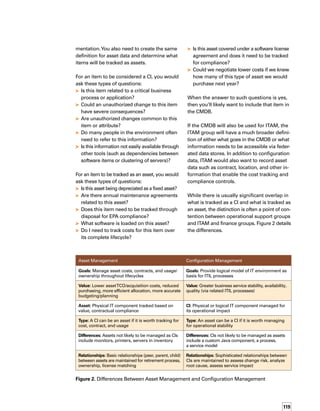
A Finer Point on CIs
I believe a better definition of a CI itself is quite
simply “A managed, specific object or element
in the IT environment.” A CI, by definition, is
under change control. A CI’s lifecycle, while it
may have stages, is also typically undefined in
terms of time — unlike a Project or Incident,
which are managed primarily in terms of progr-
ress through their lifecycles and ultimate closure.
Servers and applications can have Incidents
and Known Errors – but can a Contract?
That means that certain things are not CIs,
for example:
	 Events
	 Incidents
	 Requests for change
	 Projects
	 CI records (the representation is not
the object)
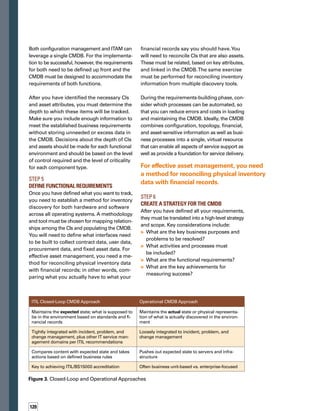
CIs should always be specific.“Oracle Financials,”
if present in the environment, would be a logical
CI, containing and using many physical CIs (e.g.,
software components and datastores). A Generi-
ic “Human Resource ManagementApplication”
as a reference category would not be a CI.
Figure 1. Detailed Configuration Item Taxonomy
Conceptual Model Inheritance
84
CIs have subtypes, and those subtypes in
turn can have subtypes. Figure 1 illustrates
one representation.
The major types of CIs are:
	 Base CI
	 Operational CI
	 Production CI
They are “nested,” which means that an Operat-
tional CI is also a base CI, and a Production CI
is also an Operational CI as well as a base CI
(Figure 2).
Configuration Item
Conceptual Model CI Subtypes
Operational CI
Production CI
Figure 2. CI Subtypes
Subtyping is often over-applied. An important
reason to subtype (in conceptual modeling) is
if a subtype can have a relationship in which the
parent does not participate. Figure 3 shows this
clearly: A Change can apply to any CI or subt-
type, a Measurement Definition can apply to an
Operational CI or a Production CI, and an Event
can only be associated with a Production CI.
These major types of CIs and their allowable
relationships are shown in Figure 4.
This is a simplified representation compared
to some industry standards; it is a conceptual
model seeking to concisely cover a broad
spectrum of IT concerns. It’s primarily about
refining language and concepts.The goal is not
technical precision, but rather resonance with
common industry usages, which overlap and
are not well delineated. It’s an attempt to push
common usage towards more rigor. It also
deliberately omits a number of technical asp-
pects that would ultimately be necessary to
realize a solution.
Note that there are other representations of
IT data, such as standards from the Object
Management Group (OMG), Distributed
ManagementTask Force (DMTF), andTele-
Management Forum (TMF).This article
represents a much simpler framework as
compared to these highly complex standards.
Types of Configuration Items
The base CI is the master category to which all
CIs belong. It is any “thing” in the IT environm-
ment that requires management (usually defined
as being under change control of some sort).
CIs have differing levels of involvement in day-
to-day service management and production
processes.The base level CI includes docum-
mentation and the definitions of service level
measurements, objectives, and agreements.
Any type of CI may be involved in an RFC;
however, change control for items that are
not Production CIs (i.e., Operational or Prod-
duction) may or may not be formalized. For
example, the service management group may
Conceptual Model CI
Figure 3. CI Subtypes and Key Relationships
85
Figure 4. Major CITypes, Supporting ITSM Entities, andTheir Allowable Relationships
define service offerings, or the asset managem-
ment group may add new assets, without going
through the highest-formality change processes
reserved for Production CIs.
CIs have differing levels of involvement
in day-to-day service management
and production processes.
An Operational CI is distinguished from the
other CI types (Document and Group) in that
it is involved in day-to-day business processes,
Configuration Item
Operational CI
Production CI
Deployed Object
Deployed Software System
Service
Document
Metadata
Contains Uses
1 * * *
Conceptual Model
Risk
Service Offering
Ordered Service
ContractAgreement
Deploy Point
Component Datastore
Assembly CI
Measurement
OS Instance (Server)
Machine
Application
Asset
Technology
Product
Business
Process
Strategy
Program
Release
Incident
Known Error
Change (RFC)
Project
Event
Problem
Service Request
Account
May tie to Configuration Item,
Program, Project, Service
Request, Service Offering,
Service, Asset, and Contract.
Other linkages possible
86
can be measured, and is a primary entity in
the Service Management workflow.
A Production CI, in turn, refines the concept of
Operational CI to include the core CIs that may
be involved in Incidents and have Known Errors.
(Think data center, or production workstation.)
Change control for production CIs is usually
a formal, high-visibility process that is what
most enterprise IT people think of when referr-
ring to “the change process.”
Logical and Physical CIs
CIs can be logical or physical.Top down versus
bottom up is another way to think of this dist-
tinction: logical are top down, physical are
bottom up.
Physical, in this case, means there is no ambig-
guity about the boundaries of the CI (even if
it is only transient bits on volatile storage).
Logical means that some consensus is required
to set the bounds of the CI. Applications (espec-
cially those built in-house), processes, and
services (in the service catalog sense) are the
best examples of logical CIs. Machines, comp-
ponents, files, and network-addressableWeb
Services are physical CIs. Managing logical
CIs is challenging and requires a clearly defined
process to establish the bounds of a potentially
blurry “thing.”
Partitioning the Data Model
There are few, if any, vendor products currently
on the market that cover the entire scope of
this conceptual data model. The IT organization
will therefore need to integrate two or more
products. These integration points can be
understood by simply drawing boxes around
the entities, representing systems of record,
and then observing where those boxes are
crossed by relationship lines — that is where
interfaces must be built.
For example, if service request management
is handled by a different system than service
Figure 5. Partitioning Data Across Systems
Service Request Management System
Service Management
System
may cause the initation of
Conceptual Model Partitioning
Ordered Service
Service Offering
Service
Request
Change
(RFC)
Problem
Incident
5tips
for 	
categorizing
configuration
items
management, some service requests may result
in formal requests for change (Figure 5).This,
in turn, requires some sort of interface between
the two systems to handle the relationship
between Service Request and Change.The
interface may be one of several types:
	 Service Requests requiring RFCs are autom-
matically moved from the Service Request
management system to the Service Managem-
ment system (automated interfaces can be
difficult to build).
	 Each Service Request is assigned an unamb-
biguous identifier, which is then manually
entered into the RFC system (potential for
human error).
	 The Change is created and its identifier is
manually entered into the Service Request
(again potential for human error).
If no cross-reference is created, the service
request is at risk if RFC approval is needed to
complete it.
The creation of data silos that do not interope-
erate is one of the most pervasive architectural
failures in modern IT systems, and we shouldn’t
add to the problem. Just remember that interf-
faces are expensive to build and run, so don’t
underestimate the cost of integrating several
best-in-class systems.
Bridging the Process Framew­
work and Technical Systems
Processes consume and produce data, which
is not some mere technicality that can be def-
ferred to vendors or developers. A proper data
analysis only starts here.The definition and
normalization of conceptual entity models,
representing a user’s universe of discourse,
is an essential part of any full process analysis,
and is a key bridge between the process framew-
work and the technical systems supporting it.  n
Charles Betz is a senior enterprise
architect for a Fortune 50 corporat­
tion. Previously, he was the head
of Enterprise Repository Services
forthespecialtyelectronicsretailer
BestBuy,andhasalsoworkedasan
IT architect for Target Corporation
and Accenture. He holds a Master
of Science in Software Engineering
from the University of Minnesota,
and is a frequent speaker at industry events. He is
the author of the www.erp4it.com weblog.
This article is an excerpt from the book Making Shoes
for the Cobbler’s Children: Using Architecture and
Patterns to Enable IT Governance, by Charles Betz,
copyright©2006MorganKaufmann.Allrightsreserved.
ABOUT THE AUTHOR
Keep CIs specific.
Avoid over-applying
subtypes. However,
subtypes are import-
tant if a subtype can
have a relationship in
which the parent does
not participate.
Remember that CIs —
base, Operational,
and Production —
have differing levels
of involvement in
day-to-day service
management and
production processes.
Think of logical CIs
as a top-down view.
Physical CIs are
bottom up.
Integrate products to
cover the entire scope
of this conceptual data
model, and don’t under-
estimate the cost of
integrating several
best-in-class systems.
The creation of data silos that do not interoperate
is one of the most pervasive architectural failures in
modern IT systems.
88
Mission:
By Val Sanford
Adopting a pragmatic approach to
gathering data can help you create an
effective CMDB. Use these guidelines
to overcome what might, at first, seem
like an impossible mission.
Possible
89
D
eploying a configuration management
database (CMDB) can be a complex
process that involves integrating inf-
formation, processes, and people into a single
cohesive system. Successful CMDB implement-
tations in today’s diverse IT environments
focus on optimizing the most critical services
that IT provides to the business.
However, even with a focus on key IT services,
you may still find it challenging to effectively
aggregate data from a wide variety of sources
in different formats.You must carefully identify,
collect, and rationalize the data before it can be
used effectively to operate your IT environment.
You may look at the obstacles and think this
is a Mission: Impossible. However, adopting
a pragmatic approach to gathering data can
help you achieve “Mission: Accomplished”
by creating a usable, effective CMDB solution.
Gathering the
Right Data in Your
CMDB to Optimize
IT Services
90
Your Mission, Should You
Choose to Accept It
Industry experts identify data gathering as one
of the first steps in successfully deploying
a CMDB solution.1
Taking this seemingly simple
first step depends on dozens of decisions that
must occur at both the organization and IT
operational levels. Understanding these decis-
sions, along with your organization’s priorities,
is a prerequisite to effective data gathering.
The data gathering process can be broken
into three key stages:
Data identification
Data collection
Data utilization and optimization
Proper planning is crucial in mitigating the ine-
evitable disruptions caused by the introduction
of any enterprisewide system. Maintain a cross-
functional planning team of IT and business
stakeholders to help you plan the CMDB implem-
mentation and evaluate it along the way.This
cross-functional team will help accommodate
business changes, ensuring that the CMDB
remains a current, effective tool that increases
your organization’s competitive advantage and
market value.
Avoid trying to migrate all of your systems to
the CMDB at the same time (it just may self-
destruct like the tape in the movie Mission:
Impossible). Get the most out of your implem-
mentation by selecting, as a starting point, one
service that IT provides to the business. After
the successful rollout of a limited CMDB implem-
mentation, you can use the expertise, planning
materials, and process you developed for the
first implementation to integrate other services
into your CMDB.
Remember that the primary data sources will
still be in place, and that you can migrate them
in stages, according to the priority of the busin-
ness services they support. By starting small,
your organization is likely to see results much
more quickly, thereby proving the value of


the CMDB and gaining support for it before
deploying it to the wider organization.
Data Identification
To avoid getting bogged down in terabytes of
data, narrow your focus to the data that support
the most critical services that IT provides to
the business.Think about the decisions your
organization makes and what data is required
to support those decisions. By focusing on
the data that supports the IT service you’ve
prioritized, you can more easily determine
which data types are critical and which are not.
You can then select specific data to integrate
into the CMDB, based on your organization’s
priorities. It is important to create a target list
that distinguishes between the key configur-
ration items (CIs) that belong in the CMDB itself
and the related or extended CI data, such as
Web response times, server availability, CPU
capacity, bandwidth utilization, database quer-
ries per second, and failed downloads. CIs are
physical, logical, or conceptual entities in your
environment and have configurable attributes,
while related CI data describes or defines CIs.
Questions to Ask During the
Data Identification Process
Potential data sources span your entire organiz-
zation, but the data must meet a specific set of
criteria to be included in the CMDB.You can
define these criteria by answering questions,
such as:
What services that IT provides to the busin-
ness, such as Web banking, inventory
management, or payroll, are most critical
to our organization?
Which applications and devices (collectively
called “elements”) support these critical


1.  Dennis Drogseth, “Analytics and the new structural approach to management,” NetworkWorld’s Network/Systems
Management Newsletter, January 30, 2006.
To avoid getting bogged down in terabytes of
data, narrow your focus to the data that support
the most critical services that IT provides to
the business.
services?Which of these elements should
we store as CIs in the CMDB?
What monitoring and management tools
update these CIs?
What specific data from each of these
tools needs to be provided to our CMDB
for each element?
Which elements should we consider ext-
tended CMDB data?
What are the relationships between our
CIs? How do we represent those relations-
ships in the CMDB?
Is all the data required to make business
decisions already being collected? If not,
what data is missing and how do we
collect it?
Is there complementary data in other syst-
tems? (For example, if one system reports
the status of a port, will another system rep-
port on the health of the server connected
to that port?)Which applications will subs-
scribe to the data available in the CMDB?
Data Collection
Once you’ve identified all of the data you want
to include in your CMDB, the next stage is to
collect that data. One of the first challenges
is determining the actual collection methods
available, since different tools provide different
data extraction methods. Options range from
using well-documented application programm-
ming interfaces (APIs) to usingWeb Services
data migration or homegrown scripts.You’ll
likely end up using a combination of methods
to accommodate all the data sources. Cross-
functional teamwork is just as crucial at this
stage, and is likely to include the administrators
of the tools that supply the data you’ve selected.
You’ll need to develop solutions and processes
that have no negative impact on either day-to-
day business operations or the CMDB project
itself. Data collection options must also be
compatible with network security protocols
set by your company, and you must predict
and manage capacity and performance issues.
As in the data identification phase, you must
answer several sets of questions in the data


Case Study: The Customer 
Support Web site
The following case study illustrates the data identt
tification stage of the data gathering process.
The customer support Web site is a top corporate
priority for Business X.The company has released
seven new products and has signed a dozen new
channel partners.To facilitate the successful rollout
of new products and partnerships, it is critical that
Business X’s customer supportWeb site provides relt
liable access to knowledge base articles, downloadat
able patches, documentation, and other resources.
Business X has assigned a cross-functional team to
define the data set for their CMDB. First, the team
must identify the applications that support the custt
tomer support Web site, including their customer
relationship management (CRM) system, trouble
ticketing system, content management system,
and Web portal application.The team must then
identify the elements that support these systems and
applications, including their primary and secondary
databases, servers, storage area networks (SANs),
firewalls, routers, switches, the LDAP server, and
e-mail servers. By identifying these elements, the
team determines the configuration items to include in
the CMDB and notes their relationships to each other.
Next, the team must identify the additional data
Business X needs from both its monitoring and
management tools. For example, Business X has
decided to gather the following data from its
monitoring tools:
Configuration files and settings
Fault and availability alerts
Performance metrics
Security and intrusion detection events
User-experience metrics
Finally, the team must use this identification process
for each type of data needed in the CMDB. By succt
cessfully identifying data their organization needs
to capture, the Business X cross-functional team is
taking the first step in ensuring a successful rollout
of a limited CMDB implementation.
•
•
•
•
•
91
92
collection stage. Pertinent questions involve
choosing tools, addressing data compatibility
issues, and choosing a data collection solution.
Choosing Tools
With so many potential sources of information
in many different formats, a tools audit can
help minimize network complexity, thereby
reducing the number of inputs into your CMDB.
Simplifying your network infrastructure also
has the benefits of improving efficiency, reduci-
ing costs, and ensuring the day-to-day stability
of the disparate systems in your heterogen-
neous environment.
Questions to ask about tools in the data collect-
tion stage include the following:
What data is available for use
by other systems?
What methods are available for extracting
that data?
Are there license restrictions on data
extraction that need to be addressed?
What teams are using the tool today
and how do they use it?
Will configuring the tool to send data
to the CMDB affect existing processes?
Even with the most efficient processes, you
need to think about the possibility of losing
some data when using tools to populate the
CMDB. Questions to ask about handling data
loss between tools and the CMDB include
the following:
What level of data loss is acceptable?
What actions can we take to deal with
data loss?
What impact will data loss have on the
applications that rely on that data?
Will processes need to change to accomm-
modate data loss?


Addressing Data
Compatibility Issues
In addition to resolving tool and data loss
issues, you must also address data compatib-
bility issues. Managing the translation or norm-
malization of data from source formats to
a format usable by the CMDB is one issue, but
there are other compatibility issues that need
to be addressed.
Establishing a Data Resolution Protocol for
reconciling data compatibility issues is critical
to the success of the project. A Data Resolution
Protocol is a hierarchical rule set that reflects
decisions made about how disparate data is
managed and valued.When establishing a Data
Resolution Protocol, use a Janusian2
approach:
Look at data from the bottom up, as well as
from the top down. In other words, consider
both the consumer and supplier points of view.
Questions to ask when developing a Data
Resolution Protocol include the following:
How often does the extended data need
to be collected? Daily? On demand? As
changes occur?
Does the age of the stored data have an
impact on its validity?
Are different systems reporting conflicting
information about a CI? If so, why? Does
one system get data automatically and
one get data by way of manual input?
Will weighting be applied to data based
on business needs, age, collection method,
or other factors?
Is duplicate data being collected? If so, how
should the redundant data be handled?


2  Rothenberg (1979) coined the term “Janusian thinking” (after Janus, the Roman god with two faces that looked in
opposite directions) to refer to thinking contradictory thoughts at the same time; i.e., conceiving two opposing ideas
to be true concurrently. Rex C. Mitchell, Ph.D. - StrategicThinking www.csun.edu/~hfmgt001/st-thinking.htm
When establishing a Data Resolution Protocol,
look at data from the bottom up, as well as
from the top down. In other words, consider
both the consumer and supplier points of view.
93
What are the rules for normalizing conf-
flicting semantics between data sources?
How are discrepancies in data flagged?
Choosing a Data
Collection Solution
Once stakeholders in your organization have
agreed to data selection requirements and
collection methodologies, the next logical
step is to perform a build-or-buy evaluation.
In some cases, organizations may decide to
create a data collection solution in-house.
However, there are off-the-shelf solutions availa-
able that may meet your needs. In either case,
involve your vendors early in the process and
set the expectation that they must work tog-
gether. Heterogeneous environments are more
efficient and effective when vendors cooperate
to deliver a system to you, the customer.
When considering which tools to buy or build,
include both practical and strategic needs.
Think about the rate of change in your infras-
structure — dynamic environments need
more flexibility than static ones.The size and
variety of your infrastructure is also a factor.
Be sure to think about both the short-term and
future needs of the company.
Possible requirements for a data collection
solution include the following:
Out-of-the-box support for the systems
with which you need to integrate
Bidirectional, multidirectional, or unidirect-
tional integration between tools
Support for both real-time
and batch collection


Use of existing standards
ISO or IT Infrastructure Library
(ITIL®
) certification
Rapid deployment, configuration, and
optimization to ensure quick ROI
Automated auditing to help meet
compliance efforts
Extendibility and low service costs
Automated data scrubbing to reconcile data
based on your Data Resolution Protocol
Data Utilization
and Optimization
The ultimate goal of any CMDB implementation
is to utilize the data in a way that optimizes your
organization’s IT infrastructure and decision-
making capabilities, and thus optimizes the
services you provide to the business. Once
you’ve completed the initial implementation of
your CMDB, it’s time to take a step back and
evaluate. Have you met your mission objective?
The evaluation process is twofold: First, rev-
view your objectives so you can measure your
progress and identify areas for improvement.
Second, determine whether you need to enh-
hance, enrich, or add to your initial data set so
you can optimize your business services.
Reviewing Your
Mission Objective
Dynamic environments offer limitless opport-
tunities for improvement. Comparing perform-
mance against your mission objective offers
you the opportunity to adjust your data set to
continue to support your organization’s most
critical business services.
Thinking about the objective of your mission
and the results you expected when implementi-
ing the CMDB will help your cross-functional
team think about ways to optimize the CMDB
implementation for improving the level of
service you provide to the business. If you’re


The ultimate goal of any CMDB implementation
is to utilize the data in a way that optimizes your
organization’s IT infrastructure and decision-
making capabilities, and thus optimizes the
services you provide to the business.
94
not getting the results you want, use your
mission statement as the basis of a decision-
making process to help you determine the
changes you need. Review your objectives,
measure results against those objectives, and
then review, optimize, and enhance your initial
data set.
Your mission objectives may include:
Reduce mean time to restore a service
Automate ticket opening
Automate prioritization of incidents
based on business needs
Improve root cause analysis
Improve service availability
Manage change by understanding priority
and service impact
Automate communication and approval
process for change requests
Predict outages and apply
pre-emptive actions
Support automated capacity planning
and on-demand computing
Improve service level management
Autogenerate accurate and timely reports
Link service level agreements
to IT components
Improve financial controls
Apply service-based cost allocation
of IT components
Determine total cost of ownership
on IT assets
Identify cost savings more easily

–
–
–

–
–
–
–

–
–

–
–
–
Reviewing the Initial Data
Set to Optimize I.T. Services
The initial data set may not provide all of the
information you need to make all of the imp-
portant business, operational, and technical
decisions for your organization. Changes in
your IT environment or business needs, whether
planned or unplanned, can affect data requirem-
ments.When you implement a CMDB, consider
incorporating an ongoing data assessment
process.Two useful steps in the assessment
are building use cases and defining an iterative
process for data evaluation.
Building use cases for additional data can help
you identify what might be missing. For example,
if your data collection tool receives a network
event from your enterprise management syst-
tem for a device that does not yet have a CI in
the CMDB, the collection tool could query the
enterprise management system for additional
data, create a CI in the CMDB, and populate the
CI with appropriate attributes, such as device
type, operating system, and so on.
The following iterative data collection process
can help set the stage for enriching and enhanci-
ing the initial data set you incorporated into
your CMDB:
Consider incorporating an ongoing data
assessment process.
5tips
for 	
gathering 	
data
For each service you provide to the busin-
ness and the elements associated with that
service, identify the conditions in which
additional data may be needed
Identify the source of that additional data
Identify the consumer of that data
Re-examine goals and objectives made in
the initial project and adjust as necessary
Establishing such an iterative data collection
process will help your CMDB evolve with
your organization, thereby accelerating your
ability to provide the most effective services
to the business.
Mission Accomplished:
An Effective CMDB
and Optimized Services
At each stage of the CMDB implementation
process, there are specific challenges your org-
ganization must overcome. Stringent managem-
ment of data requirements and scope, as well
as close collaboration with service and tool
vendors, can mitigate pain points throughout
the data selection and collection stages. More
importantly, performing the implementation
process in a pragmatic and iterative manner
will reduce costs, minimize disruption, and
ensure the successful adoption of any CMDB
initiative. And success in implementing your
CMDB is the first step to optimizing services
that IT provides to the business. n
1.
2.
3.
4.
ValSanfordisvicepresidentofpro­
ducts for Singlestep Technologies,
Inc.,aSeattle-basedsoftwarecomp­
panythatdevelopsdataintegration
and automation solutions. Prior to
Singlestep,Valservedasavicepre­
sidentatNetworkCommerce,Inc.,
and as a director at VersusLaw.
SheholdsaBachelorofArtsdegree
from Whitworth College.
ABOUT THE AUTHOR
Narrow your focus to
the data that support
the most critical serv-
vices that IT provides
to the business.
Distinguish between
the key CIs that
belong in the CMDB
itself and the related
or extended CI data.
Make sure your data
collection solutions
and processes have
no negative impact
on either day-to-day
business operations or
the CMDB project itself.
Review your objectives
so you can measure
your progress
and identify areas
for improvement.
Determine whether
you need to enhance,
enrich, or add to your
initial data set so you
can optimize your
business services.
Performing the implementation process in a
pragmatic and iterative manner will reduce
costs, minimize disruption, and ensure the
successful adoption of any CMDB initiative.
Business Service
Software
Hardware
96
T
he data in a configuration management
database (CMDB) can be divided into
three distinct layers: hardware, software,
and services. So, what does this have to do
with an Oreo®
cookie? Read on, and you will
see it’s not as far-fetched as it may at first seem.
Let’s start with the physical infrastructure —
the hardware assets. Switches, routers, servers,
frames, disks, supervisor cards, CPU cards,
power distribution units, cables, and even lapt-
tops, desktops, monitors, and printers make
up the foundation of the IT infrastructure. In
most cases, these components of the infrastruct-
ture are uniquely identified by serial numbers,
have asset tags, and can be seen physically.
Some hardware components plug into a chassis
or frame and are dependent on that parent
component to function. Software is installed on
the hardware components in the infrastructure.
Software installations cannot exist independentl-
ly of the hardware hosts on which they reside.
Technicians are dispatched to the location of
the hardware — not the software and certainly
not the business service.
The business service is enabled by hardware
and software.The business service is logical
in nature.There are no real tangible facets of
the business service. A business service does
not have a serial number, weight, color, width,
length, or height. Business services cannot be
physically moved, they are not purchased as
a whole, and they are not physically installed
or uninstalled.
The hardware components and the
business service are the two chocolate
wafers of the Oreo cookie, and
software is the filling that holds the
wafers together.
Services, Software,
and Hardware CIs: 	
Just Like an
Oreo®
Cookie
By Jonathan Markworth
The CMDB is the cookie jar for the Oreo®
cookies that represent your
business systems. Business services and hardware components are
the two chocolate wafers, and software is the filling that holds the
wafers together.
1.  Oreo is a registered trademark of Kraft Foods.
!
97
98
Software is installed on hardware and is most
likely to be recognized as connected to the busin-
ness service. Users often report issues to the
service desk by referencing software by name.
Software installations reside on hardware
assets — the router, server, laptop, or deskt-
top. Operating systems, which are also softw-
ware installations, define a group of hardware
components as a host. Application software
is installed into the operating system and,
once operational, is able to provide the busin-
ness service.
When you combine these three layers in the
CMDB, the hardware components and the
business service are the two chocolate wafers
of the Oreo cookie, and software is the filling
that holds the wafers together.
CMDB: The I.T. Cookie Jar
I have been asked, “What is the right way to
implement a CMDB?” The consultant’s standard
answer is, “It depends.” But a few important
guidelines can help you determine the best
way to proceed.
First, and most importantly, have a clear unders-
standing of the business need for the CMDB.
What problem is the CMDB going to solve?
If you are implementing the IT Infrastructure
Library (ITIL®
) framework by the book, then
the CMDB is mandatory — change impact
assessments and configuration baselines used
during release management both depend on
the existence of a CMDB.
Beyond satisfying an ITIL requirement, look
at the CMDB as the single source of truth for
describing your IT infrastructure — much the
same way as a production manager would look
at a schematic describing a manufacturing
line. For the production manager, the business
issue is simple. Optimizing production requires
a complete understanding of the components
and their relationships that make up a complex
production system.
Perhaps over-simplified, the manufacturing line
here is like one of the cookies in the factory
cookie jar. For the CIO, a business system —
such as accounting, enterprise resource
planning (ERP), customer relationship managem-
ment (CRM), or even e-mail — can be looked
at as a cookie in the IT cookie jar.
Second, try not to eat the whole jar of cookies
at one sitting. I suppose all our mothers would
probably agree that this is good advice. But if
you think about it, the stomachache you would
get eating a whole jar of cookies in one sitting
is very similar to the feeling organizations can
get when trying to tackle all the configuration
items (CIs) for all business services in the CMDB
across the entire enterprise in one giant step.
A better approach would be to rank your
business services by importance, financial
impact, and criticality, and then fill in the
CMDB data — the services, software, and
hardware — for a few of those business serv-
vices at a time.Yes, you will make mistakes
in modeling the CIs and CI relationships in the
CMDB.Yes, you will need to make adjustments
along the way. But if you really thought that
you wouldn’t need to change the orientation
of the CMDB sometime during the next ten
years due to a radical change in infrastructure
or business orientation … well then, I think you
get my point.
Filling the CMDB one cookie at a time will dec-
crease the time it takes to demonstrate the
successful use of the CMDB and will provide
the traction needed for your configuration
management program to mature. Biting off
more than you can chew or stuffing your mouth
with too many cookies will only cause probl-
lems. It may even cause the business to lose
interest and completely eliminate the funding
you need to continue this effort.
Finally, don’t get too caught up in the right way
to eat an Oreo cookie. How do you eat an Oreo
cookie? Do you eat the whole cookie, unscrew
5tips
for filling 	
the CMDB	
cookie car
the wafers, eat the wafers first, or eat the filling
first? Does it really matter?
My point is this: If you have a rock-solid softw-
ware asset management process in place where
compliance is continually measured, then eat
the center first (i.e., populate the CMDB with
your software data and ensure you have the
level of data and interfaces needed to support
the operational processes you are focusing on).
If you have mature hardware asset managem-
ment with an audited, verified, complete, and
accurate hardware inventory, then eat one of
the chocolate wafers first. If you have neither,
but are getting hammered by the business
need for transparency between its services
and how IT aligns to these services, then
perhaps eating the other wafer might be
the best approach.
Your method of filling the CMDB is less imp-
portant than your understanding that the CIs
are not complete until all three layers are re­
presented — just as the Oreo cookie is not
complete without the two chocolate wafers
and the creamy filling.
Bring Enough to Share
A CMDB implementation is successful when
all interested and concerned parties consider
your CMDB the single source of truth for the
IT infrastructure. It doesn’t mean all of the data
is stored in one place. But it does mean that
when a new infrastructure component is added
to the environment through change and release
management, the workflow includes more than
just the IT organization. Finance, contracts,
asset management, and other business groups
should be included in the process flow.
Don’t underestimate the importance of any ass-
sistance that can be provided by mature asset,
contract, and inventory management practices
that may already exist in your environment.
Contract and asset management are sources
of funding for your CMDB. A mature asset inv-
ventory can be used to seed the CMDB or even
extend the CMDB through federation. Some
IT asset management staff resources and exp-
pertise in maintaining inventories should be
involved or even own the ongoing maintenance
of the CMDB hardware and software inventory.
I think it is even more important to consider the
financial impact of including contract managem-
ment in the change management process.
Most contracts require 60 to 90 days of notice
before removing a line item from the schedule.
How much can be saved by leveraging the forw-
ward schedule of changes in this situation?
Bring enough to share. Remember that the
deployment of a CMDB will require resources.
If your CMDB is going to be more than just
a database that stores electronic inventory
records, you will need the support of the busin-
ness to commit to a formal configuration
management program. Leverage the CI and
its federation to other business data, and
build around your CMDB the processs flows
that make the business more efficient. n
If you have a complete and
accurate hardware inventory,
a mature software asset
management discipline,
and/or a recent business
impact assessment that
describes your critical
business services, then
make use of them.
Make it easy on the people
who need to be involved
in both configuration and
asset management activities
by defining workflows and
work instructions that
accommodate both.
Define complementary
processes — those that
seamlessly transcend
disciplinary boundaries —
instead of loading more
administrative responsibility
an an already strained staff.
Keep in mind that it’s
unlikely that automated
tools will completely replace
the need for disciplined
lifecycle processes.
Pick one or two mission-
critical business services to
get started. It’s better to pick
one area of the business
and build on success than
fail to deliver any value.
JonathanMarkworthisamanaging
consultant with CompuCom
Systems, Inc. , headquartered
in Dallas, Texas. Jonathan has
successfully performed a variety
offunctionsintheITindustryduring
the last 20 years. He is certified in
ITILandSixSigma,andisacertified
Project Management Professional
(PMP).AspartofCompuCom’sIntegratedInfrastructure
Management practice, Jonathan and the CompuCom
CenterofExcellenceteamareresponsiblefordeploying
effectivesolutionsforchange,configuration,release,
and asset management.
ABOUT THE AUTHOR
A CMDB implementation is successful
when all interested and concerned
parties consider your CMDB the single
source of truth for the IT infrastructure.
100
Capabilities
enabledbyACMDB
101
Section 2  Capabilities enabled by A CMDB
“To provide real value in managing
a changing infrastructure, you must identify
the interdepencies between components.”
—	Hans-Heinz Wisotzky, MATERNA GmbH
Information  Communications
“The configuration management
process and the CMDB together create
the foundation where components,
systems, and configurations are brought
together and understood.”
—	Perry Sellars, Strategic Technologies
“The federated approach allows you
to store a subset of critical data for all
processes in the CMDB with “pointers”
to data stores for less critical information.”
—	Julie Manis, Accenture
“Implementing a CMDB along with an
integrated set of tools provides companies
a competitive advantage that enables IT
organizations to not only respond to the
needs of the business, but to proactively
support the business.”
—	Kia Behnia, BMC Software
“Integrating the CMDB with sources
of identity information enables you
to include in the CMDB information
about the relationships of people to
the IT infrastructure.”
—	Ahmad Abdel-Wahed, Microsoft, 	
and Bob Worner, BMC Software
“When information is federated between
a centralized CMDB and various other
applications that help you manage
functional processes, the consumers
and users of vast quantities of data are
brought together.”
—	Kevin Behr, Gene Kim, and George Spafford,
IT Process Institute
“Implementing an integrated service
management tool supported by a CMDB
is a critical success factor in supporting an
effective IT service management initiative.”
—	Troy DuMoulin, Pink Elephant
“Integrating network configuration
management information into your CMDB
will help you integrate the network layer
into your overall IT service model and better
align IT service delivery to business needs.”
—	Jeff Gibson, Voyence
“The CMDB should include data about
the relationship of an event to the business
customers who rely on a service, as well
as the relationship of an event to the
personnel required to resolve it.”
—	Troy McAlpin, Invoq Systems
“By having business processes defined
in the CMDB, the IT organization will
now have increased visibility into
the business.”
—	Devesh Sharma, Oracle
142
108 150
124
116
128
134
156
160
102
102
Management:
Thekeytoa  
Infrastructure
PicturePerfect
When a CMDB is the
centerpiece of your
change management
process, you can 	
more efficiently and
accurately change
your IT infrastructure 	
to meet business needs.
By Hans-Heinz Wisotzky
Change
103
104
Y
our company’s IT infrastructure is in
a constant state of change: new techn-
nologies, new business models, and
changed work processes demand continual
adjustments to the technology. To react quickly
to the changing market situations and the
resulting requirements of the business, you
must implement changes to the IT infrastructure
speedily and smoothly. Any delay can impede,
or even paralyze, critical business processes.
The real challenge is striking the
right balance between agility
and control.
Nonetheless, changes must also be controlled.
Hastily planned and implemented changes
can do more harm than good. In fact, some
market observers assert that up to 80 percent
of all IT problems are caused by unauthorized
or insufficiently controlled changes.Those
outages impact the critical business processes
that rely on IT.
The real challenge is striking the right balance
between agility and control.This balance is
found in the interplay between the people that
make changes, the processes they follow, and
the data and tools that support those processes.
Well-engineered processes provide other
benefits as well. One benefit is that making
changes to IT infrastructure is now “in scope”
for a range of government regulations. Ano-
other benefit is overall IT efficiency.While IT
capital budgets are flat, businesses nonethel-
less expect IT to support new strategic initiat-
tives.Your IT organization is not operating at
peak efficiency if hastily implemented changes
cause failures that result in expensive and
labor-intensive repairs. Many IT organizations
find that once they get better control of changes,
they can squeeze budget out of operations
to fund new initiatives.
LookBeyondAssetManagement
One of the central problems in striking the
right balance between agility and control is
that many companies don’t understand what
their infrastructure looks like, what it should
look like, and how the individual components
affect each other. Nearly all IT service providers
perform inventory and asset management,
and both of these instruments provide a picture
of the infrastructure.
However, neither provides an infrastructure
view with enough detail to provide value to
operations managers. Servers, clients, or app-
plications can be traced and registered during
the inventory process. But pure inventory
management is not in a position to differentiate
between “good and evil,” or in other words,
between authorized and non-authorized
changes to the inventory. It only provides
a single snapshot, which shifts out of focus
as the infrastructure changes.
To provide real value in managing a changing
infrastructure, you must identify the interdep-
pendencies between components. Asset
management doesn’t care how the elements
are interconnected to provide an IT service, nor
does it focus on how a change can affect the
whole infrastructure. Understanding the current
state of the infrastructure helps you to reduce
the risk of each change and helps you to inc-
crease the success of implementing changes.
Sharpen the Focus with
Configuration Management
and the CMDB
Configuration management will help you
extend asset management with information
about the interdependencies between infras-
structure elements.This will give you a sharply
To provide real value in managing a changing
infrastructure, you must identify the inter-
dependencies between components.
105
focused picture of the operating state of
components. Configuration management is
concerned with the target status of the IT
infrastructure. It also forms an important
interface for all IT service processes within
the relevant frameworks, such as the IT
Infrastructure Library (ITIL®
).
The key element behind configuration mana-
agement is the configuration management
database (CMDB), a repository that ideally
mirrors the actual current target situation of
the IT infrastructure. In many companies,
confusion exists when configuration managem-
ment and asset management are not clearly
separated from each other.These companies
operate configuration management solely on
the basis of data from asset management —
which is not a particularly healthy situation.
For example, if you are implementing ITIL
best practices, you can use asset management
data as a starting point for configuration
management, but you can’t simply take asset
management data and use it for configurat-
tion management.
Understanding the current state of the
infrastructure helps you to reduce the risk
of each change and helps you to increase
the success of implementing changes.
Similarly, the real value of the CMDB emerges
when it is seen as a resource for IT service
management. In fact, all IT service processes
described in ITIL can benefit from the CMDB,
including change management. Not only are
the individual configuration items (CIs) maint-
tained in the CMDB, but so are their status and
relationship to other CIs.
With a CMDB, you can completely assess
the results of any upcoming changes: which
components will be influenced by a change,
which connections have to be taken into cons-
sideration, and which business processes
are affected.
Compose a Clear Picture with
Change Management
Every step in a change request can and should
be closely interconnected with the underlying
CMDB. Ideally, as soon as a request for change
(RFC) is received in the change management
process, it should be analyzed with information
about the CI in the CMDB to get an immediate
view as to whether the change is feasible.
During prioritization, planning, and implem-
mentation of RFCs, the logical target status
description supplies valuable data for decision-
making, as well. By using the CI relationships
that are mapped there, you can recognize
potential problems or conflicts early in every
project phase, well before there are effects
on productive systems, and thus, on users’
work processes.
This early identification provides you an
excellent method of keeping service quality
at a high level for the customer.The benefits
are obvious:You avoid failures due to unsucc-
cessful changes, and you simultaneously
reduce the time from RFC submission to
106
making a decision and implementation.
This enables you to quickly and successfully
implement changes without losing control.
When a change is successfully implemented,
each change to existing or newly acquired CIs
is documented in the CMDB.
When designing change manage-
ment processes, always take into
account information from the CMDB.
The CMDB serves as an important basis for
change management in other ways, as well.
It provides a suitable starting point when
processes in change management have to
be redesigned and regulated within your IT
organization. For example, you can use the
CMDB when introducing standardized ITIL-
compatible IT service processes to make them
traceable and free them from fault sources.
When designing change management proc-
cesses, always take into account information
from the CMDB.This will achieve two object-
tives: The change process can be partly autom-
mated by means of clear work steps, and
the standardized procedure facilitates the
search for faults when problems arise.
Avoid Out-of-Focus
Images Through Ongoing
CMDB Maintenance
Even with integrated change management,
you still need to perform maintenance on
the CMDB to ensure that the quality of the
infrastructure picture remains sharp.The gap
between the target and current status of the
IT infrastructure is ever widening, primarily
as a result of users who, on their own, install
programs and adapt their PCs or field service
notebooks. A CMDB can be out-of-date in just
two hours; you’ll need to keep the current
status up to date through regular audits, and
then compare the current status with the CMDB’s
target status.
With the appropriate tools, the audit can be
carried out automatically in many cases. Here’s
the difficult part: The audit will likely uncover
rogue changes that do not reconcile with CI
data in the CMDB.You’ll need to decide which
of those rogue changes should be updated
in the CMDB and which rogue changes should
be removed as quickly as possible.You can’t
really automate this much, since many of the
decisions have to be made and carried out by
a member of the IT staff.
In any case, you’ll need to ensure that all
changes to the infrastructure flow back into
the CMDB as updates to related CIs, as this is
the only way to ensure that the CMDB always
mirrors the current status. If the current status
deviates from CI information in the CMDB, you’ll
find yourself looking at an out-of-focus image.
Capture the Perfect Picture
A picture perfect infrastructure is within your
reach. Use asset management as a starting
point, and build upon asset management
data to effectively map your configurations.
Populate your CMDB with the configuration
data, and use the CMDB to determine the
feasibility of each proposed change before
moving forward with the change.The result
will be fewer, if any, failed changes, resulting
in less disruption to the business, and ultimately,
better service to the business you support. n
Hans-Heinz Wisotzky is vice
president of the Competence
Center Service Management at
MATERNA GmbH Information
 Communications, an IT service
provider. His main interests are
Business Service Management,
IT Service Management, and ITIL.
ABOUT THE AUTHOR
Use the CMDB to determine the feasibility of
each proposed change before moving forward
with the change.
5tips
for efficient 
change 	
management 
using a cmdb
Use asset
management data
as a starting point
for configuration
management.
Identify the
interdependencies
between components.
Use the CMDB
to determine the
feasibility of each prop-
posed change before
moving forward with
the change.
When designing
change management
processes, always
take into account
information from
the CMDB.
Maintain the CMDB
and ensure that all
changes to the infras-
structure flow back
into the CMDB as
updates to related CIs.
108
The CMDB is more than a static repository
of information. It is an integral part of the
configuration management (CM) process,
providing the foundation for other IT processes
that enable the delivery of business services.
When you start your CMDB project, make
sure CM is part of the equation.
Remember
By Perry Sellars
“CM”
in CMDB
the
109
C
reating a configuration management
database (CMDB) and loading con­
figuration item (CI) data into it takes
a significant amount of time. But don’t stop
after you’ve populated the CMDB. Although
you’ll have an accurate snapshot of the inf-
frastructure at that moment, you’ll lose the
reliability of the CMDB information after just
one undocumented change. Ongoing control
and management of your IT infrastructure
requires a process that is both owned and
improved over time.
The CMDB is not the end point or nirvana
of a configuration management process im­
plementation. An accurate CMDB provides
component or configuration information to
other service management processes; that is,
change management (effective impact analys-
sis) and incident and problem management
(event correlation).This interdependency
places configuration management as the
foundational element in an effective service
management strategy.
The CMDB provides common infor-
mation and a shared view of the IT
infrastructure, including information
about each infrastructure component.
The CMDB enables you to share critical inform-
mation across the IT organization. However,
to create value, you must integrate the CMDB
at two levels. First, you need to integrate the
CMDB with other IT service support and serv-
vice delivery functions.The CMDB provides
common information and a shared view of the
IT infrastructure, including information about
each infrastructure component: its function,
operating state, history, and relationship to
other components. Access to this information
allows IT functions to work together, enabling
end-to-end service management.
Second, you need to identify the linkages or
relationships that exist between IT services
and infrastructure and the business functions
110
they support. From accounting to order proc-
cessing to customer relationship building, IT
enables business functions.To make basic cost-
versus-risk decisions and resource allocation
determinations, IT needs information about
what business function is supported by an IT
service or component.
An effective configuration management proc-
cess can help you integrate IT with the service
provided to the business. Configuration mana-
agement also helps you to build and maintain
an accurate and relevant CMDB.
Why You Need Configuration
Management with a CMDB
When you set up your CMDB, make sure conf-
figuration management is part of the process.
Configuration management includes a variety
of functions:
Planning. Define the process and decide how
your organization will implement configuration
management. Planning includes the strategy,
policies, scope, and objectives, as well as organi­
zation roles and responsibilities.Thoughtful
planning provides a sound foundation from
which to maintain a manageable and cont-
trollable CMDB. Many organizations hurry
through this very important activity and end
up with a CMDB that lacks supporting configu­
ration management processes, resulting in an
unmanageable and soon to be out-of-date datab-
base filled with unusable and inaccurate data.
Identification. Break down and uniquely define
the infrastructure components or configuration
items. A minimum set of identification inform-
mation includes owner, dependency relations-
ships, basic attribute data, and revision or
version number. Identification enables you to
control, record, and report configuration items
to the level the business requires. As a rough
Asset vs. 	
Configuration 	
Management
It’s important to distinguish between configurt
ration and asset management.Typically, IT
Operations directs the CMDB and the configut
uration management process, which is focused
on proper function of the IT infrastructure.
Procurement or Finance directs asset managemt
ment, which is focused on financial accounting
of IT capital assets.
Asset management is concerned with details
such as:When did we acquire the asset? How
much did it cost? Is there an asset tag on it?
What’s the depreciation level? If it is an IT
component in production but not considered
a capital asset, it is no longer tracked by asset
management.Additionally, if it is in production,
but fully depreciated and not considered for
property tax, it’s no longer tracked.
Configuration management, on the other hand,
is more concerned with questions such as:
Who is using this particular configuration item
or component?What service is this component
a part of, and what business function does it
support? Is it a single point of failure?What
is the service-pack level of this component?
If you are using the CMDB only to control
components from an asset perspective, then
you are not utilizing the CMDB to its fullest
potential. Use configuration management
to unleash the power of the CMDB — to help
IT track important configuration information,
and ultimately, to explain to business partners
how a particular component is critical to a
business service.
An effective configuration management
process can help you integrate IT with the
service provided to the business.
111
Figure 1. IT Service Support and Benefits of Integrated Practices
guide, identify components or CIs to the lowest
level of independent change.
Control. Establish guidelines to record and
maintain only authorized and identifiable CIs
in the CMDB.You’ll want to identify processes
that update CI data, such as change managem-
ment, discovery, and reconciliation, as well as
people authorized to modify CI data directly.
This activity ensures the data integrity of the
CMDB to enable meaningful impact analysis,
event and problem correlation, and service
continuity planning.
Status accounting. Perform the all-important
management reporting activity. For all CIs under
control in the CMDB, you need to track changes
to CIs and make sure records are traceable.
Status data should include the current vers-
sion or revision number, the functional status
(development, testing, production, retired) of
the CI, and its change history. Status reports
can establish baselines prior to major change
events or releases into the infrastructure, and
can help reduce investigation time for incident
and problem management. Status reports
can serve as the snapshot in time if a fallback
is required.
Verification and audit. Review the CI data in
the CMDB and verify the effectiveness of the
configuration management process that is
responsible for maintaining accurate data.
If the results of scheduled or random audits
are published and reviewed at department
meetings, the entire organization can share
a sense of responsibility for maintaining an
accurate CMDB.
Function Challenge as standalone practice Benefits of integrated practice
Service Desk
and Incident
Management
Service Desk doesn’t have critical
information to quickly and efficiently
process the request, creating an
extended outage while researching.
With information about the state, history, and
configuration of the infrastructure component
of the service in question, the service desk is
more efficient and effective.
Problem
Management
80 percent of problems are related
to a recent change.
Access to change history for the failed component
and other dependent components helps quickly
identify the root cause of failure. Event correlation
is made possible through correctly identified CIs
and the ability to match common incidents.
Change
Management
Making a change without
a risk assessment can lead
to unplanned outages.
Knowing the success rate of past similar changes,
what other infrastructure is dependent on the comp­
ponent about to be changed, and which business
users rely on the component significantly improves
the change success rate.
Release
Management
and Software
Control and
Distribution
Releasing a software or operating
system patch to an unknown
configuration is risky.
Full knowledge of the hardware, software, and
settings of a component improves the release
process and provides a way to quickly understand
the patch level of the infrastructure.
112
Configuration Management
Establishes the Foundational
Process for More Effective I.T.
Service Support
Service support ensures that your customers
have access to appropriate IT services that
enable their business function.The service desk
is a key part of your service support strategy,
because it provides your IT organization’s face
to the customer. Service support processes
help you deliver high-quality service, enabling
consistent availability of the applications that
customers want and more immediate response
time to failures if they occur. Without confi­
guration management, these service support
functions cost more and deliver less value
since you must repeat steps to solicit or hunt
down component information.
Figure 1 on page 111 shows the functions of IT
service support, the challenges of implementing
each function as a standalone process, and
the benefits of integrating the function with
configuration management.
Service support processes help you deliver high-
quality service, enabling consistent availability of
the applications that customers want and more
immediate response time to failures.
Service support processes are more effective
when they have accurate component-level
information. However, these processes require
access to information created in many places
and functions within IT. Consolidating all of this
information in a single CMDB enables faster
resolution of problems, higher success rates
for changes, and fewer unplanned outages.
You’ll likely have happier customers, as you’re
more likely to achieve higher service levels, and
you’ll also reduce the labor required to continu-
ually hunt down component-level information.
Figure 2. IT Service Delivery and Benefits of Integrated Practices
Function Challenge as standalone practice Benefits of integrated practice
Service Level
Management (SLM)
Service level agreements related
to individual components limit
effectiveness of SLM.
Nested service levels all relating back to
an IT service or business function provide
an integrated view that is increasingly
demanded by business budget owners.
Capacity
Management
Capacity management of silos is
increasinglyrecognizedasinsufficient.
Composite capacity management of
a collection of infrastructure components
enables support of critical business services.
Service Continuity
Management
Continuity management often misses
critical elements that render the
partial plan insufficient to respond
to an actual crisis.
An entire picture of all components and users
of a critical business service enables effective
continuity planning.
Availability
Management
Availability of a server or application
in isolation is meaningless to
a business user.
End-to-end availability management delivers
on a basic business user requirement.
Financial
Management,
not just Asset
Management
Financial management of individual
assets meets accounting requirem­
ments but does not enable strategic
decision-making.
Financial management and understanding
of service costs help IT make cost vs.
benefit and resource allocation decisions
that deliver competitive advantage.
113
Configuration Management
Enables More Effective I.T.
Service Delivery Functions
Service delivery ensures consistent operation
of the IT infrastructure upon which the busin-
ness depends.With an effective and accurate
CMDB, you can greatly enhance important
service delivery functions, such as service
level management, service continuity, and
capacity management.
Figure 2 shows the functions of IT service de­
livery, the challenges of implementing each
function as a standalone process, and the
benefits of integrating the function with conf-
figuration management.
Many service delivery functions cannot succeed
without accurate configuration information.
However, this information is created in a broad
range of places and functions within IT. Consoli­
dating all of the information in a single CMDB
enables systems-level capacity and availability
management, continuity and risk planning,
and better overall financial management of IT
resources.You also can more effectively utilize
scarce IT resources to improve service levels
and service quality. As a result, you can spend
less on IT back-office functions and more on
new strategic initiatives to better deliver service.
Configuration Management
Enables Control of Critical
Business Functions
When you undertake an initiative to implement
a CMDB and configuration management, begin
by examining the services provided by IT to
the business.Take a top-down view, rather than
Figure 3. Mapping Business Process to Configuration Items
Document
Business Process
Internal
External
Archival
GL
AP
AR
Orders
Procurement
Service
Determine
Workflow
Communication
Customer
Portal
Identify
Services
Map to IT
Infrastructure
FSC
2 node Oracle RAC
Storage Foundation for Oracle RAC Storage Foundation for Oracle RAC
v210 Infra v210 Infrav210 Infra
v440
app DBs
v210
web and midVVR
F12K-dmd
app DBs
F12K-dme
app DBs
v210
mid
v210
web
v210
web
v210
mid
6 Node VCS Cluster 2 Node VCS Cluster
1 node Oracle RAC
TCA
E-mail
SAP
Oracle
Apps
Business Impact Service Definition Service Continuity Disaster Recovery
Finance
Storage Foundation HA
Oracle Enterprise Agent for VCS
Custom Agents for VCS
(including PECS, FDM, IMS,
BID, MedForms, PTO)
GLOBAL CLUSTER OPTION
ORACLE DATA GUARD
With an effective and accurate CMDB,
you can greatly enhance important service
delivery functions.
114
a bottom-up or component-level-up view. Start
with your most critical business services —
maybe two or three — and focus your efforts
on the components that make up those services.
Consider e-mail, for example. Just like picking
up the phone and receiving a dial tone, e-mail
is a critical communication link for most comp-
panies. In fact, some organizations are almost
completely shut down by e-mail outages,
resulting in lost revenue and customer diss-
satisfaction.Therefore, to ensure that you keep
this critical service up and running, you’ll want
to break down the service into configurations
and CIs. Figure 3 on the previous page illust-
trates the mapping of a business service to CIs.
When your CMDB houses information about
a service and its components, the information
is readily available to various IT functions, there­
by improving the efficiency and effectiveness
of those functions. Some examples follow:
Change management. Suppose Microsoft
releases a new version of Outlook or a patch
for Outlook.You may have 20 Exchange servers
in your organization at different service pack
levels. If you don’t have a CMDB that’s up to
date, how do you know which servers this next
service pack affects? Using the “patch and
pray” approach to determining what servers
need the service pack is not appropriate for
business-critical functions such as e-mail.
With an effective configuration management
process, you can interrogate the CMDB and
learn that the service pack is required on ser­
vers one, two, three, and four, but does not
apply to any other servers because they were
already updated.
Additionally, an effective change management
process, coupled with an effective CMDB, allows
you to evaluate the impact that taking down
these servers will have on your business cust-
tomers.You can perform a risk assessment by
looking at the compatibility of this service pack
with any others previously applied.
Release management. When you release the
service pack to the identified servers, are you
going to do a delta release or a package release?
By using the data in the CMDB, you can det-
termine whether applying a package release
will have a low impact and risk.Without effect-
tive configuration management, you end up
with a spot check.
You might apply the release on one server
with the intent that if it doesn’t fail for a month,
you’ll apply it to the rest of the environment,
whether it’s needed or not. If it fails, something
specific to that one server may have caused
the failure. In other words, it may not have
failed on any of the other 20 servers because
they don’t have that same issue.Those other
20 servers could be the ones that are running
an application for the majority of the business
users. Perhaps the server that failed is used
only by the development organization.The
other 20 servers could fail, too, but you just
don’t know when that’s going to happen.
The CMDB makes release management
much more efficient and effective.
When your CMDB houses information about
a service and its components, the information
is readily available to various IT functions.
5tips
for ensuring 
cm is part of 
your cmdb
Incident management. If the server goes down
and Outlook fails, your incident management
process identifies the failing CIs. A customer
can open an incident with the service desk.
You know an Exchange server went down, but
you can’t tell which one.You identify a patch
to resolve the problem. Again, how do you
determine which servers this patch applies to?
Do you apply it just to the one that’s down?
Or do you interrogate the CMDB so you can
apply the patch to other servers that haven’t
failed yet, allowing you to proactively take
care of this incident and keep another failure
from occurring?
If you have used a CMDB to identify and control
what version of Outlook you’re running, you
have the information at your fingertips.You
don’t need to physically check every server.
That easily leads you to a request for change:
You need to apply service pack ABC to servers
one, two, three, four, and five.
Continuity management. Suppose a company
has a business continuity plan that lets the IT
team move their operations from point A to
point B, but they can’t move the connection
to their customers from point A to point B. If
a disaster occurred, their customers would not
be able to connect to the alternate site. How
would business continue in this case?
The configuration management
process and the CMDB together
create the foundation where com-
ponents, systems, and configurations
are brought together and understood.
An effective configuration management process
will help identify such gaps.When approaching
service continuity management, first identify
your business services, breaking them down
into IT environments or configurations.These
can then be further divided into components
or configuration items. Is this starting to
sound familiar?
If the company in this example had an effective
configuration management process, it
would have identified the users of that service.
Then it would have identified the infras-
structure that provides user connectivity for
that service and noticed that it was missing
from the service continuity plan.
CMDB Sets Foundation
for Knowledge
The configuration management process and the
CMDB together create the foundation where
components, systems, and configurations are
brought together and understood. As a result,
IT knows the pertinent details about each CI
important to a particular service provided to
the business. Such knowledge enables you
to more efficiently and effectively provide IT
service support and IT service delivery.You can
save time and money, and focus on new strat-
tegic initiatives that facilitate business services. n
Perry Sellars, a consultant with
Strategic Technologies, is a publ­
lished author, featured speaker,
ITIL Certified Master, and an ISEB
accreditedITILtutor.Hehas23years
of experience in IT, system, and
networkmanagement,andhascond­
ducted ITIL maturity assessments
and implementation consulting
for customers since 1996. Perry may be contacted at
perry.sellars@stratech.com.
ABOUT THE AUTHOR
Establish the
vision — why the
organization is
making a commitm-
ment to service
management.
Start with the
service and identify
the infrastructure
components or CIs
that are part of
the service.
Record and maintain
only authorized
and identifiable
CIs in the CMDB.
Track changes
to CIs and make
sure records
are traceable.
Review CI data in the
CMDB and verify
effectiveness of
the configuration
management proc-
cess responsible
for maintaining
accurate data.
116
Facilitating Effective
I.T. Asset Management 	
with the CMDB:
A Nine-Step Approach
117
A
well-designed configuration manage­
ment database (CMDB) can provide
business value in multiple ways. Many
organizations deploy a CMDB not only to enable
configuration, change, and release managem-
ment, but also to facilitate more effective IT
asset management (ITAM) and cost controls.
In this article, I’ll walk you through nine steps
to achieving additional business value from
your CMDB by leveraging it as the foundation
for effective asset management. Figure 1 outl-
lines the steps.
Step 1	
Define the Purpose of the CMDB
Start by defining a purpose that relates to your
business goals and how the CMDB will add
value to the business.The functions the CMDB
will serve, the benefits to be derived, and the
metrics and measurements of success should
be defined and prioritized in the first stage of
planning the project.
Many organizations initiate an ITAM program
to control and manage the total cost of owner­
ship (TCO) for IT assets over their lifecycle.The
aim of ITAM is to align technology investments
with business objectives to derive optimal
value. Additional value can be gained by broa­d­
ening the scope and purpose of the CMDB
to include ITAM functions. A central repository
for asset data has many of the same data ele­
ments as a CMDB. By designing your CMDB
to include asset data in addition to configur-
ration data, the CMDB can be leveraged by
multiple IT service processes and can be used
to control theTCO for assets, delivering addit-
tional value to the organization.
A traditional CMDB contains information on
the relationships between configuration items
(CIs). Often, these CIs overlap with or are the
same items tracked for cost purposes as assets.
CIs can be linked to federated asset-related
data such as user and location data, fixed asset
value, procurement data, contract and license
data, and discovery data from the physical
environment. ITAM lifecycle process workflows
use these links to asset data to optimize controls
around software licenses, leases, warranties,
retirement, depreciation, andTCO.
Combining asset and CI records in a federated
repository eliminates duplication of data and
lowers the cost to maintain and manage mul­
tiple data stores. Reconciling data sources and
keeping asset and configuration data in sync
establishes a single, definitive source for asset
and configuration data.This single definitive
data source can be used to synchronize dep-
pendent IT service management processes,
Designing a CMDB that also functions as an asset management repository
requires broader definitions of the configuration items included in a
traditional CMDB. Follow these steps to successfully scope and manage
the asset management aspects of a CMDB initiative. By julie manis
7
1
4
step
step
step
2
8
5
step
step
step
3
6
9
step
step
step
Define the
purpose
of the CMDB
Identify all
stakeholders and
create a CMDB
reference group
Define the role
of the CMDB in
IT service
management
Define the
scope for
configuration
items and assets
and the differences
between them
Define
functional
requirements
Create a
strategy for the
CMDB
Start small,
think big
for design and
implementation
Consider tool
overlap and
organizational
gaps
Remember
critical plan
functions
Figure 1. Steps for a Successful CMDB
118
such as linking ITAM and change processes
and data, or ITAM and service desk processes
and data, etc.
A CMDB should depict relationships in more
granularity than traditional asset repositories,
because it must also provide incident, problem,
change, and other IT Infrastructure Library (ITIL®
)
processes with dependency information. An
asset manager can use this data to better roll up
individual asset metrics into business service-
level metrics; for example, the total cost of
assets associated with a service such as “Web
order entry.”
Step 2	
Identify All Stakeholders and Create 	
a CMDB Reference Group 
The CMDB is a tool that involves many more
users and stakeholders than just the configur-
ration management or asset management
teams, and it is important that you include the
views, concerns, and requirements of other
teams in the early stages of the project. After
identification of all project stakeholders, a refe­
rence group should be formed.
The reference group should be made up of
representatives of all groups that generate
requests for change, members of the ITAM
group, and members of other affected IT serv-
vice management groups such as the service
desk or problem management team.The size
of this group varies by the organization, but
remember that the bigger the group, the more
communication required.You want to keep
this group small enough that you get the inf-
formation you need, yet big enough that you
cover all your stakeholders.
Team members should include a mix of people
junior enough to be involved in the day-to-day
work of the organization, as well as process
owners and managers who understand the
business issues to be addressed by the CMDB
implementation.The members should also be
prepared to spend a significant amount of time
forming the data definition of items in the data
model, and should be the people who finally
sign off on data loaded into the tool.
Step 3	
Define the Role of the CMDB 	
in I.T.ServiceManagement
When you gather requirements for your CMDB,
think about what you want the tool to be able
to do in the long term. But also keep in mind
the high-priority, urgent needs and make sure
that you include those in the early stages.The
concept is to start small, but think big.
In the near term, your goal may be to create
a CMDB that can be used for change, release,
and configuration management.You may also
want to leverage asset data for the financial
controls required for ITAM. In the long term,
this combined data can facilitate incident and
problem management as well as capacity and
availability management.
CIs may vary widely and may include
hardware, software, and documentation.
By prioritizing these needs, you may determine
that the organization’s top priority and most
pressing need is software license management.
You would start by populating the CMDB with
discovered asset inventory data and software
license data to be reconciled for license comp-
pliance. At the beginning the scope would
be small, but you would design and plan the
CMDB to have the flexibility and extensibility
to meet your other requirements over time.
The CMDB reference group needs to define
how the CMDB will be leveraged by ITAM and
all other IT service management processes
and set priorities.
Step 4	
Define the Scope for Configuration
Items and Assets and the Differences 
Between Them
You’ll need to work with the business stakeh-
holders to determine what data needs to be
collected to identify, track, and control the conf-
figuration lifecycle. CIs may vary widely and
may include hardware, software, and docum-
119
mentation.You also need to create the same
definition for asset data and determine what
items will be tracked as assets.
For an item to be considered a CI, you would
ask these types of questions:
	 Is this item related to a critical business
process or application?
	 Could an unauthorized change to this item
have severe consequences?
	 Are unauthorized changes common to this
item or attribute?
	 Do many people in the environment often
need to refer to this information?
	 Is this information not easily available through
other tools (such as dependencies between
software items or clustering of servers)?
For an item to be tracked as an asset, you would
ask these types of questions:
	 Is this asset being depreciated as a fixed asset?
	 Are there annual maintenance agreements
related to this asset?
	 Does this item need to be tracked through
disposal for EPA compliance?
	 What software is loaded on this asset?
	 Do I need to track costs for this item over
its complete lifecycle?
	 Is this asset covered under a software license
agreement and does it need to be tracked
for compliance?
	 Could we negotiate lower costs if we knew
how many of this type of asset we would
purchase next year?
When the answer to such questions is yes,
then you’ll likely want to include that item in
the CMDB.
If the CMDB will also be used for ITAM, the
ITAM group will have a much broader definit-
tion of either what goes in the CMDB or what
information needs to be accessible via federa-
ated data stores. In addition to configuration
data, ITAM would also want to record asset
data such as contract, location, and other inf-
formation that enable the cost tracking and
compliance controls.
While there is usually significant overlap in
what is tracked as a CI and what is tracked as
an asset, the distinction is often a point of cont-
tention between operational support groups
and ITAM and finance groups. Figure 2 details
the differences.
Figure 2. Differences Between Asset Management and Configuration Management
Asset Management Configuration Management
Goals: Manage asset costs, contracts, and usage/
ownership throughout lifecycles
Goals: Provide logical model of IT environment as
basis for ITIL processes
Value: Lower assetTCO/acquisition costs, reduced
purchasing, more efficient allocation, more accurate
budgeting/planning
Value: Greater business service stability, availability,
quality (via related ITIL processes)
Asset: Physical IT component tracked based on
value, contractual compliance
CI: Physical or logical IT component managed for
its operational impact
Type: A CI can be an asset if it is worth tracking for
cost, contract, and usage
Type: An asset can be a CI if it is worth managing
for operational stability
Differences: Assets not likely to be managed as CIs
include monitors, printers, servers in inventory
Differences: CIs not likely to be managed as assets
include a custom Java component, a process,
a service model
Relationships: Basic relationships (peer, parent, child)
between assets are maintained for retirement process,
ownership, license matching
Relationships: Sophisticated relationships between
CIs are maintained to assess change risk, analyze
root cause, assess service impact
120
Both configuration management and ITAM can
leverage a single CMDB. For the implementa­
tion to be successful, however, the requirements
for both need to be defined up front and the
CMDB must be designed to accommodate the
requirements of both functions.
After you have identified the necessary CIs
and asset attributes, you must determine the
depth to which these items will be tracked.
Make sure you include enough information to
meet the established business requirements
without storing unneeded or excess data in
the CMDB. Decisions about the depth of CIs
and assets should be made for each functional
environment and should be based on the level
of control required and the level of criticality
for each component type.
Step 5	
Define Functional Requirements
Once you have defined what you want to track,
you need to establish a method for inventory
discovery for both hardware and software
across all operating systems. A methodology
and tool must be chosen for mapping relation­
ships among the CIs and populating the CMDB.
You will need to define what interfaces need
to be built to collect contract data, user data,
procurement data, and fixed asset data. For
effective asset management, you need a me­
thod for reconciling physical inventory data
with financial records; in other words, comp-
paring what you actually have to what your
financial records say you should have.You
will need to reconcile CIs that are also assets.
These must be related, based on key attributes,
and linked in the CMDB.The same exercise
must be performed for reconciling inventory
information from multiple discovery tools.
During the requirements-building phase, con­
sider which processes can be automated, so
that you can reduce errors and costs in loading
and maintaining the CMDB. Ideally, the CMDB
combines configuration, topology, financial,
and asset-sensitive information as well as busin-
ness processes into a single, virtual resource
that can enable all aspects of service support as
well as provide a foundation for service delivery.
Step 6	
Create a Strategy for the CMDB
After you have defined all your requirements,
they must be translated into a high-level strategy
and scope. Key considerations include:
	 What are the key business purposes and
problems to be resolved?
	 What activities and processes must
be included?
	 What are the functional requirements?
	 What are the key achievements for
measuring success?
Figure 3. Closed-Loop and Operational Approaches
ITIL Closed-Loop CMDB Approach Operational CMDB Approach
Maintains the expected state; what is supposed to
be in the environment based on standards and fin-
nancial records
Maintains the actual state or physical representat-
tion of what is actually discovered in the environm-
ment
Tightly integrated with incident, problem, and
change management, plus other IT service mana-
agement domains per ITIL recommendations
Loosely integrated to incident, problem, and
change management
Compares content with expected state and takes
actions based on defined business rules
Pushes out expected state to servers and infras-
structure
Key to achieving ITIL/BS15000 accreditation Often business unit-based vs. enterprise-focused
For effective asset management, you need
a me­thod for reconciling physical inventory
data with financial records.
121
Closed-loop or operational approach. Your
strategy and scope will help determine which
approach you use for your CMDB.The two
approaches currently used to design a CMDB
are the closed-loop approach and the operat-
tional approach. Industry analysts, consultants,
and vendors often use the same wording for
both approaches, further contributing to the
confusion about these approaches. Be sure to
agree on a common language and term dict-
tionary, so all stakeholders interpret terms and
the approach in the same way. Figure 3 highl-
lights the characteristics of the two approaches.
We expect the best practices from both of
these approaches to merge.The closed-loop
approach will become the dominant approach,
due to greater maturity in discovery and service
management software, ITAM and CMDB vend-
dor strategies, and greater adoption of ITIL.
Federated or unified model. The two basic mo­
dels for the structure of the CMDB are a federa-
ated model and a unified model. A federated
model is a centralized database linked to other
data stores. A federated model helps you avoid
the high setup and maintenance costs associa-
ated with the pure centralized approach. The
alternative, a unified model, stores all CMDB
data in a single, unified data structure. A unif-
fied model has fewer interfaces to build and
maintain, and works well for a CMDB that is
not too complex.
For most organizations, especially ones that
are large or complex, adding ITAM data to the
CMDB contributes to the complexity and size
of the database, making a unified approach
impractical. If you populate the CMDB with all
the attributes required for every ITIL process
and ITAM, a single data store would quickly
become unmanageable.The federated approa­
ch allows you to store a subset of critical data
for all processes in the CMDB with “pointers”
to data stores for less critical information.
Step 7	
Start Small, Think Big for Design 	
and Implementation
Your design and implementation plan for the
CMDB should be based on the big picture or
vision established early in the project. However,
two goals must be kept separate:
	 The long-term capabilities of the tool
	 The immediate, most urgent needs
of the business
The overall design should focus on meeting
the requirements of all the stakeholder groups.
But when you plan the actual implementation,
focus on the most critical business priorities
first and start as small as possible, limiting
your scope and the level of detail tracked
for configuration items. For example, an ap­
propriate model to start with might be:
	 Windows Servers — name, location,
IP number, person, or
	 Software — name, version, publisher, person
After the tool has been live for some time, the
plan should define a method for expanding
the scope on the basis of operational needs.
Items should be included only if they support
the vision for the project and a prioritized list
of requirements.
It is important that the tool you use for a CMDB
be able to accommodate future growth. If you
choose a tool that allows only configuration
mapping and later you want to include asset
functions, you’ll be challenged if the CMDB
cannot accommodate items such as contract
data.You want to make sure the base structure
and functionality of the tool will allow you to
expand as you go.
122
Step 8	
Consider Tool Overlap 	
and Organizational Gaps
Remember that the CMDB is not an inventory
tool. It should not just replicate data that is
equally well presented through various inv-
ventory tools, but should provide additional
information, such as:
	 Topology mapping and dependencies
between critical applications
	 Tracking data for releases and builds
	 Ownership in the organization and cost
center data
	 Contract data
	 Incident management tickets
Since a CMDB has interfaces to so many other
processes, groups, and activities in the organi­
zation, the design and implementation of the
CMDB tend to expose a number of problems
in an organization.These gaps often include:
	 Lack of clarity about packaging and software
releases (What is a release? How is new
software installed on a server?)
	 Lack of consistent naming standards
for hardware
	 Lack of inventory or discovery tools for all
segments of the population
	 Lack of change management; for example,
the process might exist but is not respected
	 Lack of ownership of hardware; for examp-
ple, assets might have no clear owner or
support group
Your work plan should allow time to identify
and resolve these problems.
Step 9	
Remember Critical Plan Functions
An effective work plan for deploying a CMDB
must ensure that the following items are imple­
mented along with tools and processes:
	 Metrics — Establish audits, measures,
and metrics to determine the success and
quality of the CMDB.
	 Support — Define who will maintain data,
manage databases, and audit for quality.
	 Communication — Employ a comprehen­
sive communication plan that identifies
who will be impacted by the program, and
states the goals of the projects, the benefits
to be achieved, and the measures of success.
	 Training — Provide process and tool
training for each of the teams using and
supporting the CMDB.Training must focus
not just on the functionality of the tool but
equally on the underlying processes that
leverage the CMDB.
The Key to Delivering
a Successful CMDB
Defining value and success up front is the key
to successfully delivering a CMDB. Identify the
strategic goals of your CMDB.Your strategy
should incorporate business purpose, high-level
sponsorship, tool and architecture options,
operational processes, communication strate­
gies, training approaches, and the metrics
by which success will be evaluated.These
elements will set the groundwork for an eff-
fective program.
Combining asset and CI records in a federated
repository eliminates duplication of data and
lowers the cost to maintain and manage
multiple data stores.
5tips
for effective
asset 	
management 
with the cmdb
Define the data the CMDB will store, the funct-
tional requirements of the CMDB system, your
structural approach, and your plan for turning
your vision into reality.The effort you put into
the beginning of the project will guide you and
help you deliver a CMDB that will provide the
information required to make effective business
decisions — creating maximum value. n
Julie Manis is an operational lead
in asset management for the Global
Architecture and Core Technolog­
gies group at Accenture. She has
more than 20 years of experience
delive­ringhigh-valuelifecyclemana­
agement solutions, ITIL standard
process solutions, and enterprise
systems management solutions.
ABOUT THE AUTHOR
Define the data the CMDB will store, the functional
requirements of the CMDB system, your structural
approach, and your plan for turning your vision
into reality.
Develop and
articulate a clear
CMDB strategy
linked to business
objectives.
Ensure overt
buy-in from
senior leadership.
Construct an
effective commu­
nications program
and regularly
report solution
effectiveness.
Ensure and
maintain the
commitment
of operations
employees.
Take small steps —
don’t try to boil
the ocean.
124
Y
ou wouldn’t write a check without
making sure you had enough money
in the bank to cover it. When you do
home banking, you expect that your bank has
accurately recorded your deposits and withd-
drawals. Each time you add or take out money,
you assume the transaction worked flawlessly,
and that changes to your account are updated
accurately.This high degree of accuracy and
timeliness can help you decide how much mone-
ey you should add to your account to cover big
expenses and when you must make deposits
to cover these expenses. Unfortunately, IT
decisions are not always made based on this
same high standard of data integrity. Perhaps
this is because many people are unaware of
the power of a configuration management
database, also known as a CMDB.
What is a CMDB and why do you need one?
The IT Infrastructure Library (ITIL®
), a framew-
work for best practices in Service Management,
recommends that organizations consider the
value of using a CMDB. A CMDB provides
a common data model for storing IT configur-
ration item information and their relationships.
It offers a single source of record with a logical
model of the IT infrastructure and services.
This model is used to identify, manage, and
verify all configuration items and their relat-
tionships in the environment.This concept of
a CMDB serving as single source of data, or
“truth,” is its greatest strength.Without a cent-
tralized foundation of accurate configuration
information, IT organizations will continue to
work in isolation, and may not have data neede-
ed to better align their activities with business
objectives. In continuing the banking analogy,
consider the CMDB as the general ledger, the
main record for the bank accounts, including
accounts receivable, accounts payable,
and expenses.
However, not all management data related to
configuration items are appropriate for storage
in the CMDB.This is why organizations should
consider a CMDB based on a federated data
model.Why? Just like links within the general
ledger to financial details stored in the accounts
receivable system, a federated CMDB links to
IT details. For example, a federated approach
allows for other useful management inform-
mation — such as service level agreements,
purchase orders, incident and problem tickets,
By kia behnia
CMDB Business Value
Unfortunately, IT decisions are not always made based on a high
standard of data integrity. Perhaps this is because many people are
unaware of the power of a CMDB.
125
126
performance and utilization data — to be
linked to the configuration items within the
CMDB. As a result, a federated CMDB can help
IT drive down the cost of mean-time-to-repair,
minimize downtime and improve responsiven-
ness to business requirements without becomi-
ing a bottleneck to those activities.
There are a variety of ways that a federated
CMDB can help IT organizations manage their
infrastructure and services from a business
perspective. Six of them are listed here:
No. 1	
Makes I.T. more responsive 	
to business needs 
A CMDB can transform the way organizations
conduct business by helping them be more
responsive and efficient. Having central, up-
to-date information about configuration items
enables IT departments to make better planning
decisions in response to business needs.This
is important for planning data center migrations,
server consolidation, merging of infrastructure
due to merger and acquisition activity, and
other key business needs.
No. 2	
Provides a service-oriented view 	
of the I.T. infrastructure
In addition to storing configuration information
about the physical IT infrastructure, a CMDB
should store information about the configur-
ration items’ logical relationships to each other
and to the business services that the IT infras-
structure supports.This information provides
business context for processes and activities
so that the risk is assessed correctly and activit-
ties are prioritized according to business needs.
Service level agreements can be maintained
and measured on the business service, as well
as the IT infrastructure components upon
which a business service relies. Having these
logical services defined in the CMDB allows
for better decision-making and it positions
the IT organization for more effective autom-
mation in the future. For example, when ass-
sessing a known vulnerability on a server, by
using the information in the CMDB, an organ-
nization can assess risk based on both the
severity of a patch, as well as the business
context of the systems that are vulnerable.
This capability allows IT organizations to prio-
oritize patches to machines that support the
business services and ensure that business-
critical systems are secure.
No. 3	
Facilitates compliance
Another driver for a CMDB is its ability to help
IT organizations audit an environment quickly
and accurately. Some of this concern is focused
around regulatory compliance areas, such as
Sarbanes-Oxley and HIPAA, as well as to more
cost effectively manage assets. A CMDB helps
to ensure that asset information is accurate
and up-to-date because it provides the enabling
technologies needed to tie together IT service
management processes. A CMDB, coupled with
an integrated change management process,
can enable IT organizations to provide control
over critical changes and monitor the history
of changes made to their environment.
Having a central, federated repository of all the
configuration information and their relationships
helps avoid downtime, because you can plan
changes more effectively and understand the
impact of a change.
No. 4	
Reduces the impact of changes
The number of IT changes in an environment
will increase as the environment becomes more
complex.The changes are both planned and
unplanned, such as the preventative release
of a security patch and the reactive release
of a patch in response to a new virus. At the
same time, the maintenance window of when
changes are acceptable to the business cont-
tinues to shrink. People are more mobile and
often work weekends and nights. As companies
become more global, there is never a good
time to implement changes. However, a CMDB
(coupled with effective change management
processes and configuration automation)
127
provides the ability to effectively manage the
dramatic increase in the number of changes
in an environment. Having a central, federated
repository of all the configuration information
and their relationships helps avoid downtime,
because you can plan changes more effectively
and understand the impact of a change.
A federated CMDB allows for sharing of config-
uration data across the organization so that
processes can operate with access to all of the
configuration data and the system dependencies.
No. 5	
Helps connect the “islands of 	
information” within the I.T. department
In many organizations, IT functions are spread
across silos, with each group utilizing a set of
tools to perform a specific set of tasks. Often,
these tools have a partial view of the environm-
ment, which makes problem isolation and
troubleshooting difficult. As IT departments
adopt processes that span silos, there is a need
to share critical data about the infrastructure
and the services the infrastructure supports.
A federated CMDB allows for sharing of conf-
figuration data across the organization so that
processes can operate with access to all of the
configuration data and the system dependenc-
cies. For example, the accurate data within
a CMDB helps ensure that routine network
maintenance does not cause outages across
systems that are connected to the network.
Without this capability, outages can occur as
a result of unreliable or incomplete data, even if
the IT staff follows otherwise effective processes.
No. 6	
Creates synergy among processes,
data and automation tools 
By eliminating the islands of isolation, IT organiz-
zations can now use an integrated approach
with tools that increase awareness of data and
processes.When various groups use different
tools with different data, the diagnostics are
too often done in isolation. One group in IT
may inadvertently step on the toes of another
group.The security team, for example, may
pick one weekend to send patch upgrades and
then inadvertently disrupt database backups
that had been planned by another team in IT.
The CMDB, however, enables teams to coord-
dinate processes, utilize the common data in
those processes, and help automate them.
Implementing a CMDB along with an integrated
set of tools provides companies a competitive
advantage that enables IT organizations to not
only respond to the needs of business, but to
proactively support the business. It helps IT
to be respected as the enabler of business-
critical technology. Departments will move
faster, companies will be able to more easily
integrate the infrastructures of companies they
buy, and businesses will be more responsive
to customers and other dynamic business
pressures with a CMDB in-house. In addition,
IT organizations can make sure they are not
writing any checks they can’t cash by better
managing risks, avoiding unnecessary downt-
time, and becoming more efficient. n
Kia Behnia is the Chief Technology
Officer for the Change and Configu­
uration Management solutions for
BMC Software. Prior to joining the
company,hewasCTOforMarimba.
Earlierinhiscareer,Behniawasone
of the principal technologists for
Tivoli Systems. He can be reached
at kia_behnia@bmc.com.
ABOUT THE AUTHOR
Copyright 2005, Line56.com
128
Leveraging
Identity 	
Information
Through 	
the CMDB
An identity management solution unifies
and manages information about people 	
who have access to the IT infrastructure. 	
By leveraging identity management, you
can achieve a comprehensive, accurate,
and up-to-date source of people informat-
tion for the CMDB.
T
he volume of information maintained
by a configuration management datab-
base (CMDB) is rapidly increasing in
scope. Initially, the CMDB was purely an asset
store that described the assets in the IT infras-
structure: what they are, where they are, and
their configurations.Then the CMDB evolved
to include the physical and logical relationships
and dependencies of the assets.Today, the
CMDB includes the relationships of assets to
the business services and the business proc-
cesses they support.The CMDB continues
to evolve, and the next necessary step in its
evolution is the addition of people as configur­
ation items (CIs).
People are an integral part of the IT environment.
They interact with and impact the IT infrastruct-
ture in many ways, depending on their roles
and responsibilities. People access the IT inf-
frastructure and modify the information that
resides in it. People who are IT staff members
may even change the infrastructure itself as they
add resources and update or retire existing ones.
In this article, we’ll discuss how an identity
management solution can provide a compreh-
hensive, accurate, and up-to-date source of
people information for the CMDB.
The Challenge: Unifying and
Normalizing Data
Enterprises already have a great deal of people
information residing in their IT infrastructures.
Platforms and applications maintain data about
employees who have access privileges. Netw-
work directories include user authentication
information (user IDs and passwords) and
authorization information (access privileges)
for the systems within their purview.The human
resources (HR) system maintains location, job
title, contact information, certifications held,
and other employee data.
The information is voluminous and complex.
Employees in diverse groups and departments
have access to different applications. Access
privileges vary widely depending on people’s
By Ahmad Abdel-Wahed and Bob Worner
129
130
responsibilities within their roles. Managers,
for example, may have access to salary inform-
mation in the HR system whereas nonmanag-
gerial employees do not. Certain members of
the IT staff not only have access rights to IT
resources but also are authorized to change
the IT infrastructure.
The challenge in leveraging this information
is that it is fragmented and scattered across
the enterprise in disparate systems, each with
different ways of representing data. Moreover,
it is in a constant state of flux as people enter
and leave the organization, and change their
roles and responsibilities. So how do you unify
and normalize this information?That’s where
identity management comes in.
The Solution:
identity management
An identity management solution unifies and
manages information about people who have
access to the IT infrastructure, enabling you
to control and manage that access effectively.
The information falls into four areas:
Who are the users?
What do they have access to?
Who approved that access?
What are they doing with that access?
An identity management solution gathers
identity information from across the enterprise,
normalizes it, and consolidates it into a single
data store.The identity management data store
can also hold other information about users,
such as their roles and contact information.
One of the most important identity managem-
ment functions is to ensure that identity inf-
formation is comprehensive, up to date, and
consistent.To assist in this area, some solutions
automatically discover identity information
from the many sources across the enterprise.
Automatic discovery streamlines information
gathering and keeps the information in the
identity data store up to date by continually


scanning the environment and recording any
changes it detects.
An identity management solution also brokers
data between multiple identity and resource
repositories, ensuring that all instances of
a particular data item, such as a user’s e-mail
address, are consistent in all locations where
that item is distributed. If a change is made
in one location, the solution propagates that
change to all relevant locations.
The CMDB continues to evolve, and the next
necessary step in its evolution is the addition
of people as configuration items.
With the identity management solution in place,
you can manage user access from a single
point, enabling more effective access control
and greater agility in accommodating change.
For example, from the data store, the solution
can determine all systems to which a particular
user has access.This is important when an
employee terminates his or her relationship
with the company.The administrator can use
the identity management system to immediatel-
ly and completely revoke all access privileges
on all relevant systems, and eliminate lingering
access, which is a common security hole.
Identity Information
and the CMDB
Well-designed CMDBs, like their identity data
store counterparts, are built on a federated
architecture that permits consolidation and
maintenance of information without actually
moving it to the CMDB. In this way, the CMDB
can leverage the vast amount of information
currently available across the IT infrastructure
without having to replicate the data and store
it internally.
In addition, like identity management solutions,
CMDBs offer autodiscovery capabilities that
scan the IT environment, gathering and cons-
solidating information regarding the makeup of
the infrastructure.The more advanced CMDBs
automatically discover the physical and logical
relationships and dependencies among assets.
Some even include the relationships of the
assets to the business services they support
through integration with service impact modeli-
ing tools.
Vendors are working to extend the reach of
autodiscovery even further to include the rel-
lationships between the IT assets and the
business processes they support.This can be
accomplished through integration with busin-
ness process management tools such as the
Business Process Execution Language (BPEL).
It is possible to leverage the federated archit-
tecture and autodiscovery capabilities of the
CMDB to extend its reach into the people inform-
mation that is available in the identity managem-
ment data store. Integrating the CMDB with
sources of identity information enables you to
include in the CMDB information about the
relationships of people to the IT infrastructure.
This information can then be made available
through the CMDB to systems-based solutions
that support IT management processes.
Identity information can add considerable
value in a number of IT management areas.
Here are just a few examples:
Change management. The change managem-
ment team can determine which users will be
affected by a planned change; notify them about
the impending change; keep them informed of
status; and notify them upon successful comp-
pletion.The business role of users affected by
Integrating the CMDB with sources of identity
information enables you to include in the
CMDB information about the relationships of
people to the IT infrastructure.
131
132
a proposed change and information regarding
the application targeted for the change can
help you determine the impact to the affected
users, and you can arrange alternative change
schedules, if necessary.
As an example, development platforms used
by application development teams should not
be targeted for change near the end of a develo-
opment cycle — possible impacts to the develo-
opment schedule caused by an unsuccessful
change would be much more severe than
impacts occurring earlier in the development
cycle.These functions can be automated by
a systems-based change and configuration
management solution.The change management
team can also determine the availability of
people who have the skills to implement
planned changes so the team can develop
meaningful schedules.
The business role of users
affected by a proposed change
and information regarding the
application targeted to change
can help you determine the
impact to the affected users.
Incident and problem management. The service
desk can determine which support engineers
support which IT assets and obtain such cont-
tact information as telephone numbers and
e-mail addresses.This information increases
the efficiency and speed of incident resolution.
Another common scenario is to have the ident-
tity management solution provide a self-service
function that previously was provided through
the service desk (e.g., password reset, applic-
cation access request). Using the identity link,
the service desk system can be updated with
either successfully completed transactions
(closed tickets) or system issue tickets in the
case where the self-service action fails to comp-
plete (opened tickets). For the purposes of autom-
mating this process, the identity data of the
CMDB is instrumental in providing data relevant
to the individual as part of the ticket creation.
Capacity planners can determine which
business applications are associated with
which assets and work with the business
application owner to determine current
and future capacity requirements.
Service level management. The service level
management team can determine which users
access which applications and work with
those users to establish meaningful service
level agreements. In addition, the team can
proactively inform business users when those
agreements are in danger of being missed and
propose corrective action.
Capacity management and provisioning.
Capacity planners can determine which busin-
ness applications are associated with which
assets and work with the business application
owner to determine current and future capacit-
ty requirements. For seasonal businesses, the
employee turnover rates are cyclical and cap-
pacity can be planned based on the expecte-
ed usage level determined by the business
application owner.
The possibilities are virtually limitless and
certainly exciting. n
133
of Leveraging Identity 	
Information Through 	
the CMDB
5BENEFITSAhmad Abdel-Wahed is a program manager in the
Microsoft Identity and Access Management group.
Ahmad is a longtime Microsoft ve­teran who has a
great deal of indus­try experience.
ABOUT THE AUTHORS
Bob Worner is the director of
SolutionLineManagement,Identity
Management Business Unit, for
BMCSoftware.Withmorethan20
years of experience in software
architecture, design, and developm­
ment, Bob is responsible for long-
term market analysis and business
development of BMC Software’s
identity management product solutions.
You can include in the CMDB
information about the relationships
of people to the IT infrastructure.
You can manage user access
from a single point, enabling more
effective access control and greater
agility in accommodating change.
You can better manage changes,
because the change management
team can determine which users
will be affected by a planned change
and communicate with them
throughout the change process.
You can increase the efficiency
and speed of incident resolution,
because the service desk can det-
termine which support engineers
support which IT assets.
You can establish meaningful
service level agreements and
determine capacity requirements,
because you can know which
users are associated with which
applications and assets.
134
CMDB: The Key 	
    to Jump-Starting 	
                 ITIL Success
By Kevin Behr, Gene Kim, 	
and George Spafford
Three experts discuss their Visible 	
Ops methodology, which offers a simple	
approach to implementing ITIL in four 	
practical steps. In this methodology, 	
the CMDB is a key factor in driving
quick wins.
135
S
ince 2000, we have met with and
observed hundreds of information
technology (IT) organizations to find
those operating most efficiently and effectively.
We identified eight high-performing IT teams
with the highest service levels, best security, and
greatest operational efficiencies.We documente-
ed how these highly efficient and effective
organizations work so that others can jump-
start their own IT Infrastructure Library (ITIL®
)
implementation efforts.
What makes high-performing organizations
different from average organizations, both
qualitatively and quantitatively?We looked
for practices that were universal to all eight
high-performing organizations, and we turned
to ITIL as a process framework to normalize
the terms the different groups used. In the
high-performing organizations, common
processes occurred in change, configuration,
and release management, as well as in incid-
dent and problem management.
All of the high performers had repeatable
and verifiable processes to release infrastruct-
ture components with a known working conf-
figuration.They had a culture of change
management as a primary way to do work,
and they all used causality in their incident
and problem resolution processes. Here are the
characteristics we identified in each of the
high-performing organizations:
	 Server to system administrator ratios greater
than 100 to 1 — In high-performing organ-
nizations, each system administrator controls
more than 100 servers. In contrast, organiz-
zations not using effective processes have
ratios of 15 or fewer servers to one system
administrator. Figure 1 illustrates the server
to system ratio benchmark.
	 Low ratio of unplanned to planned work —
In high-performing organizations, unplanned
work is only 5 percent of operational exp-
penses. Our research showed that average
organizations spend 25 to 45 percent of their
total operational expenses on unplanned,
unscheduled work.
	 Higher staffing early in the IT lifecycle —
High-performing organizations deploy more
resources and staff in the preproduction
build phase, where the cost of defect repair
is least expensive.
	 Collaborative working relationships between
IT operations and IT security — In high-
performing organizations, IT operations and
IT security work together to solve common
objectives. IT operations performs most of
the work, and IT security acts as coach and
consultant. Low performers, in contrast,
have a combative relationship between
teams whose objectives are not aligned.
	 Posture of compliance — In high-performing
organizations, IT operations and auditors
typically have a trusted working relationship
because controls are visible, verifiable, and
regularly documented. In low performers,
the absence of controls causes auditors
to ask questions and make suggestions,
which often creates an adversarial relations-
ship with operations.
	 Culture of change management — There
is a ubiquitous understanding throughout
high-performing organizations that changes
must be effectively managed to achieve
business objectives. Organizations that have
large amounts of unplanned work and
uncontrolled change have yet to realize
the causal relationships between changes
and incidents.
OPERATIONS METRICS BENCHMARKS:
BEST IN CLASS: SERVER/SYSADMIN RATIOS
SERVER / SYS ADMIN RATIO
“Best in Class”
Ops and Security
SERVERS
0
100
1,000
10,000
10
1
20 40 60 80 100 120 140
Efficiency of Operation
SizeofOperation
Figure 1. Server to System Administrator Ratio
136
	 Culture of causality — Through the use
of controls and metrics, high-performing
organizations identify and solve problems
by logically studying cause and effect. In
contrast, many average organizations have
a culture of “let’s see if this works.”
	 Management by fact — High-performing
organizations value controls and metrics,
not only to aid effective problem-solving,
but to also aid fact-driven decision-making,
as opposed to “management by belief”
or “management by the honor system.”
Where Do I Start with ITIL?
After studying these top performers, we set
out to develop a methodology to answer the
urgent question that everyone was asking:
“Where do I start with ITIL?” Although ITIL
provides a wealth of best practices, it lacks
significant prescriptive guidance about the
order in which, as well as how, the processes
should be implemented. Many of the ITIL best
practices are seemingly dependent on other
practices already in place. Compounding the
confusion, much of the third-party information
that is publicly available on ITIL isn’t based on
what’s been done by top performers, and is
often too general and vague to effectively
aid organizations.
We assume that you may be following some
of these practices already, but you may not
have a centralized or unified configuration
management database (CMDB) in place.
A CMDB is critical to creating the linkage
between functional groups.This linkage
enables the top-performing organizations
to provide real business value.
One key to successfully implementing ITIL is
effectively utilizing information about the peop-
ple, processes, and technology that make up
Visible Ops Practice CMDB Enables you to:
Stabilize the Patient –
Reduce access to the
production environment
	 Identify CIs in the production environment quickly and easily
	 Limit access rights to production CIs
	 Create maintenance windows for production CIs
Electrify the Fence –
Prevent unauthorized changes
	 Identify relationships between people CIs, infrastructure CIs,
and change history
	 Produce regular change reports about all production CIs
	 Compare approved change list to detected change list
Modify First Response –
Link incident and problem
management to recent changes
	 Accompany incident ticket with history of recent changes
to related CIs
	 If no changes were authorized for the CI, then expand the
investigation circle to the next ring of related CIs
Create the Change Team –
Manage change resources
	Standardize on an approval and communication process, impact
assessment, and forward scheduling changes — all based on
CMDB CI and relationship data
Utilize a Change Tracking System –
Enforce auditable process
	 Create and store a history of change approval and change history
related to each CI
Figure 2. Capabilities Enabled by CMDB forVisible Ops Practices in Phase 1
IT. An enterprise CMDB consolidates this inf-
formation and enables you to take action on it.
We developed theVisible Ops methodology
based on four key phases. In each phase,
use of configuration item (CI) data contained
in a unified CMDB enables the people and
processes to effectively implement some of
the key practices.
Phase 1	
Stabilize the Patient
The goal of the first phase is to reduce the
amount of unplanned work as a percentage
of total work to less than 25 percent.You curb
the number of surprise system outages by
freezing change outside of scheduled maint-
tenance windows.To reduce mean time to
repair (MTTR), you also ensure that incident
and problem managers have all change-
related information at hand to determine the
cause of an outage.
CI data contained in the CMDB enables the
people and processes to effectively implement
some of the key practices in this phase.
(See Figure 2.)
Compliance 	
and the CMDB
An increasing number of regulations and
privacy laws directly affect IT. As a result, key
processes must be defined, and IT personnel
must follow the defined processes.The
processes must include activities to mitigate
identified risks. And the process and results
must be auditable.
The CMDB provides a central store of data
that helps you meet compliance requirements
in several important ways. First, the CMDB
and IT service model can help you quickly
identify what is in scope for various IT audits.
Second, CMDB data can help you confirm
that the controls function as designed. And
third, the CMDB can help you verify that
changes and configurations are controlled
to the specification of audit requirements.
Without a CMDB, you’ll need to audit various
data stores and IT processes separately,
driving up costs. A unified CMDB can help
support common processes, which are
more easily documented and controlled,
across the entire IT organization. Finally,
you can reduce the impact of control and
audit requirements on IT functions when you
have a central CMDB and data.The result is
faster compliance and lower ongoing cost
of implementing and maintaining effective
controls in IT.
A CMDB is critical to creating the linkage
between functional groups.
137
138
Phase 2	
Catch and Release; 	
Find Fragile Artifacts
In this phase, you inventory CIs and services
to identify those with the lowest change success
rates, highest MTTR, and highest business
downtime costs.You identify fragile artifacts —
those infrastructure items that are difficult and
costly to support and maintain, are tied to an
audit requirement, or are critical to the busin-
ness.You treat these fragile artifacts with extra
caution to avert risky changes and massive
episodes of unplanned work.
If you haven’t yet started a CMDB implementat-
tion, the key here is to identify the fragile artifacts
and populate your CMDB with information about
those CIs first.The CMDB can enable many
capabilities, as shown in Figure 3.
Phase 3	
Create a Repeatable Build Library
In Phase 3, you establish a repeatable build
process for the most critical CIs to enable a
“cheaper to rebuild than repair” philosophy.
By this phase, you typically can reduce unp-
planned work to less than 15 percent and
dramatically reduce the number of different
configurations in the production environment.
You’ll reap the highest return on investment
from implementing effective release managem-
ment processes, but you’ll need to complete
the first two phases to successfully get through
this phase.You will have to define build mecha-
anisms, create system images, and establish
documentation.The result is a repeatable
process for building infrastructure from “bare
metal.” CI data contained in the CMDB enables
the implementation of some of the key pract-
tices in this phase. (See Figure 4.)
Visible Ops Practice CMDB Enables you to:
Catch and Release –
Audit and tag all infrastructure
components
	Serve as a central location to store information about each
identified CI
	 Enable identification of dependency information about related CIs
	Enable centralized storage of key CI attribute data
Find Fragile Artifacts –
Identify and label critical
or hard-to-repair components
	 Correlate and analyze change history and change success rate
of each class of CI
	Enable a change risk assessment of planned changes
to historically fragile CIs
Prevent Configuration Mutation –
Prevent out-of-process changes
	Enforce the change process in Phase 1 as a way to enforce
the update of the CI inventory in the CMDB
Figure 3. Capabilities Enabled by CMDB forVisible Ops Practices in Phase 2
139
Phase 4	
Enable Continuous Improvement
In the previous phases, you progressively
built a closed loop between the release,
control, and resolution processes.This final
phase implements metrics to enable the
continuous improvement of all of these
processes to best meet business objectives.
Philipp M. Nattermann wrote inThe McKinsey
Quarterly that if all you are doing is adopting
best practices, then eventually, all you are
going to get is competitive parity.1
To really
excel, you need to optimally apply all your
resources to achieve the real business goals.
The CMDB is IT’s knowledge repository and,
as such, is a critical enabler of cross-functional
performance measurement.When information
is federated between a centralized CMDB and
various other applications that help you
manage functional processes, the consumers
and users of vast quantities of data are
brought together.
We recommend a core set of performance
metrics based on what we learned from
studying top performers. Much of this data
can be found in a CMDB or integrated from
other data stores:
Release Measures
	 Time to provision known good builds —
How long does it take to build and provis-
sion the infrastructure from bare metal?
Shorter is better, and should be shorter
than any MTTR requirement.
	 Number of turns to establish a known
good build — How many times must the
build be modified before it is acceptable
for deployment? Lower is better. A high
number indicates the need for a more
automated process.
Visible Ops Practice CMDB Enables you to:
Enable a Release Team –
Deploy reliable configurations
into production
	 Identify production CIs
	 Identify functional state of CIs
	 Provide clear picture of target release environment
to ensure successful release
Create a Repeatable Build Process –
Streamline production release
	 Clearly identify CIs in the preproduction and production
environments
	 Identify CIs in a build catalog
	 Create a documented build process CI associated with
each item in the build catalog
Maintain a Definitive Software 	
Library (DSL) – Standardize storage
of approved builds
	 Identify production CIs not in the DSL and those
that don’t have a related build process CI
	 Inventory CIs found in the DSL
Create an Acceptance Process Contract –
Get approval from preproduction
and post-production resources
	Store the contract as a revision-controlled CI
Move from Production Acceptance 	
to Deployment for all approved builds
	 Process request for change (RFC) for system rollout —
including risk analysis, forward scheduling of changes, etc.
Figure 4. Capabilities Enabled by CMDB forVisible Ops Practices in Phase 3
1.  Philipp M. Nattermann, “Best practice does not equal best strategy,”The McKinsey Quarterly, 2000 Number
2.  www.mckinseyquarterly.com/article_page.aspx?ar=809L2=21L3=35
140
	 Shelf life of builds — How long will each
build be in production until it is replaced?
Longer is typically better, because it enables
release management teams to stay out of
reactive mode.
	 Percentage of systems that match known
good builds — According to the detective
controls, how many production systems
actually match their corresponding golden
builds? Higher is better, because it indicates
the absence of uncontrolled production
configuration drift.
	 Percentage of builds that have security
signoff — How many configurations are
approved by security? Higher is better,
because it indicates that security is involved
in the standard “blessing” process.
	 Number of fast-tracked builds — How
many builds are rushed into production
through the emergency change process?
Lower is better, because each fast-tracked
build represents a deviation from the int-
tended process.
	 Ratio of release engineers to system adm-
ministrators —What percentage of staff
is deployed on preproduction processes?
Higher is typically better because the cost of
defect repair is much lower in preproduction.
Change and
Configuration Measures
	 Number of changes authorized per
week — How many changes, as measured
by the change management process, are
implemented? In general, higher is better,
as long as the change success rate remains
high as well.
	 Number of actual changes made per
week — How many changes, as measured
by detective controls, are implemented?
In general, higher is better, but should not
be higher than the changes authorized by
the Change Advisory Board (CAB).
	 Number of unauthorized changes —
How many changes circumvent the change
process? This is typically measured by using
the detective controls, or worse, through
unplanned outages. Lower is better.
	 Change success rate — How many changes
are successfully implemented, without
causing an outage or episode of unplanned
work? Higher is better: Best-in-class organ-
nizations achieve better than 99 percent.
	 Number of service-affecting outages —
How many changes result in service imp-
pairment or an outage? Lower is better.
	 Number of emergency changes — How
many changes require using the CAB
emergency change process? Lower is
typically better, since it indicates a higher
percentage of planned work.
	 Number of “special” changes — How
many changes, for whatever reason, are
made outside of the change process?
Lower is better, because these indicate
that a change process is not fully funct-
tional and that management is allowing
certain categories of changes to bypass
change management entirely.
	 Number of “business as usual” changes —
How many low-impact changes occur?
This metric reflects the number of changes
that have been identified as “standard”
and do not require review.This metric
also reflects the number of changes that
can pass through without requiring change
management scrutiny, but are still logged.
In general, higher is better.
	 Change management overhead — How
much effort (in hours or staffing) is the
change management function consuming?
In general, this number should be low.
A high number may indicate a bureauc-
cratic process, rather than one that
enables productivity.
	 Changes submitted versus changes
reviewed —What is the ratio of evaluated
change requests against the total change
requests turned in?A lower number is better.
When information is federated between a
centralized CMDB and various other applications
that help you manage functional processes, the
consumers and users of vast quantities of data
are brought together.
of Using 	
a CMDB to 	
Support ITIL
Processes
5 
BENEFITS
Incident and
Problem Measures
	 Mean time to repair (MTTR) — The average
time to restore service after an interruption.
	 Mean time between failures (MTBF) —
The average time between service incidents.
CMDB Enables Top Performers
The practices we learned from top-performing
IT organizations illuminate an approach to
solving IT operational process issues.Top
performers have repeatable and verifiable
processes for release management, a culture
of change management, and incident and
problem resolution processes that rely on
causality.The data contained in a unified
CMDB enables people and processes to effect-
tively implement these practices, and the four
phases ofVisible Ops can provide a practical
framework for more effectively implementing
ITIL.We are confident that if you follow these
steps, you will be able to replicate the transf-
formation that other IT practitioners have
achieved with their organizations. n
A CMDB consolid-
dates and enables
you to act on the inf-
formation about the
people, processes,
and technology that
make up IT.
A CMDB enables
key practices
that help reduce
the amount of
unplanned work.
A CMDB helps you to
better correlate and
analyze change history,
assess the risk of
planned changes,
and enforce the
change process.
A CMDB helps you
identify CIs and
their status so you
can establish a rep-
peatable process
for building your
infrastructure.
As the knowledge
repository for IT,
a CMDB is a
critical enabler of
cross-functional
performance
measurement.
Kevin Behr is the CTO and chief
operationalstrategistforIPServices
at the IT Process Institute. He
cofounded the ITPI with Gene Kim.
Kevin is an active member of the
Information Systems Audit and
Control Association. Kevin is a
frequently invited speaker called
on to address a broad range of
technology and management framework topics.
Kevin is co-author of The Visible Ops Handbook.
ABOUT THE AUTHORS
George Spafford is the managing
directorofSpaffordGlobalConsulti­
ing. He is a recognized expert in IT
process and audit. He is a prolific
author, contributing articles to a
wide range of IT publications. His
Daily News e-mail list subscribers
include high-level executives from
Fortune 500 and international comp­
panies. Georgeisco-authorofTheVisibleOpsHandbook.
Gene Kim is cofounder of the IT
Process Institute and is also the
CTO and cofounder of Tripwire.
Gene co-chaired the Best in Class
SecurityandOperationsRoundtable
(BIC-SORT) with the Software
Engineering Institute. He is co-
authorofTheVisibleOpsHandbook
and is a primary researcher for the
IT Controls Benchmarking Survey.
This article is based on “TheVisible Ops Handbook, Starting ITIL in 4 Practical Steps” written by the three
authors and published by the InformationTechnology Process Institute (ITPI).
Top performers have repeatable
and verifiable processes for release
management, a culture of change
management, and incident and
problem resolution processes that
rely on causality.
142
Just as a resort condominium
sets a higher standard for
housing, the CMDB raises 	
the bar on how IT accesses 	
data about IT application and
infrastructure components. 	
The result is a better ability to
break down organizational
silos and provide end-to-end	
IT service management.
By Troy DuMOULIN
CMDB:
The Resort 	
Condominium	
for IT
143
A
n evolution is taking place in informat-
tion technology (IT) organizations across
the globe.The interest in IT service
management, the passage of business legislat-
tion that impacts IT (such as the Sarbanes-
Oxley Act of 2002), and the interest in standards
are symptomatic of something much more
fundamental.
At the root of this focus on service, process,
and legislation is a growing awareness that
there is no true separation between business
processes and the underlying IT services
and systems.
IT has become so vital to business that comp-
panies literally cannot function without it. For
several years, organizations have increasingly
relied on IT to optimize the cost and efficiency
of business processes. It’s clear that no one is
likely to revert to manual processes. Ultimately,
this means that every business process —
whether it is banking, energy production, pro­
duct shipping, invoicing, or something else —
is dependent on business applications and
infrastructure services. And, if the way a spec-
cific critical IT component enables or disables
a business process is not understood, then
the IT function cannot truly claim to be aligned
with business.
Today’s I.T. Challenges
Three key challenges are placing new demands
on the way IT is managed. First, customers of
services supported by IT have become more
savvy.They demand faster response times and
error-free use of the wide variety of applications
found in a corporate environment. Users exp-
press frustration when they receive answers
such as, “The server is up.Try calling the netw-
work folks.” Also, business managers who
care little about underlying infrastructure and
operations issues (and rightly so) are dem-
manding budget and cost visibility while ins-
sisting on end-to-end service guarantees and
performance-based service level agreements.
Second, the siloed approach to managing IT
is inefficient. While budgets have remained
flat, IT organizations still must support new
business initiatives.They face greater pressure
to increase efficiency and reduce costs in inf-
frastructure maintenance and IT operations.
Different parts of the organization are often
unaware of what is happening in other areas,
and, as a result, groups work at odds with each
other. Planning and procurement occur at a dep-
partmental level instead of an enterprise level,
causing IT tools, such as monitoring software,
incident management systems, and inventory
products, to be purchased redundantly by indiv-
vidual groups.The operations group implements
changes that undo security patches. Managing
solely by silo or technology domain creates
artificial barriers. If one part of the organization
holds information that another part needs to be
efficient, then silos create friction and expense.
Third, IT organizations must meet new comp-
pliance and audit requirements that are applied
to all parts of the IT function. If each silo has
a different change management process, all
must be documented and audited separately.
The cost of each team following a different
approach has increased.
As a result of these inefficiencies and new req-
quirements, many IT organizations are moving
away from a technology-focused approach,
which emphasizes the cost optimization of
technical domains and components. Instead,
they are adopting the cross-functional service
management practices of service support and
service delivery, which focus on how techno­
logy is bundled into consumable services that
support business needs.
The move to end-to-end service management
cannot be efficiently and reliably achieved when
disparate data sources are spread across the
There is no true separation between
business processes and the underlying
IT services and systems.
144
organization for the sole purposes of the funct-
tional groups that maintain them.What’s neede-
ed is a central repository of record of all IT
infrastructure components: a configuration
management database (CMDB).While, from
an IT culture perspective, this may seem like
a drastic move, you simply have to look at the
enterprise resource planning (ERP) systems
IT has been installing for the business for the
last ten years to see the same model.
CMDB As Resort Condominium
Let’s compare the current state of data managem-
ment to every IT domain group managing its
own data on a separate island, accessible only
by rowboat. Imagine that each group has built
a home for this data. In some rare cases, this
home is represented by an exclusive, state-of-
the-art resort. However, on most islands, these
data stores are represented by unique and
disconnected structures that meet the needs
of those nearby, but prevent easy connection
to the world beyond.
Now, let’s tie this island scenario back to the
business problem: A number of processes
require information from these disconnected
data stores, but there is limited or no access to
them. In fact, in some cases, the rowboat —
the only means of accessing the islands — has
been hidden or the oars have been removed.
This very issue has spawned an entire cottage
industry of rowboat networks and integrations
to tie these islands together. However, whene-
ever the seas get rough the rowboats must
head back to the harbor.
Building a CMDB is about taking those who
live in an isolated structure and moving them
to a resort condominium (a.k.a. the CMDB).
First, because of the numerous amenities prov-
vided, it’s a better place to live. Second, the
resort condominium (CMDB) ensures that these
new “residents” still own the data in their ind-
dividual condominium — so they don’t have
to relinquish control. However, they will need to
comply with condominium association rules.
With a resort condominium (CMDB), all the
data is now under one structure and can be
accessed through adjoining rooms, hallways,
and elevators. If a unique, exclusive resort with
specific functionality already exists, a perman-
nent bridge is built between the exclusive resort
and the condominium to improve bidirectional
access.The key benefit to the condominium
owners is that they now are granted members-
ship access to the island resort. At this point,
the condominium (CMDB) is in a position to
support the various business requests and IT
process needs.
Cross-Functional Service
Management Strategies
Bring New Challenges
However, there is a problem.These new resid-
dents are not accustomed to the new cultural
demands of living in a shared condominium
complex.While they own the condominium
and are free to decorate the inside of their cond-
dominiums to their own tastes, they must
follow guidelines that did not apply to their
individual island homes. Restrictions, such as
building and fire codes, now apply, and the
condominium occupants must undergo annual
inspections (audits). As a result of these restrict-
tions, many of these residents resist the move
to the central condominium or long to return
to the carefree island life.
Going back to the business issue, many IT
managers may not be accustomed to the new
cultural demands of integrated IT processes
and shared data systems. Functional managers
can own data in a CMDB, but they must follow
guidelines that did not apply when they mana-
aged that data in isolated stores. Data struct-
tures and maintenance procedures must be
followed by all.
Given the business risk, inefficiencies,
and costs, IT can no longer justify
maintaining silos of data.
145
The resulting resistance to maintaining conf-
figuration item (CI) data in the CMDB creates
a challenge for IT managers. Nonetheless, given
the business risk, inefficiencies, and costs, IT
can no longer justify maintaining silos of data.
The new residents have to find a way to adapt
to the new living arrangement.The move to the
condominium is more about culture, managem-
ment, and behavioral change than it is about
changing a mailing address.
Similarly, the data owners in the silos need
to adapt to the new processes that are implem-
mented as a result of the shift to a service
management strategy. New horizontal mana-
agement roles, such as service and process
ownership roles, are grafted on top of existing
domain-based organizational structures.This
requires the re-engineering of IT processes, as
well as the changing of organizational structure
and culture.These changes involve a number
of difficult challenges:
Defining repeatable cross-departmental
processes and overlaying them across
domain-based organizational structures
Redefining job descriptions to include new
areas of accountability and responsibilities
for process-based activities
Providing generalized business knowledge
and awareness of how roles impact other
functions — not only the skills required
for specialized activities
Changing values, beliefs, and corporate
cultures from unconstructive depart­mental
competition to customer-focused cooperation
Rewarding and compensating individuals,
as well as departments, on the basis of
process participation
Adopting collaboration tools that automate
workflow and multiprocess data integration
Without a doubt, the most difficult task facing
IT executives is to convince IT professionals
that they don’t manage boxes and applications
in isolation. For example, to the IT organization
that is focused on managing and optimizing
technology domains, the processes represen­


ted by the IT Infrastructure Library (ITIL®
), as
well as the introduction of service management
tools, such as the CMDB, may seem like an
incredible overhead.This type of organization
will not realize the real value of the CMDB and
may look at it as something that merely creates
more work and has questionable benefits.
Questions will be raised, such as “Where is
the return on investment in implementing these
processes and tools?”
However, if IT understands its relationship to
the business and perceives itself as a service
provider, then these processes and the supp-
porting CMDB are simply the cost of doing
business.The question then becomes, “How
can IT even attempt to be a service provider
without them?”
Implementing service management tools that
integrate the links between silos can help IT
overcome the challenges represented by the
transition away from a technology-centric
management approach. Service management
tools can also be used to help encourage behavi-
ioral change and process-oriented accountability.
Integrated Service
Management Tools
Enable Cross-Functional
Process Integration
Effective management of the IT environment
requires a shift in approach, culture, and tools.
The condominium model represents a move
away from island-based point solutions to an
integrated suite of IT tools.
Silo-based organizations have historically
used domain-focused IT solutions and tools
Implementing service management
tools that integrate the links
between silos can help IT overcome
the challenges represented by the
transition away from a technology-
centric management approach.
146
for management and monitoring. Now organiz-
zations realize the need for an integrated suite
of tools that enable IT service modeling, process
integration, and shared data access.
As organizations strive to automate the IT
processes that define, support, manage, and
control IT services, ITIL is becoming the global
de facto standard for IT management best
practices. Figure 1 represents the ITIL processe-
es from a tool perspective.
As shown at the center of Figure 1, ITIL establ-
lishes the process of configuration management
to manage, control, and provide information
to all other IT processes relating to inventory,
financial asset data, and relationships between
physical components and IT services.The
CMDB is the repository for this information.
Other processes, such as incident and probl-
lem management, focus on the support of IT
services. Security, change, and release managem-
ment focus on the control of exposure, changes,
and the deployment of new or modified comp-
ponents into the production environment.
Processes such as availability, capacity, IT serv-
vice continuity, and financial management
enable a day-to-day operational view, as well
as tactical planning, modeling, and costing.
Finally, service level management translates
technology components to elements of IT services
and provides reporting, quality management,
Figure 1. ITIL Processes from aTool Perspective
Service Level Management
Change Management
Security Management
Configuration Management
Relationships
Inventory
What / Where
Asset
 TCO
Capacity
Management
Service
Desk
Incident
Management
Service Continuity
Management
Financial Mgmt.
for I.T.
Release
Management
Availability
Management
Problem
Management
147
and relationship management between the
business and the IT organization.
From a tool perspective, the relationships bet-
tween the ITIL processes require condominium-
like connectivity as opposed to island-based
point solutions that focus on a single technical
domain.The concept of an integrated best pract-
tice framework, such as ITIL, takes on a whole
new meaning when considering the implications
on the underlying automating technologies.
The benefits of a condominium model can be
especially appealing to an organization sensit-
tive to cost and risk:
The shared facilities and infrastructure of
the condominium can be funded by the
consolidation of multiple island groups.
This will allow the condominium association
to focus on and fund specialized projects
around accessibility, high-speed transport-
tation, and the look and feel of the resort.
Communication and possible evacuation
and recovery become much more managea-
able when the data owners all live under
one roof.
By taking potential changes to the condom-
minium association board for voting and
approval (the change management process),
it is well understood how each proposed
change will affect the community as a whole.
The condominium association will have
a better understanding of the cost struct-
tures, making condominium fees much
easier to define.
And, most importantly, a beautiful central
foyer with a directory (service catalog)
provides a single entrance for visitors
who wish to engage with the individual
condominium owners.
Human Resources Order
Management
Financial
Marketing
SalesSupply
Procurement Service
Customers, products, and
everything else
Figure A. Central Data for Many Processes
Lessons from 	
Business Integration 	
via ERP Systems
The business has experience using software to help
break down silos and streamline processes.The widest
spread adoption of integrated enterprise resource
planning (ERP) solutions is a primary example of this
experience. ERP solutions focus on a central principle:
An organization should manage data about the busint
ness in one repository of record that supports and
is connected to the workflow management records
and transactions for all major business processes.
(See Figure A.)
Most business processes require access to the same
data, but replicating this data in several sources is
difficult, risky, and prone to error.These complications
have encouraged the trend toward a data management
model in which a central data repository is understood
to be the warehouse of record, or truth.When necesst
sary, based on unique functionality requirements,
this central repository receives data from a collection
of child repositories for consolidation, management,
harmonization, and improvement.
IT faces the very same challenges that prompted the
business to move toward the ERP model.
Like business processes, various IT management
processes require access to data about technology,
people, and business relationships from different
perspectives. For example, information about an
application or a server should, in principle, be stored
in one database record. Depending on the process
that requires this data, the data may be viewed
differently or even called different names.
Procurement might refer to the server, for example,
as an inventory record that focuses on attributes
such as the lifecycle, owner number, and location.
Asset management uses an asset record to contain
attributes of the server, such as cost, leasing, contract,
and licensing information. Change management
might refer to the server using a configuration item
record, in which the focus is on relationships and the
business impact of that server.The principles of data
management dictate that regardless of which proct
cesses control and manage data, the data should be
stored and managed only once.
148
5tips
for 	
Overcoming 	
I.T. Silos
Create a central rep-
pository of record of
all IT infrastructure
components: a CMDB.
Re-engineer IT proc-
cesses and change the
organizational structure
and culture as needed
to shift to a service
management strategy.
Convince IT pro­
fessionals that they
don’t manage boxes
and applications
in isolation.
Implement service
management tools
that integrate the
links between silos.
Support the relations-
ships between the
ITIL processes by
using cross-functional
connectivity rather
than point solutions
that focus on a single
technical domain.
Integrated Service
Management Tools Become
Mission Critical
When organizations integrate IT processes with
the CMDB, they can more efficiently deliver
end-to-end service management. Implementi-
ing an integrated service management tool
supported by a CMDB is a critical success
factor in supporting an effective IT service
management initiative.
As more and more elements of IT service
management become dependent on the workf-
flow and data, the service management tool
becomes a primary workflow management
and productivity application for many core IT
business processes.The service management
application graduates from a “nice to have”
solution to a mission-critical business applic-
cation. Such a tool enables cross-functional
processes and the integration of IT silos. n
Troy DuMoulin is an experienced
executive consultant with a solid
and rich background in business
processre-engineering.Troyholds
theManagementCertificateinITIL
and has extensive experience in
leading service management prog­
grams with a regional and global
scope.HismainfocusatPinkElephant
(www.pinkelephant.com) is to deliver strategic and
tactical-levelconsultingservicestoclientsbasedupon
a demonstrated knowledge of organizational transf­
formation issues. Troy is a frequent speaker at ITSM
events and is a contributing author for the ITIL book
Planning to Implement IT Service Management.
ABOUT THE AUTHOR
When organizations integrate ITIL processes
with the CMDB, they can more efficiently
deliver end-to-end service management.
Don’t 	
Forgetthe
Network
Network configuration manage­ment 	
is an important function that should be
integrated with an overall configuration
manage­ment and CMDB strategy. For 	
a successful CMDB initiative, follow 	
a three-step approach for populating
the CMDB with network data, and use
purpose-built network configuration
management tools. By jeff gibson
150
152
W
e often think that IT services rely
solely on servers and applications.
However, those servers and applic-
cations sit on top of the critical communications
infrastructure that comprises network devices,
such as routers, switches, load balancers, and
firewalls. Integrating network configuration
management information into your configur-
ration management database (CMDB) will help
you integrate the network layer into your overa-
all IT service model and better align IT service
delivery to business needs.
Network Configuration and
Change Management
If you look at the complete picture of IT-to-
business alignment — starting with business
priorities and mapping down through business
processes, applications, servers, databases,
and virtualized environments — the network
layer is the foundation, as Figure 1 illustrates.
If this communication infrastructure is not
properly configured and running with nearly
flawless execution, the business-critical applic-
cations and the multitieredWeb-centric comp-
puting environments on which they reside will
not work.When network information is included
in the CMDB, you can explicitly identify these
dependencies to help improve the overall
management of the IT infrastructure, as well
as the business processes that rely on properly
functioning networks.
The management of the network layer is critical.
Changes at this layer have very high risk, and
failure can have broad impact.The lower the
component’s position on the pyramid, the
larger the number of users that will be affected
by a failure. Network failures can affect thous-
sands of users instantly. Unintended failures
caused by misconfiguration can take entire
offices, regions, and continents offline. Based
on conversations with customers, we’ve found
that a configuration change on a network dev-
vice is the most common cause of network
downtime, and accounts for a staggering 50
to 90 percent of all outages, depending on the
type of business.
Changes at the network layer have very high
risk, and failure can have broad impact.
Network configuration and change management
(NCCM) systems centralize the management
of this layer and are designed to manage and
control the critical configuration files. (See the
sidebar, “Configuring Network Devices.”)With
NCCM systems in place, you can determine
the exact configuration of every network device
deployed in the network environment without
reading configuration files directly.These app­
lications are designed to manage a variety
of configuration file formats, and include the
discovery and storage of configuration data
for network devices.
Figure 1.The Entire Computing Stack Built on Network Devices
NCCM provides a change control and change
history function that is needed to implement
revision control of configuration files, as well
as physical network system changes.This comp-
prehensive provisioning records every change
that is made to that configuration or source
file, and stores a copy of each configuration
file revision so that you can revert to previous
versions to restore working configurations.
You can also schedule and automate updates
to configuration files across multiple devices
by various means. And, you can apply policies
that check for configurations that are not allow­
ed or that enforce required configurations on
the devices.
You should integrate the network change and
configuration process with broader IT-wide
change and configuration processes. However,
the network-specific aspects of the information
can be included in a federated CMDB strategy
so that you can share critical network information
with other IT service management functions,
while keeping information needed for NCCM
applications separated in a local database.
CMDB Enables NCCM
Integration with I.T.
Service Management
Integrating NCCM solutions with a broader
IT service management portfolio provides
significant benefits. As organizations move
away from siloed technology management,
integration of network operations and applic-
cation dependencies enables a complete
end-to-end service management approach.
Logical connections between network compon-
nents and other configuration items (CIs) are
a key source of relationship dependency data
in the CMDB. Including network components
in the CMDB provides contextual relationships
Configuring 	
Network Devices
Most router or switch configurations are stored in
files that are usually contained in the device’s flash
memory.These files are used when the device is
started and are reread when necessary to pick up
a configuration change.The files contain instructions
that configure the devices to operate in a certain
manner — much the same way as operating system
configuration files and application configuration
files.These files are full of details and are often
difficult to read except by network engineers.
Network engineers and administrators frequently
change the configuration of network devices.They
add, remove, and change content in these critical
files that determine the operation of the router itself.
They may also change the board and cards within
the hardware, and such changes will appear as
changes in the configuration files.
During the past few years, multifunction devices
have become prevalent. For example, single devices
may provide routing and switching capability, or
a single device may have many blades, appearing
as multiple devices in the same chassis.These devt
vices, along with firewalls and load balancers, yield
various configuration schemes that are often more
complicated, adding to the complexity of the manat
agement of the network layer.
Many network device vendors offer simple tools
that support changes to their products. Other vendt
dors offer tools that help manage other aspects
of network device configuration. However, to standt
dardize and structure the management of these
critical devices across the enterprise, organizations
often deploy purpose-built network configuration
and change management (NCCM) applications
that allow the IT organization to take control of the
network at the device level.
Logical connections between network
components and other configuration
items (CIs) are a key source of relationship
dependency data in the CMDB.
153
154
that enable you to view the business impact
of network components.You will know exactly
which components of the network infrastruct-
ture support specific business services.
A federated database of network CIs supports
the IT Infrastructure Library (ITIL®
) framework
for change and release management as it rel-
lates to network infrastructure elements. As
a result, you can control changes to that inf-
frastructure in accordance with ITIL-defined
processes.This provides greater availability,
reliability, and security for business services
and ensures that the services do not become
isolated islands of value.
You can better set and deliver systemwide serv-
vice level commitments for various IT functions
by leveraging a centralized CMDB that contains
shared information about CIs, including all
network devices. Some of the common integ­
ration points with other IT service management
functions that leverage network-related CI data
in a CMDB include:
	 Integration with change management —
All network change requests should go
through the enterprisewide change manage­
ment systems.The NCCM system can initiate
the change request. After risk analysis,
approval status can be passed back to the
NCCM system, which can then implement
the change, provision the new configurat-
tion file at a predetermined time, and store
a copy of the new configuration file revis-
sion. After successful implementation, the
enterprisewide change system can close
the change request.
	 Integration with incident management —
NCCM policy violations can automatically
generate an incident ticket with the service
desk.You should resolve each network
configuration policy violation following
the enterprisewide incident and problem
management process.
	 Integration with service impact managem-
ment —The logical dependency relations-
ships of the network are critical to providing
a business-relevant picture of IT services.
Router configuration changes don’t always
affect the whole router, but can be limited
to traffic on certain routes.With detailed
network dependency information in the
CMDB, you have a specific view of busin-
ness impact.
Three-Step Approach
for Populating the CMDB
Data about network components is stored in
a centralized CMDB as CIs.You should add
network data to the CMDB only if it helps ident-
tify business impact and enables alignment
of the IT infrastructure with business priorities.
Some network data should not be in the CMDB.
For example, specialized data needed to manage
network interconnects — such as vendor-
specific device settings or control and provisioni-
ing of configuration files that require additional
Configuration 	
Management 	
Terminology
ITIL configuration management focuses
on maintaining accurate information in
the CMDB.You could also think of this
as configuration item (CI) management.
Network configuration management focuses
on the settings in configuration files that
control the proper function of a network
device. Another way to look at it is as settt
tings management.
Thus, network configuration management
is related to overall ITIL configuration
management, but is function specific
(focused on networks) and more concer­ned
with provisioning and known good conft
figurations (settings).
You should add network data to the CMDB only if
it helps identify business impact and enables align-
ment of the IT infrastructure with business priorities.
of Including 
Network Data 
in the CMDB
5 
BENEFITS
attribute data — is best stored in the network
configuration management tool database.
Network data should be added to the CMDB in
phases as you build up related tools and analy­
tics. A three-step approach is recommended.
Step 1	
Add network devices
In the first step, you should add network
devices, such as routers, switches, firewalls,
and load balancers, to the CMDB.The goal is
to inventory what network devices are in the
production environment. At this point, you
can begin to draw critical impact relationships
and integrate change management with the
rest of the IT infrastructure.
Some agentless discovery tools may find basic
information about network devices. Other, more
specialized tools may find detailed configurat-
tion information about both the hardware and
configuration settings of the device. Other tools
may also find firewall and application server
software that may be considered part of the
network. A combination of discovery tools can
be used to populate the CMDB with baseline
information about what makes up the network.
Step 2
Add detailed hardware data 
In Step 2, or as a parallel step to Step 1, you
should add more detailed hardware data for
those devices, such as cards or memory.The
cards and the memory are subcomponents
of network devices.They are frequently
changed and should be identified as CIs in
the CMDB.
Step 3
Add logical configuration relationships
In the final step, you should add logical conf-
figuration relationships, such as the actual
network interfaces on the devices. Adding
relationship and dependency information
enables you to view the service impact relev-
vant to network data in the CMDB in a much
more granular manner.
For example, numerous network interfaces
will reside on a single device. Many times,
these interfaces (you can think of them as
logical ports) have independent configurat-
tions. One interface may be to the services
of a certain set of applications and databases,
while another interface may impact relations-
ships to a different set. Adding this logical
information to the CMDB allows for much
finer-grained impact relationships, which is a
more accurate view of the service model.
From this information in the CMDB, you will
gain a picture that includes the physical device,
thephysicalconnectivity,andthelogicalconnec­
tivity to applications that are used as part of
business processes.
The deeper logical configuration data should
remain with the network configuration applic-
cations. But down the road, when the analytics
surrounding CMDBs become more sophistic-
cated, this could be centralized as well.
Network Data in the CMDB for
Better I.T. Management
The network is the foundation of the IT infras-
structure. In the modern business, the network
is so critical that even interaction with the outs-
side world is dependent on it.Without it, nothing
functions.Therefore, bringing network data
into the CMDB should be a top priority of any
business — especially those seeking to better
manage their resources through ITIL and other
best practices. n
Jeff Gibson has more than a decade of experience in
software development in both product development
andenterpriseIT.HecurrentlyleadsateamatVoyence
focusedonintegratingthecompany’snetworkchange
and configuration management product with other
vendortechnologiestoproducehigher-valuesolutions
for customers and partners.
ABOUT THE AUTHOR
You gain insight into
contextual relations-
ships, which enables
you to view the busin-
ness impact of netw-
work components.
You gain a picture
that includes the
physical device, the
physical connectivity,
and the logical conn-
nectivity to various
applications that are
used as part of busin-
ness processes.
You can explicitly
identify dependencies
to help improve the
overall management
of the IT infrastructure.
You can control infras-
structure changes in
accordance with ITIL-
defined processes,
enabling greater availa-
ability, reliability, and
security for services.
You can better set
and deliver systemw-
wide service level
commitments for
various IT functions.
156
T
he configuration management database
(CMDB) is fast becoming the unified
source of information for IT service
management functions.The CMDB provides
an important store of information about assets
and configuration items (CIs) in the IT infras-
structure, including their relationships and
dependencies.The CMDB also contains infor­
mation about the alignment of IT resources with
an enterprise’s business needs. IT personnel
increasingly rely on such a data source to
effectively manage the incident, service, and
support processes.
Can People	
Be Configuration Items?
157
Get more out of your CMDB and
streamline your IT service support by
maintaining a dynamic repository of informat-
tion about the people involved in, and affected by,
the incident management process. By Troy McAlpin
158
Can people be CIs too?The answer is an over­
whelming “yes.” People can — and should —
be CIs because they represent an organization’s
human assets.Therefore, the CMDB should
include data about the relationship of an event
to the business customers who rely on a serv-
vice, as well as the relationship of an event
to the personnel required to resolve it in the
incident management process.This relationship
information relies upon data about People CIs.
People CIs are an obvious extension to the data
you already include in the CMDB. Personnel,
after all, are some of the most expensive resour­
ces in IT. Information about people can improve
your organization’s ability to resolve incidents
and provide IT services to the business.
People CI Data
What information about people should you
maintain in your CMDB?You’ll want to include
their duties, skills, certifications, and interests,
as well as the services they use and the services
they support. Relevant contact information, such
as phone or pager number, e-mail address,
instant messaging handle, location, language,
time zone, and schedule, should also be inclu­
ded. In other words, People CIs should include
the following information about the people
who consume and provide services: who they
are, what they do, how you find them, and the
events and services that are pertinent to them.
People CIs have attributes that help you under­
stand who the best person is to help resolve
an incident.The attributes also can indicate
that a person is an end user of IT, is associated
with a particular service, and wants to know
about an impact or a potential service level
agreement (SLA) violation, for example.
Sometimes, a person will play different roles
depending on the event. Someone may be
a direct impact person for one type of event
because of a dependence on a particular asset
or service. But, for another type of event with
a different asset, that person may be respons-
sible for resolving incidents. For example, if
a network component fails, the network support
or operations team is primarily responsible.
However, the network security group may also
need to be informed about the failure.You
have to understand the person’s relationship
to the service and the different components
that make up the service, as well as the role
the person will play.
Because a person’s functions can change often,
all of this information can get complicated.
For example, travel plans or schedule changes
affect someone’s availability. If someone gains
additional technical certifications, that person
can now assist on different types of events.
Maintaining People CIs in your CMDB can help
keep all the information straight.
Autodiscovery of People
CI Data
When you populate the CMDB with normal
asset configuration information, you probably
use an autodiscovery tool. However, discovering
the relevant information about your people
assets, their attributes, and the relationships
affecting the incident management processes,
while equally important, would likely be accom­
plished in a different manner.
Discovering your People CIs can be especially
challenging.These CIs are mobile.They get on
airplanes; they move around often; they travel
from time zone to time zone; they speak different
languages; they are globally dispersed; and
their interests and contact methods change.
You need to have a“people” equivalent to autod-
discovery: a self-service collection mechanism.
People CIs are an obvious extension to the
data you already include in the CMDB.
The mechanism should have a front-end user
interface that allows the owner of a service,
or someone who is involved in incident or
service management, to provide specific inform-
mation. Using the self-service functionality,
5tips
on 	
people	
cis
individuals would state:This is who I am, this
is when I’ll be available, and this is how you
find me when the events I care about occur.
Because your human assets are mobile and
ever-changing, don’t expect a one-time static
load of People CI information to be sufficient.
Stale data in the course of an event is useless
data.Therefore, you should make it easy for
people to access and update the information
as necessary.
IT assets and tools — because they’re mac-
chines that don’t have feelings — don’t care
how many times they get pinged during autod-
discovery. Humans, on the other hand, tend
to be a little more upset when they get pinged
often. Participants will be more satisfied with
the process if the updating of People CI inform-
mation is accomplished through a straightf-
forward,Web-based, self-service mechanism.
If you need a more forcible approach, remind
them periodically that they need to confirm
the accuracy of their CI information, and autom-
matically invalidate unconfirmed data on
a timed basis.
Matching People CIs
to Incidents
Using People CI data can benefit incident ma­
nagement and support. Not only can this data
help you identify the best person to resolve
an incident, but it also can help you determine
which people are the users of the service affec­
ted by an incident. Such knowledge facilitates
better communication with these users.
Storing the People CI information in your CMDB
enables other service impact and systems
management applications to use it. For ex­
ample, say an original event is dispatched as
a low-severity ticket, and appropriate people are
assigned to work on the problem. However,
the attempted resolution fails. Perhaps the
severity of the incident changes, an SLA is
about to breach, or something changes the way
the event is proceeding. Proactive communic-
cation to the business users of the affected
service is now necessary.
The content of your communication is very
important — you need to relay appropriate
information to the right people. Knowing attri­
butes about people and their roles in different
processes will help you deliver context-sensi­tive
information.
As a result, business users of the services IT
provides will have a higher degree of satisfaction
because you will be able to target information
more specifically and reduce the all-too-comm-
mon noise of the incident management process.
When users receive messages that are filtered
and relevant to them, they are unlikely to tune
out the information.Your messages to them
should be few and pertinent — sent only
when there is a direct impact to the services
they need.
A Look to the Future
Incident resolution and notification can become
an automated process. Events and incidents
detected by management applications can be
enriched from the CMDB and matched against
personnel who are best suited to cure the inc-
cident.Those personnel can be located, notified,
and enabled to resolve the event based on the
expert information in the CMDB.The service
desk, service owner, business service owner,
and other impacted stakeholders can be proa-
actively notified with relevant information
about the incident. As a result, you can reduce
the number of support tickets, increase service
levels, and ensure personnel assets are focused
on important business services. n
Troy McAlpin is the founder, chief
executive officer, and chairman
of Invoq Systems. The company
develops and provides automated,
broad-scale notification and intera­
action solutions to customers in
a wide range of industries.
ABOUT THE AUTHOR
Include information
in the CMDB about
your personnel
assets (People CIs).
Capture the attributes,
interests, skills, and
duties for the people
involved in, or affec­
ted by, the incident
management process.
Establish a self-service
collection mechanism
for gathering and upd-
dating People CI data.
Use the CMDB to
match incidents with
the personnel best-
suited to resolve them.
Let the CI data help
you communicate
the appropriate
information to the
right people.
160
L
ego®
revolutionized building blocks by
providing a set of standardized pieces  
with uniform connectors that children
of all ages can assemble to create large struct-
tures of nearly infinite variety. Service-Oriented
Architectures andWeb Services have brought
a similar revolution to application development.
TheWeb Services model offers a building-block
approach in which each “block” delivers a
particular business service, such as credit card
verification. Like Lego blocks, these services
have standard interfaces, so you can easily
combine them to create larger services. For
example, you can integrate a credit card verif-
fication service with other services to create
an online order entry service. Such services
are also called composite services.
Web Services have some interesting properties
that make them a valuable building block for
the IT-intensive enterprise. First, once develo-
oped, aWeb Service can be reused many times,
which drives down development costs and
cuts development time. Second,Web Services
are independent of both location and platform,
so you can combine services even if they reside
on different servers, in different organizations
around the world, running different operating
systems and applications.Third, independent
software vendors have added standardWeb
Services interfaces to their applications, exp-
posing application functionality as aWeb Service.
As a result, business application programmers
can now take advantage ofWeb Services to
integrate applications and third-party systems.
TheWeb Services model offers a building-
block approach in which each “block” delivers
a particular business service.
What makes this really powerful is the addition
of tools and standards that allow the execution
of these services to be combined into a process
flow. A standard that creates a common app-
proach to process-based execution of Web
Services is the Business Process Execution
Language (BPEL). BPEL is an XML-based
programming language designed to utilize
the Web Services interface that connects to
applications and third-party systems. BPEL
is now backed by major industry players, such
as BEA Systems, IBM, Oracle, and SAP. BPEL
enables programmers to define entire business
processes that execute though a managed
series of Web Service calls.The processes
designed in BPEL can be easily combined to
create even higher-level processes — to any
level of hierarchy.
When CMDB information links 	
a BPEL-designed business process 	
to Web Services and underlying 	
IT services, you can dramatically
improve the alignment of IT with the
goals of the business.
to manage I.T. 	
from the business 	
perspective
By Devesh Sharma
UsingBPEL,BSM,andtheCMDB
161
Two sides of a great story
BPEL enables you to take a giant leap forward
in business process and application development.
You can now develop business applications
from the top down by starting with a simple
definition of the business processes you want
to enable.These processes can transcend the
boundaries of traditional packaged business
applications, paving the way for the developm-
ment of composite applications that span
multiple traditional applications.What’s more,
BPEL makes it easier for IT to work closely with
business managers in developing business
applications because it provides a common
means of communication that both parties
can understand.
But enhancing business application developm-
ment is only half the story.The other half is
equally exciting. BPEL enables you to take a
giant leap forward in aligning IT with the goals
of the business. A BPEL-designed business
process, by definition, identifies the underlying
Web Services needed to execute the process.
ThoseWeb Services are tied to and executed on
specific IT infrastructure components.Therefore,
BPEL provides the link between the business
process and underlying IT services and infras-
structure.That link is critical to managing and
prioritizing IT resources from a business pers-
spective.With the combination of BPEL and
Business Service Management (BSM), your IT
organization can step up the service maturity
ladder and manage IT services from a business
process perspective.
You can now develop business applications from
the top down by starting with a simple definition
of the business processes you want to enable.
CMDB —A natural Link,
a natural evolution
There is a natural place in the IT service
management infrastructure to link IT service
management tools and solutions with BPEL.
That place is the configuration management
database (CMDB). In fact, BPEL awareness is
a natural next step in CMDB evolution.
The CMDB evolved from an IT asset repository
to a more sophisticated data source that houses
not only assets but also their physical and logical
topologies.Today, the CMDB is evolving further
to include the relationships among assets and
the business services they support.This evolution
has been enabled primarily by a corresponding
evolution of autodiscovery tools that populate
the CMDB.These tools have advanced from
discovering assets to discovering the physical
and logical relationships of the assets. And, like
the CMDB, autodiscovery tools are continuing
to evolve to discover the relationships of the
assets to business services.
By having business processes de-
fined in the CMDB, the IT organization
will now have increased visibility into
the business.
The natural next step in CMDB evolution is
the discovery of the relationships between
business services and business processes.
This step will be enabled primarily by the
evolution of autodiscovery tools to capture
these relationships from BPEL processes.
Another exciting possibility is to evolve infras-
structure monitoring tools to permit them to
leverage the BPEL information in the CMDB
to monitor the availability and performance of
business processes, and pass the information
to a business activity monitoring (BAM) system.
By having business processes defined in the
CMDB, the IT organization will now have inc-
creased visibility into the business.This means
that knowing the real-time impact of IT events
on business processes is now possible. IT can
prioritize its response based on the importance
to the business, rather than follow the all-too-
common first-in, first-out incident management
approach. In addition, the planning of IT-related
changes can now take into consideration the
162
impact to specific business processes.This,
then, allows IT to act in partnership with the
business to assess the most appropriate time
for the change, and to route the approval
through the process owner. Finally, the inclus-
sion of business processes in the CMDB greatly
enhances regulatory compliance by providing
auditors and process control departments with
direct line of sight from the process to the
supporting infrastructure.Through automation
with autodiscovery tools and the CMDB, you have
also reduced the burden on the IT department.
better and Best
The implications of a BPEL-aware CMDB are
enormous for virtually all IT service management
disciplines. A broad range of IT service mana-
agement functions are greatly improved with
the addition of CMDB information about the
relationship of various IT infrastructure
components. However, those functions are
dramatically improved with the addition of
CMDB information about how those IT infras-
structure components are used in the course
of executing a business process.
For example, IT staff focused on incident and
problem management are more productive
when they are armed with relationship
information about the infrastructure. But they
become instantly business-aware when they
can determine priorities for addressing probl-
lems based on the effect those problems will
have on business operations. For example, if
two server problems are reported concurrently,
the staff can see which business processes are
supported by each server, and make informed
decisions about which problem to address
first based on business impact. It is the CMDB
information linking the BPEL process toWeb
Services and underlying IT services that makes
this dramatic improvement in efficiency and
business alignment possible.
Another example is in the functional area
of change and configuration management.
With information about the relationship of
infrastructure components toWeb Services
and business processes, the staff can determ-
mine, up front, the business risk and potential
impact of a proposed infrastructure change.
As a result, the staff can implement the change
in a way that minimizes —oreveneliminates—
disruption to the business, through forward
scheduling of changes and proactive comm-
munication to potentially affected business
users.Without a link from business process
to IT infrastructure, that level of effective
change management is just not possible.
In infrastructure and application management,
the operations staff can look beyond the infras-
structure and applications themselves to see
the more relevant business picture.With this
visibility, the staff can monitor and manage
capacity, availability, and performance from a
perspective that is aligned with business priorities.
BPEL-aware discovery will greatly facilitate
reporting to auditors, making it easier and less
costly to comply and to demonstrate compliance.
In addition, BPEL-aware discovery tools will perm-
mit the IT staff to immediately determine and
document the relationships among IT infrastruct-
ture components and business processes.
This mapping, which is essential for comp-
pliance with government mandates, such as
the Sarbanes-Oxley Act, is currently consuming
many hours of IT staff time because it typically
must be collected and organized manually.
BPEL-aware discovery will greatly facilitate repor­
ting to auditors, making it easier and less costly
to comply and to demonstrate compliance.
What’s more, the discovery tools will be able
to detect changes made to either the infras-
structure or to the BPEL processes, and can
update the CMDB accordingly.This will not
only ensure the validity of the CMDB inform-
mation, but also will make the organization
more agile in adapting both business processes
and the supporting IT infrastructure to changes
in the business environment.
As with Lego building blocks, the possibilities
are limitless — and the fun is just beginning. n
of BPEL, BSM,
and the CMDB
5 
BENEFITS
Business Process Execution Language
Business Process Execution Language (BPEL) is an XML-based programming language
and execution environment that is built on top ofWeb Services specifications. It enables
programmers to define portable business process definitions forWeb Services Definition
Language (WSDL)-based processes.These processes can be used and reused, as well
as combined into larger processes.
What’s the difference between BPEL and business process modeling tools? BPEL
actually executes processes that are based on Web Services. A process modeling
tool is generally used to depict processes.Those processes may be based on BPEL
processes, some other programming environment, or simply a process model that
is not linked to any specific technology. Because process modeling tools can be used
to design and model processes that do not include their execution components, such
a process model may differ from the actual processes being executed, whereas BPEL
brings together the offline modeling capability with actual execution (so long as the
model is driven byWeb Services).
BPEL is derived from the combinaton of two similar languages:Web Services Flow
Language (WSFL) from IBM and XLANG from Microsoft.The two companies decided
to integrate their languages into a new language, BPEL4WS. InApril 2003, BEA Systems,
IBM, Microsoft, SAP, and Siebel Systems submitted BPEL4WS 1.1 to the Organization
for the Advancement of Structured Information Standards (OASIS) for standardization.
The OASIS WS-BPEL technical committee voted in September 2004 to release the
standard specification, namedWS-BPEL 2.0.
Today, a number of engines run standard BPEL processes, including engines from IBM,
Microsoft, Oracle, and SAP. Some of these engines permit graphical representation
of the processes and their interrelationships.
Devesh Sharma is senior principal
product manager for Oracle Fusion
Middleware. His areas of focus
includebusinessprocessmanage­
ment,Service-OrientedArchitecture,
and applications integration. He
also spearheads Oracle’s strategy
forbusinessprocessmodelingand
simulation tools. Devesh has more
than 14 years of diverse experience in the IT industry.
Jihad El-Assaad, Pierre Germain, and Matthew 	
Selheimer also contributed to this article.
ABOUT THE AUTHOR
Enhanced ability to
prioritize and address
problems, based on
business impact.
Increased agility in
adapting both busin-
ness processes and
the IT infrastructure to
changes in the busin-
ness environment.
Improved ability to
comply with governm-
ment mandates
through reporting of
relationships among
infrastructure compon-
nents and business
processes.
Enhanced monitoring
and management of
process availability
and performance.
Greater insight into
how proposed
changes will affect
business processes.
164
I
n the first edition of Viewpoint, we introd-
duced you to Dr. Henry, CMDB. In case you
missed that article, you should be aware
that Dr. Henry is a fictional therapist, with a
specialty in infrastructure management. He has
great credentials for dealing with pain in the
enterprise. Unlike other experts, Dr. Henry started
his career as a CMDB (configuration managem-
ment database) before becoming a therapist
to help patients deal with CMDB troubles.
What? How can a CMDB be a therapist? The
answer actually makes a lot of sense, once
you analyze some basic concepts. A therapist
helps you deal with pain, understand relat-
tionships, and focus on what’s important to
you. A CMDB provides the single source of
accurate information about your infrastruct-
ture, finds meaning in relationships, helps you
manage those relationships, and does what’s
necessary to enable your IT organization to
realize its full potential. Dr. Henry offers the
best of both worlds.
Dr. Henry recently met with me to discuss
questions he has received from patients on
some of the most pressing issues facing IT
organizations today:
Q: “I’m having real problems with my relat-
tionships. I can no longer sort out how one
configuration item relates to another. It’s stress-
ing me out. Any advice you can give me?”
Dr. Henry: While other therapists may tell
you that your problem with relationships
stems from issues in your childhood, I have
more practical suggestions that will actually
help you. You should consider using a CMDB,
which provides a common data model for
Are your CMDB
relationship problems
keeping you up at night?
Dr. Henry, fictional therapist, helps you deal with pain in the enterprise
Just ask Dr. Henry
165
storing IT configuration item information and
their relationships.This single source of record
provides a logical model of your IT infrastructure
and services.With this model, you can identify,
manage, and verify all configuration items
and their relationships in your IT environment.
Q: I’ve tried to implement a CMDB multiple
times and I keep getting the same results.
There’s more data in my CMDB than I know
what to do with.This can be overwhelming.
I know I should get rid of some relationship
data, but I just can’t seem to discard anything
because I might need this information somed-
day.What should I do?
Dr. Henry: You’re suffering from the classic
“pack-rat” syndrome. I see this all the time.
People with this condition tend to keep big
piles of magazines they never throw out,
hang on to really old computer diskettes
(yes, diskettes), keep food in their refrigerators
until it starts to smell, and have a real affinity
for saving old shopping receipts.They have
every computer they ever purchased stored
in their offices, along with old printers that
no longer work. Fortunately, there is hope for
this condition, so pay attention.
With a CMDB, you can identify,
manage, and verify all configuration
items and their relationships in your
IT environment.
First, you have to understand the problem.
You must accept the fact that you have more
data than you know what to do with — and
that you need to store less critical data outside
of the CMDB. For example, do you need to
have CD-ROM drive information for every
desktop in your organization in the CMDB?
By Linda Donovan
166
Probably not. And if you do, you can store it
somewhere else, just in case you need this
information in the future. It means letting
go of the old hoarding habits and freeing up
your CMDB to focus on the data you need.
So, put the less-relevant information into
an extended data layer, which is available
if your CMDB is based on a federated data
model. With this federated approach, the
data is always there for you if you need it.
It’s like cleaning out your closet and storing
in the garage the things you don’t use everyd-
day. You still have the things you can’t bear
to throw away, but they are not cluttering up
your home.
Q: It’s too difficult to keep track of the location
of different systems, PCs, and other items in
my enterprise. So, I wind up buying more
equipment, and my costs are getting out of
control. I’m so upset about this that I can’t
sleep at night. Any suggestions?
Dr.Henry: Let’s talk our way through this problem
and take action.What you’re really looking for
is a way to get control of all this data. Aren’t
you aware of the great potential of a CMDB
to track elements in your infrastructure and
sort out how these elements are related?
I don’t want to brag, but I’ve got this situation
all figured out.
Here’s what you should do.Think about how
using a CMDB with asset management will
reduce costs.The CMDB, along with other
solutions, will help you to track which assets
are used for which purposes, or identify the
availability and service problems related to
certain types of assets. It’s too expensive and
unnecessary to have to buy more assets than
you need.With a CMDB, and other solutions
that work with it, you can get the maximum
advantage out of your IT assets and software.
It offers an accurate view of available assets
and how these assets are being used.
Q: Our IT organization just can’t respond fast
enough to business needs. My business-side
customers are screaming that we’re unrespons-
sive, and my budget is being cut. Can you help?
Dr. Henry: Hmmm….I think this calls for some
regression therapy. If I were treating you as an
individual, I’d ask you about your childhood,
how you handled challenges over the years,
and what made your life difficult. But this isn’t
about you — it’s about your enterprise. So
let’s understand how your IT organization got
into this situation in the first place.
Chances are you probably had a lot of changes
happening all at once.The CMDB should be
able to ease the pain by providing a single
source of truth for change management,
incident management, and configuration
management, so that transactions and changes
that support one area of the business don’t
have a negative impact on another area.
You know, that brings me to an important point
about relationships: honesty and truthfulness.
These two attributes are critical to relationship
success, and the CMDB provides that single
source of truth.With central, up-to-date infor-
mation about configuration items, IT departments
can be more responsive to business needs
and have greater ability to support service
management processes.
With central, up-to-date information about
configuration items, IT departments can be more
responsive to business needs and have greater
ability to support service management processes.
167
Put the less-relevant information
into an extended data layer, which
is available if your CMDB is based
on a federated data model.
Q: I couldn’t wait to get results from our CMDB,
so I tried just to get everything implemented
as soon as possible.The process was chaotic.
It was keeping me up at night worrying. I even
had a nightmare that I went to turn on my
computer and it started to attack me. I just
couldn’t take it. Halfway through the project,
I gave up.There was just too much to do and
so little time. Can you help me?
Dr. Henry: It’s been awhile since I’ve done
dream therapy, so bear with me.You have
a lot of anxiety about this project — to the
point you’re dreaming that the computer is
attacking you.That’s not a good sign, especially
since your livelihood is based on computers
and what they represent.
It’s obvious that you tried to implement a CMDB
without following the recommended phased
approach.You would have been much more
successful if you tried to more fully understand
the scope of the project and break it down into
manageable chunks. Maybe you didn’t ask the
right questions when you first began the project,
so you didn’t fully understand the data requirem-
ments. Perhaps you forgot to go to the IT Infras-
structure Library (ITIL®
) to learn about best
practices before the project was underway.
Maybe you didn’t comprehend the state of your
infrastructure, or you had unclear definitions
of the IT services and their alignment with the
business.And, perhaps you got too many people
involved in the project, without clearly identifying
their roles, and it spun out of control. Remember,
a phased approach is a healthy approach.
Well, our session is ending, so be sure to
reflect on what I’ve said. Define the scope
of your activities.Write down your thoughts
about how you plan to do an implementat-
tion in phases. And make an appointment to
meet with me next week. n
ABOUT THE AUTHORS
Linda Donovan is a senior strategic
marketing manager who manages
theBMCSoftwareThoughtLeadership
Council, a group of experts tasked
withprovidingcommentary,analysis,
andinsightforITexecutivesandtheir
teams. Linda has broad experience
in theenterprisesoftwareandaeros­
spaceindustries,includingexpertise
inITprogrammarketing,communications,andstrategic
analysis.Shehasbeentheeditorofavarietyofcorporate
publications and has taught communications courses
at three universities.
Dr.Henry,CMDB,isanaccomplished
CMDB therapist with more than 15
yearsofexperienceinthesoftware
industry.Hispracticesareworldwide
and he resides in cyberspace.
CONTRIBUTORS
We greatly appreciate the contributions of the following people and companies:
Ahmad Abdel-Wahed, Microsoft
Alexandre Avelar, CSC BRASIL
Kia Behnia, BMC Software
Kevin Behr, IT Process Institute
Charles Betz
Tom Bishop, BMC Software
David Chiu, BMO Financial Group
Linda Donovan, BMC Software
Dennis Drogseth, Enterprise Management Associates
Troy DuMoulin, Pink Elephant
V’Ali Ford, EMS
Jeff Gibson, Voyence
Gene Kim, IT Process Institute
Joe Lord, Aliant
Julie Manis, Accenture
Jonathan Markworth, CompuCom
Tim Mason, TRM Associates
Troy McAlpin, Invoq Systems
Javier Leyva Novoa, Quitze Tecnología
Jason Odden, Wipro
Brady Orand, Column Technologies
Craig Piercey, Aliant
Frederieke C.M. Winkler Prins, Service Management Partners
Val Sanford, Singlestep
Perry Sellars, Strategic Technologies
Devesh Sharma, Oracle
George Spafford, IT Process Institute
Selma Turki, IBM
Kyle Ward, Aliant
Hans-Heinz Wisotzky, MATERNA GmbH Information  Communication
Bob Worner, BMC Software
Editor-in-Chief: Elaine Korn
Senior Editor: Leanne Bantsari
Technical Editor: Kurt Milne
Technical Reviewers: Brian Emerson, Dave Wilt
Editorial Team: Wendy Assatourian, Linda Donovan, Elizabeth Ferrarini,
Paul Mangione, Sheila Mangione, Suszi McFadden
Creative Design: Liora Blum Graphic Design
Cover Photograph and Design: Della Calfee
Creative Direction: Michele Floriani, Della Calfee
Special Thanks: Kim Bigler, Kelly Blice, Kimberly Chihaoui, Michael Cotignola,
Jihad El-Assaad, Karl-Anders Falk, Pierre Germain, Ali Ghazanfari, Jan Hagge,
Rhonda Hagstedt, Margaret Henry, Dan Hoffmann, Eric Holliday, Susana
Landeira, Maggie McLening, Paul Peissner, Faye Rukstales, Matthew Selheimer,
Tanya Solomon, Molly Thiel, Andy Walker
Call 800-841-2031. Learn how BMC Software BSM solutions can help your business.
©2006 BMC Software Inc. All rights reserved.
ACKNOWLEDGEMENTS
Industry luminary Malcolm Fry and a team of experts, including David Chiu,
Troy DuMoulin, Brian Emerson, Jeanne Morain, Michael Nicoletti, Maria
Ritchie, Michael Os, Angie Massicotte, and Ken Turbitt, will guide you in the
forthcoming book, Step-by-Step Guide to Building a CMDB. Filled with best
practice examples and practical advice, the book details 25 steps for deliver-
ing a CMDB:
1. Obtain CMDB knowledge
2. Review and agree on CMDB goals
3. Create a CMDB mission statement
4. Review and identify governance requirements
5. Review and select supporting best practices
6. Identify inventory and asset requirements
7. Identify and address potential problems
8. Review and define benefits
9. Final scoping objective and expansion planning
10. Define service catalog CMDB requirements
11. Define requirements for other processes, including non-ITIL processes
12. Define configuration item level — IT service model
13. Define configuration item relationships
14. Define configuration item attributes
15. Design IT model blueprint
16. Select technologies for your CMDB
17. Calculate and present ROI
18. Construct your CMDB
19. Create configuration item lifecycle management process
20. Identify and install metrics — KPIs, CSFs, and reporting
21. Build supporting processes
22. Select tool to automate CMDB population
23. Populate your CMDB
24. Train the CMDB configuration management team
25. Create a continuous service improvement program
Malcolm Fry is a recognized IT industry luminary with more than 35 years
experience in information technology. He serves as an independent executive
advisor to BMC Software. Malcolm is the author of four best-selling books on
IT service and support, he has had many articles and papers published, and he
is regularly contacted as a source of information by technology journalists. In
addition, he is the solo performer in a highly successful, best-selling video and
DVD series made for the Help Desk Institute. He is an original contributor to IT
Infrastructure Library (ITIL®
) and has Masters-level ITIL certification.
The other contributors are respected subject matter experts.
Step-by-Step Guide to Building a CMDB is scheduled to be available in Sep-
tember 2006. For more information about this book, and to register for a free
copy, please go to www.BMC.com/StepByStep.
COMING SOON
STEP-BY-STEP GUIDE TO BUILDING A CMDB
CMDB
Business
Value
A Planning
Checklist
for CMDB
Success
Demystifying
Configuration
Items
Implementing a
CMDB-based
IT Service
Structure
6Tips for
Managing the
“People” Factor
Published by
BMC Software
Published by
BMC Software
A Compilation of Articles by Industry ExpertsA Compilation of Articles by Industry Experts
VIEWPOINTFocuson:CMDBLeadershipVOLUMETWO
About BMC Software
BMC Software helps IT organizations drive greater
business value through better management of
technology. Our industry-leading Business Service
Management solutions ensure that everything IT
doesisprioritized according to business impact, so
IT can proactively address business requirements
to lower costs, drive revenue and mitigate risk.
BMC solutions share BMC Atrium™ technologies
to enable IT to manage across the complexity of
diverse systems and processes — from mainframe
to distributed, databases to applications, service
to security. Founded in 1980, BMC has offices
worldwide and fiscal 2005 revenues of more than
$1.46 billion. BMC Software. Activate your business
with the power of IT. For more information, visit
www.bmc.com.
This publication was created by BMC Software.
Focus on CMDB LeadershipFocus on CMDB Leadership
BMC_VIEWPOINT_II_Focus on CMDB

BMC_VIEWPOINT_II_Focus on CMDB

  • 1.
    CMDB Business Value A Planning Checklist for CMDB Success Demystifying Configuration Items Implementinga CMDB-based IT Service Structure 6Tips for Managing the “People” Factor Published by BMC Software Published by BMC Software A Compilation of Articles by Industry ExpertsA Compilation of Articles by Industry Experts VIEWPOINTFocuson:CMDBLeadershipVOLUMETWO About BMC Software BMC Software helps IT organizations drive greater business value through better management of technology. Our industry-leading Business Service Management solutions ensure that everything IT doesisprioritized according to business impact, so IT can proactively address business requirements to lower costs, drive revenue and mitigate risk. BMC solutions share BMC Atrium™ technologies to enable IT to manage across the complexity of diverse systems and processes — from mainframe to distributed, databases to applications, service to security. Founded in 1980, BMC has offices worldwide and fiscal 2005 revenues of more than $1.46 billion. BMC Software. Activate your business with the power of IT. For more information, visit www.bmc.com. This publication was created by BMC Software. Focus on CMDB LeadershipFocus on CMDB Leadership
  • 2.
    CONTRIBUTORS We greatly appreciatethe contributions of the following people and companies: Ahmad Abdel-Wahed, Microsoft Alexandre Avelar, CSC BRASIL Kia Behnia, BMC Software Kevin Behr, IT Process Institute Charles Betz Tom Bishop, BMC Software David Chiu, BMO Financial Group Linda Donovan, BMC Software Dennis Drogseth, Enterprise Management Associates Troy DuMoulin, Pink Elephant V’Ali Ford, EMS Jeff Gibson, Voyence Gene Kim, IT Process Institute Joe Lord, Aliant Julie Manis, Accenture Jonathan Markworth, CompuCom Tim Mason, TRM Associates Troy McAlpin, Invoq Systems Javier Leyva Novoa, Quitze Tecnología Jason Odden, Wipro Brady Orand, Column Technologies Craig Piercey, Aliant Frederieke C.M. Winkler Prins, Service Management Partners Val Sanford, Singlestep Perry Sellars, Strategic Technologies Devesh Sharma, Oracle George Spafford, IT Process Institute Selma Turki, IBM Kyle Ward, Aliant Hans-Heinz Wisotzky, MATERNA GmbH Information & Communication Bob Worner, BMC Software Editor-in-Chief: Elaine Korn Senior Editor: Leanne Bantsari Technical Editor: Kurt Milne Technical Reviewers: Brian Emerson, Dave Wilt Editorial Team: Wendy Assatourian, Linda Donovan, Elizabeth Ferrarini, Paul Mangione, Sheila Mangione, Suszi McFadden Creative Design: Liora Blum Graphic Design Cover Photograph and Design: Della Calfee Creative Direction: Michele Floriani, Della Calfee Special Thanks: Kim Bigler, Kelly Blice, Kimberly Chihaoui, Michael Cotignola, Jihad El-Assaad, Karl-Anders Falk, Pierre Germain, Ali Ghazanfari, Jan Hagge, Rhonda Hagstedt, Margaret Henry, Dan Hoffmann, Eric Holliday, Susana Landeira, Maggie McLening, Paul Peissner, Faye Rukstales, Matthew Selheimer, Tanya Solomon, Molly Thiel, Andy Walker Call 800-841-2031. Learn how BMC Software BSM solutions can help your business. ©2006 BMC Software Inc. All rights reserved. ACKNOWLEDGEMENTS Industry luminary Malcolm Fry and a team of experts, including David Chiu, Troy DuMoulin, Brian Emerson, Jeanne Morain, Michael Nicoletti, Maria Ritchie, Michael Os, Angie Massicotte, and Ken Turbitt, will guide you in the forthcoming book, Step-by-Step Guide to Building a CMDB. Filled with best practice examples and practical advice, the book details 25 steps for deliver- ing a CMDB: 1. Obtain CMDB knowledge 2. Review and agree on CMDB goals 3. Create a CMDB mission statement 4. Review and identify governance requirements 5. Review and select supporting best practices 6. Identify inventory and asset requirements 7. Identify and address potential problems 8. Review and define benefits 9. Final scoping objective and expansion planning 10. Define service catalog CMDB requirements 11. Define requirements for other processes, including non-ITIL processes 12. Define configuration item level — IT service model 13. Define configuration item relationships 14. Define configuration item attributes 15. Design IT model blueprint 16. Select technologies for your CMDB 17. Calculate and present ROI 18. Construct your CMDB 19. Create configuration item lifecycle management process 20. Identify and install metrics — KPIs, CSFs, and reporting 21. Build supporting processes 22. Select tool to automate CMDB population 23. Populate your CMDB 24. Train the CMDB configuration management team 25. Create a continuous service improvement program Malcolm Fry is a recognized IT industry luminary with more than 35 years experience in information technology. He serves as an independent executive advisor to BMC Software. Malcolm is the author of four best-selling books on IT service and support, he has had many articles and papers published, and he is regularly contacted as a source of information by technology journalists. In addition, he is the solo performer in a highly successful, best-selling video and DVD series made for the Help Desk Institute. He is an original contributor to IT Infrastructure Library (ITIL® ) and has Masters-level ITIL certification. The other contributors are respected subject matter experts. Step-by-Step Guide to Building a CMDB is scheduled to be available in Sep- tember 2006. For more information about this book, and to register for a free copy, please go to www.BMC.com/StepByStep. COMING SOON STEP-BY-STEP GUIDE TO BUILDING A CMDB
  • 3.
    05 A Messagefrom Tom Bishop Chief Technology Officer, BMC Software Section 1 PRACTICAL Advice for DEPLOYING A CMDB 08 The IT Service Structure: Insight Gained through Implementing a CMDB A CMDB-based service structure can help you accelerate your transition from a tactical, silo-focused IT organization to a more strategic, business-focused powerhouse. Learn from the experience of an organization that did just that. By David Chiu 16 Ensure CMDB Success With a Planning Checklist Ask the right questions before you start your large enterprise CMDB implementation, and the project will be much smoother. Use this checklist as a guide. By Selma Turki 22 Four Practical Steps to a Successful CMDB Implementation You can achieve a successful CMDB implementation if you approach it in a methodical way. Here, we provide a view of a CMDB implementation through the eyes of the project managers. By Joe Lord, Craig Piercey, Kyle Ward 28 A Milestone-Based Approach to a Rapid CMDB Definition- to-Deployment Initiative You really can implement a CMDB initiative that achieves both thorough- ness and quick results.This eight-phase approach, each with an accompanying milestone, describes how. By Jason Odden 36 Advice for Achieving Quick Wins with Your CMDB Implementation Identify and achieve quick wins to realize greater success with your CMDB implementation. By V’Ali Ford 42 Using ITIL’s Configuration Management Activities for CMDB Success Use the five ITIL configuration management activities, plus an additional activity developed by Quitze, as the basis to deliver a CMDB that supports the needs of the business. By Javier Leyva Novoa 50 Six Tips for Effectively Managing the “People” Factor Successful implementation and long- term viability depend on how effectively you manage the human aspects of the CMDB. Here are six tips for including the human factor in your CMDB equation. By Tim Mason tableofcontents Focus on: CMDB LeadershipFocus on: CMDB Leadership
  • 4.
    56 FiveDesignConsiderations fora CMDB Get a head start on the most difficult issues of CMDB design by first examining five important topics: configuration items, federated systems, data schema, discovery, and data integration and reconciliation. By Dennis Drogseth 64 AccelerateyourCMDB Implementation with a Best Practice Process Model Using a best practice process model speeds up the definition phase, which reduces costs and helps you to hit the ground running with your configuration management and CMDB initiatives. By Frederieke Winkler Prins 71 People:TheKeytoCracking the IT Service Model Code People provide insight to business processes and create a link to the IT infrastructure, helping you develop an accurate service model. By Alexandre Avelar 74 StartwithServiceDefinitions and Reap Success Begin your CMDB initiative by defining the services that IT provides to the business, and increase your chances of success.This article shows you how. By Brady Orand 80 DemystifyingConfiguration Items The configuration item (CI) is one of the most necessary, yet problematic, concepts in IT governance. This article presents a simplified way of categorizing CIs that may be useful in designing, populating, and managing an effective CMDB. By Charles Betz 88 MissionPossible: Gathering the Right Data in Your CMDB to Optimize IT Services Adopting a pragmatic approach to gathering data can help you create an effective CMDB. Use these guidelines to overcome what might, at first, seem like an impossible mission. By Val Sanford 96 Services,Software,andHardware CIs: Just like an Oreo Cookie! The CMDB is the cookie jar for the Oreo cookies that represent your business systems. Business services and hardware components are the two chocolate wafers, and software is the filling that holds the wafers together. By Jonathan Markworth tableofcontents
  • 5.
    tableofcontents Section 2 Capabilities enabled byA CMDB 102 Change Management: The Key to a Picture Perfect Infrastructure When a CMDB is the centerpiece of your change management process, you can more efficiently and accurately change your IT infrastructure to meet business needs. By Hans-Heinz Wisotzky 108 Rememberthe“CM”inCMDB The CMDB is more than a static repository of information. It is an integral part of the configuration management (CM) process, providing the foundation for other IT processes that enable the delivery of business services. When you start your CMDB project, make sure CM is part of the equation. By Perry Sellars 116 Facilitating Effective ITAsset Management with the CMDB: A Nine-Step Approach Designing a CMDB that also functions as an asset repository requires broader definitions of the configuration items included in a traditional CMDB. Follow these steps to successfully scope and manage the asset management aspects of a CMDB initiative. By Julie Manis 124 CMDBBusinessValue Unfortunately, IT decisions are not always made based on a high standard of data integrity. Perhaps this is because many people are unaware of the power of a CMDB. By Kia Behnia 128 Leveraging Identity Information Through the CMDB By leveraging identity management, you can achieve a comprehensive, accurate, and up-to-date source of people information for the CMDB. By Ahmad Abdel-Wahed, Bob Worner 134 CMDB: TheKeytoJump-Starting ITIL Success Three experts discuss theVisible Ops methodology, which offers a simple approach to implementing ITIL in four practical steps. In this methodology, the CMDB is a key factor in driving quick wins. By Kevin Behr, Gene Kim, George Spafford 142 CMDB:TheResort Condominium for IT Just as a resort condominium can streamline a housing complex, the CMDB can improve access to data about IT application and infrastructure components.The result is a better ability to break down organizational silos and provide end-to-end service management. By Troy DuMoulin 150 Don’tForgetthe Network Follow a three-step approach for populating the CMDB with network data and using purpose-built network configuration management tools for a successful CMDB initiative. By Jeff Gibson 156 CanPeopleBeConfiguration Items? Get more out of your CMDB and stream- line your IT service support by maintaining a dynamic repository of information about the people involved in, and affected by, the incident management process. By Troy McAlpin
  • 6.
    160 UsingBPEL,BSM,andthe CMDB toManage IT from the Business Perspective When CMDB information links a BPEL- designed business process toWeb Services and underlying IT services, you can drama- tically improve the alignment of IT with the goals of the business. By Devesh Sharma postscript 164 Dr. Henry CMDB implementations keeping you up at night? Just ask Dr. Henry… By Linda Donovan tableofcontents
  • 7.
    Welcome to thesecond edition ofVIEWPOINT.Ourfirstedition focused on the value of a configurat- tion management database (CMDB) and provided expert advice on how to achieve a successful CMDB implem- mentation.We received a very posit- tive response to the first edition and our readers have asked for more. In addition, companies are embracing the CMDB at a tremendous rate, and as a result, we bring you this second edition, which again includes a broad rangeofarticlesfromBMCcustomers, partners, and industry experts. This publication has two sections. Section One, “Practical Advice for Deploying a CMDB,” is designed to help organizations jump-start their implementations, make the process a smooth one, and get the most value out of it. In our lead article, David Chiu of BMO Financial Group talks about how you can use a CMDB- based service structure to accelerate yourtransitiontoastrategic,business- focused IT organization. SelmaTurki of IBM identifies the quest- tions to ask before you start a large enterprise CMDB implementation and provides a checklist that you can use as a guide.AlexandreAvelar of CSC BRASIL discusses how people are the key to cracking the IT service model code.Additional articles in this section include design recommend- ations, incorporating best practices from the IT Infrastructure Library (ITIL® ), and a variety of other guidel- lines for success. Section Two, “Capabilities Enabled by a CMDB,” includes a number of articles describing the capabilities the CMDB facilitates. For example, Julie Manis ofAccenture discusses a nine-step approach for using the CMDB to facilitate effective IT asset management. Perry Sellars of Strat- tegic Technologies explains how the CMDB is an integral part of the configuration management (CM) process, providing the foundation for other IT processes that enable the delivery of business services. Be sure to read the article by Devesh Sharma of Oracle, which discusses using Business Process Execution Language (BPEL), BSM, and the CMDB to manage IT from the busin- ness perspective. Section Two also includes articles providing insight into such areas as the benefit of categorizing people as configuration items in the CMDB, using the CMDB to jump-start ITIL implementations, and other compelling topics. Although I’ve just mentioned a handf- ful of articles above, this edition of VIEWPOINT contains many other interesting and informative articles. I’d like to personally thank all of the contributors for helping to make this book practical, educational, and usef- ful. As you can see from the breadth of companies contributing articles to this edition, the CMDB has truly become an industry phenomenon, and we look forward to future cont- tributions from many of you now reading this. You may also be interested to know the CMDB has become such an imp- portantresourcethatBMCandseveral other leading companies have joined together to create a new interopera- abilityspecificationdesignedtoenable customers to federate and access informationfromtheircomplex,multi- vendor IT infrastructures.Working together, we will develop an open, industry-wide specification for sharing information between CMDBs and other data repositories.We plan to submit a draft specification to an industry standards organization later this year. Best regards,and good luck on those CMDB implementations, Tom Bishop ChiefTechnology Officer, BMC Software ABOUT TOM BISHOP Tom Bishop was named one of the top 25 CTOs by InfoWorld Magazine in 2004. A well-known technology innovator, he holds nine patents in fault tolerant computing and has been involved in leading the develop­ ment of industry standards such as the Distributed Management Task Force (DMTF) and POSIX. For more than 20 years, he has served in senior technology and strategy roles at leadi- ing organizations including UNIX International, Tandem Computers, and CompuCare Management Syst- tems. Tom was an early employee of Tivoli Systems and rose quickly through the organization, serving first in key development roles before being named Chief Technology Officer and General Manager for IBMTivoli’s Embedded Solutions business unit. A Message from tom bishop Chief Technology Officer, bmc software
  • 8.
  • 9.
    “The power ofa CMDB lies in its ability to provide a structured way to identify the relationships between IT resources, also known as CIs, and the business functions they support.” — David Chiu, BMO Financial Group “A CMDB cannot be built in isolation. It is at the heart of the ITIL framework and is what keeps ITIL best practices alive and kicking.” — Selma Turki, IBM “The CMDB is enabling us to deliver improved service and availability to the business that depends on us.” — Joe Lord, Craig Piercey, and Kyle Ward, Aliant “The key is to prioritize and start with those processes that have the greatest expected improvement from integration with the CMDB.” — Jason Odden, Wipro “Achieving a quick win can help you establish greater efficiencies and increase your pace toward reaching your ultimate CMDB goal.” — V’Ali Ford, EMS “Providing accurate and consistent information about CIs and their relevance to the business ultimately will enable the business to meet its goals.” — Javier Leyva Novoa, Quitze Tecnologia “To a large degree, successful implemen- tation and long-term viability depend on how effectively you manage the human aspects of the CMDB.” — Tim Mason, TRM Associates “Your CMDB can significantly empower your organization — once it is a consistent, dynamic and trusted data source.” — Dennis Drogseth, Enterprise Management Associates “A best practice process model is a time- saving and money-saving shortcut to successful service management.” — Frederieke C.M. Winkler Prins, Service Management Partners “The people in your enterprise are the key to creating business relevance and cracking the service model code.” — Alexandre Avelar, CSC BRASIL “Start with a critical business service and then build out the service model or the dependencies within the CMDB that go behind that service.” — Brady Orand, Column Technologies “CIs have differing levels of involvement in day-to-day service management and production processes.” — Charles Betz “The ultimate goal of any CMDB imple- mentation is to utilize the data in a way that optimizes your organization’s IT infrastructure and decision-making capabilities, and thus optimizes the services you provide to the business.” — Val Sanford, Singlestep “A CMDB implementation is successful when all interested parties consider your CMDB the single source of truth for the IT infrastructure.” — Jonathan Markworth, CompuCom Section 1 PRACTICAL Advice for DEPLOYING A CMDB 64 16 71 22 28 36 42 50 74 80 88 96 8 56
  • 10.
    a CMDB ACMDB-based service structure can help you accelerate your transition from a tactical, silo-focused IT organization to a more strategic, business-focused powerhouse. Learn from the experience of an organization that did just that. By David Chiu InsightGained through Implementing The I.T. Service Structure:
  • 11.
    10 T he power ofa configuration managem- ment database (CMDB) lies in its ability to provide a structured way to identify the relationship between IT resources, also known as configuration items (CIs), and the business functions they support. By consolid- dating and structuring the data with information about various types of CI relationships and dependencies, you can create a structured representation of IT that enables a broad range of service management capabilities that are otherwise not possible.The relationship inform- mation that is stored in the CMDB provides a common language and awareness that allows you to manage IT from a business perspective. The concepts and practices enabled by an IT service structure are powerful and drive bottom line value both within IT and to the business. As your IT organization increases its maturity level of IT service management practices, you reach a point where further increases in service levels are not feasible without a way to identify and communicate dependency relationships. If you can’t identify the link between the service you deliver and the people, processes, applic- cations, servers, databases, and networks that enable that service, you really can’t manage and deliver IT services with the level of quality the business expects.You must transition from managing IT resources in technology silos to managing them in the context of a broad serv- vice picture. An IT service structure enables this powerful leap forward in capability. This article shares insight gained through im­ plementing a CMDB-based service structure at BMO Financial Group, and shows you how to leverage the CI relationships managed by a CMDB to build an IT service structure that will help you accelerate your transition from a tactical, silo-focused IT organization to a more strategic, business-focused powerhouse. The goal is to help you understand a whole new set of questions and the broad range of powerful new capabilities that emerge when you see the pieces of the IT infrastructure, people, and processes as a collective whole. ServiceManagementevolution Let’s start with the obvious. IT has become very complex. It is impossible for one individual to understand how everything works together. It’s difficult to determine how a business transa- action flows across the IT infrastructure, and complicated to figure out how different techn- nology components depend on each other. If you’ve ever been involved in a data center consolidation, you know how hard it is to pred- dict the impact of pulling the plug on a server and moving it to a new location. Now combine that increased complexity with an ever-increasing set of expectations from the clients and users of IT within your organization, and you have a recipe for high expectations that are more and more difficult to meet. To more effectively manage the complexity, and to better meet the expectations of the users, you first need to recognize that you have to start managing IT as a service. But moving toward managing IT as a service is complex.You also need a parallel transition in tools and infor­ mation to manage IT from a new perspective. It’s easier to make this transition if you develop a way to structure data about the IT infrastruc­ ture and its relationships.The first step is to create an accurate inventory of the pieces of your IT infrastructure.Then, identify the relat- tionships between those various pieces and the IT services they deliver to the business. Finally, put the people and processes in place to update and maintain that information on an ongoing basis. Creating this set of structured data gives you an accurate picture and subpictures of various IT systems.This picture of how everything is related and how it fits together to enable the delivery of IT services is your IT service structure. You must transition from managing IT resources in technology silos to managing them in the context of a broad service picture.
  • 12.
    11 This IT servicestructure opens up a whole new set of possibilities in managing IT. With the IT service structure in place, you can relate IT resources to the business and manage them from a business perspective. How? By “walking the structure.” Analyze and use information in the CMDB to answer key busin- ness questions such as: What is the real cost of delivering a business service — not just the cost of the technology assets that provide the service, but also the associated support and maintenance costs absorbed by the IT organization? What is the impact of an IT failure, change implementation, or other infrastructure event on the delivery of business services? What is the capacity of technology assets required to support a particular business service today and in the future, and what is the current capacity utilization of that service? What is the quality of a particular business service provided by IT with respect to such factors as availability, reliability, perform- mance, and incidents reported by users? By answering these questions, you can gain insight that will enable you to better align IT with your business goals. Defining the Structure You’ll need to really think through your IT service structure to portray the highly complex IT environment in a form that can be easily managed and communicated to a business audience. Creating such a structure in the CMDB involves: Establishing CIs Defining the hierarchical relationships among the CIs Defining the functional relationships among the CIs A graphical representation of a generic IT service structure is illustrated in Figure 1. Establishing CIs.The CMDB is vital if you are implementing IT Infrastructure Library (ITIL® ) best practices, because it provides a centralized access point for a wealth of information about all IT resources (or CIs). CIs are physical assets such as servers, PCs, and network equipment, as well as logical assets such as software, documentation, and contracts. CIs can also be attribute information such as the configuration, cost, and location of hardware CIs.An important aspect of the CMDB is that it provides a single source of truth that all ITIL processes can share. Consequently, the CMDB provides a point of integration across IT service management processes — integration that is essential for a successful ITIL implementation. You may have already established your techn- nology assets as CIs in a CMDB.To have a comp- plete picture, however, you should include additional CIs depicting other vital IT resources, such as people and services.Technical support and change implementation personnel provide IT services, making it essential that, in addition to hardware and software, you include people in the definition of the IT service structure.
  • 13.
    12 An important aspectof the CMDB is that it provides a single source of truth that all ITIL processes can share. One way to incorporate people into the struc­ ture is to create CIs that define human roles in the delivery of IT services — for example, an application support group that provides second-level support for a particular set of applications. Including people in the structure delivers real business value because it provides better visibility into costs.This enables you to calculate the total cost of providing a particular business service, including not only the acquis- sition and implementation of technical assets that provide the service, but also the costs associated with maintaining those assets and supporting the people who use the service. Another distinct entity that you must account for in the structure is an event, such as a service failure or scheduled maintenance. Events can be represented by service records that are es­ tablished as CIs.The service records not only specify events but also tie the events to specific IT technology assets, permitting you to examine such factors as service quality over time. Establishing hierarchical relationships. Once the CIs have been established, you can group them by their hierarchical relationships.You can use hierarchical relationships to describe the decomposition of an aggregate into its subsets.Take care in determining the degree of granularity here.Too much granularity creates unnecessary data volume and complexity, hampering analysis.Too little granularity limits the scope of analysis. Any given service can include the following technical elements: Platform and platform devices Software Database Figure 1. IT Service Structure One way to incorporate people into the structure is to create CIs that define human roles in the delivery of IT services. Connected to Uses/UsedBy Used By Uses Uses/UsedBy Connected to Runs on (Installed on) Runs (Contains) Runs (Contains) Member of / Consists of Member of / Consists of Governs Governs Governs Governed by Connectedto DataExchange Creates Datafeed Receives Datafeed Backsup/Backedupby Connectedto Uses/UsedBy Runson/Runs System Name: xyz SERVICE Technology Name: [System] + Technology SYSTEM TECHNOLOGY PLATFORM DEVICE PLATFORM NETWORK DEVICE SOFTWARE DOCUMENTNETWORK Image SOFTWARE DATABASE FACILITY TECHNOLOGY TECHNOLOGY TECHNOLOGY Software Name: [System] + Software TECHNOLOGY Database Name: [System] + Database TECHNOLOGY Document Name: [System] + Document TECHNOLOGY Facility Name: [System] + Facility TECHNOLOGY LogicalCIs SubsystemsSystemsServices Physical/VirtualCIs
  • 14.
    13 Network and networkdevices Documentation Facilities Establishing functional relationships. The next step is to establish the functional relationships and interdependencies among CIs, including: The physical relationships, such as which servers connect to which network nodes or which applications run on which servers The logical relationships, such as which virtual servers are hosted on which physic- cal servers The relationships of the technology assets to the business services they support; for example, the IT infrastructure components that support an online bill payment service In this step, a major issue that you’ll need to address is controlling the number and comple­xity of functional relationships to be defined and managed.The situation is similar to the comp- plex relationships among people. Some are familial or social, while others are health related or service oriented.The list is long and varied. When people discuss relationships, however, they typically do so in a particular context that narrows the relationships to be considered. For example, in the context of patient admission to a hospital, only health- related and familial relationships are relevant. Likewise, in the world of IT, the context det- termines the type of relationships that are of interest to you. Consider an example in which a server failure occurs. If you’re the technician troubleshooting the problem, you may be int- terested in the physical and logical relationships of the server to other technology assets. If you’re service desk personnel, on the other hand, you probably are interested in the relationships between the failed server and the business services it supports. Including people in the structure delivers real business value because it provides better visibility into costs.
  • 15.
    14 Categorization enables youto deal with the volume and complexity of relationships and present data in a straightforward, understanda- able manner.You only look at the relationship types that are of interest to you.To categorize relationships by type, you need an IT service structure that provides a formal method to define and name relationship types. For exa- ample, the term “runs on” may be established to define a type of relationship between an application and a server. Conversely, the term “run” defines the relationship between a server and an application. The Payoff With the IT service structure defined and maint- tained in the CMDB, you have a comprehensive, manageable, and easily accessible source of information about IT resources, which creates more efficient and effective IT processes.The service structure provides a “book of record” of all dependencies.That enables a real unders- standing of the picture of the IT systems as a whole.With that information, the possibilities of improving basic IT functions are exciting, and they are virtually limitless. Here are just a few examples of how you can use the IT service structure to improve existing processes and functions: Service costing — It is nearly impossible to determine the cost of services if you can’t roll up the costs of underlying IT compon- nents related to particular services. With a service structure, you can calculate the total cost of delivering a particular service that IT provides, including not only the ope­ rating cost of the technology assets, but also the associated maintenance and support costs as indicated by the service records. Service restoration — When a server fails, restoration of service is difficult unless you know what infrastructure components are dependent on that server. With a service structure, you can determine all business services supported by the server and quickly notify the users affected by the problem, informing them of any known workarounds and advising them of what to expect in terms of problem resolution. Incident management — Incident managem- ment often becomes complicated when multiple incidents simultaneously are subm- mitted to the service desk. With a service structure, you can quickly and easily prio­ ritize responses based on business impact, facilitating the most efficient use of limited IT resources. Problem management — Without a service structure, much of your time spent on probl- lem management is determining the cause of the failure. With a service structure in place, you can quickly determine which systems are impacted, along with any recent changes to all related systems, signi­ ficantly reducing the time spent on root cause analysis. Change impact management — Change impact management is most effective when it includes analysis of the impact of a change on upstream and downstream systems.With a service structure in place, you can easily analyze each change request to identify the business systems that will be affected by a planned infrastructure change, ensuring that you can execute the change with minimal or no business disruption. With a service structure, you can quickly and easily prioritize responses based on business impact.
  • 16.
    5tips for implementing acmdb Capacity management — Capacity managem- ment is typically done at the infrastructure component level.With a service structure in place, you can conduct capacity mana- agement at the service level. Capacity for a service can be planned, monitored, and managed.You can have a holistic view of all the components that make up the service. A capacity index number can be calculated and monitored for the whole instead of via each component. Service level management — Service level management is difficult if you don’t cons- sider the combined performance of all components that deliver the service. If five major components contribute to the proper function of a critical business application, the combined service level is dependent on each of those components.With a serv- vice structure in place, end-to-end service management can include nested service levels, as related to the overall service level agreement, for each component. Redefine the Role of I.T. If you don’t have a service structure, you won’t have a standard way of representing the picture as a whole.With a service structure, you can quickly gauge the delivery quality of a parti­ cular business service and determine where improvements are required, ensuring the continuing delivery of business services at agreed-upon levels.With the ability to perform these functions, you can redefine the role of IT from managing technology to maximizing the value contribution of IT resources to the busin- ness of the enterprise. Bottom line: IT no longer just supports business operations; it becomes a key player in advancing business goals. n DavidChiuisaseniorbusinesstech­ nology specialist at BMO Financial Group. David was one of the proc­ cess architects for many of the ITIL processes implemented in BMO duringthelastfiveyears,including release,change,configuration,and service level management. He now provides leadership and subject matter expertise for the continual improvement of the established ITIL processes through the use of statisticalprocesscontroltechniquesandotherquality improvementmethodology.Davidwon“BestITILCase Study”awardsatthe7thand8thAnnualInternational ITServiceManagementConferences.Heisalsoacon­ tributingauthorforHDI’sbook,ImplementingService andSupportManagementProcesses:APracticalGuide. ABOUT THE AUTHOR Establish techno­logy CIs in the CMDB, including physical assets (servers, PCs, network equip­ment), logical assets (software, documen­tation, contracts) and attribute infor­mation (configuration, cost, and location of hardware CIs). Group CIs by their hierarchical relations- ships, and carefully determine the degree of granularity. Include events, such as a service failure or scheduled main­ tenance, in the CMDB. Events can be repres- sented by service records that are established as CIs. Incorporate people into the CMDB by creating CIs that define human roles in the delivery of IT services. Control the number and complexity of functional relationships to be defined and managed.
  • 17.
    16 Ask the right questionsbefore you start your CMDB, and your implementation will be smoother. Use this checklist as a guide. By Selma Turki CMDB Success withaPlanning Checklist Ensure
  • 18.
    17 I f you arethinking about implementing a configuration management database (CMDB), you are probably wondering, “How do I get started in a way that will ens- sure success?”The answer is, “By asking the right questions up front.” In particular, for large, geographically dispersed organizat- tions, it’s better to undergo rigorous planning up front. Spending time at the outset to obtain buy-in from the project’s multiple stakeholders, as well as to attain consensus on approach, will save you time and headaches in the long run. As an IT architect responsible for service management and asset management implem- mentations for IBM clients, I have assisted a number of organizations in implementing a CMDB. Over time, I’ve developed a set of questions that help uncover the right inform- mation before an IBM team begins a CMDB engagement. Posing these questions to our clients drives up our success rate because the questions encourage clients to think about requirements and help set expectations for the project.The answers to these questions help us avoid surprises as we travel down the road toward a CMDB. Asking these questions also assists us in staying within the client’s schedule and budget. If you are looking to implement a CMDB, you need to understand that building a successful CMDB takes time.You have to use a rigorous methodology and have a strong commitment if you’re going to incorporate all relevant IT components into a consolidated CMDB.The IT Infrastructure Library (ITIL® ) framework serves as an excellent guide. For large, geographically dispersed organizations, it’s better to undergo rigorous planning upfront. Below, I will present in a checklist format the set of questions that you should ask before you start your CMDB implementation.The goal is to help you get all potential issues on the table so you can prepare for any obstacles that may arise, and accelerate your progress toward a fully functional CMDB. Defining Scope Implementing a CMDB is an ambitious effort. Ambition is a good thing, but it needs to be tempered with an understanding that, in large environments, a phased approach will probably be best.You have to consider not only the overa- all scope, but also your short-term, midterm, and long-term view and vision.The following questions will help: Are we going to build a single CMDB for the entire enterprise or one for each data center? How can we maintain existing data sources, if appropriate, and how can we eliminate the need for sources that must be maint- tained manually? How should we approach, review, and analyze the many disparate data sources that are collecting configuration item (CI) data throughout the enterprise?
  • 19.
    18 What isthe scope of the existing service desk?Will it be expanded? What is the scope of the existing change process, if any? Which service level agreements (SLAs) do we want to implement? Should we start with the most willing department or the most reluctant one? Which data source will become master and which will become slaves? Should we incorporate only those comp- ponents that are the most expensive to maintain and support, or should we follow financial rules and guidelines? Should we limit the CMDB to only those components involved in supporting the most critical business applications? Should we try to map CIs based on busin- ness impact from the start or save this effort for a future project? Should we take over all elements that will be part of an automated update procedure up front or leave them for a second phase? (Keep in mind that incorporating them into an automated process may mean building an integration point.) People, processes, technology, and information all come into play in the CMDB. When I asked an executive at a major telec- communications company about how much of the enterprise he wanted to address with the CMDB, he initially drew out a large and complex organizational chart. As we went through the scoping questions, he began to see he needed a realistic rollout plan.We talked about which groups would be reluctant to embrace the CMDB and which groups already had tools and processes in place. When we sat down again a week later, the executive had identified three groups for a phased implementation.The first group was the one least likely to resist the CMDB and that had the most to gain.We consolidated five or six existing databases, put processes in place, and demonstrated success within about three months.This initial phase paved the way for a successful rollout to the other two groups, each of which took about three months. This executive’s decision to start with a group most willing and enthusiastic was based on his insight into the nature of his enterprise. The opposite approach can work equally well in some organizations because demonstrating success in a reluctant group can have a sign- nificant impact on getting others to buy in. correlatingPeople,Processes, TECHNOLOGY, AND Information People, processes, technology, and informat- tion all come into play in the CMDB. For that reason, I find that adopting a model and approach correlated to all four — and reflecti- ing that model in your plan — will increase your success rate. I’ve proven this in many engagements. Here are the questions I ask: What are the processes behind the CMDB? Which kind of actions and/or processes will keep the CMDB alive and relevant? Which components and their related attributes are used by the service desk, the analysts, the change managers, and existing SLAs? Who are the main players, stakeholders, and users of the different processes — in particular, those around configuration management? Which SLAs do you already have in place or want to implement? Which changes will you be managing and tracking in the CMDB? Is your organization ready from a role/ profile perspective? Have you thought about the people impact of implementing an ITIL process-based app- proach? (People will either have more or less to do, depending on the situation.) Have you explained to those affected how their job and role will change as a result of the CMDB implementation?
  • 20.
    19 Have youthought about the technology aspect?Technology is also important, considering that it needs to be acquired, mastered, and maintained. Reducing the number of data sources is an essential step. One of our government clients was outsourci- ing its IT function, but wanted to bring the effort back in-house.The organization had nothing in place — no staff, no processes, no tools.The client was working on ISO certif- fication, so a process-driven approach with proven processes and supporting technology was important. Our adopted approach, which focuses on people, processes, information, and technology, was the perfect match. It helped the agency structure the organization, hire the right people, put best practices in place, train staff, and identify data needs and rep- porting requirements. Limiting the Number of Data Sources When enterprises start looking at the amount of data that various individuals and groups are keeping, they are often overwhelmed.The reality is that much of this information doesn’t belong in a CMDB. Moreover, there’s a lot of duplicate and redundant information. If you don’t whittle it down before you begin buildi- ing your central repository, you’ll end up with a CMDB that is large and unwieldy. It takes a lot of time and effort to examine the data and determine what data should go and what should stay, but reducing the number of data sources is an essential step. Here are a few questions that will help you identify the right information, so that you end up with a CMDB that is relevant, accurate, consistent, and business driven: What processes will be integrated with the CMDB? Change management? Asset management? Which CIs are needed by those processes? Who will be using these CIs as part of their normal activities? Do CIs need to be physically consolidated into the CMDB or could/will they be seen through a federated view? How will existing CIs be integrated? Through a complete move or by using an integration point into the target CMDB? Are the CIs part of any SLAs? Have CI relationships been created? If so, how? Do these relationships need to be maintained? One of our clients, a company that had gone through a number of mergers and acquisitions, found that it had nearly 65 different databases scattered among various groups.The company was trying to consolidate several business applications and infrastructure components to achieve greater efficiency and reduce costs. We explained that they needed to closely exa- amine all the data sources, check the relevance of each one, and determine which ones were within the scope of the CMDB and which ones were not. The effort delayed the CMDB project for nearly a year.Was it worth it? Absolutely.Without this effort, obstacles would have materialized at every step. It would have cost the company much more in terms of time, money, and eff- fort because it would have been necessary to build integration points to all the disparate data sources. Maintaining those integration points would have been a major headache. Instead, the various groups weeded out unn- necessary data, consolidated where they could, and ultimately ended up with six data sources that were relevant to the CMDB.
  • 21.
    20 Strong leadership and ITILExpertise Strong leadership is essential, not only in the client organization but also from the external consulting team. Moreover, the stronger the ties between the teams, the more effective they become at driving the project forward and keeping the key stakeholders involved and motivated. Strong leadership drives the project ahead despite obstacles, political iss- sues, and resistance to change.Without strong leadership, you can count on delays, cost overruns, and a high risk of failure. A CMDB cannot be built in isolation. It is at the heart of the ITIL framework and is what keeps ITIL best practices alive and kicking. That makes a keen knowledge of ITIL ext- tremely important — because ITIL provides the framework for efficient service support and delivery. Questions aren’t really applicable in this case, so I’m listing several important characteristics of a strong leader and some thoughts on what is expected of someone in this role: Has the confidence and support of senior management and the respect of peers Demonstrates leadership abilities in other projects Displays good listening and negotiating skills Is knowledgeable in multiple IT service management disciplines Possesses a good working knowledge of ITIL guidelines Has a solid understanding of the business drivers and requirements The client featured in the previous section had enormous obstacles to overcome. Mergers and acquisitions had resulted in a complex environment. Political issues sometimes made reaching agreement a grueling task. People felt ownership in their own data and processes. It took a strong leader to bring everyone together and ultimately reduce the number of data sources to a manageable number and create a CMDB that delivers value to the business. CommunicatingforBuy-inandCommitment Communication is vital at every step of the project, from early planning through piloting and rollout. Communication helps people understand the “why” and the “how” of the CMDB project — that is, why the enterprise needs the CMDB and the value it will deliver. It keeps them informed of the project’s progress and lets them know when the project will affect specific groups. The CMDB is the heart of the ITIL framework and is what keeps ITIL best practices alive and kicking. Bear in mind that most of the key players have already built their own homegrown methods of maintaining data that is relevant to their job functions and technical requirements. Switchi- ing from their familiar spreadsheets, databases, and paper-based systems is unsettling at best. Effective communication explains how elimin- nating their obsolete, manual processes and replacing them with a CMDB and ITIL best practices will make their jobs easier and ensure greater success for the enterprise as a whole. Communicating the added value for the busin- ness, including its benefits from a user point of view, has a major impact on people’s buy-in. Executive sponsorship is also required and should be highlighted throughout the project lifecycle.Without effective communication, you can expect to experience resistance to change, project delays, and a slow adoption rate. Questions aren’t applicable here either, so I’m providing a checklist of communication activities that will help instill enthusiasm in everyone involved in the CMDB project, as well as everyone who participates in IT service mana- agement processes: Strong executive sponsorship and communication from executives displaying support
  • 22.
    5tips for success E-mailcampaigns announcing the project, with regular and repeated communication of plans and status to people whose jobs will be impacted by the project A section on the corporate intranet describing the mission and goals of the project, key players, benefits to the business, road maps, and schedules Focus groups — initially to gain input from all affected areas of the business and then on an ongoing basis to validate plans, road maps, and schedules Consulting workshops around organization changes and communication Meetings, meetings, meetings — but be sure to keep them productive, to the point, and fun, if possible, to avoid meeting burnout Workshops to train people on software tools and processes Occasionally, we have a client that for one reason or another doesn’t do a good job of communication.At one company in particular, people had become frustrated and concerned as the project progressed.They knew they would be forced to change their way of worki- ing, but hadn’t been convinced of the value of making that change. The IBM team had to come in after the fact and launch a major communication campaign to sell the project.We used a combination of e-mail messages, meetings, workshops, and other channels to disseminate key messages about the project.These efforts alleviated a lot of concerns that key stakeholders had, and ultimately, turned around a bad situation. ACHIEVING SUCCESS Building a CMDB is the beginning of a journey that requires consistency, commitment, good communication, and a process-driven business focus. By asking the right questions before you embark on your journey, you can avoid many roadblocks. Use the questions and recommend- dations presented here as a starting point, but feel free to add your own. n Selma Turki has ten years of experience working in computer technology. She has been with IBM for seven years, starting at IBMCanadaLtd.asanITspecialist. In 2000, Selma transferred to IBM Belgium as an IT architect. Selma concentrates on assisting clients in the consulting, planning, design, andimplementationofservicemanagementandasset management solutions, based on the ITIL framework and the Worldwide IBM IRMa best practices. ABOUT THE AUTHOR Carefully scope out the project and come up with a well-defined plan. Consider people, process, information, and techno­logy when building your approach. Weed out un­necessary data and reduce the number of data sources involved. Select a strong leader with a thorough knowledge of service management and ITIL, as well as good listening and negotiating skills. Use a variety of means to communicate your message and gain buy-in across the enterprise. Strong leadership drives the project ahead despite obstacles, political issues, and resistance to change.
  • 23.
  • 24.
    23 M anaging a configurationmanagem- ment database (CMDB) implement- tation is like rock climbing.You don’t just blindly race up the wall to the top — in fact, that would be impossible. Instead, you move methodically, one step at a time, to avoid stumbling or falling. Both rock climbing and a CMDB implementation are challenging, but the end goal of each is attainable if you take a systematic approach and understand and analyze the requirements before moving forward. And when you achieve that end result — whether it be reaching the top of the rock wall or successfully implementing a CMDB — you’ll have a great sense of accomplishment. In November 2005, we initiated our CMDB implementation at xwave, an Aliant Company. The project included integrating mainframe data into our CMDB, since both our Infrastructure Services (IS) team and our business stakeh- holders prioritized a business process that included applications based on the mainframe. Our goal was to achieve the maximum benefit with minimal additional data. The incremental approach we adopted enabled us to effectively meet our implementation goals and avoid scope creep, which could have der- railed our project.We successfully completed the implementation in less than 90 days. Based on our experience, we recommend a four- step approach to a CMDB implementation. We wanted to ensure we included enough data on CIs and attributes in the CMDB, and that the data would be useful. Step 1 Identify the Requirements The requirements phase involved defining the project scope; that is, detailing and documenti- ing the business requirements and obtaining stakeholder and IS agreement on what was to be initially encompassed by this initiative. We wanted to ensure we included enough data on configuration items (CIs) and attributes in the CMDB, and that the data would be useful to the support teams and the business. We By Joe Lord, Craig Piercey, and Kyle Ward You can achieve a successful CMDB implementation if you approach it in a methodical way. Here, we provide a view of a CMDB implementation through the eyes of the project managers. SuccessfulCMDB Implementation Practical Steps4 toa
  • 25.
    24 also wanted toavoid going too wide or deep with the scope, while keeping in mind how the project affected our current processes and how we would deal with the fairly static nature of the mainframe environment. We ensured that each CI we planned to include in the CMDB was either already utilizing, or going to utilize, our change management proc- cess, so that moving forward, any changes to the infrastructure would be captured in the CMDB.We were adamant about this app- proach, because to maintain the integrity of the CI data in the CMDB, we’d need to track any changes to CIs. Stakeholder satisfaction and involvement was also a key priority. Applicable teams from support, metrics, and management assisted us to ensure we would meet the business needs with the initiative.We explained to them the benefits they would derive by having cert- tain information captured within the CMDB. We finalized the requirements phase with the completion of a requirements document, which we made sure was approved by all involved stakeholders. Below are some of the key questions we posed to our stakeholders to help determine requirements: How much detailed information do you want to track for each CI? Are you tracking that data today? Where are you keeping it? How is it tracked? What value does it add to the business or the support team? If you are giving us a requirement, how are you going to keep that requirement current in the CMDB? One of the biggest challenges at this phase was identifying the actual stakeholders who needed to be involved in the project or who would need to consume CMDB data. We addressed this challenge through discovery discussions with client contacts from the support team and service managers to ensure we had the right people at the table. The other major challenge was keeping the scope manageable.We accomplished this by relentlessly focusing on our objective — maximum benefit with minimum additional data collection — and ensured that all stakeh- holders understood the importance of conc- centrating on this objective. The potential content of the mainframe CIs and their attributes was extensive, and we wanted this information to be kept at a mana- ageable level to ensure data accuracy would be maintained.We started small, and then let the project grow only as needed.The “nice to have” requirements that did not provide business value were dismissed, so that we could focus on the business need and mana- ageability of the data. We ensured that each CI we planned to include in the CMDB was either already utilizing, or going to utilize, our change management process. Step 2 Design In the design phase, we took the requirements document and asked ourselves, “Where do these requirements fit in?”We began this phase by identifying how we would use the CMDB, as well as how the previously defined required data would be captured. We then examined our processes. For example, we looked at our change and incident management processes to determine how we would ensure that any changes in the infrastructure were flagged, and how cases related to any of the CIs would be associated properly back to those CIs.We then documented these processes in a stand- dard operating procedure document. We also defined and built compliance reports to ensure that the outlined processes for conf- figuration management would be followed.
  • 26.
    25 These compliance reportsalso would serve as a method of auditing the recorded data. Finally, we used the specified requirements for gathering the CIs and their attributes as the basis for building the templates and the reports needed for post-implementation. We clearly communicated to all stakeholders how we were going to capture information and how the data would be populated in the CMDB. Once the requirements document was finalized and approved by the stakeholders, we built an import template for the support team to populate with their CI information.We also used the template to: Identify any compliance reports we would need to build to ensure that we would be documenting and training our support teams on these processes Ensure that the processes would be followed on a continual basis Verify that any required post-implementation reports would be built and ready Our biggest challenge at this phase was ens- suring that the requirements were clearly defined before we began the design. In a few cases, stakeholders were adamant that they needed data that wasn’t identified in the requirements phase. We evaluated each request to include additional CI data in the defined scope.We expanded upon the requirem- ments document in cases where we determined the business need was critical. Step 3 Build In the build phase, we gathered data to popu- ulate the CMDB based on information from all stakeholders.We used the templates that we had created in the design phase to gather the data.The key stakeholders verified that the information in the templates was complete and accurate data.We checked to make sure that the CI data would actually fit in the places in the CMDB that we had identified the data would reside. We clearly communicated to all stakeholders how we were going to capture information and how the data would be populated in the CMDB. We also conducted training sessions with the support teams and stakeholders to ensure that they clearly understood their requirements and responsibilities related to how the CMDB would be used and how the configuration management process would be managed. We explained how the CMDB was related to other service management procedures, and how it would benefit support individuals as well as the business.This communication was essential in attaining buy-in from everyo- one affected by this project. The biggest challenge at this stage was getting all of the stakeholders together at one time so that they could understand the collective value of the CMDB implementation and how their needs affected or tied in with other areas of the business. Step 4 Implement During the implementation phase, we took what we had defined and built and put it in place. Since we had been very methodical in the requirements, design, and build phases, our implementation phase was very straightf- forward. In this phase, we first finalized a standard operating procedure for configuration mana- agement for the mainframe from a service delivery perspective.We wrote this document with input from all the groups, taking informat- tion from the requirements phase; incorporating processes we already had defined for the configuration management service itself and breaking it down to a mainframe level; and having that document approved and published. We then imported the approved data into the CMDB. The biggest challenge we encountered at this phase was ensuring that the scope was kept in line with our initially defined parameters. We had to convince stakeholders that this
  • 27.
    26 wasn’t the timeto expand the scope of the project, but agreed that these needs would be considered for a subsequent phase. Results The CMDB is enabling us to deliver improved service and availability to the business that depends on us.We conduct quarterly custome- er value index measurements and the level of client satisfaction is improving.We attribute this to our CMDB implementation. In addition, while the implementation has been in place for only three months, our compliance reports show that the support teams have embraced and are following the defined processes. Finally, the CMDB is already providing us with initial lifecycle data of the CIs from infrastructure changes and incidents associated with them — information that wasn’t available prior to this implementation.This view provides valuable historical data that can be used by both the business and other service management processes. For example, we use historical data to help us analyze problems reported with infrastructure items. Three Key Takeaways Don’t look at your CMDB implementation as a rock wall that is impossible to scale.Take a methodical, analytical approach to ensure success.When setting forth with your implem- mentation, keep three key points in mind.The first point is to clearly define your phases and plainly document the deliverables under each phase. Have a clear understanding of the des- sired end result of each phase and document it accordingly. The second point is to ensure that you stay within the defined scope. Other requirements may arise, but if you take them on, the scope may end up too broad to accomplish in one initiative. It’s alright to add to the scope if the business requirement is critical. If it isn’t, make a note of the additional requirements, and you’ll have a head start when you begin to expand upon your CMDB implementation. The third main point is to continually commun- nicate with everyone involved in, or affected by, the implementation. Ensure that they und- derstand the scope of the CMDB project, as well as the benefits they will realize as a result of learning new processes.We provided ongoing communications, so that everyone who needed to be was engaged at every stage of the process. As a result, we did not have a challenge in gaining acceptance of the CMDB. n The CMDB is enabling us to deliver improved service and availability to the business.
  • 28.
    5tips for a smooth implementation Keep the scope manageable by relentlessly focusing on your objective. Keep in mind how the CMDB project affects your current processes. Involve applicable teams to ensure that the CMDB initiative meets business needs. Define requirements clearly before beginn- ning the design. Communicate the scope and benefits with everyone involv­ed in, or affected by, the implementation. Joe Lord is the team lead for the Configuration Management team and the Configuration Managem­ ment process owner within Aliant. Hisresponsibilitiesinvolveproviding guidance to, and overseeing his team’s involvement in, several ITIL processinitiatives.Joehasworked in IT for six years and is currently certified as an ITIL Practitioner. ABOUT THE AUTHORS Craig Piercey is a senior technical analyst with Aliant and is team lead of the Mainframe Technical Database Support Team. In his 23- year IT career, Craig has performed many roles. His primary area of expertiseiswithsystems-managed storageandvirtualization.Histeam supports the ICT environment and delivers ICT solutions. Craig has been a key contribut­ tor to ISO certifications and ITIL implementations. Kyle Ward is a business process analyst with Atlantic Canadian- based Aliant. Kyle is part of the Configuration Management team, and is currently heavily involved in several ITIL process initiatives within the organization. Kyle has worked in IT for seven years and is ITIL certified.
  • 29.
    28 M ost IT departmentshave taken one of two distinct approaches in deplo­ ying a configuration management database (CMDB). One approach is to focus on thoroughness, and the team spends months, if not years, planning the solution.This approach may make sense in certain situations, such as a complex deployment in a large enterprise. However, the delay in actually implementing the CMDB causes functional groups to become impatient because they see no signs of progr- ress. Many times, the functional groups will move forward with disparate solutions.These disparate solutions are hard to integrate once the overall CMDB solution implementation is under way. The other approach is to focus on quick results. Organizations taking this approach jump right to implementation without much, if any, planning. A Milestone-Based Rapid CMDB Approach to a Definition-to-Deployment Initiative
  • 30.
    29 They load theCMDB with as much data as they can access. However, functional processes rely on accurate, reliable CMDB data.The result of this sort of implementation is that the CMDB data does not support the functional processes that depend on it. You need to identify the providers, consumers, and data sources that the CMDB will impact. While these approaches attack the challenge in different ways, they both often fail for the same reason: It is difficult to determine ahead of time the entire size and scope of the CMDB implementation. At Wipro, we have devised an innovative ap- p­roach that is thorough, yet drives quick results. Through working with numerous customers on CMDB deployments, we have created an iterative eight-phase CMDB implementation approach. You really can implement a CMDB initiative that achieves both thoroughness and quick results. This eight-phase approach, each with an accompanying milestone, describes how. By Jason Odden
  • 31.
    30 This approach providesa complete definition- to-deployment plan for a rapid CMDB implem- mentation at a reasonable cost.The output of each phase is a milestone that represents a significant achievement and value, empoweri- ing the organization following this methodology to make informed decisions regarding the implementation of a CMDB. Achieve these milestones in order, and you can scope and plan your CMDB implementation in real time.This approach is designed to work with any out-of-the-box CMDB solution. Each milestone can act as a checkpoint for the previo- ous milestones.That allows you to take a holistic, flexible approach toward your CMDB initiative. Phase 1 Identify CMDB Providers, Consumers, and Processes To reach the milestone in this phase, you must be able to provide the right configuration data to the people and processes that need it. First, you need to identify the providers, consumers, and data sources that the CMDB will impact. We recommend you use a best practices framew- work, such as the IT Infrastructure Library (ITIL® ), to accomplish this. Next, you’ll need to identify the touch points in each of the processes the CMDB crosses. Best practices frameworks touch a number of different processes, and not every organization will be at the same maturity level for every process.The key is to prioritize and start with those processes that have the greatest expected improvement from integration with the CMDB. The scope of the CMDB is also considered during this stage. Identify a reasonable and limited scope for the initial deployment of the CMDB — a reasonable, conservative scope that can be implemented well, learned from, and repeated to broaden and deepen the CMDB over time. Consider the following questions: What processes, such as change managem- ment, would consume data from the CMDB? What other applications, such as network discovery tools and applications, would provide data to the CMDB? What specific roles of people will provide data to the CMDB or query from it? How important is each application that consumes data from the CMDB? Prioritize and start with those processes that have the greatest expected improvement from integration with the CMDB. Milestone for phase 1 CMDB providers, consumers, and processes are identified. Checkpoint. Providers, consumers, and proc- cesses should align with each other. Another useful activity is to prioritize processes and scope areas, keeping them reasonable, cons- servative, and repeatable. Project phases should be sensible and align with external depend- dencies. Note: Initial scope may be limited to achieve quick wins. If you have identified multiple CMDB releases, you will need to keep future phases and milestones carefully aligned with each release. Risk factors. Providers and consumers not only need to be identified, but also put in the cont- text of the processes that rely on the CMDB. If something is missing from this broad picture, the CMDB is at risk of not satisfying all the needs of business and IT processes.Without clearly defined dependencies among providers, consumers, and processes, project phases could be defined that do not have all the nece- essary prerequisites in place. Similarly, CMDB elements could be implemented before the processes are in place to maintain or take advantage of these CMDB elements.
  • 32.
    31 Phase 2 Quantify theNumber of CIs and Their Relationships (Sizing) Phase 2 is intended, within the scope identified as milestone 1, to define and quantify the configuration items (CIs) and relationships. You’ll want to consider the following: How many records will you be storing in the CMDB? How are CIs going to be related to each other? How will you populate or discover those relationships? How will you maintain the accuracy of the data? Milestone for phase 2 The number of CIs and their relationships are effectively quantified. Checkpoint.You’ll need to manage the trade- off between the benefit of having the data versus the cost of maintaining the data. If you find yourself with too much manual adm- ministration, you might want to go back to phase 1 and refine the scope. Again, if you have multiple releases of the CMDB identif- fied, these releases can be realigned to bala- ance sizing requirements. You’ll need to manage the trade-off between the benefit of having the data versus the cost of maintaining the data. Risk factors. If you don’t achieve accurate sizing in this milestone, you might have dozens of manual links that never get updated (leading to an out-of-date CMDB).You might also end up with a database that’s either too small or too big. As a result, you might install the CMDB on insufficient hardware that provides poor performance.You may also find that you don’t have the right staff for the amount of manual maintenance or data administration you’re setting up. Phase 3 Define a High-Level Data Model The purpose of this phase is ensure that you perform a gap analysis between the CMDB technology that you plan to implement and the data you defined in phase 1. Map the data that each of the providers has to offer, along with the data consumers will need. If you’re going to build a CMDB tool, then the process of achieving this milestone will include a complete design phase. The gap analysis helps you to look at the list of fields to be included in the solution, and comp- pare them against the data sources you already have. Ask yourself the following questions: Based on the prioritized processes, what data do we need? What data do we already have?Where is it located? What data fields are already included in the solution? Where is the gap and what fields are missing in these areas? Can we make everything fit with our CMDB solution, or do we need some custom work or development?
  • 33.
    32 Milestone for phase3 A high-level data model is defined and documented. Checkpoint. If you discover that a required data source isn’t included in the planned CMDB solution, you may need to customize the sol- lution. Make sure the benefit of having the data justifies the cost of customization.You might want to change the phasing of the integ- gration to start with an initial scope that utilizes what is included in the solution. Likewise, if you find yourself with more processes than you can handle, or with data sources that aren’t going to provide much value, then you might return to phase 1 and refocus on a couple of them. Risk factors. If you don’t realize this milestone, you may end up with a CMDB that won’t be able to accommodate all of the data provided to it. Similarly, the CMDB won’t be able to provide data that’s asked of it. Furthermore, if you don’t perform a gap analysis, you’ll have a large list of fields and a very complex struct- ture. As a result, you’ll have trouble tying the data to the tool later in the implementation. Make sure the benefit of having the data justifies the cost of customization. By starting with a list of attributes (fields) and comparing what is available from the providers and needed by the consumers, you avoid getting mired in the technology itself. This comparison will lead to the set of fields actua- ally required — a much smaller set of data than every­thing all providers have to offer. This required set of attributes can then be compared to the technology in a simple gap analysis exercise. Phase 4 Define the Relational Class Model The purpose of this phase is to determine the relational hierarchy necessary to define and store the attributes and relationships that make up the CMDB. To this end, you’ll want to make sure the fields are in the right place with the right structure.Your detailed design diagrams should show all of the relationships between entities. During this phase, remember these guidelines: If tools or technologies rely on the data structure, try to stay within that structure. Avoid unnecessary complexity in the data structure. If using an object-oriented model, take care to put attributes in the right level, especially where there are potentially many layers of subclasses. A complete, out-of-box solution can save you time and money in designing a model that can define and extend to all of those classes. Milestone for phase 4 The relational class model is clearly defined. Checkpoint.The level of customization of the tool still allows for reasonable performance, maintenance, and upgrade capability. Phases still make sense within the context of the data model and structure. Precedence of data from the provider systems should also be understood at this point, since it must be reconciled into the CMDB (else the data be incorrect or inconsistent). Risk factors. If you skip this phase and don’t achieve this milestone, you will either have not enough or too much segregation between the different types of records in the CMDB. Also, you might end up with records that are too big or too unmanageable.
  • 34.
    33 Phase 5 Model theData Reconciliation The purpose of this phase is to start the transition from design to implementation by modeling data reconciliation. Milestone 1 identified all of the different data users and providers. Now, you’re ready to create those integrations by mapping how data will be reconciled when it comes from two different sources.The goal is to have one single data set. You’ll need to know the following: What are the rules for data precedence? What are the compare rules for any two data sets? How do you compare and merge those records? How often do you need to collect, compare, and merge data into the published CMDB? What is the frequency of discovery? What are the data set requirements for how the data maps into the system? What sorts of jobs will continue ad hoc versus a scheduled or automated reconc- ciliation process within the CMDB? How do you identify each record? Milestone for phase 5 A process has been defined for reconciling data when you have more than one data source. Checkpoint. Overall complexity is a key point here. It is entirely possible to architect reconc- ciliation rules that are unrealistic to create and maintain. Implementation phasing and stages should also be in line with provider data availa- ability, process maturity, and consumer tool and process readiness. Risk factors. If you don’t achieve this milestone, your CMDB might have duplicate records — either in the same place or in different places. In other words, your CMDB has bad data. Phase 6 Extend CMDB Attributes and Structure In this phase you will perform the CMDB attrib- bute and class-level implementation of the data model you’ve created.You’ll want to add any needed fields, classes, and relationship types, as well as any workflow to link the prov- vider and consumer systems and processes together. If any attributes have been identified without at least one provider or one consumer (remember, these can be manual), you can add them later. The goal is to have one single data set. The end result should look like a well-structured CMDB (what’s in it and what fields are there) ready to have CIs plugged into it. Now you know it’s the right time to create those integrations. Milestone for phase 6 CMDB attributes and class-level implementation of the data model are complete. Checkpoint. If you skip phase 5, or casually outline the process in milestone 5, you’ll have a poorly structured CMDB.Verify your implem- mentation in milestone 6 against the design from milestone 5 to ensure completeness. Risk factors. If you do not meet this milestone, you might not find the fields you need when you are ready to import data or to integrate data from other tools. In other words, failure to perform this phase could result in your inability to load or to integrate all of the data.
  • 35.
    34 Phase 7 Migrate andConvert Data This phase has two purposes: to conduct one- time loads of data into the CMDB from your legacy sources, and to create the integrations you’ve prioritized. Make sure you include cons- sumers’ integrations.Also, don’t forget to create any federated links. If you have data that is not stored in the CMDB, but would be referenced, you’ll need to create those links. You can perform both phase 7 and phase 8 iteratively when you start an integration, by creating the reconciliation rules for the data source and then executing them. Milestone for phase 7 Data is migrated and converted and integrat- tions are created. Checkpoint.Training, testing, and user accept- tance will reveal whether you have successf- fully accomplished this milestone. Failure to complete testing and training will lead to poor acceptance of the CMDB as it is deployed. Risk factors. If you don’t complete this phase, you’ll have an empty or an incomplete CMDB. Phase 8 Deploy the CMDB The purpose of this phase is to complete all of the activities needed to get your system ready for production.This includes the following: Test the system and user acceptance in preproduction. Migrate any preproduction systems to full production systems. Train personnel to use the CMDB. Inform key audiences about the CMDB. Test all integrations. Validate that everyone knows how to use the CMDB. If people don’t know how to use the CMDB, then its value goes untapped and the organization gets shortchanged. Before you go into production, you might want to have several iterations where you import other data feeds or data sources, test them, and deploy them.
  • 36.
    5tips for defining anddeploying a cmdb Milestone for phase 8 CMDB is successfully in production. Checkpoint. Production system is live and int- tegrations are functioning. Users are trained and using the system appropriately. Processes are interacting with the CMDB and keeping it up to date. Risk factors. If you don’t thoroughly complete the tasks in this phase, the resulting CMDB may have incomplete data, insufficient data, or data loaded with bugs. If people don’t know how to use the CMDB, then its value goes unt- tapped and the organization gets shortchanged. Successful Definition to Deployment This eight-phase approach answers the often- conflicting needs for both thoroughness and quick results. By following this approach, meeting the milestone in each phase, watching the checkpoints, and knowing the risk factors, you can rapidly progress from definition to deployment of your CMDB. n Jason Odden is a principal solutions architect at Wipro. He is a certified RemedyApprovedConsultant(RAC) and has more than nine years of Remedy® experienceanddozens of successful implementations in a wide array of environments. In ad­dition to his customer focus, Jason has been an active member of the Remedy community, participating in alpha and beta programs, and has been a presenter at numerous national Remedy User Groups (RUGs). Jason is ITIL Foundation Certified. ABOUT THE AUTHOR Know what delivers value to your custome- ers and providers of CMDB data. Define the appro­ priate scope and depth of the project. Make sure that you’ve completely thought through the design of the CMDB. Plan for the future. In your efforts to get something up and running quickly, make sure you don’t hinder the future functionality of your CMDB. Go back and refine as needed, and have a flexible attitude so you can build the best CMDB possible for your organization.
  • 37.
    36 D o you embracethe idea and promise of the configuration management datab- base (CMDB), but feel overwhelmed by the details? Do you have a lot of asset data and configuration items (CIs) that you’d like to put into the CMDB, but have no idea where or how to start — or how to identify the inform- mation you need to gather? Breaking down your CMDB project into smaller pieces will enable you to really wrap your arms around it. By identifying and achieving quick wins, you can make significant progress toward a successful CMDB implementation. Here is some guidance for this “quick win” approach. Identify the Most Mature Data Collection Method Populating the CMDB with CI data is a quick win. I usually start by asking the client: How do you currently collect data, how often, and in what database do you store that information? And then I recommend that we start building the CMDB using the client’s most mature method for data collection.
  • 38.
    37 Identify and achievequick wins to realize greater success with your CMDB implementation. Here’s how. Advice for Achieving Quick Wins with Your CMDB Implementation By v’ali ford
  • 39.
    38 Your most maturemethod might be a discovery tool. Or, you might have a well-defined manual auditing process, where you walk the floors to take an inventory of your assets.Whatever your most mature method is, start there. Define a List of I.T. Services In addition to identifying your most mature data collection method, create a service catal- log, or list of services that IT provides to end users. Creating the service catalog is critical, because it allows you to go to the business stakeholders to determine the services that the business sees IT providing for them. For example, the service could be the ability to take online orders or the capability to prov- vide outstanding customer service through a customer support application that is always available. It might also be access to the Intern- net, network services, or printing services. Once you know what services IT provides to the business, you’ll usually have a good idea of what you’ll need to build, as well as the CI information you’ll need to gather to populate the CMDB. Focus on a Well-Defined Service That I.T. Provides to the Business If you already have a service catalog, determine the business service that has the most well- defined processes. Some organizations decide to start with their pain points. However, we’ve found that in many cases, the areas with major pain points usually lack a sound process to gather the necessary information to populate the CMDB.You would need to engineer a new process and then collect the data to populate the CMDB, and this would result in a longer time frame for implementation. To achieve a quick win, start where the proc- cesses are already defined. If the processes are defined and you’re already collecting the data, then that can lead to an even quicker win. You can demonstrate the power of the CMDB with this quick win, and at the same time, you can use your initial success to begin to address one of the processes that has pain points. Create a Topology Tree for Each Service Catalog Item After you define your list of services and populate your most mature data into the CMDB, you can identify the CIs that support each service that IT provides to the business. Add the application databases that reside on those CIs, and on top of that, add the service. Eventually, you will have a full topology tree, so you’ll be able to see the assets that support each service catalog item. To achieve a quick win, start where the processes are already defined. Typically, your most mature method of gathe- ering data covers an entire asset class, so you’re probably discovering a large majority of a system, such as desktops or servers. In some cases, your topology representation might need to have a generic item that represents the network infrastructure, for example. At least you’ll have a placeholder, so you know that you will need a discovery method to fill in the unknown cloud of network services, including routers, switches, hubs, Ethernet cables — everything that makes up that netw- work infrastructure.The key is gathering that information, developing the service catalog, and then filling in the unknown areas on the topology tree. Keep in mind that today, discovery tools are best suited to identify the assets that support the services that IT provides to the business. You should have discussions with the business stakeholders to define the services themselves and the assets that support those services. In the future, I expect that discovery solutions will be enhanced to provide service discovery as well.
  • 40.
    39 Reconcile Multiple DataSets If you have created a topology tree for each service, you need to pull in other data sources so you can create a more accurate represent- tation to attach to the service catalog. Start with a pen and paper exercise of building a matrix.Think about all of your data sources; what can you discover?Then, think about the asset classes that you want to bring into the CMDB, such as desktops, servers, or printers. Next, match the discovery tool to the asset class.Then rank their attributes; which source do you use when there is conflicting data? For example, if you have three data sources for printer information (and thus, three sets of data) — and you need to determine the amount of memory in the printer — then which data set do you use? After you define your list of services and populate your most mature data into the CMDB, you can identify the CIs that support each service that IT provides to the business. Completing this exercise allows you to begin building out your reconciliation and rules.You will have multiple data sets coming into the CMDB, so you must determine how you will reconcile into your production data set. Having this matrix helps you decide what the authori- itative data source will be. During this exercise, we also work with our clients to bring an IT Infrastructure Library (ITIL® ) perspective to the assets, relating incid- dents and problems and changes through the discovered items in the CMDB. It’s at this point that organizations really start to see improvem- ment in IT infrastructure management. Success Story: Convert Data and Establish Discovery Feed We have worked with several organizations that achieved quick wins upon which they can continue to build. One client, a large pharmac- ceutical company, needed to convert its current repository of asset data into data suitable for the CMDB.The company wanted to retire a fixed asset system that contained information about the entire infrastructure: databases, applications — everything in the IT environm- ment — as well as contract information. However, the company’s discovery tool found only desktop data. To meet the company’s needs, we began by converting the fixed asset data from the lega- acy system and bringing that data into the CMDB. Next, we adjusted the desktop data discovery feed so it could populate the CMDB. Once the desktop data was feeding the CMDB, we set up a process to reconcile the discovery data versus the CMDB data. The quick win was to get rid of the legacy system, populate the CMDB with this data, and create a discovery feed into the CMDB. Then, when the data was in the CMDB, we began work on tying it to the appropriate business services. You will have multiple data sets coming into the CMDB, so you must determine how you will reconcile into your production data set. This company already had a list of services, along with service level agreements that dict-
  • 41.
    40 tated when aservice would be available and when it could be taken down for maintenance. We brought the list of services directly into the CMDB, and placed the repository of asset data within the topology map.Then, we took the organization’s IT service catalog and determined the business services below each item in the service catalog. Underneath that, we determ- mined the applications supporting the business services, and then the databases that support the applications and servers that support the database. In this case, we had a good reposit- tory for data. In essence, we completed the topology tree. Achieving a quick win can help you establish greater efficiencies and increase your pace towards reaching your ultimate CMDB goal. The greatest benefit to our client was a reposi- itory directly tied to its help desk ticketing system.The company had an external asset repository for reference purposes. Previously, the help desk solution didn’t feed into the rep- pository, so there was no way to capture the data that related assets to an incident, or ass- sets to a problem. Now that the asset data is tied to the help desk system, the company can see exactly how many changes have been made to a particular asset or how many incidents have been reported against an asset.That was a big win for this client. Quick Win for Greater Efficiency Achieving a quick win can help you establish greater efficiencies and increase your pace toward reaching your ultimate CMDB goal. For example, time management and product- tivity experts encourage you to consolidate your data from a handwritten address book, a PDA address book, a Microsoft Outlook address book, and a calendar down to one place, so that you quickly and efficiently know the true source of your data.The same thing is true for your CIs and a CMDB. If you have CI information scattered in multiple databases, you don’t know which one is accurate.You have to take more time just to find out which database to query. The quick win is achieved when the data is in a central location, and everyone knows where to find the information they need.When you need to update that data, add new data, or find another source, you know where you will be consolidating that information — in the CMDB. Then you will have a starting point for your CMDB on which to continue building.You can identify other data sources that will make this view even more comprehensive than it was before, and therefore increase your efficiency even further.  n The quick win is achieved when the data is in a central location, and everyone knows where to find the information they need.
  • 42.
    5tips for A QUICKWIN APPROACH TO A CMDB INITIATIVE V’Ali Ford is a Remedy application architect and developer with EMS. He is a Remedy Approved Consult­ tant (RAC) and has seven years of experience developing solutions in the BMC® Remedy® IT Service Management Suite and BMC® Remedy® Customer Service and Supportapp­lications. V’Alihasapp­ liedprovenmethodologiestoanalyze,design,develop, and document systems for EMS’s clients. V’Ali has successfully led teams to integrate various products with BMC® Remedy® products. He is well-versed in industry standard best practices such as ITIL. ABOUT THE AUTHOR Identify your most mature data collection method. Meet with business stakeholders and develop a list of services that IT provides to the business. Create a topology map that illustrates how your assets support the services you provide. Use a matrix to help determine which data set is the authorit- tative data set, and establish your data reconciliation rules. Leverage the quick win for further improvements to your IT infrastructure processes.
  • 43.
    42 Configuration Management Activities Using ITIL’s for CMDBSuccess Use the five ITIL configuration management activities, plus an additional activity developed by Quitze, as the basis to deliver a CMDB that supports the needs of the business. This article explains how. By Javier Leyva Novoa
  • 44.
    43 T he configuration managementdatabase (CMDB) is essential for effective conf- figuration management. Moreover, it is the key element in the entire IT Infrastructure Library (ITIL® ) best practices service model. The ITIL book, Best Practices for Service Support, discusses and defines five specific configuration management activities, ranging from planning to verification and audit.At Quitze, we use these five activities, plus one additional activity, as a framework for CMDB implementations. In this article, I’ll expand upon the ITIL configu- uration management recommendations by providing specific guidance for effectively evolvi- ing through the six activities, which will set the stage for a successful CMDB implementation.
  • 45.
    44 Activity 1 Planning ITIL’sBest Practices for Service Support book states that this first activity includes“planning and def- fining the purpose, scope, objectives, policies and procedures, and the organizational and techn- nical context, for Configuration Management.”1 Activities in planning a configuration management process include: Assigning a person to be responsible for the process and systems Analyzing existing configuration managem- ment systems, data, and processes Gaining agreement on the purpose, objectives, scope, priorities, and implementation approach for the configuration management process Planning for and obtaining funding for configuration management tools Attaining commitment for extra resources The important tasks in this activity are defining the depth and breadth of the CMDB as well as the business policies and rules surrounding the CMDB. Defining the borders helps to focus the implementation so you don’t try to accomplish too much in the first phase. It’s fine to save some of the less business-critical requirements for a future phase. Tips for effective planning include the following: Get management support, starting from the top. Gain commitment from everyone — in all parts of the organization — who needs to be involved in the project. Clearly define your business idea and be able to succinctly articulate it. Know your mission. Examine your motives. Make sure you have a passion for owning a configurat- tion management process. Be willing to commit to the hours, discipline, continual learning, and the possible frustrations of owning your own business IT process. Conduct a competitive analysis of the configuration management market, including products, prices, promotions, advertising, distribution, quality, and service. Also be aware of the outside influences that affect your business. Seek help from other organizations, vendors, professionals, government agencies, employees, trade associations, and trade shows. Be alert, and ask lots of questions. If you don’t plan effectively, it will take much longer to deploy the initial phase of the conf- figuration management process and the CMDB. The staff responsible for the deployment may become disinterested.You’ll end up gathering information that is not aligned with business objectives, or acquiring tools that are unnecess- sary. Finally, you will not address and resolve external influences that inhibit or change the scope of the initiative. Activity 2 Identification Once you’ve defined the breadth and depth of your CMDB, you will need to identify each of the configuration items (CIs) that will be stored in the CMDB. According to ITIL, this activity includes “selecting and identifying the configuration structures for all the infras- structure’s CIs, including their ‘owner,’ their interrelationships and configuration docum- mentation. It includes allocating identifiers and version numbers for CIs, labeling each item, and entering it on the Configuration Management Database (CMDB).”2 You’ll need to have a working knowledge of the common data model (CDM) of the CMDB. Understanding the CDM will enable you to: Determine the attributes of each class, so you can find out if your CDM attributes are sufficient for the business requirements 1. ITIL Best Practices for Service Support, p 121, Her Majesty’s Stationery Office, 2000 Defining the borders helps to focus the implementation so you don’t try to accomplish too much in the first phase.
  • 46.
    45 Know which typesof configuration items are not included within the CDM scope and which will be created later as classes within the CMDB Next, you’ll need to identify the external data sources from which the CI information will be obtained — either automatically or manually. You’ll also need to identify the data sources that you’ll only point to, to obtain the CI information. Tips for effective identification of CIs include the following: Conduct a workshop with everyone involved in the process to prioritize services and rel- lated CIs to put in the CMDB, how they rel- late to each other, and how data is captured. Use a service catalog, or a list of services that IT offers, to define the initial depth and breadth of the CMDB by completing the following steps: Identify the critical services that affect critical business functions. Analyze each critical service to pinpoint every IT component that supports it. Catalog all components that support critical services into families, so the cate- egorization will be easier. Identify key attributes of each family so you can more easily support the components. Use the basic relationships between components, such as “component of” or “impacts directly on.” Acquire the assistance of a technical writer or a documentation analyst. Evaluate the quality and value of existing configuration documentation. Involve appropriate hardware/ software suppliers. 1. 2. 3. 4. 5. If you don’t effectively prioritize CIs, you will find that you are storing a lot of useless inform- mation in your CMDB, resulting in excessive storage and search costs, confusion when searching information, and an abundance of problems in managing and maintaining CMDB data.You will also likely discover that you are not storing critical information that people need, and people will be less likely to use CMDB data. Activity 3 Control ITIL states that this activity entails “ensuring that only authorized and identifiable CIs are accepted and recorded, from receipt to disposal. It ensures that no CI is added, modified, rep- placed or removed without appropriate cont- trolling documentation, e.g. an approved Change request, and an updated specification.”3 The CMDB permission schema plays a crucial role in this activity. If you don’t have an inform- mation security schema, you cannot be assured that you are providing truthful and timely inf- formation about the CI to the right process. Figure 1 is an example of a permission schema. You will also need to identify which processes, applications, and users rely on CMDB data, and codify any business rules that are going to be put in the CMDB.These tasks will require you to do the following: Define the role of people accessing the CMDB. Define what type of data is associated with every role. Provide a means for disaster recovery. Define permissions to control retrieval of a copy of the controlled master for software, data, and documentation. Define the method for determining whether the configuration data matches the minimal requirements. 2,3. Ibid If you don’t effectively prioritize CIs, you will find that you are storing a lot of useless information in your CMDB.
  • 47.
    46 Tips for effectivecontrol of the CMDB include the following: Implement a robust tool that allows you to store and manage information about CIs so that anyone can see the status of every CI and the history of incidents, problems, changes, service level agreem- ments, etc. Be sure to consider the business rules and policies around the CMDB, so the inf- formation will be consistent. Examples of business rules or policies include: The change management process is the only process that allows modificat- tion of CMDB data. All the hardware CIs must have the “HW” prefix in the name. Use a robust change management solution, integrated with the CMDB, for processing every IT infrastructure change.This will enable you to know which CIs are involved in every change, and to track all changes associated with a CI. Validate the CI information before updating the CMDB if you use a discovery system. Define which attributes must be included in the comparison. Define what to do if a CI is discovered with changes. – – – – Coordinate documentation efforts in advance of major hardware and software upgrades. Involve the asset management group for desktop equipment inventories. If you don’t effectively control access to CI information in the CMDB you will find that CI data is changed without proper authorization, causing the data to be inconsistent. In addition, confidential information may be used for illegal or other purposes that are not aligned with the business. Incorrect CI data will also increase the time required to fix incidents. Ultimately, inconsistent CI data will cause your CMDB to be irrelevant in your organization. Activity 4 Status Accounting According to ITIL, this activity includes “the reporting of all current and historical data concerned with each CI throughout its life cycle.This enables Changes to CIs and their records to be traceable, e.g. tracking the status of a CI as it changes from one state to another for instance ‘under development,’ ‘being tested,’ ‘live,’ or ‘withdrawn.’” 4 Figure 1. Example of a Permission Schema Type of CI Group Process Read Write PC Support-Hardware Incident Management X Problem Management X Change Management X Release Management X Support-Software Incident Management X Problem Management Microsoft Windows Server Support-Hardware Incident Management X Problem Management X Change Management X Release Management X Support-Applications Incident Management X Problem Management X Change Management X Release Management X Support-Networking Incident Management X Problem Management X Change Management X Release Management X 4. Ibid
  • 48.
    47 To perform thistask, you will need to maint- tain the status of CIs within the CMDB, as well as other related information, including: Lifecycle state of each registered CI Incident, problem, change, and release history of each CI Service level agreement with the busin- ness associated with each CI This process of obtaining and maintaining status information can be manual or automatic, but we suggest that you use a robust configu- uration management solution that supports CIs of varying complexity, such as entire systems, releases, single hardware items, software modules, or hierarchical and networked relat- tionships between CIs. Your configuration management tools should facilitate the impact assessment of requests for change (RFCs) by storing information about the relationships between CIs.This will enable the status accounting to be auditable. When an organization understands how important the CMDB is in supporting business needs, it will automatically publish on its intranet the status accounting of critical CIs stored in the CMDB, sorted by status and type. If users need to know the full status accounti- ing report, they can run the report manually. Using the statistical results from this accounti- ing, you can find: Behavior patterns Baseline and release identifiers Latest software item versions for a system build or application The number of changes for a system or IT component The number of baselines and releases The usage and volatility of CIs Comparisons of baselines and releases Tips for effective status accounting include the following: Use statistical reports from your configur- ration management solution or IT service management applications to assist with this activity. Have executive and detail reports that feed the business needs. Record vital statistics (for example, change requests) about the product. Filter status accounting according to the permission schema. Have flexibility for getting reports from the configuration management tool. If you don’t effectively perform status accounti- ing and have IT managers review the reports, then you will lose control of the CI data.This will cause CIs to have an unknown state.You will also lose pattern identification, which means the CI data cannot be used to find the root causes of problems with CIs. Finally, you will lose information about changes and releases associated with CIs. Activity 5 Verification and Audit ITIL describes this activity as “a series of rev- views and audits that verify the physical exi- istence of CIs and check that they are correctly recorded in the Configuration Management system.”5 In other words, this activity will help you to determine if the CMDB data is accurate. You will need to perform audits of the following: CIs that may have been updated without an associated RFC CI revisions that do not comply with the defined standards Ultimately, inconsistent CI data will cause your CMDB to be irrelevant in your organization. 5. Ibid
  • 49.
    48 Revisions to softwarethat may not be regist- tered in the defined software library, which will allow you to know the presence of unlicensed or non-tested software Also perform verification when the following conditions occur: A CI is associated with an incident, problem, change, release, service level agreement, operational level agreement, and underp- pinning contracts The relationship of a CI with its environment is being researched The history of the CI is being consulted You’ll also need to verify activities performed by the discovery system.These activities will enable you to know when there are differences between the discovered information on a CI and the data stored in the CMDB. Tips for effective verification and audit include the following: Get your CIO’s support to help you make verification a “must” on a regular basis, year after year; make sure everyone is committed to the verification process bef- fore beginning. Use reporting tools to help determine which CIs are not operating properly, or which CIs are actually being used.This activity will help you better align the CMDB to the needs of the business. Integrate your configuration management tool with a network monitoring and discove- ery tool to help to determine the quality of the data in the CMDB. Create an audit schedule based on how critical each CI is to the business.This act- tivity is especially important if you use an automatic discovery tool. If you don’t effectively perform verification and audit, you will have inconsistent data. The CIs in production will not match the description in the CMDB.You will also have unauthorized CIs in your CMDB (unlicensed software, for example), and CI data will not match the minimum established requirements. Ultimately, if you have incorrect data in the CMDB, your IT organization will not use it. Activity 6 Backing Up and Archiving the CMDB Based on our experience with CMDB projects, we add a sixth activity to the five configurat- tion management activities outlined in ITIL. Backing up and archiving the CMDB rests with the IT service management application. The frequency and method depend on the business objectives. However, you will need to back up the data from the RDBMS data handler, the platform on which the CMDB is built, the relationship between the CIs, any service level agreements related to the CIs, the application tools and other tools integrated with the CMDB, and the external information sources.Your configuration management tool can help with exporting and archiving this data. The archiving activity refers to extracting information from the CMDB that is no longer useful for everyday activities, but that may be useful for audit and control purposes.You might be able to use the CMDB platform functionality.You will, however, need to define the rules under which the information archiving will take place.You might define the end life of each CI to determine when to archive.To determine which CIs or which information to archive, you might also ask yourself which CIs are critical to the organization. Tips for effective backup of the CMDB include: Make sure your procedures for backing up the CMDB align to the business. For example, “The CMDB needs to have a full Integrate your configuration management tool with a network monitoring and discovery tool to help to determine the quality of the data in the CMDB.
  • 50.
    of using itil’s configuration management activities 5  BENEFITS backup every Sunday at 12 a.m., before the start of the work week.” Keep a diary of the backups made on the CMDB, including the date and status of every backup, readily available.This task often is the responsibility of the configur- ration manager. Test the backups from time to time to ensure accuracy.Again, this task often is the respons- sibility of the configuration manager. Back up the CMDB structure when you first populate the CMDB and anytime you make changes to it. Perform delta backups of the data in the CMDB. If you don’t effectively back up and archive the CMDB, be prepared to recover from hardware or software failure through other mechanisms. If your backups of the CMDB are ineffective, you will consume a lot of space with useless backups that either may not work when you need them or will restore the CMDB with ina- accurate information. In addition, the CMDB may have security vulnerabilities. A CMDB to Support Business Needs Deploying a CMDB is more than storing inform- mation in a database. Use these six activities as a framework for your CMDB implementation, so you can achieve a useful configuration management process as well as a CMDB that effectively helps you support the needs of the business. Providing accurate and consistent information about CIs and their relevance to the business ultimately will enable the busin- ness to meet its goals. n Javier Leyva Novoa is a new technologies manager at Quitze Tecnología. Javier is a Remedy ApprovedConsultant(RAC)and ITILcertified,andhasadvisednumer- ouscustomers about ITIL, COBIT, and BMC Software products. He hasbeenatrustedleaderincomplex projectssupportingITILprocesses. ABOUT THE AUTHOR Providing accurate and consistent information about CIs and their relevance to the business ultimately will enable the business to meet its goals. Effective planning focuses the implem- mentation and reduces the time to deploy the initial phase of the configuration management process and the CMDB. Effective prioritization of CIs will help you reduce data storage costs, streamline data searches, encourage use of CMDB data, and more easily manage and maintain CMDB data. Effective control of access to information in the CMDB helps ensure the consistency of CI data and the relevancy of the CMDB to your organization. Effective status accounting helps you to control the CI data and track information about changes and releases associated with CIs. Effective verification and audit helps ensure that your data is consistent, that the CIs in production match the description in the CMDB, and that the CIs in your CMDB are authorized CIs.
  • 51.
    50 Successful implementation andlong-term viability depend on how effectively you manage the human aspects of the CMDB. Here are six tips for including the human factor in your CMDB equation. By Tim Mason for effectively managing “People” factor the I recently completed a configuration manage­ ment database (CMDB) implementation at a major oil company.The implementation of this world-class CMDB has been so well accepted that the company honored us with two internal company awards. The implementation wasn’t without difficulty, however. In fact, one of the biggest challen­ges to our long-term success was getting the “people” side of the CMDB equation right.The implementation team tackled this challenge head on and overcame it. Sophisticated technologies were available, and related technologies were evolving at a rapid pace. Discovery tools were becoming more thorough and more automated, and modeling tools were becoming more sophisticated. But these tools alone did not guarantee a successful implementation. We also needed to address and resolve the people issues.
  • 52.
  • 53.
    52 CMDB: the PeopleAngle If you’re like most IT professionals, you’re pre­tty well convinced that your enterprise needs a CMDB. After all, understanding which IT assets make up the infrastructure and how those assets deliver business value is core to making business-focused decisions within IT. And maybe your CIO is demanding better and quicker information about the effect of an IT change on the business, the impact of changing a sourcing arrangement, or the criticality of specific infrastructure elements on business processes. It’s also likely that you’ve spent a lot of money on one-off audits and cleanup exercises to gather and organize this informat- tion when you need it. The answer to these challenges is to create a sustainable source of information and know­ ledge that enables effective management of IT. In other words, implement a CMDB that is compatible with IT Infrastructure Library (ITIL® ) guidelines. In reality, however, maintaining a global source of knowledge on IT assets and their business value is a huge challenge. Multiple sourcing arrangements, organizational transfor­mation, and IT asset migration all complicate the goal. A large percentage of critical information is not discoverable, and many enterprises finish a CMDB project only to discover that maintaining it is a nightmare. Some have resor­t­ed to large, centralized teams to manage and maintain data. Others simply fail to maintain it. One of the biggest challenges to long-term success is getting the “people” side of the equation right. So here’s a single thought to keep in mind th­roughout your CMDB project: To a large degree, successful implementation and long- term via­bility depend on how effectively you manage the human aspects of the CMDB. Below, I’ll pro­vide some guidelines on how to do just that. Tip 1 Hook into Existing Processes Your enterprise already has a lot of IT processes in place: changes, installs, projects, handovers, and so forth. Our team found that adding Update CMDB tasks to each of those existing processes paid off enormously. By adding those tasks, we hooked into any existing process that resulted in changes that needed to be reflected in the CMDB. To a large degree, successful implementation and long-term viability depend on how effectively you manage the human aspects of the CMDB. The change process is an obvious place to begin. However, not everything you want to maintain in the CMDB falls under the scope of change control. Moreover, putting everything that does fall under change control into the CMDB can translate into an unworkable change process. A change of application owner or business contact, for example, may not be controlled by the change process. It does, however, represent a change that must be reflected in the CMDB. We also looked beyond the change process to processes related to operational acceptance. We ensured that whenever a support group began to work on correcting an issue, the CMDB was updated to reflect the current state. We also embedded the data-center installation process — that is, the process of getting items into a data center and into a rack — as workf- flow in the CMDB. The real challenges are spotting the relevant processes and getting people to follow the new step.
  • 54.
    53 Tip 2 Communicate Widelyand Take A Top-Down Approach Communication that explains the value and benefits of the CMDB is vital to getting buy-in. Effective communication gives people insight into CMDB project goals and benefits. It can — and should — take a variety of forms, including e-mail campaigns, an intranet site, meetings, workshops, and training. However, you can’t make things happen through communication alone. People quickly develop communication fatigue, and let’s face it, the life of an operations person is not full of spare time to attend training courses and worry about new tasks. Getting people to follow the right process and take responsibility for data on the configuration items (CIs) they know requires more than communication and more than training.We found we absolutely needed supp- port from the top of the operations organization. The challenge here is that the people adding and maintaining data are often not the people benefiting from it. Too often, IT operations peo­ple see the CMDB as an overhead or burden. Anything you can do to communicate how it will make their lives easier or add value for them is important to the success of the project. Tip 3 Make it easy to use, give something back Making it easy to update and maintain the CMDB and get data from it sounds obvious, but I want to stress that this is critical to the success of your implementation. Unless you pay attention to the user interface, you’ll end up with a CMDB that makes it difficult to find data and understand important relationships. When that happens, people aren’t inclined to use the CMDB — or keep it up to date. We set a goal of ensuring that we weren’t making the CMDB any harder to use than it had to be.To achieve this goal, we dedicated time to building reporting tools, quick wild-card searches, and views for visualizing and navig- gating the CMDB. The challenge here is that the people adding and maintaining data are often not the people benefiting from it. While we mandated that people use the CMDB, we also recognized that mandates never win hearts and minds. So we also spent some time to make the CMDB especially useful to people who were adding and maintaining data.This often meant incorporating more CI types and attributes than were needed for configuration management purposes.These types and attri­ butes, however, benefited key groups of users who maintained critical data, which gave them a stake in keeping data up to date. We also made sure that the core data that was critical to the enterprise was maintained globally, while data that was specific to certain groups didn’t need to be. TIP 4 Establish Data Ownership and Clear Measures Clear accountability for data goes hand in hand with the process element.We found that every­ one wanted information from the CMDB, but no one wanted to pay to maintain it. People pointed to the configuration management team and said, “It’s their responsibility.” Conf- figuration managers, however, cannot own the data because they have no way of knowing if the data is accurate.They can own the proc- cesses related to checking accuracy, but not the data itself. With this in mind, we built a model of data ownership with clear measures that put the onus of maintaining CMDB data on the people who know the data best.This involved implem- menting a network of data owners and data managers. The data managers are members of the support group for each CI. We aligned their roles to the data they need to support on a CI — for example, operating system support was aligned to operating system infor­mation. Data managers are accountable to a data owner for data quality.
  • 55.
    54 We incorporated dataquality targets into con­ tracts for third parties and established personal objectives for internal staff. The data owner acts as an escalation point to which configuration management can raise issues.We modeled all this in the CMDB. Now, when users click on a field, they can immediately see who owns the data. TIP 5 Automate Data Checking ITIL audit and verification processes can be time consuming, so you need to give some thought to ensuring that you focus only on the data critical to the audit.To assist with this, we built in some automatic functionality that iden­tifies missing data and basic errors, and notifies the appropriate data manager. It’s important to understand that this function­ ality does not validate fields during data entry. Why? Because when you force people to fill in a field to complete a process, they’ll resort to entering anything they can think of if they don’t have the correct information.They do this because they want to finish the task at hand and move on to the next one. Obviously, this can wreak havoc with accuracy. To overcome this problem, we included Unknown as a valid entry. By doing so, we allow people to complete a task even if they don’t have all the information required by the CMDB.The verification functionality picks up on the missing and unknown information and alerts the data manager that some action is required. tip 6 Use Autodiscovery Appropriately Discovery tools play a vital role in managi- ing the detailed, complex information about hardware configurations, such as patch infor­ mation, BIOS settings and dates, memory, and disk allocations. While important, this information represents only a fraction of the picture when asking important questions, such as “Whom do I contact to get approval to reb- boot theVMWare server?” The message here is that autodiscovery is criti­ cal to providing an asset base with detailed configuration information.To make the leap to a successful CMDB, however, you need to understand that people and process are vital. So, use autodiscovery appropriately and don’t rely on it for all data. PEOPLE PROVIDE KEY TO SUCCESS As technologists, it’s easy for us to get caught up in the technology side of things when we approach a major project, such as a CMDB We built a model of data ownership with clear measures that put the onus of maintaining CMDB data on the people who know the data best.
  • 56.
    OF MANAGING THE PEOPLE FACTOR 5  BENEFITS implementation. We need to keep in mind that an effective CMDB implementation also involves people and processes.Too often in IT, we overlook the people side of the equation. By following the tips in this article, you can ensure that you effectively manage the human capital in your enterprise, so you can build your own world-class CMDB that’s worthy of internal and external awards. n Tim Mason is a founding director at TRM Associates, an information management consultancy firm. Tim brings deep experience and insight from an extensive background in managementconsultingataleading U.K. consulting firm. While working in the industry, he has held intern­ national IT assignments spanning Europe, Australia, Asia, and the United States. ABOUT THE AUTHOR Efficiency — If you automate data checking, you can streamline ITIL audit and verification processes. Integrated process for updating CMDB — By adding Update CMDB tasks to existing proc- cesses, you can create a hook to any process that results in changes that need to be reflected in the CMDB. Buy-in from stakeholders and participants — By communicating how the CMDB will make their lives easier or add value for them, you can more easily gain buy-in. Up-to-date CMDB — If you make the interface easy to use, people will be more inclined to use the CMDB and keep it up to date. Accountability — You can increase accountability by establishing data ownership to create an escalation point and by defining clear ways to measure performance. To make the leap to a successful CMDB, you need to understand that people and process are vital.
  • 57.
    56 Get a headstart on the most difficult issues of CMDB design by first examining five important topics: configuration items, federated systems, data schema, discovery, and data integration and reconciliation. Here are the questions to consider. By Dennis Drogseth Considerations for a CMDB 5design
  • 58.
    57 Y our configuration managementdatab- base (CMDB) can significantly empower your organization — once it is a cons- sistent, dynamic, and trusted data source that supports such objectives as change and conf- figuration management, inventory and asset management, and service assurance. The CMDB can enhance the alignment of busin- ness and IT. It can also help IT to reap enormous advantages in operational effectiveness by improving cost efficiency and service quality. And perhaps most importantly, the CMDB is a potential cornerstone not only for IT Infras- structure Library (ITIL® ) process initiatives,
  • 59.
    58 but also foradoption of long-term IT systems management technology. However, a CMDB initiative requires patience, perseverance, and a willingness to plan for multiple phases of deployment over months and possibly even years.  You’ll need a set of achievable first-phase goals, and will need to choose your underlying architecture wisely. In our May 2004 report “Next Generation Architecture,” we at Enterprise Management Associates (EMA) posed that management technology solutions, such as the CMDB, need the following: Effective and non-redundant data gathering across disciplines A distributed or federated data store to support multiple management disciplines Cooperative analytic engines to flexibly enable access to this data store Role-based views of services to enable real-time analysis and historical reporting Targeted and validated automated actions Dynamic mapping to service and busin- ness objectives A CMDB, as defined by ITIL, is process-centric, and as such, it can only imply these architect- tural goals. In fact, a CMDB-like capability would have become necessary in the industry even if ITIL had never existed. Many companies have already recognized that developing an effective approach to storing and sharing data in support of operational and business goals is becoming a top-of-mind requirement in its own right. In other words, the CMDB has architectural roots that are just as deep and meaningful as ITIL process objectives. Such an architectural approach to a CMDB can create the following benefits: Efficiencies in data gathering — You can gain structural efficiencies that will help you gather data from multiple sources for multiple sources in a consistent, coherent, and trusted fashion. Efficiencies in data analysis — Greater efficiencies in accessing and analyzing data make it easier for IT to write and support multiple management applications. Foundation for policy-based automation — A foundation for policy-based automation can directly support your critical busin- ness processes. New model for product integration — You can more easily integrate products within single brands or suites, as well as across brands, when your architecture provides a model for product integration. Foundation for modularity — A structural foundation for modularity in management product design gives you greater choice, flexibility, and adaptability. Your CMDB can significantly empower your organization — once it is a consistent, dynamic, and trusted data source. Before You Design: Goals and Objectives As you begin your CMDB initiative, ask yourself the following questions: What are the short-term and long-term goals — including operational and busin- ness-related goals — I want to accomplish with a CMDB? How can I best quantify these goals? What internal IT constituencies are affected by these goals and objectives? Which constituencies in the company need to provide input to the CMDB initiative? What external customer or consumer constituencies are likely to be affected by these objectives? What outside supplier relationships — such asWAN services and application hosting, for example — will likely be affected by these objectives? What current IT processes will be affected by this CMDB initiative? What are the short-term and long-term CMDB requirements for my company? What do I need to do to prepare my IT organization for the cultural and process
  • 60.
    59 changes that aservice management and CMDB initiative will require? What are the organizational implications of investing in a CMDB? For instance, to what degree will my IT organization evolve in focus and value to the business by leveraging the CMDB as a catalyst? What are the organizational implications of becoming more service provider–like and more accountable? For operational or business alignment reasons — or both — do I need to define a separately accountable organization around the CMDB? Your answers to these questions will guide you through five design considerations that are integral to your CMDB deployment. Design Consideration No. 1 Configuration Items Configuration items (CIs) are the entities that populate the CMDB or CMDB system, and are fundamental to the CMDB itself. CIs in a CMDB could include: Network and systems hardware System software, including operating systems Business systems and custom-built applications Commercial off-the-shelf packages, standard products, and database products Physical databases Software releases Configuration documentation, such as system and interface specifications, licenses, and maintenance agreements Service management components and records, such as capacity plans, IT service continuity plans, known errors, and requests for comment (RFCs) ITIL emphasizes that CIs are not isolated entities, but are interrelated components of a service management fabric. CIs are ultimately important only insofar as they participate in the active support and delivery of business services. Successful CMDB deployments have clear, attainable objectives that are implemented in phases, adding breadth and depth over time. The initial discussion of what CIs need to go into the CMDB in first-phase deployments is therefore predicated on the goals of that phase. To identify the focus for the initial phase, ask yourself which areas are priorities for your company’s CMDB initiative. Many CMDB initiatives address the following: Change and configuration management Disaster recovery planning Security audit and compliance Consolidation (business application, server, and application) Service assurance Asset management Capacity planning Lifecycle application planning and service planning With your goals for the first phase as a guide, you can define the CIs that need to go into the core CMDB by using a model that has two axes. (See Figure 1.) Low time sensitivity High granularity of data High time sensitivity High granularity of data High time sensitivity Low granularity of data Low time sensitivity Low granularity of data GranularityofInformation Time Sensitivity Figure 1. Considerations for storing CI data in core CMDB Along one axis is time sensitivity and how often the CMDB needs to be updated. Along the other axis is granularity of information, or what EMA calls “atomicity.” Using these axes for CI planning, an IT organization might choose to keep inventory, topology, Configuration items are ultimately important insofar as they participate in the active support and delivery of business services.
  • 61.
    60 and configuration detailin the core database, where time sensitivity is low and atomicity is high. On the other hand, granular and ext- tremely time-sensitive performance information might reside in one or more databases that have bidirectional integration with the CMDB. In this bidirectional integration, performance information could leverage relationship and configuration modeling in the core CMDB, while the core CMDB could be updated when critical services and CI components were deg- graded or unavailable. By prioritizing your first-phase objective in terms of change manage­ment, service level management, inventory and asset managem- ment, or some other area, it then becomes possible to set initial objectives for CI requirem- ments which will, in turn, impact CMDB design. Design Consideration No. 2 Federated Systems Even if first-phase CMDB deployments are single and centralized, most CMDBs will evolve into federated systems. As organizations need to accommodate many types of technology management investments, a CMDB will need to support not only multiple sources of data, but also different types of data from different vendors’ products. And because these various data stores are unlikely to follow the same data schema, federation is an effective design point for reconciling and integrating different types of data. When planning a federated CMDB system, ask yourself questions such as these: Which of my existing management tools must be integrated into the CMDB? – Are these tools designed for, or sufficient for, CMDB integration? – How reliably do these tools gather accurate data? – How effectively do these tools deconstruct data to show contexts for actions taken? What standards are used in the management technologies available to me and how committed are my vendors to standards for the CMDBs being considered? How do the vendors of my management products define federation, and is my investment protected? How do CMDB-related management produ- ucts integrate with other CMDB products? Federation is an effective design point for recon- ciling and integrating different types of data. What are my priorities for CMDB federation? – Level of complexity versus quick deployment? Many successful CMDB implementations build toward federation from a core, central CMDB that is sufficient for the initial CMDB task or discipline at hand, such as a CMDB focused specifically on change management for the data center.
  • 62.
    61 – Level ofcomplexity versus the near-term and long-term resources available for administration and support? – Database design, performance, and scala- ability? In some cases, vendors replicate data; in others, data is accessed dynamic- cally and reconciled through policies. How does the notion of federation map to: – Current processes? – Currentorplannedorganizationaldynamics? – Current or planned supplier relationships? Design Consideration No. 3 Data Schema When you establish your data schema, which represents the content structure of your data, I recommend that you focus on phase-one requirements, while also keeping an eye toward a more comprehensive set of longer- term requirements. In the end, you’ll be more successful building from near-term accomp- plishments than you will be spending many months, and possibly years, architecting a complete CMDB design before any real value is seen.Technologies and standards are both evolving, so in five years, your options for a complete CMDB system might be substantively different from today. When planning data schema for the CMDB, ask yourself questions such as these: What information can reside outside the scope of my initial CIs but still relate to those CIs? In many implementations, some resources, such as contractual information, asset-specific financial information, or trouble ticket details, reside outside the CMDB and are not treated as core CIs.The CMDB is linked to these resources so that it is updated when they affect critical parameters of CI status, such as service level agreement (SLA) violations or an open trouble ticket on a CI. What kind of modeling or schemas do my CIs require and at what level of complexity, in both the near and longer term? What kind of relationships must be captured and why?What standards are most likely to be relevant for me near-term and long-term? How dynamically and automatically can my CIs populate my CMDB? How can my CIs and their schema best optimize: – Immediate impact to services? – Immediate impact to consumers? – Automated triggers to operational policies? – Automated triggers to business policies? Is there a skill set required or a services tax to be paid for either integrating CIs or supporting complex modeling schema? Be sure to understand what your vendor provides and what you either need to do on your own or pay for through extra services. CMDB implementations can be complex, so one rule of thumb is never to invest in anything that you don’t first understand.
  • 63.
    62 Design Consideration No.4 Autodiscovery Much information and insight about your systems and processes can be discovered in an automated fashion. Most autodiscovery tools are designed to gather specific information, and each type of discovery tool should be considered when you plan your CMDB. How you prioritize your autodiscovery capabilities will be influenced by the initial and future focus of your CMDB. Consider gathering information about the following, all of which can be relevant to the ITIL vision of the CMDB: The physical and logical network Systems and application components Detailed configuration information for each device or software component Relevant modeling of infrastructure to service Relevant modeling of service to consumer population Relevant modeling of business impact Relevant modeling of associated depend- dencies (service contracts and objectives) Relevant modeling of operational depend- dencies (who does what and when) Relevant insights into consumer consumpt- tion behavior so that operational and service planning can be optimized Keep in mind that only some types of discovery will be needed for a CMDB core. Other inform- mation gathered through autodiscovery may more appropriately reside in federated data stores accessed by the CMDB. Design Consideration No. 5 Data Integration and Reconciliation A CMDB demands integration across multiple sources, almost all of which have their own data stores and data schema.   This multitude of data presents probably the single greatest challenge to planning and developing an eff- fective federated CMDB system. Your system will require some level of data normalization, so that management applicat- tions have a single, consistent way to access data. Similarly, data normalization provides a common approach for representing CIs, so that services can be more effectively modeled. The data schema you choose for your core CMDB and the standards you adopt for applic- cation-to-application communication will dictate how data needs to be normalized throughout your CMDB system. Data reconciliation is another challenge. Most IT organizations have many management tools that provide discovery capabilities that are redundant to one another. IT must reconcile the collective data so that the wealth of data is still available and the integrity and quality of the CMDB data is maintained as data is added, updated, and removed from the CMDB. Data reconciliation must address the unificat- tion of disparate data reported for the same CI. Data reconciliation must ensure that a CI is correctly identified, even if various managem- ment tools have named the same CI differently. Time dependencies and disparities of the data must be reconciled. And, finally, data reconc- ciliation must maintain the ability to link and synchronize to extended data about a CI in response to a request from the enterprise level CMDB. The greater the breadth of CIs supported, the greater the need to address data integration and reconciliation challenges in the near term. Prioritize your objectives, so you can develop a phased approach to meet the data integrat- tion and reconciliation requirements of your CMDB system. Most autodiscovery tools are designed to gather specific information, and each type of discovery tool should be considered when you plan your CMDB.
  • 64.
    5tips for cmdb design Datareconciliation must address the unification of disparate data reported for the same CI. Effective Design: CMDB as Enabler By carefully considering your needs for conf- figuration items, federated systems, data schema, discovery, and data integration and reconciliation, you can better ensure the effective design of your CMDB. A successful CMDB deployment will create a consistent, dynamic, and trusted data source that will enable new process efficiencies within and across your IT organization. n Dennis Drogseth, vice president, EnterpriseManagementAssociates, directsateamofanalyststhatfocus on the development of networked services management. He has pion­ neered research in management strategies such as performance andavailability,integratedsecurity, changing organizational dynamics inIT,andenterpriseandserviceprovidermanagement issues. He has a Bachelor of Arts degree, magna cum laude, from Yale University. ABOUT THE AUTHOR Be flexible in applying ITIL best practices, using ITIL as a catalyst rather than a religion. Be willing to re-evaluate your CMDB progress based on checkpoints and results. Be aware of technology options and how they support both process and architectural requirements. Focus carefully on the definition and scope of CIs. Follow open — not proprietary and unpublished — data schemas.
  • 65.
    64 By Frederieke C.M.Winkler Prins G etting things right at the outset of a service management initiative — in the process definition stage — is vital to the success of the overall project. Many have turned to IT Infrastructure Library (ITIL® ) processes to guide them in delivering and supporting their services. And while ITIL provides useful theoretical guidelines, it does not define the process flow. Consequently, enterprises are struggling through the process definition phase, parti- cularly when in the midst of a configuration management and a configuration managem- ment database (CMDB) initiative. There is good news, however. You can hit the ground running with your configuration management and CMDB initiatives by starting with a best practice process model. At Service Management Partners, Inc. (SMP), we use a best practice process model to enable IT service providers to implement the CMDB, as well as configuration management and the other service support processes, in just 12 weeks.This comprehensive process model incorporates not only the ITIL guidelines but also the feedback from our partners and customers, who have contributed their ideas over the years to make it even better. Using a best practice process model speeds up the definition phase, which reduces costs and helps you to hit the ground running with your configura­tion management and CMDB initiatives. your CMDB Implementation with Accelerate A Best Practice Process Model
  • 66.
  • 67.
    66 The STandardized PROCESSes challenge Awell-defined process spells out roles and responsibilities down to the work instruction level. It defines the order of process steps, inputs and outputs of each process step, and the specific work tasks and functions performed at each step. A good process ensures that everyone who performs a given task does it in the same way, knows what to expect as input from the previous step, and delivers consistent output to the next step in the flow. As a result, well-defined processes enable high-quality service delivery and accurate and detailed reporting that provides visibility into IT performance across the enterprise. Moreo- over, well-documented processes support compliance with government mandates and industry regulations, often eliminating weeks of manual effort required to gather and collate information for audits. Figure 1 illustrates the generic process model, as defined by ITIL. Defining and standardizing on process flows across multiple groups within IT can be a grueling and time-consuming effort.You must get the right people together, which means setting up meetings with representatives of all the groups that provide input, are respons- sible for process activities, or rely on output, and then getting consensus on a common process definition.Typically, each group already has its own way of doing things and may not be focused on integration with other groups and processes. Each group may have its own quality initiatives and may have fine-tuned its isolated procedures. Convincing people that they should change their way of working so they can integrate with other groups is not easy. Political allegiances often come into play, making it difficult to agree on a stand- dard approach. Figure 1.The Generic Process Model Source: ITIL Service Support Appendix B: Process theory and practice, page 273 Process Process Control Process Enablers Activities and Sub-Processes Quality Parameters and Key Performance Indicators Process Owner Process Goal Resources Roles Input and Input Specifications Output and Output Specifications
  • 68.
    67 HOW a BestPractice Process Model HELPS A best practice process model combines field- proven processes with practical, detailed, and specific instructions on how enterprises supp- port and deliver their services. Starting with such a model doesn’t mean you eliminate the process definition phase of your service mana- agement initiative.You still need to get the right people together in a room to review and agree on processes. It’s a different kind of meeting, however, because people recognize that the model represents processes that are already integrated and generally accepted as industry best practice. The goal of the meeting is to see if there are improvements or changes that should be made to the model to optimize it for the unique needs of the organization.This eliminates a lot of political hurdles and resistance to change. If someone suggests deviating from the model, the discussion more appropriately centers on the expected benefits to the enterprise that justify the additional cost to implement such variations. Figure 2 shows a basic process flow for upd- dating configuration items (CIs).This process would be represented as a single step in the change management process diagram.Your organization may need to modify this flow to meet a specific need or requirement. For exa- ample, if your requisition system supports automated CI registration, your team might decide to include CI registration as part of the CI requisition step, instead of as a separate process step.Your team can decide what spec- cific modifications are needed to support your unique requirements. All in all, it is definitely more efficient to spend precious time evaluating various process modifications than starting from scratch. If you do start from scratch and don’t use a best practice model for your CMDB or conf- figuration management initiative, you may A best practice process model combines field- proven processes with practical, detailed, and specific instructions on how enterprises support and deliver their services. Yes Yes Yes Yes No No Registration or update of contract required? No Update of existing Cls requested? From Change Management To Change Management No NoYes Update of supplier information required? Requisition of new Cls requested? Cl Requisition Registration of new Cls requested? 1 Cl Registration 3Supplier Information Maintenance2 Cl Update 4 Contract Administration5 Figure 2. Example Process Diagram — Configuration Item Update
  • 69.
    68 find that: a)you can’t get agreement from all the stakeholders on basic process flows and definitions, b) the various process flows may not integrate, and c) the service management applications you select may not be able to supp- port these custom processes without months of expensive application customization effort. This best practice process model approach speeds up the definition phase, which reduces costs and enables you to begin reaping the rewards of a working configuration managem- ment process and CMDB more quickly. The IMportance of Tool Integration Once the process definition is complete, you need to implement software that both autom- mates and enforces the agreed-upon process definitions.This implementation can turn into a lengthy and costly effort if the underlying software tools were not considered during the process definition phase. A best practice model that takes into account out-of-the-box software setup ensures that the software will support the standard processes your organization establ- lishes with little or no customization. In cases where you have adjusted the model to accommodate the needs of your enterprise, you may have to make minor modifications to the tool. Minimizing the amount of customizat- tion, however, saves you time and money, makes for an easier upgrade path in the future, and no less importantly, reduces your risk. While almost all ITIL service support and service delivery processes utilize tools that draw on the CI data in the CMDB, certain processes and tools utilize shared data more frequently. (See Figure 3.) For example, the change management process relies heavily on CI data to identify related CIs and services for risk and impact analysis activi- ities. Standard work instructions predefined in the process should identify what specific CMDB data is needed at each process step. You need to implement software that both automates and enforces the agreed-upon process definitions. Process and Tool CMDB Data Usage Incident management CIs supporting the affected service and their relationships are used to decrease resolution times. Problem management CIs and their dependencies are used to facilitate root cause analysis. Change management CIs and services related to a change request are used to optimize risk and impact analysis. Service level management CI information is used to determine service dependencies. Continuity management CI information is used to capture infrastructure information to be used if disaster strikes for one or more services. Availability management CI information is used to track service availability. Capacity management CI information is used to plan and track capacity utilization per service. Figure 3. Process andTools Most Dependent on CMDB Data
  • 70.
    69 Additional Keys toSuccess Once you’ve created well-defined processes and automated them as much as possible, you should consider other critical success factors that help ensure the adoption of IT service management processes.They include maint- taining data accuracy, monitoring and measuring performance, accommodating the needs of multiple groups, and training people on processes and tools. Maintaining data accuracy. Applications and people that follow a standardized process both consume and generate data. If the data is not accurate, then the process may not perform as designed.You can ensure accuracy by clearly identifying what data is created and consumed at each process step, and by making the right people responsible for maintaining data accuracy. Who are the right people? If the data is stored in the CMDB, then the right people are those who stand to gain the most from ensuring that a particular set of CI data is up to date. For example, the desktop support group needs information on the configuration of desktop and laptop computers. Consequently, that group has a stake in keeping desktop and laptop information current. Other groups might include the MicrosoftWindows server group, UNIX server group, and application development group.The bottom line is that you need to look at the CIs for each IT process, and assign responsibility for maintaining relevant CIs to someone in each group. Monitoring and measuring performance. Enterprises often get so focused on implem- mentation activities that they forget about measuring performance. However, a best practice process model should include def- fined performance measures for overall process quality. Processes that utilize CMDB data should include the definition of key perf- formance indicators (KPIs) that allow the IT organization to measure the success and effectiveness of a particular process. KPIs set the stage for ongoing adjustments that drive IT efficiency and make CMDB data more complete, more accurate, and more valuable. Figure 4 shows one example of a standard KPI for configuration management. Also consider other critical success factors that help ensure the adoption of IT service management processes. Figure 4. A Standard KPI for Configuration Management KPI Definition Frequency Unit Time required to upd­ date CMDB The average time it takes to get the status of a CMDB update task from “Scheduled” to “Closed” Monthly Number of work hours
  • 71.
    70 Accommodating the needsof all stakeholders. As enterprises implement configuration management and a CMDB, it’s essential to make sure that all the process owners and all groups that use the best practice process model continue to be involved in refining the processes and determining which CIs and CI attributes need to reside in the CMDB. Each service management discipline has unique needs for CI information. If each group doesn’t have a voice in the implem- mentation or in any changes that occur, two problems can arise. First, the information needs of one or more groups might not be incorporated into the CMDB, which makes the CMDB less relevant for them. Second, the opposite could also occur, whereby one group makes assumptions for another group about their data needs.This leads to a CMDB populated with either unnecessary or too much data, making it more difficult and time- consuming to maintain. Training on processes and tools. Lastly, and equally essential, enterprises need to ensure that they have time in the schedule and money in the budget for training.Training that covers process awareness, as well as how to use supporting tools, fosters broader organizat- tional acceptance and makes the transition to new or changed ways of working easier. Results That Speak for Themselves A best practice process model is a time-saving and money-saving shortcut to successful service management. SMP customers are saving at least four months of process defin- nition effort by using a standard model. Using a best practice model accelerates the process definition phase, which not only ena- ables you to begin realizing the benefits of the CMDB more quickly, but also reduces staffing costs by saving hours spent on the project. Once you have the CMDB in place, you can focus more of your efforts on imp- proving your service to the business you support — and supporting the business is what it’s all about. n Frederieke C.M. Winkler Prins is a certified ITIL Master with more than 15 years of experience in the deliveryofITservicemanagement solutions to leading corporations and government agencies around the globe, including Avaya, DHL, Philip Morris, Dutch Ministry of Justice, and the Royal British Navy. She lectures regularly on the topic and co-founded Service Management Partners (SMP) in 1998. ABOUT THE AUTHOR Training that covers process awareness, as well as how to use supporting tools, fosters broader organizational acceptance. 5tips for CMDB success Establish efficient, repeatable processes, including roles, responsibilities, and individual tasks. Define processes that take into account the software tools that will support and enforce them. Monitor progress and measure results to identify areas for improvement. Give stakeholders responsibility for keeping their own CI data up to date. Provide training to ensure process awareness and knowledge of how to use the tools.
  • 72.
    People: People provide insightto business processes and create a link to the IT infrastructure, helping you develop an accurate service model. The Key to Cracking the IT Service Model Code By ALEXANDRE AVELAR 71
  • 73.
    72 M apping IT servicemodels for your configuration management datab- base (CMDB) may seem like a diff- ficult code to crack at first. Automated tools can facilitate collection of some of the inform- mation you need about the IT infrastructure, so you can build service models. Nonethel- less, it is the people in your enterprise that are the key to creating business relevance and cracking the service model code. In a technology implementation, it’s somet- times easy to get caught up with just that — the technology. However, in defining a service model, you also need the insights of experts and specialists from across the company who understand how the business process works and can create a link back to the IT infrastruct- ture. In essence, people can help you decode the IT service model puzzle and ensure that the model you create accurately represents the final process you want to implement. To effectively gather information from a variety of people and groups, you will want to create a collaborative working environment. In addit- tion, you’ll need to ensure that your methodo- ology respects people’s other priorities and time commitments. In short, strive to get as much information as possible, in as little time as possible, so you don’t unduly interfere with people’s normal work activities. Collecting information If you are responsible for managing a CMDB project at your organization, your job is to collect the insights and knowledge of all groups that will use and benefit from the CMDB. Then, you must use this information to: Create an accurate model of configuration item (CI) dependencies and information linkages throughout the IT infrastructure, systems, and applications, and the busin- ness processes they support Facilitate collaboration among business users and IT professionals Allow immediate visibility of information workflow paths, CIs involved, conflicts, omissions, and weak points As you go through the process of creating a service model, you need to encourage user participation and capture detailed process knowledge that will help establish a common language and unrestricted collaboration. Through ongoing dialog with all stakeholders, you can uncover real or perceived discrepancies and misconceptions in the current workflow model, and drive a heightened degree of common understanding among the process stakeholders.What’s more, you can create an opportunity for making the workflow more efficient and secure. The people in your enterprise that are the key to creating business relevance and cracking the service model code. As you create your model, intensive revision and reiteration will be required to identify all the right elements, attributes, and relationships, and to position them correctly in the service workflow chain.The complexity of most IT service models — from basic infrastructure to systems, databases, applications, services, users, and finally, to lines of business — requires constant change in the mapping process, until you have a final model that satisfies all stakeholders. SOLVING THE PUZZLE: Focus on the SErvice CSC BRASIL recently mapped service models for a telecommunications company.The first business process we tackled was billing.There are many aspects to billing, so we divided billing into several subprocesses and started with the prepay subprocess. Even this one aspect has many facets, including multiple entry points, varying cycles, and links to many applications and databases.
  • 74.
    5tips for mapping service models Our key contact was the client’s project manager, who identified the people who fully understood the process and the infrastructure components that support it.They included: Process analyst — Understands the enter­ prise processes and uses this ability to map business processes Billing specialist — Manages the billing application and databases, as well as other applications that connect to the billing application Server software engineer — Has a view of the logical connections between servers, clustered and high-availability environments, and how service applications run Network specialist — Identifies which servers and network devices support the service, as well as the relationship between those servers and network devices (i.e., routers, LAN,WAN, etc.) Help desk administrator — Understands the relationship between events and the help desk notification process To develop and document a complete service, you need to ask the right people a lot of questions. By conferring with these experts, we gained insight into the multiple touch points between the prepay subprocess and the IT services upon which it relies. For example, people prep- pay either by purchasing prepaid cards using their credit card or by withdrawing directly from their bank accounts. Each payment method has different applications and IT systems supporting it.We learned how the servers are connected, clustered, and configured for the different payment methods.We learned that there are five cycles in the billing sequence and that each runs at a different time of the month. The model had to accurately represent each entry point, cycle, job schedule, and so forth. Along the way, we worked with all stakeholders to fine-tune the model, uncover discrepancies, and correct errors.The end result was an acc- curate representation of the service that clearly showed what IT infrastructure was involved in supporting the prepay process. Our final billing service model mapped every aspect of every subprocess — from the custo­ mer’s request for the service to the comp­letion of the billing for that request. Each person brought their own unique perspective in helping us decode the overall billing service model. People are the Key Although automated tools are critical to mapp- ping infrastructure relationships that are stored in a CMDB, always keep in mind that people play a vital role in that mapping process. Disc- covery tools can collect information regarding components, such as infrastructure devices, configurations, and applications, but do not generally identify the relationships and relev- vance to the business.This information resides in people’s minds and is constantly changing. To develop and document a complete service, you need to ask the right people a lot of quest- tions. Also, remember that the service model of a particular type of business process will not be the same for all companies.You must create a unique service model for each unique situation, based on the business process requirements. n Alexandre Avelar, a consultant withCSCBRASIL,hasabachelor’s degree in mathematics from Rio de Janeiro State University and a bachelor’s degree in software development from Estácio de Sá University.Hehas19years’working experience with mainframe and distributed system environments. For the last 17 years, he has been involved with event management, and the last three of those years, he has focused on IT service management. ABOUT THE AUTHOR Focus on a single process or subprocess. Identify experts in a variety of roles across the enterprise who understand the process and the infras- structure components that support it. Ask the experts for specific detailed information about their particular area of expertise. Take an iterative approach, revising and correcting the model based on input from the experts. Remember that the service model for a particular business process will not be the same for all companies.
  • 75.
  • 76.
    Y ou’ve decided toimplement IT service management (ITSM) and a configurat- tion management database (CMDB), but now what?Where do you begin? IT Infrastructure Library (ITIL® ) best practices recommend that you start at your greatest pain point or where the greatest benefit can be gained. Incident management, problem management, change management, and the CMDB are the most common areas to start, and from a theoretical perspective, that makes sense. However, I contend that the place to start is with the definition of services. Visions for ITSM Success A service is essentially a human concept. There’s nothing you can point to and say, “This is a physical service.” A service is a collection of physical entities, activities, and roles to help provide a cohesive service to a customer. Start with Service Definitions and Reap Success By Brady Orand Begin your CMDB initiative by defining your services, and increase your success. This article shows you how. 75
  • 77.
    76 IT service managementis all about managing services — hence the name.Without the proper definition of services in the organization, all other ITSM initiatives, including the CMDB, will encounter difficulties. When implementing any project, the first step is to establish your vision.Your vision can be either broad or highly specific. Making it spec- cific, however, enables you to better determine how your initiative is meeting its objectives and aligning to your vision.Therefore, for an ITSM initiative, your vision should align to the concept of services. People, processes, and technologies work together to provide services for your customers. Many decisions in an ITSM implementation will be far easier if you have already defined the services involved. When you implement incident, problem, or change management, for example, you have many decisions to make. If you don’t look at the big picture of where you’re going, you will have to go back and rework those decisions once that vision is clarif- fied. So if you start with an understanding of the services you are offering, then there’s less rework later. Most IT organizations today are still in the technology phase — providing technology to support business. Most IT personnel are technologists first.They naturally want to imp- plement technology and look at things from a technology standpoint. So, when defining services, you need to think differently — start looking at the real role of IT team members based on what IT does to support the business functions of the organization. For example, an employee’s title may be “database administ- trator,” but this person’s role in the company is not limited to managing the database; rather, he or she supports financial operations, performs order fulfillment, or supplies the production line — whatever business service the datab- base supports. When adopting various ITIL processes, organiz- zations face some common questions: How do we classify incidents? How do we communicate trends to the business? How do we know who the business owners are? What models do we need in our CMDB? How do we organize the CMDB? On what criteria do we base our reports? Where should we send our reports? Who do we talk to before implementing a change? People, processes, and technologies work together to provide services for your customers. These questions and others can be answered more easily if they are considered in the context of their relationship to the business. Unders- standing services also begins the culture shift within IT from a technology provider to a true service provider.The very exercise of defining and communicating services begins to transf- form the level of thinking about IT throughout IT and the business. It also improves the rel- lationship between IT and the business that IT serves. All too often, organizations that get excited about ITIL start a variety of initiatives to implem- ment various processes in their environment. One organization I worked with was in the midst of implementing change management, incident management, and problem managem- ment in parallel. However, these three parallel endeavors were being undertaken in three separate groups — without any communicat- tion among them. In this case, the processes may have worked well within themselves, but the interactions between them likely would have been difficult, misaligned, and error prone. After beginning its parallel endeavors, this org- ganization decided to develop a service catalog. During the discussions of services offered, IT leaders realized that they needed to re-evaluate
  • 78.
    77 some of theirearlier decisions. As a result, all three of the initial groups modified their individual processes based on whether the change request, incident resolution, or problem root cause analysis was related to a prioritized service.The interaction of those processes was dependent on the type of service offered, as well. Although defining services may not completely solve this communications gap, it will go a long way toward establishing the vision for all of these endeavors and helping to ensure that they are consistent. Steps to Creating Service Definitions When I help companies to create service de­ finitions, first I gather all the IT stakeholders together and ask them what services they prov- vide to the business.They usually start saying things like, “We do change management,” or “We do patch management.” I turn the conversation into a business discuss- sion, and ask them to define the services that the business consumes. For example, a business does not buy change management or incident management. A business buys the ability to provide outstanding customer service or the ability to efficiently fulfill orders or to keep its production line operating smoothly. Defining services is an exercise in getting diff- ferent minds to meet. IT needs to realize that the business doesn’t care about the details of patch management, change management, intrusion detection, or virus detection. Even though these are vital activities performed by IT, the business is not really concerned with them. Rather, the business is focused on comp- pleting its critical business processing. But if those critical IT activities weren’t performed, then the business would most definitely care — because their critical business proc- cesses would not be operating effectively. When working with customers, I essentially run a brainstorming session with the stakeholders. Anything that IT does falls underneath one of the five basic services that occur within a business. (See sidebar.)We can identify what a company manufactures, for example, and we can identify the services that support manuf- facturing.We might break down those services further so we can get more detailed reporting and understand exactly what IT is doing to help support the business. If you start with an understanding of the services you are offering, then there’s less rework later. The next step is for IT to identify its business partners, its customers, and the people who can affect change within IT from a business standpoint.Then IT says to these groups, “Here are the services we think we offer you.” For example, IT might say, “We provide you with this ERP system so you can effectively manage your financial system.” The business might come back and say, “We don’t care about the ERP system.We only care about being able to get our jobs done, which includes order fulfillment. As long as it’s easy and it works, we don’t care what the back-end technology is.” This discussion usually occurs with the owner of the service, otherwise known as the“customer.” It’s important to distinguish between a user and a customer. A user is a person who interacts with a service on a daily basis.The customer is a person (or department) who funds the service — paying money for that service on behalf of their people. A business does not buy change management or incident management.A business buys the ability to provide outstanding customer service or the ability to efficiently fulfill orders or to keep its production line operating smoothly.
  • 79.
    78 Finally, we askthe executive team to identify the top three or top five services that support or enable their business strategy. After focusing on the list of services — ident- tifying the services IT is offering and the cust- tomers it is serving — it becomes obvious to the people involved what the next steps are. Elements of a Service Definition A simple service definition might include the following: Name Description Customer User 5 Business Services In most businesses, five basic services are being provided: Manufacturing — The process used to create the product or service offered to the end customer Sales —The functions used to find and close business Order fulfillment — The process used to deliver the product or service to the paying customer Product support — The functions that make sure customers use the product and receive value Administration — Back-office functions, such as human resour­ces, payroll, and finance, that keep a company running and executives out of jail Service Customers Service Users Business Service Publication Communication Delivery of Services Support of Services Service Definition Service Modeling Service Desk FulfillmentSales SupportProductAdministration Service Catalog Supporting ITIL Processes Configuration Management DatabaseCMDB Start with a critical business service and then build out the service model or the dependencies within the CMDB that go behind that service. Figure 1. Foundations of Service
  • 80.
    5tips for starting withservices A more advanced service definition also might include such details as the business process that relies on the service and the promised service level. From these definitions, a more compalete service catalog can be developed as the service management initiative evolves. Vertical Slices for Building the CMDB Figure 1 shows the relationship between IT services, ITIL processes, and the CMDB. At the top level, the service catalog communicates IT services to the business.The next level is the service desk and the processes that communic- cate through it. At the bottom is the CMDB that supports all of those processes. When developing a CMDB, you can be particul- larly effective by taking a vertical approach: Start with a critical business service and then build out the service model or the dependencies within the CMDB that go behind that service. You want to build one vertical slice first — from the network layer all the way up to the service — to make sure that model works, and then apply those lessons to different services. Your service definitions will help you in making decisions for other IT service management processes, as well. For example, establishing the categories, types, and items (CTIs) for inc- cident, problem, and change management can be made far easier once these services have been defined. In addition, basing your CTIs on services can improve your reporting capabilities. As an example, suppose that an incident has been detected in your environment. If you describe the overall service first and drill down into the incident to determine whether it’s hardw- ware or software, then you can use the physical configuration item (CI), which is located in the CMDB, to determine exactly where that incid- dent occurred. At the end of the month, for each customer, you can generate the list of incidents that this customer experienced that month and the problems you resolved.You can also report the changes made to the various services this month for each customer.These reports help IT show the value it provides to the customer who’s paying for IT services. Once the services have been defined, you will find that all other ITIL endeavors will flow far more easily through improved decision-making. These endeavors will also be better aligned with the long-term vision as well as with each other — and, as a result, the culture will begin to shift from a technology organization to a true service organization. n BradyOrandisanITservicemanagem­ ment practice manager at Column Technologies Inc. Brady has more than15years’experienceinvarious aspects of IT service management, from development to consulting with large organizations. He is ITIL Service Manager certified and is actively involved in supporting IT service management. ABOUT THE AUTHOR Start with a list of basic services and drill down from there. Identify your business customers early. Communicate with the business customers. Build one vertical slice first, from the network layer all the way up to the service. Make sure the first model works, and then apply those lessons to different services. Once the services have been defined, you will find that all other ITIL endeavors will flow far more easily through improved decision-making.
  • 81.
    Demystifying Configuration The configurationitem (CI) is one of the most necessary, yet problematic, concepts in IT governance. It is highly abstract: Any managed “thing” in the IT environment — from an individual computer chip to an entire mainframe — can be a CI. This article helps sort through ITIL’s vague data architecture and helps present a simplified way of categorizing CIs that is useful in designing, populating, and managing an effective CMDB. By Charles Betz Items 80
  • 83.
    82 A number of processframeworks are currently available to assist you in effectively managing your IT infras- structure: Control Objectives for Information and relatedTechnology (COBIT), Capability Maturity Model (CMM), and the IT Infrastruct- ture Library (ITIL® ).They provide a common language and accepted set of practices, des­ cribing overall IT capabilities and processes. However, there are limitations to pure process- centricity.When one is architecting systems (defined as combinations of people, process, and technology), the concept of data is critical. The frameworks imply shared data, but they do not go far enough in specifying concepts needed to implement a shared data model. From an enterprise architecture perspective, the consequences of this are clear: Processes can’t be fully optimized because the “things” that the processes are managing are still unclear to the process stakeholders. In many cases, redundancy is the result: two processes may be managing the same thing, but calling it by two different names. Or, very different things may be lumped inappropriately together in a given process context — a particular problem with the configuration item (CI) concept. Exploring ITIL CI Definition Shortcomings The ITIL definition of a CI is as follows: “Component of an infrastructure — or an item, such as a Request for Change, associated with an infrastructure — that is (or is to be) under the control of Configuration Management. CIs may vary widely in complexity, size, and type, from an entire system (including all hardw- ware, software, and documentation) to a single module or a minor hardware component.” The above sentences are imprecise from a data management point of view. Essentially, the CI, as it is viewed by ITIL, could be construed as any piece of data representing any IT concept. The phrase “item, … associated with …” extends the CI concept unmanageably — every data element in the IT problem domain becomes a CI.There is then a paradox; if a Request for Change (RFC) is a CI, and a CI, by definition, is under Change Management, that means the RFC requires an RFC requires an RFC and so forth …. The high level of generality makes the CI concept difficult to manage from the perspectives of process, data, and application. Here is the ITIL specification as it describes the inter-relationships of CIs: “Configuration structures should describe the relationship and position of CIs in each structure …. CIs should be selected by applyi- ing a decomposition process to the top-level item using guidance criteria for the selection of CIs. A CI can exist as part of any number of different CIs or CI sets at the same time …. The CI level chosen depends on the business and service requirements. “Although a ‘child’ CI should be ‘owned’ by one ‘parent’ CI, it can be ‘used by’ any number of other CIs …. “Components should be classified into CI types ….Typical CI types are: software produ- ucts, business systems, system software …. The life-cycle states for each CI type should also be defined; e.g., an application Release may be registered, accepted, installed, or withdrawn …. “The relationships between CIs should be stored so as to provide dependency inform- mation. For example, … a CI is a part of another CI[,] … a CI is connected to another CI [,] … a CI uses another CI ….” This is again highly general. One issue in the industry is that some vendors have interprete- ed this specification to allow their end users too much freedom in defining CIs and their relationships. In some tools, a server might be “a part of” a RAM chip; a printer might be
  • 84.
    83 “connected to” adata model — connections that obviously do not make logical sense. The high level of generality makes the CI concept difficult to manage from the pers- spectives of process, data, and application. More rigor is necessary. This analysis refines the ITIL represen­tation and makes it more specific by applying data modeling (metamodeling) principles. A Finer Point on CIs I believe a better definition of a CI itself is quite simply “A managed, specific object or element in the IT environment.” A CI, by definition, is under change control. A CI’s lifecycle, while it may have stages, is also typically undefined in terms of time — unlike a Project or Incident, which are managed primarily in terms of progr- ress through their lifecycles and ultimate closure. Servers and applications can have Incidents and Known Errors – but can a Contract? That means that certain things are not CIs, for example: Events Incidents Requests for change Projects CI records (the representation is not the object) CIs should always be specific.“Oracle Financials,” if present in the environment, would be a logical CI, containing and using many physical CIs (e.g., software components and datastores). A Generi- ic “Human Resource ManagementApplication” as a reference category would not be a CI. Figure 1. Detailed Configuration Item Taxonomy Conceptual Model Inheritance
  • 85.
    84 CIs have subtypes,and those subtypes in turn can have subtypes. Figure 1 illustrates one representation. The major types of CIs are: Base CI Operational CI Production CI They are “nested,” which means that an Operat- tional CI is also a base CI, and a Production CI is also an Operational CI as well as a base CI (Figure 2). Configuration Item Conceptual Model CI Subtypes Operational CI Production CI Figure 2. CI Subtypes Subtyping is often over-applied. An important reason to subtype (in conceptual modeling) is if a subtype can have a relationship in which the parent does not participate. Figure 3 shows this clearly: A Change can apply to any CI or subt- type, a Measurement Definition can apply to an Operational CI or a Production CI, and an Event can only be associated with a Production CI. These major types of CIs and their allowable relationships are shown in Figure 4. This is a simplified representation compared to some industry standards; it is a conceptual model seeking to concisely cover a broad spectrum of IT concerns. It’s primarily about refining language and concepts.The goal is not technical precision, but rather resonance with common industry usages, which overlap and are not well delineated. It’s an attempt to push common usage towards more rigor. It also deliberately omits a number of technical asp- pects that would ultimately be necessary to realize a solution. Note that there are other representations of IT data, such as standards from the Object Management Group (OMG), Distributed ManagementTask Force (DMTF), andTele- Management Forum (TMF).This article represents a much simpler framework as compared to these highly complex standards. Types of Configuration Items The base CI is the master category to which all CIs belong. It is any “thing” in the IT environm- ment that requires management (usually defined as being under change control of some sort). CIs have differing levels of involvement in day- to-day service management and production processes.The base level CI includes docum- mentation and the definitions of service level measurements, objectives, and agreements. Any type of CI may be involved in an RFC; however, change control for items that are not Production CIs (i.e., Operational or Prod- duction) may or may not be formalized. For example, the service management group may Conceptual Model CI Figure 3. CI Subtypes and Key Relationships
  • 86.
    85 Figure 4. MajorCITypes, Supporting ITSM Entities, andTheir Allowable Relationships define service offerings, or the asset managem- ment group may add new assets, without going through the highest-formality change processes reserved for Production CIs. CIs have differing levels of involvement in day-to-day service management and production processes. An Operational CI is distinguished from the other CI types (Document and Group) in that it is involved in day-to-day business processes, Configuration Item Operational CI Production CI Deployed Object Deployed Software System Service Document Metadata Contains Uses 1 * * * Conceptual Model Risk Service Offering Ordered Service ContractAgreement Deploy Point Component Datastore Assembly CI Measurement OS Instance (Server) Machine Application Asset Technology Product Business Process Strategy Program Release Incident Known Error Change (RFC) Project Event Problem Service Request Account May tie to Configuration Item, Program, Project, Service Request, Service Offering, Service, Asset, and Contract. Other linkages possible
  • 87.
    86 can be measured,and is a primary entity in the Service Management workflow. A Production CI, in turn, refines the concept of Operational CI to include the core CIs that may be involved in Incidents and have Known Errors. (Think data center, or production workstation.) Change control for production CIs is usually a formal, high-visibility process that is what most enterprise IT people think of when referr- ring to “the change process.” Logical and Physical CIs CIs can be logical or physical.Top down versus bottom up is another way to think of this dist- tinction: logical are top down, physical are bottom up. Physical, in this case, means there is no ambig- guity about the boundaries of the CI (even if it is only transient bits on volatile storage). Logical means that some consensus is required to set the bounds of the CI. Applications (espec- cially those built in-house), processes, and services (in the service catalog sense) are the best examples of logical CIs. Machines, comp- ponents, files, and network-addressableWeb Services are physical CIs. Managing logical CIs is challenging and requires a clearly defined process to establish the bounds of a potentially blurry “thing.” Partitioning the Data Model There are few, if any, vendor products currently on the market that cover the entire scope of this conceptual data model. The IT organization will therefore need to integrate two or more products. These integration points can be understood by simply drawing boxes around the entities, representing systems of record, and then observing where those boxes are crossed by relationship lines — that is where interfaces must be built. For example, if service request management is handled by a different system than service Figure 5. Partitioning Data Across Systems Service Request Management System Service Management System may cause the initation of Conceptual Model Partitioning Ordered Service Service Offering Service Request Change (RFC) Problem Incident
  • 88.
    5tips for categorizing configuration items management, someservice requests may result in formal requests for change (Figure 5).This, in turn, requires some sort of interface between the two systems to handle the relationship between Service Request and Change.The interface may be one of several types: Service Requests requiring RFCs are autom- matically moved from the Service Request management system to the Service Managem- ment system (automated interfaces can be difficult to build). Each Service Request is assigned an unamb- biguous identifier, which is then manually entered into the RFC system (potential for human error). The Change is created and its identifier is manually entered into the Service Request (again potential for human error). If no cross-reference is created, the service request is at risk if RFC approval is needed to complete it. The creation of data silos that do not interope- erate is one of the most pervasive architectural failures in modern IT systems, and we shouldn’t add to the problem. Just remember that interf- faces are expensive to build and run, so don’t underestimate the cost of integrating several best-in-class systems. Bridging the Process Framew­ work and Technical Systems Processes consume and produce data, which is not some mere technicality that can be def- ferred to vendors or developers. A proper data analysis only starts here.The definition and normalization of conceptual entity models, representing a user’s universe of discourse, is an essential part of any full process analysis, and is a key bridge between the process framew- work and the technical systems supporting it.  n Charles Betz is a senior enterprise architect for a Fortune 50 corporat­ tion. Previously, he was the head of Enterprise Repository Services forthespecialtyelectronicsretailer BestBuy,andhasalsoworkedasan IT architect for Target Corporation and Accenture. He holds a Master of Science in Software Engineering from the University of Minnesota, and is a frequent speaker at industry events. He is the author of the www.erp4it.com weblog. This article is an excerpt from the book Making Shoes for the Cobbler’s Children: Using Architecture and Patterns to Enable IT Governance, by Charles Betz, copyright©2006MorganKaufmann.Allrightsreserved. ABOUT THE AUTHOR Keep CIs specific. Avoid over-applying subtypes. However, subtypes are import- tant if a subtype can have a relationship in which the parent does not participate. Remember that CIs — base, Operational, and Production — have differing levels of involvement in day-to-day service management and production processes. Think of logical CIs as a top-down view. Physical CIs are bottom up. Integrate products to cover the entire scope of this conceptual data model, and don’t under- estimate the cost of integrating several best-in-class systems. The creation of data silos that do not interoperate is one of the most pervasive architectural failures in modern IT systems.
  • 89.
    88 Mission: By Val Sanford Adoptinga pragmatic approach to gathering data can help you create an effective CMDB. Use these guidelines to overcome what might, at first, seem like an impossible mission. Possible
  • 90.
    89 D eploying a configurationmanagement database (CMDB) can be a complex process that involves integrating inf- formation, processes, and people into a single cohesive system. Successful CMDB implement- tations in today’s diverse IT environments focus on optimizing the most critical services that IT provides to the business. However, even with a focus on key IT services, you may still find it challenging to effectively aggregate data from a wide variety of sources in different formats.You must carefully identify, collect, and rationalize the data before it can be used effectively to operate your IT environment. You may look at the obstacles and think this is a Mission: Impossible. However, adopting a pragmatic approach to gathering data can help you achieve “Mission: Accomplished” by creating a usable, effective CMDB solution. Gathering the Right Data in Your CMDB to Optimize IT Services
  • 91.
    90 Your Mission, ShouldYou Choose to Accept It Industry experts identify data gathering as one of the first steps in successfully deploying a CMDB solution.1 Taking this seemingly simple first step depends on dozens of decisions that must occur at both the organization and IT operational levels. Understanding these decis- sions, along with your organization’s priorities, is a prerequisite to effective data gathering. The data gathering process can be broken into three key stages: Data identification Data collection Data utilization and optimization Proper planning is crucial in mitigating the ine- evitable disruptions caused by the introduction of any enterprisewide system. Maintain a cross- functional planning team of IT and business stakeholders to help you plan the CMDB implem- mentation and evaluate it along the way.This cross-functional team will help accommodate business changes, ensuring that the CMDB remains a current, effective tool that increases your organization’s competitive advantage and market value. Avoid trying to migrate all of your systems to the CMDB at the same time (it just may self- destruct like the tape in the movie Mission: Impossible). Get the most out of your implem- mentation by selecting, as a starting point, one service that IT provides to the business. After the successful rollout of a limited CMDB implem- mentation, you can use the expertise, planning materials, and process you developed for the first implementation to integrate other services into your CMDB. Remember that the primary data sources will still be in place, and that you can migrate them in stages, according to the priority of the busin- ness services they support. By starting small, your organization is likely to see results much more quickly, thereby proving the value of the CMDB and gaining support for it before deploying it to the wider organization. Data Identification To avoid getting bogged down in terabytes of data, narrow your focus to the data that support the most critical services that IT provides to the business.Think about the decisions your organization makes and what data is required to support those decisions. By focusing on the data that supports the IT service you’ve prioritized, you can more easily determine which data types are critical and which are not. You can then select specific data to integrate into the CMDB, based on your organization’s priorities. It is important to create a target list that distinguishes between the key configur- ration items (CIs) that belong in the CMDB itself and the related or extended CI data, such as Web response times, server availability, CPU capacity, bandwidth utilization, database quer- ries per second, and failed downloads. CIs are physical, logical, or conceptual entities in your environment and have configurable attributes, while related CI data describes or defines CIs. Questions to Ask During the Data Identification Process Potential data sources span your entire organiz- zation, but the data must meet a specific set of criteria to be included in the CMDB.You can define these criteria by answering questions, such as: What services that IT provides to the busin- ness, such as Web banking, inventory management, or payroll, are most critical to our organization? Which applications and devices (collectively called “elements”) support these critical 1.  Dennis Drogseth, “Analytics and the new structural approach to management,” NetworkWorld’s Network/Systems Management Newsletter, January 30, 2006. To avoid getting bogged down in terabytes of data, narrow your focus to the data that support the most critical services that IT provides to the business.
  • 92.
    services?Which of theseelements should we store as CIs in the CMDB? What monitoring and management tools update these CIs? What specific data from each of these tools needs to be provided to our CMDB for each element? Which elements should we consider ext- tended CMDB data? What are the relationships between our CIs? How do we represent those relations- ships in the CMDB? Is all the data required to make business decisions already being collected? If not, what data is missing and how do we collect it? Is there complementary data in other syst- tems? (For example, if one system reports the status of a port, will another system rep- port on the health of the server connected to that port?)Which applications will subs- scribe to the data available in the CMDB? Data Collection Once you’ve identified all of the data you want to include in your CMDB, the next stage is to collect that data. One of the first challenges is determining the actual collection methods available, since different tools provide different data extraction methods. Options range from using well-documented application programm- ming interfaces (APIs) to usingWeb Services data migration or homegrown scripts.You’ll likely end up using a combination of methods to accommodate all the data sources. Cross- functional teamwork is just as crucial at this stage, and is likely to include the administrators of the tools that supply the data you’ve selected. You’ll need to develop solutions and processes that have no negative impact on either day-to- day business operations or the CMDB project itself. Data collection options must also be compatible with network security protocols set by your company, and you must predict and manage capacity and performance issues. As in the data identification phase, you must answer several sets of questions in the data Case Study: The Customer Support Web site The following case study illustrates the data identt tification stage of the data gathering process. The customer support Web site is a top corporate priority for Business X.The company has released seven new products and has signed a dozen new channel partners.To facilitate the successful rollout of new products and partnerships, it is critical that Business X’s customer supportWeb site provides relt liable access to knowledge base articles, downloadat able patches, documentation, and other resources. Business X has assigned a cross-functional team to define the data set for their CMDB. First, the team must identify the applications that support the custt tomer support Web site, including their customer relationship management (CRM) system, trouble ticketing system, content management system, and Web portal application.The team must then identify the elements that support these systems and applications, including their primary and secondary databases, servers, storage area networks (SANs), firewalls, routers, switches, the LDAP server, and e-mail servers. By identifying these elements, the team determines the configuration items to include in the CMDB and notes their relationships to each other. Next, the team must identify the additional data Business X needs from both its monitoring and management tools. For example, Business X has decided to gather the following data from its monitoring tools: Configuration files and settings Fault and availability alerts Performance metrics Security and intrusion detection events User-experience metrics Finally, the team must use this identification process for each type of data needed in the CMDB. By succt cessfully identifying data their organization needs to capture, the Business X cross-functional team is taking the first step in ensuring a successful rollout of a limited CMDB implementation. • • • • • 91
  • 93.
    92 collection stage. Pertinentquestions involve choosing tools, addressing data compatibility issues, and choosing a data collection solution. Choosing Tools With so many potential sources of information in many different formats, a tools audit can help minimize network complexity, thereby reducing the number of inputs into your CMDB. Simplifying your network infrastructure also has the benefits of improving efficiency, reduci- ing costs, and ensuring the day-to-day stability of the disparate systems in your heterogen- neous environment. Questions to ask about tools in the data collect- tion stage include the following: What data is available for use by other systems? What methods are available for extracting that data? Are there license restrictions on data extraction that need to be addressed? What teams are using the tool today and how do they use it? Will configuring the tool to send data to the CMDB affect existing processes? Even with the most efficient processes, you need to think about the possibility of losing some data when using tools to populate the CMDB. Questions to ask about handling data loss between tools and the CMDB include the following: What level of data loss is acceptable? What actions can we take to deal with data loss? What impact will data loss have on the applications that rely on that data? Will processes need to change to accomm- modate data loss? Addressing Data Compatibility Issues In addition to resolving tool and data loss issues, you must also address data compatib- bility issues. Managing the translation or norm- malization of data from source formats to a format usable by the CMDB is one issue, but there are other compatibility issues that need to be addressed. Establishing a Data Resolution Protocol for reconciling data compatibility issues is critical to the success of the project. A Data Resolution Protocol is a hierarchical rule set that reflects decisions made about how disparate data is managed and valued.When establishing a Data Resolution Protocol, use a Janusian2 approach: Look at data from the bottom up, as well as from the top down. In other words, consider both the consumer and supplier points of view. Questions to ask when developing a Data Resolution Protocol include the following: How often does the extended data need to be collected? Daily? On demand? As changes occur? Does the age of the stored data have an impact on its validity? Are different systems reporting conflicting information about a CI? If so, why? Does one system get data automatically and one get data by way of manual input? Will weighting be applied to data based on business needs, age, collection method, or other factors? Is duplicate data being collected? If so, how should the redundant data be handled? 2  Rothenberg (1979) coined the term “Janusian thinking” (after Janus, the Roman god with two faces that looked in opposite directions) to refer to thinking contradictory thoughts at the same time; i.e., conceiving two opposing ideas to be true concurrently. Rex C. Mitchell, Ph.D. - StrategicThinking www.csun.edu/~hfmgt001/st-thinking.htm When establishing a Data Resolution Protocol, look at data from the bottom up, as well as from the top down. In other words, consider both the consumer and supplier points of view.
  • 94.
    93 What are therules for normalizing conf- flicting semantics between data sources? How are discrepancies in data flagged? Choosing a Data Collection Solution Once stakeholders in your organization have agreed to data selection requirements and collection methodologies, the next logical step is to perform a build-or-buy evaluation. In some cases, organizations may decide to create a data collection solution in-house. However, there are off-the-shelf solutions availa- able that may meet your needs. In either case, involve your vendors early in the process and set the expectation that they must work tog- gether. Heterogeneous environments are more efficient and effective when vendors cooperate to deliver a system to you, the customer. When considering which tools to buy or build, include both practical and strategic needs. Think about the rate of change in your infras- structure — dynamic environments need more flexibility than static ones.The size and variety of your infrastructure is also a factor. Be sure to think about both the short-term and future needs of the company. Possible requirements for a data collection solution include the following: Out-of-the-box support for the systems with which you need to integrate Bidirectional, multidirectional, or unidirect- tional integration between tools Support for both real-time and batch collection Use of existing standards ISO or IT Infrastructure Library (ITIL® ) certification Rapid deployment, configuration, and optimization to ensure quick ROI Automated auditing to help meet compliance efforts Extendibility and low service costs Automated data scrubbing to reconcile data based on your Data Resolution Protocol Data Utilization and Optimization The ultimate goal of any CMDB implementation is to utilize the data in a way that optimizes your organization’s IT infrastructure and decision- making capabilities, and thus optimizes the services you provide to the business. Once you’ve completed the initial implementation of your CMDB, it’s time to take a step back and evaluate. Have you met your mission objective? The evaluation process is twofold: First, rev- view your objectives so you can measure your progress and identify areas for improvement. Second, determine whether you need to enh- hance, enrich, or add to your initial data set so you can optimize your business services. Reviewing Your Mission Objective Dynamic environments offer limitless opport- tunities for improvement. Comparing perform- mance against your mission objective offers you the opportunity to adjust your data set to continue to support your organization’s most critical business services. Thinking about the objective of your mission and the results you expected when implementi- ing the CMDB will help your cross-functional team think about ways to optimize the CMDB implementation for improving the level of service you provide to the business. If you’re The ultimate goal of any CMDB implementation is to utilize the data in a way that optimizes your organization’s IT infrastructure and decision- making capabilities, and thus optimizes the services you provide to the business.
  • 95.
    94 not getting theresults you want, use your mission statement as the basis of a decision- making process to help you determine the changes you need. Review your objectives, measure results against those objectives, and then review, optimize, and enhance your initial data set. Your mission objectives may include: Reduce mean time to restore a service Automate ticket opening Automate prioritization of incidents based on business needs Improve root cause analysis Improve service availability Manage change by understanding priority and service impact Automate communication and approval process for change requests Predict outages and apply pre-emptive actions Support automated capacity planning and on-demand computing Improve service level management Autogenerate accurate and timely reports Link service level agreements to IT components Improve financial controls Apply service-based cost allocation of IT components Determine total cost of ownership on IT assets Identify cost savings more easily – – – – – – – – – – – – Reviewing the Initial Data Set to Optimize I.T. Services The initial data set may not provide all of the information you need to make all of the imp- portant business, operational, and technical decisions for your organization. Changes in your IT environment or business needs, whether planned or unplanned, can affect data requirem- ments.When you implement a CMDB, consider incorporating an ongoing data assessment process.Two useful steps in the assessment are building use cases and defining an iterative process for data evaluation. Building use cases for additional data can help you identify what might be missing. For example, if your data collection tool receives a network event from your enterprise management syst- tem for a device that does not yet have a CI in the CMDB, the collection tool could query the enterprise management system for additional data, create a CI in the CMDB, and populate the CI with appropriate attributes, such as device type, operating system, and so on. The following iterative data collection process can help set the stage for enriching and enhanci- ing the initial data set you incorporated into your CMDB: Consider incorporating an ongoing data assessment process.
  • 96.
    5tips for gathering data Foreach service you provide to the busin- ness and the elements associated with that service, identify the conditions in which additional data may be needed Identify the source of that additional data Identify the consumer of that data Re-examine goals and objectives made in the initial project and adjust as necessary Establishing such an iterative data collection process will help your CMDB evolve with your organization, thereby accelerating your ability to provide the most effective services to the business. Mission Accomplished: An Effective CMDB and Optimized Services At each stage of the CMDB implementation process, there are specific challenges your org- ganization must overcome. Stringent managem- ment of data requirements and scope, as well as close collaboration with service and tool vendors, can mitigate pain points throughout the data selection and collection stages. More importantly, performing the implementation process in a pragmatic and iterative manner will reduce costs, minimize disruption, and ensure the successful adoption of any CMDB initiative. And success in implementing your CMDB is the first step to optimizing services that IT provides to the business. n 1. 2. 3. 4. ValSanfordisvicepresidentofpro­ ducts for Singlestep Technologies, Inc.,aSeattle-basedsoftwarecomp­ panythatdevelopsdataintegration and automation solutions. Prior to Singlestep,Valservedasavicepre­ sidentatNetworkCommerce,Inc., and as a director at VersusLaw. SheholdsaBachelorofArtsdegree from Whitworth College. ABOUT THE AUTHOR Narrow your focus to the data that support the most critical serv- vices that IT provides to the business. Distinguish between the key CIs that belong in the CMDB itself and the related or extended CI data. Make sure your data collection solutions and processes have no negative impact on either day-to-day business operations or the CMDB project itself. Review your objectives so you can measure your progress and identify areas for improvement. Determine whether you need to enhance, enrich, or add to your initial data set so you can optimize your business services. Performing the implementation process in a pragmatic and iterative manner will reduce costs, minimize disruption, and ensure the successful adoption of any CMDB initiative.
  • 97.
  • 98.
    T he data ina configuration management database (CMDB) can be divided into three distinct layers: hardware, software, and services. So, what does this have to do with an Oreo® cookie? Read on, and you will see it’s not as far-fetched as it may at first seem. Let’s start with the physical infrastructure — the hardware assets. Switches, routers, servers, frames, disks, supervisor cards, CPU cards, power distribution units, cables, and even lapt- tops, desktops, monitors, and printers make up the foundation of the IT infrastructure. In most cases, these components of the infrastruct- ture are uniquely identified by serial numbers, have asset tags, and can be seen physically. Some hardware components plug into a chassis or frame and are dependent on that parent component to function. Software is installed on the hardware components in the infrastructure. Software installations cannot exist independentl- ly of the hardware hosts on which they reside. Technicians are dispatched to the location of the hardware — not the software and certainly not the business service. The business service is enabled by hardware and software.The business service is logical in nature.There are no real tangible facets of the business service. A business service does not have a serial number, weight, color, width, length, or height. Business services cannot be physically moved, they are not purchased as a whole, and they are not physically installed or uninstalled. The hardware components and the business service are the two chocolate wafers of the Oreo cookie, and software is the filling that holds the wafers together. Services, Software, and Hardware CIs: Just Like an Oreo® Cookie By Jonathan Markworth The CMDB is the cookie jar for the Oreo® cookies that represent your business systems. Business services and hardware components are the two chocolate wafers, and software is the filling that holds the wafers together. 1.  Oreo is a registered trademark of Kraft Foods. ! 97
  • 99.
    98 Software is installedon hardware and is most likely to be recognized as connected to the busin- ness service. Users often report issues to the service desk by referencing software by name. Software installations reside on hardware assets — the router, server, laptop, or deskt- top. Operating systems, which are also softw- ware installations, define a group of hardware components as a host. Application software is installed into the operating system and, once operational, is able to provide the busin- ness service. When you combine these three layers in the CMDB, the hardware components and the business service are the two chocolate wafers of the Oreo cookie, and software is the filling that holds the wafers together. CMDB: The I.T. Cookie Jar I have been asked, “What is the right way to implement a CMDB?” The consultant’s standard answer is, “It depends.” But a few important guidelines can help you determine the best way to proceed. First, and most importantly, have a clear unders- standing of the business need for the CMDB. What problem is the CMDB going to solve? If you are implementing the IT Infrastructure Library (ITIL® ) framework by the book, then the CMDB is mandatory — change impact assessments and configuration baselines used during release management both depend on the existence of a CMDB. Beyond satisfying an ITIL requirement, look at the CMDB as the single source of truth for describing your IT infrastructure — much the same way as a production manager would look at a schematic describing a manufacturing line. For the production manager, the business issue is simple. Optimizing production requires a complete understanding of the components and their relationships that make up a complex production system. Perhaps over-simplified, the manufacturing line here is like one of the cookies in the factory cookie jar. For the CIO, a business system — such as accounting, enterprise resource planning (ERP), customer relationship managem- ment (CRM), or even e-mail — can be looked at as a cookie in the IT cookie jar. Second, try not to eat the whole jar of cookies at one sitting. I suppose all our mothers would probably agree that this is good advice. But if you think about it, the stomachache you would get eating a whole jar of cookies in one sitting is very similar to the feeling organizations can get when trying to tackle all the configuration items (CIs) for all business services in the CMDB across the entire enterprise in one giant step. A better approach would be to rank your business services by importance, financial impact, and criticality, and then fill in the CMDB data — the services, software, and hardware — for a few of those business serv- vices at a time.Yes, you will make mistakes in modeling the CIs and CI relationships in the CMDB.Yes, you will need to make adjustments along the way. But if you really thought that you wouldn’t need to change the orientation of the CMDB sometime during the next ten years due to a radical change in infrastructure or business orientation … well then, I think you get my point. Filling the CMDB one cookie at a time will dec- crease the time it takes to demonstrate the successful use of the CMDB and will provide the traction needed for your configuration management program to mature. Biting off more than you can chew or stuffing your mouth with too many cookies will only cause probl- lems. It may even cause the business to lose interest and completely eliminate the funding you need to continue this effort. Finally, don’t get too caught up in the right way to eat an Oreo cookie. How do you eat an Oreo cookie? Do you eat the whole cookie, unscrew
  • 100.
    5tips for filling theCMDB cookie car the wafers, eat the wafers first, or eat the filling first? Does it really matter? My point is this: If you have a rock-solid softw- ware asset management process in place where compliance is continually measured, then eat the center first (i.e., populate the CMDB with your software data and ensure you have the level of data and interfaces needed to support the operational processes you are focusing on). If you have mature hardware asset managem- ment with an audited, verified, complete, and accurate hardware inventory, then eat one of the chocolate wafers first. If you have neither, but are getting hammered by the business need for transparency between its services and how IT aligns to these services, then perhaps eating the other wafer might be the best approach. Your method of filling the CMDB is less imp- portant than your understanding that the CIs are not complete until all three layers are re­ presented — just as the Oreo cookie is not complete without the two chocolate wafers and the creamy filling. Bring Enough to Share A CMDB implementation is successful when all interested and concerned parties consider your CMDB the single source of truth for the IT infrastructure. It doesn’t mean all of the data is stored in one place. But it does mean that when a new infrastructure component is added to the environment through change and release management, the workflow includes more than just the IT organization. Finance, contracts, asset management, and other business groups should be included in the process flow. Don’t underestimate the importance of any ass- sistance that can be provided by mature asset, contract, and inventory management practices that may already exist in your environment. Contract and asset management are sources of funding for your CMDB. A mature asset inv- ventory can be used to seed the CMDB or even extend the CMDB through federation. Some IT asset management staff resources and exp- pertise in maintaining inventories should be involved or even own the ongoing maintenance of the CMDB hardware and software inventory. I think it is even more important to consider the financial impact of including contract managem- ment in the change management process. Most contracts require 60 to 90 days of notice before removing a line item from the schedule. How much can be saved by leveraging the forw- ward schedule of changes in this situation? Bring enough to share. Remember that the deployment of a CMDB will require resources. If your CMDB is going to be more than just a database that stores electronic inventory records, you will need the support of the busin- ness to commit to a formal configuration management program. Leverage the CI and its federation to other business data, and build around your CMDB the processs flows that make the business more efficient. n If you have a complete and accurate hardware inventory, a mature software asset management discipline, and/or a recent business impact assessment that describes your critical business services, then make use of them. Make it easy on the people who need to be involved in both configuration and asset management activities by defining workflows and work instructions that accommodate both. Define complementary processes — those that seamlessly transcend disciplinary boundaries — instead of loading more administrative responsibility an an already strained staff. Keep in mind that it’s unlikely that automated tools will completely replace the need for disciplined lifecycle processes. Pick one or two mission- critical business services to get started. It’s better to pick one area of the business and build on success than fail to deliver any value. JonathanMarkworthisamanaging consultant with CompuCom Systems, Inc. , headquartered in Dallas, Texas. Jonathan has successfully performed a variety offunctionsintheITindustryduring the last 20 years. He is certified in ITILandSixSigma,andisacertified Project Management Professional (PMP).AspartofCompuCom’sIntegratedInfrastructure Management practice, Jonathan and the CompuCom CenterofExcellenceteamareresponsiblefordeploying effectivesolutionsforchange,configuration,release, and asset management. ABOUT THE AUTHOR A CMDB implementation is successful when all interested and concerned parties consider your CMDB the single source of truth for the IT infrastructure.
  • 101.
  • 102.
    101 Section 2 Capabilities enabled by A CMDB “To provide real value in managing a changing infrastructure, you must identify the interdepencies between components.” — Hans-Heinz Wisotzky, MATERNA GmbH Information Communications “The configuration management process and the CMDB together create the foundation where components, systems, and configurations are brought together and understood.” — Perry Sellars, Strategic Technologies “The federated approach allows you to store a subset of critical data for all processes in the CMDB with “pointers” to data stores for less critical information.” — Julie Manis, Accenture “Implementing a CMDB along with an integrated set of tools provides companies a competitive advantage that enables IT organizations to not only respond to the needs of the business, but to proactively support the business.” — Kia Behnia, BMC Software “Integrating the CMDB with sources of identity information enables you to include in the CMDB information about the relationships of people to the IT infrastructure.” — Ahmad Abdel-Wahed, Microsoft, and Bob Worner, BMC Software “When information is federated between a centralized CMDB and various other applications that help you manage functional processes, the consumers and users of vast quantities of data are brought together.” — Kevin Behr, Gene Kim, and George Spafford, IT Process Institute “Implementing an integrated service management tool supported by a CMDB is a critical success factor in supporting an effective IT service management initiative.” — Troy DuMoulin, Pink Elephant “Integrating network configuration management information into your CMDB will help you integrate the network layer into your overall IT service model and better align IT service delivery to business needs.” — Jeff Gibson, Voyence “The CMDB should include data about the relationship of an event to the business customers who rely on a service, as well as the relationship of an event to the personnel required to resolve it.” — Troy McAlpin, Invoq Systems “By having business processes defined in the CMDB, the IT organization will now have increased visibility into the business.” — Devesh Sharma, Oracle 142 108 150 124 116 128 134 156 160 102
  • 103.
  • 104.
    Management: Thekeytoa Infrastructure PicturePerfect Whena CMDB is the centerpiece of your change management process, you can more efficiently and accurately change your IT infrastructure to meet business needs. By Hans-Heinz Wisotzky Change 103
  • 105.
    104 Y our company’s ITinfrastructure is in a constant state of change: new techn- nologies, new business models, and changed work processes demand continual adjustments to the technology. To react quickly to the changing market situations and the resulting requirements of the business, you must implement changes to the IT infrastructure speedily and smoothly. Any delay can impede, or even paralyze, critical business processes. The real challenge is striking the right balance between agility and control. Nonetheless, changes must also be controlled. Hastily planned and implemented changes can do more harm than good. In fact, some market observers assert that up to 80 percent of all IT problems are caused by unauthorized or insufficiently controlled changes.Those outages impact the critical business processes that rely on IT. The real challenge is striking the right balance between agility and control.This balance is found in the interplay between the people that make changes, the processes they follow, and the data and tools that support those processes. Well-engineered processes provide other benefits as well. One benefit is that making changes to IT infrastructure is now “in scope” for a range of government regulations. Ano- other benefit is overall IT efficiency.While IT capital budgets are flat, businesses nonethel- less expect IT to support new strategic initiat- tives.Your IT organization is not operating at peak efficiency if hastily implemented changes cause failures that result in expensive and labor-intensive repairs. Many IT organizations find that once they get better control of changes, they can squeeze budget out of operations to fund new initiatives. LookBeyondAssetManagement One of the central problems in striking the right balance between agility and control is that many companies don’t understand what their infrastructure looks like, what it should look like, and how the individual components affect each other. Nearly all IT service providers perform inventory and asset management, and both of these instruments provide a picture of the infrastructure. However, neither provides an infrastructure view with enough detail to provide value to operations managers. Servers, clients, or app- plications can be traced and registered during the inventory process. But pure inventory management is not in a position to differentiate between “good and evil,” or in other words, between authorized and non-authorized changes to the inventory. It only provides a single snapshot, which shifts out of focus as the infrastructure changes. To provide real value in managing a changing infrastructure, you must identify the interdep- pendencies between components. Asset management doesn’t care how the elements are interconnected to provide an IT service, nor does it focus on how a change can affect the whole infrastructure. Understanding the current state of the infrastructure helps you to reduce the risk of each change and helps you to inc- crease the success of implementing changes. Sharpen the Focus with Configuration Management and the CMDB Configuration management will help you extend asset management with information about the interdependencies between infras- structure elements.This will give you a sharply To provide real value in managing a changing infrastructure, you must identify the inter- dependencies between components.
  • 106.
    105 focused picture ofthe operating state of components. Configuration management is concerned with the target status of the IT infrastructure. It also forms an important interface for all IT service processes within the relevant frameworks, such as the IT Infrastructure Library (ITIL® ). The key element behind configuration mana- agement is the configuration management database (CMDB), a repository that ideally mirrors the actual current target situation of the IT infrastructure. In many companies, confusion exists when configuration managem- ment and asset management are not clearly separated from each other.These companies operate configuration management solely on the basis of data from asset management — which is not a particularly healthy situation. For example, if you are implementing ITIL best practices, you can use asset management data as a starting point for configuration management, but you can’t simply take asset management data and use it for configurat- tion management. Understanding the current state of the infrastructure helps you to reduce the risk of each change and helps you to increase the success of implementing changes. Similarly, the real value of the CMDB emerges when it is seen as a resource for IT service management. In fact, all IT service processes described in ITIL can benefit from the CMDB, including change management. Not only are the individual configuration items (CIs) maint- tained in the CMDB, but so are their status and relationship to other CIs. With a CMDB, you can completely assess the results of any upcoming changes: which components will be influenced by a change, which connections have to be taken into cons- sideration, and which business processes are affected. Compose a Clear Picture with Change Management Every step in a change request can and should be closely interconnected with the underlying CMDB. Ideally, as soon as a request for change (RFC) is received in the change management process, it should be analyzed with information about the CI in the CMDB to get an immediate view as to whether the change is feasible. During prioritization, planning, and implem- mentation of RFCs, the logical target status description supplies valuable data for decision- making, as well. By using the CI relationships that are mapped there, you can recognize potential problems or conflicts early in every project phase, well before there are effects on productive systems, and thus, on users’ work processes. This early identification provides you an excellent method of keeping service quality at a high level for the customer.The benefits are obvious:You avoid failures due to unsucc- cessful changes, and you simultaneously reduce the time from RFC submission to
  • 107.
    106 making a decisionand implementation. This enables you to quickly and successfully implement changes without losing control. When a change is successfully implemented, each change to existing or newly acquired CIs is documented in the CMDB. When designing change manage- ment processes, always take into account information from the CMDB. The CMDB serves as an important basis for change management in other ways, as well. It provides a suitable starting point when processes in change management have to be redesigned and regulated within your IT organization. For example, you can use the CMDB when introducing standardized ITIL- compatible IT service processes to make them traceable and free them from fault sources. When designing change management proc- cesses, always take into account information from the CMDB.This will achieve two object- tives: The change process can be partly autom- mated by means of clear work steps, and the standardized procedure facilitates the search for faults when problems arise. Avoid Out-of-Focus Images Through Ongoing CMDB Maintenance Even with integrated change management, you still need to perform maintenance on the CMDB to ensure that the quality of the infrastructure picture remains sharp.The gap between the target and current status of the IT infrastructure is ever widening, primarily as a result of users who, on their own, install programs and adapt their PCs or field service notebooks. A CMDB can be out-of-date in just two hours; you’ll need to keep the current status up to date through regular audits, and then compare the current status with the CMDB’s target status. With the appropriate tools, the audit can be carried out automatically in many cases. Here’s the difficult part: The audit will likely uncover rogue changes that do not reconcile with CI data in the CMDB.You’ll need to decide which of those rogue changes should be updated in the CMDB and which rogue changes should be removed as quickly as possible.You can’t really automate this much, since many of the decisions have to be made and carried out by a member of the IT staff. In any case, you’ll need to ensure that all changes to the infrastructure flow back into the CMDB as updates to related CIs, as this is the only way to ensure that the CMDB always mirrors the current status. If the current status deviates from CI information in the CMDB, you’ll find yourself looking at an out-of-focus image. Capture the Perfect Picture A picture perfect infrastructure is within your reach. Use asset management as a starting point, and build upon asset management data to effectively map your configurations. Populate your CMDB with the configuration data, and use the CMDB to determine the feasibility of each proposed change before moving forward with the change.The result will be fewer, if any, failed changes, resulting in less disruption to the business, and ultimately, better service to the business you support. n Hans-Heinz Wisotzky is vice president of the Competence Center Service Management at MATERNA GmbH Information Communications, an IT service provider. His main interests are Business Service Management, IT Service Management, and ITIL. ABOUT THE AUTHOR Use the CMDB to determine the feasibility of each proposed change before moving forward with the change.
  • 108.
    5tips for efficient change management using a cmdb Use asset management data as a starting point for configuration management. Identify the interdependencies between components. Use the CMDB to determine the feasibility of each prop- posed change before moving forward with the change. When designing change management processes, always take into account information from the CMDB. Maintain the CMDB and ensure that all changes to the infras- structure flow back into the CMDB as updates to related CIs.
  • 109.
    108 The CMDB ismore than a static repository of information. It is an integral part of the configuration management (CM) process, providing the foundation for other IT processes that enable the delivery of business services. When you start your CMDB project, make sure CM is part of the equation. Remember By Perry Sellars “CM” in CMDB the
  • 110.
    109 C reating a configurationmanagement database (CMDB) and loading con­ figuration item (CI) data into it takes a significant amount of time. But don’t stop after you’ve populated the CMDB. Although you’ll have an accurate snapshot of the inf- frastructure at that moment, you’ll lose the reliability of the CMDB information after just one undocumented change. Ongoing control and management of your IT infrastructure requires a process that is both owned and improved over time. The CMDB is not the end point or nirvana of a configuration management process im­ plementation. An accurate CMDB provides component or configuration information to other service management processes; that is, change management (effective impact analys- sis) and incident and problem management (event correlation).This interdependency places configuration management as the foundational element in an effective service management strategy. The CMDB provides common infor- mation and a shared view of the IT infrastructure, including information about each infrastructure component. The CMDB enables you to share critical inform- mation across the IT organization. However, to create value, you must integrate the CMDB at two levels. First, you need to integrate the CMDB with other IT service support and serv- vice delivery functions.The CMDB provides common information and a shared view of the IT infrastructure, including information about each infrastructure component: its function, operating state, history, and relationship to other components. Access to this information allows IT functions to work together, enabling end-to-end service management. Second, you need to identify the linkages or relationships that exist between IT services and infrastructure and the business functions
  • 111.
    110 they support. Fromaccounting to order proc- cessing to customer relationship building, IT enables business functions.To make basic cost- versus-risk decisions and resource allocation determinations, IT needs information about what business function is supported by an IT service or component. An effective configuration management proc- cess can help you integrate IT with the service provided to the business. Configuration mana- agement also helps you to build and maintain an accurate and relevant CMDB. Why You Need Configuration Management with a CMDB When you set up your CMDB, make sure conf- figuration management is part of the process. Configuration management includes a variety of functions: Planning. Define the process and decide how your organization will implement configuration management. Planning includes the strategy, policies, scope, and objectives, as well as organi­ zation roles and responsibilities.Thoughtful planning provides a sound foundation from which to maintain a manageable and cont- trollable CMDB. Many organizations hurry through this very important activity and end up with a CMDB that lacks supporting configu­ ration management processes, resulting in an unmanageable and soon to be out-of-date datab- base filled with unusable and inaccurate data. Identification. Break down and uniquely define the infrastructure components or configuration items. A minimum set of identification inform- mation includes owner, dependency relations- ships, basic attribute data, and revision or version number. Identification enables you to control, record, and report configuration items to the level the business requires. As a rough Asset vs. Configuration Management It’s important to distinguish between configurt ration and asset management.Typically, IT Operations directs the CMDB and the configut uration management process, which is focused on proper function of the IT infrastructure. Procurement or Finance directs asset managemt ment, which is focused on financial accounting of IT capital assets. Asset management is concerned with details such as:When did we acquire the asset? How much did it cost? Is there an asset tag on it? What’s the depreciation level? If it is an IT component in production but not considered a capital asset, it is no longer tracked by asset management.Additionally, if it is in production, but fully depreciated and not considered for property tax, it’s no longer tracked. Configuration management, on the other hand, is more concerned with questions such as: Who is using this particular configuration item or component?What service is this component a part of, and what business function does it support? Is it a single point of failure?What is the service-pack level of this component? If you are using the CMDB only to control components from an asset perspective, then you are not utilizing the CMDB to its fullest potential. Use configuration management to unleash the power of the CMDB — to help IT track important configuration information, and ultimately, to explain to business partners how a particular component is critical to a business service. An effective configuration management process can help you integrate IT with the service provided to the business.
  • 112.
    111 Figure 1. ITService Support and Benefits of Integrated Practices guide, identify components or CIs to the lowest level of independent change. Control. Establish guidelines to record and maintain only authorized and identifiable CIs in the CMDB.You’ll want to identify processes that update CI data, such as change managem- ment, discovery, and reconciliation, as well as people authorized to modify CI data directly. This activity ensures the data integrity of the CMDB to enable meaningful impact analysis, event and problem correlation, and service continuity planning. Status accounting. Perform the all-important management reporting activity. For all CIs under control in the CMDB, you need to track changes to CIs and make sure records are traceable. Status data should include the current vers- sion or revision number, the functional status (development, testing, production, retired) of the CI, and its change history. Status reports can establish baselines prior to major change events or releases into the infrastructure, and can help reduce investigation time for incident and problem management. Status reports can serve as the snapshot in time if a fallback is required. Verification and audit. Review the CI data in the CMDB and verify the effectiveness of the configuration management process that is responsible for maintaining accurate data. If the results of scheduled or random audits are published and reviewed at department meetings, the entire organization can share a sense of responsibility for maintaining an accurate CMDB. Function Challenge as standalone practice Benefits of integrated practice Service Desk and Incident Management Service Desk doesn’t have critical information to quickly and efficiently process the request, creating an extended outage while researching. With information about the state, history, and configuration of the infrastructure component of the service in question, the service desk is more efficient and effective. Problem Management 80 percent of problems are related to a recent change. Access to change history for the failed component and other dependent components helps quickly identify the root cause of failure. Event correlation is made possible through correctly identified CIs and the ability to match common incidents. Change Management Making a change without a risk assessment can lead to unplanned outages. Knowing the success rate of past similar changes, what other infrastructure is dependent on the comp­ ponent about to be changed, and which business users rely on the component significantly improves the change success rate. Release Management and Software Control and Distribution Releasing a software or operating system patch to an unknown configuration is risky. Full knowledge of the hardware, software, and settings of a component improves the release process and provides a way to quickly understand the patch level of the infrastructure.
  • 113.
    112 Configuration Management Establishes theFoundational Process for More Effective I.T. Service Support Service support ensures that your customers have access to appropriate IT services that enable their business function.The service desk is a key part of your service support strategy, because it provides your IT organization’s face to the customer. Service support processes help you deliver high-quality service, enabling consistent availability of the applications that customers want and more immediate response time to failures if they occur. Without confi­ guration management, these service support functions cost more and deliver less value since you must repeat steps to solicit or hunt down component information. Figure 1 on page 111 shows the functions of IT service support, the challenges of implementing each function as a standalone process, and the benefits of integrating the function with configuration management. Service support processes help you deliver high- quality service, enabling consistent availability of the applications that customers want and more immediate response time to failures. Service support processes are more effective when they have accurate component-level information. However, these processes require access to information created in many places and functions within IT. Consolidating all of this information in a single CMDB enables faster resolution of problems, higher success rates for changes, and fewer unplanned outages. You’ll likely have happier customers, as you’re more likely to achieve higher service levels, and you’ll also reduce the labor required to continu- ually hunt down component-level information. Figure 2. IT Service Delivery and Benefits of Integrated Practices Function Challenge as standalone practice Benefits of integrated practice Service Level Management (SLM) Service level agreements related to individual components limit effectiveness of SLM. Nested service levels all relating back to an IT service or business function provide an integrated view that is increasingly demanded by business budget owners. Capacity Management Capacity management of silos is increasinglyrecognizedasinsufficient. Composite capacity management of a collection of infrastructure components enables support of critical business services. Service Continuity Management Continuity management often misses critical elements that render the partial plan insufficient to respond to an actual crisis. An entire picture of all components and users of a critical business service enables effective continuity planning. Availability Management Availability of a server or application in isolation is meaningless to a business user. End-to-end availability management delivers on a basic business user requirement. Financial Management, not just Asset Management Financial management of individual assets meets accounting requirem­ ments but does not enable strategic decision-making. Financial management and understanding of service costs help IT make cost vs. benefit and resource allocation decisions that deliver competitive advantage.
  • 114.
    113 Configuration Management Enables MoreEffective I.T. Service Delivery Functions Service delivery ensures consistent operation of the IT infrastructure upon which the busin- ness depends.With an effective and accurate CMDB, you can greatly enhance important service delivery functions, such as service level management, service continuity, and capacity management. Figure 2 shows the functions of IT service de­ livery, the challenges of implementing each function as a standalone process, and the benefits of integrating the function with conf- figuration management. Many service delivery functions cannot succeed without accurate configuration information. However, this information is created in a broad range of places and functions within IT. Consoli­ dating all of the information in a single CMDB enables systems-level capacity and availability management, continuity and risk planning, and better overall financial management of IT resources.You also can more effectively utilize scarce IT resources to improve service levels and service quality. As a result, you can spend less on IT back-office functions and more on new strategic initiatives to better deliver service. Configuration Management Enables Control of Critical Business Functions When you undertake an initiative to implement a CMDB and configuration management, begin by examining the services provided by IT to the business.Take a top-down view, rather than Figure 3. Mapping Business Process to Configuration Items Document Business Process Internal External Archival GL AP AR Orders Procurement Service Determine Workflow Communication Customer Portal Identify Services Map to IT Infrastructure FSC 2 node Oracle RAC Storage Foundation for Oracle RAC Storage Foundation for Oracle RAC v210 Infra v210 Infrav210 Infra v440 app DBs v210 web and midVVR F12K-dmd app DBs F12K-dme app DBs v210 mid v210 web v210 web v210 mid 6 Node VCS Cluster 2 Node VCS Cluster 1 node Oracle RAC TCA E-mail SAP Oracle Apps Business Impact Service Definition Service Continuity Disaster Recovery Finance Storage Foundation HA Oracle Enterprise Agent for VCS Custom Agents for VCS (including PECS, FDM, IMS, BID, MedForms, PTO) GLOBAL CLUSTER OPTION ORACLE DATA GUARD With an effective and accurate CMDB, you can greatly enhance important service delivery functions.
  • 115.
    114 a bottom-up orcomponent-level-up view. Start with your most critical business services — maybe two or three — and focus your efforts on the components that make up those services. Consider e-mail, for example. Just like picking up the phone and receiving a dial tone, e-mail is a critical communication link for most comp- panies. In fact, some organizations are almost completely shut down by e-mail outages, resulting in lost revenue and customer diss- satisfaction.Therefore, to ensure that you keep this critical service up and running, you’ll want to break down the service into configurations and CIs. Figure 3 on the previous page illust- trates the mapping of a business service to CIs. When your CMDB houses information about a service and its components, the information is readily available to various IT functions, there­ by improving the efficiency and effectiveness of those functions. Some examples follow: Change management. Suppose Microsoft releases a new version of Outlook or a patch for Outlook.You may have 20 Exchange servers in your organization at different service pack levels. If you don’t have a CMDB that’s up to date, how do you know which servers this next service pack affects? Using the “patch and pray” approach to determining what servers need the service pack is not appropriate for business-critical functions such as e-mail. With an effective configuration management process, you can interrogate the CMDB and learn that the service pack is required on ser­ vers one, two, three, and four, but does not apply to any other servers because they were already updated. Additionally, an effective change management process, coupled with an effective CMDB, allows you to evaluate the impact that taking down these servers will have on your business cust- tomers.You can perform a risk assessment by looking at the compatibility of this service pack with any others previously applied. Release management. When you release the service pack to the identified servers, are you going to do a delta release or a package release? By using the data in the CMDB, you can det- termine whether applying a package release will have a low impact and risk.Without effect- tive configuration management, you end up with a spot check. You might apply the release on one server with the intent that if it doesn’t fail for a month, you’ll apply it to the rest of the environment, whether it’s needed or not. If it fails, something specific to that one server may have caused the failure. In other words, it may not have failed on any of the other 20 servers because they don’t have that same issue.Those other 20 servers could be the ones that are running an application for the majority of the business users. Perhaps the server that failed is used only by the development organization.The other 20 servers could fail, too, but you just don’t know when that’s going to happen. The CMDB makes release management much more efficient and effective. When your CMDB houses information about a service and its components, the information is readily available to various IT functions.
  • 116.
    5tips for ensuring cmis part of your cmdb Incident management. If the server goes down and Outlook fails, your incident management process identifies the failing CIs. A customer can open an incident with the service desk. You know an Exchange server went down, but you can’t tell which one.You identify a patch to resolve the problem. Again, how do you determine which servers this patch applies to? Do you apply it just to the one that’s down? Or do you interrogate the CMDB so you can apply the patch to other servers that haven’t failed yet, allowing you to proactively take care of this incident and keep another failure from occurring? If you have used a CMDB to identify and control what version of Outlook you’re running, you have the information at your fingertips.You don’t need to physically check every server. That easily leads you to a request for change: You need to apply service pack ABC to servers one, two, three, four, and five. Continuity management. Suppose a company has a business continuity plan that lets the IT team move their operations from point A to point B, but they can’t move the connection to their customers from point A to point B. If a disaster occurred, their customers would not be able to connect to the alternate site. How would business continue in this case? The configuration management process and the CMDB together create the foundation where com- ponents, systems, and configurations are brought together and understood. An effective configuration management process will help identify such gaps.When approaching service continuity management, first identify your business services, breaking them down into IT environments or configurations.These can then be further divided into components or configuration items. Is this starting to sound familiar? If the company in this example had an effective configuration management process, it would have identified the users of that service. Then it would have identified the infras- structure that provides user connectivity for that service and noticed that it was missing from the service continuity plan. CMDB Sets Foundation for Knowledge The configuration management process and the CMDB together create the foundation where components, systems, and configurations are brought together and understood. As a result, IT knows the pertinent details about each CI important to a particular service provided to the business. Such knowledge enables you to more efficiently and effectively provide IT service support and IT service delivery.You can save time and money, and focus on new strat- tegic initiatives that facilitate business services. n Perry Sellars, a consultant with Strategic Technologies, is a publ­ lished author, featured speaker, ITIL Certified Master, and an ISEB accreditedITILtutor.Hehas23years of experience in IT, system, and networkmanagement,andhascond­ ducted ITIL maturity assessments and implementation consulting for customers since 1996. Perry may be contacted at perry.sellars@stratech.com. ABOUT THE AUTHOR Establish the vision — why the organization is making a commitm- ment to service management. Start with the service and identify the infrastructure components or CIs that are part of the service. Record and maintain only authorized and identifiable CIs in the CMDB. Track changes to CIs and make sure records are traceable. Review CI data in the CMDB and verify effectiveness of the configuration management proc- cess responsible for maintaining accurate data.
  • 117.
    116 Facilitating Effective I.T. AssetManagement with the CMDB: A Nine-Step Approach
  • 118.
    117 A well-designed configuration manage­ mentdatabase (CMDB) can provide business value in multiple ways. Many organizations deploy a CMDB not only to enable configuration, change, and release managem- ment, but also to facilitate more effective IT asset management (ITAM) and cost controls. In this article, I’ll walk you through nine steps to achieving additional business value from your CMDB by leveraging it as the foundation for effective asset management. Figure 1 outl- lines the steps. Step 1 Define the Purpose of the CMDB Start by defining a purpose that relates to your business goals and how the CMDB will add value to the business.The functions the CMDB will serve, the benefits to be derived, and the metrics and measurements of success should be defined and prioritized in the first stage of planning the project. Many organizations initiate an ITAM program to control and manage the total cost of owner­ ship (TCO) for IT assets over their lifecycle.The aim of ITAM is to align technology investments with business objectives to derive optimal value. Additional value can be gained by broa­d­ ening the scope and purpose of the CMDB to include ITAM functions. A central repository for asset data has many of the same data ele­ ments as a CMDB. By designing your CMDB to include asset data in addition to configur- ration data, the CMDB can be leveraged by multiple IT service processes and can be used to control theTCO for assets, delivering addit- tional value to the organization. A traditional CMDB contains information on the relationships between configuration items (CIs). Often, these CIs overlap with or are the same items tracked for cost purposes as assets. CIs can be linked to federated asset-related data such as user and location data, fixed asset value, procurement data, contract and license data, and discovery data from the physical environment. ITAM lifecycle process workflows use these links to asset data to optimize controls around software licenses, leases, warranties, retirement, depreciation, andTCO. Combining asset and CI records in a federated repository eliminates duplication of data and lowers the cost to maintain and manage mul­ tiple data stores. Reconciling data sources and keeping asset and configuration data in sync establishes a single, definitive source for asset and configuration data.This single definitive data source can be used to synchronize dep- pendent IT service management processes, Designing a CMDB that also functions as an asset management repository requires broader definitions of the configuration items included in a traditional CMDB. Follow these steps to successfully scope and manage the asset management aspects of a CMDB initiative. By julie manis 7 1 4 step step step 2 8 5 step step step 3 6 9 step step step Define the purpose of the CMDB Identify all stakeholders and create a CMDB reference group Define the role of the CMDB in IT service management Define the scope for configuration items and assets and the differences between them Define functional requirements Create a strategy for the CMDB Start small, think big for design and implementation Consider tool overlap and organizational gaps Remember critical plan functions Figure 1. Steps for a Successful CMDB
  • 119.
    118 such as linkingITAM and change processes and data, or ITAM and service desk processes and data, etc. A CMDB should depict relationships in more granularity than traditional asset repositories, because it must also provide incident, problem, change, and other IT Infrastructure Library (ITIL® ) processes with dependency information. An asset manager can use this data to better roll up individual asset metrics into business service- level metrics; for example, the total cost of assets associated with a service such as “Web order entry.” Step 2 Identify All Stakeholders and Create a CMDB Reference Group The CMDB is a tool that involves many more users and stakeholders than just the configur- ration management or asset management teams, and it is important that you include the views, concerns, and requirements of other teams in the early stages of the project. After identification of all project stakeholders, a refe­ rence group should be formed. The reference group should be made up of representatives of all groups that generate requests for change, members of the ITAM group, and members of other affected IT serv- vice management groups such as the service desk or problem management team.The size of this group varies by the organization, but remember that the bigger the group, the more communication required.You want to keep this group small enough that you get the inf- formation you need, yet big enough that you cover all your stakeholders. Team members should include a mix of people junior enough to be involved in the day-to-day work of the organization, as well as process owners and managers who understand the business issues to be addressed by the CMDB implementation.The members should also be prepared to spend a significant amount of time forming the data definition of items in the data model, and should be the people who finally sign off on data loaded into the tool. Step 3 Define the Role of the CMDB in I.T.ServiceManagement When you gather requirements for your CMDB, think about what you want the tool to be able to do in the long term. But also keep in mind the high-priority, urgent needs and make sure that you include those in the early stages.The concept is to start small, but think big. In the near term, your goal may be to create a CMDB that can be used for change, release, and configuration management.You may also want to leverage asset data for the financial controls required for ITAM. In the long term, this combined data can facilitate incident and problem management as well as capacity and availability management. CIs may vary widely and may include hardware, software, and documentation. By prioritizing these needs, you may determine that the organization’s top priority and most pressing need is software license management. You would start by populating the CMDB with discovered asset inventory data and software license data to be reconciled for license comp- pliance. At the beginning the scope would be small, but you would design and plan the CMDB to have the flexibility and extensibility to meet your other requirements over time. The CMDB reference group needs to define how the CMDB will be leveraged by ITAM and all other IT service management processes and set priorities. Step 4 Define the Scope for Configuration Items and Assets and the Differences Between Them You’ll need to work with the business stakeh- holders to determine what data needs to be collected to identify, track, and control the conf- figuration lifecycle. CIs may vary widely and may include hardware, software, and docum-
  • 120.
    119 mentation.You also needto create the same definition for asset data and determine what items will be tracked as assets. For an item to be considered a CI, you would ask these types of questions: Is this item related to a critical business process or application? Could an unauthorized change to this item have severe consequences? Are unauthorized changes common to this item or attribute? Do many people in the environment often need to refer to this information? Is this information not easily available through other tools (such as dependencies between software items or clustering of servers)? For an item to be tracked as an asset, you would ask these types of questions: Is this asset being depreciated as a fixed asset? Are there annual maintenance agreements related to this asset? Does this item need to be tracked through disposal for EPA compliance? What software is loaded on this asset? Do I need to track costs for this item over its complete lifecycle? Is this asset covered under a software license agreement and does it need to be tracked for compliance? Could we negotiate lower costs if we knew how many of this type of asset we would purchase next year? When the answer to such questions is yes, then you’ll likely want to include that item in the CMDB. If the CMDB will also be used for ITAM, the ITAM group will have a much broader definit- tion of either what goes in the CMDB or what information needs to be accessible via federa- ated data stores. In addition to configuration data, ITAM would also want to record asset data such as contract, location, and other inf- formation that enable the cost tracking and compliance controls. While there is usually significant overlap in what is tracked as a CI and what is tracked as an asset, the distinction is often a point of cont- tention between operational support groups and ITAM and finance groups. Figure 2 details the differences. Figure 2. Differences Between Asset Management and Configuration Management Asset Management Configuration Management Goals: Manage asset costs, contracts, and usage/ ownership throughout lifecycles Goals: Provide logical model of IT environment as basis for ITIL processes Value: Lower assetTCO/acquisition costs, reduced purchasing, more efficient allocation, more accurate budgeting/planning Value: Greater business service stability, availability, quality (via related ITIL processes) Asset: Physical IT component tracked based on value, contractual compliance CI: Physical or logical IT component managed for its operational impact Type: A CI can be an asset if it is worth tracking for cost, contract, and usage Type: An asset can be a CI if it is worth managing for operational stability Differences: Assets not likely to be managed as CIs include monitors, printers, servers in inventory Differences: CIs not likely to be managed as assets include a custom Java component, a process, a service model Relationships: Basic relationships (peer, parent, child) between assets are maintained for retirement process, ownership, license matching Relationships: Sophisticated relationships between CIs are maintained to assess change risk, analyze root cause, assess service impact
  • 121.
    120 Both configuration managementand ITAM can leverage a single CMDB. For the implementa­ tion to be successful, however, the requirements for both need to be defined up front and the CMDB must be designed to accommodate the requirements of both functions. After you have identified the necessary CIs and asset attributes, you must determine the depth to which these items will be tracked. Make sure you include enough information to meet the established business requirements without storing unneeded or excess data in the CMDB. Decisions about the depth of CIs and assets should be made for each functional environment and should be based on the level of control required and the level of criticality for each component type. Step 5 Define Functional Requirements Once you have defined what you want to track, you need to establish a method for inventory discovery for both hardware and software across all operating systems. A methodology and tool must be chosen for mapping relation­ ships among the CIs and populating the CMDB. You will need to define what interfaces need to be built to collect contract data, user data, procurement data, and fixed asset data. For effective asset management, you need a me­ thod for reconciling physical inventory data with financial records; in other words, comp- paring what you actually have to what your financial records say you should have.You will need to reconcile CIs that are also assets. These must be related, based on key attributes, and linked in the CMDB.The same exercise must be performed for reconciling inventory information from multiple discovery tools. During the requirements-building phase, con­ sider which processes can be automated, so that you can reduce errors and costs in loading and maintaining the CMDB. Ideally, the CMDB combines configuration, topology, financial, and asset-sensitive information as well as busin- ness processes into a single, virtual resource that can enable all aspects of service support as well as provide a foundation for service delivery. Step 6 Create a Strategy for the CMDB After you have defined all your requirements, they must be translated into a high-level strategy and scope. Key considerations include: What are the key business purposes and problems to be resolved? What activities and processes must be included? What are the functional requirements? What are the key achievements for measuring success? Figure 3. Closed-Loop and Operational Approaches ITIL Closed-Loop CMDB Approach Operational CMDB Approach Maintains the expected state; what is supposed to be in the environment based on standards and fin- nancial records Maintains the actual state or physical representat- tion of what is actually discovered in the environm- ment Tightly integrated with incident, problem, and change management, plus other IT service mana- agement domains per ITIL recommendations Loosely integrated to incident, problem, and change management Compares content with expected state and takes actions based on defined business rules Pushes out expected state to servers and infras- structure Key to achieving ITIL/BS15000 accreditation Often business unit-based vs. enterprise-focused For effective asset management, you need a me­thod for reconciling physical inventory data with financial records.
  • 122.
    121 Closed-loop or operationalapproach. Your strategy and scope will help determine which approach you use for your CMDB.The two approaches currently used to design a CMDB are the closed-loop approach and the operat- tional approach. Industry analysts, consultants, and vendors often use the same wording for both approaches, further contributing to the confusion about these approaches. Be sure to agree on a common language and term dict- tionary, so all stakeholders interpret terms and the approach in the same way. Figure 3 highl- lights the characteristics of the two approaches. We expect the best practices from both of these approaches to merge.The closed-loop approach will become the dominant approach, due to greater maturity in discovery and service management software, ITAM and CMDB vend- dor strategies, and greater adoption of ITIL. Federated or unified model. The two basic mo­ dels for the structure of the CMDB are a federa- ated model and a unified model. A federated model is a centralized database linked to other data stores. A federated model helps you avoid the high setup and maintenance costs associa- ated with the pure centralized approach. The alternative, a unified model, stores all CMDB data in a single, unified data structure. A unif- fied model has fewer interfaces to build and maintain, and works well for a CMDB that is not too complex. For most organizations, especially ones that are large or complex, adding ITAM data to the CMDB contributes to the complexity and size of the database, making a unified approach impractical. If you populate the CMDB with all the attributes required for every ITIL process and ITAM, a single data store would quickly become unmanageable.The federated approa­ ch allows you to store a subset of critical data for all processes in the CMDB with “pointers” to data stores for less critical information. Step 7 Start Small, Think Big for Design and Implementation Your design and implementation plan for the CMDB should be based on the big picture or vision established early in the project. However, two goals must be kept separate: The long-term capabilities of the tool The immediate, most urgent needs of the business The overall design should focus on meeting the requirements of all the stakeholder groups. But when you plan the actual implementation, focus on the most critical business priorities first and start as small as possible, limiting your scope and the level of detail tracked for configuration items. For example, an ap­ propriate model to start with might be: Windows Servers — name, location, IP number, person, or Software — name, version, publisher, person After the tool has been live for some time, the plan should define a method for expanding the scope on the basis of operational needs. Items should be included only if they support the vision for the project and a prioritized list of requirements. It is important that the tool you use for a CMDB be able to accommodate future growth. If you choose a tool that allows only configuration mapping and later you want to include asset functions, you’ll be challenged if the CMDB cannot accommodate items such as contract data.You want to make sure the base structure and functionality of the tool will allow you to expand as you go.
  • 123.
    122 Step 8 Consider ToolOverlap and Organizational Gaps Remember that the CMDB is not an inventory tool. It should not just replicate data that is equally well presented through various inv- ventory tools, but should provide additional information, such as: Topology mapping and dependencies between critical applications Tracking data for releases and builds Ownership in the organization and cost center data Contract data Incident management tickets Since a CMDB has interfaces to so many other processes, groups, and activities in the organi­ zation, the design and implementation of the CMDB tend to expose a number of problems in an organization.These gaps often include: Lack of clarity about packaging and software releases (What is a release? How is new software installed on a server?) Lack of consistent naming standards for hardware Lack of inventory or discovery tools for all segments of the population Lack of change management; for example, the process might exist but is not respected Lack of ownership of hardware; for examp- ple, assets might have no clear owner or support group Your work plan should allow time to identify and resolve these problems. Step 9 Remember Critical Plan Functions An effective work plan for deploying a CMDB must ensure that the following items are imple­ mented along with tools and processes: Metrics — Establish audits, measures, and metrics to determine the success and quality of the CMDB. Support — Define who will maintain data, manage databases, and audit for quality. Communication — Employ a comprehen­ sive communication plan that identifies who will be impacted by the program, and states the goals of the projects, the benefits to be achieved, and the measures of success. Training — Provide process and tool training for each of the teams using and supporting the CMDB.Training must focus not just on the functionality of the tool but equally on the underlying processes that leverage the CMDB. The Key to Delivering a Successful CMDB Defining value and success up front is the key to successfully delivering a CMDB. Identify the strategic goals of your CMDB.Your strategy should incorporate business purpose, high-level sponsorship, tool and architecture options, operational processes, communication strate­ gies, training approaches, and the metrics by which success will be evaluated.These elements will set the groundwork for an eff- fective program. Combining asset and CI records in a federated repository eliminates duplication of data and lowers the cost to maintain and manage multiple data stores.
  • 124.
    5tips for effective asset management with the cmdb Define the data the CMDB will store, the funct- tional requirements of the CMDB system, your structural approach, and your plan for turning your vision into reality.The effort you put into the beginning of the project will guide you and help you deliver a CMDB that will provide the information required to make effective business decisions — creating maximum value. n Julie Manis is an operational lead in asset management for the Global Architecture and Core Technolog­ gies group at Accenture. She has more than 20 years of experience delive­ringhigh-valuelifecyclemana­ agement solutions, ITIL standard process solutions, and enterprise systems management solutions. ABOUT THE AUTHOR Define the data the CMDB will store, the functional requirements of the CMDB system, your structural approach, and your plan for turning your vision into reality. Develop and articulate a clear CMDB strategy linked to business objectives. Ensure overt buy-in from senior leadership. Construct an effective commu­ nications program and regularly report solution effectiveness. Ensure and maintain the commitment of operations employees. Take small steps — don’t try to boil the ocean.
  • 125.
    124 Y ou wouldn’t writea check without making sure you had enough money in the bank to cover it. When you do home banking, you expect that your bank has accurately recorded your deposits and withd- drawals. Each time you add or take out money, you assume the transaction worked flawlessly, and that changes to your account are updated accurately.This high degree of accuracy and timeliness can help you decide how much mone- ey you should add to your account to cover big expenses and when you must make deposits to cover these expenses. Unfortunately, IT decisions are not always made based on this same high standard of data integrity. Perhaps this is because many people are unaware of the power of a configuration management database, also known as a CMDB. What is a CMDB and why do you need one? The IT Infrastructure Library (ITIL® ), a framew- work for best practices in Service Management, recommends that organizations consider the value of using a CMDB. A CMDB provides a common data model for storing IT configur- ration item information and their relationships. It offers a single source of record with a logical model of the IT infrastructure and services. This model is used to identify, manage, and verify all configuration items and their relat- tionships in the environment.This concept of a CMDB serving as single source of data, or “truth,” is its greatest strength.Without a cent- tralized foundation of accurate configuration information, IT organizations will continue to work in isolation, and may not have data neede- ed to better align their activities with business objectives. In continuing the banking analogy, consider the CMDB as the general ledger, the main record for the bank accounts, including accounts receivable, accounts payable, and expenses. However, not all management data related to configuration items are appropriate for storage in the CMDB.This is why organizations should consider a CMDB based on a federated data model.Why? Just like links within the general ledger to financial details stored in the accounts receivable system, a federated CMDB links to IT details. For example, a federated approach allows for other useful management inform- mation — such as service level agreements, purchase orders, incident and problem tickets, By kia behnia CMDB Business Value Unfortunately, IT decisions are not always made based on a high standard of data integrity. Perhaps this is because many people are unaware of the power of a CMDB.
  • 126.
  • 127.
    126 performance and utilizationdata — to be linked to the configuration items within the CMDB. As a result, a federated CMDB can help IT drive down the cost of mean-time-to-repair, minimize downtime and improve responsiven- ness to business requirements without becomi- ing a bottleneck to those activities. There are a variety of ways that a federated CMDB can help IT organizations manage their infrastructure and services from a business perspective. Six of them are listed here: No. 1 Makes I.T. more responsive to business needs A CMDB can transform the way organizations conduct business by helping them be more responsive and efficient. Having central, up- to-date information about configuration items enables IT departments to make better planning decisions in response to business needs.This is important for planning data center migrations, server consolidation, merging of infrastructure due to merger and acquisition activity, and other key business needs. No. 2 Provides a service-oriented view of the I.T. infrastructure In addition to storing configuration information about the physical IT infrastructure, a CMDB should store information about the configur- ration items’ logical relationships to each other and to the business services that the IT infras- structure supports.This information provides business context for processes and activities so that the risk is assessed correctly and activit- ties are prioritized according to business needs. Service level agreements can be maintained and measured on the business service, as well as the IT infrastructure components upon which a business service relies. Having these logical services defined in the CMDB allows for better decision-making and it positions the IT organization for more effective autom- mation in the future. For example, when ass- sessing a known vulnerability on a server, by using the information in the CMDB, an organ- nization can assess risk based on both the severity of a patch, as well as the business context of the systems that are vulnerable. This capability allows IT organizations to prio- oritize patches to machines that support the business services and ensure that business- critical systems are secure. No. 3 Facilitates compliance Another driver for a CMDB is its ability to help IT organizations audit an environment quickly and accurately. Some of this concern is focused around regulatory compliance areas, such as Sarbanes-Oxley and HIPAA, as well as to more cost effectively manage assets. A CMDB helps to ensure that asset information is accurate and up-to-date because it provides the enabling technologies needed to tie together IT service management processes. A CMDB, coupled with an integrated change management process, can enable IT organizations to provide control over critical changes and monitor the history of changes made to their environment. Having a central, federated repository of all the configuration information and their relationships helps avoid downtime, because you can plan changes more effectively and understand the impact of a change. No. 4 Reduces the impact of changes The number of IT changes in an environment will increase as the environment becomes more complex.The changes are both planned and unplanned, such as the preventative release of a security patch and the reactive release of a patch in response to a new virus. At the same time, the maintenance window of when changes are acceptable to the business cont- tinues to shrink. People are more mobile and often work weekends and nights. As companies become more global, there is never a good time to implement changes. However, a CMDB (coupled with effective change management processes and configuration automation)
  • 128.
    127 provides the abilityto effectively manage the dramatic increase in the number of changes in an environment. Having a central, federated repository of all the configuration information and their relationships helps avoid downtime, because you can plan changes more effectively and understand the impact of a change. A federated CMDB allows for sharing of config- uration data across the organization so that processes can operate with access to all of the configuration data and the system dependencies. No. 5 Helps connect the “islands of information” within the I.T. department In many organizations, IT functions are spread across silos, with each group utilizing a set of tools to perform a specific set of tasks. Often, these tools have a partial view of the environm- ment, which makes problem isolation and troubleshooting difficult. As IT departments adopt processes that span silos, there is a need to share critical data about the infrastructure and the services the infrastructure supports. A federated CMDB allows for sharing of conf- figuration data across the organization so that processes can operate with access to all of the configuration data and the system dependenc- cies. For example, the accurate data within a CMDB helps ensure that routine network maintenance does not cause outages across systems that are connected to the network. Without this capability, outages can occur as a result of unreliable or incomplete data, even if the IT staff follows otherwise effective processes. No. 6 Creates synergy among processes, data and automation tools By eliminating the islands of isolation, IT organiz- zations can now use an integrated approach with tools that increase awareness of data and processes.When various groups use different tools with different data, the diagnostics are too often done in isolation. One group in IT may inadvertently step on the toes of another group.The security team, for example, may pick one weekend to send patch upgrades and then inadvertently disrupt database backups that had been planned by another team in IT. The CMDB, however, enables teams to coord- dinate processes, utilize the common data in those processes, and help automate them. Implementing a CMDB along with an integrated set of tools provides companies a competitive advantage that enables IT organizations to not only respond to the needs of business, but to proactively support the business. It helps IT to be respected as the enabler of business- critical technology. Departments will move faster, companies will be able to more easily integrate the infrastructures of companies they buy, and businesses will be more responsive to customers and other dynamic business pressures with a CMDB in-house. In addition, IT organizations can make sure they are not writing any checks they can’t cash by better managing risks, avoiding unnecessary downt- time, and becoming more efficient. n Kia Behnia is the Chief Technology Officer for the Change and Configu­ uration Management solutions for BMC Software. Prior to joining the company,hewasCTOforMarimba. Earlierinhiscareer,Behniawasone of the principal technologists for Tivoli Systems. He can be reached at kia_behnia@bmc.com. ABOUT THE AUTHOR Copyright 2005, Line56.com
  • 129.
    128 Leveraging Identity Information Through theCMDB An identity management solution unifies and manages information about people who have access to the IT infrastructure. By leveraging identity management, you can achieve a comprehensive, accurate, and up-to-date source of people informat- tion for the CMDB.
  • 130.
    T he volume ofinformation maintained by a configuration management datab- base (CMDB) is rapidly increasing in scope. Initially, the CMDB was purely an asset store that described the assets in the IT infras- structure: what they are, where they are, and their configurations.Then the CMDB evolved to include the physical and logical relationships and dependencies of the assets.Today, the CMDB includes the relationships of assets to the business services and the business proc- cesses they support.The CMDB continues to evolve, and the next necessary step in its evolution is the addition of people as configur­ ation items (CIs). People are an integral part of the IT environment. They interact with and impact the IT infrastruct- ture in many ways, depending on their roles and responsibilities. People access the IT inf- frastructure and modify the information that resides in it. People who are IT staff members may even change the infrastructure itself as they add resources and update or retire existing ones. In this article, we’ll discuss how an identity management solution can provide a compreh- hensive, accurate, and up-to-date source of people information for the CMDB. The Challenge: Unifying and Normalizing Data Enterprises already have a great deal of people information residing in their IT infrastructures. Platforms and applications maintain data about employees who have access privileges. Netw- work directories include user authentication information (user IDs and passwords) and authorization information (access privileges) for the systems within their purview.The human resources (HR) system maintains location, job title, contact information, certifications held, and other employee data. The information is voluminous and complex. Employees in diverse groups and departments have access to different applications. Access privileges vary widely depending on people’s By Ahmad Abdel-Wahed and Bob Worner 129
  • 131.
    130 responsibilities within theirroles. Managers, for example, may have access to salary inform- mation in the HR system whereas nonmanag- gerial employees do not. Certain members of the IT staff not only have access rights to IT resources but also are authorized to change the IT infrastructure. The challenge in leveraging this information is that it is fragmented and scattered across the enterprise in disparate systems, each with different ways of representing data. Moreover, it is in a constant state of flux as people enter and leave the organization, and change their roles and responsibilities. So how do you unify and normalize this information?That’s where identity management comes in. The Solution: identity management An identity management solution unifies and manages information about people who have access to the IT infrastructure, enabling you to control and manage that access effectively. The information falls into four areas: Who are the users? What do they have access to? Who approved that access? What are they doing with that access? An identity management solution gathers identity information from across the enterprise, normalizes it, and consolidates it into a single data store.The identity management data store can also hold other information about users, such as their roles and contact information. One of the most important identity managem- ment functions is to ensure that identity inf- formation is comprehensive, up to date, and consistent.To assist in this area, some solutions automatically discover identity information from the many sources across the enterprise. Automatic discovery streamlines information gathering and keeps the information in the identity data store up to date by continually scanning the environment and recording any changes it detects. An identity management solution also brokers data between multiple identity and resource repositories, ensuring that all instances of a particular data item, such as a user’s e-mail address, are consistent in all locations where that item is distributed. If a change is made in one location, the solution propagates that change to all relevant locations. The CMDB continues to evolve, and the next necessary step in its evolution is the addition of people as configuration items. With the identity management solution in place, you can manage user access from a single point, enabling more effective access control and greater agility in accommodating change. For example, from the data store, the solution can determine all systems to which a particular user has access.This is important when an employee terminates his or her relationship with the company.The administrator can use the identity management system to immediatel- ly and completely revoke all access privileges on all relevant systems, and eliminate lingering access, which is a common security hole. Identity Information and the CMDB Well-designed CMDBs, like their identity data store counterparts, are built on a federated architecture that permits consolidation and maintenance of information without actually moving it to the CMDB. In this way, the CMDB can leverage the vast amount of information currently available across the IT infrastructure without having to replicate the data and store it internally.
  • 132.
    In addition, likeidentity management solutions, CMDBs offer autodiscovery capabilities that scan the IT environment, gathering and cons- solidating information regarding the makeup of the infrastructure.The more advanced CMDBs automatically discover the physical and logical relationships and dependencies among assets. Some even include the relationships of the assets to the business services they support through integration with service impact modeli- ing tools. Vendors are working to extend the reach of autodiscovery even further to include the rel- lationships between the IT assets and the business processes they support.This can be accomplished through integration with busin- ness process management tools such as the Business Process Execution Language (BPEL). It is possible to leverage the federated archit- tecture and autodiscovery capabilities of the CMDB to extend its reach into the people inform- mation that is available in the identity managem- ment data store. Integrating the CMDB with sources of identity information enables you to include in the CMDB information about the relationships of people to the IT infrastructure. This information can then be made available through the CMDB to systems-based solutions that support IT management processes. Identity information can add considerable value in a number of IT management areas. Here are just a few examples: Change management. The change managem- ment team can determine which users will be affected by a planned change; notify them about the impending change; keep them informed of status; and notify them upon successful comp- pletion.The business role of users affected by Integrating the CMDB with sources of identity information enables you to include in the CMDB information about the relationships of people to the IT infrastructure. 131
  • 133.
    132 a proposed changeand information regarding the application targeted for the change can help you determine the impact to the affected users, and you can arrange alternative change schedules, if necessary. As an example, development platforms used by application development teams should not be targeted for change near the end of a develo- opment cycle — possible impacts to the develo- opment schedule caused by an unsuccessful change would be much more severe than impacts occurring earlier in the development cycle.These functions can be automated by a systems-based change and configuration management solution.The change management team can also determine the availability of people who have the skills to implement planned changes so the team can develop meaningful schedules. The business role of users affected by a proposed change and information regarding the application targeted to change can help you determine the impact to the affected users. Incident and problem management. The service desk can determine which support engineers support which IT assets and obtain such cont- tact information as telephone numbers and e-mail addresses.This information increases the efficiency and speed of incident resolution. Another common scenario is to have the ident- tity management solution provide a self-service function that previously was provided through the service desk (e.g., password reset, applic- cation access request). Using the identity link, the service desk system can be updated with either successfully completed transactions (closed tickets) or system issue tickets in the case where the self-service action fails to comp- plete (opened tickets). For the purposes of autom- mating this process, the identity data of the CMDB is instrumental in providing data relevant to the individual as part of the ticket creation. Capacity planners can determine which business applications are associated with which assets and work with the business application owner to determine current and future capacity requirements. Service level management. The service level management team can determine which users access which applications and work with those users to establish meaningful service level agreements. In addition, the team can proactively inform business users when those agreements are in danger of being missed and propose corrective action. Capacity management and provisioning. Capacity planners can determine which busin- ness applications are associated with which assets and work with the business application owner to determine current and future capacit- ty requirements. For seasonal businesses, the employee turnover rates are cyclical and cap- pacity can be planned based on the expecte- ed usage level determined by the business application owner. The possibilities are virtually limitless and certainly exciting. n
  • 134.
    133 of Leveraging Identity Information Through the CMDB 5BENEFITSAhmad Abdel-Wahed is a program manager in the Microsoft Identity and Access Management group. Ahmad is a longtime Microsoft ve­teran who has a great deal of indus­try experience. ABOUT THE AUTHORS Bob Worner is the director of SolutionLineManagement,Identity Management Business Unit, for BMCSoftware.Withmorethan20 years of experience in software architecture, design, and developm­ ment, Bob is responsible for long- term market analysis and business development of BMC Software’s identity management product solutions. You can include in the CMDB information about the relationships of people to the IT infrastructure. You can manage user access from a single point, enabling more effective access control and greater agility in accommodating change. You can better manage changes, because the change management team can determine which users will be affected by a planned change and communicate with them throughout the change process. You can increase the efficiency and speed of incident resolution, because the service desk can det- termine which support engineers support which IT assets. You can establish meaningful service level agreements and determine capacity requirements, because you can know which users are associated with which applications and assets.
  • 135.
    134 CMDB: The Key to Jump-Starting ITIL Success By Kevin Behr, Gene Kim, and George Spafford Three experts discuss their Visible Ops methodology, which offers a simple approach to implementing ITIL in four practical steps. In this methodology, the CMDB is a key factor in driving quick wins.
  • 136.
    135 S ince 2000, wehave met with and observed hundreds of information technology (IT) organizations to find those operating most efficiently and effectively. We identified eight high-performing IT teams with the highest service levels, best security, and greatest operational efficiencies.We documente- ed how these highly efficient and effective organizations work so that others can jump- start their own IT Infrastructure Library (ITIL® ) implementation efforts. What makes high-performing organizations different from average organizations, both qualitatively and quantitatively?We looked for practices that were universal to all eight high-performing organizations, and we turned to ITIL as a process framework to normalize the terms the different groups used. In the high-performing organizations, common processes occurred in change, configuration, and release management, as well as in incid- dent and problem management. All of the high performers had repeatable and verifiable processes to release infrastruct- ture components with a known working conf- figuration.They had a culture of change management as a primary way to do work, and they all used causality in their incident and problem resolution processes. Here are the characteristics we identified in each of the high-performing organizations: Server to system administrator ratios greater than 100 to 1 — In high-performing organ- nizations, each system administrator controls more than 100 servers. In contrast, organiz- zations not using effective processes have ratios of 15 or fewer servers to one system administrator. Figure 1 illustrates the server to system ratio benchmark. Low ratio of unplanned to planned work — In high-performing organizations, unplanned work is only 5 percent of operational exp- penses. Our research showed that average organizations spend 25 to 45 percent of their total operational expenses on unplanned, unscheduled work. Higher staffing early in the IT lifecycle — High-performing organizations deploy more resources and staff in the preproduction build phase, where the cost of defect repair is least expensive. Collaborative working relationships between IT operations and IT security — In high- performing organizations, IT operations and IT security work together to solve common objectives. IT operations performs most of the work, and IT security acts as coach and consultant. Low performers, in contrast, have a combative relationship between teams whose objectives are not aligned. Posture of compliance — In high-performing organizations, IT operations and auditors typically have a trusted working relationship because controls are visible, verifiable, and regularly documented. In low performers, the absence of controls causes auditors to ask questions and make suggestions, which often creates an adversarial relations- ship with operations. Culture of change management — There is a ubiquitous understanding throughout high-performing organizations that changes must be effectively managed to achieve business objectives. Organizations that have large amounts of unplanned work and uncontrolled change have yet to realize the causal relationships between changes and incidents. OPERATIONS METRICS BENCHMARKS: BEST IN CLASS: SERVER/SYSADMIN RATIOS SERVER / SYS ADMIN RATIO “Best in Class” Ops and Security SERVERS 0 100 1,000 10,000 10 1 20 40 60 80 100 120 140 Efficiency of Operation SizeofOperation Figure 1. Server to System Administrator Ratio
  • 137.
    136 Culture ofcausality — Through the use of controls and metrics, high-performing organizations identify and solve problems by logically studying cause and effect. In contrast, many average organizations have a culture of “let’s see if this works.” Management by fact — High-performing organizations value controls and metrics, not only to aid effective problem-solving, but to also aid fact-driven decision-making, as opposed to “management by belief” or “management by the honor system.” Where Do I Start with ITIL? After studying these top performers, we set out to develop a methodology to answer the urgent question that everyone was asking: “Where do I start with ITIL?” Although ITIL provides a wealth of best practices, it lacks significant prescriptive guidance about the order in which, as well as how, the processes should be implemented. Many of the ITIL best practices are seemingly dependent on other practices already in place. Compounding the confusion, much of the third-party information that is publicly available on ITIL isn’t based on what’s been done by top performers, and is often too general and vague to effectively aid organizations. We assume that you may be following some of these practices already, but you may not have a centralized or unified configuration management database (CMDB) in place. A CMDB is critical to creating the linkage between functional groups.This linkage enables the top-performing organizations to provide real business value. One key to successfully implementing ITIL is effectively utilizing information about the peop- ple, processes, and technology that make up Visible Ops Practice CMDB Enables you to: Stabilize the Patient – Reduce access to the production environment Identify CIs in the production environment quickly and easily Limit access rights to production CIs Create maintenance windows for production CIs Electrify the Fence – Prevent unauthorized changes Identify relationships between people CIs, infrastructure CIs, and change history Produce regular change reports about all production CIs Compare approved change list to detected change list Modify First Response – Link incident and problem management to recent changes Accompany incident ticket with history of recent changes to related CIs If no changes were authorized for the CI, then expand the investigation circle to the next ring of related CIs Create the Change Team – Manage change resources Standardize on an approval and communication process, impact assessment, and forward scheduling changes — all based on CMDB CI and relationship data Utilize a Change Tracking System – Enforce auditable process Create and store a history of change approval and change history related to each CI Figure 2. Capabilities Enabled by CMDB forVisible Ops Practices in Phase 1
  • 138.
    IT. An enterpriseCMDB consolidates this inf- formation and enables you to take action on it. We developed theVisible Ops methodology based on four key phases. In each phase, use of configuration item (CI) data contained in a unified CMDB enables the people and processes to effectively implement some of the key practices. Phase 1 Stabilize the Patient The goal of the first phase is to reduce the amount of unplanned work as a percentage of total work to less than 25 percent.You curb the number of surprise system outages by freezing change outside of scheduled maint- tenance windows.To reduce mean time to repair (MTTR), you also ensure that incident and problem managers have all change- related information at hand to determine the cause of an outage. CI data contained in the CMDB enables the people and processes to effectively implement some of the key practices in this phase. (See Figure 2.) Compliance and the CMDB An increasing number of regulations and privacy laws directly affect IT. As a result, key processes must be defined, and IT personnel must follow the defined processes.The processes must include activities to mitigate identified risks. And the process and results must be auditable. The CMDB provides a central store of data that helps you meet compliance requirements in several important ways. First, the CMDB and IT service model can help you quickly identify what is in scope for various IT audits. Second, CMDB data can help you confirm that the controls function as designed. And third, the CMDB can help you verify that changes and configurations are controlled to the specification of audit requirements. Without a CMDB, you’ll need to audit various data stores and IT processes separately, driving up costs. A unified CMDB can help support common processes, which are more easily documented and controlled, across the entire IT organization. Finally, you can reduce the impact of control and audit requirements on IT functions when you have a central CMDB and data.The result is faster compliance and lower ongoing cost of implementing and maintaining effective controls in IT. A CMDB is critical to creating the linkage between functional groups. 137
  • 139.
    138 Phase 2 Catch andRelease; Find Fragile Artifacts In this phase, you inventory CIs and services to identify those with the lowest change success rates, highest MTTR, and highest business downtime costs.You identify fragile artifacts — those infrastructure items that are difficult and costly to support and maintain, are tied to an audit requirement, or are critical to the busin- ness.You treat these fragile artifacts with extra caution to avert risky changes and massive episodes of unplanned work. If you haven’t yet started a CMDB implementat- tion, the key here is to identify the fragile artifacts and populate your CMDB with information about those CIs first.The CMDB can enable many capabilities, as shown in Figure 3. Phase 3 Create a Repeatable Build Library In Phase 3, you establish a repeatable build process for the most critical CIs to enable a “cheaper to rebuild than repair” philosophy. By this phase, you typically can reduce unp- planned work to less than 15 percent and dramatically reduce the number of different configurations in the production environment. You’ll reap the highest return on investment from implementing effective release managem- ment processes, but you’ll need to complete the first two phases to successfully get through this phase.You will have to define build mecha- anisms, create system images, and establish documentation.The result is a repeatable process for building infrastructure from “bare metal.” CI data contained in the CMDB enables the implementation of some of the key pract- tices in this phase. (See Figure 4.) Visible Ops Practice CMDB Enables you to: Catch and Release – Audit and tag all infrastructure components Serve as a central location to store information about each identified CI Enable identification of dependency information about related CIs Enable centralized storage of key CI attribute data Find Fragile Artifacts – Identify and label critical or hard-to-repair components Correlate and analyze change history and change success rate of each class of CI Enable a change risk assessment of planned changes to historically fragile CIs Prevent Configuration Mutation – Prevent out-of-process changes Enforce the change process in Phase 1 as a way to enforce the update of the CI inventory in the CMDB Figure 3. Capabilities Enabled by CMDB forVisible Ops Practices in Phase 2
  • 140.
    139 Phase 4 Enable ContinuousImprovement In the previous phases, you progressively built a closed loop between the release, control, and resolution processes.This final phase implements metrics to enable the continuous improvement of all of these processes to best meet business objectives. Philipp M. Nattermann wrote inThe McKinsey Quarterly that if all you are doing is adopting best practices, then eventually, all you are going to get is competitive parity.1 To really excel, you need to optimally apply all your resources to achieve the real business goals. The CMDB is IT’s knowledge repository and, as such, is a critical enabler of cross-functional performance measurement.When information is federated between a centralized CMDB and various other applications that help you manage functional processes, the consumers and users of vast quantities of data are brought together. We recommend a core set of performance metrics based on what we learned from studying top performers. Much of this data can be found in a CMDB or integrated from other data stores: Release Measures Time to provision known good builds — How long does it take to build and provis- sion the infrastructure from bare metal? Shorter is better, and should be shorter than any MTTR requirement. Number of turns to establish a known good build — How many times must the build be modified before it is acceptable for deployment? Lower is better. A high number indicates the need for a more automated process. Visible Ops Practice CMDB Enables you to: Enable a Release Team – Deploy reliable configurations into production Identify production CIs Identify functional state of CIs Provide clear picture of target release environment to ensure successful release Create a Repeatable Build Process – Streamline production release Clearly identify CIs in the preproduction and production environments Identify CIs in a build catalog Create a documented build process CI associated with each item in the build catalog Maintain a Definitive Software Library (DSL) – Standardize storage of approved builds Identify production CIs not in the DSL and those that don’t have a related build process CI Inventory CIs found in the DSL Create an Acceptance Process Contract – Get approval from preproduction and post-production resources Store the contract as a revision-controlled CI Move from Production Acceptance to Deployment for all approved builds Process request for change (RFC) for system rollout — including risk analysis, forward scheduling of changes, etc. Figure 4. Capabilities Enabled by CMDB forVisible Ops Practices in Phase 3 1.  Philipp M. Nattermann, “Best practice does not equal best strategy,”The McKinsey Quarterly, 2000 Number 2.  www.mckinseyquarterly.com/article_page.aspx?ar=809L2=21L3=35
  • 141.
    140 Shelf lifeof builds — How long will each build be in production until it is replaced? Longer is typically better, because it enables release management teams to stay out of reactive mode. Percentage of systems that match known good builds — According to the detective controls, how many production systems actually match their corresponding golden builds? Higher is better, because it indicates the absence of uncontrolled production configuration drift. Percentage of builds that have security signoff — How many configurations are approved by security? Higher is better, because it indicates that security is involved in the standard “blessing” process. Number of fast-tracked builds — How many builds are rushed into production through the emergency change process? Lower is better, because each fast-tracked build represents a deviation from the int- tended process. Ratio of release engineers to system adm- ministrators —What percentage of staff is deployed on preproduction processes? Higher is typically better because the cost of defect repair is much lower in preproduction. Change and Configuration Measures Number of changes authorized per week — How many changes, as measured by the change management process, are implemented? In general, higher is better, as long as the change success rate remains high as well. Number of actual changes made per week — How many changes, as measured by detective controls, are implemented? In general, higher is better, but should not be higher than the changes authorized by the Change Advisory Board (CAB). Number of unauthorized changes — How many changes circumvent the change process? This is typically measured by using the detective controls, or worse, through unplanned outages. Lower is better. Change success rate — How many changes are successfully implemented, without causing an outage or episode of unplanned work? Higher is better: Best-in-class organ- nizations achieve better than 99 percent. Number of service-affecting outages — How many changes result in service imp- pairment or an outage? Lower is better. Number of emergency changes — How many changes require using the CAB emergency change process? Lower is typically better, since it indicates a higher percentage of planned work. Number of “special” changes — How many changes, for whatever reason, are made outside of the change process? Lower is better, because these indicate that a change process is not fully funct- tional and that management is allowing certain categories of changes to bypass change management entirely. Number of “business as usual” changes — How many low-impact changes occur? This metric reflects the number of changes that have been identified as “standard” and do not require review.This metric also reflects the number of changes that can pass through without requiring change management scrutiny, but are still logged. In general, higher is better. Change management overhead — How much effort (in hours or staffing) is the change management function consuming? In general, this number should be low. A high number may indicate a bureauc- cratic process, rather than one that enables productivity. Changes submitted versus changes reviewed —What is the ratio of evaluated change requests against the total change requests turned in?A lower number is better. When information is federated between a centralized CMDB and various other applications that help you manage functional processes, the consumers and users of vast quantities of data are brought together.
  • 142.
    of Using aCMDB to Support ITIL Processes 5  BENEFITS Incident and Problem Measures Mean time to repair (MTTR) — The average time to restore service after an interruption. Mean time between failures (MTBF) — The average time between service incidents. CMDB Enables Top Performers The practices we learned from top-performing IT organizations illuminate an approach to solving IT operational process issues.Top performers have repeatable and verifiable processes for release management, a culture of change management, and incident and problem resolution processes that rely on causality.The data contained in a unified CMDB enables people and processes to effect- tively implement these practices, and the four phases ofVisible Ops can provide a practical framework for more effectively implementing ITIL.We are confident that if you follow these steps, you will be able to replicate the transf- formation that other IT practitioners have achieved with their organizations. n A CMDB consolid- dates and enables you to act on the inf- formation about the people, processes, and technology that make up IT. A CMDB enables key practices that help reduce the amount of unplanned work. A CMDB helps you to better correlate and analyze change history, assess the risk of planned changes, and enforce the change process. A CMDB helps you identify CIs and their status so you can establish a rep- peatable process for building your infrastructure. As the knowledge repository for IT, a CMDB is a critical enabler of cross-functional performance measurement. Kevin Behr is the CTO and chief operationalstrategistforIPServices at the IT Process Institute. He cofounded the ITPI with Gene Kim. Kevin is an active member of the Information Systems Audit and Control Association. Kevin is a frequently invited speaker called on to address a broad range of technology and management framework topics. Kevin is co-author of The Visible Ops Handbook. ABOUT THE AUTHORS George Spafford is the managing directorofSpaffordGlobalConsulti­ ing. He is a recognized expert in IT process and audit. He is a prolific author, contributing articles to a wide range of IT publications. His Daily News e-mail list subscribers include high-level executives from Fortune 500 and international comp­ panies. Georgeisco-authorofTheVisibleOpsHandbook. Gene Kim is cofounder of the IT Process Institute and is also the CTO and cofounder of Tripwire. Gene co-chaired the Best in Class SecurityandOperationsRoundtable (BIC-SORT) with the Software Engineering Institute. He is co- authorofTheVisibleOpsHandbook and is a primary researcher for the IT Controls Benchmarking Survey. This article is based on “TheVisible Ops Handbook, Starting ITIL in 4 Practical Steps” written by the three authors and published by the InformationTechnology Process Institute (ITPI). Top performers have repeatable and verifiable processes for release management, a culture of change management, and incident and problem resolution processes that rely on causality.
  • 143.
    142 Just as aresort condominium sets a higher standard for housing, the CMDB raises the bar on how IT accesses data about IT application and infrastructure components. The result is a better ability to break down organizational silos and provide end-to-end IT service management. By Troy DuMOULIN CMDB: The Resort Condominium for IT
  • 144.
    143 A n evolution istaking place in informat- tion technology (IT) organizations across the globe.The interest in IT service management, the passage of business legislat- tion that impacts IT (such as the Sarbanes- Oxley Act of 2002), and the interest in standards are symptomatic of something much more fundamental. At the root of this focus on service, process, and legislation is a growing awareness that there is no true separation between business processes and the underlying IT services and systems. IT has become so vital to business that comp- panies literally cannot function without it. For several years, organizations have increasingly relied on IT to optimize the cost and efficiency of business processes. It’s clear that no one is likely to revert to manual processes. Ultimately, this means that every business process — whether it is banking, energy production, pro­ duct shipping, invoicing, or something else — is dependent on business applications and infrastructure services. And, if the way a spec- cific critical IT component enables or disables a business process is not understood, then the IT function cannot truly claim to be aligned with business. Today’s I.T. Challenges Three key challenges are placing new demands on the way IT is managed. First, customers of services supported by IT have become more savvy.They demand faster response times and error-free use of the wide variety of applications found in a corporate environment. Users exp- press frustration when they receive answers such as, “The server is up.Try calling the netw- work folks.” Also, business managers who care little about underlying infrastructure and operations issues (and rightly so) are dem- manding budget and cost visibility while ins- sisting on end-to-end service guarantees and performance-based service level agreements. Second, the siloed approach to managing IT is inefficient. While budgets have remained flat, IT organizations still must support new business initiatives.They face greater pressure to increase efficiency and reduce costs in inf- frastructure maintenance and IT operations. Different parts of the organization are often unaware of what is happening in other areas, and, as a result, groups work at odds with each other. Planning and procurement occur at a dep- partmental level instead of an enterprise level, causing IT tools, such as monitoring software, incident management systems, and inventory products, to be purchased redundantly by indiv- vidual groups.The operations group implements changes that undo security patches. Managing solely by silo or technology domain creates artificial barriers. If one part of the organization holds information that another part needs to be efficient, then silos create friction and expense. Third, IT organizations must meet new comp- pliance and audit requirements that are applied to all parts of the IT function. If each silo has a different change management process, all must be documented and audited separately. The cost of each team following a different approach has increased. As a result of these inefficiencies and new req- quirements, many IT organizations are moving away from a technology-focused approach, which emphasizes the cost optimization of technical domains and components. Instead, they are adopting the cross-functional service management practices of service support and service delivery, which focus on how techno­ logy is bundled into consumable services that support business needs. The move to end-to-end service management cannot be efficiently and reliably achieved when disparate data sources are spread across the There is no true separation between business processes and the underlying IT services and systems.
  • 145.
    144 organization for thesole purposes of the funct- tional groups that maintain them.What’s neede- ed is a central repository of record of all IT infrastructure components: a configuration management database (CMDB).While, from an IT culture perspective, this may seem like a drastic move, you simply have to look at the enterprise resource planning (ERP) systems IT has been installing for the business for the last ten years to see the same model. CMDB As Resort Condominium Let’s compare the current state of data managem- ment to every IT domain group managing its own data on a separate island, accessible only by rowboat. Imagine that each group has built a home for this data. In some rare cases, this home is represented by an exclusive, state-of- the-art resort. However, on most islands, these data stores are represented by unique and disconnected structures that meet the needs of those nearby, but prevent easy connection to the world beyond. Now, let’s tie this island scenario back to the business problem: A number of processes require information from these disconnected data stores, but there is limited or no access to them. In fact, in some cases, the rowboat — the only means of accessing the islands — has been hidden or the oars have been removed. This very issue has spawned an entire cottage industry of rowboat networks and integrations to tie these islands together. However, whene- ever the seas get rough the rowboats must head back to the harbor. Building a CMDB is about taking those who live in an isolated structure and moving them to a resort condominium (a.k.a. the CMDB). First, because of the numerous amenities prov- vided, it’s a better place to live. Second, the resort condominium (CMDB) ensures that these new “residents” still own the data in their ind- dividual condominium — so they don’t have to relinquish control. However, they will need to comply with condominium association rules. With a resort condominium (CMDB), all the data is now under one structure and can be accessed through adjoining rooms, hallways, and elevators. If a unique, exclusive resort with specific functionality already exists, a perman- nent bridge is built between the exclusive resort and the condominium to improve bidirectional access.The key benefit to the condominium owners is that they now are granted members- ship access to the island resort. At this point, the condominium (CMDB) is in a position to support the various business requests and IT process needs. Cross-Functional Service Management Strategies Bring New Challenges However, there is a problem.These new resid- dents are not accustomed to the new cultural demands of living in a shared condominium complex.While they own the condominium and are free to decorate the inside of their cond- dominiums to their own tastes, they must follow guidelines that did not apply to their individual island homes. Restrictions, such as building and fire codes, now apply, and the condominium occupants must undergo annual inspections (audits). As a result of these restrict- tions, many of these residents resist the move to the central condominium or long to return to the carefree island life. Going back to the business issue, many IT managers may not be accustomed to the new cultural demands of integrated IT processes and shared data systems. Functional managers can own data in a CMDB, but they must follow guidelines that did not apply when they mana- aged that data in isolated stores. Data struct- tures and maintenance procedures must be followed by all. Given the business risk, inefficiencies, and costs, IT can no longer justify maintaining silos of data.
  • 146.
    145 The resulting resistanceto maintaining conf- figuration item (CI) data in the CMDB creates a challenge for IT managers. Nonetheless, given the business risk, inefficiencies, and costs, IT can no longer justify maintaining silos of data. The new residents have to find a way to adapt to the new living arrangement.The move to the condominium is more about culture, managem- ment, and behavioral change than it is about changing a mailing address. Similarly, the data owners in the silos need to adapt to the new processes that are implem- mented as a result of the shift to a service management strategy. New horizontal mana- agement roles, such as service and process ownership roles, are grafted on top of existing domain-based organizational structures.This requires the re-engineering of IT processes, as well as the changing of organizational structure and culture.These changes involve a number of difficult challenges: Defining repeatable cross-departmental processes and overlaying them across domain-based organizational structures Redefining job descriptions to include new areas of accountability and responsibilities for process-based activities Providing generalized business knowledge and awareness of how roles impact other functions — not only the skills required for specialized activities Changing values, beliefs, and corporate cultures from unconstructive depart­mental competition to customer-focused cooperation Rewarding and compensating individuals, as well as departments, on the basis of process participation Adopting collaboration tools that automate workflow and multiprocess data integration Without a doubt, the most difficult task facing IT executives is to convince IT professionals that they don’t manage boxes and applications in isolation. For example, to the IT organization that is focused on managing and optimizing technology domains, the processes represen­ ted by the IT Infrastructure Library (ITIL® ), as well as the introduction of service management tools, such as the CMDB, may seem like an incredible overhead.This type of organization will not realize the real value of the CMDB and may look at it as something that merely creates more work and has questionable benefits. Questions will be raised, such as “Where is the return on investment in implementing these processes and tools?” However, if IT understands its relationship to the business and perceives itself as a service provider, then these processes and the supp- porting CMDB are simply the cost of doing business.The question then becomes, “How can IT even attempt to be a service provider without them?” Implementing service management tools that integrate the links between silos can help IT overcome the challenges represented by the transition away from a technology-centric management approach. Service management tools can also be used to help encourage behavi- ioral change and process-oriented accountability. Integrated Service Management Tools Enable Cross-Functional Process Integration Effective management of the IT environment requires a shift in approach, culture, and tools. The condominium model represents a move away from island-based point solutions to an integrated suite of IT tools. Silo-based organizations have historically used domain-focused IT solutions and tools Implementing service management tools that integrate the links between silos can help IT overcome the challenges represented by the transition away from a technology- centric management approach.
  • 147.
    146 for management andmonitoring. Now organiz- zations realize the need for an integrated suite of tools that enable IT service modeling, process integration, and shared data access. As organizations strive to automate the IT processes that define, support, manage, and control IT services, ITIL is becoming the global de facto standard for IT management best practices. Figure 1 represents the ITIL processe- es from a tool perspective. As shown at the center of Figure 1, ITIL establ- lishes the process of configuration management to manage, control, and provide information to all other IT processes relating to inventory, financial asset data, and relationships between physical components and IT services.The CMDB is the repository for this information. Other processes, such as incident and probl- lem management, focus on the support of IT services. Security, change, and release managem- ment focus on the control of exposure, changes, and the deployment of new or modified comp- ponents into the production environment. Processes such as availability, capacity, IT serv- vice continuity, and financial management enable a day-to-day operational view, as well as tactical planning, modeling, and costing. Finally, service level management translates technology components to elements of IT services and provides reporting, quality management, Figure 1. ITIL Processes from aTool Perspective Service Level Management Change Management Security Management Configuration Management Relationships Inventory What / Where Asset TCO Capacity Management Service Desk Incident Management Service Continuity Management Financial Mgmt. for I.T. Release Management Availability Management Problem Management
  • 148.
    147 and relationship managementbetween the business and the IT organization. From a tool perspective, the relationships bet- tween the ITIL processes require condominium- like connectivity as opposed to island-based point solutions that focus on a single technical domain.The concept of an integrated best pract- tice framework, such as ITIL, takes on a whole new meaning when considering the implications on the underlying automating technologies. The benefits of a condominium model can be especially appealing to an organization sensit- tive to cost and risk: The shared facilities and infrastructure of the condominium can be funded by the consolidation of multiple island groups. This will allow the condominium association to focus on and fund specialized projects around accessibility, high-speed transport- tation, and the look and feel of the resort. Communication and possible evacuation and recovery become much more managea- able when the data owners all live under one roof. By taking potential changes to the condom- minium association board for voting and approval (the change management process), it is well understood how each proposed change will affect the community as a whole. The condominium association will have a better understanding of the cost struct- tures, making condominium fees much easier to define. And, most importantly, a beautiful central foyer with a directory (service catalog) provides a single entrance for visitors who wish to engage with the individual condominium owners.
  • 149.
    Human Resources Order Management Financial Marketing SalesSupply ProcurementService Customers, products, and everything else Figure A. Central Data for Many Processes Lessons from Business Integration via ERP Systems The business has experience using software to help break down silos and streamline processes.The widest spread adoption of integrated enterprise resource planning (ERP) solutions is a primary example of this experience. ERP solutions focus on a central principle: An organization should manage data about the busint ness in one repository of record that supports and is connected to the workflow management records and transactions for all major business processes. (See Figure A.) Most business processes require access to the same data, but replicating this data in several sources is difficult, risky, and prone to error.These complications have encouraged the trend toward a data management model in which a central data repository is understood to be the warehouse of record, or truth.When necesst sary, based on unique functionality requirements, this central repository receives data from a collection of child repositories for consolidation, management, harmonization, and improvement. IT faces the very same challenges that prompted the business to move toward the ERP model. Like business processes, various IT management processes require access to data about technology, people, and business relationships from different perspectives. For example, information about an application or a server should, in principle, be stored in one database record. Depending on the process that requires this data, the data may be viewed differently or even called different names. Procurement might refer to the server, for example, as an inventory record that focuses on attributes such as the lifecycle, owner number, and location. Asset management uses an asset record to contain attributes of the server, such as cost, leasing, contract, and licensing information. Change management might refer to the server using a configuration item record, in which the focus is on relationships and the business impact of that server.The principles of data management dictate that regardless of which proct cesses control and manage data, the data should be stored and managed only once. 148
  • 150.
    5tips for Overcoming I.T.Silos Create a central rep- pository of record of all IT infrastructure components: a CMDB. Re-engineer IT proc- cesses and change the organizational structure and culture as needed to shift to a service management strategy. Convince IT pro­ fessionals that they don’t manage boxes and applications in isolation. Implement service management tools that integrate the links between silos. Support the relations- ships between the ITIL processes by using cross-functional connectivity rather than point solutions that focus on a single technical domain. Integrated Service Management Tools Become Mission Critical When organizations integrate IT processes with the CMDB, they can more efficiently deliver end-to-end service management. Implementi- ing an integrated service management tool supported by a CMDB is a critical success factor in supporting an effective IT service management initiative. As more and more elements of IT service management become dependent on the workf- flow and data, the service management tool becomes a primary workflow management and productivity application for many core IT business processes.The service management application graduates from a “nice to have” solution to a mission-critical business applic- cation. Such a tool enables cross-functional processes and the integration of IT silos. n Troy DuMoulin is an experienced executive consultant with a solid and rich background in business processre-engineering.Troyholds theManagementCertificateinITIL and has extensive experience in leading service management prog­ grams with a regional and global scope.HismainfocusatPinkElephant (www.pinkelephant.com) is to deliver strategic and tactical-levelconsultingservicestoclientsbasedupon a demonstrated knowledge of organizational transf­ formation issues. Troy is a frequent speaker at ITSM events and is a contributing author for the ITIL book Planning to Implement IT Service Management. ABOUT THE AUTHOR When organizations integrate ITIL processes with the CMDB, they can more efficiently deliver end-to-end service management.
  • 151.
    Don’t Forgetthe Network Network configurationmanage­ment is an important function that should be integrated with an overall configuration manage­ment and CMDB strategy. For a successful CMDB initiative, follow a three-step approach for populating the CMDB with network data, and use purpose-built network configuration management tools. By jeff gibson 150
  • 153.
    152 W e often thinkthat IT services rely solely on servers and applications. However, those servers and applic- cations sit on top of the critical communications infrastructure that comprises network devices, such as routers, switches, load balancers, and firewalls. Integrating network configuration management information into your configur- ration management database (CMDB) will help you integrate the network layer into your overa- all IT service model and better align IT service delivery to business needs. Network Configuration and Change Management If you look at the complete picture of IT-to- business alignment — starting with business priorities and mapping down through business processes, applications, servers, databases, and virtualized environments — the network layer is the foundation, as Figure 1 illustrates. If this communication infrastructure is not properly configured and running with nearly flawless execution, the business-critical applic- cations and the multitieredWeb-centric comp- puting environments on which they reside will not work.When network information is included in the CMDB, you can explicitly identify these dependencies to help improve the overall management of the IT infrastructure, as well as the business processes that rely on properly functioning networks. The management of the network layer is critical. Changes at this layer have very high risk, and failure can have broad impact.The lower the component’s position on the pyramid, the larger the number of users that will be affected by a failure. Network failures can affect thous- sands of users instantly. Unintended failures caused by misconfiguration can take entire offices, regions, and continents offline. Based on conversations with customers, we’ve found that a configuration change on a network dev- vice is the most common cause of network downtime, and accounts for a staggering 50 to 90 percent of all outages, depending on the type of business. Changes at the network layer have very high risk, and failure can have broad impact. Network configuration and change management (NCCM) systems centralize the management of this layer and are designed to manage and control the critical configuration files. (See the sidebar, “Configuring Network Devices.”)With NCCM systems in place, you can determine the exact configuration of every network device deployed in the network environment without reading configuration files directly.These app­ lications are designed to manage a variety of configuration file formats, and include the discovery and storage of configuration data for network devices. Figure 1.The Entire Computing Stack Built on Network Devices
  • 154.
    NCCM provides achange control and change history function that is needed to implement revision control of configuration files, as well as physical network system changes.This comp- prehensive provisioning records every change that is made to that configuration or source file, and stores a copy of each configuration file revision so that you can revert to previous versions to restore working configurations. You can also schedule and automate updates to configuration files across multiple devices by various means. And, you can apply policies that check for configurations that are not allow­ ed or that enforce required configurations on the devices. You should integrate the network change and configuration process with broader IT-wide change and configuration processes. However, the network-specific aspects of the information can be included in a federated CMDB strategy so that you can share critical network information with other IT service management functions, while keeping information needed for NCCM applications separated in a local database. CMDB Enables NCCM Integration with I.T. Service Management Integrating NCCM solutions with a broader IT service management portfolio provides significant benefits. As organizations move away from siloed technology management, integration of network operations and applic- cation dependencies enables a complete end-to-end service management approach. Logical connections between network compon- nents and other configuration items (CIs) are a key source of relationship dependency data in the CMDB. Including network components in the CMDB provides contextual relationships Configuring Network Devices Most router or switch configurations are stored in files that are usually contained in the device’s flash memory.These files are used when the device is started and are reread when necessary to pick up a configuration change.The files contain instructions that configure the devices to operate in a certain manner — much the same way as operating system configuration files and application configuration files.These files are full of details and are often difficult to read except by network engineers. Network engineers and administrators frequently change the configuration of network devices.They add, remove, and change content in these critical files that determine the operation of the router itself. They may also change the board and cards within the hardware, and such changes will appear as changes in the configuration files. During the past few years, multifunction devices have become prevalent. For example, single devices may provide routing and switching capability, or a single device may have many blades, appearing as multiple devices in the same chassis.These devt vices, along with firewalls and load balancers, yield various configuration schemes that are often more complicated, adding to the complexity of the manat agement of the network layer. Many network device vendors offer simple tools that support changes to their products. Other vendt dors offer tools that help manage other aspects of network device configuration. However, to standt dardize and structure the management of these critical devices across the enterprise, organizations often deploy purpose-built network configuration and change management (NCCM) applications that allow the IT organization to take control of the network at the device level. Logical connections between network components and other configuration items (CIs) are a key source of relationship dependency data in the CMDB. 153
  • 155.
    154 that enable youto view the business impact of network components.You will know exactly which components of the network infrastruct- ture support specific business services. A federated database of network CIs supports the IT Infrastructure Library (ITIL® ) framework for change and release management as it rel- lates to network infrastructure elements. As a result, you can control changes to that inf- frastructure in accordance with ITIL-defined processes.This provides greater availability, reliability, and security for business services and ensures that the services do not become isolated islands of value. You can better set and deliver systemwide serv- vice level commitments for various IT functions by leveraging a centralized CMDB that contains shared information about CIs, including all network devices. Some of the common integ­ ration points with other IT service management functions that leverage network-related CI data in a CMDB include: Integration with change management — All network change requests should go through the enterprisewide change manage­ ment systems.The NCCM system can initiate the change request. After risk analysis, approval status can be passed back to the NCCM system, which can then implement the change, provision the new configurat- tion file at a predetermined time, and store a copy of the new configuration file revis- sion. After successful implementation, the enterprisewide change system can close the change request. Integration with incident management — NCCM policy violations can automatically generate an incident ticket with the service desk.You should resolve each network configuration policy violation following the enterprisewide incident and problem management process. Integration with service impact managem- ment —The logical dependency relations- ships of the network are critical to providing a business-relevant picture of IT services. Router configuration changes don’t always affect the whole router, but can be limited to traffic on certain routes.With detailed network dependency information in the CMDB, you have a specific view of busin- ness impact. Three-Step Approach for Populating the CMDB Data about network components is stored in a centralized CMDB as CIs.You should add network data to the CMDB only if it helps ident- tify business impact and enables alignment of the IT infrastructure with business priorities. Some network data should not be in the CMDB. For example, specialized data needed to manage network interconnects — such as vendor- specific device settings or control and provisioni- ing of configuration files that require additional Configuration Management Terminology ITIL configuration management focuses on maintaining accurate information in the CMDB.You could also think of this as configuration item (CI) management. Network configuration management focuses on the settings in configuration files that control the proper function of a network device. Another way to look at it is as settt tings management. Thus, network configuration management is related to overall ITIL configuration management, but is function specific (focused on networks) and more concer­ned with provisioning and known good conft figurations (settings). You should add network data to the CMDB only if it helps identify business impact and enables align- ment of the IT infrastructure with business priorities.
  • 156.
    of Including NetworkData in the CMDB 5  BENEFITS attribute data — is best stored in the network configuration management tool database. Network data should be added to the CMDB in phases as you build up related tools and analy­ tics. A three-step approach is recommended. Step 1 Add network devices In the first step, you should add network devices, such as routers, switches, firewalls, and load balancers, to the CMDB.The goal is to inventory what network devices are in the production environment. At this point, you can begin to draw critical impact relationships and integrate change management with the rest of the IT infrastructure. Some agentless discovery tools may find basic information about network devices. Other, more specialized tools may find detailed configurat- tion information about both the hardware and configuration settings of the device. Other tools may also find firewall and application server software that may be considered part of the network. A combination of discovery tools can be used to populate the CMDB with baseline information about what makes up the network. Step 2 Add detailed hardware data In Step 2, or as a parallel step to Step 1, you should add more detailed hardware data for those devices, such as cards or memory.The cards and the memory are subcomponents of network devices.They are frequently changed and should be identified as CIs in the CMDB. Step 3 Add logical configuration relationships In the final step, you should add logical conf- figuration relationships, such as the actual network interfaces on the devices. Adding relationship and dependency information enables you to view the service impact relev- vant to network data in the CMDB in a much more granular manner. For example, numerous network interfaces will reside on a single device. Many times, these interfaces (you can think of them as logical ports) have independent configurat- tions. One interface may be to the services of a certain set of applications and databases, while another interface may impact relations- ships to a different set. Adding this logical information to the CMDB allows for much finer-grained impact relationships, which is a more accurate view of the service model. From this information in the CMDB, you will gain a picture that includes the physical device, thephysicalconnectivity,andthelogicalconnec­ tivity to applications that are used as part of business processes. The deeper logical configuration data should remain with the network configuration applic- cations. But down the road, when the analytics surrounding CMDBs become more sophistic- cated, this could be centralized as well. Network Data in the CMDB for Better I.T. Management The network is the foundation of the IT infras- structure. In the modern business, the network is so critical that even interaction with the outs- side world is dependent on it.Without it, nothing functions.Therefore, bringing network data into the CMDB should be a top priority of any business — especially those seeking to better manage their resources through ITIL and other best practices. n Jeff Gibson has more than a decade of experience in software development in both product development andenterpriseIT.HecurrentlyleadsateamatVoyence focusedonintegratingthecompany’snetworkchange and configuration management product with other vendortechnologiestoproducehigher-valuesolutions for customers and partners. ABOUT THE AUTHOR You gain insight into contextual relations- ships, which enables you to view the busin- ness impact of netw- work components. You gain a picture that includes the physical device, the physical connectivity, and the logical conn- nectivity to various applications that are used as part of busin- ness processes. You can explicitly identify dependencies to help improve the overall management of the IT infrastructure. You can control infras- structure changes in accordance with ITIL- defined processes, enabling greater availa- ability, reliability, and security for services. You can better set and deliver systemw- wide service level commitments for various IT functions.
  • 157.
    156 T he configuration managementdatabase (CMDB) is fast becoming the unified source of information for IT service management functions.The CMDB provides an important store of information about assets and configuration items (CIs) in the IT infras- structure, including their relationships and dependencies.The CMDB also contains infor­ mation about the alignment of IT resources with an enterprise’s business needs. IT personnel increasingly rely on such a data source to effectively manage the incident, service, and support processes. Can People Be Configuration Items?
  • 158.
    157 Get more outof your CMDB and streamline your IT service support by maintaining a dynamic repository of informat- tion about the people involved in, and affected by, the incident management process. By Troy McAlpin
  • 159.
    158 Can people beCIs too?The answer is an over­ whelming “yes.” People can — and should — be CIs because they represent an organization’s human assets.Therefore, the CMDB should include data about the relationship of an event to the business customers who rely on a serv- vice, as well as the relationship of an event to the personnel required to resolve it in the incident management process.This relationship information relies upon data about People CIs. People CIs are an obvious extension to the data you already include in the CMDB. Personnel, after all, are some of the most expensive resour­ ces in IT. Information about people can improve your organization’s ability to resolve incidents and provide IT services to the business. People CI Data What information about people should you maintain in your CMDB?You’ll want to include their duties, skills, certifications, and interests, as well as the services they use and the services they support. Relevant contact information, such as phone or pager number, e-mail address, instant messaging handle, location, language, time zone, and schedule, should also be inclu­ ded. In other words, People CIs should include the following information about the people who consume and provide services: who they are, what they do, how you find them, and the events and services that are pertinent to them. People CIs have attributes that help you under­ stand who the best person is to help resolve an incident.The attributes also can indicate that a person is an end user of IT, is associated with a particular service, and wants to know about an impact or a potential service level agreement (SLA) violation, for example. Sometimes, a person will play different roles depending on the event. Someone may be a direct impact person for one type of event because of a dependence on a particular asset or service. But, for another type of event with a different asset, that person may be respons- sible for resolving incidents. For example, if a network component fails, the network support or operations team is primarily responsible. However, the network security group may also need to be informed about the failure.You have to understand the person’s relationship to the service and the different components that make up the service, as well as the role the person will play. Because a person’s functions can change often, all of this information can get complicated. For example, travel plans or schedule changes affect someone’s availability. If someone gains additional technical certifications, that person can now assist on different types of events. Maintaining People CIs in your CMDB can help keep all the information straight. Autodiscovery of People CI Data When you populate the CMDB with normal asset configuration information, you probably use an autodiscovery tool. However, discovering the relevant information about your people assets, their attributes, and the relationships affecting the incident management processes, while equally important, would likely be accom­ plished in a different manner. Discovering your People CIs can be especially challenging.These CIs are mobile.They get on airplanes; they move around often; they travel from time zone to time zone; they speak different languages; they are globally dispersed; and their interests and contact methods change. You need to have a“people” equivalent to autod- discovery: a self-service collection mechanism. People CIs are an obvious extension to the data you already include in the CMDB. The mechanism should have a front-end user interface that allows the owner of a service, or someone who is involved in incident or service management, to provide specific inform- mation. Using the self-service functionality,
  • 160.
    5tips on people cis individuals wouldstate:This is who I am, this is when I’ll be available, and this is how you find me when the events I care about occur. Because your human assets are mobile and ever-changing, don’t expect a one-time static load of People CI information to be sufficient. Stale data in the course of an event is useless data.Therefore, you should make it easy for people to access and update the information as necessary. IT assets and tools — because they’re mac- chines that don’t have feelings — don’t care how many times they get pinged during autod- discovery. Humans, on the other hand, tend to be a little more upset when they get pinged often. Participants will be more satisfied with the process if the updating of People CI inform- mation is accomplished through a straightf- forward,Web-based, self-service mechanism. If you need a more forcible approach, remind them periodically that they need to confirm the accuracy of their CI information, and autom- matically invalidate unconfirmed data on a timed basis. Matching People CIs to Incidents Using People CI data can benefit incident ma­ nagement and support. Not only can this data help you identify the best person to resolve an incident, but it also can help you determine which people are the users of the service affec­ ted by an incident. Such knowledge facilitates better communication with these users. Storing the People CI information in your CMDB enables other service impact and systems management applications to use it. For ex­ ample, say an original event is dispatched as a low-severity ticket, and appropriate people are assigned to work on the problem. However, the attempted resolution fails. Perhaps the severity of the incident changes, an SLA is about to breach, or something changes the way the event is proceeding. Proactive communic- cation to the business users of the affected service is now necessary. The content of your communication is very important — you need to relay appropriate information to the right people. Knowing attri­ butes about people and their roles in different processes will help you deliver context-sensi­tive information. As a result, business users of the services IT provides will have a higher degree of satisfaction because you will be able to target information more specifically and reduce the all-too-comm- mon noise of the incident management process. When users receive messages that are filtered and relevant to them, they are unlikely to tune out the information.Your messages to them should be few and pertinent — sent only when there is a direct impact to the services they need. A Look to the Future Incident resolution and notification can become an automated process. Events and incidents detected by management applications can be enriched from the CMDB and matched against personnel who are best suited to cure the inc- cident.Those personnel can be located, notified, and enabled to resolve the event based on the expert information in the CMDB.The service desk, service owner, business service owner, and other impacted stakeholders can be proa- actively notified with relevant information about the incident. As a result, you can reduce the number of support tickets, increase service levels, and ensure personnel assets are focused on important business services. n Troy McAlpin is the founder, chief executive officer, and chairman of Invoq Systems. The company develops and provides automated, broad-scale notification and intera­ action solutions to customers in a wide range of industries. ABOUT THE AUTHOR Include information in the CMDB about your personnel assets (People CIs). Capture the attributes, interests, skills, and duties for the people involved in, or affec­ ted by, the incident management process. Establish a self-service collection mechanism for gathering and upd- dating People CI data. Use the CMDB to match incidents with the personnel best- suited to resolve them. Let the CI data help you communicate the appropriate information to the right people.
  • 161.
    160 L ego® revolutionized building blocksby providing a set of standardized pieces   with uniform connectors that children of all ages can assemble to create large struct- tures of nearly infinite variety. Service-Oriented Architectures andWeb Services have brought a similar revolution to application development. TheWeb Services model offers a building-block approach in which each “block” delivers a particular business service, such as credit card verification. Like Lego blocks, these services have standard interfaces, so you can easily combine them to create larger services. For example, you can integrate a credit card verif- fication service with other services to create an online order entry service. Such services are also called composite services. Web Services have some interesting properties that make them a valuable building block for the IT-intensive enterprise. First, once develo- oped, aWeb Service can be reused many times, which drives down development costs and cuts development time. Second,Web Services are independent of both location and platform, so you can combine services even if they reside on different servers, in different organizations around the world, running different operating systems and applications.Third, independent software vendors have added standardWeb Services interfaces to their applications, exp- posing application functionality as aWeb Service. As a result, business application programmers can now take advantage ofWeb Services to integrate applications and third-party systems. TheWeb Services model offers a building- block approach in which each “block” delivers a particular business service. What makes this really powerful is the addition of tools and standards that allow the execution of these services to be combined into a process flow. A standard that creates a common app- proach to process-based execution of Web Services is the Business Process Execution Language (BPEL). BPEL is an XML-based programming language designed to utilize the Web Services interface that connects to applications and third-party systems. BPEL is now backed by major industry players, such as BEA Systems, IBM, Oracle, and SAP. BPEL enables programmers to define entire business processes that execute though a managed series of Web Service calls.The processes designed in BPEL can be easily combined to create even higher-level processes — to any level of hierarchy. When CMDB information links a BPEL-designed business process to Web Services and underlying IT services, you can dramatically improve the alignment of IT with the goals of the business. to manage I.T. from the business perspective By Devesh Sharma UsingBPEL,BSM,andtheCMDB
  • 162.
    161 Two sides ofa great story BPEL enables you to take a giant leap forward in business process and application development. You can now develop business applications from the top down by starting with a simple definition of the business processes you want to enable.These processes can transcend the boundaries of traditional packaged business applications, paving the way for the developm- ment of composite applications that span multiple traditional applications.What’s more, BPEL makes it easier for IT to work closely with business managers in developing business applications because it provides a common means of communication that both parties can understand. But enhancing business application developm- ment is only half the story.The other half is equally exciting. BPEL enables you to take a giant leap forward in aligning IT with the goals of the business. A BPEL-designed business process, by definition, identifies the underlying Web Services needed to execute the process. ThoseWeb Services are tied to and executed on specific IT infrastructure components.Therefore, BPEL provides the link between the business process and underlying IT services and infras- structure.That link is critical to managing and prioritizing IT resources from a business pers- spective.With the combination of BPEL and Business Service Management (BSM), your IT organization can step up the service maturity ladder and manage IT services from a business process perspective. You can now develop business applications from the top down by starting with a simple definition of the business processes you want to enable. CMDB —A natural Link, a natural evolution There is a natural place in the IT service management infrastructure to link IT service management tools and solutions with BPEL. That place is the configuration management database (CMDB). In fact, BPEL awareness is a natural next step in CMDB evolution. The CMDB evolved from an IT asset repository to a more sophisticated data source that houses not only assets but also their physical and logical topologies.Today, the CMDB is evolving further to include the relationships among assets and the business services they support.This evolution has been enabled primarily by a corresponding evolution of autodiscovery tools that populate the CMDB.These tools have advanced from discovering assets to discovering the physical and logical relationships of the assets. And, like the CMDB, autodiscovery tools are continuing to evolve to discover the relationships of the assets to business services. By having business processes de- fined in the CMDB, the IT organization will now have increased visibility into the business. The natural next step in CMDB evolution is the discovery of the relationships between business services and business processes. This step will be enabled primarily by the evolution of autodiscovery tools to capture these relationships from BPEL processes. Another exciting possibility is to evolve infras- structure monitoring tools to permit them to leverage the BPEL information in the CMDB to monitor the availability and performance of business processes, and pass the information to a business activity monitoring (BAM) system. By having business processes defined in the CMDB, the IT organization will now have inc- creased visibility into the business.This means that knowing the real-time impact of IT events on business processes is now possible. IT can prioritize its response based on the importance to the business, rather than follow the all-too- common first-in, first-out incident management approach. In addition, the planning of IT-related changes can now take into consideration the
  • 163.
    162 impact to specificbusiness processes.This, then, allows IT to act in partnership with the business to assess the most appropriate time for the change, and to route the approval through the process owner. Finally, the inclus- sion of business processes in the CMDB greatly enhances regulatory compliance by providing auditors and process control departments with direct line of sight from the process to the supporting infrastructure.Through automation with autodiscovery tools and the CMDB, you have also reduced the burden on the IT department. better and Best The implications of a BPEL-aware CMDB are enormous for virtually all IT service management disciplines. A broad range of IT service mana- agement functions are greatly improved with the addition of CMDB information about the relationship of various IT infrastructure components. However, those functions are dramatically improved with the addition of CMDB information about how those IT infras- structure components are used in the course of executing a business process. For example, IT staff focused on incident and problem management are more productive when they are armed with relationship information about the infrastructure. But they become instantly business-aware when they can determine priorities for addressing probl- lems based on the effect those problems will have on business operations. For example, if two server problems are reported concurrently, the staff can see which business processes are supported by each server, and make informed decisions about which problem to address first based on business impact. It is the CMDB information linking the BPEL process toWeb Services and underlying IT services that makes this dramatic improvement in efficiency and business alignment possible. Another example is in the functional area of change and configuration management. With information about the relationship of infrastructure components toWeb Services and business processes, the staff can determ- mine, up front, the business risk and potential impact of a proposed infrastructure change. As a result, the staff can implement the change in a way that minimizes —oreveneliminates— disruption to the business, through forward scheduling of changes and proactive comm- munication to potentially affected business users.Without a link from business process to IT infrastructure, that level of effective change management is just not possible. In infrastructure and application management, the operations staff can look beyond the infras- structure and applications themselves to see the more relevant business picture.With this visibility, the staff can monitor and manage capacity, availability, and performance from a perspective that is aligned with business priorities. BPEL-aware discovery will greatly facilitate reporting to auditors, making it easier and less costly to comply and to demonstrate compliance. In addition, BPEL-aware discovery tools will perm- mit the IT staff to immediately determine and document the relationships among IT infrastruct- ture components and business processes. This mapping, which is essential for comp- pliance with government mandates, such as the Sarbanes-Oxley Act, is currently consuming many hours of IT staff time because it typically must be collected and organized manually. BPEL-aware discovery will greatly facilitate repor­ ting to auditors, making it easier and less costly to comply and to demonstrate compliance. What’s more, the discovery tools will be able to detect changes made to either the infras- structure or to the BPEL processes, and can update the CMDB accordingly.This will not only ensure the validity of the CMDB inform- mation, but also will make the organization more agile in adapting both business processes and the supporting IT infrastructure to changes in the business environment. As with Lego building blocks, the possibilities are limitless — and the fun is just beginning. n
  • 164.
    of BPEL, BSM, andthe CMDB 5  BENEFITS Business Process Execution Language Business Process Execution Language (BPEL) is an XML-based programming language and execution environment that is built on top ofWeb Services specifications. It enables programmers to define portable business process definitions forWeb Services Definition Language (WSDL)-based processes.These processes can be used and reused, as well as combined into larger processes. What’s the difference between BPEL and business process modeling tools? BPEL actually executes processes that are based on Web Services. A process modeling tool is generally used to depict processes.Those processes may be based on BPEL processes, some other programming environment, or simply a process model that is not linked to any specific technology. Because process modeling tools can be used to design and model processes that do not include their execution components, such a process model may differ from the actual processes being executed, whereas BPEL brings together the offline modeling capability with actual execution (so long as the model is driven byWeb Services). BPEL is derived from the combinaton of two similar languages:Web Services Flow Language (WSFL) from IBM and XLANG from Microsoft.The two companies decided to integrate their languages into a new language, BPEL4WS. InApril 2003, BEA Systems, IBM, Microsoft, SAP, and Siebel Systems submitted BPEL4WS 1.1 to the Organization for the Advancement of Structured Information Standards (OASIS) for standardization. The OASIS WS-BPEL technical committee voted in September 2004 to release the standard specification, namedWS-BPEL 2.0. Today, a number of engines run standard BPEL processes, including engines from IBM, Microsoft, Oracle, and SAP. Some of these engines permit graphical representation of the processes and their interrelationships. Devesh Sharma is senior principal product manager for Oracle Fusion Middleware. His areas of focus includebusinessprocessmanage­ ment,Service-OrientedArchitecture, and applications integration. He also spearheads Oracle’s strategy forbusinessprocessmodelingand simulation tools. Devesh has more than 14 years of diverse experience in the IT industry. Jihad El-Assaad, Pierre Germain, and Matthew Selheimer also contributed to this article. ABOUT THE AUTHOR Enhanced ability to prioritize and address problems, based on business impact. Increased agility in adapting both busin- ness processes and the IT infrastructure to changes in the busin- ness environment. Improved ability to comply with governm- ment mandates through reporting of relationships among infrastructure compon- nents and business processes. Enhanced monitoring and management of process availability and performance. Greater insight into how proposed changes will affect business processes.
  • 165.
    164 I n the firstedition of Viewpoint, we introd- duced you to Dr. Henry, CMDB. In case you missed that article, you should be aware that Dr. Henry is a fictional therapist, with a specialty in infrastructure management. He has great credentials for dealing with pain in the enterprise. Unlike other experts, Dr. Henry started his career as a CMDB (configuration managem- ment database) before becoming a therapist to help patients deal with CMDB troubles. What? How can a CMDB be a therapist? The answer actually makes a lot of sense, once you analyze some basic concepts. A therapist helps you deal with pain, understand relat- tionships, and focus on what’s important to you. A CMDB provides the single source of accurate information about your infrastruct- ture, finds meaning in relationships, helps you manage those relationships, and does what’s necessary to enable your IT organization to realize its full potential. Dr. Henry offers the best of both worlds. Dr. Henry recently met with me to discuss questions he has received from patients on some of the most pressing issues facing IT organizations today: Q: “I’m having real problems with my relat- tionships. I can no longer sort out how one configuration item relates to another. It’s stress- ing me out. Any advice you can give me?” Dr. Henry: While other therapists may tell you that your problem with relationships stems from issues in your childhood, I have more practical suggestions that will actually help you. You should consider using a CMDB, which provides a common data model for Are your CMDB relationship problems keeping you up at night? Dr. Henry, fictional therapist, helps you deal with pain in the enterprise Just ask Dr. Henry
  • 166.
    165 storing IT configurationitem information and their relationships.This single source of record provides a logical model of your IT infrastructure and services.With this model, you can identify, manage, and verify all configuration items and their relationships in your IT environment. Q: I’ve tried to implement a CMDB multiple times and I keep getting the same results. There’s more data in my CMDB than I know what to do with.This can be overwhelming. I know I should get rid of some relationship data, but I just can’t seem to discard anything because I might need this information somed- day.What should I do? Dr. Henry: You’re suffering from the classic “pack-rat” syndrome. I see this all the time. People with this condition tend to keep big piles of magazines they never throw out, hang on to really old computer diskettes (yes, diskettes), keep food in their refrigerators until it starts to smell, and have a real affinity for saving old shopping receipts.They have every computer they ever purchased stored in their offices, along with old printers that no longer work. Fortunately, there is hope for this condition, so pay attention. With a CMDB, you can identify, manage, and verify all configuration items and their relationships in your IT environment. First, you have to understand the problem. You must accept the fact that you have more data than you know what to do with — and that you need to store less critical data outside of the CMDB. For example, do you need to have CD-ROM drive information for every desktop in your organization in the CMDB? By Linda Donovan
  • 167.
    166 Probably not. Andif you do, you can store it somewhere else, just in case you need this information in the future. It means letting go of the old hoarding habits and freeing up your CMDB to focus on the data you need. So, put the less-relevant information into an extended data layer, which is available if your CMDB is based on a federated data model. With this federated approach, the data is always there for you if you need it. It’s like cleaning out your closet and storing in the garage the things you don’t use everyd- day. You still have the things you can’t bear to throw away, but they are not cluttering up your home. Q: It’s too difficult to keep track of the location of different systems, PCs, and other items in my enterprise. So, I wind up buying more equipment, and my costs are getting out of control. I’m so upset about this that I can’t sleep at night. Any suggestions? Dr.Henry: Let’s talk our way through this problem and take action.What you’re really looking for is a way to get control of all this data. Aren’t you aware of the great potential of a CMDB to track elements in your infrastructure and sort out how these elements are related? I don’t want to brag, but I’ve got this situation all figured out. Here’s what you should do.Think about how using a CMDB with asset management will reduce costs.The CMDB, along with other solutions, will help you to track which assets are used for which purposes, or identify the availability and service problems related to certain types of assets. It’s too expensive and unnecessary to have to buy more assets than you need.With a CMDB, and other solutions that work with it, you can get the maximum advantage out of your IT assets and software. It offers an accurate view of available assets and how these assets are being used. Q: Our IT organization just can’t respond fast enough to business needs. My business-side customers are screaming that we’re unrespons- sive, and my budget is being cut. Can you help? Dr. Henry: Hmmm….I think this calls for some regression therapy. If I were treating you as an individual, I’d ask you about your childhood, how you handled challenges over the years, and what made your life difficult. But this isn’t about you — it’s about your enterprise. So let’s understand how your IT organization got into this situation in the first place. Chances are you probably had a lot of changes happening all at once.The CMDB should be able to ease the pain by providing a single source of truth for change management, incident management, and configuration management, so that transactions and changes that support one area of the business don’t have a negative impact on another area. You know, that brings me to an important point about relationships: honesty and truthfulness. These two attributes are critical to relationship success, and the CMDB provides that single source of truth.With central, up-to-date infor- mation about configuration items, IT departments can be more responsive to business needs and have greater ability to support service management processes. With central, up-to-date information about configuration items, IT departments can be more responsive to business needs and have greater ability to support service management processes.
  • 168.
    167 Put the less-relevantinformation into an extended data layer, which is available if your CMDB is based on a federated data model. Q: I couldn’t wait to get results from our CMDB, so I tried just to get everything implemented as soon as possible.The process was chaotic. It was keeping me up at night worrying. I even had a nightmare that I went to turn on my computer and it started to attack me. I just couldn’t take it. Halfway through the project, I gave up.There was just too much to do and so little time. Can you help me? Dr. Henry: It’s been awhile since I’ve done dream therapy, so bear with me.You have a lot of anxiety about this project — to the point you’re dreaming that the computer is attacking you.That’s not a good sign, especially since your livelihood is based on computers and what they represent. It’s obvious that you tried to implement a CMDB without following the recommended phased approach.You would have been much more successful if you tried to more fully understand the scope of the project and break it down into manageable chunks. Maybe you didn’t ask the right questions when you first began the project, so you didn’t fully understand the data requirem- ments. Perhaps you forgot to go to the IT Infras- structure Library (ITIL® ) to learn about best practices before the project was underway. Maybe you didn’t comprehend the state of your infrastructure, or you had unclear definitions of the IT services and their alignment with the business.And, perhaps you got too many people involved in the project, without clearly identifying their roles, and it spun out of control. Remember, a phased approach is a healthy approach. Well, our session is ending, so be sure to reflect on what I’ve said. Define the scope of your activities.Write down your thoughts about how you plan to do an implementat- tion in phases. And make an appointment to meet with me next week. n ABOUT THE AUTHORS Linda Donovan is a senior strategic marketing manager who manages theBMCSoftwareThoughtLeadership Council, a group of experts tasked withprovidingcommentary,analysis, andinsightforITexecutivesandtheir teams. Linda has broad experience in theenterprisesoftwareandaeros­ spaceindustries,includingexpertise inITprogrammarketing,communications,andstrategic analysis.Shehasbeentheeditorofavarietyofcorporate publications and has taught communications courses at three universities. Dr.Henry,CMDB,isanaccomplished CMDB therapist with more than 15 yearsofexperienceinthesoftware industry.Hispracticesareworldwide and he resides in cyberspace.
  • 169.
    CONTRIBUTORS We greatly appreciatethe contributions of the following people and companies: Ahmad Abdel-Wahed, Microsoft Alexandre Avelar, CSC BRASIL Kia Behnia, BMC Software Kevin Behr, IT Process Institute Charles Betz Tom Bishop, BMC Software David Chiu, BMO Financial Group Linda Donovan, BMC Software Dennis Drogseth, Enterprise Management Associates Troy DuMoulin, Pink Elephant V’Ali Ford, EMS Jeff Gibson, Voyence Gene Kim, IT Process Institute Joe Lord, Aliant Julie Manis, Accenture Jonathan Markworth, CompuCom Tim Mason, TRM Associates Troy McAlpin, Invoq Systems Javier Leyva Novoa, Quitze Tecnología Jason Odden, Wipro Brady Orand, Column Technologies Craig Piercey, Aliant Frederieke C.M. Winkler Prins, Service Management Partners Val Sanford, Singlestep Perry Sellars, Strategic Technologies Devesh Sharma, Oracle George Spafford, IT Process Institute Selma Turki, IBM Kyle Ward, Aliant Hans-Heinz Wisotzky, MATERNA GmbH Information Communication Bob Worner, BMC Software Editor-in-Chief: Elaine Korn Senior Editor: Leanne Bantsari Technical Editor: Kurt Milne Technical Reviewers: Brian Emerson, Dave Wilt Editorial Team: Wendy Assatourian, Linda Donovan, Elizabeth Ferrarini, Paul Mangione, Sheila Mangione, Suszi McFadden Creative Design: Liora Blum Graphic Design Cover Photograph and Design: Della Calfee Creative Direction: Michele Floriani, Della Calfee Special Thanks: Kim Bigler, Kelly Blice, Kimberly Chihaoui, Michael Cotignola, Jihad El-Assaad, Karl-Anders Falk, Pierre Germain, Ali Ghazanfari, Jan Hagge, Rhonda Hagstedt, Margaret Henry, Dan Hoffmann, Eric Holliday, Susana Landeira, Maggie McLening, Paul Peissner, Faye Rukstales, Matthew Selheimer, Tanya Solomon, Molly Thiel, Andy Walker Call 800-841-2031. Learn how BMC Software BSM solutions can help your business. ©2006 BMC Software Inc. All rights reserved. ACKNOWLEDGEMENTS Industry luminary Malcolm Fry and a team of experts, including David Chiu, Troy DuMoulin, Brian Emerson, Jeanne Morain, Michael Nicoletti, Maria Ritchie, Michael Os, Angie Massicotte, and Ken Turbitt, will guide you in the forthcoming book, Step-by-Step Guide to Building a CMDB. Filled with best practice examples and practical advice, the book details 25 steps for deliver- ing a CMDB: 1. Obtain CMDB knowledge 2. Review and agree on CMDB goals 3. Create a CMDB mission statement 4. Review and identify governance requirements 5. Review and select supporting best practices 6. Identify inventory and asset requirements 7. Identify and address potential problems 8. Review and define benefits 9. Final scoping objective and expansion planning 10. Define service catalog CMDB requirements 11. Define requirements for other processes, including non-ITIL processes 12. Define configuration item level — IT service model 13. Define configuration item relationships 14. Define configuration item attributes 15. Design IT model blueprint 16. Select technologies for your CMDB 17. Calculate and present ROI 18. Construct your CMDB 19. Create configuration item lifecycle management process 20. Identify and install metrics — KPIs, CSFs, and reporting 21. Build supporting processes 22. Select tool to automate CMDB population 23. Populate your CMDB 24. Train the CMDB configuration management team 25. Create a continuous service improvement program Malcolm Fry is a recognized IT industry luminary with more than 35 years experience in information technology. He serves as an independent executive advisor to BMC Software. Malcolm is the author of four best-selling books on IT service and support, he has had many articles and papers published, and he is regularly contacted as a source of information by technology journalists. In addition, he is the solo performer in a highly successful, best-selling video and DVD series made for the Help Desk Institute. He is an original contributor to IT Infrastructure Library (ITIL® ) and has Masters-level ITIL certification. The other contributors are respected subject matter experts. Step-by-Step Guide to Building a CMDB is scheduled to be available in Sep- tember 2006. For more information about this book, and to register for a free copy, please go to www.BMC.com/StepByStep. COMING SOON STEP-BY-STEP GUIDE TO BUILDING A CMDB
  • 170.
    CMDB Business Value A Planning Checklist for CMDB Success Demystifying Configuration Items Implementinga CMDB-based IT Service Structure 6Tips for Managing the “People” Factor Published by BMC Software Published by BMC Software A Compilation of Articles by Industry ExpertsA Compilation of Articles by Industry Experts VIEWPOINTFocuson:CMDBLeadershipVOLUMETWO About BMC Software BMC Software helps IT organizations drive greater business value through better management of technology. Our industry-leading Business Service Management solutions ensure that everything IT doesisprioritized according to business impact, so IT can proactively address business requirements to lower costs, drive revenue and mitigate risk. BMC solutions share BMC Atrium™ technologies to enable IT to manage across the complexity of diverse systems and processes — from mainframe to distributed, databases to applications, service to security. Founded in 1980, BMC has offices worldwide and fiscal 2005 revenues of more than $1.46 billion. BMC Software. Activate your business with the power of IT. For more information, visit www.bmc.com. This publication was created by BMC Software. Focus on CMDB LeadershipFocus on CMDB Leadership