Making SIAM Work

Making SIAM Work
(for you)
Mike Nayler
Lockheed Martin UK Ltd
14 January 2014
1
Agenda
Making SIAM Work

•
•
•
•

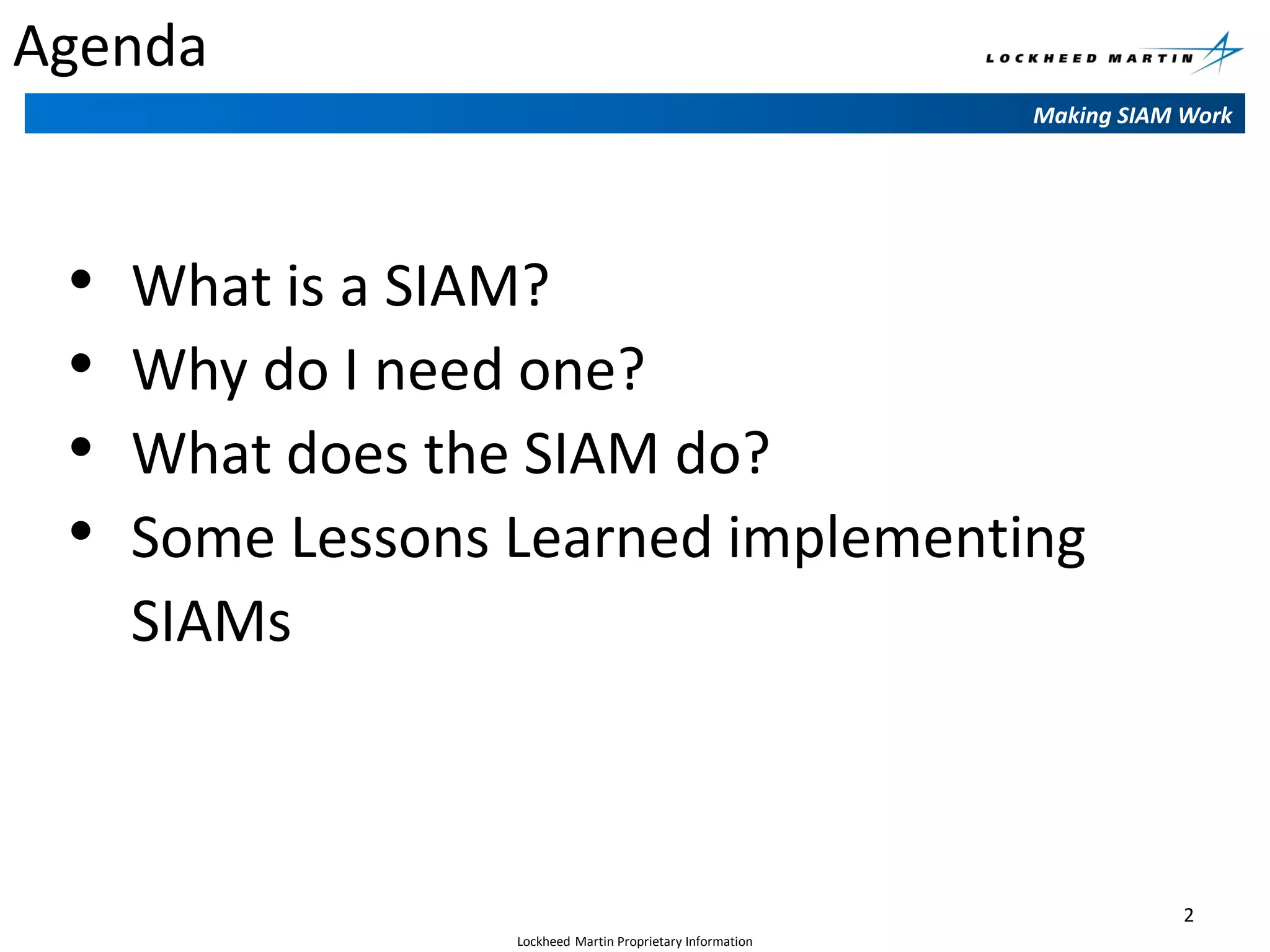
What is a SIAM?
Why do I need one?
What does the SIAM do?
Some Lessons Learned implementing
SIAMs

2
Lockheed Martin Proprietary Information
What is SIAM?
Making SIAM Work

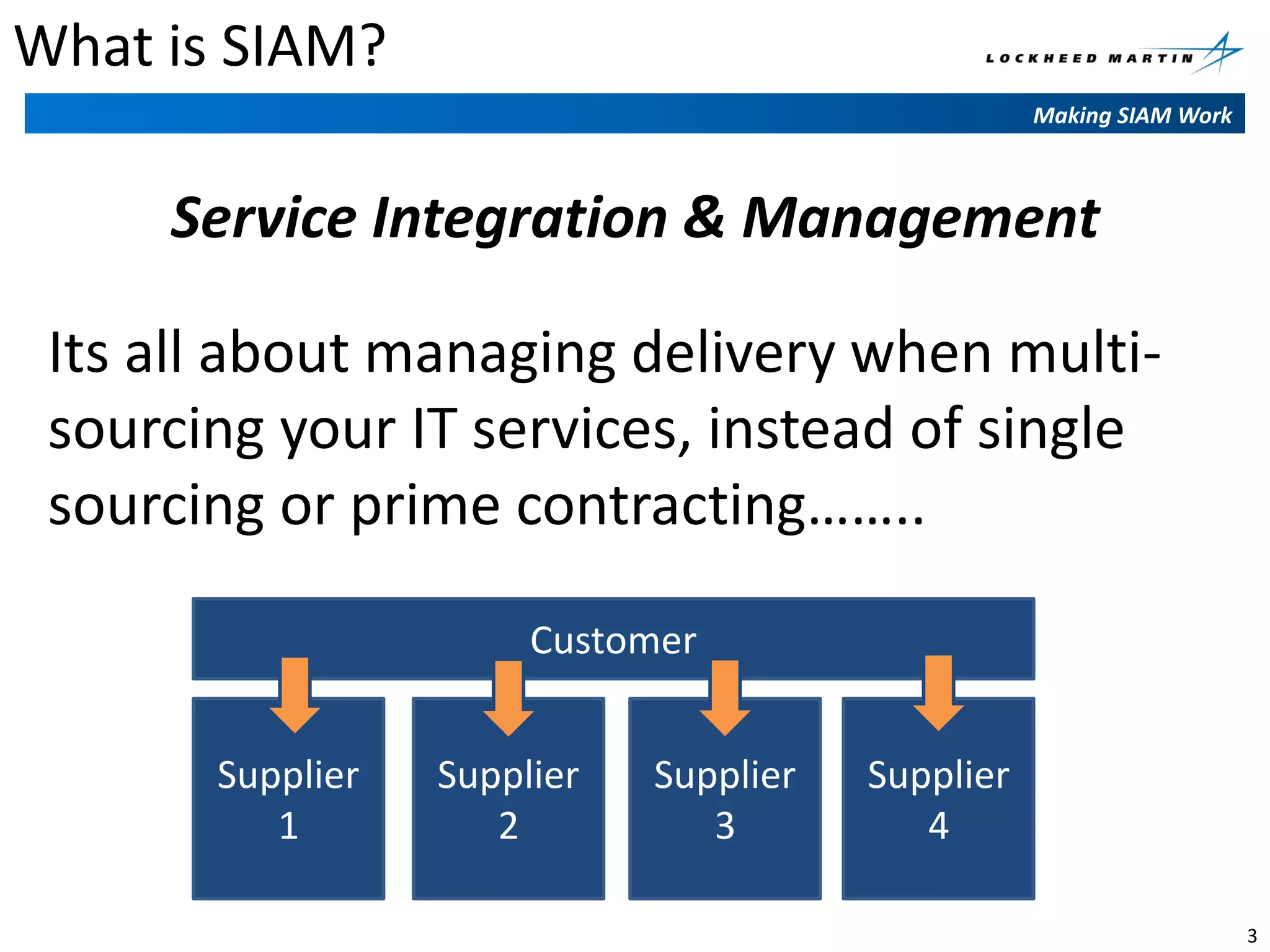
Service Integration & Management
Its all about managing delivery when multisourcing your IT services, instead of single
sourcing or prime contracting……..
Customer
Supplier
1

Supplier
2

Supplier
3

Supplier
4
3
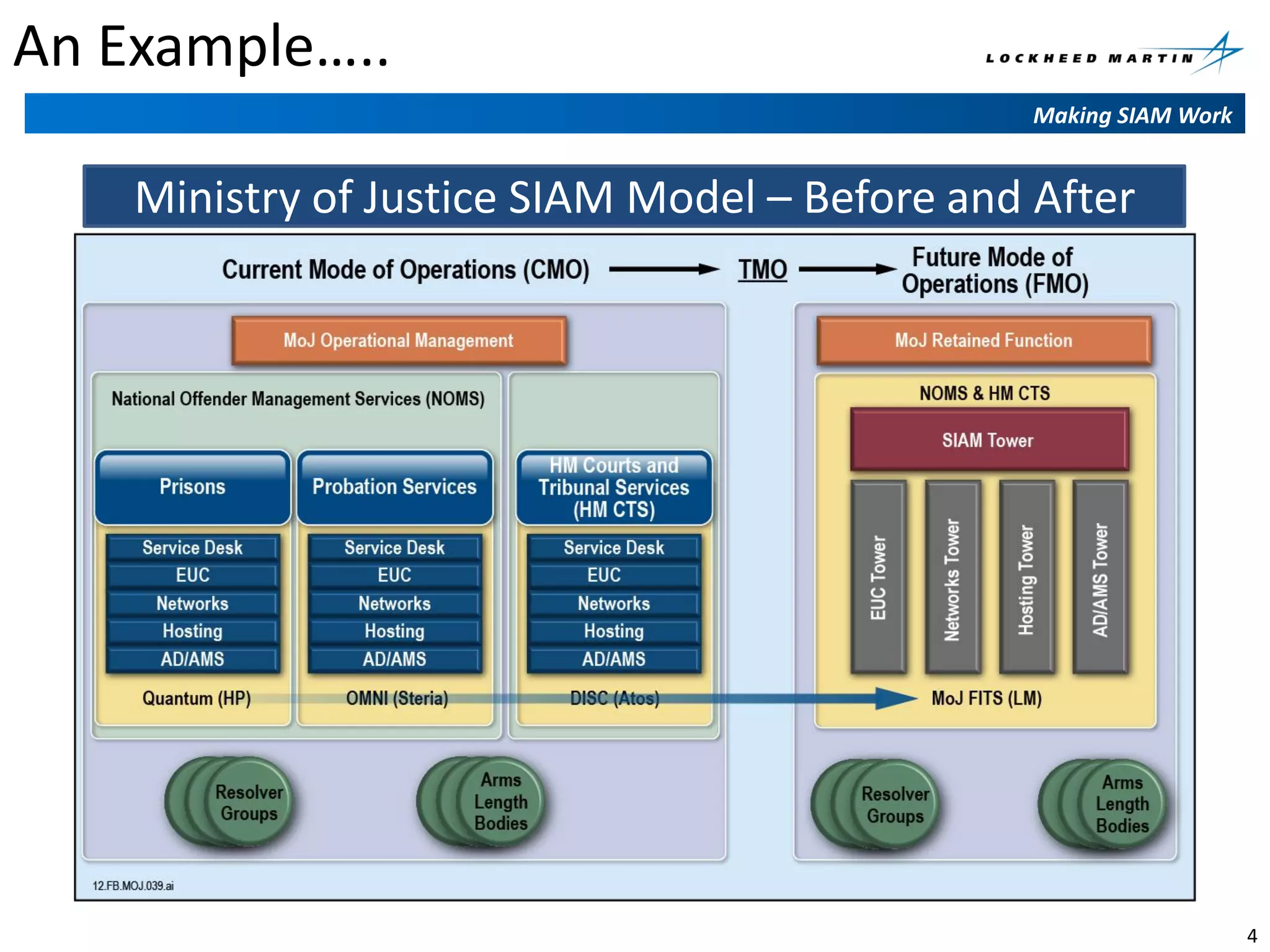
An Example…..
Making SIAM Work

Ministry of Justice SIAM Model – Before and After

4
Multi-Sourcing - The ‘Tower’ Model
Making SIAM Work

• To achieve efficiencies by ‘commoditising’
commodities and buying at scale
• To achieve optimum effectiveness by procuring
services at an Enterprise level and delivering them
with a common, standardised approach
• To enable the delivery of innovative ideas and
technologies through a mix of different businesses
(commitment to SME revenue)
• To meet user demands for “better, quicker, cheaper”

5
Making SIAM Work

Why do I need one?

6
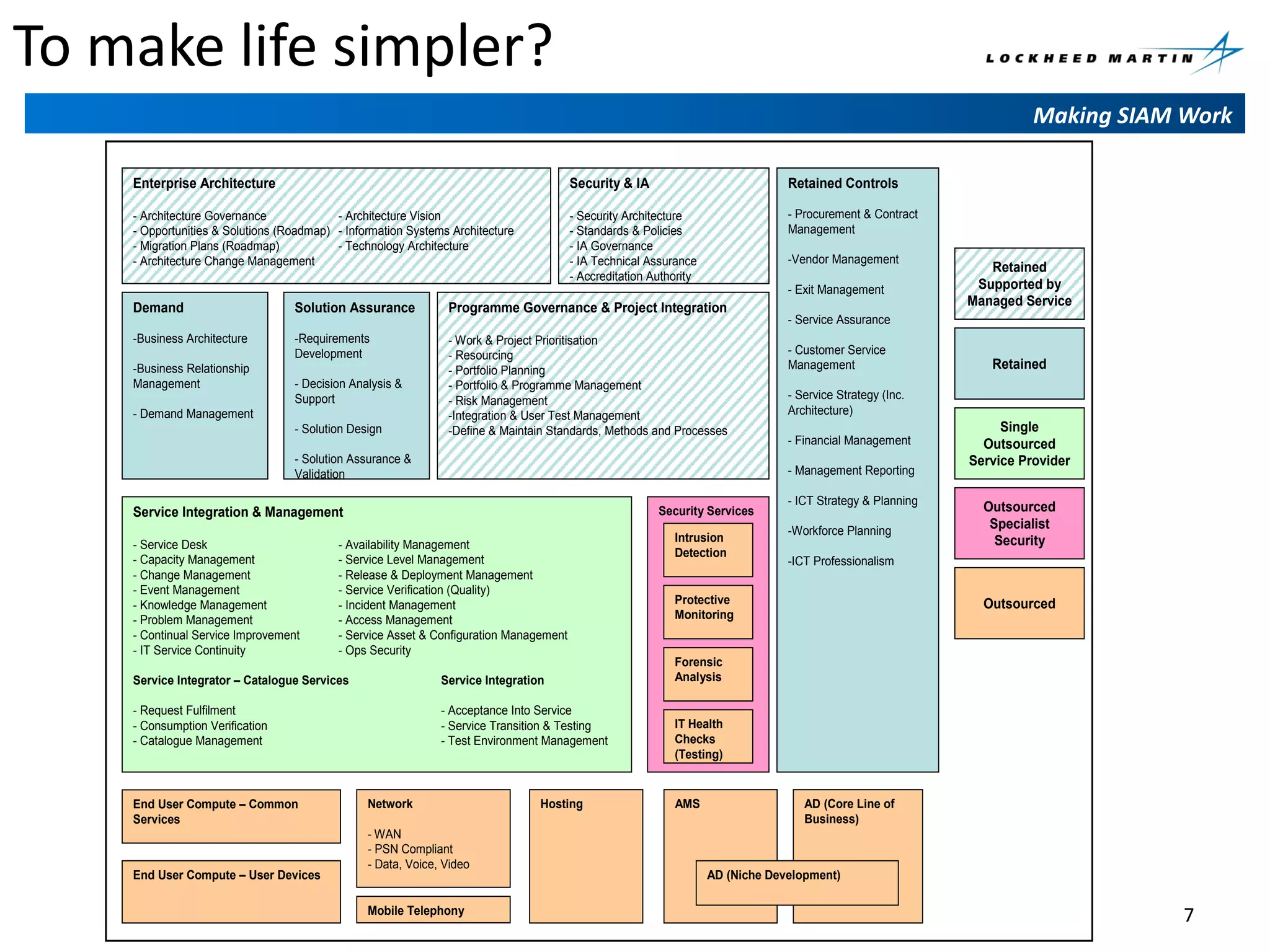
To make life simpler?
Making SIAM Work
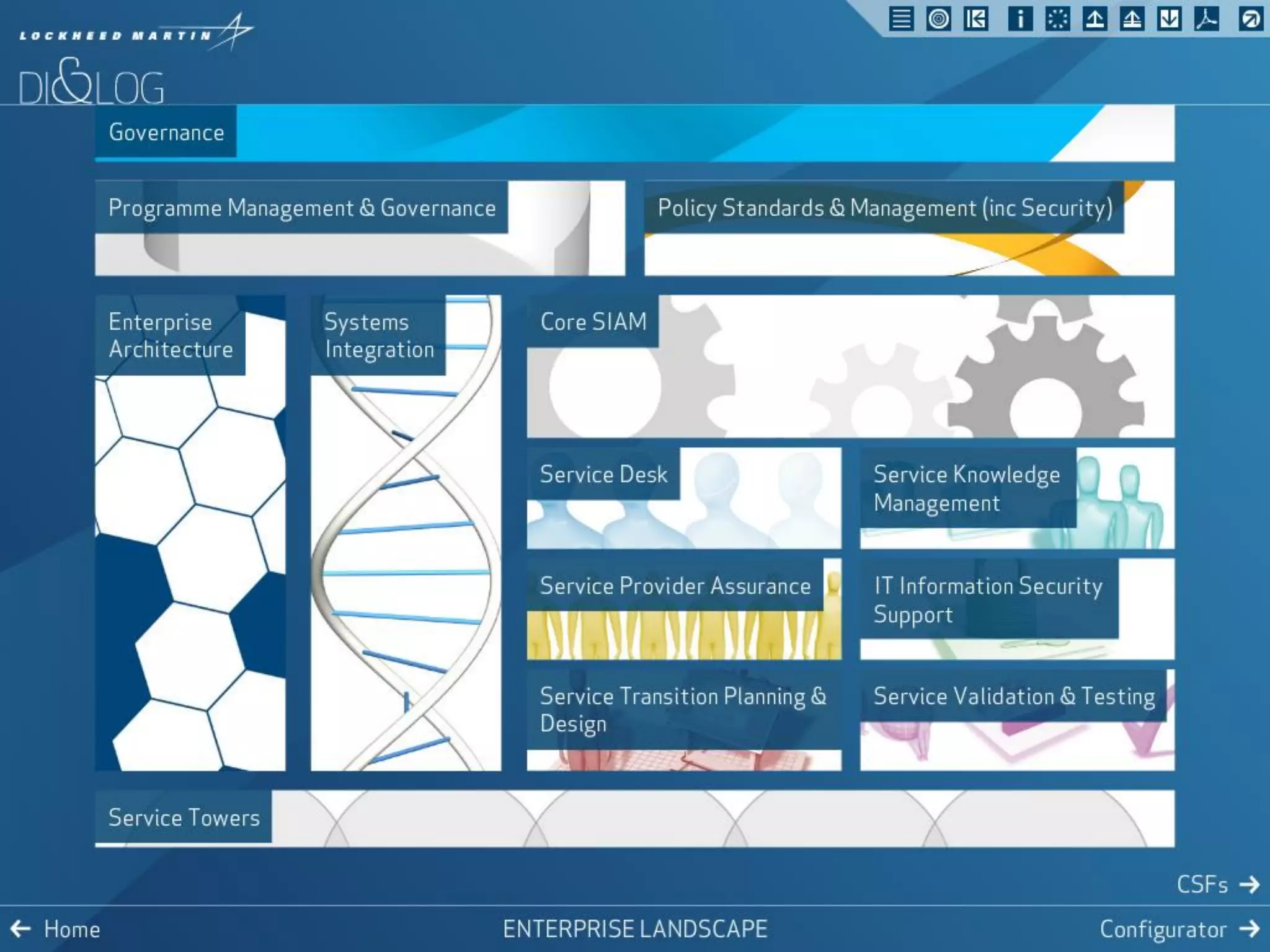
Enterprise Architecture

Security & IA

Retained Controls

- Architecture Governance
- Architecture Vision
- Opportunities & Solutions (Roadmap) - Information Systems Architecture
- Migration Plans (Roadmap)
- Technology Architecture
- Architecture Change Management

- Security Architecture
- Standards & Policies
- IA Governance
- IA Technical Assurance
- Accreditation Authority

- Procurement & Contract
Management
-Vendor Management
- Exit Management

Demand

Solution Assurance

Programme Governance & Project Integration

-Business Architecture

-Requirements
Development

- Work & Project Prioritisation
- Resourcing
- Portfolio Planning
- Portfolio & Programme Management
- Risk Management
-Integration & User Test Management
-Define & Maintain Standards, Methods and Processes

-Business Relationship
Management

- Decision Analysis &
Support

- Demand Management
- Solution Design
- Solution Assurance &
Validation

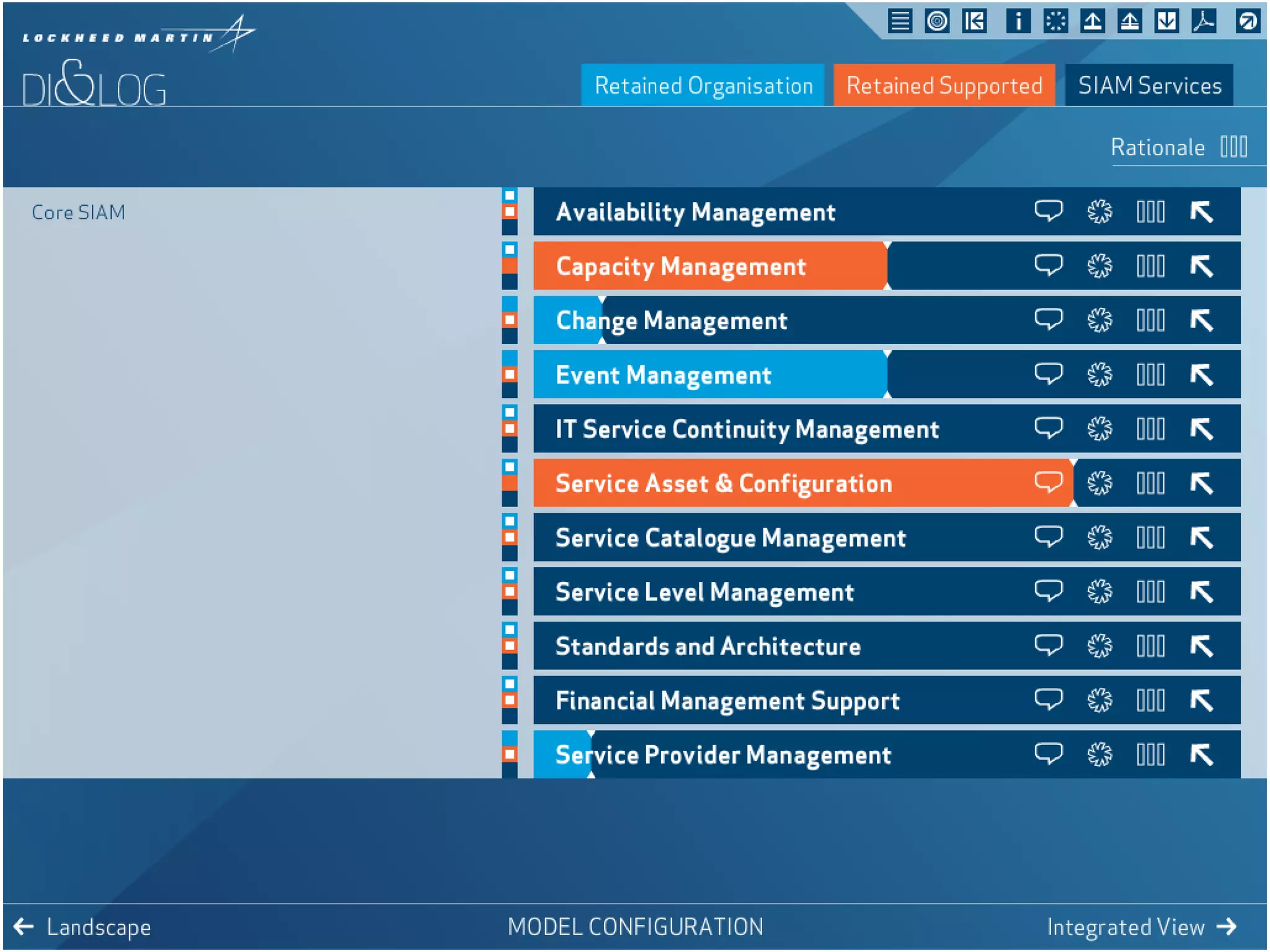
- Service Desk
- Capacity Management
- Change Management
- Event Management
- Knowledge Management
- Problem Management
- Continual Service Improvement
- IT Service Continuity

Security Services

- Availability Management
- Service Level Management
- Release & Deployment Management
- Service Verification (Quality)
- Incident Management
- Access Management
- Service Asset & Configuration Management
- Ops Security

Service Integrator – Catalogue Services

Service Integration

- Request Fulfilment
- Consumption Verification
- Catalogue Management

- Acceptance Into Service
- Service Transition & Testing
- Test Environment Management

End User Compute – Common
Services

End User Compute – User Devices

- Service Assurance
- Customer Service
Management

Network
- WAN
- PSN Compliant
- Data, Voice, Video

Mobile Telephony

Hosting

Intrusion
Detection

Retained

- Service Strategy (Inc.
Architecture)
- Financial Management
- Management Reporting

Service Integration & Management

Retained
Supported by
Managed Service

- ICT Strategy & Planning
-Workforce Planning

Single
Outsourced
Service Provider
Outsourced
Specialist
Security

-ICT Professionalism

Protective
Monitoring

Outsourced

Forensic
Analysis

IT Health
Checks
(Testing)

AMS

AD (Core Line of
Business)

AD (Niche Development)

7
Making SIAM Work

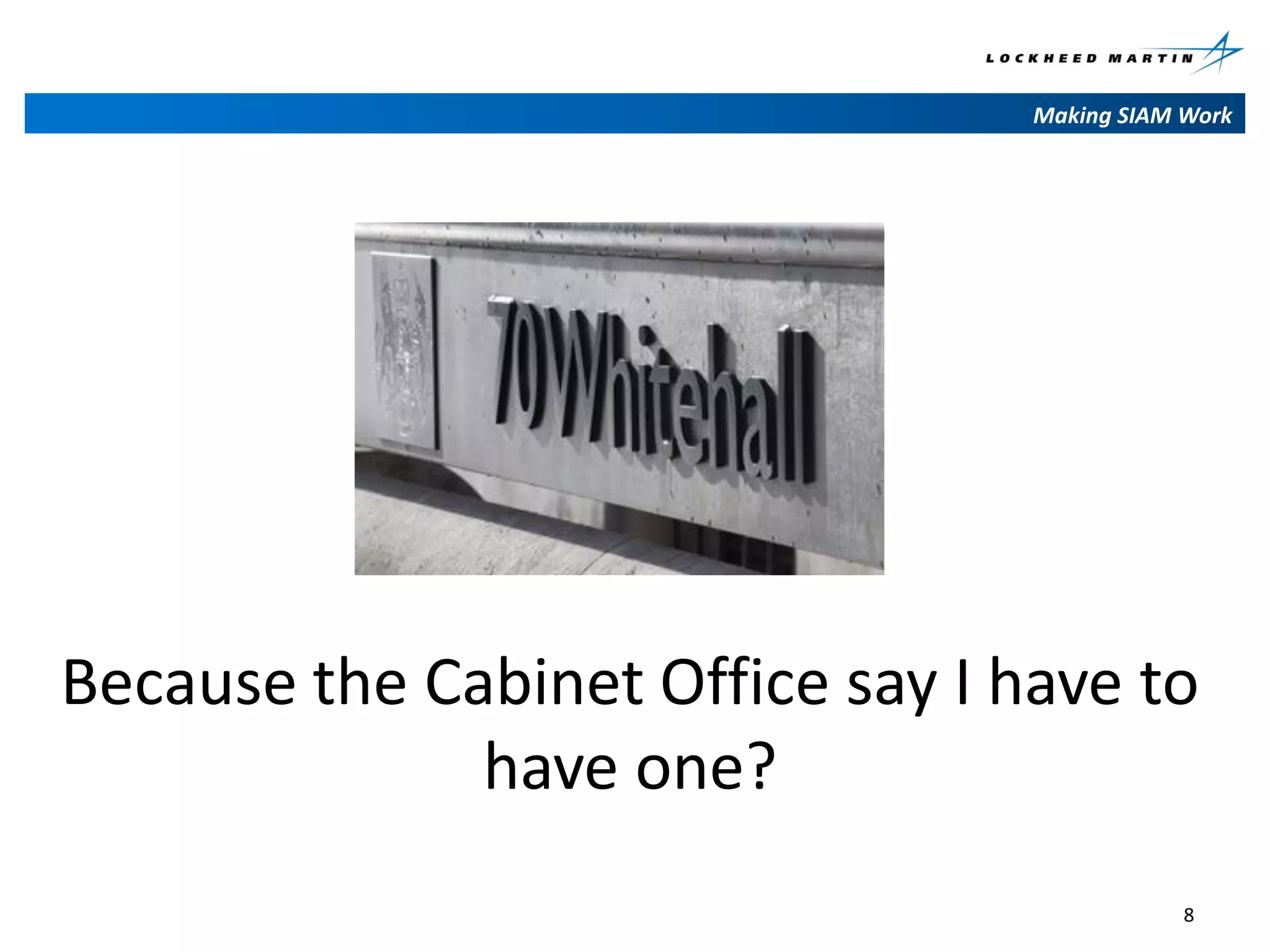
Because the Cabinet Office say I have to
have one?
8
Why implement a SIAM?
Making SIAM Work

• Integration of the delivery of the separate Towers
into a single service, supported by effective service
levels
• Management of the Tower suppliers to deliver to this
set of service levels
• The need for someone to have a focus on the
customer and delivery of the Business objectives
• Enterprise delivery against corporate policies and
processes

9
Making SIAM Work

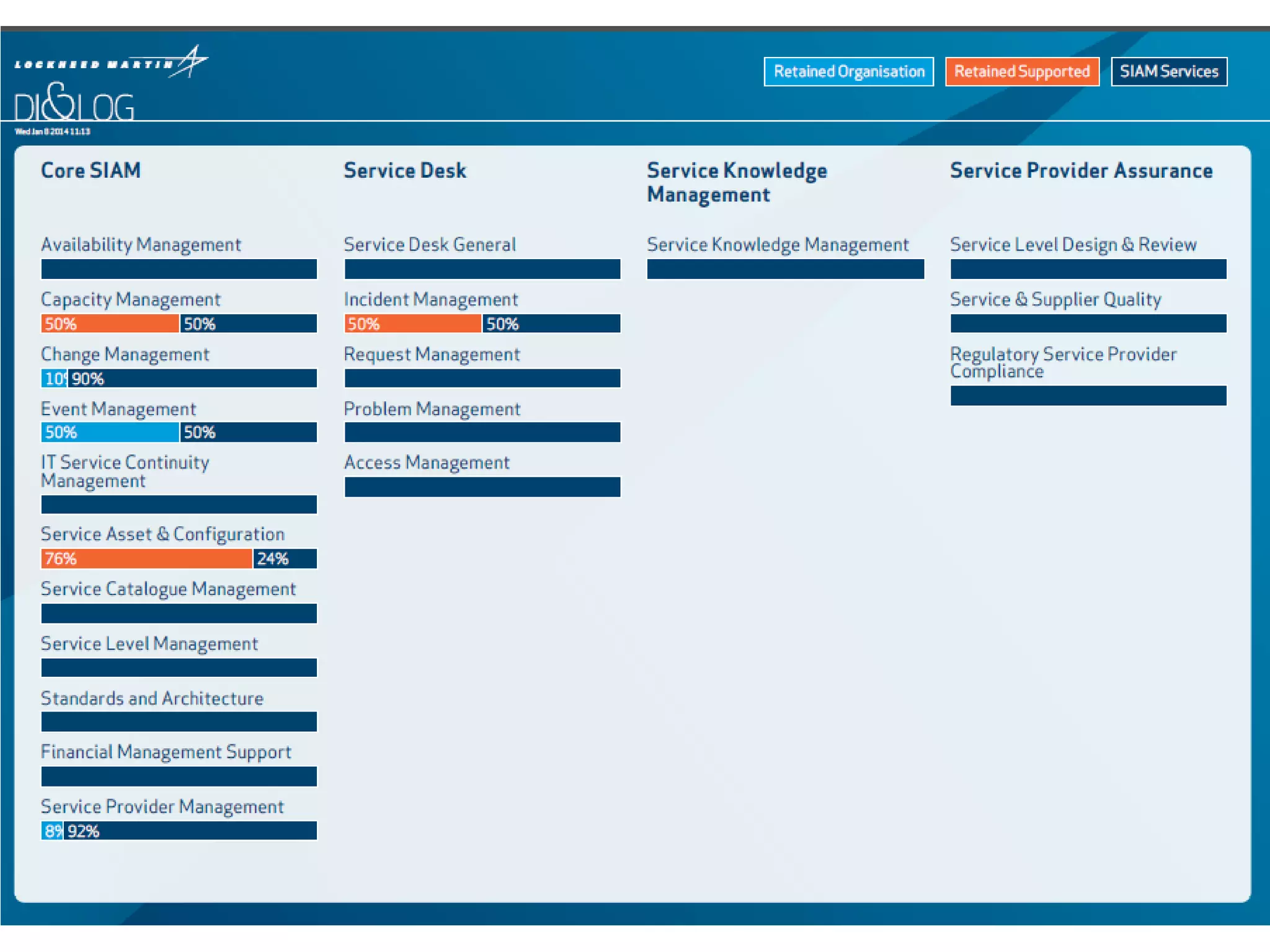
What does SIAM do?
(and not do)
10
Making SIAM Work

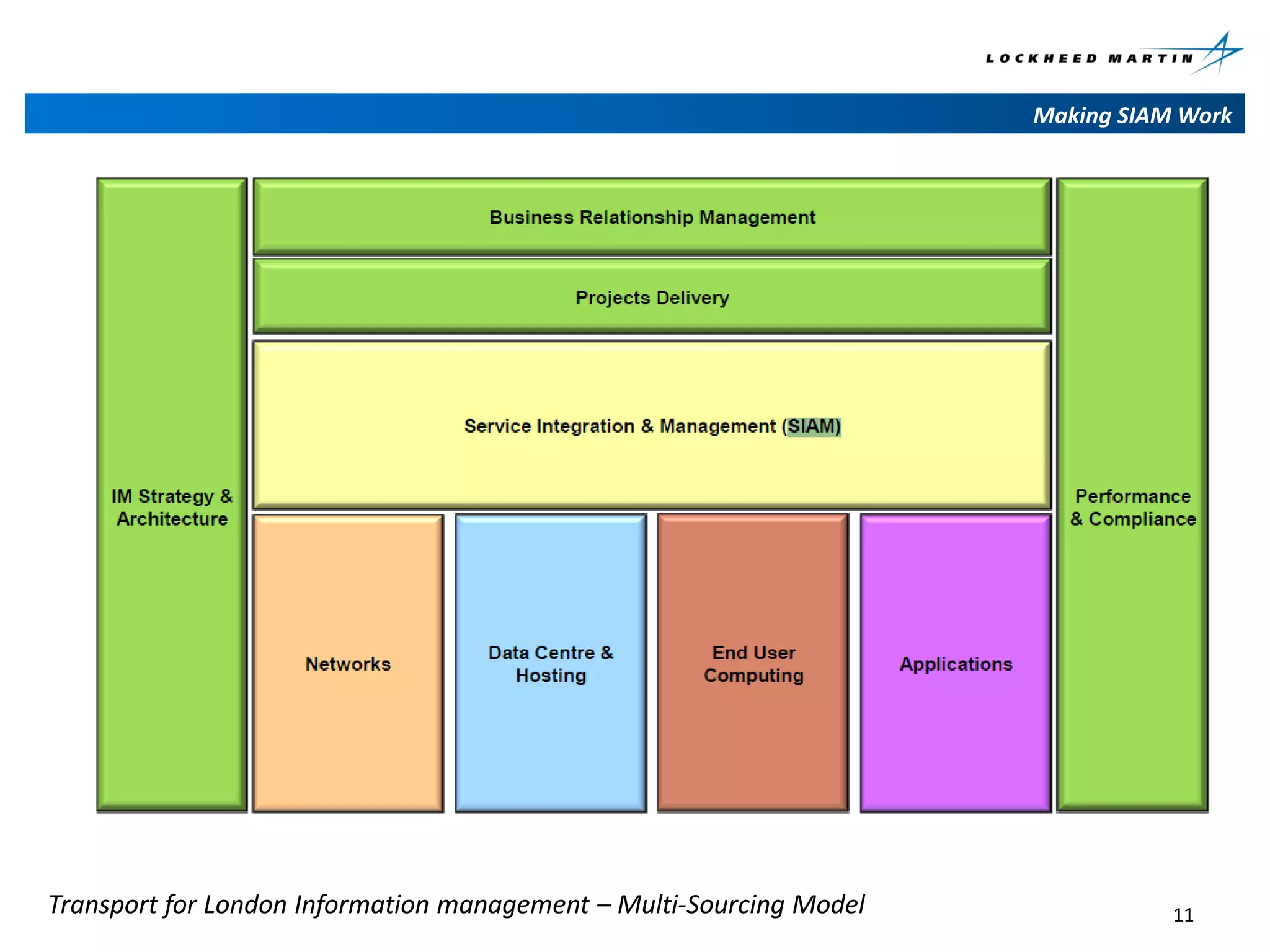
Transport for London Information management – Multi-Sourcing Model

11
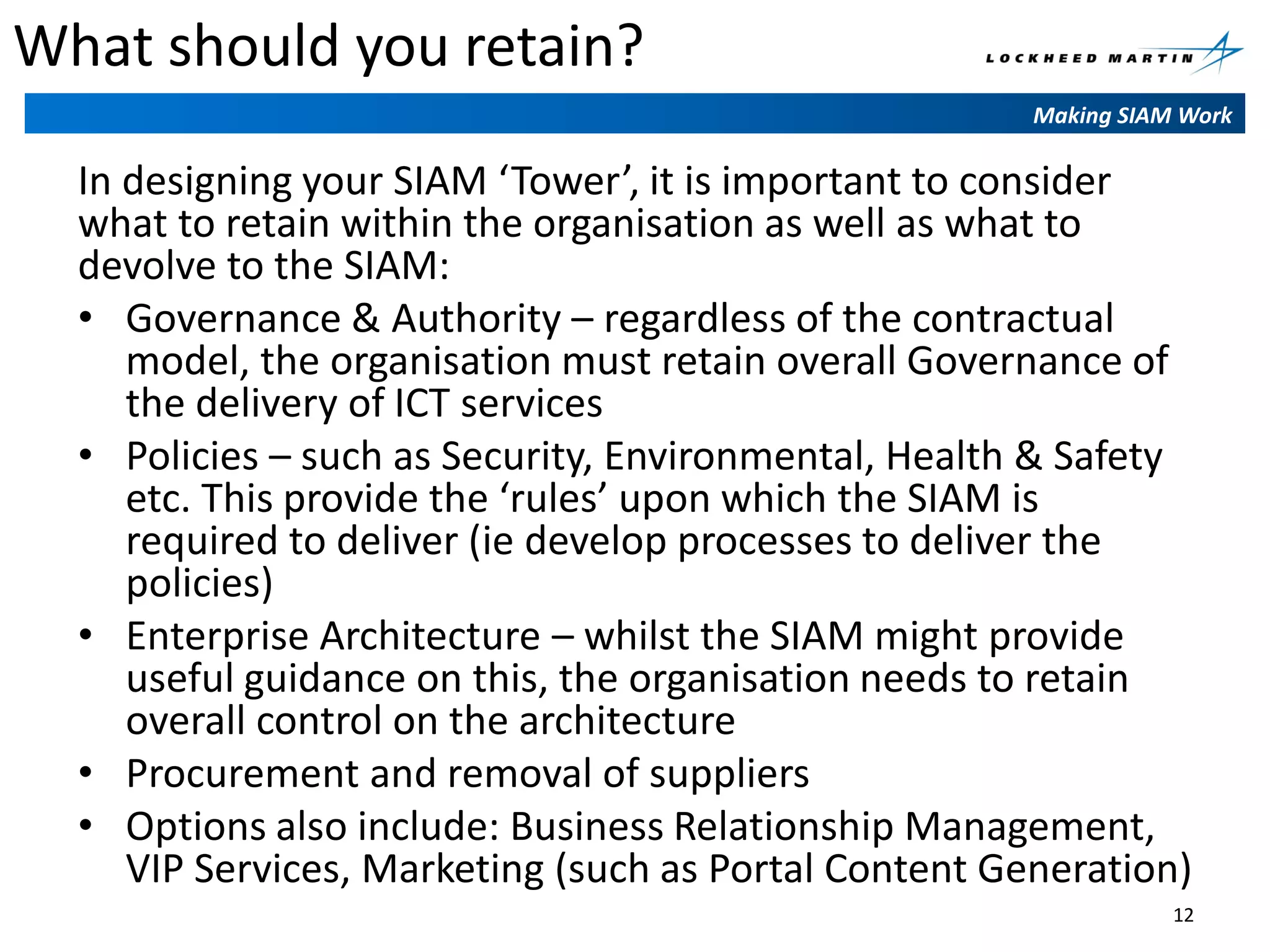
What should you retain?
Making SIAM Work

In designing your SIAM ‘Tower’, it is important to consider
what to retain within the organisation as well as what to
devolve to the SIAM:
• Governance & Authority – regardless of the contractual
model, the organisation must retain overall Governance of
the delivery of ICT services
• Policies – such as Security, Environmental, Health & Safety
etc. This provide the ‘rules’ upon which the SIAM is
required to deliver (ie develop processes to deliver the
policies)
• Enterprise Architecture – whilst the SIAM might provide
useful guidance on this, the organisation needs to retain
overall control on the architecture
• Procurement and removal of suppliers
• Options also include: Business Relationship Management,
VIP Services, Marketing (such as Portal Content Generation)
12
What does SIAM do?
Making SIAM Work

• The SIAM manages the delivery of a disparate set of Tower
suppliers into a single service – to meet the enterprise
service level requirements of the organisation
• They provide a ‘single pane of glass’ view of a complex
range of constituent parts, allowing the organisation to
focus on the priorities – providing decision quality
• Implements the ITIL framework and delivers the service
desk
• Fosters collaboration among the suppliers for the best
outcome for the Business – BS11000
• Manage change and delivery of Continuous Service
Improvement
• Creates and Manages the Total Cost of Ownership of the
ICT Estate
13
Optional Roles
Making SIAM Work

• Transition – planning and executing the move
from single sourcing to multi-sourcing
• Systems Integration – manage the integration of
new systems
• Delivers Information Security across the
organisation
• Acts as the organisation’s Innovation Partner Assists with the development of future Business
Cases to implement innovation and improvement
• Programme & Project Management
14
A word about the Tower suppliers
Making SIAM Work

• Need clear and early guidance about the role
of SIAM
• Need to ensure their Service Management
functions can interface closely with SIAM
• Must recognise the ‘authority’ of SIAM
(devolved from the customer)

15
Making SIAM Work

16
Lessons Learned
Making SIAM Work

• Create the SIAM function first, then the other Towers
-reverse engineering processes is painful and
expensive!
• Open, constructive dialogue is essential for a
collaborative model to work – between the
Business, the ICT Department, the SIAM and the
Tower Suppliers
• A shared and consistent vision for the organisation –
takes initial investment, but ensures a single sense of
purpose (make this happen early)

17
Lessons Learned
Making SIAM Work

• A clear and robust service management (ITSM) toolset – to
provide the organisation a highly effective ‘single-pane-ofglass’ will save significant problems later on
• Visible and demonstrable independence of the SIAM function
– ensuring objectivity in managing competing demands. Clear
devolution of Authority
• A culture of innovation and Continuous Service Improvement
– giving a focus on future business needs
• Programme level Multi-Sourcing /SIAM models are still being
evaluated- for some this is proving too complex and negates
the benefits of commoditisation

18
Making SIAM Work

19
Making SIAM Work

20
Making SIAM Work

21
Making SIAM Work

Thanks for coming

22

Making SIAM Work (for you)

  • 1.
    Making SIAM Work MakingSIAM Work (for you) Mike Nayler Lockheed Martin UK Ltd 14 January 2014 1
  • 2.
    Agenda Making SIAM Work • • • • Whatis a SIAM? Why do I need one? What does the SIAM do? Some Lessons Learned implementing SIAMs 2 Lockheed Martin Proprietary Information
  • 3.
    What is SIAM? MakingSIAM Work Service Integration & Management Its all about managing delivery when multisourcing your IT services, instead of single sourcing or prime contracting…….. Customer Supplier 1 Supplier 2 Supplier 3 Supplier 4 3
  • 4.
    An Example….. Making SIAMWork Ministry of Justice SIAM Model – Before and After 4
  • 5.
    Multi-Sourcing - The‘Tower’ Model Making SIAM Work • To achieve efficiencies by ‘commoditising’ commodities and buying at scale • To achieve optimum effectiveness by procuring services at an Enterprise level and delivering them with a common, standardised approach • To enable the delivery of innovative ideas and technologies through a mix of different businesses (commitment to SME revenue) • To meet user demands for “better, quicker, cheaper” 5
  • 6.
    Making SIAM Work Whydo I need one? 6
  • 7.
    To make lifesimpler? Making SIAM Work Enterprise Architecture Security & IA Retained Controls - Architecture Governance - Architecture Vision - Opportunities & Solutions (Roadmap) - Information Systems Architecture - Migration Plans (Roadmap) - Technology Architecture - Architecture Change Management - Security Architecture - Standards & Policies - IA Governance - IA Technical Assurance - Accreditation Authority - Procurement & Contract Management -Vendor Management - Exit Management Demand Solution Assurance Programme Governance & Project Integration -Business Architecture -Requirements Development - Work & Project Prioritisation - Resourcing - Portfolio Planning - Portfolio & Programme Management - Risk Management -Integration & User Test Management -Define & Maintain Standards, Methods and Processes -Business Relationship Management - Decision Analysis & Support - Demand Management - Solution Design - Solution Assurance & Validation - Service Desk - Capacity Management - Change Management - Event Management - Knowledge Management - Problem Management - Continual Service Improvement - IT Service Continuity Security Services - Availability Management - Service Level Management - Release & Deployment Management - Service Verification (Quality) - Incident Management - Access Management - Service Asset & Configuration Management - Ops Security Service Integrator – Catalogue Services Service Integration - Request Fulfilment - Consumption Verification - Catalogue Management - Acceptance Into Service - Service Transition & Testing - Test Environment Management End User Compute – Common Services End User Compute – User Devices - Service Assurance - Customer Service Management Network - WAN - PSN Compliant - Data, Voice, Video Mobile Telephony Hosting Intrusion Detection Retained - Service Strategy (Inc. Architecture) - Financial Management - Management Reporting Service Integration & Management Retained Supported by Managed Service - ICT Strategy & Planning -Workforce Planning Single Outsourced Service Provider Outsourced Specialist Security -ICT Professionalism Protective Monitoring Outsourced Forensic Analysis IT Health Checks (Testing) AMS AD (Core Line of Business) AD (Niche Development) 7
  • 8.
    Making SIAM Work Becausethe Cabinet Office say I have to have one? 8
  • 9.
    Why implement aSIAM? Making SIAM Work • Integration of the delivery of the separate Towers into a single service, supported by effective service levels • Management of the Tower suppliers to deliver to this set of service levels • The need for someone to have a focus on the customer and delivery of the Business objectives • Enterprise delivery against corporate policies and processes 9
  • 10.
    Making SIAM Work Whatdoes SIAM do? (and not do) 10
  • 11.
    Making SIAM Work Transportfor London Information management – Multi-Sourcing Model 11
  • 12.
    What should youretain? Making SIAM Work In designing your SIAM ‘Tower’, it is important to consider what to retain within the organisation as well as what to devolve to the SIAM: • Governance & Authority – regardless of the contractual model, the organisation must retain overall Governance of the delivery of ICT services • Policies – such as Security, Environmental, Health & Safety etc. This provide the ‘rules’ upon which the SIAM is required to deliver (ie develop processes to deliver the policies) • Enterprise Architecture – whilst the SIAM might provide useful guidance on this, the organisation needs to retain overall control on the architecture • Procurement and removal of suppliers • Options also include: Business Relationship Management, VIP Services, Marketing (such as Portal Content Generation) 12
  • 13.
    What does SIAMdo? Making SIAM Work • The SIAM manages the delivery of a disparate set of Tower suppliers into a single service – to meet the enterprise service level requirements of the organisation • They provide a ‘single pane of glass’ view of a complex range of constituent parts, allowing the organisation to focus on the priorities – providing decision quality • Implements the ITIL framework and delivers the service desk • Fosters collaboration among the suppliers for the best outcome for the Business – BS11000 • Manage change and delivery of Continuous Service Improvement • Creates and Manages the Total Cost of Ownership of the ICT Estate 13
  • 14.
    Optional Roles Making SIAMWork • Transition – planning and executing the move from single sourcing to multi-sourcing • Systems Integration – manage the integration of new systems • Delivers Information Security across the organisation • Acts as the organisation’s Innovation Partner Assists with the development of future Business Cases to implement innovation and improvement • Programme & Project Management 14
  • 15.
    A word aboutthe Tower suppliers Making SIAM Work • Need clear and early guidance about the role of SIAM • Need to ensure their Service Management functions can interface closely with SIAM • Must recognise the ‘authority’ of SIAM (devolved from the customer) 15
  • 16.
  • 17.
    Lessons Learned Making SIAMWork • Create the SIAM function first, then the other Towers -reverse engineering processes is painful and expensive! • Open, constructive dialogue is essential for a collaborative model to work – between the Business, the ICT Department, the SIAM and the Tower Suppliers • A shared and consistent vision for the organisation – takes initial investment, but ensures a single sense of purpose (make this happen early) 17
  • 18.
    Lessons Learned Making SIAMWork • A clear and robust service management (ITSM) toolset – to provide the organisation a highly effective ‘single-pane-ofglass’ will save significant problems later on • Visible and demonstrable independence of the SIAM function – ensuring objectivity in managing competing demands. Clear devolution of Authority • A culture of innovation and Continuous Service Improvement – giving a focus on future business needs • Programme level Multi-Sourcing /SIAM models are still being evaluated- for some this is proving too complex and negates the benefits of commoditisation 18
  • 19.
  • 20.
  • 21.
  • 22.