
Why You Need a Configuration Management Database:  Where ITIL ®  Fits In Kunal Hasija
Agenda ITIL and the goals for a Configuration Management Database (CMDB) It’s all about relationships Key CMDB concepts Takeaways
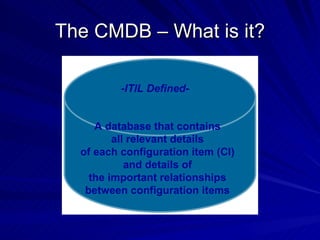
The CMDB – What is it? -ITIL Defined- A database that contains all relevant details of each configuration item (CI) and details of the important relationships between configuration items
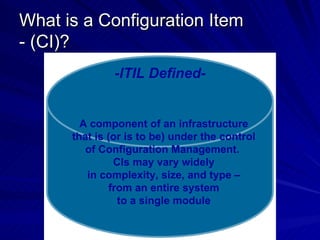
What is a Configuration Item  - (CI)? -ITIL Defined- A component of an infrastructure that is (or is to be) under the control of Configuration Management.  CIs may vary widely in complexity, size, and type – from an entire system to a single module
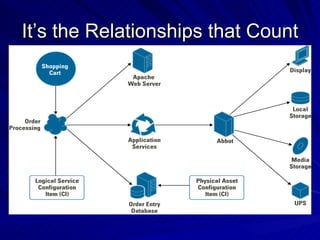
What’s in a CMDB? Configuration items are in a CMDB and they have relationships Capture, record, provide status, urgency and the impact of data between CIs Information about relationships and their components are captured as CI records Ensure IT applications and people are working off of a single “source of record” across your organization
ITIL and the Goal of a Configuration Management Database (CMDB) Account for all the IT assets and configurations within the organization and its services Provide accurate information on configurations and their documentation to support all the other Service Management processes  Provide a sound basis for Incident Management, Problem Management, Change Management and Release Management  Provide verification of the configuration records against the infrastructure and correct any exceptions
Benefits of Configuration Management Control – Verifying and correcting configuration records gives you a greater degree of control over your infrastructure Integration – Integrating all configuration-related IT processes can reduce errors and the number of staff needed to administer your environment  Decision Support – Making decisions and meeting commitments is easier when you have complete and accurate data, resulting in better resource and performance estimates
It’s the Relationships that Count
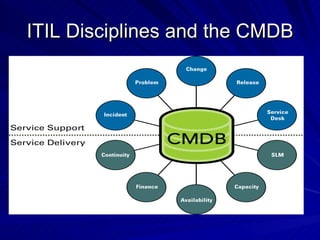
ITIL Disciplines and the CMDB
Relationships – Incident Management Automatically populate records Provide status of configuration items Provide urgency data for priorities Provide impact data for priorities Provide escalation data
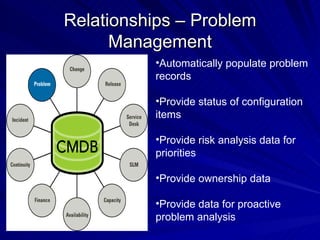
Relationships – Problem Management Automatically populate problem records Provide status of configuration items Provide risk analysis data for priorities Provide ownership data Provide data for proactive problem analysis
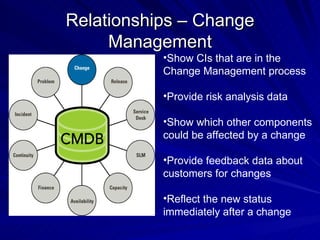
Relationships – Change Management Show CIs that are in the Change Management process Provide risk analysis data Show which other components could be affected by a change Provide feedback data about customers for changes Reflect the new status immediately after a change
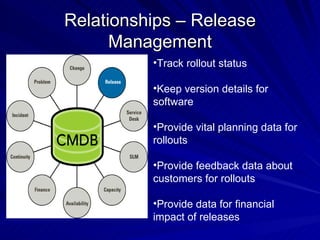
Relationships – Release Management Track rollout status Keep version details for software Provide vital planning data for rollouts Provide feedback data about customers for rollouts Provide data for financial impact of releases
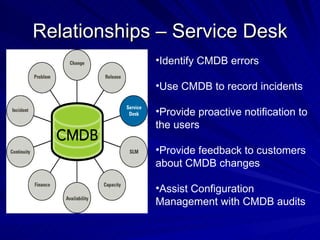
Relationships – Service Desk Identify CMDB errors Use CMDB to record incidents Provide proactive notification to the users  Provide feedback to customers about CMDB changes Assist Configuration Management with CMDB audits
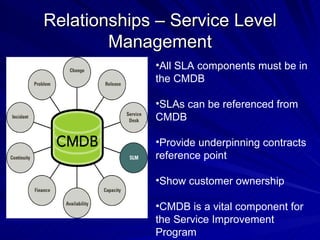
Relationships – Service Level Management All SLA components must be in the CMDB SLAs can be referenced from CMDB Provide underpinning contracts reference point Show customer ownership CMDB is a vital component for the Service Improvement Program
Data is the Key No matter which service management processes you implement, the data they use will make them effective Your configuration data must be accurate, which means it must be updated frequently Configurations are constantly changing, so last week’s correct data could be horribly obsolete this week Your configuration data must also be available to all of your IT processes, because even the most accurate data is useless if you can’t get to it
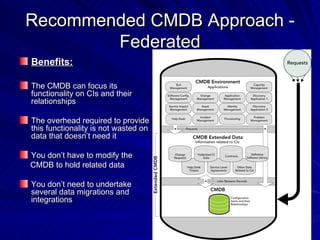
Recommended CMDB Approach - Federated Benefits: The CMDB can focus its functionality on CIs and their relationships The overhead required to provide this functionality is not wasted on data that doesn’t need it You don’t have to modify the  CMDB to hold related data You don’t need to undertake several data migrations and integrations
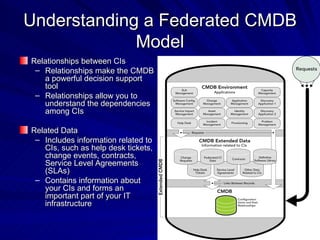
Understanding a Federated CMDB Model Relationships between CIs Relationships make the CMDB a powerful decision support tool Relationships allow you to understand the dependencies among CIs Related Data Includes information related to CIs, such as help desk tickets, change events, contracts, Service Level Agreements (SLAs) Contains information about your CIs and forms an important part of your IT infrastructure
Key Takeaways Relationships between CIs bring it all together CMDB provides a single source of record that can be leveraged by all IT processes Configuration Management provides better control, integration and decision support across your organization It is critical to ensure the CMDB always provides accurate information about your infrastructure A federated CMDB creates an approach that is scalable and maintainable
Thank You Kunal Hasija, Configuration Team Lead

Kunalhasija CMDB & ITIL

  • 1.
    Why You Needa Configuration Management Database: Where ITIL ® Fits In Kunal Hasija
  • 2.
    Agenda ITIL andthe goals for a Configuration Management Database (CMDB) It’s all about relationships Key CMDB concepts Takeaways
  • 3.
    The CMDB –What is it? -ITIL Defined- A database that contains all relevant details of each configuration item (CI) and details of the important relationships between configuration items
  • 4.
    What is aConfiguration Item - (CI)? -ITIL Defined- A component of an infrastructure that is (or is to be) under the control of Configuration Management. CIs may vary widely in complexity, size, and type – from an entire system to a single module
  • 5.
    What’s in aCMDB? Configuration items are in a CMDB and they have relationships Capture, record, provide status, urgency and the impact of data between CIs Information about relationships and their components are captured as CI records Ensure IT applications and people are working off of a single “source of record” across your organization
  • 6.
    ITIL and theGoal of a Configuration Management Database (CMDB) Account for all the IT assets and configurations within the organization and its services Provide accurate information on configurations and their documentation to support all the other Service Management processes Provide a sound basis for Incident Management, Problem Management, Change Management and Release Management Provide verification of the configuration records against the infrastructure and correct any exceptions
  • 7.
    Benefits of ConfigurationManagement Control – Verifying and correcting configuration records gives you a greater degree of control over your infrastructure Integration – Integrating all configuration-related IT processes can reduce errors and the number of staff needed to administer your environment Decision Support – Making decisions and meeting commitments is easier when you have complete and accurate data, resulting in better resource and performance estimates
  • 8.
  • 9.
  • 10.
    Relationships – IncidentManagement Automatically populate records Provide status of configuration items Provide urgency data for priorities Provide impact data for priorities Provide escalation data
  • 11.
    Relationships – ProblemManagement Automatically populate problem records Provide status of configuration items Provide risk analysis data for priorities Provide ownership data Provide data for proactive problem analysis
  • 12.
    Relationships – ChangeManagement Show CIs that are in the Change Management process Provide risk analysis data Show which other components could be affected by a change Provide feedback data about customers for changes Reflect the new status immediately after a change
  • 13.
    Relationships – ReleaseManagement Track rollout status Keep version details for software Provide vital planning data for rollouts Provide feedback data about customers for rollouts Provide data for financial impact of releases
  • 14.
    Relationships – ServiceDesk Identify CMDB errors Use CMDB to record incidents Provide proactive notification to the users Provide feedback to customers about CMDB changes Assist Configuration Management with CMDB audits
  • 15.
    Relationships – ServiceLevel Management All SLA components must be in the CMDB SLAs can be referenced from CMDB Provide underpinning contracts reference point Show customer ownership CMDB is a vital component for the Service Improvement Program
  • 16.
    Data is theKey No matter which service management processes you implement, the data they use will make them effective Your configuration data must be accurate, which means it must be updated frequently Configurations are constantly changing, so last week’s correct data could be horribly obsolete this week Your configuration data must also be available to all of your IT processes, because even the most accurate data is useless if you can’t get to it
  • 17.
    Recommended CMDB Approach- Federated Benefits: The CMDB can focus its functionality on CIs and their relationships The overhead required to provide this functionality is not wasted on data that doesn’t need it You don’t have to modify the CMDB to hold related data You don’t need to undertake several data migrations and integrations
  • 18.
    Understanding a FederatedCMDB Model Relationships between CIs Relationships make the CMDB a powerful decision support tool Relationships allow you to understand the dependencies among CIs Related Data Includes information related to CIs, such as help desk tickets, change events, contracts, Service Level Agreements (SLAs) Contains information about your CIs and forms an important part of your IT infrastructure
  • 19.
    Key Takeaways Relationshipsbetween CIs bring it all together CMDB provides a single source of record that can be leveraged by all IT processes Configuration Management provides better control, integration and decision support across your organization It is critical to ensure the CMDB always provides accurate information about your infrastructure A federated CMDB creates an approach that is scalable and maintainable
  • 20.
    Thank You KunalHasija, Configuration Team Lead