MANAGEMENT PROCESS
H Ramasubramanian
Planning
Planning
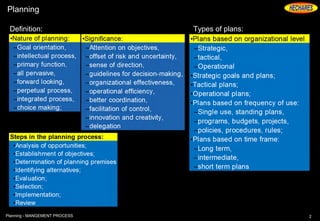
Definition: Types of plans:
2Planning - MANGEMENT PROCESS
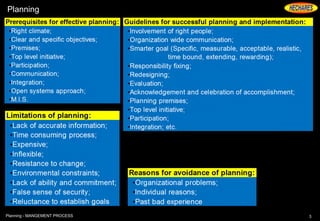
Planning
.
3Planning - MANGEMENT PROCESS
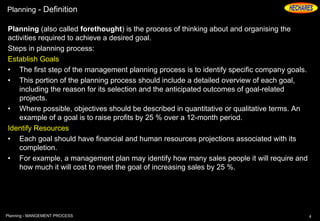
Planning - Definition
Planning (also called forethought) is the process of thinking about and organising the
activities required to achieve a desired goal.
Steps in planning process:
Establish Goals
• The first step of the management planning process is to identify specific company goals.
• This portion of the planning process should include a detailed overview of each goal,
including the reason for its selection and the anticipated outcomes of goal-related
projects.
• Where possible, objectives should be described in quantitative or qualitative terms. An
example of a goal is to raise profits by 25 % over a 12-month period.
Identify Resources
• Each goal should have financial and human resources projections associated with its
completion.
• For example, a management plan may identify how many sales people it will require and
how much it will cost to meet the goal of increasing sales by 25 %.
4Planning - MANGEMENT PROCESS
Planning - Definition
Establish Goal-Related Tasks
• Each goal should have tasks or projects associated with its achievement.
• For example, if a goal is to raise profits by 25 %, a manager will need to outline the tasks
required to meet that objective.
• Examples of tasks might include increasing the sales staff or developing advanced sales
training techniques.
Prioritise Goals and Tasks
• Prioritising goals and tasks is about ordering objectives in terms of their importance.
• The tasks deemed most important will theoretically be approached and completed first.
• The prioritising process may also reflect steps necessary in completing a task or
achieving a goal.
• For example, if a goal is to increase sales by 25 % and an associated task is to increase
sales staff, the company will need to complete the steps toward achieving that objective
in chronological order.
Create Assignments and Timelines
• As the company prioritises projects, it must establish timelines for completing associated
tasks and assign individuals to complete them.
• This portion of the management planning process should consider the abilities of staff
members and the time necessary to realistically complete assignments.
5Planning - MANGEMENT PROCESS
Planning - Definition
• For example, the sales manager in this scenario may be given monthly earning quotas to
stay on track for the goal of increasing sales by 25 %.
Establish Evaluation Methods
• A management planning process should include a strategy for evaluating the progress
toward goal completion throughout an established time period.
• One way to do this is through requesting a monthly progress report from department
heads.
Identify Alternative Courses of Action
• Even the best-laid plans can sometimes be thrown off track by unanticipated events.
• A management plan should include a contingency plan if certain aspects of the master
plan prove to be unattainable.
• Alternative courses of action can be incorporated into each segment of the planning
process, or for the plan in its entirety.
Intellectual Process:
• Planning is an intellectual process of thinking in advance.
• It is a process of deciding the future on the series of events to follow. Planning is a
process where a number of steps are to be taken to decide the future course of action.
6Planning - MANGEMENT PROCESS
Planning - Definition
• Managers or executives have to consider various courses of action, achieve the desired
or set goal.
• Go in details of the pros and cons of every course of action and then finally decide what
courses of action may suit them best.
Primary function:
• Planning precedes other function in the management process.
• Certainly, setting of goals to be achieved and lines of action to be followed precedes the
organisation, direction, supervision and control.
• No doubt, planning precedes other functions of management.
• It is primary requisite before other management functions step in.
• But all functions are inter-connected.
• It is mixed in all managerial functions.
• But there too gets the precedence.
• Planning thus gets primary everywhere.
7Planning - MANGEMENT PROCESS
Planning - Definition
All pervasive: (Present throughout)
• Planning pervades management activities.
• From primary of planning follows pervasiveness of planning.
• It is the function of every managerial personnel.
• The character, nature and scope of planning may change fro personnel to personnel.
• But, the planning as an action remains intact.
• Plans cannot make an enterprise successful. Action is required.
• Planning seeks to achieve a consistent, coordinated structure of operations focused on
desired goals / trends.
• Without plans, action must become merely activity producing nothing but chaos.
Perpetual process: (continuous)
• Planning is a continuous process and a never ending activity of a manger.
• It is based upon some assumptions which may or may not come true in the future.
• Managers has to go on modifying, revising and adjusting plans in the light of changing
circumstances.
8Planning - MANGEMENT PROCESS
Planning - Definition
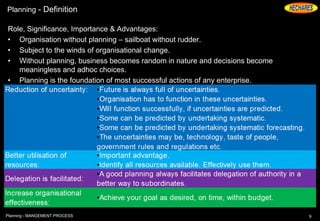
Role, Significance, Importance & Advantages:
• Organisation without planning – sailboat without rudder.
• Subject to the winds of organisational change.
• Without planning, business becomes random in nature and decisions become
meaningless and adhoc choices.
• Planning is the foundation of most successful actions of any enterprise.
9Planning - MANGEMENT PROCESS
Planning - Definition
10Planning - MANGEMENT PROCESS
Planning - Definition
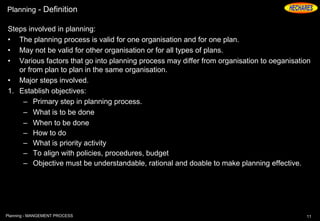
Steps involved in planning:
• The planning process is valid for one organisation and for one plan.
• May not be valid for other organisation or for all types of plans.
• Various factors that go into planning process may differ from organisation to oeganisation
or from plan to plan in the same organisation.
• Major steps involved.
1. Establish objectives:
– Primary step in planning process.
– What is to be done
– When to be done
– How to do
– What is priority activity
– To align with policies, procedures, budget
– Objective must be understandable, rational and doable to make planning effective.
11Planning - MANGEMENT PROCESS
Planning - Definition
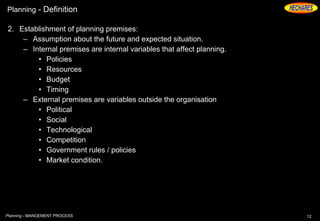
2. Establishment of planning premises:
– Assumption about the future and expected situation.
– Internal premises are internal variables that affect planning.
• Policies
• Resources
• Budget
• Timing
– External premises are variables outside the organisation
• Political
• Social
• Technological
• Competition
• Government rules / policies
• Market condition.
12Planning - MANGEMENT PROCESS
Planning - Definition
3. Determining alternative courses:
– Determine and evaluate alternative actions.
– No occasions without alternatives.
– Worthy and meaningful
– It is imperative that alternative plans must be developed before deciding upon the
exact plan.
4. Evaluation of alternatives:
– Study their strong and weak points
– Give weightage to various factors involved.
• More cash flow
• Least risk
• Long term business
• Competition pressure
– Decision to be taken on an alternate.
5. Selection of course of action:
– It is the point of decision making
– Deciding upon the plan to be adopted to meet objectives.
13Planning - MANGEMENT PROCESS
Planning - Definition
6. Formulating derivative plans:
– Gives effect and support basic plan.
– Ex: Run a flight from Chennai – Patna
• Staffing
• Operation
• Fuel
• Maintenance
• Stores purchase
– Each manager and department need to contribute to prepare the master plan on the
basis of derived plans.
7. Establishing sequence of activities:
– After basic and derivative plans are prepared for the activities, timing plan to be
made.
– Timing is essential.
– Gives practical shape and concrete form to the project.
– Starting and finishing time is fixed.
– Bad timing and sequence result in project failure.
– Who will do, what they will do, when they will do.
14Planning - MANGEMENT PROCESS
Planning - Definition
8. Feed-back or follow-up actions:
– Planning alone is not sufficient.
– To see whether actions are taken as per plan.
– If not, what is the cause, how to resolve and keep going.
– Whether the plan is working for that project and that situation.
– If conditions have changed, plan becomes outdated and require change.
– Regular follow-up / review required for effective implementation.
• The plan should be communicated to all connected in the project.
• Objective and course of action should be clearly defined.
• No ambiguity.
15Planning - MANGEMENT PROCESS
Planning - Definition
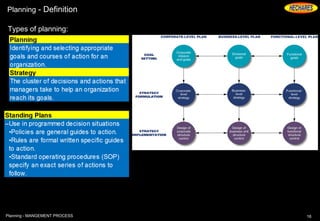
Types of planning:
16Planning - MANGEMENT PROCESS
Planning - Definition
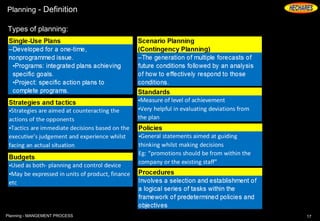
Types of planning:
17Planning - MANGEMENT PROCESS
Planning - Definition
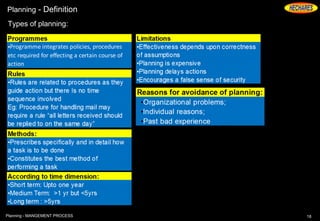
Types of planning:
18Planning - MANGEMENT PROCESS

Planning management process

  • 1.
  • 2.
    Planning Definition: Types ofplans: 2Planning - MANGEMENT PROCESS
  • 3.
  • 4.
    Planning - Definition Planning(also called forethought) is the process of thinking about and organising the activities required to achieve a desired goal. Steps in planning process: Establish Goals • The first step of the management planning process is to identify specific company goals. • This portion of the planning process should include a detailed overview of each goal, including the reason for its selection and the anticipated outcomes of goal-related projects. • Where possible, objectives should be described in quantitative or qualitative terms. An example of a goal is to raise profits by 25 % over a 12-month period. Identify Resources • Each goal should have financial and human resources projections associated with its completion. • For example, a management plan may identify how many sales people it will require and how much it will cost to meet the goal of increasing sales by 25 %. 4Planning - MANGEMENT PROCESS
  • 5.
    Planning - Definition EstablishGoal-Related Tasks • Each goal should have tasks or projects associated with its achievement. • For example, if a goal is to raise profits by 25 %, a manager will need to outline the tasks required to meet that objective. • Examples of tasks might include increasing the sales staff or developing advanced sales training techniques. Prioritise Goals and Tasks • Prioritising goals and tasks is about ordering objectives in terms of their importance. • The tasks deemed most important will theoretically be approached and completed first. • The prioritising process may also reflect steps necessary in completing a task or achieving a goal. • For example, if a goal is to increase sales by 25 % and an associated task is to increase sales staff, the company will need to complete the steps toward achieving that objective in chronological order. Create Assignments and Timelines • As the company prioritises projects, it must establish timelines for completing associated tasks and assign individuals to complete them. • This portion of the management planning process should consider the abilities of staff members and the time necessary to realistically complete assignments. 5Planning - MANGEMENT PROCESS
  • 6.
    Planning - Definition •For example, the sales manager in this scenario may be given monthly earning quotas to stay on track for the goal of increasing sales by 25 %. Establish Evaluation Methods • A management planning process should include a strategy for evaluating the progress toward goal completion throughout an established time period. • One way to do this is through requesting a monthly progress report from department heads. Identify Alternative Courses of Action • Even the best-laid plans can sometimes be thrown off track by unanticipated events. • A management plan should include a contingency plan if certain aspects of the master plan prove to be unattainable. • Alternative courses of action can be incorporated into each segment of the planning process, or for the plan in its entirety. Intellectual Process: • Planning is an intellectual process of thinking in advance. • It is a process of deciding the future on the series of events to follow. Planning is a process where a number of steps are to be taken to decide the future course of action. 6Planning - MANGEMENT PROCESS
  • 7.
    Planning - Definition •Managers or executives have to consider various courses of action, achieve the desired or set goal. • Go in details of the pros and cons of every course of action and then finally decide what courses of action may suit them best. Primary function: • Planning precedes other function in the management process. • Certainly, setting of goals to be achieved and lines of action to be followed precedes the organisation, direction, supervision and control. • No doubt, planning precedes other functions of management. • It is primary requisite before other management functions step in. • But all functions are inter-connected. • It is mixed in all managerial functions. • But there too gets the precedence. • Planning thus gets primary everywhere. 7Planning - MANGEMENT PROCESS
  • 8.
    Planning - Definition Allpervasive: (Present throughout) • Planning pervades management activities. • From primary of planning follows pervasiveness of planning. • It is the function of every managerial personnel. • The character, nature and scope of planning may change fro personnel to personnel. • But, the planning as an action remains intact. • Plans cannot make an enterprise successful. Action is required. • Planning seeks to achieve a consistent, coordinated structure of operations focused on desired goals / trends. • Without plans, action must become merely activity producing nothing but chaos. Perpetual process: (continuous) • Planning is a continuous process and a never ending activity of a manger. • It is based upon some assumptions which may or may not come true in the future. • Managers has to go on modifying, revising and adjusting plans in the light of changing circumstances. 8Planning - MANGEMENT PROCESS
  • 9.
    Planning - Definition Role,Significance, Importance & Advantages: • Organisation without planning – sailboat without rudder. • Subject to the winds of organisational change. • Without planning, business becomes random in nature and decisions become meaningless and adhoc choices. • Planning is the foundation of most successful actions of any enterprise. 9Planning - MANGEMENT PROCESS
  • 10.
  • 11.
    Planning - Definition Stepsinvolved in planning: • The planning process is valid for one organisation and for one plan. • May not be valid for other organisation or for all types of plans. • Various factors that go into planning process may differ from organisation to oeganisation or from plan to plan in the same organisation. • Major steps involved. 1. Establish objectives: – Primary step in planning process. – What is to be done – When to be done – How to do – What is priority activity – To align with policies, procedures, budget – Objective must be understandable, rational and doable to make planning effective. 11Planning - MANGEMENT PROCESS
  • 12.
    Planning - Definition 2.Establishment of planning premises: – Assumption about the future and expected situation. – Internal premises are internal variables that affect planning. • Policies • Resources • Budget • Timing – External premises are variables outside the organisation • Political • Social • Technological • Competition • Government rules / policies • Market condition. 12Planning - MANGEMENT PROCESS
  • 13.
    Planning - Definition 3.Determining alternative courses: – Determine and evaluate alternative actions. – No occasions without alternatives. – Worthy and meaningful – It is imperative that alternative plans must be developed before deciding upon the exact plan. 4. Evaluation of alternatives: – Study their strong and weak points – Give weightage to various factors involved. • More cash flow • Least risk • Long term business • Competition pressure – Decision to be taken on an alternate. 5. Selection of course of action: – It is the point of decision making – Deciding upon the plan to be adopted to meet objectives. 13Planning - MANGEMENT PROCESS
  • 14.
    Planning - Definition 6.Formulating derivative plans: – Gives effect and support basic plan. – Ex: Run a flight from Chennai – Patna • Staffing • Operation • Fuel • Maintenance • Stores purchase – Each manager and department need to contribute to prepare the master plan on the basis of derived plans. 7. Establishing sequence of activities: – After basic and derivative plans are prepared for the activities, timing plan to be made. – Timing is essential. – Gives practical shape and concrete form to the project. – Starting and finishing time is fixed. – Bad timing and sequence result in project failure. – Who will do, what they will do, when they will do. 14Planning - MANGEMENT PROCESS
  • 15.
    Planning - Definition 8.Feed-back or follow-up actions: – Planning alone is not sufficient. – To see whether actions are taken as per plan. – If not, what is the cause, how to resolve and keep going. – Whether the plan is working for that project and that situation. – If conditions have changed, plan becomes outdated and require change. – Regular follow-up / review required for effective implementation. • The plan should be communicated to all connected in the project. • Objective and course of action should be clearly defined. • No ambiguity. 15Planning - MANGEMENT PROCESS
  • 16.
    Planning - Definition Typesof planning: 16Planning - MANGEMENT PROCESS
  • 17.
    Planning - Definition Typesof planning: 17Planning - MANGEMENT PROCESS
  • 18.
    Planning - Definition Typesof planning: 18Planning - MANGEMENT PROCESS