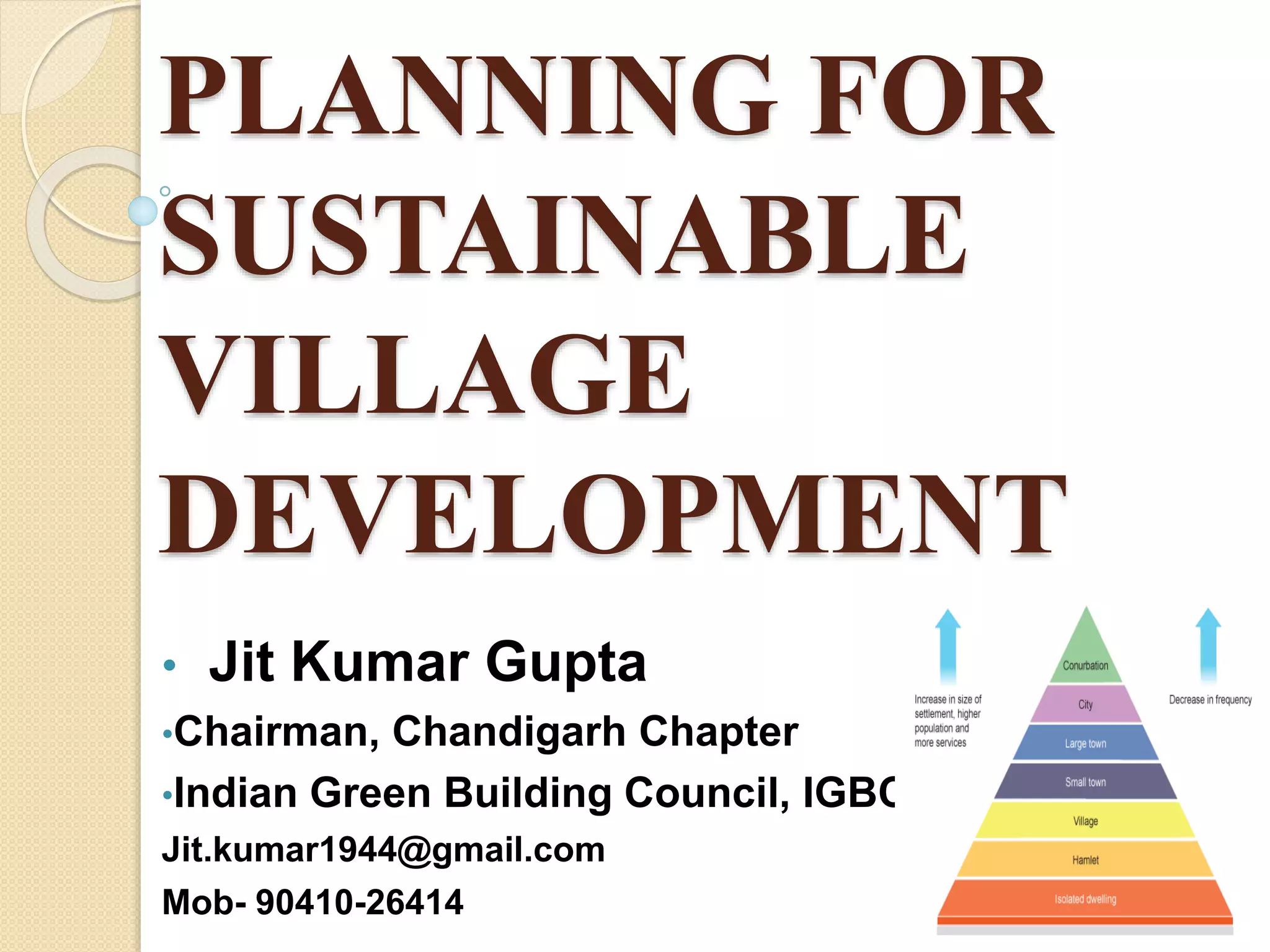
PLANNING FOR
SUSTAINABLE
VILLAGE
DEVELOPMENT
• Jit Kumar Gupta
•Chairman, Chandigarh Chapter
•Indian Green Building Council, IGBC
Jit.kumar1944@gmail.com
Mob- 90410-26414
Population Scenario- India-2011
 Population of India reached
 250 million in 1919
 500 million in 1966 (47 yrs. Later)
 1000 million in 2000 ( 34 yrs. Later)
 1027 million in 2001 (1yr Later)
 1210 million in 2011 (10 yrs. Later)
 2020– Indian Population -1380 M (35% )- 483 million_
 2050- Indian population- 1600 mil. -- 50% in Urban India.
 Metropolitan Centers -5 (1951)- -53 (2011)-68(2031)
 10 m plus- nil (1951)- 3 (2011) -7 (2031)-9 (2051
 Urban India --first time added more persons(91m) than Rural
India (90m) in last decade
 During last 100 years, India witnessed—
- -Urbanization level going up by 3 times
- --Urban settlements growing merely 4 times
- --Total Population multiplying 5 times
- -Urban population increasing 15 times and
- -Rural population increasing 3.5 times
 Increased population requires -- More housing, More
educational/ healthcare/ institutions
 More commercial space ,More transportation– More
infrastructure– more Resources
Hierarchy of Human Settlements
Population Distribution- India-2011
Urban Pop. Distribution(2011)377 m (31.1 %)-
7935 towns/cities
-Mega Cities with Pop > 10m - 4% of total pop
- Cities with Population 5-10m- 3%
- Cities with Population 1-5m- 6%
- Cities with Population 0.1-1m- 9%
- Cities with Population < 0.1 m- 9%
** Rural Pop Distribution(2011) 833 m ( 68.9%) -------
6,40, 867 villages ( Inhabited -5,99,608)
 236,004 Indian villages have a population < 500,
 while 4,681 villages have a population of 10,000
---- Very large (>10k), large villages(>5k)-17%( 23.54%)
-- Medium villages (2-5 k)— 24%( 34.63%)
--- Small villages (1-2000) — 17% (23.70%)
------Hamlets (500-1000) — 8% (12.39%)
---- Small Hamlets(<500)— -- 3% ( 5.74 %)
 2 out of 3 Indian lives in villages.
 Every 6th Indian lives in large villages
 6 out of 10 ruralites live in large and medium villages.
 Globally, Every ninth person lives in Indian Villages
Rural India-
Role and
importance
Rural India- Role and Importance
 “India lives in villages” -words of Mahatma
Gandhi many decades ago
 .Even after 90 years - data does not seem to
disagree
 House majority of Indian population -69% --
roughly one-eleventh of humanity
 almost 73% households-- still in rural areas
 Villages critical to India’s growth
 Despite decline in share of population- villages to
hold large population- more than 50% by 2050
 India- second largest urban/rural system globally
after China- with 6.4 lakh Villages Vs 0.08 lakh
towns/cities
 Provider of food;- daily/basic needs of human
living
Rural India--Contributions of Agriculture to GDP
 Agriculture contributes 14 % of India’s GDP,
 main source of income for 69 % of rural
population
 Agriculture - strongly influences
 -- food security
 --prices of food
 -- monetary wages.
 -- rural income & demand
 --supply of raw materials to several industrial
sectors
 Year-to-year --agricultural growth declining, – low
irrigated land /more rainfed land.
 1% decline in agricultural growth-- pulls back
industrial/ GDP growth by 0.52
Rural India-
Problems
Urban Vs Rural
 India Vs Bharat debate is not new.
 Urban –Rural divide debated for years
 Little progress--in bridging gap over last seven
decades
 Gap widening - when looking at;
 --physical,
 --socio-economic,
 --healthcare,
 --education indicators
 No city exists in isolation
 - invariably supported by large number of villages
 -- for sustaining urban activities/population
 --for meeting daily needs
 Cities/villages cannot be seen in isolation
 - two sides of same coin
Large Population
Declining share in GDP
 Rural India contribution of agriculture to GDP reduced from
51.88% in 1950 to 13.94% in 2013.
 --almost 69 % of population lives in rural areas
 50% labour force still dependant on agriculture,
 --Situation -- definitely not sustainable
Livelihood & Employment
 Almost three fourths of rural households—
 -- live with a monthly income of less than Rs 5000.
 -- More than half rural households-- do not own land
 - more than half of them casual labour..
 source--Socio- Economic and Caste Census

Poverty Estimates
 Though poverty reducing over time,
 -- poverty reduction in urban areas higher than rural
areas.
 -- nearly 26% of rural India is poor, compared to a
meagre 13.7% in urban areas.
Low level of Literacy
Low Literacy Levels
 Rural literacy rate lower than urban literacy rate
 Large gender disparity -- urban female literacy rate is
almost higher by 20% than the rural female.
Net Attendance –Rural Vs Urban- Low
 Net attendance --insight into education dynamics of India.
 rate of fall of net attendance -from primary to secondary much
steeper in rural areas.
 Reasons- lack of family commitment, migration, climate
induced disasters, famine and poverty.
Health Indicators- Poor Health
 Health said to be wealth of a society--best indicators of
well-being of population and human resources
development.
 Rural India lags behind Urban India in all the
indicators; Infant Mortality
Access to basic services- Poor
Problems- water
POOR QUALITY HOUSING
Unorganized Marketing
Problems- Rural India
 Large population base -69%
 High degree of Poverty ( Majority of rural India lives on Rs 35 per day)
 Lack of sanitation - adverse impact on health;
 Low level of literacy-- Low level of gainful employment
 Low level of skill
 Low land man ratio-2.4 Vs 17.7;
 Inadequate level of basic infrastructure /services /amenities- water supply,
sanitation, drainage, power, SWM
 Agriculture largely rainfed--Low level of irrigation facilities
 Poor quality of Housing- Katcha, temporary
 Haphazard and unplanned development
 Low level of Healthcare & Educational facilities
 Poor quality of living environment
 Poor accessibility to urban markets
 Low order of rural industries
 High degree of indebtedness
 High water pollution-
 Loss of soil /desertification-- due to erosion, Overgrazing / deforestation
 - Large number of Villages -Prone to Natural Hazards
Options for making
Rural India- livable,
sustainable, green,
inclusive and safe
Planning Villages
-Need
-MORD
-Objectives
-SWOT Analysis
Need for Village Planning
 Villages Critical for scripting growth/ development of
India
 In the words of Mahatma Gandhi- father of nation-
‘ India lives in villages . India will prosper if villages
prosper, if villages perish India will perish too”
 Former President- Dr Kalam- gave the concept of
 PURA- ( Providing Urban Amenities in Rural areas)--
--to make villages usherers of new era of India
regeneration --for making India vibrant -Physically,
socially, environmentally /economically
 Villages need planned developed / management;
 -- in a holistic manner to ensure;
 -- provision of basic amenities/ services essential for
human living
 - adequate opportunities of gainful employment
 - assured quality of life
Ministry of Rural Development
 Organization-- two departments
 Department of Rural Development &Deptt. Land Resource.
 Vision--sustainable / inclusive growth of rural India through a
multipronged strategy for-- eradicating poverty by ;
 --increasing livelihoods opportunities,-- providing social safety net
 -- developing infrastructure for growth. --improving quality of life in rural
India- correcting developmental imbalances, --reaching most
disadvantaged
 Schemes– 7 Major programs operated by Ministry in rural areas;
i. Mahatma Gandhi National Rural Employment Guarantee Act (MGNREGA) for
employment,
ii. National Rural Livelihoods Mission (NRLM) for self employment and skill
iii. Housing for All : Pradhan Mantri Awaas Yojana - Grameen (PMAY-G) for
households,
iv. Pradhan Mantri Gram Sadak Yojana (PMGSY) for construction of quality
v. National Social Assistance Programme (NSAP) for social pension,
vi. Shyama Prasad Mukherjee RURBAN Mission,
vii.Integrated Watershed Management Programme (IWMP) for improving the
 schemes for capacity development of rural functionaries; Information,
Communication; and Monitoring and Evaluation.
Ministry of Rural Development
 Budget
 Budget outlay of Rs. 86000 crore -- provided
Financial Year 2016-17. additional of Rs. 9000
later making provision to Rs. 95000 crores.
 Budget outlay of Rs. 105447.88 crores allocated
Year 2017-18 and
 Budget outlay of Rs. 112403.92 crores allocated
Year 2018-19 and
 Budget outlay of Rs. 117647.19 crores allocated
Year 2019-20. and
 Budget outlay of Rs. 120147.19 crores allocated
Financial Year 2021-22.
Need for Village Planning
Villages have great potential for ;
 -providing simple/healthy/cost-effective living
 Leveraging national Economy
 Providing gainful employment to more than 2/3rd work
force
 Eradicating poverty- 365 million
 Providing quality of life to majority of Indians
 Minimizing migration-- to urban areas
 Controlling -unregulated population growth in urban
areas
 Minimizing slums/houselessness -- in urban sector
 Ensuring-- housing for all
 Promoting-- planned development in India
 Taking care of majority of urban ills
Village Planning- Objectives
Village Planning should revolve around/aim at--:Empowerment,
enablement, accountability of Panchayati Raj Institutions – for
inclusive development with social justice,/ efficient delivery of service
 Promoting-- holistic development of Villages
 Preventing -- distress migration from Rural areas to urban areas--
 Guaranteeing -- a decent standard of living.
 Providing -- basic amenities/facilities
 Making village “hub”- to attract resources for development
 Providing easier, faster/ cheaper-- access to urban markets-
 Offering Remunerative price of agricultural produce/ commodities
 Making villages self- sufficient-- in day- to- day needs
 Economic empowerment- sharing of resources
 Social empowerment -- engaging all sections of community in the task
of village development.
 Creating sustainability- a culture of cooperative living for
 inclusive & rapid development.
 Improving Village environment/ Ecology
 Promoting Planned Development
 Making Village self-reliant -- energy/ resources
 Promoting integrated urban –rural growth
SWOT - Analysis
Opportunities
Weakness
 Rich natural resources
 Good Natural attributes
 Cultural strength
 Provider of food/basic human needs
 Provider of raw material for industries
 Large population base
 Sustainer of economy
 Considerable contribution to GDP
 Small and compact social fabric
 Lack of infrastructure/services
 Poor accessibility/Areas of neglect
 Low land holding/ high social divide
 Lower order of literacy/ low level of skill
 Poor educational /healthcare facilities
 High dependence on agriculture
 -outdated agricultural practices
 Poor housing/ Poor quality of life
 Poor capacity to plan/ develop
 Poor financial health/low wages
 High degree of poverty/unemployment
Strength
For making agriculture more productive
Skilling India, Promoting higher growth
rate-- making India economically vibrant
•Eradicating poverty
•Providing gainful employment for all
•Promoting economical/cost-effective
development
• Improving connectivity between urban /
rural areas-synergizing urban-rural growth
• Making growth of urban Centers rational
• Promoting operational efficiency of
urban /rural settlements
Threats--Neglect of rural areas will
lead to---Chaos, unemployment, poverty,
poor health, lower quality of life,
development paralysis, haphazard
/unplanned urban development, large
scale migration, neglect of agriculture,
food scarcity, food insecurity decline of
industrial productivity, loss of large rural
market, Rapid growth of slums
Options for making
Rural India- Vibrant—
Promoting
- 73rd CAA, 1992
Regional Planning
-District Planning
-Metropolitan Area Planning
-Aspirational Districts
-Ru-Urban Mission
73rd
Constitutional
Amendment
Act, 1992-Rural
73rd Constitutional Amendment Act, 1992-Rural
The Panchayati raj system is a ;
--3-tier system with
-- elected bodies at --village,
--taluk/ block/ district levels.
--System based in part on ;
--traditional {Panchayati raj. Panchayat governance}
for
-- Decentralisation/empowering local institutions
-- harmonizing centralized Indian governmental
administration-- with a degree of local autonomy.
-- for greater people participation in local
government
-- more effective implementation of rural development
programs.
73RD amendment calls for- having a duly elected -
- gram panchayat -- for each village or group of
villages,
-- Block level council—Block Samiti and
PANCHAYATI Raj system in india- Features
--Gram Sabha or village assembly ---as foundation of Panchayati Raj
System.
--73rd Amendment empowered Gram Sabhas to conduct social audits in
addition to its other functions
-- All seats in a Panchayat at every level are to be filled by elections .
--Not less than one-third of total seats--- for membership / chairpersons--
reserved for women.
--- Reservation for weaker caste --(SCs and ST– based on proportion of
their population
---- a State Election Commission --To supervise, direct / control--
elections to Panchayats-
--Constitution of a State Finance Commission in every State/UT, for every
five years--- to suggest measures to strengthen finances of panchayati raj
institutions.
-- To promote bottom-up-planning-- the District Planning Committee (DPC)
in every district– accorded constitutional status.
-- 29 fuctions given in Eleventh Schedule of Constitution- for
Panchayats
-- Panchayats to play an effective role in planning/ implementation of
works related them
ELEVNTH SCHEDULE
1. Agriculture, including agricultural extension.
2. Land improvement, implementation of land reforms, land consolidation
3. Minor irrigation, water management and watershed development
4. Animal husbandry, dairying and poultry.
5. Fisheries 6. Social forestry and farm forestry
7. Minor forest produce.
8. Small scale industries, including food processing industries
9. Khadi, village and cottage industries. 10. Rural housing.
11. Drinking water 12. Fuel and fodder.
13. Roads, culverts, bridges, ferries, waterways/other means of communication
14. Rural electrification
15- Education including primary and secondary schools
16 Non- conventional sources of energy 17. Technical Training and vocational
education 18. Public distribution system
19. Adult and non-formal education. 20 Maintenance of public assets
21. Cultural activities 22. Markets and fairs
23. Health and sanitation, including hospitals, primary health centers and
dispensaries 24. Family welfare. 25. Women and child development.
26. Social welfare, including welfare of the handicapped and mentally retarded.
27. Welfare of the weaker section
28 Public distribution system
29. Poverty Alleviation programmes
Regional Planning
Globally--Most progressive countries/states/ cities
- adopted Regional perspective for :
---Integrating urban and rural settlements
--for Minimizing migration
--Making urban development-- more rational / sustainable
--Promoting co-operation & collaboration; between urban-rural areas
- Minimizing local competition /conflicts,
- Infrastructure optimization between neighboring cities/rural
settlements,
-- Preventing disasters,
-- Promoting / protecting regional ecology / bio-diversity,
-- Providing recreational activities
-- Overcoming confusion over role / responsibilities of various agencies.
-- Achieving integration and decentralized planning--
• Regional Planning optimizes Regional resources
by--
-- promoting synergies between rural & urban areas
-- connecting villages/cities through a well defined settlement hierarchy
-- using developmental potential of each settlement
-- making them more sustainable
Regional Planning- National Capital
Region
.
District Planning&
Metropolitan
Planning, Planning
for Aspirational
Districts
District Planning - DPC
• 73rd/74th CAA,1992- Landmark legislation- Rural/Urban
Empowerment- promoting Decentralization- Setting of
DPC/MAPC
•District Planning vital for growth of Rural India
•- creating synergies between villages/ cities at district level
•Committee for District planning- comprising of elected
representatives -- Constituted at district level
•- Considers District as Regional Planning Unit
-- for consolidating plans prepared by all Panchayats/
Municipalities
-- prepare draft development plan for district as a whole.
- Villages lack manpower/knowledge/ resources to prepare
village development plans
-DPC has no manpower for planning at distinct level
-- DPC needs strengthening/empowerment
-- Besides preparing Draft District Development Plan ;
-Should also be involved in implementation
-District Town Planning office to provide assistance/ support
Metropolitan Planning- MPC
243ZE. Metropolitan Planning Committee -constituted foR
Metro Area
– to prepare Draft development plan for Metropolitan area –
- ------------Consolidating both rural- urban settlements
(a) Metropolitan Planning Committees to consist of:
-- not less than two-thirds of members elected
from Municipalities/ Chairpersons of Panchayats in
Metropolitan area--
-(d) functions relating to planning / coordination for
Metropolitan assigned to such Committees;
- MPC has no manpower for planning at Metropolitan level
-- MPC -- needs strengthening and empowerment
-- Besides preparing Draft Metropolitan Development Plan
--Should also be actively involved in implementation
-- Conflict between District Planning & Metro Planning need
Resolution
Development of Aspirational Districts-
options
 117 out of 742 districts—identified as Aspirational district by
NITI Aayog—640(2001) & 593(1991)
 -- based upon indicators from—
 Health & Nutrition, Education, ;Agriculture & Water Resources,
Financial Inclusion/Skill Development/ Basic Infrastructure --
having impact on Human development Index.
 India -need adopt a policy of Ruralization rather
than Urbanization
 Treating backward districts-- not a physical
problem but human problem
 where people suffered for centuries -- due to
exclusion , poverty, acute deficiency of basic
amenities and neglect
 States neto rationalize structure of backward
districts-- based on a detailed study and
analysis
Development of Aspirational Districts-
options
 Implementing on priority- provisions of District Planning /
Metropolitan Planning ,envisioned in - 73rd and 74th
Constitutional Amendment Act , 1992
 - promoting rational /economical development of districts.
 -- Districts made a critical planning/ development Unit for;
-- equitable distribution of resources
-- integrated development of urban / rural areas ,
-- removing disconnect between urban/ rural settlements
- Promoting-- integrated development
--Rational Distribution-- of population
--Rational Distribution --of economic activities/ industry
- -- Sharing -- of infrastructure/services
- -- Economizing on development
- -- Avoiding overlapping/ duplication of development efforts
- - Generating Resources

PROMOTING
RU-URBAN
MISSION
Ru-urban mission- Genesis
 Large number of rural settlements exist in India as--Part
of a cluster of settlements
 --relatively proximate to each other.
 -- illustrate potential for growth,
 have economic drivers/locational / competitive
advantages.
 -- making them into clusters-- 'Rurban'.
 Government of India, proposed -- Shyama Prasad
Mukherji Rurban Mission (SPMRM) aimed at;
 -- developing rural areas–
 --providing economic social /physical infrastructure
facilities.
 -- development of 300 Rurban clusters,-- in next five years.
 -- clusters strengthened with --amenities/ resources
 -- mobilized through convergence of schemes of
Ru-urban mission- Vision
 National Rurban Mission (NRuM)
follows vision of;
 -- "Development of a cluster of villages
 -- that preserve and nurture
 -- essence of rural community life
 -- with focus on equity and
inclusiveness
 -- without compromising with facilities
 -- perceived essentially urban in nature,
 -- creating a cluster of "Rurban Villages
Ru-urban Mission's- OBJECTIVES/Outco
 Objective of National Rurban Mission (NRuM)
to;
 -- stimulate local economic development
 -- enhance basic services, and
 -- create well planned Rurban clusters
 -- Bridging rural-urban divide--- economic,
technological, facilities / services.
 -- Stimulating local economic development
focussing on;
 -- reduction of poverty / unemployment --in
rural areas.
 -- Spreading development in region.
Ru-urban Cluster
 A ‘Ru-urban cluster', would be -- a cluster of
--geographically contiguous villages with;
 -population of 25000 to 50000 in plain/coastal
areas and
 -- 5000 to 15000 in desert, hilly/ tribal areas.
 --Clusters of villages – to follow administrative
convergence units of Gram Panchayats
 --within a single block/ tehsil for administrative
convenience.
 -- formed by identifying geographically
contiguous villages/gram panchayats
 --within a radius of 5–10 km (or radius
appropriate to population density /geography
of region)
 -- around identified growth centre
RU-URBAN MISSION- COMPONENTS
 Skill Development --training Linked to Economic
Activities
 Agri- Services and Processing Support-- to
Agriculture /Allied Activity
 Digital Literacy --(access to digital resources for all
citizens
 24 x 7 Piped-- Water Supply
 Sanitation
 Solid waste / liquid management / Vermi compost Pit
 Metalling Village Streets with Drains
 Creating Fully equipped Mobile Health Unit
 Up- gradation of primary/secondary /higher
secondary schools
 Promoting Inter- village roads connectivity/ Public
transport
 . Citizen Service Centres- for electronic delivery of
Methodology for
Village Planning
Key Elements of Model Village Plannin
Village Plan should essentially focus on:
-- Promoting planned development-- based on local climate/culture
-- Making Village– self- sufficient in all daily basic needs of human living
--Providing- appropriate quality of life
-- Creating opportunities- for gainful employment/economic growth
-- Promoting community living / co-operative /community farming
-- Providing housing for all –adequately lighted/ventilated
--Providing clean water, sanitation, drainage, solid waste management
--accessibility through Metalled approach roads/ internal stree
-- creating common spaces- & Community buildings -- healthcare/
education , janjghar, Panchayat ghar etc- creating self-sufficiency in
Energy
--Providing E- Sampark kendra, vocational /learning centre
--Creating Space for village/cottage /agro based industries, shops etc for
day to day needs/agro products/dairy farming
--Adopting self help approach/Creating self-help Groups- using local
resources
-- creating - open spaces/parks/water bodies- Using low lying areas
--Using green energy from solar/gobar for promoting clean environment,
water /energy self-sufficiency
– Asset maintenance / management, environment/soil management
-Methodology for village planning
-- different in approach/ intent /contents- when compared to
urban planning.
-Village planning based on;
-Empowering people, communities / local institutions
--based on local initiative consultative/ participatory
mechanism
-- using simple/direct technique,
-- involving all stakeholders.
-- making - time bound, quick/simple decisions/actions
i. Holding Exploratory meeting with Panchayat for:
-- briefing about project ,
-- Defining aim & objectives /scope,
-- making value addition to village,
-- planning & development,
--processes / methodology to be followed
-- for implementation and
--consent for going ahead with project.
Methodology for village Planning
Ii. Approval from Panchayat
Iii. Calling meeting of Gram Sabha involving all residents
for:
-- explaining the project,
-- its benefits,
-- understanding the problems,
--identifying needs and priorities
--understanding their vision,
-- promoting participatory mechanism,
-- sourcing suggestions and
obtaining approval of the residents.
- role of residents,
iv. Creating a Think Tank comprising --elders, NGO,
Panchayat for aiding/advising about plan preparation and
implementation.
---Carrying out a SWOT Analysis
V Carrying out a;
-- socio-economic, demographic survey
-- asking for priorities of development/infrastructure .
VI Creating a physical map of the village defining --
-- location/conditions of houses
-- community buildings,
-- public buildings
-- Mapping services--sewerage, roads,
--- sanitation/ storm/waste water drainage, network
-- street lights(if any) etc
vii. Preparing inventory of:
-- problems,
--deficiency in infrastructure,
---amenities,
-- additional facilities needed etc
viii. Making projections/forecast for next 5 years for
population, housing and other infrastructure, services etc
x Preparing Draft Development Plan of Village based
on:
-- studies made
-- analysis carried out,
--vision and priorities defined ,
-- problems identified,
--Understanding needs/ requirements of village
-projections made for -- development / amenities /
services
--rough estimates / cost of development.
x. Sharing Draft Development Plan with:
-- Think Tank and
-- Panchayat
-- for approval in principal
for placing before Gram Sabha.
•xii. Development works to comprise --
*Water Supply
*Sewerage
* Streets
*Drainage
* Street Lighting
Toilets in houses/ community latrines
* Water Bodies
*Afforestation, Landscaping of open spaces--Plantation of Trees
*Construction of Panchayat Ghar / Community Centre
*Providing dispensary for Residents/ animals
*School &Library
* Creating Vocational Centre/ Anganwari/ adult education centre
*Krishi Vigyan Kendra – -for sale of essential agricultural inputs, seeds,
--latest information about prices/marketing options of agricultural
produce,
--new options for crop/agriculture diversification, weather forecast and
--innovations in agriculture,
* Co-operative Banking &
E-Samparak Kendra
XIV Village development Plan shall essentially be taken up as a joint
venture of all :
-- stakeholders involving residents,
-- Panchayat,/ Panchayat officials
--Think Tank,
-- NGOs,
--state/ local rural development agencies
--corporate agencies etc
-- for formulation / implementation of Plan --Plan is reviewed
periodically to meet emerging village demand
XV Methodology for Financing
Funding of development works to be through:
--Funds made available by state
- Income of Panchayat from its own resources
-- Grant- in- aid by state,
--funds made available by Panchayat , MPLAD/MLA
-- funds available under different state/ local level rural development schemes,
-- contribution by villagers ,
- Funds from Self- Help Groups
-- Individual Donations/contributions
-- international agencies – Funding viability gap
Strategy for Different Villages
 However, different planning, development strategies
would be required for planning differently situated
Villages
 Urban Villages- made integral part of urban planning
and development strategies with well defined planning
norms/standards- creating tourism potential. Part of
funds generated from urban development used for urban
villages
 Urbanisable Villages- Villages provided with all urban
facilities for easier future integration with urban areas-
through well defined norms/ planned development-
supported by the concerned urban centre
 Rural Villages—To be developed as villages with basic
amenities/infrastructure/ employment through producing
day to day goods needed for urban living- vegetables,
dairy products, fruits/ vegetables etc- self-contained
villages
 Villages falling in hill areas and plains/desert/coastal
Greening
Rural
development
in India
Strengthened climate resilience of
communities:
 . Greening rural development schemes through --Afforestation, plantations,
fodder development and vegetation belts in coastal areas help--
 -- promote resilience of rural population/ production systems,
 -- reduce risks from climatic variations/ droughts, floods/ cyclones.
 -- build livelihood resilience
 -- improve local communities’ coping capacity;
 -- reduce potential impacts of climate change.
 -- increase biodiversity
 -- make local ecosystems more resilient.
 -- enhance resilience in flood-prone areas.
 : Large scale Forestry ;
 soil conservation ;
 afforestation,
 plantations / vegetation can
 -- sequester carbon
 -- reduce greenhouse gas emissions.
 -- contribute to national / global efforts to address climate change
Greening Rural Development in India
Greening does more than just
improve the environment—it
contributes to better economic
growth
Greening rural development --will
lead to five broad green outcomes:
• inclusive growth
• Improved natural resource
conservation,
• increased efficiency of resource
use,
• reduced negative environmental
impacts,
• strengthened climate resilience of
communities and
• contribution to climate change
mitigation.
Greening rural development -- will contribute to---
inclusive local growth by:
• Improving agricultural productivity
through increased yield response to
fertilizers and water availability for
irrigation
• increasing incomes for the rural poor
through green value-chains and markets
• increasing returns on investment
through improved ecosystem services in
aquaculture, fisheries and infrastructure
in flood prone regions
• Reducing economic costs from natural
disasters by strengthening local resilience
• increasing private investment in clean
technology and green resources
Greening will provide new
business opportunities for rural
entrepreneurs
• Conserving water quality
and quantity through
increased water use
efficiency in agriculture,
construction and drinking water
and by reducing the pollutant load
in sanitation waste
• improving vegetative cover
and biodiversity
• reducing soil erosion and
increasing soil carbon
Greening will help to conserve
groundwater in hard-rock
regions, which occupy 70% of
India’s landmass
Greening rural development will improve---
environmental sustainability --in three ways by:
• Reducing the impact of drought through
water harvesting, resilient cropping and
secure drinking water and fodder supply
• Reducing the impact of floods through
better drainage, resilient cropping and
flood resilient systems for drinking water
and sanitation services
• Reducing the disease burden
through safe disposal of sanitation waste
and water contaminants, cleaner habitats
and less use of chemical fertilizers
• Conserving biodiversity and
protecting sustenance resources for
the rural poor, including health and shelter
inputs and productive resources including
fibres, dyes, oils and resins
Greening will significantly
reduce cattle and
agricultural losses from
drought and flooding
Greening rural development to make--
Communities more resilient --to natural disasters
in four ways by:
Greening rural development –make public
expenditure more effective over the medium term
in five ways by:
• Making assets created through public
expenditure more durable
• Reducing outlays on schemes aimed at
poverty reduction through better
livelihoods for the poor and better food
and nutrition security
• Reducing the need to reinvest in water
provision in ‘slipped back’ habitations
• Reducing expenditure on relief and
recovery in disaster prone communities
• Reducing need for subsidies on fossil
fuels because of improved energy use
in housing, roads, water supply and on
fertilizers because of improved soil
fertility and increased use of non-
chemical fertilizers
Greening is likely to have a
positive impact on public
expenditure over the medium-
term
MGNREGP can be greened by:
• Preparing a perspective plan for every
Gram Panchayat incorporating
landscape and watershed based
planning
• Strengthening capacities of Gram
Panchayats to develop green
proposals and monitor green results
• Strengthening the capacities of block
level officials to help implementing
partners deliver green results
• Developing an MGNREGS green index
to monitor green impact
• Incentivizing Gram Panchayats to
reach threshold level on Green index
Greening Indira Awas Yojna -will increase resource
use efficiency / reduce negative environmental impact and
will help to:
 increase resource use-
efficiency in housing
construction through better use
of building materials, water, energy
 increase environment
sustainability--through increased
use of renewable building materials
including bamboo and wooden
structures
 Reduce negative
consequences through less use
of water and energy in housing
construction
Indira Awas Yojna can be greened by:
• Preparing region-specific
Handbooks of Green Building
Designs including green
construction materials
• Establishing district level Building
Resource Centres to promote green
technologies
• Developing an IAY Green Index to
measure, monitor and report on
green results
• Providing an additional subsidy to
families building housing units that
score above threshold on the green
index
• Providing additional funds to
districts committing to green
housing units under IAY
Greening National Rural Drinking Water Program
will help to conserve /regenerate resource base /reduce water
wastage and will:
 improve sustainability of
drinking water sources
 increase use of renewable
energy through solar pumps,
energy-efficient pumps and
gravity-based systems
 promote technologies for
treating contamination to
ensure zero sludge generation
and safe sludge disposal
 promote roof rain water
harvesting
SUCCESS
STORIES
Village Dharnai –Bihar- Solar Power
Once struggling to get basic electricity - Dharnai-- first village in India to
completely run on solar power. Used diesel-based generators / cow dung to meet
electricity requirement -- costly and unhealthy. Launched solar-powered 100
kilowatt micro-grid in 2014, quality electricity provided to more than 2,400 people
living .
Payvihir– Maharashtra-Organic Forest,Fruits
Turning a barren, 182-hectare land under community forest right, into a
forest.— village started growing & selling organic Sitafals (custard
apples) and Mangoes in Mumbai under their brand Naturals Melghat!
Hiware Bazaar, Maharashtra- Water management
.Facing water shortage village decided to shun water-intensive crops
opted for horticulture / dairy farming. Consistent water conservation led to rising
groundwater levels and village started to prosper. Today, village has 294 open
wells-- brimming with water & prosperity. -village never called a single water
tanker since 1995. village has 60 millionaires& highest per-capita income in
Odanthurai, Tamil Nadu-Solar/Wind Energy
Panchayat generating electricity for own use,/ also selling to Tamil Nadu
Electricity Board---already won international acclaim through unique
welfare schemes / energy self-sufficiency drives, Village trying a corpus
of Rs 5 crore- to install wind /solar energy farms--enable free supply of
electricity to over 8,000 residents.
Khonoma, Nagaland-First Green Villag
India’s first green village.--perfectly terraced fields, this unique, self-
sustaining village- Protects and conserves natural habitat. Hunting is
banned in village. -- Village practices its own eco-friendly version
of jhum agriculture that enriches the soil.
Punsari, Gujarat- Technology driven Villag
Punsari village,-- Closed-circuit cameras, water purifying plants, biogas
plants, air-conditioned schools, Wi-Fi, biometric machines – village has it
all- done in eight years, at a cost of Rs. 16 crore. The man Transformation
by its young tech-savvy sarpanch – 33-year-old Himanshu Patel – who
states that his village offers “the amenities of a city but the spirit of a
Mawlynnong, Meghalaya- Cleanest
village
 plastic is banned--spotless paths lined with flowers-- bamboo
dustbins stand at every corner, --volunteers sweep streets at regular
intervals -- large signboards warn visitors against littering. --
Cleanliness is a ritual – from tiny toddlers to toothless grannies –
Thanks to village community, --village Known as cleanest village in
India /Asia.
Piplantri, Rajasthan- Saving girls&
Trees
Village Panchyat saving girl children and increases green cover ---plants
111 trees every time a girl is born --ensures these trees survive,-- attaining
fruitation as girls grow up. - set up a fixed deposit for girls - parents sign
an affidavit-- that ensures their education.-During last nine years, people
planted over a quarter million trees on village’s grazing commons. To
prevent trees from being infested with termite,-planted over 2.5 million
aloe-vera plants around them. Trees/aloe vera, are a source of livelihood
for several residents.
Consultation; Collaboration, Co-Operation
Preserve /Develop Water Bodies
Conclusions
 Even after almost 7 decades of independence,
 existing policies taken a toll on rural India.
 villages development taking a backseat
 Created an economy of- rich cities and poor villages,
 -- surging urban areas and decaying rural areas.
 Need for ---
 Creating balance/synergies between urban /rural development
 Making Urban & Rural areas supportive of each other -
Physically, socially, economically , structurally, culturally and
financially
 Sharing amenities/facilities between urban and rural areas
 Creating appropriate level of employment for all in rural India
 Removing poverty by-- Skilling rural India, making agriculture
more productive; more scientific , more skilled-
 Reducing dependence on agriculture
 Prioritizing Planned development- of both rural & urban areas-
using Regional Planning, followed by Rural/urban Planning
 Providing basic amenities / facilities to all
Conclusions
 Promoting culture of co-operation/ sharing in villages-
for doing all activities
 Leveraging technologies -- for skilling, employment
 Making villages self-sufficient -- in all day-to-day
requirements
 Promoting education / literacy-- for all
 Making rural planning/development-- integral part of
academics at all level in urban/rural areas
 Creating skilled manpower-- for planning / development
of rural areas
 Running specialized courses --for rural development
 Involving all educational institutions-- in process of rural
development
 Adopting villages -- by academic institutions for planning
/ development
 Institutions imparting architecture/Engineering
educations-- to lead by adoption
Conclusions
 Promoting agriculture-- based on crop diversification/
growing cash crops
 Promoting water conservation /preservation
 Adopting green practices-- for development based on
nature
 Promoting solar/gas based energy-- for lighting and cooking
 Promoting agro-based industries-- for making value addition/
generating employment
 Implementing 73 rd CCA in letters & spirits
 Implementing Ru-urban mission pan India
 Converging all missions at local level
 Empowering village panchayats-- involving communities
 Involving professionals- Architects/planners/
engineers/economists-- in framing District/ Metropolitan
plans based on the concept of Regional Plans.
 Creating self help groups-- for planning /implementation of
projects
THANKS
THANKS
THANKS

Planning for villages -

  • 1.
    PLANNING FOR SUSTAINABLE VILLAGE DEVELOPMENT • JitKumar Gupta •Chairman, Chandigarh Chapter •Indian Green Building Council, IGBC Jit.kumar1944@gmail.com Mob- 90410-26414
  • 3.
    Population Scenario- India-2011 Population of India reached  250 million in 1919  500 million in 1966 (47 yrs. Later)  1000 million in 2000 ( 34 yrs. Later)  1027 million in 2001 (1yr Later)  1210 million in 2011 (10 yrs. Later)  2020– Indian Population -1380 M (35% )- 483 million_  2050- Indian population- 1600 mil. -- 50% in Urban India.  Metropolitan Centers -5 (1951)- -53 (2011)-68(2031)  10 m plus- nil (1951)- 3 (2011) -7 (2031)-9 (2051  Urban India --first time added more persons(91m) than Rural India (90m) in last decade  During last 100 years, India witnessed— - -Urbanization level going up by 3 times - --Urban settlements growing merely 4 times - --Total Population multiplying 5 times - -Urban population increasing 15 times and - -Rural population increasing 3.5 times  Increased population requires -- More housing, More educational/ healthcare/ institutions  More commercial space ,More transportation– More infrastructure– more Resources
  • 4.
    Hierarchy of HumanSettlements
  • 5.
    Population Distribution- India-2011 UrbanPop. Distribution(2011)377 m (31.1 %)- 7935 towns/cities -Mega Cities with Pop > 10m - 4% of total pop - Cities with Population 5-10m- 3% - Cities with Population 1-5m- 6% - Cities with Population 0.1-1m- 9% - Cities with Population < 0.1 m- 9% ** Rural Pop Distribution(2011) 833 m ( 68.9%) ------- 6,40, 867 villages ( Inhabited -5,99,608)  236,004 Indian villages have a population < 500,  while 4,681 villages have a population of 10,000 ---- Very large (>10k), large villages(>5k)-17%( 23.54%) -- Medium villages (2-5 k)— 24%( 34.63%) --- Small villages (1-2000) — 17% (23.70%) ------Hamlets (500-1000) — 8% (12.39%) ---- Small Hamlets(<500)— -- 3% ( 5.74 %)  2 out of 3 Indian lives in villages.  Every 6th Indian lives in large villages  6 out of 10 ruralites live in large and medium villages.  Globally, Every ninth person lives in Indian Villages
  • 6.
  • 7.
    Rural India- Roleand Importance  “India lives in villages” -words of Mahatma Gandhi many decades ago  .Even after 90 years - data does not seem to disagree  House majority of Indian population -69% -- roughly one-eleventh of humanity  almost 73% households-- still in rural areas  Villages critical to India’s growth  Despite decline in share of population- villages to hold large population- more than 50% by 2050  India- second largest urban/rural system globally after China- with 6.4 lakh Villages Vs 0.08 lakh towns/cities  Provider of food;- daily/basic needs of human living
  • 8.
    Rural India--Contributions ofAgriculture to GDP  Agriculture contributes 14 % of India’s GDP,  main source of income for 69 % of rural population  Agriculture - strongly influences  -- food security  --prices of food  -- monetary wages.  -- rural income & demand  --supply of raw materials to several industrial sectors  Year-to-year --agricultural growth declining, – low irrigated land /more rainfed land.  1% decline in agricultural growth-- pulls back industrial/ GDP growth by 0.52
  • 9.
  • 10.
    Urban Vs Rural India Vs Bharat debate is not new.  Urban –Rural divide debated for years  Little progress--in bridging gap over last seven decades  Gap widening - when looking at;  --physical,  --socio-economic,  --healthcare,  --education indicators  No city exists in isolation  - invariably supported by large number of villages  -- for sustaining urban activities/population  --for meeting daily needs  Cities/villages cannot be seen in isolation  - two sides of same coin
  • 11.
  • 12.
    Declining share inGDP  Rural India contribution of agriculture to GDP reduced from 51.88% in 1950 to 13.94% in 2013.  --almost 69 % of population lives in rural areas  50% labour force still dependant on agriculture,  --Situation -- definitely not sustainable
  • 13.
    Livelihood & Employment Almost three fourths of rural households—  -- live with a monthly income of less than Rs 5000.  -- More than half rural households-- do not own land  - more than half of them casual labour..  source--Socio- Economic and Caste Census 
  • 14.
    Poverty Estimates  Thoughpoverty reducing over time,  -- poverty reduction in urban areas higher than rural areas.  -- nearly 26% of rural India is poor, compared to a meagre 13.7% in urban areas.
  • 15.
    Low level ofLiteracy
  • 16.
    Low Literacy Levels Rural literacy rate lower than urban literacy rate  Large gender disparity -- urban female literacy rate is almost higher by 20% than the rural female.
  • 17.
    Net Attendance –RuralVs Urban- Low  Net attendance --insight into education dynamics of India.  rate of fall of net attendance -from primary to secondary much steeper in rural areas.  Reasons- lack of family commitment, migration, climate induced disasters, famine and poverty.
  • 18.
    Health Indicators- PoorHealth  Health said to be wealth of a society--best indicators of well-being of population and human resources development.  Rural India lags behind Urban India in all the indicators; Infant Mortality
  • 19.
    Access to basicservices- Poor
  • 20.
  • 21.
  • 22.
  • 23.
    Problems- Rural India Large population base -69%  High degree of Poverty ( Majority of rural India lives on Rs 35 per day)  Lack of sanitation - adverse impact on health;  Low level of literacy-- Low level of gainful employment  Low level of skill  Low land man ratio-2.4 Vs 17.7;  Inadequate level of basic infrastructure /services /amenities- water supply, sanitation, drainage, power, SWM  Agriculture largely rainfed--Low level of irrigation facilities  Poor quality of Housing- Katcha, temporary  Haphazard and unplanned development  Low level of Healthcare & Educational facilities  Poor quality of living environment  Poor accessibility to urban markets  Low order of rural industries  High degree of indebtedness  High water pollution-  Loss of soil /desertification-- due to erosion, Overgrazing / deforestation  - Large number of Villages -Prone to Natural Hazards
  • 24.
    Options for making RuralIndia- livable, sustainable, green, inclusive and safe
  • 25.
  • 26.
    Need for VillagePlanning  Villages Critical for scripting growth/ development of India  In the words of Mahatma Gandhi- father of nation- ‘ India lives in villages . India will prosper if villages prosper, if villages perish India will perish too”  Former President- Dr Kalam- gave the concept of  PURA- ( Providing Urban Amenities in Rural areas)-- --to make villages usherers of new era of India regeneration --for making India vibrant -Physically, socially, environmentally /economically  Villages need planned developed / management;  -- in a holistic manner to ensure;  -- provision of basic amenities/ services essential for human living  - adequate opportunities of gainful employment  - assured quality of life
  • 27.
    Ministry of RuralDevelopment  Organization-- two departments  Department of Rural Development &Deptt. Land Resource.  Vision--sustainable / inclusive growth of rural India through a multipronged strategy for-- eradicating poverty by ;  --increasing livelihoods opportunities,-- providing social safety net  -- developing infrastructure for growth. --improving quality of life in rural India- correcting developmental imbalances, --reaching most disadvantaged  Schemes– 7 Major programs operated by Ministry in rural areas; i. Mahatma Gandhi National Rural Employment Guarantee Act (MGNREGA) for employment, ii. National Rural Livelihoods Mission (NRLM) for self employment and skill iii. Housing for All : Pradhan Mantri Awaas Yojana - Grameen (PMAY-G) for households, iv. Pradhan Mantri Gram Sadak Yojana (PMGSY) for construction of quality v. National Social Assistance Programme (NSAP) for social pension, vi. Shyama Prasad Mukherjee RURBAN Mission, vii.Integrated Watershed Management Programme (IWMP) for improving the  schemes for capacity development of rural functionaries; Information, Communication; and Monitoring and Evaluation.
  • 28.
    Ministry of RuralDevelopment  Budget  Budget outlay of Rs. 86000 crore -- provided Financial Year 2016-17. additional of Rs. 9000 later making provision to Rs. 95000 crores.  Budget outlay of Rs. 105447.88 crores allocated Year 2017-18 and  Budget outlay of Rs. 112403.92 crores allocated Year 2018-19 and  Budget outlay of Rs. 117647.19 crores allocated Year 2019-20. and  Budget outlay of Rs. 120147.19 crores allocated Financial Year 2021-22.
  • 29.
    Need for VillagePlanning Villages have great potential for ;  -providing simple/healthy/cost-effective living  Leveraging national Economy  Providing gainful employment to more than 2/3rd work force  Eradicating poverty- 365 million  Providing quality of life to majority of Indians  Minimizing migration-- to urban areas  Controlling -unregulated population growth in urban areas  Minimizing slums/houselessness -- in urban sector  Ensuring-- housing for all  Promoting-- planned development in India  Taking care of majority of urban ills
  • 30.
    Village Planning- Objectives VillagePlanning should revolve around/aim at--:Empowerment, enablement, accountability of Panchayati Raj Institutions – for inclusive development with social justice,/ efficient delivery of service  Promoting-- holistic development of Villages  Preventing -- distress migration from Rural areas to urban areas--  Guaranteeing -- a decent standard of living.  Providing -- basic amenities/facilities  Making village “hub”- to attract resources for development  Providing easier, faster/ cheaper-- access to urban markets-  Offering Remunerative price of agricultural produce/ commodities  Making villages self- sufficient-- in day- to- day needs  Economic empowerment- sharing of resources  Social empowerment -- engaging all sections of community in the task of village development.  Creating sustainability- a culture of cooperative living for  inclusive & rapid development.  Improving Village environment/ Ecology  Promoting Planned Development  Making Village self-reliant -- energy/ resources  Promoting integrated urban –rural growth
  • 31.
  • 32.
    Opportunities Weakness  Rich naturalresources  Good Natural attributes  Cultural strength  Provider of food/basic human needs  Provider of raw material for industries  Large population base  Sustainer of economy  Considerable contribution to GDP  Small and compact social fabric  Lack of infrastructure/services  Poor accessibility/Areas of neglect  Low land holding/ high social divide  Lower order of literacy/ low level of skill  Poor educational /healthcare facilities  High dependence on agriculture  -outdated agricultural practices  Poor housing/ Poor quality of life  Poor capacity to plan/ develop  Poor financial health/low wages  High degree of poverty/unemployment Strength For making agriculture more productive Skilling India, Promoting higher growth rate-- making India economically vibrant •Eradicating poverty •Providing gainful employment for all •Promoting economical/cost-effective development • Improving connectivity between urban / rural areas-synergizing urban-rural growth • Making growth of urban Centers rational • Promoting operational efficiency of urban /rural settlements Threats--Neglect of rural areas will lead to---Chaos, unemployment, poverty, poor health, lower quality of life, development paralysis, haphazard /unplanned urban development, large scale migration, neglect of agriculture, food scarcity, food insecurity decline of industrial productivity, loss of large rural market, Rapid growth of slums
  • 33.
    Options for making RuralIndia- Vibrant— Promoting - 73rd CAA, 1992 Regional Planning -District Planning -Metropolitan Area Planning -Aspirational Districts -Ru-Urban Mission
  • 34.
  • 35.
    73rd Constitutional AmendmentAct, 1992-Rural The Panchayati raj system is a ; --3-tier system with -- elected bodies at --village, --taluk/ block/ district levels. --System based in part on ; --traditional {Panchayati raj. Panchayat governance} for -- Decentralisation/empowering local institutions -- harmonizing centralized Indian governmental administration-- with a degree of local autonomy. -- for greater people participation in local government -- more effective implementation of rural development programs. 73RD amendment calls for- having a duly elected - - gram panchayat -- for each village or group of villages, -- Block level council—Block Samiti and
  • 36.
    PANCHAYATI Raj systemin india- Features --Gram Sabha or village assembly ---as foundation of Panchayati Raj System. --73rd Amendment empowered Gram Sabhas to conduct social audits in addition to its other functions -- All seats in a Panchayat at every level are to be filled by elections . --Not less than one-third of total seats--- for membership / chairpersons-- reserved for women. --- Reservation for weaker caste --(SCs and ST– based on proportion of their population ---- a State Election Commission --To supervise, direct / control-- elections to Panchayats- --Constitution of a State Finance Commission in every State/UT, for every five years--- to suggest measures to strengthen finances of panchayati raj institutions. -- To promote bottom-up-planning-- the District Planning Committee (DPC) in every district– accorded constitutional status. -- 29 fuctions given in Eleventh Schedule of Constitution- for Panchayats -- Panchayats to play an effective role in planning/ implementation of works related them
  • 37.
    ELEVNTH SCHEDULE 1. Agriculture,including agricultural extension. 2. Land improvement, implementation of land reforms, land consolidation 3. Minor irrigation, water management and watershed development 4. Animal husbandry, dairying and poultry. 5. Fisheries 6. Social forestry and farm forestry 7. Minor forest produce. 8. Small scale industries, including food processing industries 9. Khadi, village and cottage industries. 10. Rural housing. 11. Drinking water 12. Fuel and fodder. 13. Roads, culverts, bridges, ferries, waterways/other means of communication 14. Rural electrification 15- Education including primary and secondary schools 16 Non- conventional sources of energy 17. Technical Training and vocational education 18. Public distribution system 19. Adult and non-formal education. 20 Maintenance of public assets 21. Cultural activities 22. Markets and fairs 23. Health and sanitation, including hospitals, primary health centers and dispensaries 24. Family welfare. 25. Women and child development. 26. Social welfare, including welfare of the handicapped and mentally retarded. 27. Welfare of the weaker section 28 Public distribution system 29. Poverty Alleviation programmes
  • 38.
    Regional Planning Globally--Most progressivecountries/states/ cities - adopted Regional perspective for : ---Integrating urban and rural settlements --for Minimizing migration --Making urban development-- more rational / sustainable --Promoting co-operation & collaboration; between urban-rural areas - Minimizing local competition /conflicts, - Infrastructure optimization between neighboring cities/rural settlements, -- Preventing disasters, -- Promoting / protecting regional ecology / bio-diversity, -- Providing recreational activities -- Overcoming confusion over role / responsibilities of various agencies. -- Achieving integration and decentralized planning-- • Regional Planning optimizes Regional resources by-- -- promoting synergies between rural & urban areas -- connecting villages/cities through a well defined settlement hierarchy -- using developmental potential of each settlement -- making them more sustainable
  • 39.
  • 40.
  • 41.
    District Planning -DPC • 73rd/74th CAA,1992- Landmark legislation- Rural/Urban Empowerment- promoting Decentralization- Setting of DPC/MAPC •District Planning vital for growth of Rural India •- creating synergies between villages/ cities at district level •Committee for District planning- comprising of elected representatives -- Constituted at district level •- Considers District as Regional Planning Unit -- for consolidating plans prepared by all Panchayats/ Municipalities -- prepare draft development plan for district as a whole. - Villages lack manpower/knowledge/ resources to prepare village development plans -DPC has no manpower for planning at distinct level -- DPC needs strengthening/empowerment -- Besides preparing Draft District Development Plan ; -Should also be involved in implementation -District Town Planning office to provide assistance/ support
  • 42.
    Metropolitan Planning- MPC 243ZE.Metropolitan Planning Committee -constituted foR Metro Area – to prepare Draft development plan for Metropolitan area – - ------------Consolidating both rural- urban settlements (a) Metropolitan Planning Committees to consist of: -- not less than two-thirds of members elected from Municipalities/ Chairpersons of Panchayats in Metropolitan area-- -(d) functions relating to planning / coordination for Metropolitan assigned to such Committees; - MPC has no manpower for planning at Metropolitan level -- MPC -- needs strengthening and empowerment -- Besides preparing Draft Metropolitan Development Plan --Should also be actively involved in implementation -- Conflict between District Planning & Metro Planning need Resolution
  • 43.
    Development of AspirationalDistricts- options  117 out of 742 districts—identified as Aspirational district by NITI Aayog—640(2001) & 593(1991)  -- based upon indicators from—  Health & Nutrition, Education, ;Agriculture & Water Resources, Financial Inclusion/Skill Development/ Basic Infrastructure -- having impact on Human development Index.  India -need adopt a policy of Ruralization rather than Urbanization  Treating backward districts-- not a physical problem but human problem  where people suffered for centuries -- due to exclusion , poverty, acute deficiency of basic amenities and neglect  States neto rationalize structure of backward districts-- based on a detailed study and analysis
  • 45.
    Development of AspirationalDistricts- options  Implementing on priority- provisions of District Planning / Metropolitan Planning ,envisioned in - 73rd and 74th Constitutional Amendment Act , 1992  - promoting rational /economical development of districts.  -- Districts made a critical planning/ development Unit for; -- equitable distribution of resources -- integrated development of urban / rural areas , -- removing disconnect between urban/ rural settlements - Promoting-- integrated development --Rational Distribution-- of population --Rational Distribution --of economic activities/ industry - -- Sharing -- of infrastructure/services - -- Economizing on development - -- Avoiding overlapping/ duplication of development efforts - - Generating Resources 
  • 46.
  • 47.
    Ru-urban mission- Genesis Large number of rural settlements exist in India as--Part of a cluster of settlements  --relatively proximate to each other.  -- illustrate potential for growth,  have economic drivers/locational / competitive advantages.  -- making them into clusters-- 'Rurban'.  Government of India, proposed -- Shyama Prasad Mukherji Rurban Mission (SPMRM) aimed at;  -- developing rural areas–  --providing economic social /physical infrastructure facilities.  -- development of 300 Rurban clusters,-- in next five years.  -- clusters strengthened with --amenities/ resources  -- mobilized through convergence of schemes of
  • 48.
    Ru-urban mission- Vision National Rurban Mission (NRuM) follows vision of;  -- "Development of a cluster of villages  -- that preserve and nurture  -- essence of rural community life  -- with focus on equity and inclusiveness  -- without compromising with facilities  -- perceived essentially urban in nature,  -- creating a cluster of "Rurban Villages
  • 49.
    Ru-urban Mission's- OBJECTIVES/Outco Objective of National Rurban Mission (NRuM) to;  -- stimulate local economic development  -- enhance basic services, and  -- create well planned Rurban clusters  -- Bridging rural-urban divide--- economic, technological, facilities / services.  -- Stimulating local economic development focussing on;  -- reduction of poverty / unemployment --in rural areas.  -- Spreading development in region.
  • 50.
    Ru-urban Cluster  A‘Ru-urban cluster', would be -- a cluster of --geographically contiguous villages with;  -population of 25000 to 50000 in plain/coastal areas and  -- 5000 to 15000 in desert, hilly/ tribal areas.  --Clusters of villages – to follow administrative convergence units of Gram Panchayats  --within a single block/ tehsil for administrative convenience.  -- formed by identifying geographically contiguous villages/gram panchayats  --within a radius of 5–10 km (or radius appropriate to population density /geography of region)  -- around identified growth centre
  • 51.
    RU-URBAN MISSION- COMPONENTS Skill Development --training Linked to Economic Activities  Agri- Services and Processing Support-- to Agriculture /Allied Activity  Digital Literacy --(access to digital resources for all citizens  24 x 7 Piped-- Water Supply  Sanitation  Solid waste / liquid management / Vermi compost Pit  Metalling Village Streets with Drains  Creating Fully equipped Mobile Health Unit  Up- gradation of primary/secondary /higher secondary schools  Promoting Inter- village roads connectivity/ Public transport  . Citizen Service Centres- for electronic delivery of
  • 52.
  • 53.
    Key Elements ofModel Village Plannin
  • 54.
    Village Plan shouldessentially focus on: -- Promoting planned development-- based on local climate/culture -- Making Village– self- sufficient in all daily basic needs of human living --Providing- appropriate quality of life -- Creating opportunities- for gainful employment/economic growth -- Promoting community living / co-operative /community farming -- Providing housing for all –adequately lighted/ventilated --Providing clean water, sanitation, drainage, solid waste management --accessibility through Metalled approach roads/ internal stree -- creating common spaces- & Community buildings -- healthcare/ education , janjghar, Panchayat ghar etc- creating self-sufficiency in Energy --Providing E- Sampark kendra, vocational /learning centre --Creating Space for village/cottage /agro based industries, shops etc for day to day needs/agro products/dairy farming --Adopting self help approach/Creating self-help Groups- using local resources -- creating - open spaces/parks/water bodies- Using low lying areas --Using green energy from solar/gobar for promoting clean environment, water /energy self-sufficiency – Asset maintenance / management, environment/soil management
  • 55.
    -Methodology for villageplanning -- different in approach/ intent /contents- when compared to urban planning. -Village planning based on; -Empowering people, communities / local institutions --based on local initiative consultative/ participatory mechanism -- using simple/direct technique, -- involving all stakeholders. -- making - time bound, quick/simple decisions/actions i. Holding Exploratory meeting with Panchayat for: -- briefing about project , -- Defining aim & objectives /scope, -- making value addition to village, -- planning & development, --processes / methodology to be followed -- for implementation and --consent for going ahead with project.
  • 56.
    Methodology for villagePlanning Ii. Approval from Panchayat Iii. Calling meeting of Gram Sabha involving all residents for: -- explaining the project, -- its benefits, -- understanding the problems, --identifying needs and priorities --understanding their vision, -- promoting participatory mechanism, -- sourcing suggestions and obtaining approval of the residents. - role of residents, iv. Creating a Think Tank comprising --elders, NGO, Panchayat for aiding/advising about plan preparation and implementation. ---Carrying out a SWOT Analysis
  • 57.
    V Carrying outa; -- socio-economic, demographic survey -- asking for priorities of development/infrastructure . VI Creating a physical map of the village defining -- -- location/conditions of houses -- community buildings, -- public buildings -- Mapping services--sewerage, roads, --- sanitation/ storm/waste water drainage, network -- street lights(if any) etc vii. Preparing inventory of: -- problems, --deficiency in infrastructure, ---amenities, -- additional facilities needed etc viii. Making projections/forecast for next 5 years for population, housing and other infrastructure, services etc
  • 58.
    x Preparing DraftDevelopment Plan of Village based on: -- studies made -- analysis carried out, --vision and priorities defined , -- problems identified, --Understanding needs/ requirements of village -projections made for -- development / amenities / services --rough estimates / cost of development. x. Sharing Draft Development Plan with: -- Think Tank and -- Panchayat -- for approval in principal for placing before Gram Sabha.
  • 59.
    •xii. Development worksto comprise -- *Water Supply *Sewerage * Streets *Drainage * Street Lighting Toilets in houses/ community latrines * Water Bodies *Afforestation, Landscaping of open spaces--Plantation of Trees *Construction of Panchayat Ghar / Community Centre *Providing dispensary for Residents/ animals *School &Library * Creating Vocational Centre/ Anganwari/ adult education centre *Krishi Vigyan Kendra – -for sale of essential agricultural inputs, seeds, --latest information about prices/marketing options of agricultural produce, --new options for crop/agriculture diversification, weather forecast and --innovations in agriculture, * Co-operative Banking & E-Samparak Kendra
  • 60.
    XIV Village developmentPlan shall essentially be taken up as a joint venture of all : -- stakeholders involving residents, -- Panchayat,/ Panchayat officials --Think Tank, -- NGOs, --state/ local rural development agencies --corporate agencies etc -- for formulation / implementation of Plan --Plan is reviewed periodically to meet emerging village demand XV Methodology for Financing Funding of development works to be through: --Funds made available by state - Income of Panchayat from its own resources -- Grant- in- aid by state, --funds made available by Panchayat , MPLAD/MLA -- funds available under different state/ local level rural development schemes, -- contribution by villagers , - Funds from Self- Help Groups -- Individual Donations/contributions -- international agencies – Funding viability gap
  • 61.
    Strategy for DifferentVillages  However, different planning, development strategies would be required for planning differently situated Villages  Urban Villages- made integral part of urban planning and development strategies with well defined planning norms/standards- creating tourism potential. Part of funds generated from urban development used for urban villages  Urbanisable Villages- Villages provided with all urban facilities for easier future integration with urban areas- through well defined norms/ planned development- supported by the concerned urban centre  Rural Villages—To be developed as villages with basic amenities/infrastructure/ employment through producing day to day goods needed for urban living- vegetables, dairy products, fruits/ vegetables etc- self-contained villages  Villages falling in hill areas and plains/desert/coastal
  • 64.
  • 65.
    Strengthened climate resilienceof communities:  . Greening rural development schemes through --Afforestation, plantations, fodder development and vegetation belts in coastal areas help--  -- promote resilience of rural population/ production systems,  -- reduce risks from climatic variations/ droughts, floods/ cyclones.  -- build livelihood resilience  -- improve local communities’ coping capacity;  -- reduce potential impacts of climate change.  -- increase biodiversity  -- make local ecosystems more resilient.  -- enhance resilience in flood-prone areas.  : Large scale Forestry ;  soil conservation ;  afforestation,  plantations / vegetation can  -- sequester carbon  -- reduce greenhouse gas emissions.  -- contribute to national / global efforts to address climate change
  • 66.
    Greening Rural Developmentin India Greening does more than just improve the environment—it contributes to better economic growth Greening rural development --will lead to five broad green outcomes: • inclusive growth • Improved natural resource conservation, • increased efficiency of resource use, • reduced negative environmental impacts, • strengthened climate resilience of communities and • contribution to climate change mitigation.
  • 67.
    Greening rural development-- will contribute to--- inclusive local growth by: • Improving agricultural productivity through increased yield response to fertilizers and water availability for irrigation • increasing incomes for the rural poor through green value-chains and markets • increasing returns on investment through improved ecosystem services in aquaculture, fisheries and infrastructure in flood prone regions • Reducing economic costs from natural disasters by strengthening local resilience • increasing private investment in clean technology and green resources Greening will provide new business opportunities for rural entrepreneurs
  • 68.
    • Conserving waterquality and quantity through increased water use efficiency in agriculture, construction and drinking water and by reducing the pollutant load in sanitation waste • improving vegetative cover and biodiversity • reducing soil erosion and increasing soil carbon Greening will help to conserve groundwater in hard-rock regions, which occupy 70% of India’s landmass Greening rural development will improve--- environmental sustainability --in three ways by:
  • 69.
    • Reducing theimpact of drought through water harvesting, resilient cropping and secure drinking water and fodder supply • Reducing the impact of floods through better drainage, resilient cropping and flood resilient systems for drinking water and sanitation services • Reducing the disease burden through safe disposal of sanitation waste and water contaminants, cleaner habitats and less use of chemical fertilizers • Conserving biodiversity and protecting sustenance resources for the rural poor, including health and shelter inputs and productive resources including fibres, dyes, oils and resins Greening will significantly reduce cattle and agricultural losses from drought and flooding Greening rural development to make-- Communities more resilient --to natural disasters in four ways by:
  • 70.
    Greening rural development–make public expenditure more effective over the medium term in five ways by: • Making assets created through public expenditure more durable • Reducing outlays on schemes aimed at poverty reduction through better livelihoods for the poor and better food and nutrition security • Reducing the need to reinvest in water provision in ‘slipped back’ habitations • Reducing expenditure on relief and recovery in disaster prone communities • Reducing need for subsidies on fossil fuels because of improved energy use in housing, roads, water supply and on fertilizers because of improved soil fertility and increased use of non- chemical fertilizers Greening is likely to have a positive impact on public expenditure over the medium- term
  • 71.
    MGNREGP can begreened by: • Preparing a perspective plan for every Gram Panchayat incorporating landscape and watershed based planning • Strengthening capacities of Gram Panchayats to develop green proposals and monitor green results • Strengthening the capacities of block level officials to help implementing partners deliver green results • Developing an MGNREGS green index to monitor green impact • Incentivizing Gram Panchayats to reach threshold level on Green index
  • 72.
    Greening Indira AwasYojna -will increase resource use efficiency / reduce negative environmental impact and will help to:  increase resource use- efficiency in housing construction through better use of building materials, water, energy  increase environment sustainability--through increased use of renewable building materials including bamboo and wooden structures  Reduce negative consequences through less use of water and energy in housing construction
  • 73.
    Indira Awas Yojnacan be greened by: • Preparing region-specific Handbooks of Green Building Designs including green construction materials • Establishing district level Building Resource Centres to promote green technologies • Developing an IAY Green Index to measure, monitor and report on green results • Providing an additional subsidy to families building housing units that score above threshold on the green index • Providing additional funds to districts committing to green housing units under IAY
  • 74.
    Greening National RuralDrinking Water Program will help to conserve /regenerate resource base /reduce water wastage and will:  improve sustainability of drinking water sources  increase use of renewable energy through solar pumps, energy-efficient pumps and gravity-based systems  promote technologies for treating contamination to ensure zero sludge generation and safe sludge disposal  promote roof rain water harvesting
  • 75.
  • 76.
    Village Dharnai –Bihar-Solar Power Once struggling to get basic electricity - Dharnai-- first village in India to completely run on solar power. Used diesel-based generators / cow dung to meet electricity requirement -- costly and unhealthy. Launched solar-powered 100 kilowatt micro-grid in 2014, quality electricity provided to more than 2,400 people living .
  • 77.
    Payvihir– Maharashtra-Organic Forest,Fruits Turninga barren, 182-hectare land under community forest right, into a forest.— village started growing & selling organic Sitafals (custard apples) and Mangoes in Mumbai under their brand Naturals Melghat!
  • 78.
    Hiware Bazaar, Maharashtra-Water management .Facing water shortage village decided to shun water-intensive crops opted for horticulture / dairy farming. Consistent water conservation led to rising groundwater levels and village started to prosper. Today, village has 294 open wells-- brimming with water & prosperity. -village never called a single water tanker since 1995. village has 60 millionaires& highest per-capita income in
  • 79.
    Odanthurai, Tamil Nadu-Solar/WindEnergy Panchayat generating electricity for own use,/ also selling to Tamil Nadu Electricity Board---already won international acclaim through unique welfare schemes / energy self-sufficiency drives, Village trying a corpus of Rs 5 crore- to install wind /solar energy farms--enable free supply of electricity to over 8,000 residents.
  • 80.
    Khonoma, Nagaland-First GreenVillag India’s first green village.--perfectly terraced fields, this unique, self- sustaining village- Protects and conserves natural habitat. Hunting is banned in village. -- Village practices its own eco-friendly version of jhum agriculture that enriches the soil.
  • 81.
    Punsari, Gujarat- Technologydriven Villag Punsari village,-- Closed-circuit cameras, water purifying plants, biogas plants, air-conditioned schools, Wi-Fi, biometric machines – village has it all- done in eight years, at a cost of Rs. 16 crore. The man Transformation by its young tech-savvy sarpanch – 33-year-old Himanshu Patel – who states that his village offers “the amenities of a city but the spirit of a
  • 82.
    Mawlynnong, Meghalaya- Cleanest village plastic is banned--spotless paths lined with flowers-- bamboo dustbins stand at every corner, --volunteers sweep streets at regular intervals -- large signboards warn visitors against littering. -- Cleanliness is a ritual – from tiny toddlers to toothless grannies – Thanks to village community, --village Known as cleanest village in India /Asia.
  • 83.
    Piplantri, Rajasthan- Savinggirls& Trees Village Panchyat saving girl children and increases green cover ---plants 111 trees every time a girl is born --ensures these trees survive,-- attaining fruitation as girls grow up. - set up a fixed deposit for girls - parents sign an affidavit-- that ensures their education.-During last nine years, people planted over a quarter million trees on village’s grazing commons. To prevent trees from being infested with termite,-planted over 2.5 million aloe-vera plants around them. Trees/aloe vera, are a source of livelihood for several residents.
  • 84.
  • 85.
  • 86.
    Conclusions  Even afteralmost 7 decades of independence,  existing policies taken a toll on rural India.  villages development taking a backseat  Created an economy of- rich cities and poor villages,  -- surging urban areas and decaying rural areas.  Need for ---  Creating balance/synergies between urban /rural development  Making Urban & Rural areas supportive of each other - Physically, socially, economically , structurally, culturally and financially  Sharing amenities/facilities between urban and rural areas  Creating appropriate level of employment for all in rural India  Removing poverty by-- Skilling rural India, making agriculture more productive; more scientific , more skilled-  Reducing dependence on agriculture  Prioritizing Planned development- of both rural & urban areas- using Regional Planning, followed by Rural/urban Planning  Providing basic amenities / facilities to all
  • 87.
    Conclusions  Promoting cultureof co-operation/ sharing in villages- for doing all activities  Leveraging technologies -- for skilling, employment  Making villages self-sufficient -- in all day-to-day requirements  Promoting education / literacy-- for all  Making rural planning/development-- integral part of academics at all level in urban/rural areas  Creating skilled manpower-- for planning / development of rural areas  Running specialized courses --for rural development  Involving all educational institutions-- in process of rural development  Adopting villages -- by academic institutions for planning / development  Institutions imparting architecture/Engineering educations-- to lead by adoption
  • 88.
    Conclusions  Promoting agriculture--based on crop diversification/ growing cash crops  Promoting water conservation /preservation  Adopting green practices-- for development based on nature  Promoting solar/gas based energy-- for lighting and cooking  Promoting agro-based industries-- for making value addition/ generating employment  Implementing 73 rd CCA in letters & spirits  Implementing Ru-urban mission pan India  Converging all missions at local level  Empowering village panchayats-- involving communities  Involving professionals- Architects/planners/ engineers/economists-- in framing District/ Metropolitan plans based on the concept of Regional Plans.  Creating self help groups-- for planning /implementation of projects
  • 89.