Jit Kumar Gupta
Former Director College of Architecture
IET Bhaddal
Jit.kumar1944@gmail.com
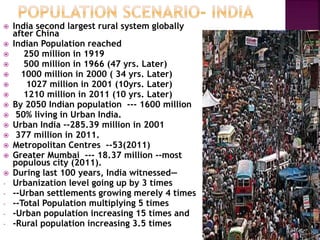
 India second largest rural system globally
after China
 Indian Population reached
 250 million in 1919
 500 million in 1966 (47 yrs. Later)
 1000 million in 2000 ( 34 yrs. Later)
 1027 million in 2001 (10yrs. Later)
 1210 million in 2011 (10 yrs. Later)
 By 2050 Indian population --- 1600 million
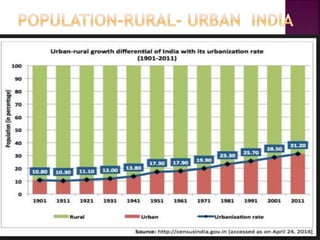
 50% living in Urban India.
 Urban India --285.39 million in 2001
 377 million in 2011.
 Metropolitan Centres --53(2011)
 Greater Mumbai --- 18.37 million --most
populous city (2011).
 During last 100 years, India witnessed—
- Urbanization level going up by 3 times
- --Urban settlements growing merely 4 times
- --Total Population multiplying 5 times
- -Urban population increasing 15 times and
- -Rural population increasing 3.5 times
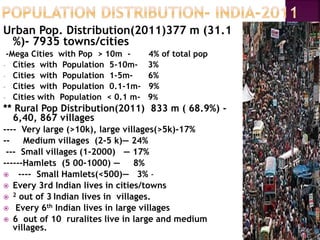
Urban Pop. Distribution(2011)377 m (31.1
%)- 7935 towns/cities
-Mega Cities with Pop > 10m - 4% of total pop
- Cities with Population 5-10m- 3%
- Cities with Population 1-5m- 6%
- Cities with Population 0.1-1m- 9%
- Cities with Population < 0.1 m- 9%
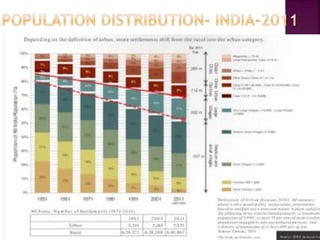
** Rural Pop Distribution(2011) 833 m ( 68.9%) -
6,40, 867 villages
---- Very large (>10k), large villages(>5k)-17%
-- Medium villages (2-5 k)— 24%
--- Small villages (1-2000) — 17%
------Hamlets (5 00-1000) — 8%
 ---- Small Hamlets(<500)— 3% -
 Every 3rd Indian lives in cities/towns
 2 out of 3 Indian lives in villages.
 Every 6th Indian lives in large villages
 6 out of 10 ruralites live in large and medium
villages.
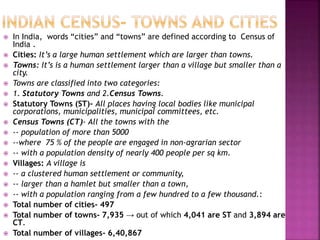
 In India, words “cities” and “towns” are defined according to Census of
India .
 Cities: It’s a large human settlement which are larger than towns.
 Towns: It’s is a human settlement larger than a village but smaller than a
city.
 Towns are classified into two categories:
 1. Statutory Towns and 2.Census Towns.
 Statutory Towns (ST)- All places having local bodies like municipal
corporations, municipalities, municipal committees, etc.
 Census Towns (CT)- All the towns with the
 -- population of more than 5000
 --where 75 % of the people are engaged in non-agrarian sector
 -- with a population density of nearly 400 people per sq km.
 Villages: A village is
 -- a clustered human settlement or community,
 -- larger than a hamlet but smaller than a town,
 -- with a population ranging from a few hundred to a few thousand.:
 Total number of cities- 497
 Total number of towns- 7,935 → out of which 4,041 are ST and 3,894 are
CT.
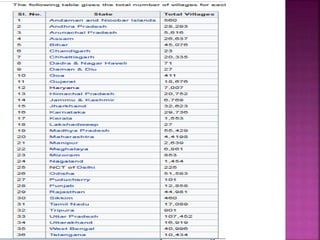
 Total number of villages- 6,40,867
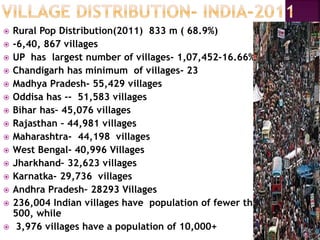
 Rural Pop Distribution(2011) 833 m ( 68.9%)
 -6,40, 867 villages
 UP has largest number of villages- 1,07,452-16.66%
 Chandigarh has minimum of villages- 23
 Madhya Pradesh- 55,429 villages
 Oddisa has -- 51,583 villages
 Bihar has– 45,076 villages
 Rajasthan – 44,981 villages
 Maharashtra- 44,198 villages
 West Bengal- 40,996 Villages
 Jharkhand– 32,623 villages
 Karnatka- 29,736 villages
 Andhra Pradesh– 28293 Villages
 236,004 Indian villages have population of fewer than
500, while
 3,976 villages have a population of 10,000+
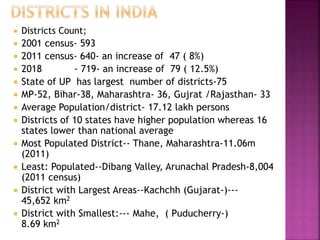
 Districts Count;
 2001 census- 593
 2011 census- 640- an increase of 47 ( 8%)
 2018 - 719- an increase of 79 ( 12.5%)
 State of UP has largest number of districts-75
 MP-52, Bihar-38, Maharashtra- 36, Gujrat /Rajasthan- 33
 Average Population/district- 17.12 lakh persons
 Districts of 10 states have higher population whereas 16
states lower than national average
 Most Populated District-- Thane, Maharashtra-11.06m
(2011)
 Least: Populated--Dibang Valley, Arunachal Pradesh-8,004
(2011 census)
 District with Largest Areas--Kachchh (Gujarat-)---
45,652 km2
 District with Smallest:--- Mahe, ( Puducherry-)
8.69 km2
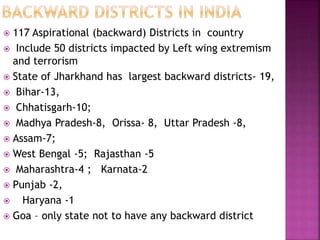
 117 Aspirational (backward) Districts in country
 Include 50 districts impacted by Left wing extremism
and terrorism
 State of Jharkhand has largest backward districts- 19,
 Bihar-13,
 Chhatisgarh-10;
 Madhya Pradesh-8, Orissa- 8, Uttar Pradesh -8,
 Assam-7;
 West Bengal -5; Rajasthan -5
 Maharashtra-4 ; Karnata-2
 Punjab -2,
 Haryana -1
 Goa – only state not to have any backward district
 Villages critical to India’s growth
 Housing majority of Indian population -69%
 Despite fall in share of population- villages to
provide residence in future to large population-
more than 50% by 2050
 India has large number of Villages(6.4lakh) vs 0.08
lakh towns/cities
 Provider of food/day to day/basic needs of human
living
 Mainstay of industry and national economy
 Large contributor to Indian GDP
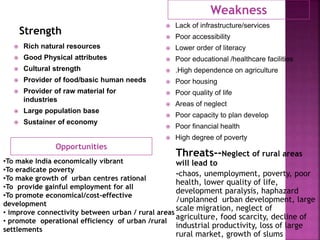
Opportunities
Weakness
 Rich natural resources
 Good Physical attributes
 Cultural strength
 Provider of food/basic human needs
 Provider of raw material for
industries
 Large population base
 Sustainer of economy
 Lack of infrastructure/services
 Poor accessibility
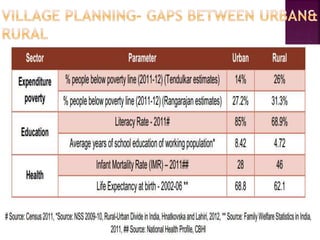
 Lower order of literacy
 Poor educational /healthcare facilities
 .High dependence on agriculture
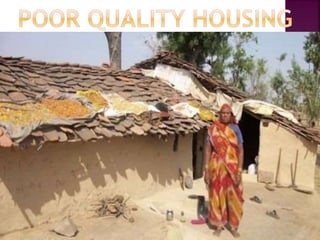
 Poor housing
 Poor quality of life
 Areas of neglect
 Poor capacity to plan develop
 Poor financial health
 High degree of poverty
Strength
Threats--Neglect of rural areas
will lead to
-chaos, unemployment, poverty, poor
health, lower quality of life,
development paralysis, haphazard
/unplanned urban development, large
scale migration, neglect of
agriculture, food scarcity, decline of
industrial productivity, loss of large
rural market, growth of slums
•To make India economically vibrant
•To eradicate poverty
•To make growth of urban centres rational
•To provide gainful employment for all
•To promote economical/cost-effective
development
• improve connectivity between urban / rural areas
• promote operational efficiency of urban /rural
settlements
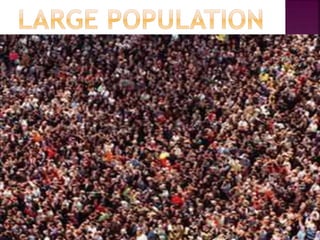
 Large population-69%
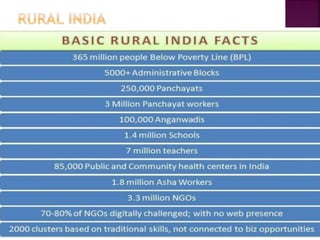
 High degree of Poverty ( 60% rural India lives on Rs 35 per day)
 Poor health
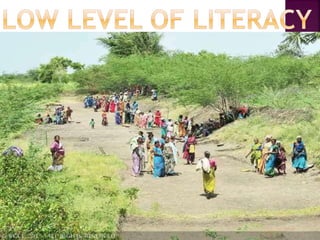
 Low level of literacy/Skill
 Low level of gainful employment
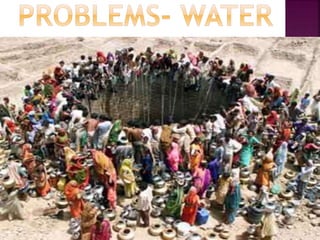
 Inadequate level of basic infrastructure /services /amenities- water
supply, sanitation, drainage, power, SWM
 Agriculture largely rainfed- low level of irrigation facilities
 Poor quality of housing
 Haphazard and unplanned development
 Low level of Healthcare and Educational facilities
 Poor quality of environment
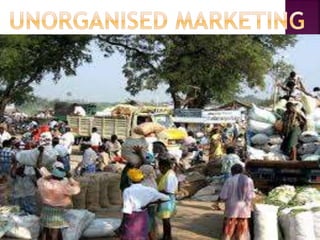
 Poor accessibility to village/ urban markets
 Low order of rural industries
 High degree of in-debtedness
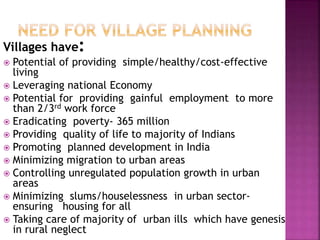
Villages have:
 Potential of providing simple/healthy/cost-effective
living
 Leveraging national Economy
 Potential for providing gainful employment to more
than 2/3rd work force
 Eradicating poverty- 365 million
 Providing quality of life to majority of Indians
 Promoting planned development in India
 Minimizing migration to urban areas
 Controlling unregulated population growth in urban
areas
 Minimizing slums/houselessness in urban sector-
ensuring housing for all
 Taking care of majority of urban ills which have genesis
in rural neglect
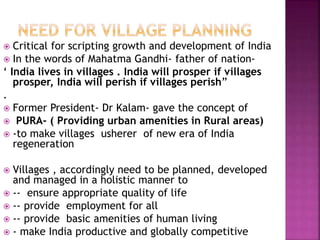
 Critical for scripting growth and development of India
 In the words of Mahatma Gandhi- father of nation-
‘ India lives in villages . India will prosper if villages
prosper, India will perish if villages perish”
.
 Former President- Dr Kalam- gave the concept of
 PURA- ( Providing urban amenities in Rural areas)
 -to make villages usherer of new era of India
regeneration
 Villages , accordingly need to be planned, developed
and managed in a holistic manner to
 -- ensure appropriate quality of life
 -- provide employment for all
 -- provide basic amenities of human living
 - make India productive and globally competitive
Village Planning should revolve around--:
 Preventing distress migration from rural to urban areas--
 Guarantee-ing a decent standard of living.
 Providing basic amenities/facilities
 Making village a “hub”-- to attract resources for
development
 Providing easier, faster/ cheaper access to urban markets--
for remunerative price of agricultural produce/ marketable
commodities produced
 Economic empowerment
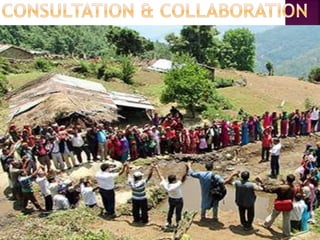
 Social empowerment -- engaging all sections of community
in the task of village development.
 Creating / sustaining a culture of cooperative living for
inclusive and rapid development.
 Improving Village environment/ Ecology
 Promoting Planned Development
 Making Village self-reliant/self-sustaining- energy/resources
 Promoting integrated urban –rural growth
Globally--Most efficient cities adopted Regional perspective for :
---Integrating urban and rural settlements
-- minimising migration
--Making urban development more rational and sustainable
--promoting co-operation and collaboration;
- minimizing local competition and conflicts,
- infrastructure optimization between neighboring cities/rural
settlements,
-- preventing disasters,
-- promoting / protecting regional ecology / bio-diversity,
-- providing recreational activities
-- overcoming confusion over role / responsibilities of various agencies.
-- achieving integration and decentralized planning--
• Regional Planning optimizes regional resources by--
-- promoting synergies between rural and urban areas
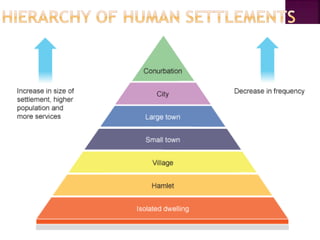
-- connecting through a well defined settlement hierarchy
-- using developmental potential of each settlement
-- making them more sustainable
--with least consumption of resources and energy.
• Large parts of rural areas not stand-alone settlements
but part of a cluster of settlements
•--relatively proximate to each other.
• --These clusters illustrate
•- potential for growth
•-- have economic drivers and
•--derive locational and competitive advantages.
•These clusters once developed -- classified as 'Rurban'.
• Government of India, launched -- Shyama Prasad
Mukherji Rurban Mission (SPMRM)
•-- aimed at developing such rural areas
•- by provisioning of economic, social and physical
infrastructure facilities.
• Mission aims at development of 300 Rurban clusters, in
the next five years.
• Clusters to be strengthened with required amenities,
•for focused development of these clusters.
•
• Rurban cluster--A cluster of 15-
20 villages having about 30 to 40 lakh population.
• clusters to be geographically contiguous Gram
Panchayats
•with a population-25000 to 50000 in plain/ coastal areas
• a population of 5000 to 15000 in desert/hilly/tribal
areas
•National Rurban Mission (NRuM) follows the vision of—
-- "Development of a cluster of villages
-- that preserve/ nurture essence of rural community
life
-- with focus on equity and inclusiveness
-- without compromising with facilities
-- perceived to be essentially urban in nature,
-- thus creating a cluster of "Rurban Villages".
••Mission's Objective-- (NRuM)
•-- to stimulate local economic development,
• ---enhance basic services, and
•-- create well planned Rurban clusters.
• Mission's Outcomes
i. Bridging the rural-urban divide-viz: economic,
technological and those related to facilities and
services.
ii. Stimulating local economic development with
emphasis on reduction of poverty and
unemployment in rural areas.
iii. Spreading development in the region.
iv. Attracting investment in rural areas.
•
el
1 Skill Development training Linked to Economic Activities
2 Agri-services and Processing.
3 Digital Literacy
4 24x7 Piped Water Supply
5 Sanitation Coverage of Individual Toilets
6 Solid and Liquid Waste Management
7 Access to Village --Streets with Drains.
8 Village Street Lights Coverage
9 Health Access to clinics and health centres at the
household / village level.
10 Up- gradation of primary, secondary and higher
secondary schools..
11 Inter- village roads connectivity
12 Citizen Service Centres
13 Public transport
14 LPG Gas Connections
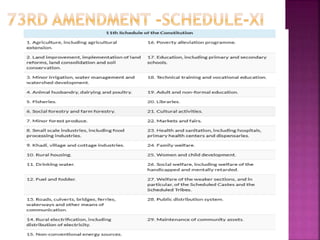
73rd Amendment 1992 added a new Part IX to
the constitution titled “The Panchayats”
•-- covering provisions from Article 243 to 243(O); -- a
new Eleventh Schedule covering 29 subjects within the
functions of the Panchayats
•- provides for a 3 tier Panchayat system, which would
be constituted in every state
•-- at the village level,
•--intermediate level and
•- district level.
•To bring uniformity in the Panchayati Raj structure in
India
• with a mandate that--“State shall take steps to
organise village panchayats and endow them with such
powers and authority as may be necessary to enable
HUDCO--Concept of Model Village
Plan
HUDCO suggested following approach for planning a
model village –
-- adopting a convergence approach
--Integrated development
--good housing,
-- sustainable technology,
-- site specific functional planning,
-- user friendly and innovative designing
-- integrating supportive inputs including:---:
a. A simple, inexpensive and aesthetically
pleasing layout --with socio-cultural living
habits of the settlements respecting geo-
climatic context
54
b. Using locally available building materials and cost
effective substitutes for scarce building material
c. Adopting “aided self-help” to ensure active
participation of the prospective allottees/ associations
in construction and development of dwelling units.
d. Physical planning to focus on conserving land
keeping in view environmental requirements.
e. Site to be made approachable and suitably
developed to avoid water logging/flooding.
f community facilitator-- school and health centers,
community center, Panchayat ghar and similar
facilities provided to develop a wholesome
community living,
Contd…
55
 However, different planning, development
strategies would be required for planning

differently situated Villages
 Urban Villages- made integral part of urban
planning and development strategies with well
defined planning norms/standards- creating
tourism potential
 Urbanisable Villages- Villages provided with all
urban facilities for easier future integration with
urban areas- through well defined norms/ planned
development-
 Rural Villages—To be developed as villages with
basic amenities/infrastructure/ employment
through producing day to day goods needed for
urban living- vegetables, dairy products, fruits/
vegetables etc
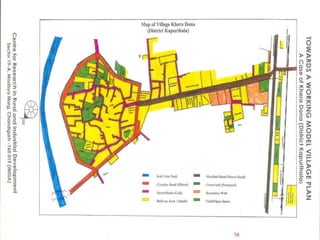
Village Level
Planning-Khera
Dona Model
Village Plan
- 57
58
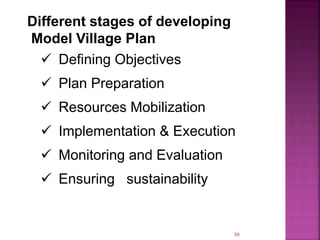
Different stages of developing
Model Village Plan
 Defining Objectives
 Plan Preparation
 Resources Mobilization
 Implementation & Execution
 Monitoring and Evaluation
 Ensuring sustainability
59
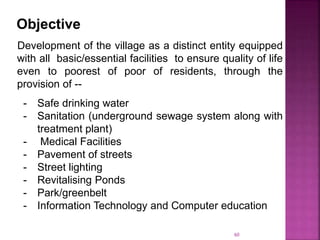
Objective
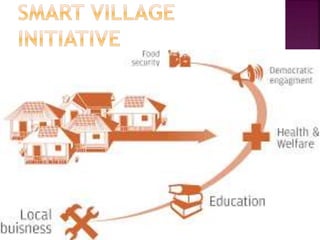
Development of the village as a distinct entity equipped
with all basic/essential facilities to ensure quality of life
even to poorest of poor of residents, through the
provision of --
- Safe drinking water
- Sanitation (underground sewage system along with
treatment plant)
- Medical Facilities
- Pavement of streets
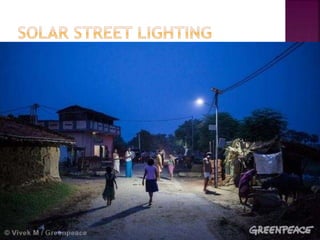
- Street lighting
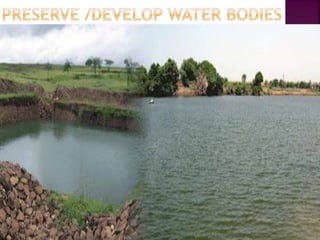
- Revitalising Ponds
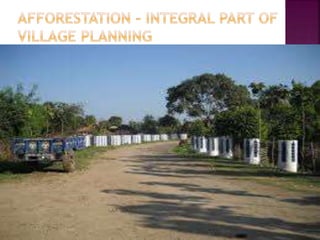
- Park/greenbelt
- Information Technology and Computer education
60
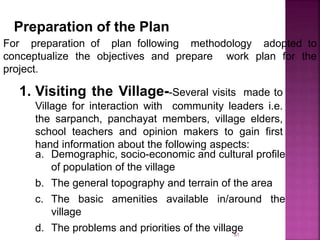
Preparation of the Plan
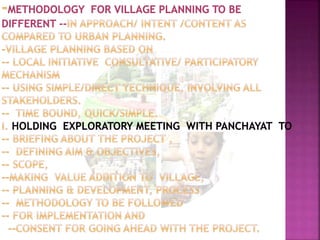
For preparation of plan following methodology adopted to
conceptualize the objectives and prepare work plan for the
project.
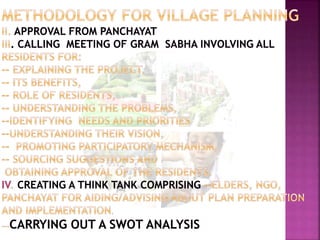
1. Visiting the Village--Several visits made to
Village for interaction with community leaders i.e.
the sarpanch, panchayat members, village elders,
school teachers and opinion makers to gain first
hand information about the following aspects:
a. Demographic, socio-economic and cultural profile
of population of the village
b. The general topography and terrain of the area
c. The basic amenities available in/around the
village
d. The problems and priorities of the village61
2. Visiting well developed villages-- well
developed modern villages i.e Palahi near
Phagwara and Begowal near Doraha visited /
studied to acquire first hand knowledge about
methodology adopted in scripting success
story of development of villages.
3. Detailed physical map --of village Khera
Dona prepared with the help of trained staff
for physically identifying the critical areas in
the village.-- to plan different facilities and
workout their cost.
4. Carrying out a pilot socio-economic survey
of the village conducted with the help of the
preliminary project schedule.
..
62
5. Based on pilot survey- final project schedule
prepared along with a set of questionnaires for
conducting door to door socio-economic survey of
all the households in the village and the
surrounding farm houses of the village. Data about
following indicators collected.
– Demographic, Socio-economic and cultural
characteristics of the village
– Demographic, Socio-economic and cultural
characteristics of emigrant villagers of Khera
Dona
Contd…..
63
– Status of basic amenities and facilities
a) Sanitation;
b) Drinking water;
c) Medical facilities
– Educational facilities
– Power, Energy and Bio-gas Plants
– Housing facilities
– Provision for community hall/leisure hall and
other facilities
– Social forestry
– Sustainability of the created facilities /assets
64
Contd…..
6. The relevant data collected collated, analysed and
evaluated vis-à-vis the socio-economic profile/amenities
available to the emigrants and permanent village residents
keeping in mind the caste divide among the rural
population.
7. Based on above data analysis of existing problems in
terms of infrastructure, service amenities and facilities
were assessed, identified and quantified.
8. Help of experts from different fields was sought to
evolve innovative approach to overcome the problems
identified above.
9. A preliminary cost estimate of providing various
amenities and facilities in the village was prepared and a
final budget estimate was prepared in the light of all the
inputs gathered.
Contd…..
65
Critical requirements for the Implementation of
the Plan
1. Finances
a) from internal sources
b) from external sources
c) other sources
2. Execution Machinery and Trained Manpower
3. Socially Recognized organization by the village
community i.e. Village Panchayat/Village Vikas
Committee
4. Government machinery
66
Sustainability
Sustainability of the created assets
considered crucial.
-- financial resources and
-- required manpower was suggested
--Creating Reserved corpus fund for
maintenance/replacement was
suggested
67
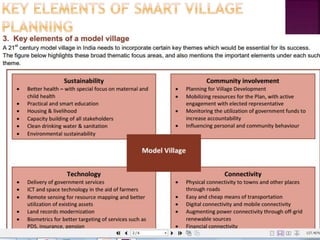
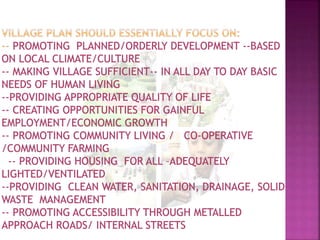
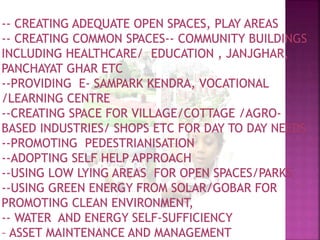
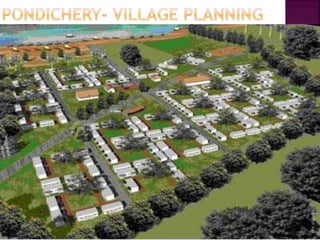
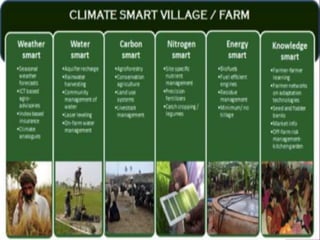
 Planning Village- to make them self-sufficient in day to
day needs
 Streets to be paved, provided with pucca drains
 Houses made pucca naturally lighted /ventilated
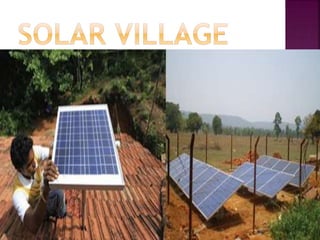
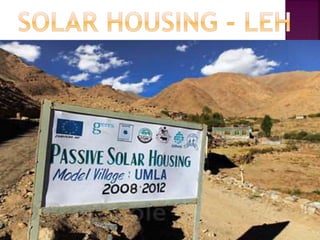
 Village to be made zero energy-using non-conventional
sources of energy- solar, bio-gas, wind energy etc
 Villages to take care of sanitation and SWM--Treating
SWM and sullage with local, simple technologies;
maintaining village ponds
 Creating open spaces, play grounds/ community spaces
/buildings
 Opening skill development centres to skill rural India
and generate employment
 Villages to adopt co-operative approach for living and
working- promote sharing
 Setting up agro-based industries, Using technologies
 Promoting Good governance
 Promoting local art, craft and culture
Planning for village development

Planning for village development

  • 1.
    Jit Kumar Gupta FormerDirector College of Architecture IET Bhaddal Jit.kumar1944@gmail.com
  • 2.
     India secondlargest rural system globally after China  Indian Population reached  250 million in 1919  500 million in 1966 (47 yrs. Later)  1000 million in 2000 ( 34 yrs. Later)  1027 million in 2001 (10yrs. Later)  1210 million in 2011 (10 yrs. Later)  By 2050 Indian population --- 1600 million  50% living in Urban India.  Urban India --285.39 million in 2001  377 million in 2011.  Metropolitan Centres --53(2011)  Greater Mumbai --- 18.37 million --most populous city (2011).  During last 100 years, India witnessed— - Urbanization level going up by 3 times - --Urban settlements growing merely 4 times - --Total Population multiplying 5 times - -Urban population increasing 15 times and - -Rural population increasing 3.5 times
  • 3.
    Urban Pop. Distribution(2011)377m (31.1 %)- 7935 towns/cities -Mega Cities with Pop > 10m - 4% of total pop - Cities with Population 5-10m- 3% - Cities with Population 1-5m- 6% - Cities with Population 0.1-1m- 9% - Cities with Population < 0.1 m- 9% ** Rural Pop Distribution(2011) 833 m ( 68.9%) - 6,40, 867 villages ---- Very large (>10k), large villages(>5k)-17% -- Medium villages (2-5 k)— 24% --- Small villages (1-2000) — 17% ------Hamlets (5 00-1000) — 8%  ---- Small Hamlets(<500)— 3% -  Every 3rd Indian lives in cities/towns  2 out of 3 Indian lives in villages.  Every 6th Indian lives in large villages  6 out of 10 ruralites live in large and medium villages.
  • 5.
     In India,words “cities” and “towns” are defined according to Census of India .  Cities: It’s a large human settlement which are larger than towns.  Towns: It’s is a human settlement larger than a village but smaller than a city.  Towns are classified into two categories:  1. Statutory Towns and 2.Census Towns.  Statutory Towns (ST)- All places having local bodies like municipal corporations, municipalities, municipal committees, etc.  Census Towns (CT)- All the towns with the  -- population of more than 5000  --where 75 % of the people are engaged in non-agrarian sector  -- with a population density of nearly 400 people per sq km.  Villages: A village is  -- a clustered human settlement or community,  -- larger than a hamlet but smaller than a town,  -- with a population ranging from a few hundred to a few thousand.:  Total number of cities- 497  Total number of towns- 7,935 → out of which 4,041 are ST and 3,894 are CT.  Total number of villages- 6,40,867
  • 7.
     Rural PopDistribution(2011) 833 m ( 68.9%)  -6,40, 867 villages  UP has largest number of villages- 1,07,452-16.66%  Chandigarh has minimum of villages- 23  Madhya Pradesh- 55,429 villages  Oddisa has -- 51,583 villages  Bihar has– 45,076 villages  Rajasthan – 44,981 villages  Maharashtra- 44,198 villages  West Bengal- 40,996 Villages  Jharkhand– 32,623 villages  Karnatka- 29,736 villages  Andhra Pradesh– 28293 Villages  236,004 Indian villages have population of fewer than 500, while  3,976 villages have a population of 10,000+
  • 11.
     Districts Count; 2001 census- 593  2011 census- 640- an increase of 47 ( 8%)  2018 - 719- an increase of 79 ( 12.5%)  State of UP has largest number of districts-75  MP-52, Bihar-38, Maharashtra- 36, Gujrat /Rajasthan- 33  Average Population/district- 17.12 lakh persons  Districts of 10 states have higher population whereas 16 states lower than national average  Most Populated District-- Thane, Maharashtra-11.06m (2011)  Least: Populated--Dibang Valley, Arunachal Pradesh-8,004 (2011 census)  District with Largest Areas--Kachchh (Gujarat-)--- 45,652 km2  District with Smallest:--- Mahe, ( Puducherry-) 8.69 km2
  • 12.
     117 Aspirational(backward) Districts in country  Include 50 districts impacted by Left wing extremism and terrorism  State of Jharkhand has largest backward districts- 19,  Bihar-13,  Chhatisgarh-10;  Madhya Pradesh-8, Orissa- 8, Uttar Pradesh -8,  Assam-7;  West Bengal -5; Rajasthan -5  Maharashtra-4 ; Karnata-2  Punjab -2,  Haryana -1  Goa – only state not to have any backward district
  • 17.
     Villages criticalto India’s growth  Housing majority of Indian population -69%  Despite fall in share of population- villages to provide residence in future to large population- more than 50% by 2050  India has large number of Villages(6.4lakh) vs 0.08 lakh towns/cities  Provider of food/day to day/basic needs of human living  Mainstay of industry and national economy  Large contributor to Indian GDP
  • 18.
    Opportunities Weakness  Rich naturalresources  Good Physical attributes  Cultural strength  Provider of food/basic human needs  Provider of raw material for industries  Large population base  Sustainer of economy  Lack of infrastructure/services  Poor accessibility  Lower order of literacy  Poor educational /healthcare facilities  .High dependence on agriculture  Poor housing  Poor quality of life  Areas of neglect  Poor capacity to plan develop  Poor financial health  High degree of poverty Strength Threats--Neglect of rural areas will lead to -chaos, unemployment, poverty, poor health, lower quality of life, development paralysis, haphazard /unplanned urban development, large scale migration, neglect of agriculture, food scarcity, decline of industrial productivity, loss of large rural market, growth of slums •To make India economically vibrant •To eradicate poverty •To make growth of urban centres rational •To provide gainful employment for all •To promote economical/cost-effective development • improve connectivity between urban / rural areas • promote operational efficiency of urban /rural settlements
  • 20.
     Large population-69% High degree of Poverty ( 60% rural India lives on Rs 35 per day)  Poor health  Low level of literacy/Skill  Low level of gainful employment  Inadequate level of basic infrastructure /services /amenities- water supply, sanitation, drainage, power, SWM  Agriculture largely rainfed- low level of irrigation facilities  Poor quality of housing  Haphazard and unplanned development  Low level of Healthcare and Educational facilities  Poor quality of environment  Poor accessibility to village/ urban markets  Low order of rural industries  High degree of in-debtedness
  • 27.
    Villages have:  Potentialof providing simple/healthy/cost-effective living  Leveraging national Economy  Potential for providing gainful employment to more than 2/3rd work force  Eradicating poverty- 365 million  Providing quality of life to majority of Indians  Promoting planned development in India  Minimizing migration to urban areas  Controlling unregulated population growth in urban areas  Minimizing slums/houselessness in urban sector- ensuring housing for all  Taking care of majority of urban ills which have genesis in rural neglect
  • 28.
     Critical forscripting growth and development of India  In the words of Mahatma Gandhi- father of nation- ‘ India lives in villages . India will prosper if villages prosper, India will perish if villages perish” .  Former President- Dr Kalam- gave the concept of  PURA- ( Providing urban amenities in Rural areas)  -to make villages usherer of new era of India regeneration  Villages , accordingly need to be planned, developed and managed in a holistic manner to  -- ensure appropriate quality of life  -- provide employment for all  -- provide basic amenities of human living  - make India productive and globally competitive
  • 30.
    Village Planning shouldrevolve around--:  Preventing distress migration from rural to urban areas--  Guarantee-ing a decent standard of living.  Providing basic amenities/facilities  Making village a “hub”-- to attract resources for development  Providing easier, faster/ cheaper access to urban markets-- for remunerative price of agricultural produce/ marketable commodities produced  Economic empowerment  Social empowerment -- engaging all sections of community in the task of village development.  Creating / sustaining a culture of cooperative living for inclusive and rapid development.  Improving Village environment/ Ecology  Promoting Planned Development  Making Village self-reliant/self-sustaining- energy/resources  Promoting integrated urban –rural growth
  • 32.
    Globally--Most efficient citiesadopted Regional perspective for : ---Integrating urban and rural settlements -- minimising migration --Making urban development more rational and sustainable --promoting co-operation and collaboration; - minimizing local competition and conflicts, - infrastructure optimization between neighboring cities/rural settlements, -- preventing disasters, -- promoting / protecting regional ecology / bio-diversity, -- providing recreational activities -- overcoming confusion over role / responsibilities of various agencies. -- achieving integration and decentralized planning-- • Regional Planning optimizes regional resources by-- -- promoting synergies between rural and urban areas -- connecting through a well defined settlement hierarchy -- using developmental potential of each settlement -- making them more sustainable --with least consumption of resources and energy.
  • 34.
    • Large partsof rural areas not stand-alone settlements but part of a cluster of settlements •--relatively proximate to each other. • --These clusters illustrate •- potential for growth •-- have economic drivers and •--derive locational and competitive advantages. •These clusters once developed -- classified as 'Rurban'. • Government of India, launched -- Shyama Prasad Mukherji Rurban Mission (SPMRM) •-- aimed at developing such rural areas •- by provisioning of economic, social and physical infrastructure facilities. • Mission aims at development of 300 Rurban clusters, in the next five years. • Clusters to be strengthened with required amenities, •for focused development of these clusters.
  • 35.
    • • Rurban cluster--Acluster of 15- 20 villages having about 30 to 40 lakh population. • clusters to be geographically contiguous Gram Panchayats •with a population-25000 to 50000 in plain/ coastal areas • a population of 5000 to 15000 in desert/hilly/tribal areas •National Rurban Mission (NRuM) follows the vision of— -- "Development of a cluster of villages -- that preserve/ nurture essence of rural community life -- with focus on equity and inclusiveness -- without compromising with facilities -- perceived to be essentially urban in nature, -- thus creating a cluster of "Rurban Villages".
  • 36.
    ••Mission's Objective-- (NRuM) •--to stimulate local economic development, • ---enhance basic services, and •-- create well planned Rurban clusters. • Mission's Outcomes i. Bridging the rural-urban divide-viz: economic, technological and those related to facilities and services. ii. Stimulating local economic development with emphasis on reduction of poverty and unemployment in rural areas. iii. Spreading development in the region. iv. Attracting investment in rural areas.
  • 37.
    • el 1 Skill Developmenttraining Linked to Economic Activities 2 Agri-services and Processing. 3 Digital Literacy 4 24x7 Piped Water Supply 5 Sanitation Coverage of Individual Toilets 6 Solid and Liquid Waste Management 7 Access to Village --Streets with Drains. 8 Village Street Lights Coverage 9 Health Access to clinics and health centres at the household / village level. 10 Up- gradation of primary, secondary and higher secondary schools.. 11 Inter- village roads connectivity 12 Citizen Service Centres 13 Public transport 14 LPG Gas Connections
  • 39.
    73rd Amendment 1992added a new Part IX to the constitution titled “The Panchayats” •-- covering provisions from Article 243 to 243(O); -- a new Eleventh Schedule covering 29 subjects within the functions of the Panchayats •- provides for a 3 tier Panchayat system, which would be constituted in every state •-- at the village level, •--intermediate level and •- district level. •To bring uniformity in the Panchayati Raj structure in India • with a mandate that--“State shall take steps to organise village panchayats and endow them with such powers and authority as may be necessary to enable
  • 54.
    HUDCO--Concept of ModelVillage Plan HUDCO suggested following approach for planning a model village – -- adopting a convergence approach --Integrated development --good housing, -- sustainable technology, -- site specific functional planning, -- user friendly and innovative designing -- integrating supportive inputs including:---: a. A simple, inexpensive and aesthetically pleasing layout --with socio-cultural living habits of the settlements respecting geo- climatic context 54
  • 55.
    b. Using locallyavailable building materials and cost effective substitutes for scarce building material c. Adopting “aided self-help” to ensure active participation of the prospective allottees/ associations in construction and development of dwelling units. d. Physical planning to focus on conserving land keeping in view environmental requirements. e. Site to be made approachable and suitably developed to avoid water logging/flooding. f community facilitator-- school and health centers, community center, Panchayat ghar and similar facilities provided to develop a wholesome community living, Contd… 55
  • 56.
     However, differentplanning, development strategies would be required for planning differently situated Villages  Urban Villages- made integral part of urban planning and development strategies with well defined planning norms/standards- creating tourism potential  Urbanisable Villages- Villages provided with all urban facilities for easier future integration with urban areas- through well defined norms/ planned development-  Rural Villages—To be developed as villages with basic amenities/infrastructure/ employment through producing day to day goods needed for urban living- vegetables, dairy products, fruits/ vegetables etc
  • 57.
  • 58.
  • 59.
    Different stages ofdeveloping Model Village Plan  Defining Objectives  Plan Preparation  Resources Mobilization  Implementation & Execution  Monitoring and Evaluation  Ensuring sustainability 59
  • 60.
    Objective Development of thevillage as a distinct entity equipped with all basic/essential facilities to ensure quality of life even to poorest of poor of residents, through the provision of -- - Safe drinking water - Sanitation (underground sewage system along with treatment plant) - Medical Facilities - Pavement of streets - Street lighting - Revitalising Ponds - Park/greenbelt - Information Technology and Computer education 60
  • 61.
    Preparation of thePlan For preparation of plan following methodology adopted to conceptualize the objectives and prepare work plan for the project. 1. Visiting the Village--Several visits made to Village for interaction with community leaders i.e. the sarpanch, panchayat members, village elders, school teachers and opinion makers to gain first hand information about the following aspects: a. Demographic, socio-economic and cultural profile of population of the village b. The general topography and terrain of the area c. The basic amenities available in/around the village d. The problems and priorities of the village61
  • 62.
    2. Visiting welldeveloped villages-- well developed modern villages i.e Palahi near Phagwara and Begowal near Doraha visited / studied to acquire first hand knowledge about methodology adopted in scripting success story of development of villages. 3. Detailed physical map --of village Khera Dona prepared with the help of trained staff for physically identifying the critical areas in the village.-- to plan different facilities and workout their cost. 4. Carrying out a pilot socio-economic survey of the village conducted with the help of the preliminary project schedule. .. 62
  • 63.
    5. Based onpilot survey- final project schedule prepared along with a set of questionnaires for conducting door to door socio-economic survey of all the households in the village and the surrounding farm houses of the village. Data about following indicators collected. – Demographic, Socio-economic and cultural characteristics of the village – Demographic, Socio-economic and cultural characteristics of emigrant villagers of Khera Dona Contd….. 63
  • 64.
    – Status ofbasic amenities and facilities a) Sanitation; b) Drinking water; c) Medical facilities – Educational facilities – Power, Energy and Bio-gas Plants – Housing facilities – Provision for community hall/leisure hall and other facilities – Social forestry – Sustainability of the created facilities /assets 64 Contd…..
  • 65.
    6. The relevantdata collected collated, analysed and evaluated vis-à-vis the socio-economic profile/amenities available to the emigrants and permanent village residents keeping in mind the caste divide among the rural population. 7. Based on above data analysis of existing problems in terms of infrastructure, service amenities and facilities were assessed, identified and quantified. 8. Help of experts from different fields was sought to evolve innovative approach to overcome the problems identified above. 9. A preliminary cost estimate of providing various amenities and facilities in the village was prepared and a final budget estimate was prepared in the light of all the inputs gathered. Contd….. 65
  • 66.
    Critical requirements forthe Implementation of the Plan 1. Finances a) from internal sources b) from external sources c) other sources 2. Execution Machinery and Trained Manpower 3. Socially Recognized organization by the village community i.e. Village Panchayat/Village Vikas Committee 4. Government machinery 66
  • 67.
    Sustainability Sustainability of thecreated assets considered crucial. -- financial resources and -- required manpower was suggested --Creating Reserved corpus fund for maintenance/replacement was suggested 67
  • 78.
     Planning Village-to make them self-sufficient in day to day needs  Streets to be paved, provided with pucca drains  Houses made pucca naturally lighted /ventilated  Village to be made zero energy-using non-conventional sources of energy- solar, bio-gas, wind energy etc  Villages to take care of sanitation and SWM--Treating SWM and sullage with local, simple technologies; maintaining village ponds  Creating open spaces, play grounds/ community spaces /buildings  Opening skill development centres to skill rural India and generate employment  Villages to adopt co-operative approach for living and working- promote sharing  Setting up agro-based industries, Using technologies  Promoting Good governance  Promoting local art, craft and culture