DEVELOPING
INSTRUCTIONAL MATERIALS
ALLISON BARBEE
BACKGROUND
THE HALLMARK OF INDIVIDUALIZED INSTRUCTION IS THAT MANY OF THE
INSTRUCTION EVENTS TYPICALLY CARRIED OUT BY THE INSTRUCTOR WITH A
GROUP OF STUDENTS ARE NOW PRESENTED TO THE INDIVIDUAL STUDENT
THROUGH INSTRUCTIONAL MATERIALS. THE AUTHORS RECOMMEND THAT
YOU PRODUCE SELF-INSTRUCTIONAL MATERIALS IN YOUR FIRST ATTEMPT AT
INSTRUCTIONAL DESIGN, THAT IS, THE MATERIALS SHOULD PERMIT THE
STUDENT TO LEARN THE NEW INFORMATION AND SKILLS WITHOUT ANY
INTERVENTION FROM AN INSTRUCTOR OR FELLOW STUDENTS.
OBJECTIVES
• Describe factors that may cause revisions in media selections and delivery systems
for given instruction.
• Name and describe the components of an instructional package.
• List four categories of criteria for judging the appropriateness of existing
instructional materials.
• Describe the designer’s role in materials development and instructional delivery.
Name appropriate rough draft materials for various final media.
• Given an instructional strategy, describe the procedures for developing instructional
materials.
• Develop instructional material based on a given instructional strategy.
DELIVERY SYSTEM
• f existing instructional materials. o Existing materials could be
substituted for planned materials on a scale ranging from a single
motivational sequence in one lesson, to an entire course or curriculum.
• Production and implementation constraints o Media formats and
delivery systems that look expensive are expensive.
• Amount of instructor facilitation o The first steps in adoption of a new
technology are usually attempts to replicate the features of the old
technology classroom. o When discussion and feedback are provided by
the instructor, initial materials development costs are lower however,
per-student costs are high and the course cannot be scaled up in size
without hiring additional instructors.
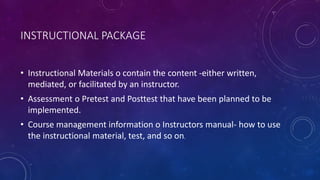
INSTRUCTIONAL PACKAGE
• Instructional Materials o contain the content -either written,
mediated, or facilitated by an instructor.
• Assessment o Pretest and Posttest that have been planned to be
implemented.
• Course management information o Instructors manual- how to use
the instructional material, test, and so on.
ASSESSMENT
• All instructional material should be accompanied by objective tests
or by product or performance assessments. These may include a
pretest and/or a posttest.
COURSE MANAGEMENT
• Test and other information
• Student guidance
• Automated class
• Student tracting
• Online testing
• Project monitoring
• Grade book
• A variety of communication
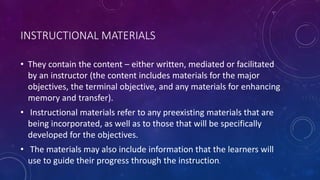
INSTRUCTIONAL MATERIALS
• They contain the content – either written, mediated or facilitated
by an instructor (the content includes materials for the major
objectives, the terminal objective, and any materials for enhancing
memory and transfer).
• Instructional materials refer to any preexisting materials that are
being incorporated, as well as to those that will be specifically
developed for the objectives.
• The materials may also include information that the learners will
use to guide their progress through the instruction.
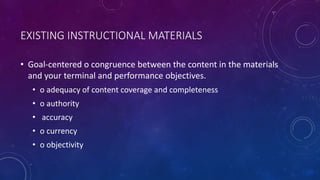
EXISTING INSTRUCTIONAL MATERIALS
• Goal-centered o congruence between the content in the materials
and your terminal and performance objectives.
• o adequacy of content coverage and completeness
• o authority
• accuracy
• o currency
• o objectivity
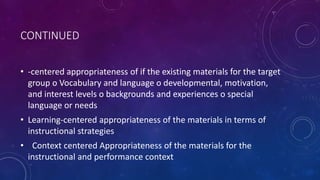
CONTINUED
• -centered appropriateness of if the existing materials for the target
group o Vocabulary and language o developmental, motivation,
and interest levels o backgrounds and experiences o special
language or needs
• Learning-centered appropriateness of the materials in terms of
instructional strategies
• Context centered Appropriateness of the materials for the
instructional and performance context
DESIGNERS ROLE MATERIAL DEVELOPMENT
• The designer the materials developer the instructor
• Individualized instruction Their role in instructional delivery is passive, but
their role
• As a facilitator is very active
• Instructors select and adapt materials to suit their instructional strategy
more increased role in delivering instruction Heavily dependent on
instructor
• Designer the instructor
• The best way is to meet with and learn from the developer
• Designer should conduct the on-site learner and context analyses themselves
INSTRUCTIONAL MATERIAL EVALUATION
• Rough draft materials
• Rapid prototypes
• o Go light on the early analysis steps of an instructional design model
• o Develop prototype instructional materials rapidly
• o Use quick interactive cycles of formative evaluation
• o Revise to shape the final form of the materials.
• o Simultaneous design and development
• Material development tools and resources
BEGINNING DEVELOPMENT
• Media production tends to be highly specialized for each different media delivery system.
Seldom will you, as an instructional designer, be responsible for actual media production,
with the possible exception of small, in-house projects. At the same time, you will be working
with media production specialists, and it's a good idea to have a working knowledge of what
it is they do, to facilitate communication and understand their problems and capabilities.
• There is no substitute for hands-on experience in this area, and we encourage you to take
advantage of course projects, internships, and other opportunities to obtain some of that
firsthand knowledge. In the meantime, here are some brief descriptions of the major
production processes and the people that carry them out.
• Multimedia
• Print
• Video
STEPS IN DEVELOPMENT
• Creating instructional materials is time consuming and, likely, costly. It's much more effective
to find existing materials that may be able to be adopted or amended to meet your needs.
• If creating new materials is deemed necessary, a variety of tools can be used to help plan and
carry out the development process.
• Preproduction activities are implemented before materials are created, and often include
identification and scheduling the tasks, specifying the treatment, establishing story boards,
and writing scripts.
• although instructional designers may not be directly involved in development, familiarity with
the steps facilitates communication with the people who have the specific skills required
during production.
• Prototyping and rapid prototyping have become embedded in the development process over
the years. These processes allow the production crew to try out and verify the validity of
ideas before committing time and funds to ideas that may require costly changes later.
STRATEGIES FOR DEVELOPMENT
• When developing content, provide contextualizing elements (collaboration, role play, case studies)
• that permit for multiple and varied perspectives. Contextualizing also helps link ideas to prior
• knowledge. Learners bring experience that is unique to their cultural and ethnic backgrounds. In
• addition, motivation and decision making should be built in to the materials being developed.
• Develop the materials so that the instructor is not built into the process. This permits the greatest
• flexibility and encourages the development of materials that are focused on learner needs. When
• developing or modifying instructional materials for the interpersonal domain, the instructor should ask
these questions:
• 1. What is my instructional strategy? This would include learner analysis, identification of goals &
objectives, sequencing of events, delivery modes (i.e., self-paced, instructor-led, etc.) and assessment
tools.
• 2. What budget do I have available? This would include not only the cost of developing or adapting
existing materials, but the cost of maintaining the instructional materials over
INSTRUCTION ELEMENT
• Once you have a general plan in mind, you can begin developing and gathering the materials for your
• instruction. Since you are developing instructional materials for the interpersonal domain, you should
• look for materials that engage the learner in interpersonal activities. Instructional and assessment
• activities should draw upon the following elements, depending upon the goals and objectives of the
• course:
• • peer-sharing
• • group activities
• interpersonal interactions
• • team games
• • questionnaires, surveys, and activities which require gathering input from others • cooperative learning •
leadership activities
• • peer activities such as counseling and tutoring
IDENTIFY SKILLS
• When developing the content you should assess the skills that are likely to be
• developed by using the instructional materials that you have created or selected.
• The material should be designed to develop these skills, depending upon the
• goals and objectives:
• • listening skills
• • person-to-person communication
• • giving and receiving feedback
• • leadership
• • teamwork and cooperation
• • conflict resolution
• Now that you have learned some strategies for developing the content, we are
• going to look at some strategies for media selection.
SUMMARY
• Translating your analysis and design opens opportunities to be creative with the instruction.
• Simply translating your analysis and strategies into prose can yield rather dry and boring
• instruction. As a teacher and instructional designer, you need to consider ways to add interesting
• and motivating approaches to the instruction. For example, consider the various introductions to
• the units used in this course. We have used a variety of styles and approaches to make the units
• interesting and appealing to the students. Making good instruction is part science and part art,
• the trick is finding the right mix to challenge and engage your students.
REFERENCE
• Dick, W., Carey, L., & Carey, J. O. (2009). The systematic design of instruction.
(7th ed., pp. 130-163). Upper Saddle River, NJ: Pearson.
ALLISON BARBEE
ABARBEE9832@MYASU.ALASU.EDU

Presentation4

  • 1.
  • 2.
    BACKGROUND THE HALLMARK OFINDIVIDUALIZED INSTRUCTION IS THAT MANY OF THE INSTRUCTION EVENTS TYPICALLY CARRIED OUT BY THE INSTRUCTOR WITH A GROUP OF STUDENTS ARE NOW PRESENTED TO THE INDIVIDUAL STUDENT THROUGH INSTRUCTIONAL MATERIALS. THE AUTHORS RECOMMEND THAT YOU PRODUCE SELF-INSTRUCTIONAL MATERIALS IN YOUR FIRST ATTEMPT AT INSTRUCTIONAL DESIGN, THAT IS, THE MATERIALS SHOULD PERMIT THE STUDENT TO LEARN THE NEW INFORMATION AND SKILLS WITHOUT ANY INTERVENTION FROM AN INSTRUCTOR OR FELLOW STUDENTS.
  • 3.
    OBJECTIVES • Describe factorsthat may cause revisions in media selections and delivery systems for given instruction. • Name and describe the components of an instructional package. • List four categories of criteria for judging the appropriateness of existing instructional materials. • Describe the designer’s role in materials development and instructional delivery. Name appropriate rough draft materials for various final media. • Given an instructional strategy, describe the procedures for developing instructional materials. • Develop instructional material based on a given instructional strategy.
  • 4.
    DELIVERY SYSTEM • fexisting instructional materials. o Existing materials could be substituted for planned materials on a scale ranging from a single motivational sequence in one lesson, to an entire course or curriculum. • Production and implementation constraints o Media formats and delivery systems that look expensive are expensive. • Amount of instructor facilitation o The first steps in adoption of a new technology are usually attempts to replicate the features of the old technology classroom. o When discussion and feedback are provided by the instructor, initial materials development costs are lower however, per-student costs are high and the course cannot be scaled up in size without hiring additional instructors.
  • 5.
    INSTRUCTIONAL PACKAGE • InstructionalMaterials o contain the content -either written, mediated, or facilitated by an instructor. • Assessment o Pretest and Posttest that have been planned to be implemented. • Course management information o Instructors manual- how to use the instructional material, test, and so on.
  • 6.
    ASSESSMENT • All instructionalmaterial should be accompanied by objective tests or by product or performance assessments. These may include a pretest and/or a posttest.
  • 7.
    COURSE MANAGEMENT • Testand other information • Student guidance • Automated class • Student tracting • Online testing • Project monitoring • Grade book • A variety of communication
  • 8.
    INSTRUCTIONAL MATERIALS • Theycontain the content – either written, mediated or facilitated by an instructor (the content includes materials for the major objectives, the terminal objective, and any materials for enhancing memory and transfer). • Instructional materials refer to any preexisting materials that are being incorporated, as well as to those that will be specifically developed for the objectives. • The materials may also include information that the learners will use to guide their progress through the instruction.
  • 9.
    EXISTING INSTRUCTIONAL MATERIALS •Goal-centered o congruence between the content in the materials and your terminal and performance objectives. • o adequacy of content coverage and completeness • o authority • accuracy • o currency • o objectivity
  • 10.
    CONTINUED • -centered appropriatenessof if the existing materials for the target group o Vocabulary and language o developmental, motivation, and interest levels o backgrounds and experiences o special language or needs • Learning-centered appropriateness of the materials in terms of instructional strategies • Context centered Appropriateness of the materials for the instructional and performance context
  • 11.
    DESIGNERS ROLE MATERIALDEVELOPMENT • The designer the materials developer the instructor • Individualized instruction Their role in instructional delivery is passive, but their role • As a facilitator is very active • Instructors select and adapt materials to suit their instructional strategy more increased role in delivering instruction Heavily dependent on instructor • Designer the instructor • The best way is to meet with and learn from the developer • Designer should conduct the on-site learner and context analyses themselves
  • 12.
    INSTRUCTIONAL MATERIAL EVALUATION •Rough draft materials • Rapid prototypes • o Go light on the early analysis steps of an instructional design model • o Develop prototype instructional materials rapidly • o Use quick interactive cycles of formative evaluation • o Revise to shape the final form of the materials. • o Simultaneous design and development • Material development tools and resources
  • 13.
    BEGINNING DEVELOPMENT • Mediaproduction tends to be highly specialized for each different media delivery system. Seldom will you, as an instructional designer, be responsible for actual media production, with the possible exception of small, in-house projects. At the same time, you will be working with media production specialists, and it's a good idea to have a working knowledge of what it is they do, to facilitate communication and understand their problems and capabilities. • There is no substitute for hands-on experience in this area, and we encourage you to take advantage of course projects, internships, and other opportunities to obtain some of that firsthand knowledge. In the meantime, here are some brief descriptions of the major production processes and the people that carry them out. • Multimedia • Print • Video
  • 14.
    STEPS IN DEVELOPMENT •Creating instructional materials is time consuming and, likely, costly. It's much more effective to find existing materials that may be able to be adopted or amended to meet your needs. • If creating new materials is deemed necessary, a variety of tools can be used to help plan and carry out the development process. • Preproduction activities are implemented before materials are created, and often include identification and scheduling the tasks, specifying the treatment, establishing story boards, and writing scripts. • although instructional designers may not be directly involved in development, familiarity with the steps facilitates communication with the people who have the specific skills required during production. • Prototyping and rapid prototyping have become embedded in the development process over the years. These processes allow the production crew to try out and verify the validity of ideas before committing time and funds to ideas that may require costly changes later.
  • 15.
    STRATEGIES FOR DEVELOPMENT •When developing content, provide contextualizing elements (collaboration, role play, case studies) • that permit for multiple and varied perspectives. Contextualizing also helps link ideas to prior • knowledge. Learners bring experience that is unique to their cultural and ethnic backgrounds. In • addition, motivation and decision making should be built in to the materials being developed. • Develop the materials so that the instructor is not built into the process. This permits the greatest • flexibility and encourages the development of materials that are focused on learner needs. When • developing or modifying instructional materials for the interpersonal domain, the instructor should ask these questions: • 1. What is my instructional strategy? This would include learner analysis, identification of goals & objectives, sequencing of events, delivery modes (i.e., self-paced, instructor-led, etc.) and assessment tools. • 2. What budget do I have available? This would include not only the cost of developing or adapting existing materials, but the cost of maintaining the instructional materials over
  • 16.
    INSTRUCTION ELEMENT • Onceyou have a general plan in mind, you can begin developing and gathering the materials for your • instruction. Since you are developing instructional materials for the interpersonal domain, you should • look for materials that engage the learner in interpersonal activities. Instructional and assessment • activities should draw upon the following elements, depending upon the goals and objectives of the • course: • • peer-sharing • • group activities • interpersonal interactions • • team games • • questionnaires, surveys, and activities which require gathering input from others • cooperative learning • leadership activities • • peer activities such as counseling and tutoring
  • 17.
    IDENTIFY SKILLS • Whendeveloping the content you should assess the skills that are likely to be • developed by using the instructional materials that you have created or selected. • The material should be designed to develop these skills, depending upon the • goals and objectives: • • listening skills • • person-to-person communication • • giving and receiving feedback • • leadership • • teamwork and cooperation • • conflict resolution • Now that you have learned some strategies for developing the content, we are • going to look at some strategies for media selection.
  • 18.
    SUMMARY • Translating youranalysis and design opens opportunities to be creative with the instruction. • Simply translating your analysis and strategies into prose can yield rather dry and boring • instruction. As a teacher and instructional designer, you need to consider ways to add interesting • and motivating approaches to the instruction. For example, consider the various introductions to • the units used in this course. We have used a variety of styles and approaches to make the units • interesting and appealing to the students. Making good instruction is part science and part art, • the trick is finding the right mix to challenge and engage your students.
  • 19.
    REFERENCE • Dick, W.,Carey, L., & Carey, J. O. (2009). The systematic design of instruction. (7th ed., pp. 130-163). Upper Saddle River, NJ: Pearson.
  • 20.