
Designing the Instruction: 
Strategies 
Prepared by: Leesha Roberts 
Source: Designing Effective Instruction by Morrison, Ross, 
Kalman and Kemp
Why Instructional Strategies? 
www.designfreebies.org 
The designer’s primary goal to design 
effective and efficient instruction. 
Prescriptions are used to ensure that 
different types of content is efficiently 
delivered. 
The prescriptions used are based on 
research, which you modify based on 
your experiences. 
Company Logo
Designing An Instructional Strategy 
Learning is an active process. 
A well designed instructional strategy 
prompts or motivates the learner to 
actively make connections. 
Researchers describe this type of 
learning as generative learning. 
The advantage of generative learning 
are the learner’s deeper 
understanding and longer retention of 
what is learned. 
Company Logo
Foundations for the Prescriptions 
Research also states that a learner 
can process new information on a 
continuum (i.e. in continuous series). 
One of the intentions of Instructional 
Strategy is to design instruction so 
that the learner is motivated to 
generate or construct these 
meaningful relationships.
Generative Strategies 
There are four generative strategies: 
 RECALL: used for facts and lists for verbatim 
recall. Specific instructional strategies that 
facilitate recall include repetition, rehearsal 
(e.g. mental practice), review and mnemonics.
Generative Strategies 
 INTEGRATION STRATEGIES: used for 
transforming information into a more easily 
remembered form. Strategies that help the 
learner transform new content include 
paraphrasing, generating questions or 
examples of new information.
Generative Strategies 
 ORGANIZATIONAL: helps the learner identify 
how new ideas relate to existing ideas. 
Strategies that help with organization is 
analyzing key ideas (i.e. categorizing, 
identifying and interrelating ideas) 
 ELABORATION: helps learners to add their 
ideas to the new information. Strategies that 
facilitate elaboration include the generating of 
mental images, creating physical diagrams 
and relating it to existing knowledge to new 
information.
Prescriptions for Instructional Strategies 
Recall Performance relies on rote 
memorization of the content. 
Application performance requires the 
learner to apply the content to a new 
situation or problem. 
Application objectives for rules and 
procedures requires the learner to 
apply the rule or procedure to solve a 
problem, explain an instance or 
complete a task.
Prescriptions for teaching Facts 
A fact is a statement of association 
between two things. 
Facts can only be recalled, they have 
no specific application. 
There are two types of facts: 
 Concrete facts – those you can sense (e.g. 
fire trucks are red) 
 Abstract facts – these cannot be observed or 
experienced. When teaching these facts you 
should try to find concrete facts for the initial 
presentation.
Applicable Generative Strategies for FACTS 
Rehearsal 
Practice 
Elaboration 
Development of Mnemonics
Prescriptions for teaching CONCEPTS 
A Concept is a category used to group 
similar ideas or things (e.g. jewelry) 
to organize knowledge. 
Strategies utilized are the same as 
those used for teaching FACTS 
Strategies for teaching strategies are: 
 Fact: repetition 
 Rehearsal 
 Review 
 Mnemonics
Prescriptions for teaching CONCEPTS 
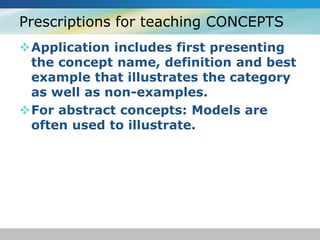
Application includes first presenting 
the concept name, definition and best 
example that illustrates the category 
as well as non-examples. 
For abstract concepts: Models are 
often used to illustrate.
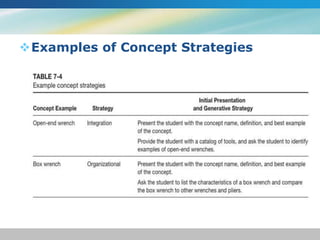
Examples of Concept Strategies
Prescriptions for teaching PRINCIPLES AND 
RULES 
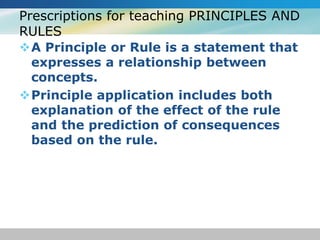
A Principle or Rule is a statement that 
expresses a relationship between 
concepts. 
Principle application includes both 
explanation of the effect of the rule 
and the prediction of consequences 
based on the rule.
Prescriptions for teaching PRINCIPLES AND 
RULES 
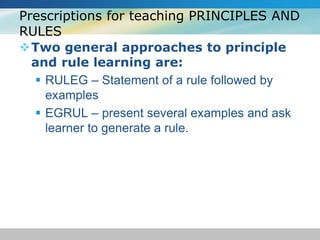
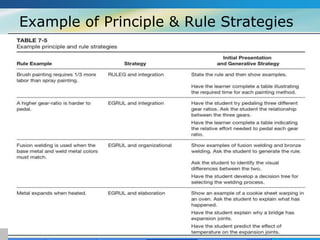
Two general approaches to principle 
and rule learning are: 
 RULEG – Statement of a rule followed by 
examples 
 EGRUL – present several examples and ask 
learner to generate a rule.
Example of Principle & Rule Strategies
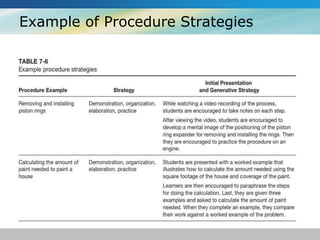
Prescriptions for teaching PROCEDURES 
A procedure is a sequence of steps 
the learner performs to accomplish a 
task. 
Strategies: 
 Recall - requires learners to list or describe 
the steps of the procedures 
 Application – requires the learner to 
demonstrate the procedures 
Generative Strategies: 
 Development of a mental model and then 
practice
Example of Procedure Strategies
Prescriptions for Teaching Interpersonal 
Skills 
Interpersonal skills deals with the 
development of communication Skills. 
Performance for Interpersonal Skills 
is either: 
 Recall OR Application with a primary 
emphasis on application 
The Strategy for designing instruction 
for Interpersonal Objectives is based 
on Bandura’s Social Learning Theory.
These are: 
 Modeling 
 Development of Verbal and Imaginable 
Models of behaviour 
 Mental Rehearsal 
 Overt Practice
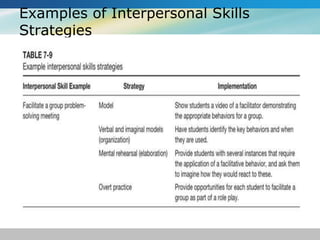
Examples of Interpersonal Skills 
Strategies
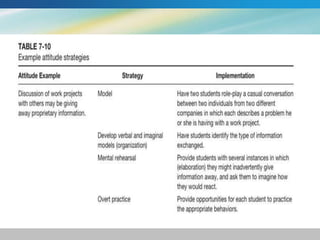
Prescriptions for Teaching Attitudes 
 An attitude consists of a belief and associated 
behavior or response. 
 The strategy for teaching (i.e., changing) 
attitudes is similar to the strategy for 
interpersonal objectives.
 Both are based on Bandura’s (1977) social 
learning theory. 
 The prescription for attitudes is to: 
• model the behavior, 
• develop the verbal and imaginal models, 
• use mental rehearsal, and 
• provide for both covert and overt rehearsal (see 
Table 7-10).
Instructional Strategies

Instructional Strategies

  • 1.
    Designing the Instruction: Strategies Prepared by: Leesha Roberts Source: Designing Effective Instruction by Morrison, Ross, Kalman and Kemp
  • 2.
    Why Instructional Strategies? www.designfreebies.org The designer’s primary goal to design effective and efficient instruction. Prescriptions are used to ensure that different types of content is efficiently delivered. The prescriptions used are based on research, which you modify based on your experiences. Company Logo
  • 3.
    Designing An InstructionalStrategy Learning is an active process. A well designed instructional strategy prompts or motivates the learner to actively make connections. Researchers describe this type of learning as generative learning. The advantage of generative learning are the learner’s deeper understanding and longer retention of what is learned. Company Logo
  • 4.
    Foundations for thePrescriptions Research also states that a learner can process new information on a continuum (i.e. in continuous series). One of the intentions of Instructional Strategy is to design instruction so that the learner is motivated to generate or construct these meaningful relationships.
  • 5.
    Generative Strategies Thereare four generative strategies:  RECALL: used for facts and lists for verbatim recall. Specific instructional strategies that facilitate recall include repetition, rehearsal (e.g. mental practice), review and mnemonics.
  • 6.
    Generative Strategies INTEGRATION STRATEGIES: used for transforming information into a more easily remembered form. Strategies that help the learner transform new content include paraphrasing, generating questions or examples of new information.
  • 7.
    Generative Strategies ORGANIZATIONAL: helps the learner identify how new ideas relate to existing ideas. Strategies that help with organization is analyzing key ideas (i.e. categorizing, identifying and interrelating ideas)  ELABORATION: helps learners to add their ideas to the new information. Strategies that facilitate elaboration include the generating of mental images, creating physical diagrams and relating it to existing knowledge to new information.
  • 8.
    Prescriptions for InstructionalStrategies Recall Performance relies on rote memorization of the content. Application performance requires the learner to apply the content to a new situation or problem. Application objectives for rules and procedures requires the learner to apply the rule or procedure to solve a problem, explain an instance or complete a task.
  • 9.
    Prescriptions for teachingFacts A fact is a statement of association between two things. Facts can only be recalled, they have no specific application. There are two types of facts:  Concrete facts – those you can sense (e.g. fire trucks are red)  Abstract facts – these cannot be observed or experienced. When teaching these facts you should try to find concrete facts for the initial presentation.
  • 10.
    Applicable Generative Strategiesfor FACTS Rehearsal Practice Elaboration Development of Mnemonics
  • 11.
    Prescriptions for teachingCONCEPTS A Concept is a category used to group similar ideas or things (e.g. jewelry) to organize knowledge. Strategies utilized are the same as those used for teaching FACTS Strategies for teaching strategies are:  Fact: repetition  Rehearsal  Review  Mnemonics
  • 12.
    Prescriptions for teachingCONCEPTS Application includes first presenting the concept name, definition and best example that illustrates the category as well as non-examples. For abstract concepts: Models are often used to illustrate.
  • 13.
  • 14.
    Prescriptions for teachingPRINCIPLES AND RULES A Principle or Rule is a statement that expresses a relationship between concepts. Principle application includes both explanation of the effect of the rule and the prediction of consequences based on the rule.
  • 15.
    Prescriptions for teachingPRINCIPLES AND RULES Two general approaches to principle and rule learning are:  RULEG – Statement of a rule followed by examples  EGRUL – present several examples and ask learner to generate a rule.
  • 16.
    Example of Principle& Rule Strategies
  • 17.
    Prescriptions for teachingPROCEDURES A procedure is a sequence of steps the learner performs to accomplish a task. Strategies:  Recall - requires learners to list or describe the steps of the procedures  Application – requires the learner to demonstrate the procedures Generative Strategies:  Development of a mental model and then practice
  • 18.
  • 19.
    Prescriptions for TeachingInterpersonal Skills Interpersonal skills deals with the development of communication Skills. Performance for Interpersonal Skills is either:  Recall OR Application with a primary emphasis on application The Strategy for designing instruction for Interpersonal Objectives is based on Bandura’s Social Learning Theory.
  • 20.
    These are: Modeling  Development of Verbal and Imaginable Models of behaviour  Mental Rehearsal  Overt Practice
  • 21.
    Examples of InterpersonalSkills Strategies
  • 22.
    Prescriptions for TeachingAttitudes  An attitude consists of a belief and associated behavior or response.  The strategy for teaching (i.e., changing) attitudes is similar to the strategy for interpersonal objectives.
  • 23.
     Both arebased on Bandura’s (1977) social learning theory.  The prescription for attitudes is to: • model the behavior, • develop the verbal and imaginal models, • use mental rehearsal, and • provide for both covert and overt rehearsal (see Table 7-10).

Editor's Notes

  • #3 The designer’s primary goal is to design effective and efficient instruction that produces reliable results each time it is presented to the learner. We achieve this goal by developing prescriptions that describe an optimum method of instruction for different types of content. These prescriptions are based on research, you modify them based on your experiences.
  • #4 Learning is an active process in which the learner constructs meaningful relationships between the new knowledge presented in the instruction and the learner’s existing knowledge. A well designed instructional strategy prompts or motivates the learner to actively make these connections between what the learner already knows and the new information.
  • #5 Research also states that a learner can process new information on a continuum that ranges from phonemic (speech and reading) to semantic (or elating to meaning or arising from distinctions between the meanings of different words or symbols) processing.