FISCAL ADMINISTRATION
FISCAL ADMINISTRATIONFiscal administration refers to systems, structures, processes, resources, and the policy, environment, government, the inter-governmental and inter-local fiscal relations, affecting among others, the following: 	o the giving of allotments and grants by the national government (NG) to local government units (LGUs); o sharing of taxing powers between the NG and the LGUs, and among LGUs units; o policy on tax rates and structure; o revenue and expenditure planning; o revenue utilization and expenditure allocation; o monitoring and approval of budgets, tax ordinances and other fiscal measures; o policy on borrowing and borrowing instruments; and o appointment and supervision of local fiscal officers.
ORGANIZING FOR FISCAL ADMINISTRATION:   Fiscal activity is present in all levels of the organization, whether line or staff; top management level through middle management; the rank and file. Top management is most interested in it; middle management is deeply involved in it; the rank and file is affected by whatever results from it.
        The principal agencies tasked with fiscal functions:  1. Congress, especially the Lower House - Congress is responsible for revenue and					            expenditure policies. 2. Department of Finance   -  Revenue generation and collection				     - Fund custody				     - Disbursements 				     - Keeping of accounts 3. Department of Budget and Management - Review of estimates and fiscal policy studies are done by the Department of Budget and Management in close consultation with the National Economic Development Authority;	The Central Bank and other economic planning entities of the state to see to it that fiscal plans and programs are geared towards national development. 4. Commission on Audit - The Commission on Audit conducts fund and performance audit to see to it that expenditures are in accordance with the Appropriation Law approvedORGANIZING FOR FISCAL ADMINISTRATION:
FISCAL CONTROL MECHANISMSFOUR JUSTIFICATIONS FOR EXPENDITURE CONTROL :1.    Prevent Misappropriation of Funds:Requires review and approval by the administrative official of the line or operating agency, of all requests for money releases and budgetary allotments, vouchers and similar papers before payments are made so that expenditures are in accordance with policy and law and not illegal, irregular, unnecessary, unconscionable, extravagant and excessive, (IIUUEE) (COA CIRC. 85-155)2.    Control to Implement Prospective Policyproactive administration inhibits governmental units from directly transacting and negotiating money matters since such kind of transaction is officially channeled through the Department of Budget and Management in the form of budget estimates as endorsed by the President.
FISCAL CONTROL MECHANISMSFOUR JUSTIFICATIONS FOR EXPENDITURE CONTROL:3.   Ensure the Wisdom and Propriety of ExpenditureClaims for payment from public funds, legality, prudence, reasonableness, the morality of the claim or charge should be established.	A review of existing contracts and transactions should be made.4.   Prevent DeficitsFiscal supervision and control may be useful but should not unduly interfere with agency prerogative to carry out programs mandated by the constitution and the laws.
SOURCES OF FUNDSOF LOCAL GOVERNMENT UNITSINTERNAL REVENUE ALLOTMENT:	- refers to the share of LGUs from the National Internal Revenue Taxes (NIRT) 	NATIONAL INTERNAL REVENUE TAXES include the following:Income tax
Estate Tax and Donor’s Tax
Value-Added Tax
Other Percentage Taxes
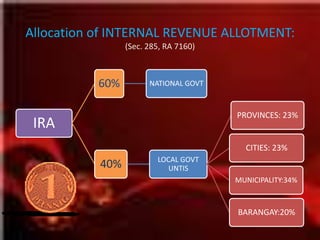
Taxes Imposed by Special Laws, such as Travel taxAllocation of INTERNAL REVENUE ALLOTMENT: (Sec. 285, RA 7160)
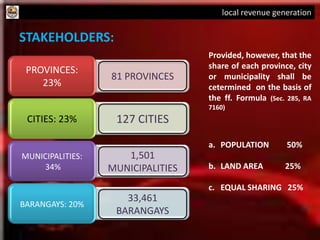
local revenue generationSTAKEHOLDERS:Provided, however, that the share of each province, city or municipality shall be cetermined  on the basis of the ff. Formula (Sec. 285, RA 7160)PROVINCES: 23%81 PROVINCESCITIES: 23%127 CITIESPOPULATION         50%LAND AREA           25%EQUAL SHARING   25%MUNICIPALITIES: 34%1,501 MUNICIPALITIESBARANGAYS: 20%33,461 BARANGAYS
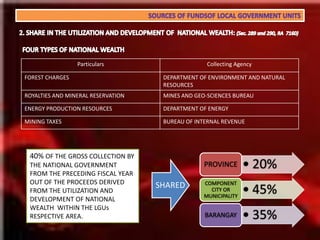
SOURCES OF FUNDSOF LOCAL GOVERNMENT UNITS2. SHARE IN THE UTILIZATION AND DEVELOPMENT OF  NATIONAL WEALTH: (Sec. 289 and 290, RA  7160)  FOUR TYPES OF NATIONAL WEALTH40% OF THE GROSS COLLECTION BY THE NATIONAL GOVERNMENT FROM THE PRECEDING FISCAL YEAR OUT OF THE PROCEEDS DERIVED FROM THE UTILIZATION AND DEVELOPMENT OF NATIONAL WEALTH  WITHIN THE LGUs RESPECTIVE AREA.
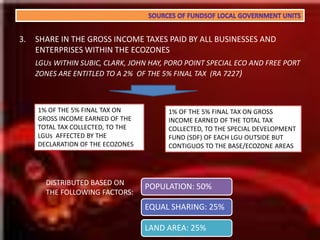
SOURCES OF FUNDSOF LOCAL GOVERNMENT UNITSSHARE IN THE GROSS INCOME TAXES PAID BY ALL BUSINESSES AND ENTERPRISES WITHIN THE ECOZONES    LGUs WITHIN SUBIC, CLARK, JOHN HAY, PORO POINT SPECIAL ECO AND FREE PORT ZONES ARE ENTITLED TO A 2%  OF THE 5% FINAL TAX  (RA 7227)1% OF THE 5% FINAL TAX ON GROSS INCOME EARNED OF THE TOTAL TAX COLLECTED, TO THE LGUs  AFFECTED BY THE DECLARATION OF THE ECOZONES  1% OF THE 5% FINAL TAX ON GROSS INCOME EARNED OF THE TOTAL TAX COLLECTED, TO THE SPECIAL DEVELOPMENT FUND (SDF) OF EACH LGU OUTSIDE BUT CONTIGUOS TO THE BASE/ECOZONE AREASDISTRIBUTED BASED ON THE FOLLOWING FACTORS:
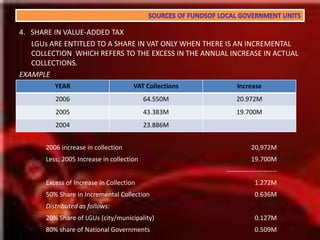
SOURCES OF FUNDSOF LOCAL GOVERNMENT UNITS4.   SHARE IN VALUE-ADDED TAX	LGUs ARE ENTITLED TO A SHARE IN VAT ONLY WHEN THERE IS AN INCREMENTAL COLLECTION  WHICH REFERS TO THE EXCESS IN THE ANNUAL INCREASE IN ACTUAL COLLECTIONS. EXAMPLE
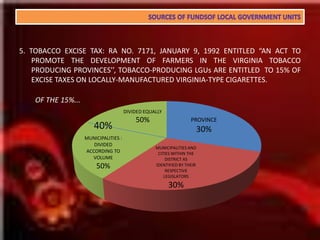
SOURCES OF FUNDSOF LOCAL GOVERNMENT UNITS5. TOBACCO EXCISE TAX: RA NO. 7171, JANUARY 9, 1992 ENTITLED “AN ACT TO PROMOTE THE DEVELOPMENT OF FARMERS IN THE VIRGINIA TOBACCO PRODUCING PROVINCES’’, TOBACCO-PRODUCING LGUs ARE ENTITLED  TO 15% OF EXCISE TAXES ON LOCALLY-MANUFACTURED VIRGINIA-TYPE CIGARETTES.OF THE 15%...DIVIDED EQUALLY 50%40%
BUDGET CONCEPT AND THE BUDGET PROCESS	 “ONE – FUND’ concept	The "one-fund" concept is the policy enunciated through PD 1177 which requires that all income and revenues of the government must accrue to the General Fund and thus can be freely allocated to fund programs and projects of government as prioritized. 	The "one-fund" concept is a fiscal management policy requiring that as much as possible, all revenues and other receipts of the government must enter the General Fund and their utilization and disbursement subject to the budgeting process. The one-fund concept is significant in that it serves as an avenue through which fiscal authorities may properly allocate scarce government resources in accordance with the priorities in the over-all program of economic development. 	It likewise provides a mechanism to control drawdowns on pooled resources. Regularly, the level of funds disbursed are monitored against the level of revenues generated. This way, we are able to stick to the targeted level of disbursement for a given period and avoid incurring a deficit. It also alerts us of possible revenue shortfalls.
BUDGET CONCEPT AND THE BUDGET PROCESS	BALANCED BUDGET CONCEPT:	In the context of government budgeting, a budget is said to be balanced when revenues match expenditures or disbursements. When expenditures exceed revenues, the government incurs a deficit which may result in the following situations:		• The government borrows money either from foreign sources or from the domestic capital market which increases the debt stock of the NG and its debt servicing requirements; 		• The government borrows money from the BangkoSentralngPilipinas; or, 		• The government withdraws funds from its cash balances in the Treasur
BUDGET CONCEPT AND THE BUDGET PROCESS	THE GOVERNMENT’S FISCAL POLICY:	Historically, national government expenditures have always exceeded total revenues resulting in annual budget deficits. Thus, the national overnment had to resort to borrowing to cover said deficits which resulted in the ballooning of foreign and domestic debts. However, in 1994, the government broke the deficit trend by posting a budget surplus of P16 billion through an aggressive privatization and revenue generation program and a prudent expenditure program. Since then, the government has been exerting efforts to maintain the surplus budget policy.	SURPLUS BUDGETING	The surplus budget policy is important to encourage economic growth. The less the government borrow from the public, the lesser the pressure on interest and inflation rates and the more funds are made available in the financial market. Such funds may be used by businessmen to build factories, hire workers, buy equipment and open more employment opportunities. By keeping more funds in the hands of the Private sector rather than competing for credit, the government helps make financing available for families who want to own homes, buy cars, or support their children's education. The government also needs to generate a budget surplus to repay the huge debt it has accumulated over the years. The reduction of the national budget debt will correspondingly lessen government's requirements for interest and principal payments. This  becomes important particularly during periods of rising interest rates and unstable exchange rates.
BUDGET CONCEPT AND THE BUDGET PROCESS 	TOTAL RESOURCE BUDGET CONCEPT is adopted by the present budgeting system which requires the preparation of the national government within the framework of the total impact of all government entities on the national economy. Under this concept, the National Government (NG) budget is considered as only one component of the entire public sector resources. 	Government-Owned and Controlled Corporations (GOCCs) and Local Government Units (LGUs) are also considered as substantial contributors to total public resources. GOCCs and LGUs are therefore required to prepare their budget consistent in form and timing with that of the NG to facilitate comprehensive evaluation of the overall budget. 	In total resource budgeting, the energies and capabilities of all public entities are harnessed in drawing up the optimal package of goods and services that can be sustained by available resources.
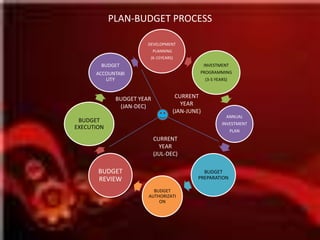
PLAN-BUDGET PROCESSCURRENT YEAR(JAN-JUNE)BUDGET YEAR(JAN-DEC)CURRENT YEAR(JUL-DEC)
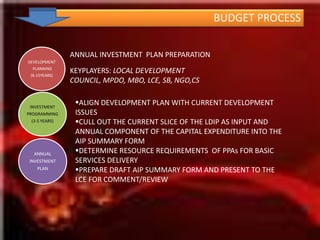
DEVELOPMENT PLANNING(6-15YEARS)BUDGET PROCESSINVESTMENT PROGRAMMING(3-5 YEARS)ANNUAL INVESTMENT  PLAN PREPARATIONKEYPLAYERS: LOCAL DEVELOPMENT COUNCIL, MPDO, MBO, LCE, SB, NGO,CS ANNUALINVESTMENT PLANALIGN DEVELOPMENT PLAN WITH CURRENT DEVELOPMENT ISSUES
CULL OUT THE CURRENT SLICE OF THE LDIP AS INPUT AND ANNUAL COMPONENT OF THE CAPITAL EXPENDITURE INTO THE AIP SUMMARY FORM
DETERMINE RESOURCE REQUIREMENTS  OF PPAs FOR BASIC SERVICES DELIVERY
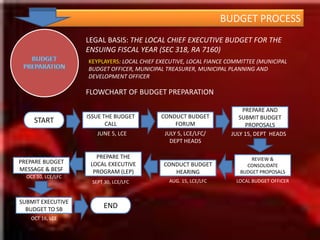
PREPARE DRAFT AIP SUMMARY FORM AND PRESENT TO THE LCE FOR COMMENT/REVIEWBUDGET PREPARATIONBUDGET PROCESSLEGAL BASIS: THE LOCAL CHIEF EXECUTIVE BUDGET FOR THE ENSUING FISCAL YEAR (SEC 318, RA 7160)KEYPLAYERS: LOCAL CHIEF EXECUTIVE, LOCAL FIANCE COMMITTEE (MUNICIPAL BUDGET OFFICER, MUNICIPAL TREASURER, MUNICIPAL PLANNING AND  DEVELOPMENT OFFICERFLOWCHART OF BUDGET PREPARATIONPREPARE AND SUBMIT BUDGET PROPOSALSSTARTISSUE THE BUDGET CALLCONDUCT BUDGET FORUMJUNE 5, LCEJULY 5, LCE/LFC/ DEPT HEADS JULY 15, DEPT  HEADS PREPARE THE LOCAL EXECUTIVE PROGRAM (LEP)REVIEW & CONSOLIDATE BUDGET PROPOSALSPREPARE BUDGET MESSAGE & BESFCONDUCT BUDGET HEARINGOCT 10, LCE/LFCLOCAL BUDGET OFFICERAUG. 15, LCE/LFCSEPT 30, LCE/LFCSUBMIT EXECUTIVE BUDGET TO SBENDOCT 16, LCE
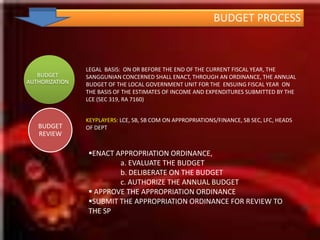
BUDGET PROCESSLEGAL  BASIS:  ON OR BEFORE THE END OF THE CURRENT FISCAL YEAR, THE SANGGUNIAN CONCERNED SHALL ENACT, THROUGH AN ORDINANCE, THE ANNUAL BUDGET OF THE LOCAL GOVERNMENT UNIT FOR THE  ENSUING FISCAL YEAR  ON THE BASIS OF THE ESTIMATES OF INCOME AND EXPENDITURES SUBMITTED BY THE LCE (SEC 319, RA 7160)KEYPLAYERS: LCE, SB, SB COM ON APPROPRIATIONS/FINANCE, SB SEC, LFC, HEADS OF DEPTBUDGET REVIEWENACT APPROPRIATION ORDINANCE, 	a. EVALUATE THE BUDGET 	b. DELIBERATE ON THE BUDGET	c. AUTHORIZE THE ANNUAL BUDGET APPROVE THE APPROPRIATION ORDINANCE
SUBMIT THE APPROPRIATION ORDINANCE FOR REVIEW TO THE SPBUDGET AUTHORIZATION
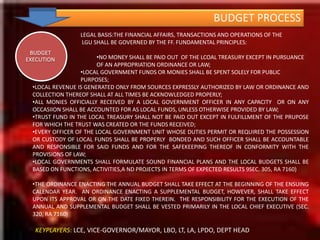
BUDGET PROCESS		LEGAL BASIS:THE FINANCIAL AFFAIRS, TRANSACTIONS AND OPERATIONS OF THE		 LGU SHALL BE GOVERNED BY THE FF. FUNDAMENTAL PRINCIPLES:NO MONEY SHALL BE PAID OUT  OF THE LCOAL TREASURY EXCEPT IN PURSUANCE OF AN APPROPRIATION ORDINANCE OR LAW;
LOCAL GOVERNMENT FUNDS OR MONIES SHALL BE SPENT SOLELY FOR PUBLIC  PURPOSES;
LOCAL REVENUE IS GENERATED ONLY FROM SOURCES EXPRESSLY AUTHORIZED BY LAW OR ORDINANCE AND COLLECTION THEREOF SHALL AT ALL TIMES BE ACKNOWLEDGED PROPERLY;

Fiscal control mechanisms mfderamos

  • 1.
  • 2.
    FISCAL ADMINISTRATIONFiscal administrationrefers to systems, structures, processes, resources, and the policy, environment, government, the inter-governmental and inter-local fiscal relations, affecting among others, the following: o the giving of allotments and grants by the national government (NG) to local government units (LGUs); o sharing of taxing powers between the NG and the LGUs, and among LGUs units; o policy on tax rates and structure; o revenue and expenditure planning; o revenue utilization and expenditure allocation; o monitoring and approval of budgets, tax ordinances and other fiscal measures; o policy on borrowing and borrowing instruments; and o appointment and supervision of local fiscal officers.
  • 3.
    ORGANIZING FOR FISCALADMINISTRATION: Fiscal activity is present in all levels of the organization, whether line or staff; top management level through middle management; the rank and file. Top management is most interested in it; middle management is deeply involved in it; the rank and file is affected by whatever results from it.
  • 4.
    The principal agencies tasked with fiscal functions: 1. Congress, especially the Lower House - Congress is responsible for revenue and expenditure policies. 2. Department of Finance - Revenue generation and collection - Fund custody - Disbursements - Keeping of accounts 3. Department of Budget and Management - Review of estimates and fiscal policy studies are done by the Department of Budget and Management in close consultation with the National Economic Development Authority; The Central Bank and other economic planning entities of the state to see to it that fiscal plans and programs are geared towards national development. 4. Commission on Audit - The Commission on Audit conducts fund and performance audit to see to it that expenditures are in accordance with the Appropriation Law approvedORGANIZING FOR FISCAL ADMINISTRATION:
  • 5.
    FISCAL CONTROL MECHANISMSFOURJUSTIFICATIONS FOR EXPENDITURE CONTROL :1. Prevent Misappropriation of Funds:Requires review and approval by the administrative official of the line or operating agency, of all requests for money releases and budgetary allotments, vouchers and similar papers before payments are made so that expenditures are in accordance with policy and law and not illegal, irregular, unnecessary, unconscionable, extravagant and excessive, (IIUUEE) (COA CIRC. 85-155)2. Control to Implement Prospective Policyproactive administration inhibits governmental units from directly transacting and negotiating money matters since such kind of transaction is officially channeled through the Department of Budget and Management in the form of budget estimates as endorsed by the President.
  • 6.
    FISCAL CONTROL MECHANISMSFOURJUSTIFICATIONS FOR EXPENDITURE CONTROL:3. Ensure the Wisdom and Propriety of ExpenditureClaims for payment from public funds, legality, prudence, reasonableness, the morality of the claim or charge should be established. A review of existing contracts and transactions should be made.4. Prevent DeficitsFiscal supervision and control may be useful but should not unduly interfere with agency prerogative to carry out programs mandated by the constitution and the laws.
  • 7.
    SOURCES OF FUNDSOFLOCAL GOVERNMENT UNITSINTERNAL REVENUE ALLOTMENT: - refers to the share of LGUs from the National Internal Revenue Taxes (NIRT) NATIONAL INTERNAL REVENUE TAXES include the following:Income tax
  • 8.
    Estate Tax andDonor’s Tax
  • 9.
  • 10.
  • 11.
    Taxes Imposed bySpecial Laws, such as Travel taxAllocation of INTERNAL REVENUE ALLOTMENT: (Sec. 285, RA 7160)
  • 12.
    local revenue generationSTAKEHOLDERS:Provided,however, that the share of each province, city or municipality shall be cetermined on the basis of the ff. Formula (Sec. 285, RA 7160)PROVINCES: 23%81 PROVINCESCITIES: 23%127 CITIESPOPULATION 50%LAND AREA 25%EQUAL SHARING 25%MUNICIPALITIES: 34%1,501 MUNICIPALITIESBARANGAYS: 20%33,461 BARANGAYS
  • 13.
    SOURCES OF FUNDSOFLOCAL GOVERNMENT UNITS2. SHARE IN THE UTILIZATION AND DEVELOPMENT OF NATIONAL WEALTH: (Sec. 289 and 290, RA 7160) FOUR TYPES OF NATIONAL WEALTH40% OF THE GROSS COLLECTION BY THE NATIONAL GOVERNMENT FROM THE PRECEDING FISCAL YEAR OUT OF THE PROCEEDS DERIVED FROM THE UTILIZATION AND DEVELOPMENT OF NATIONAL WEALTH WITHIN THE LGUs RESPECTIVE AREA.
  • 14.
    SOURCES OF FUNDSOFLOCAL GOVERNMENT UNITSSHARE IN THE GROSS INCOME TAXES PAID BY ALL BUSINESSES AND ENTERPRISES WITHIN THE ECOZONES LGUs WITHIN SUBIC, CLARK, JOHN HAY, PORO POINT SPECIAL ECO AND FREE PORT ZONES ARE ENTITLED TO A 2% OF THE 5% FINAL TAX (RA 7227)1% OF THE 5% FINAL TAX ON GROSS INCOME EARNED OF THE TOTAL TAX COLLECTED, TO THE LGUs AFFECTED BY THE DECLARATION OF THE ECOZONES 1% OF THE 5% FINAL TAX ON GROSS INCOME EARNED OF THE TOTAL TAX COLLECTED, TO THE SPECIAL DEVELOPMENT FUND (SDF) OF EACH LGU OUTSIDE BUT CONTIGUOS TO THE BASE/ECOZONE AREASDISTRIBUTED BASED ON THE FOLLOWING FACTORS:
  • 15.
    SOURCES OF FUNDSOFLOCAL GOVERNMENT UNITS4. SHARE IN VALUE-ADDED TAX LGUs ARE ENTITLED TO A SHARE IN VAT ONLY WHEN THERE IS AN INCREMENTAL COLLECTION WHICH REFERS TO THE EXCESS IN THE ANNUAL INCREASE IN ACTUAL COLLECTIONS. EXAMPLE
  • 16.
    SOURCES OF FUNDSOFLOCAL GOVERNMENT UNITS5. TOBACCO EXCISE TAX: RA NO. 7171, JANUARY 9, 1992 ENTITLED “AN ACT TO PROMOTE THE DEVELOPMENT OF FARMERS IN THE VIRGINIA TOBACCO PRODUCING PROVINCES’’, TOBACCO-PRODUCING LGUs ARE ENTITLED TO 15% OF EXCISE TAXES ON LOCALLY-MANUFACTURED VIRGINIA-TYPE CIGARETTES.OF THE 15%...DIVIDED EQUALLY 50%40%
  • 17.
    BUDGET CONCEPT ANDTHE BUDGET PROCESS “ONE – FUND’ concept The "one-fund" concept is the policy enunciated through PD 1177 which requires that all income and revenues of the government must accrue to the General Fund and thus can be freely allocated to fund programs and projects of government as prioritized. The "one-fund" concept is a fiscal management policy requiring that as much as possible, all revenues and other receipts of the government must enter the General Fund and their utilization and disbursement subject to the budgeting process. The one-fund concept is significant in that it serves as an avenue through which fiscal authorities may properly allocate scarce government resources in accordance with the priorities in the over-all program of economic development. It likewise provides a mechanism to control drawdowns on pooled resources. Regularly, the level of funds disbursed are monitored against the level of revenues generated. This way, we are able to stick to the targeted level of disbursement for a given period and avoid incurring a deficit. It also alerts us of possible revenue shortfalls.
  • 18.
    BUDGET CONCEPT ANDTHE BUDGET PROCESS BALANCED BUDGET CONCEPT: In the context of government budgeting, a budget is said to be balanced when revenues match expenditures or disbursements. When expenditures exceed revenues, the government incurs a deficit which may result in the following situations: • The government borrows money either from foreign sources or from the domestic capital market which increases the debt stock of the NG and its debt servicing requirements; • The government borrows money from the BangkoSentralngPilipinas; or, • The government withdraws funds from its cash balances in the Treasur
  • 19.
    BUDGET CONCEPT ANDTHE BUDGET PROCESS THE GOVERNMENT’S FISCAL POLICY: Historically, national government expenditures have always exceeded total revenues resulting in annual budget deficits. Thus, the national overnment had to resort to borrowing to cover said deficits which resulted in the ballooning of foreign and domestic debts. However, in 1994, the government broke the deficit trend by posting a budget surplus of P16 billion through an aggressive privatization and revenue generation program and a prudent expenditure program. Since then, the government has been exerting efforts to maintain the surplus budget policy. SURPLUS BUDGETING The surplus budget policy is important to encourage economic growth. The less the government borrow from the public, the lesser the pressure on interest and inflation rates and the more funds are made available in the financial market. Such funds may be used by businessmen to build factories, hire workers, buy equipment and open more employment opportunities. By keeping more funds in the hands of the Private sector rather than competing for credit, the government helps make financing available for families who want to own homes, buy cars, or support their children's education. The government also needs to generate a budget surplus to repay the huge debt it has accumulated over the years. The reduction of the national budget debt will correspondingly lessen government's requirements for interest and principal payments. This becomes important particularly during periods of rising interest rates and unstable exchange rates.
  • 20.
    BUDGET CONCEPT ANDTHE BUDGET PROCESS TOTAL RESOURCE BUDGET CONCEPT is adopted by the present budgeting system which requires the preparation of the national government within the framework of the total impact of all government entities on the national economy. Under this concept, the National Government (NG) budget is considered as only one component of the entire public sector resources. Government-Owned and Controlled Corporations (GOCCs) and Local Government Units (LGUs) are also considered as substantial contributors to total public resources. GOCCs and LGUs are therefore required to prepare their budget consistent in form and timing with that of the NG to facilitate comprehensive evaluation of the overall budget. In total resource budgeting, the energies and capabilities of all public entities are harnessed in drawing up the optimal package of goods and services that can be sustained by available resources.
  • 21.
    PLAN-BUDGET PROCESSCURRENT YEAR(JAN-JUNE)BUDGETYEAR(JAN-DEC)CURRENT YEAR(JUL-DEC)
  • 22.
    DEVELOPMENT PLANNING(6-15YEARS)BUDGET PROCESSINVESTMENTPROGRAMMING(3-5 YEARS)ANNUAL INVESTMENT PLAN PREPARATIONKEYPLAYERS: LOCAL DEVELOPMENT COUNCIL, MPDO, MBO, LCE, SB, NGO,CS ANNUALINVESTMENT PLANALIGN DEVELOPMENT PLAN WITH CURRENT DEVELOPMENT ISSUES
  • 23.
    CULL OUT THECURRENT SLICE OF THE LDIP AS INPUT AND ANNUAL COMPONENT OF THE CAPITAL EXPENDITURE INTO THE AIP SUMMARY FORM
  • 24.
    DETERMINE RESOURCE REQUIREMENTS OF PPAs FOR BASIC SERVICES DELIVERY
  • 25.
    PREPARE DRAFT AIPSUMMARY FORM AND PRESENT TO THE LCE FOR COMMENT/REVIEWBUDGET PREPARATIONBUDGET PROCESSLEGAL BASIS: THE LOCAL CHIEF EXECUTIVE BUDGET FOR THE ENSUING FISCAL YEAR (SEC 318, RA 7160)KEYPLAYERS: LOCAL CHIEF EXECUTIVE, LOCAL FIANCE COMMITTEE (MUNICIPAL BUDGET OFFICER, MUNICIPAL TREASURER, MUNICIPAL PLANNING AND DEVELOPMENT OFFICERFLOWCHART OF BUDGET PREPARATIONPREPARE AND SUBMIT BUDGET PROPOSALSSTARTISSUE THE BUDGET CALLCONDUCT BUDGET FORUMJUNE 5, LCEJULY 5, LCE/LFC/ DEPT HEADS JULY 15, DEPT HEADS PREPARE THE LOCAL EXECUTIVE PROGRAM (LEP)REVIEW & CONSOLIDATE BUDGET PROPOSALSPREPARE BUDGET MESSAGE & BESFCONDUCT BUDGET HEARINGOCT 10, LCE/LFCLOCAL BUDGET OFFICERAUG. 15, LCE/LFCSEPT 30, LCE/LFCSUBMIT EXECUTIVE BUDGET TO SBENDOCT 16, LCE
  • 26.
    BUDGET PROCESSLEGAL BASIS: ON OR BEFORE THE END OF THE CURRENT FISCAL YEAR, THE SANGGUNIAN CONCERNED SHALL ENACT, THROUGH AN ORDINANCE, THE ANNUAL BUDGET OF THE LOCAL GOVERNMENT UNIT FOR THE ENSUING FISCAL YEAR ON THE BASIS OF THE ESTIMATES OF INCOME AND EXPENDITURES SUBMITTED BY THE LCE (SEC 319, RA 7160)KEYPLAYERS: LCE, SB, SB COM ON APPROPRIATIONS/FINANCE, SB SEC, LFC, HEADS OF DEPTBUDGET REVIEWENACT APPROPRIATION ORDINANCE, a. EVALUATE THE BUDGET b. DELIBERATE ON THE BUDGET c. AUTHORIZE THE ANNUAL BUDGET APPROVE THE APPROPRIATION ORDINANCE
  • 27.
    SUBMIT THE APPROPRIATIONORDINANCE FOR REVIEW TO THE SPBUDGET AUTHORIZATION
  • 28.
    BUDGET PROCESS LEGAL BASIS:THEFINANCIAL AFFAIRS, TRANSACTIONS AND OPERATIONS OF THE LGU SHALL BE GOVERNED BY THE FF. FUNDAMENTAL PRINCIPLES:NO MONEY SHALL BE PAID OUT OF THE LCOAL TREASURY EXCEPT IN PURSUANCE OF AN APPROPRIATION ORDINANCE OR LAW;
  • 29.
    LOCAL GOVERNMENT FUNDSOR MONIES SHALL BE SPENT SOLELY FOR PUBLIC PURPOSES;
  • 30.
    LOCAL REVENUE ISGENERATED ONLY FROM SOURCES EXPRESSLY AUTHORIZED BY LAW OR ORDINANCE AND COLLECTION THEREOF SHALL AT ALL TIMES BE ACKNOWLEDGED PROPERLY;