PLANNING PROCESS,
PERT AND GANTT CHART
PRESENTED BY:
Archita sharma
Roll no. 03
M.Sc. Nursing 2nd
year
SNGNC, IGMC, SHIMLA.
PLANNING PROCESS
“A goal without a plan is just a wish”
INTRODUCTION
• Planning is essential in every walk of life.
• Planning is the first and foremost function of management.
• Planning, the primary function of management enables the
organization to deal with the present and anticipate the future.
• It is a process whereby management decides where it is at present, and
where it wants to be after some time in future.
DEFINITION
According to James Lundy-
“Planning means the determination of what is to be done how and
where is to be done who is to do it and how results are to be
evaluated”
According to Philip Kotler;
“Planning is deciding in the present what to do in future.”
 According to Mitchell;
“Planning is usually interpreted as a process to develop a strategy to
achieve desired objectives, to solve problems and to facilitate action.”
CONCEPT OF PLANNING
Planning is considered as a process which involves the
determination of future course of action i.e. why an action, what
action, how to take action and when to take action. Thus, the
planning process is concerned to the answers of why, what, how
and when. Although, the basic process of planning is the same for
all the managers yet the type and level of planning may differ from
manager to manager.
CONT…
In order to achieve the objectives of nursing organisation,
planning is the first step in the management function as it precedes
the execution of all other managerial functions because it provides
the frame of reference for future decisions, reduces overall impact
of changes and allows nurse managers to organise staff and direct
and control the activities necessary to accomplish the nursing
organizational objectives.
OBJECTIVES OF PLANNING
The following are the major objectives of planning:
1. To Set the Objectives-
Planning actually starts with the formulation of objectives and
planning action to achieve those objectives. The objectives are
defined in a meaningful and technical terms so that managerial
actions could be possible.
2. To Focus on Meaningful Activities-
• Effective planning lays down various courses of action, which are
useful to accomplish the objectives.
• The chances of unproductive activities are reduced to a great extent.
• Planning makes it clear for the nursing personnel working at
different levels as to how their operations can contribute to the
nursing organizational objectives that are in consistent with the
objectives of the hospital.
3. To Economizes the Time and Effort and Other Resources-
Planning at all levels keeps the whole process in order. Money, men,
machines and materials are properly utilized and wastages are
minimized. Time and efforts of the staff working is saved if they know
ahead that what is expected from them.
4. To Maintain Coordination-
Planning is the basis of coordination. With the help of plans, the
departments work in harmony and achieve their respective goals without
any failure.
5. To Reduce Risk and Uncertainty-
Proper planning is made considering various environmental factors
including the human and other factors, since there is diversity in
these factors. There is always a scope of flexibility or alternatives in
good planning that reduces the risk and uncertainty arising out of
them.
6. To Ensure Proper Control-
In planning there is a scope to lay down the methods of
performance evaluation, against the laid down standards and
targets. When these are actually measured and compared with
standards, gives good control to assure the accomplishment of
objectives as set by the plans.
7. To Achieve the Organizational Effectiveness-
The planning states the objectives within a specific use at a
particular time. Thus, planning along with the control measures and
ensures that the resources are utilized as per plan that helps to
achieve the organizational effectiveness. If this is not done, the
reasons are explored and various other measures are re- planned,
that helps to improve the effectiveness of the organization.
8. Planning Promotes Creativity-
Planning is basically the thinking function of management. It helps
innovative and creative thinking. Many new ideas come to mind of
a nurse manger when she is planning. Thus planning promotes
creativity and innovation.
9. To Improve Efficiency-
Planning determines as to when and how various tasks are to be
performed by different nursing units. This brings about efficiency
in the working of various units. Wastages are reduced and needless
efforts are avoided by advance planning.
PRINCIPLES OF PLANNING
The following list shows the principles of planning:
1. The principles of meaningful objectives: Planning should be
done by clearly defined objectives. It is a means of achieving
objectives. Hence objectives should be explicit specific and
measurable.
2. The principle of primacy: All managerial activities after
planning are executed. It provides the basis for organising
staffing, directing, co-ordinating and controlling and flows
through all of them. It is the lifeblood for all functions of
Management.
3. The principle of planning premises: Planning premises are
the anticipated environment in which the plans are expected to
operate. These are also known as conditions that will affect an
organisation.
4. The principle of alternatives: The principle of alternative
means developing many alternatives and then selecting the best
one that would help in achieving predetermined goals.
5. The principle of timing and continuity: Planning should be
done quite ahead and the action plans on time before execution
are developed. It should be an ongoing process of making
modification and re-examining new situations.
6. The principle of flexibility: Planning should be flexible. There
should be scope for readjustment to modify the plan according
to new situations.
7. The principle of communication: It means that all people
working in the organization must know the expectation and
work from them. People of all levels must be aware of
objectives and goals, policies, programs, and rules they are
going to follow to achieve the said goals.
8. The principle of adequate control techniques: The principle of
adequate control techniques states that there should be the
provision of sufficient performance standards with time
dimensions.
9. The principle of participation: There should be reasonable
participation in planning and making managerial decisions. It is a
bottom-to-top approach in management.
10.The principle of economy: According to this principle the
planner must do cost and benefit analysis of every planning
process. The total cost of planning must be less than the added
advantage of planning regarding money and another cost.
IMPORTANCE OF PLANNING
The time devoted to the planning process varies from organization
to organization and depends on the resources available to devote to
the process. Whether we decide to devote only a two-day retreat to
the process or engage in a twelve-month process, organization will
begin to realize the benefits from the start. Some of the
fundamental benefits to the planning process include:
1. It provides a framework and a clearly defined direction that
guides and supports management of the organization.
2. A uniform vision and purpose that is shared among all staff.
3. Focus on an increased level of commitment to the organization
and its goals.
4. Facilitate improved quality of services for clients and a means
of measuring the service.
5. Promotes creativity and innovation.
6. Secures economy in operations through proper allocation of
resources to various operations.
7. Ability to set priorities and to match resources to opportunities.
8. Facilitate decision making.
9. Basis of control by establishing benchmarks for appraisal of
actual performance.
10. Reduction of uncertainty and the ability to deal with risks from
the external environment.
11. Achieve coordination among all departments.
12. A process to help with crisis management.
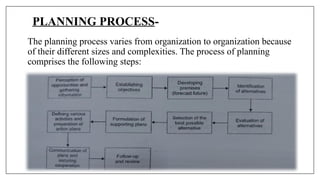
PLANNING PROCESS-
The planning process varies from organization to organization because
of their different sizes and complexities. The process of planning
comprises the following steps:
1. Perception of opportunities and gathering information: Before carrying
out the actual planning, one needs to explore and gather the relevant and
related information regarding threats and possible opportunities, strengths,
and weaknesses of the organization. Information gathered should be accurate,
precise, and up to date as based on estimation. Evaluate all the pros and cons
of possible new opportunities. It is the preliminary step before the
formulation of objectives.
2. Establishing objectives: Frame objectives by the availability
of opportunities and resources. Objectives form the core to the
planning process. It aids the staff to understand the expectation
of the organization. Objectives are the endpoints of any
organization translated into the departmental objective. These
departmental objectives then serve as the means of
accomplishing the overall objective of the organization.
3. Developing premises (forecast future): Premises are the
expected environmental or external and internal conditions to
undertake planning activities. These are an asset of forecasts
regarding these conditions or factors, and the success of
planning depends on the accuracy of these forecasts.
4. Identification of alternatives: After determining the various
planning assumptions, the next step is to work to find out the
maximum alternatives based on the empirical evidence or
experiences or intuitions. Then a short listing of the alternatives
is done for the detailed analysis.
5. Evaluation of alternatives: In this step, an attempt has been
made to evaluate the selected alternatives per the criteria
required for achieving particular objectives. All the merits and
demerits of the alternatives are listed and compared with the
criteria laid down.
6. Selection of the best possible alternatives: After evaluating all
the short-listed alternatives, the most appropriate alternative is
taken up. It is the actual stage of decision-making in the process
of planning.
7. Developing subsidiary plans: After selecting the best plan,
various derivative plans such as policies, procedures, schedules,
methods, and budgets are put into practice. These supportive
plans are the subsidiary plans formulated for various units,
sections, and activities in the light of the master plan to help the
organization to achieve its objectives in a unified manner.
8. Defining various activities and preparation of action plans:
Related activities according to plans are developed and defined.
Time plans using various managerial techniques such as
Programme Evaluation and Review Technique are developed.
These planning and control techniques are important to minimize
the time and cost and for ensuring the completion of projects.
9. Communication of plans and securing cooperation:
Supportive plans properly to the lower levels in the
organization are communicated. All staff should be aware of the
plans, its scope, and benefits. The participation of the staff at
this stage helps them to boost their morale to implement the
plans effectively to the best of their skills and abilities.
10. Follow-up and review: After implementation of the plan, it is
essential to follow it up to remove difficulties at every step of
implementation. If needed, plans may even be modified or
revised to achieve the indented goal.
TYPES OF PLANNING
Planning can be classified on the basis of time period involved, approach
used and degree of formalization, importance of content matters and coverage
of activities.
1. Long Term and Short-Term Planning-
• Long term planning involves more than one-year period, usually 3 to 5
years.
• Short term planning is also known as tactile planning, usually, covers
one year.
2. Proactive and Reactive Planning-
• Proactive planning is the 'planning in anticipation’.
• Whereas the reactive planning is the type of planning that is done
after the environmental changes have taken place.
3. Formal and Informal Planning-
4. Strategic and Operational Planning-
• Long term planning is of strategic in nature and usually
involve more than one-year period extending to
twenty years or so.
• Operational planning is short term planning, usually
covers one year or so.
5. Management (Corporate) and Functional Planning-
• Management planning denotes planning activities at the top
level, also known as corporate planning.
• Functional planning is the segmental and it is taken for each
major function of the organization, for example for personnel
management, finance, etc.
TYPES OF PLAN
A plan is a scheme, program, or method worked out beforehand for
the accomplishment of an objective.
There are two ways of classifying the plans:
• Management Point Of View.
• Hierarchical Nature Of The Plans.
Management Point of View
Here, the plans can be classified as:
 standing and single use plans.
 strategic and operational plans.
 short range or long-range plans.
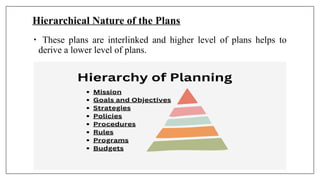
Hierarchical Nature of the Plans
• These plans are interlinked and higher level of plans helps to
derive a lower level of plans.
Purposes or Mission
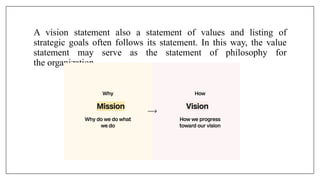
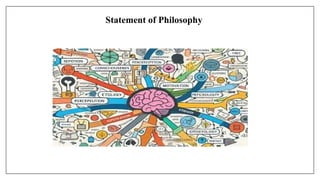
A vision statement also a statement of values and listing of
strategic goals often follows its statement. In this way, the value
statement may serve as the statement of philosophy for
the organization.
Statement of Philosophy
Objectives or Goals
• Health institute objectives are the basic plan of the hospital; a
nursing department may also have its own objectives.
• Its goals naturally contribute to the attainment of hospital
objectives, but the two sets of goals may be entirely different.
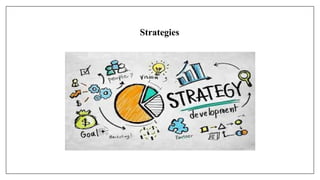
Strategies
Policies
• A policy is a designated plan or course of action to be taken in a
specific situation.
• These are general statements that guide or channel thinking in
decision-making.
Protocols
• A protocol is a detailed standard plan for patient care, such as a
protocol related to disaster management in emergency area.
• This would include various activities related to legal formalities,
technical skills, and other resources management.
Procedures
• Procedures are the plans that establish a required method of
handling future activities.
• They are chronological sequences of required actions.
• Procedures spell out how a particular nursing activity is to be
completed, often described in a number of steps or processes.
• The purpose of the procedures is to simplify operations and
eliminate duplication.
Rules
• Rules are spell out specific required actions or non-action,
allowing no discretion.
• These are the code of conduct or norms.
• It relates to the human behaviour and do not lay down any
specific sequence of action.
Standards of Care
• These are specific, detailed plan of care for individuals with
specific health problem.
• A standard of care covers a broader range of concern for the
individual than does a protocol.
• The purpose of a standard of a care is to establish the best
practice and eliminate as much variation as possible.
Standards of Nursing Practice
• These are authoritative statements that describe a common or
acceptable level of professional nursing performance.
• The standards of practice, therefore, define professional
practice.
• Indian Nursing Council has also devised general standards and
guidelines for nursing practice.
Budgets
• The budget is the fundamental planning instrument for health
agencies.
• Infact, one of the major advantages of budgeting is that it makes
people plan; because a budget is in the form of numbers, it
forces precision in planning.
PROGRAMME EVALUATION
AND REVIEW TECHNIQUE
INTRODUCTION
• The program evaluation and review technique, commonly
abbreviated as PERT, is a model designed to analyze and
represent the task involved in completion of a given project or
programme.
• It was developed in 1958 by Booz Allen Hamilton.
• In this method the time required to complete each task or activity
is identified and then calculating the minimum time required for
completing the total project.
DEFINITION
Programme evaluation and review technique (PERT), is a statistical
tool used in project management, which was designed to analyze
and represent the tasks involved in completing a given project and
to illustrate the flow of events in a project.
OBJECTIVE
The main objective of the PERT is to facilitate decision making and
to reduce both the time and cost required to complete a project.
PURPOSES
 To minimize total time to complete the program.
 To minimize tool and costs.
 To minimize idle resources.
 To allow better communication between the various level of
management.
 To identify potential problems.
 To furnish continuous timely progress and reports.
 To minimize any delay or crises in the implementation of plan.
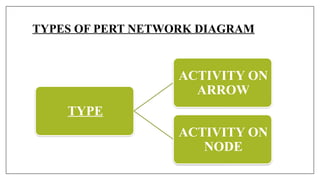
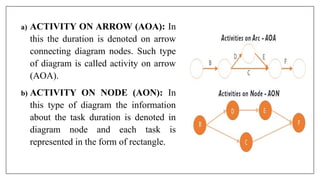
TYPES OF PERT NETWORK DIAGRAM
TYPE
ACTIVITY ON
ARROW
ACTIVITY ON
NODE
a) ACTIVITY ON ARROW (AOA): In
this the duration is denoted on arrow
connecting diagram nodes. Such type
of diagram is called activity on arrow
(AOA).
b) ACTIVITY ON NODE (AON): In
this type of diagram the information
about the task duration is denoted in
diagram node and each task is
represented in the form of rectangle.
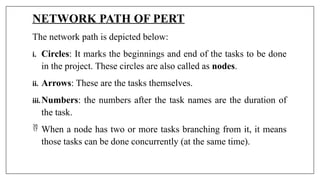
NETWORK PATH OF PERT
The network path is depicted below:
i. Circles: It marks the beginnings and end of the tasks to be done
in the project. These circles are also called as nodes.
ii. Arrows: These are the tasks themselves.
iii.Numbers: the numbers after the task names are the duration of
the task.
 When a node has two or more tasks branching from it, it means
those tasks can be done concurrently (at the same time).
STEPS IN PERT
1. Define the objective of the program or the project.
2. Identify and list out the activities which are required to
complete the project.
3. Arrange the activities in the technical sequence. Proceeding and
succeeding events should be located to bring the sequence or
sequential relationship.
4. Estimate the time required to complete each activity. This estimate is
of elapsed time such as days, weeks, months. Three-time estimates
are taken:
a) Optimistic time: It is denoted by (O). It is the minimum possible
time required to accomplish a task, assuming everything proceeds
better than is normally expected.
b) Pessimistic time: It is denoted by (P). It is the maximum possible
time required to accomplish a task, assuming everything goes wrong
(excluding major catastrophes).
c) Most probable time: It is denoted by (M). It is the best estimate
time required to accomplish a task, assuming everything proceeds as
normal.
• Expected Time of activity: It is denoted by (TE). It is the average
time, the task would require if the task were repeated on a number of
occasions over an extended period of time.
• The expected time of activity is calculated as:
• Expected time of activity (TE) = (0+4M+P)/6
5. Prepare or draw a draft of network diagram that should show
relationship between activities and events. The elapsed time estimate
is shown by numbers on the arrow.
6. Determine the critical pathway. The pathway is decided by adding
the times for the activities in each sequence and determining the
longest path in the project. The critical path determine the
total time required.
ADVANTAGES
 It is simple to understand and use.
 It shows whether the project is on schedule or behind or ahead of
the schedule.
 It identifies the activities that need closer attention.
 It determines the flexibility available with activities.
 It shows potential risk with activities.
 It provides good documentation of the project.
 It helps to set priorities among activities and resource allocations
per priority.
APPLICATION OF PERT CHART
 It is used in research and development projects.
 It is used for developing tools and introducing a new project.
 It is used for development and administration of various training
programme.
 It is used for management development and organizational
planning.
LIMITATIONS OF PERT CHART
 A major disadvantage of PERT has been its emphasis only on
time not on cost.
 The cost of setting such systems is extensive.
 It is difficult to estimate accurate time and cost of various
activities involved in a project.
 Errors in the estimation makes the PERT chart unreliable.
 These systems will not help managers to solve all their problems.
GANTT CHART
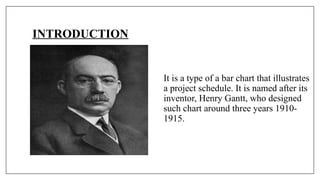
INTRODUCTION
It is a type of a bar chart that illustrates
a project schedule. It is named after its
inventor, Henry Gantt, who designed
such chart around three years 1910-
1915.
DEFINITION
It is a type of a bar chart that illustrates a project schedule. This
chart lists the tasks to be performed on the vertical axis and time
intervals on the horizontal axis. The width of the horizontal bars in
the graph shows the duration of each activity. Gantt chart illustrates
the start and finish dates of the terminal elements and summary
elements of the project.
ELEMENTS OF GANTT CHART
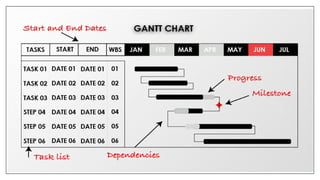
1. Task list: It runs vertically down the left of the Gantt chart to
describe project work and may be organized into groups and
subgroups.
2. Timeline: It runs horizontally across the top of the Gantt chart and
shows months, weeks, days and years.
3. Dateline: It is a vertical line that highlights the current date on the
Gantt chart.
4. Bars: Horizontal markers on the right side of the Gantt chart that
represent tasks and show progress, duration, and start and end dates.
5. Milestones: These are the diamonds that call out major events,
dates, decisions and deliverables.
6. Dependencies: The lines that connect tasks that need to happen
in a certain order.
7. Progress: It shows how far along work is and may be indicate
by % complete or bar shading.
8. Resource assigned: It indicates the person or team responsible
for completing a task.
STEPS OF GANTT CHART
1. Determine the project start date and deadline.
2. Gather all information surrounding the list of activities within a
project.
3. Determine how long each activity will take.
4. Evaluate what activities are dependent on others.
5. Create graph shell including the timeline and list of activities.
6. Begin to add bars ensuring to include dependencies and the full
duration for each activity.
USES OF GANTT CHART
 To show the current schedule status.
 To measure the task duration in the project.
 To represent cost, time and scope of the project.
 To plan how long a project should take.
 Lays out the order in which the task need to be carried out.
 Modern Gantt chart software provides dependencies in
between the tasks.
 To monitor the project's production.
 To assist in taking remedial action to bring project back on course,
if required.
ADVANTAGES OF GANTT CHART
 It helps in planning and monitoring the work of the project.
 Time is explicitly expressed in the chart.
 All tasks are visible at a glance in relation to other.
 Deadlines are depicted in a chart.
 It helps in setting the realistic time frames.
DISADVANTAGES OF GANTT CHART
 It became extraordinary complex.
 The size of the bar does not indicate the amount of work.
 They need to be constantly updated.
 It is difficult to see on one sheet of paper.
PROBLEMS IN USE OF PERT AND GANTT
CHART
 There is a chance to omit the necessary steps at the time of
planning of project.
 Number of resources available is an important restriction.
 There is possibility to failure to keep all activities progress
according to schedule.
 Lack of trained staff to adopt the techniques.
RESEARCH EVIDENCE
Vânia N Hirakata et al. conducted a Systematic Review (2022) on
exploring the gantt chart as a tool to highlight double report in case series
published during the first wave of the covid-19 pandemic. 116 articles in
the present analysis were included. Results shows that the Gantt chart
highlighted papers in which some participants were likely the same, thus
allowing easier identification of double reporting of cases. Study concluded
that unintended double reporting may occur, especially in exceptional
times. The Gantt chart may help researchers to visually identify potential
duplications, thus avoiding biased estimates in systematic review.
CONCLUSION
Planning is never ending. It is a dynamic, ongoing process that helps
organization achieving their goals. Planning is essential in every walk
of life. Planning is the first and foremost function of management.
Planning, the primary function of management enables the
organization to deal with the present and anticipate the future. PERT is
one of the planning tools that is used by project managers
worldwide. PERT helps project managers to get a clear idea of how to
manage and plan their project, concerning resources, and time. The
Gantt Chart methodology is an effective tool for project planning and
management. It provides project managers with a clear overview of
the project timeline, helps them to allocate resources efficiently, and
enables them to communicate effectively with team members.
BIBLIOGRAPHY
BOOK REFERENCES:
1. Vati Jogindra, principles & practice of nursing management & administration, jaypee
publications, ed 1st, 2013, Page No. 184-188
2. BT Basavanthappa, management of nursing services and education, jaypee publisher,
ed" 2nd Page No.57-59.
3. Joseph K. Jhony and Devu K Babitha, textbook of Nursing management and
leadership, CBS publishers, ed"1st, 2022, Page No. 37-39
4. Sudha R, Nursing Education: Principles and Concepts, Jaypee Brothers Medical
Publishers (P) Ltd. Page No. 348
5. Erb’s and Kozier, Fundamental of Nursing- Concepts, Process, and Practice, Pearson
Publication, Ed. 10th
, Page No. 227.
6. Masih Shabnam, Essentials of Nursing Management in Service and
Education, Lotus Publishers, Ed. 2nd
, Page No. 27-35, 74-80.
7. Clement Nisha, Essentials of Management of Nursing Service & Education,
Jaypee Publishers, Ed. 1st
(2016) , Page No. 59-66, 124-131.
8. Sodhi Kaur Jaspreet, Comprehensive Textbook of Nursing Education, Jaypee
Brother’s Medical Publishers (P) Ltd. Ed. 1st
(2017). Page No.428-429.
INTERNET REFFERENCES:
 https://www.slideshare.net/mathewvallanamatathil/programme-evaluation-and-
review-technique-gantt-chart
 https://pubmed.ncbi.nlm.nih.gov/35908036
PLANNING PROCESS,PERT & GANTT CHART.pptx

PLANNING PROCESS,PERT & GANTT CHART.pptx

  • 1.
    PLANNING PROCESS, PERT ANDGANTT CHART PRESENTED BY: Archita sharma Roll no. 03 M.Sc. Nursing 2nd year SNGNC, IGMC, SHIMLA.
  • 2.
    PLANNING PROCESS “A goalwithout a plan is just a wish”
  • 3.
    INTRODUCTION • Planning isessential in every walk of life. • Planning is the first and foremost function of management. • Planning, the primary function of management enables the organization to deal with the present and anticipate the future. • It is a process whereby management decides where it is at present, and where it wants to be after some time in future.
  • 4.
    DEFINITION According to JamesLundy- “Planning means the determination of what is to be done how and where is to be done who is to do it and how results are to be evaluated” According to Philip Kotler; “Planning is deciding in the present what to do in future.”  According to Mitchell; “Planning is usually interpreted as a process to develop a strategy to achieve desired objectives, to solve problems and to facilitate action.”
  • 5.
    CONCEPT OF PLANNING Planningis considered as a process which involves the determination of future course of action i.e. why an action, what action, how to take action and when to take action. Thus, the planning process is concerned to the answers of why, what, how and when. Although, the basic process of planning is the same for all the managers yet the type and level of planning may differ from manager to manager.
  • 6.
    CONT… In order toachieve the objectives of nursing organisation, planning is the first step in the management function as it precedes the execution of all other managerial functions because it provides the frame of reference for future decisions, reduces overall impact of changes and allows nurse managers to organise staff and direct and control the activities necessary to accomplish the nursing organizational objectives.
  • 7.
    OBJECTIVES OF PLANNING Thefollowing are the major objectives of planning: 1. To Set the Objectives- Planning actually starts with the formulation of objectives and planning action to achieve those objectives. The objectives are defined in a meaningful and technical terms so that managerial actions could be possible.
  • 8.
    2. To Focuson Meaningful Activities- • Effective planning lays down various courses of action, which are useful to accomplish the objectives. • The chances of unproductive activities are reduced to a great extent. • Planning makes it clear for the nursing personnel working at different levels as to how their operations can contribute to the nursing organizational objectives that are in consistent with the objectives of the hospital.
  • 9.
    3. To Economizesthe Time and Effort and Other Resources- Planning at all levels keeps the whole process in order. Money, men, machines and materials are properly utilized and wastages are minimized. Time and efforts of the staff working is saved if they know ahead that what is expected from them. 4. To Maintain Coordination- Planning is the basis of coordination. With the help of plans, the departments work in harmony and achieve their respective goals without any failure.
  • 10.
    5. To ReduceRisk and Uncertainty- Proper planning is made considering various environmental factors including the human and other factors, since there is diversity in these factors. There is always a scope of flexibility or alternatives in good planning that reduces the risk and uncertainty arising out of them.
  • 11.
    6. To EnsureProper Control- In planning there is a scope to lay down the methods of performance evaluation, against the laid down standards and targets. When these are actually measured and compared with standards, gives good control to assure the accomplishment of objectives as set by the plans.
  • 12.
    7. To Achievethe Organizational Effectiveness- The planning states the objectives within a specific use at a particular time. Thus, planning along with the control measures and ensures that the resources are utilized as per plan that helps to achieve the organizational effectiveness. If this is not done, the reasons are explored and various other measures are re- planned, that helps to improve the effectiveness of the organization.
  • 13.
    8. Planning PromotesCreativity- Planning is basically the thinking function of management. It helps innovative and creative thinking. Many new ideas come to mind of a nurse manger when she is planning. Thus planning promotes creativity and innovation.
  • 14.
    9. To ImproveEfficiency- Planning determines as to when and how various tasks are to be performed by different nursing units. This brings about efficiency in the working of various units. Wastages are reduced and needless efforts are avoided by advance planning.
  • 15.
    PRINCIPLES OF PLANNING Thefollowing list shows the principles of planning: 1. The principles of meaningful objectives: Planning should be done by clearly defined objectives. It is a means of achieving objectives. Hence objectives should be explicit specific and measurable. 2. The principle of primacy: All managerial activities after planning are executed. It provides the basis for organising staffing, directing, co-ordinating and controlling and flows through all of them. It is the lifeblood for all functions of Management.
  • 16.
    3. The principleof planning premises: Planning premises are the anticipated environment in which the plans are expected to operate. These are also known as conditions that will affect an organisation. 4. The principle of alternatives: The principle of alternative means developing many alternatives and then selecting the best one that would help in achieving predetermined goals. 5. The principle of timing and continuity: Planning should be done quite ahead and the action plans on time before execution are developed. It should be an ongoing process of making modification and re-examining new situations.
  • 17.
    6. The principleof flexibility: Planning should be flexible. There should be scope for readjustment to modify the plan according to new situations. 7. The principle of communication: It means that all people working in the organization must know the expectation and work from them. People of all levels must be aware of objectives and goals, policies, programs, and rules they are going to follow to achieve the said goals.
  • 18.
    8. The principleof adequate control techniques: The principle of adequate control techniques states that there should be the provision of sufficient performance standards with time dimensions. 9. The principle of participation: There should be reasonable participation in planning and making managerial decisions. It is a bottom-to-top approach in management. 10.The principle of economy: According to this principle the planner must do cost and benefit analysis of every planning process. The total cost of planning must be less than the added advantage of planning regarding money and another cost.
  • 19.
    IMPORTANCE OF PLANNING Thetime devoted to the planning process varies from organization to organization and depends on the resources available to devote to the process. Whether we decide to devote only a two-day retreat to the process or engage in a twelve-month process, organization will begin to realize the benefits from the start. Some of the fundamental benefits to the planning process include: 1. It provides a framework and a clearly defined direction that guides and supports management of the organization. 2. A uniform vision and purpose that is shared among all staff.
  • 20.
    3. Focus onan increased level of commitment to the organization and its goals. 4. Facilitate improved quality of services for clients and a means of measuring the service. 5. Promotes creativity and innovation. 6. Secures economy in operations through proper allocation of resources to various operations. 7. Ability to set priorities and to match resources to opportunities.
  • 21.
    8. Facilitate decisionmaking. 9. Basis of control by establishing benchmarks for appraisal of actual performance. 10. Reduction of uncertainty and the ability to deal with risks from the external environment. 11. Achieve coordination among all departments. 12. A process to help with crisis management.
  • 22.
    PLANNING PROCESS- The planningprocess varies from organization to organization because of their different sizes and complexities. The process of planning comprises the following steps:
  • 23.
    1. Perception ofopportunities and gathering information: Before carrying out the actual planning, one needs to explore and gather the relevant and related information regarding threats and possible opportunities, strengths, and weaknesses of the organization. Information gathered should be accurate, precise, and up to date as based on estimation. Evaluate all the pros and cons of possible new opportunities. It is the preliminary step before the formulation of objectives.
  • 24.
    2. Establishing objectives:Frame objectives by the availability of opportunities and resources. Objectives form the core to the planning process. It aids the staff to understand the expectation of the organization. Objectives are the endpoints of any organization translated into the departmental objective. These departmental objectives then serve as the means of accomplishing the overall objective of the organization.
  • 25.
    3. Developing premises(forecast future): Premises are the expected environmental or external and internal conditions to undertake planning activities. These are an asset of forecasts regarding these conditions or factors, and the success of planning depends on the accuracy of these forecasts.
  • 26.
    4. Identification ofalternatives: After determining the various planning assumptions, the next step is to work to find out the maximum alternatives based on the empirical evidence or experiences or intuitions. Then a short listing of the alternatives is done for the detailed analysis.
  • 27.
    5. Evaluation ofalternatives: In this step, an attempt has been made to evaluate the selected alternatives per the criteria required for achieving particular objectives. All the merits and demerits of the alternatives are listed and compared with the criteria laid down.
  • 28.
    6. Selection ofthe best possible alternatives: After evaluating all the short-listed alternatives, the most appropriate alternative is taken up. It is the actual stage of decision-making in the process of planning.
  • 29.
    7. Developing subsidiaryplans: After selecting the best plan, various derivative plans such as policies, procedures, schedules, methods, and budgets are put into practice. These supportive plans are the subsidiary plans formulated for various units, sections, and activities in the light of the master plan to help the organization to achieve its objectives in a unified manner.
  • 30.
    8. Defining variousactivities and preparation of action plans: Related activities according to plans are developed and defined. Time plans using various managerial techniques such as Programme Evaluation and Review Technique are developed. These planning and control techniques are important to minimize the time and cost and for ensuring the completion of projects.
  • 31.
    9. Communication ofplans and securing cooperation: Supportive plans properly to the lower levels in the organization are communicated. All staff should be aware of the plans, its scope, and benefits. The participation of the staff at this stage helps them to boost their morale to implement the plans effectively to the best of their skills and abilities.
  • 32.
    10. Follow-up andreview: After implementation of the plan, it is essential to follow it up to remove difficulties at every step of implementation. If needed, plans may even be modified or revised to achieve the indented goal.
  • 33.
    TYPES OF PLANNING Planningcan be classified on the basis of time period involved, approach used and degree of formalization, importance of content matters and coverage of activities. 1. Long Term and Short-Term Planning- • Long term planning involves more than one-year period, usually 3 to 5 years. • Short term planning is also known as tactile planning, usually, covers one year.
  • 34.
    2. Proactive andReactive Planning- • Proactive planning is the 'planning in anticipation’. • Whereas the reactive planning is the type of planning that is done after the environmental changes have taken place.
  • 35.
    3. Formal andInformal Planning-
  • 36.
    4. Strategic andOperational Planning- • Long term planning is of strategic in nature and usually involve more than one-year period extending to twenty years or so. • Operational planning is short term planning, usually covers one year or so.
  • 37.
    5. Management (Corporate)and Functional Planning- • Management planning denotes planning activities at the top level, also known as corporate planning. • Functional planning is the segmental and it is taken for each major function of the organization, for example for personnel management, finance, etc.
  • 38.
    TYPES OF PLAN Aplan is a scheme, program, or method worked out beforehand for the accomplishment of an objective. There are two ways of classifying the plans: • Management Point Of View. • Hierarchical Nature Of The Plans.
  • 39.
    Management Point ofView Here, the plans can be classified as:  standing and single use plans.  strategic and operational plans.  short range or long-range plans.
  • 40.
    Hierarchical Nature ofthe Plans • These plans are interlinked and higher level of plans helps to derive a lower level of plans.
  • 41.
  • 42.
    A vision statementalso a statement of values and listing of strategic goals often follows its statement. In this way, the value statement may serve as the statement of philosophy for the organization.
  • 43.
  • 44.
    Objectives or Goals •Health institute objectives are the basic plan of the hospital; a nursing department may also have its own objectives. • Its goals naturally contribute to the attainment of hospital objectives, but the two sets of goals may be entirely different.
  • 45.
  • 46.
    Policies • A policyis a designated plan or course of action to be taken in a specific situation. • These are general statements that guide or channel thinking in decision-making.
  • 47.
    Protocols • A protocolis a detailed standard plan for patient care, such as a protocol related to disaster management in emergency area. • This would include various activities related to legal formalities, technical skills, and other resources management.
  • 48.
    Procedures • Procedures arethe plans that establish a required method of handling future activities. • They are chronological sequences of required actions. • Procedures spell out how a particular nursing activity is to be completed, often described in a number of steps or processes. • The purpose of the procedures is to simplify operations and eliminate duplication.
  • 49.
    Rules • Rules arespell out specific required actions or non-action, allowing no discretion. • These are the code of conduct or norms. • It relates to the human behaviour and do not lay down any specific sequence of action.
  • 50.
    Standards of Care •These are specific, detailed plan of care for individuals with specific health problem. • A standard of care covers a broader range of concern for the individual than does a protocol. • The purpose of a standard of a care is to establish the best practice and eliminate as much variation as possible.
  • 51.
    Standards of NursingPractice • These are authoritative statements that describe a common or acceptable level of professional nursing performance. • The standards of practice, therefore, define professional practice. • Indian Nursing Council has also devised general standards and guidelines for nursing practice.
  • 52.
    Budgets • The budgetis the fundamental planning instrument for health agencies. • Infact, one of the major advantages of budgeting is that it makes people plan; because a budget is in the form of numbers, it forces precision in planning.
  • 53.
  • 54.
    INTRODUCTION • The programevaluation and review technique, commonly abbreviated as PERT, is a model designed to analyze and represent the task involved in completion of a given project or programme. • It was developed in 1958 by Booz Allen Hamilton. • In this method the time required to complete each task or activity is identified and then calculating the minimum time required for completing the total project.
  • 55.
    DEFINITION Programme evaluation andreview technique (PERT), is a statistical tool used in project management, which was designed to analyze and represent the tasks involved in completing a given project and to illustrate the flow of events in a project.
  • 56.
    OBJECTIVE The main objectiveof the PERT is to facilitate decision making and to reduce both the time and cost required to complete a project.
  • 57.
    PURPOSES  To minimizetotal time to complete the program.  To minimize tool and costs.  To minimize idle resources.  To allow better communication between the various level of management.  To identify potential problems.  To furnish continuous timely progress and reports.  To minimize any delay or crises in the implementation of plan.
  • 58.
    TYPES OF PERTNETWORK DIAGRAM TYPE ACTIVITY ON ARROW ACTIVITY ON NODE
  • 59.
    a) ACTIVITY ONARROW (AOA): In this the duration is denoted on arrow connecting diagram nodes. Such type of diagram is called activity on arrow (AOA). b) ACTIVITY ON NODE (AON): In this type of diagram the information about the task duration is denoted in diagram node and each task is represented in the form of rectangle.
  • 60.
    NETWORK PATH OFPERT The network path is depicted below: i. Circles: It marks the beginnings and end of the tasks to be done in the project. These circles are also called as nodes. ii. Arrows: These are the tasks themselves. iii.Numbers: the numbers after the task names are the duration of the task.  When a node has two or more tasks branching from it, it means those tasks can be done concurrently (at the same time).
  • 61.
    STEPS IN PERT 1.Define the objective of the program or the project. 2. Identify and list out the activities which are required to complete the project. 3. Arrange the activities in the technical sequence. Proceeding and succeeding events should be located to bring the sequence or sequential relationship.
  • 62.
    4. Estimate thetime required to complete each activity. This estimate is of elapsed time such as days, weeks, months. Three-time estimates are taken: a) Optimistic time: It is denoted by (O). It is the minimum possible time required to accomplish a task, assuming everything proceeds better than is normally expected. b) Pessimistic time: It is denoted by (P). It is the maximum possible time required to accomplish a task, assuming everything goes wrong (excluding major catastrophes). c) Most probable time: It is denoted by (M). It is the best estimate time required to accomplish a task, assuming everything proceeds as normal.
  • 63.
    • Expected Timeof activity: It is denoted by (TE). It is the average time, the task would require if the task were repeated on a number of occasions over an extended period of time. • The expected time of activity is calculated as: • Expected time of activity (TE) = (0+4M+P)/6 5. Prepare or draw a draft of network diagram that should show relationship between activities and events. The elapsed time estimate is shown by numbers on the arrow. 6. Determine the critical pathway. The pathway is decided by adding the times for the activities in each sequence and determining the longest path in the project. The critical path determine the total time required.
  • 64.
    ADVANTAGES  It issimple to understand and use.  It shows whether the project is on schedule or behind or ahead of the schedule.  It identifies the activities that need closer attention.  It determines the flexibility available with activities.  It shows potential risk with activities.  It provides good documentation of the project.  It helps to set priorities among activities and resource allocations per priority.
  • 65.
    APPLICATION OF PERTCHART  It is used in research and development projects.  It is used for developing tools and introducing a new project.  It is used for development and administration of various training programme.  It is used for management development and organizational planning.
  • 66.
    LIMITATIONS OF PERTCHART  A major disadvantage of PERT has been its emphasis only on time not on cost.  The cost of setting such systems is extensive.  It is difficult to estimate accurate time and cost of various activities involved in a project.  Errors in the estimation makes the PERT chart unreliable.  These systems will not help managers to solve all their problems.
  • 67.
  • 68.
    INTRODUCTION It is atype of a bar chart that illustrates a project schedule. It is named after its inventor, Henry Gantt, who designed such chart around three years 1910- 1915.
  • 69.
    DEFINITION It is atype of a bar chart that illustrates a project schedule. This chart lists the tasks to be performed on the vertical axis and time intervals on the horizontal axis. The width of the horizontal bars in the graph shows the duration of each activity. Gantt chart illustrates the start and finish dates of the terminal elements and summary elements of the project.
  • 70.
    ELEMENTS OF GANTTCHART 1. Task list: It runs vertically down the left of the Gantt chart to describe project work and may be organized into groups and subgroups. 2. Timeline: It runs horizontally across the top of the Gantt chart and shows months, weeks, days and years. 3. Dateline: It is a vertical line that highlights the current date on the Gantt chart. 4. Bars: Horizontal markers on the right side of the Gantt chart that represent tasks and show progress, duration, and start and end dates.
  • 71.
    5. Milestones: Theseare the diamonds that call out major events, dates, decisions and deliverables. 6. Dependencies: The lines that connect tasks that need to happen in a certain order. 7. Progress: It shows how far along work is and may be indicate by % complete or bar shading. 8. Resource assigned: It indicates the person or team responsible for completing a task.
  • 73.
    STEPS OF GANTTCHART 1. Determine the project start date and deadline. 2. Gather all information surrounding the list of activities within a project. 3. Determine how long each activity will take. 4. Evaluate what activities are dependent on others. 5. Create graph shell including the timeline and list of activities. 6. Begin to add bars ensuring to include dependencies and the full duration for each activity.
  • 74.
    USES OF GANTTCHART  To show the current schedule status.  To measure the task duration in the project.  To represent cost, time and scope of the project.  To plan how long a project should take.  Lays out the order in which the task need to be carried out.  Modern Gantt chart software provides dependencies in between the tasks.  To monitor the project's production.  To assist in taking remedial action to bring project back on course, if required.
  • 75.
    ADVANTAGES OF GANTTCHART  It helps in planning and monitoring the work of the project.  Time is explicitly expressed in the chart.  All tasks are visible at a glance in relation to other.  Deadlines are depicted in a chart.  It helps in setting the realistic time frames.
  • 76.
    DISADVANTAGES OF GANTTCHART  It became extraordinary complex.  The size of the bar does not indicate the amount of work.  They need to be constantly updated.  It is difficult to see on one sheet of paper.
  • 77.
    PROBLEMS IN USEOF PERT AND GANTT CHART  There is a chance to omit the necessary steps at the time of planning of project.  Number of resources available is an important restriction.  There is possibility to failure to keep all activities progress according to schedule.  Lack of trained staff to adopt the techniques.
  • 78.
    RESEARCH EVIDENCE Vânia NHirakata et al. conducted a Systematic Review (2022) on exploring the gantt chart as a tool to highlight double report in case series published during the first wave of the covid-19 pandemic. 116 articles in the present analysis were included. Results shows that the Gantt chart highlighted papers in which some participants were likely the same, thus allowing easier identification of double reporting of cases. Study concluded that unintended double reporting may occur, especially in exceptional times. The Gantt chart may help researchers to visually identify potential duplications, thus avoiding biased estimates in systematic review.
  • 79.
    CONCLUSION Planning is neverending. It is a dynamic, ongoing process that helps organization achieving their goals. Planning is essential in every walk of life. Planning is the first and foremost function of management. Planning, the primary function of management enables the organization to deal with the present and anticipate the future. PERT is one of the planning tools that is used by project managers worldwide. PERT helps project managers to get a clear idea of how to manage and plan their project, concerning resources, and time. The Gantt Chart methodology is an effective tool for project planning and management. It provides project managers with a clear overview of the project timeline, helps them to allocate resources efficiently, and enables them to communicate effectively with team members.
  • 80.
    BIBLIOGRAPHY BOOK REFERENCES: 1. VatiJogindra, principles & practice of nursing management & administration, jaypee publications, ed 1st, 2013, Page No. 184-188 2. BT Basavanthappa, management of nursing services and education, jaypee publisher, ed" 2nd Page No.57-59. 3. Joseph K. Jhony and Devu K Babitha, textbook of Nursing management and leadership, CBS publishers, ed"1st, 2022, Page No. 37-39 4. Sudha R, Nursing Education: Principles and Concepts, Jaypee Brothers Medical Publishers (P) Ltd. Page No. 348 5. Erb’s and Kozier, Fundamental of Nursing- Concepts, Process, and Practice, Pearson Publication, Ed. 10th , Page No. 227.
  • 81.
    6. Masih Shabnam,Essentials of Nursing Management in Service and Education, Lotus Publishers, Ed. 2nd , Page No. 27-35, 74-80. 7. Clement Nisha, Essentials of Management of Nursing Service & Education, Jaypee Publishers, Ed. 1st (2016) , Page No. 59-66, 124-131. 8. Sodhi Kaur Jaspreet, Comprehensive Textbook of Nursing Education, Jaypee Brother’s Medical Publishers (P) Ltd. Ed. 1st (2017). Page No.428-429. INTERNET REFFERENCES:  https://www.slideshare.net/mathewvallanamatathil/programme-evaluation-and- review-technique-gantt-chart  https://pubmed.ncbi.nlm.nih.gov/35908036