The document discusses the principles of management planning, emphasizing the importance of planning in achieving corporate objectives while reducing uncertainty and resource waste. It outlines ten key principles which include contribution, sound and consistent premising, coordinated planning, commitment, timing, flexibility, limiting factors, acceptance, efficiency, and navigational change. Each principle focuses on different aspects of planning to ensure effective implementation and adaptation in response to environmental changes.
What and whywe need of planning
….
Thinking in advance
What when and how is to done
Why…
To fame what is to be done
Reduce uncertainty
Reduce overlapping and wasteful
resource
Decision making
Standard to controlling
Focus on objective
4.
Principles as guideline….
1.Principle of contribution
2. Principle of Sound and Consistent Premising
3. Principle of Coordinated Planning
4. Principle of Commitment
5. Principle of Timing
6. Principle of Flexibility
7. Principle of Limiting factors
8. Principle of Acceptance
9. Principle of Efficiency
10. Principle of Navigational Change
5.
Principle ofContribution: The purpose of
planning is to ensure the effective and efficient
achievement of corporate objectives, in-fact, the
basic criteria for the formulation of plans are to
achieve the ultimate Objectives of the company.
6.
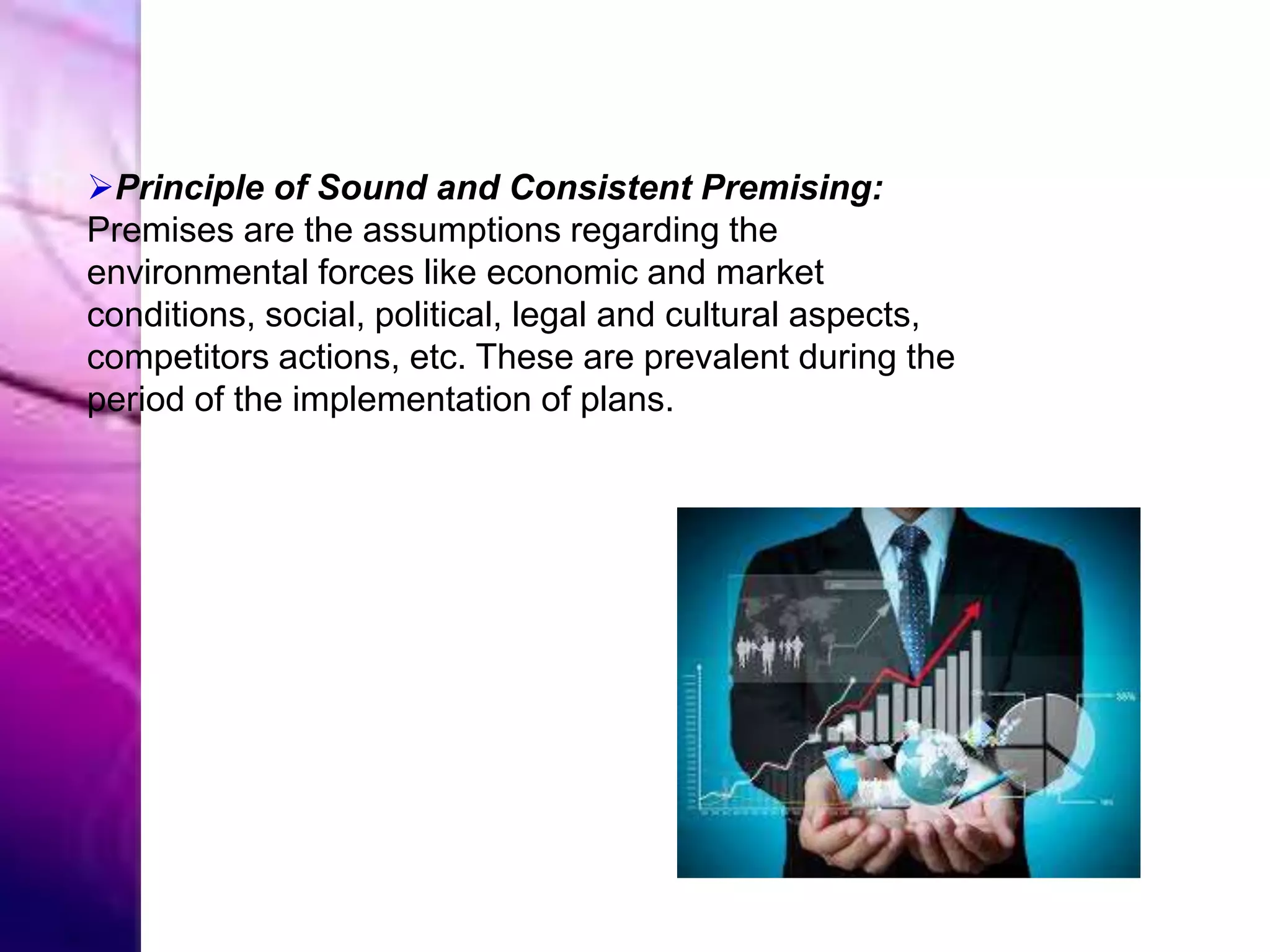
Principle of Soundand Consistent Premising:
Premises are the assumptions regarding the
environmental forces like economic and market
conditions, social, political, legal and cultural aspects,
competitors actions, etc. These are prevalent during the
period of the implementation of plans.
7.
Principle of CoordinatedPlanning: Long and short-range
plans should be coordinated with one another to form an
integrated plan, this is possible only when latter are derived
from the former. i.e. implementation of one plan should
contribute to all the other plans, this is possible only when all
plans are consistent with one another and are viewed as
parts of an integrated corporate plan.
Coordinate plans
8.
Principle of Efficiency:Cost of
planning constitute human, physical
and financial resources for their
formulation and implementation as
well. Minimizing the cost and achieving
the efficient utilization of resources
shall has to be the aim of the.
Employee satisfaction and
development, and social standing of
the organization are supposed to be
considered while calculating the cost
and benefits of plan.
9.
Principle of Limitingfactors : The limiting factors
are the lack of motivated employees, shortage of
trained personnel, shortage of capital funds,
government policy of price regulation, etc. The
company requires to monitor all these factors and
need to tackle the same in an efficient way so as to
make a smooth way for the achievement of its ultimate
objectives.
10.
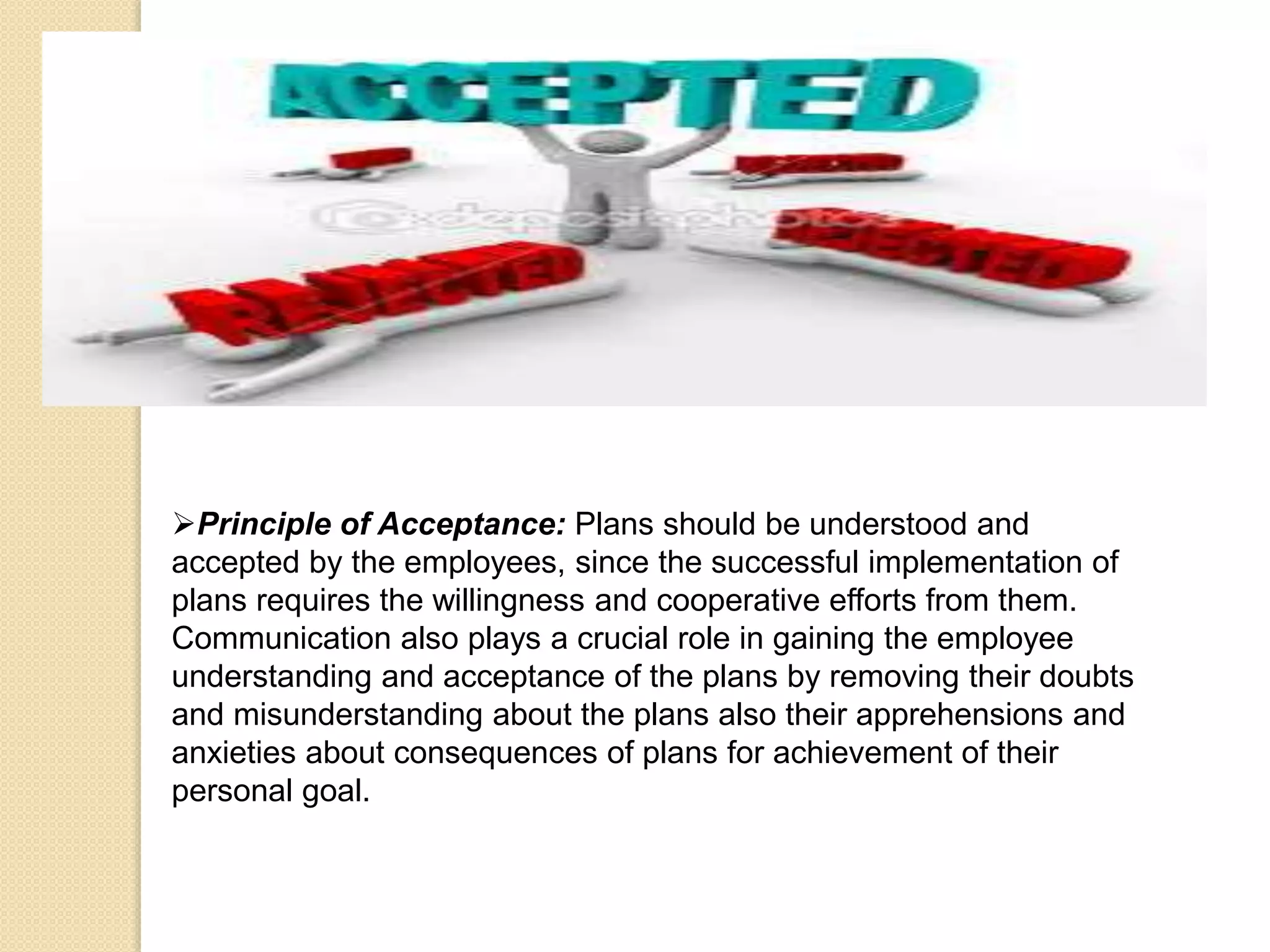
Principle of Acceptance:Plans should be understood and
accepted by the employees, since the successful implementation of
plans requires the willingness and cooperative efforts from them.
Communication also plays a crucial role in gaining the employee
understanding and acceptance of the plans by removing their doubts
and misunderstanding about the plans also their apprehensions and
anxieties about consequences of plans for achievement of their
personal goal.
11.
Principle of Timing:Number of major and
minor plans of the organization should be
arranged in a systematic manner. The plans
should be arranged in a time hierarchy,
initiation and completion of those plans should
be clearly determined.
12.
Principle of Flexibility:Plans are supposed to be flexible
to favor the organization to cope-up with the unexpected
environments. It is always required to keep in mind that future
will be different in actuality. Hence companies, therefore,
require to prepare contingency plans which may be put into
operation in response to the situations.
13.
Principle of Commitment:A commitment is required to
carry-on the business that is established. The planning shall
has to be in such a way that the product diversification
should encompass the particular period during which entire
investment on that product is recovered.
14.
Principle of NavigationalChange: Since the environment is
always not the same as predicted, plans should be reviewed
periodically. This may require changes in strategies, objectives,
policies and programmers of the organization. The management
should take all the necessary steps while reviewing the plans so that
they efficiently achieve the ultimate goals of the organization