Pivot Table & Dashboard
using Microsoft Excel
Feb. 2, 2018
Frehiwot Mulugeta
frehiwotmulu@gmail.com
Objectives
To improve data visibility, data use and facilitate
data driven decision making
– To understand and create Pivot Tables
– To create interactive dashboard
Part 1 – Pivot Table
– Definition
– Overview components of a pivot
table
– Creating pivot table
– Introducing filters and slicers
– Formatting
Definition
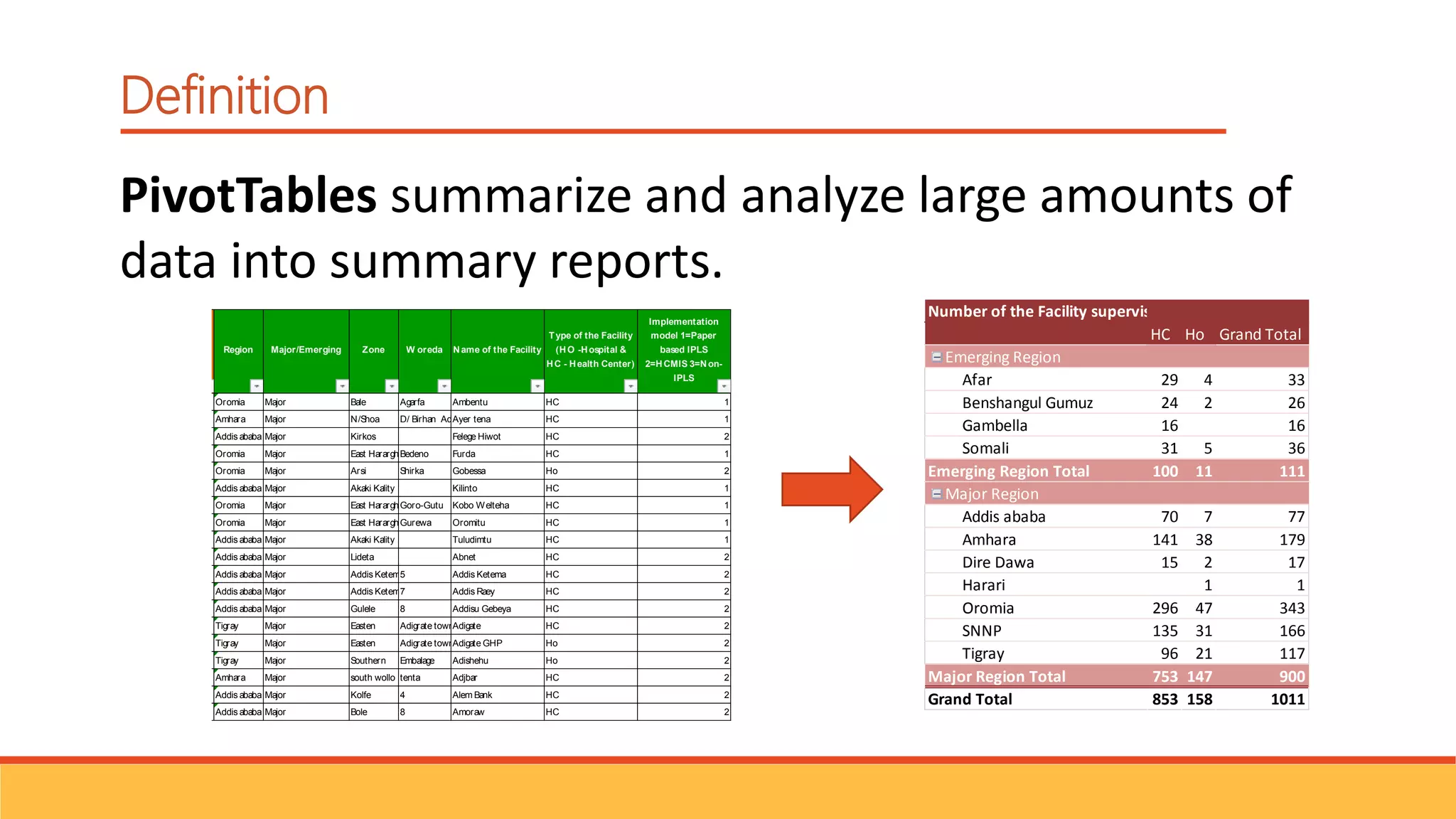
PivotTables summarize and analyze large amounts of
data into summary reports.
nth) Name of Supervisour Supplying Hub Region Major/Emerging Zone W oreda Name of the Facility
Type of the Facility
(HO -Hospital &
HC - Health Center)
Implementation
model 1=Paper
based IPLS
2=HCMIS 3=Non-
IPLS
Dame Balcha Adama Oromia Major Bale Agarfa Ambentu HC 1
Yehun Telila Addis Ababa Amhara Major N/Shoa D/ Birhan Adm.TownAyer tena HC 1
Mesfin Arega Addis Ababa Addis ababa Major Kirkos Felege Hiwot HC 2
Abdulaziz Kedir Dire Dawa Oromia Major East HarargheBedeno Furda HC 1
Dame Balcha Adama Oromia Major Arsi Shirka Gobessa Ho 2
Mesfin Arega Addis Ababa Addis ababa Major Akaki Kality Kilinto HC 1
Abdulaziz Kedir Dire Dawa Oromia Major East HarargheGoro-Gutu Kobo Welteha HC 1
Abdulaziz Kedir Dire Dawa Oromia Major East HarargheGurewa Oromitu HC 1
Mesfin Arega Addis Ababa Addis ababa Major Akaki Kality Tuludimtu HC 1
Mesfin Arega Addis Ababa Addis ababa Major Lideta Abnet HC 2
Mesfin Arega Addis Ababa Addis ababa Major Addis Ketema5 Addis Ketema HC 2
Mesfin Arega Addis Ababa Addis ababa Major Addis Ketema7 Addis Raey HC 2
Mesfin Arega Addis Ababa Addis ababa Major Gulele 8 Addisu Gebeya HC 2
Redae Gebretsadik Mekele Tigray Major Easten Adigrate townAdigate HC 2
Redae Gebretsadik Mekele Tigray Major Easten Adigrate townAdigate GHP Ho 2
Habtamu Fantaye Mekele Tigray Major Southern Embalage Adishehu Ho 2
MengeshaBelay Dessie Amhara Major south wollo tenta Adjbar HC 2
Mesfin Arega Addis Ababa Addis ababa Major Kolfe 4 Alem Bank HC 2
Mesfin Arega Addis Ababa Addis ababa Major Bole 8 Amoraw HC 2
Number of the Facility supervised
HC Ho Grand Total
Emerging Region
Afar 29 4 33
Benshangul Gumuz 24 2 26
Gambella 16 16
Somali 31 5 36
Emerging Region Total 100 11 111
Major Region
Addis ababa 70 7 77
Amhara 141 38 179
Dire Dawa 15 2 17
Harari 1 1
Oromia 296 47 343
SNNP 135 31 166
Tigray 96 21 117
Major Region Total 753 147 900
Grand Total 853 158 1011
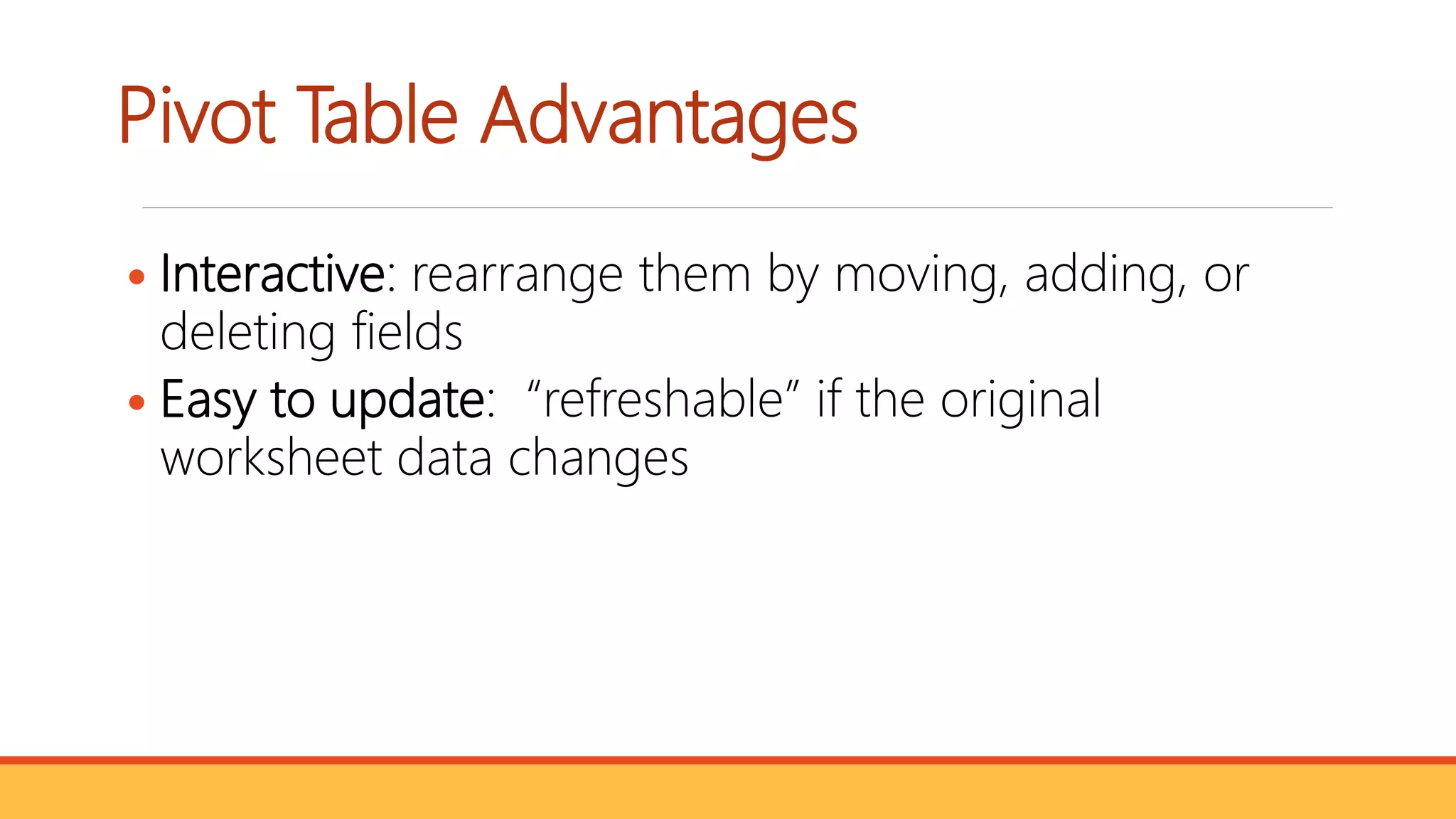
Pivot Table Advantages
 Interactive: rearrange them by moving, adding, or
deleting fields
 Easy to update: “refreshable” if the original
worksheet data changes
The data must be normalized :
◦ Must have tabular layout
◦ Every column must have column headings in
the first row.
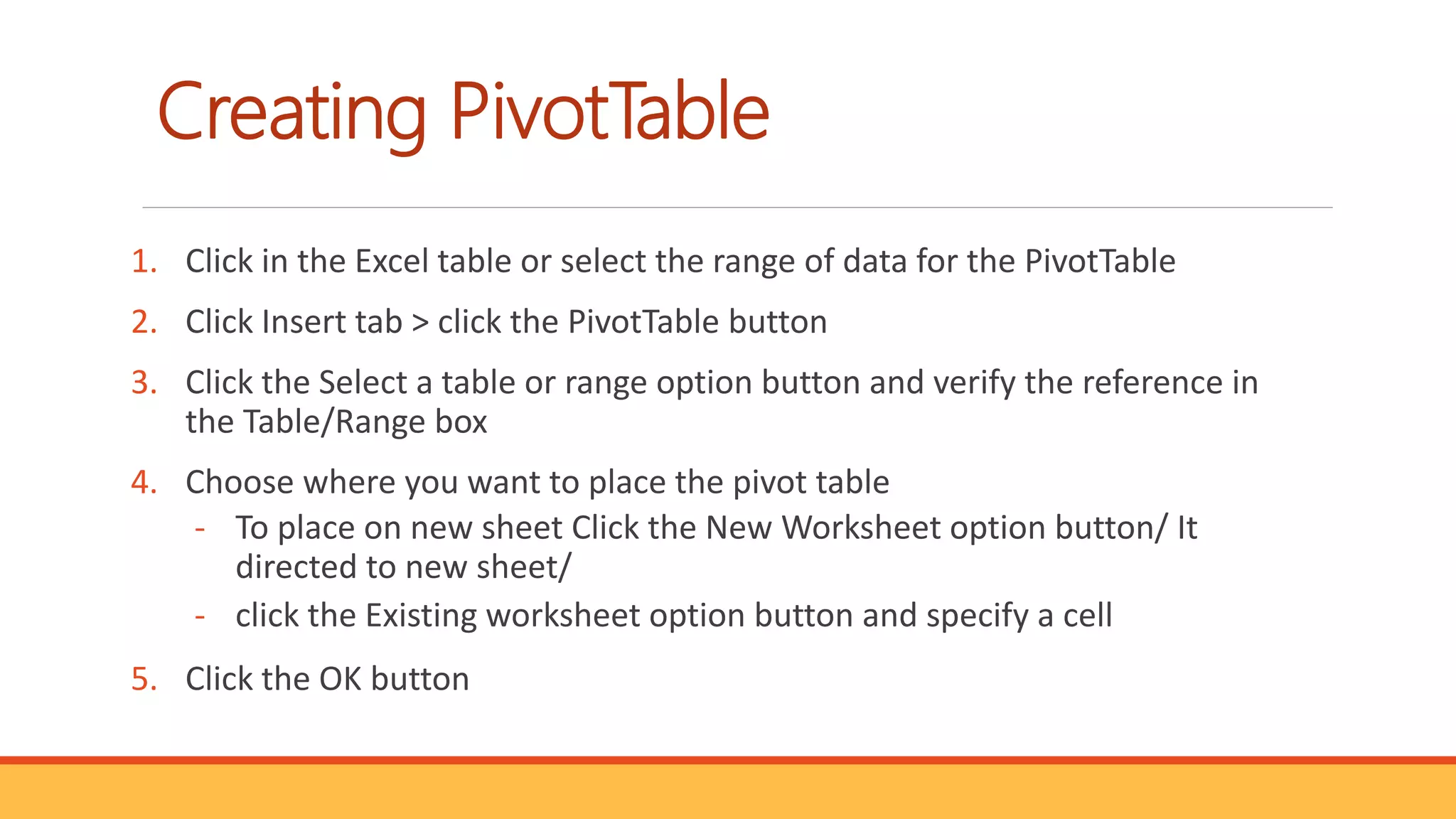
Creating PivotTable
1. Click in the Excel table or select the range of data for the PivotTable
2. Click Insert tab > click the PivotTable button
3. Click the Select a table or range option button and verify the reference in
the Table/Range box
4. Choose where you want to place the pivot table
- To place on new sheet Click the New Worksheet option button/ It
directed to new sheet/
- click the Existing worksheet option button and specify a cell
5. Click the OK button
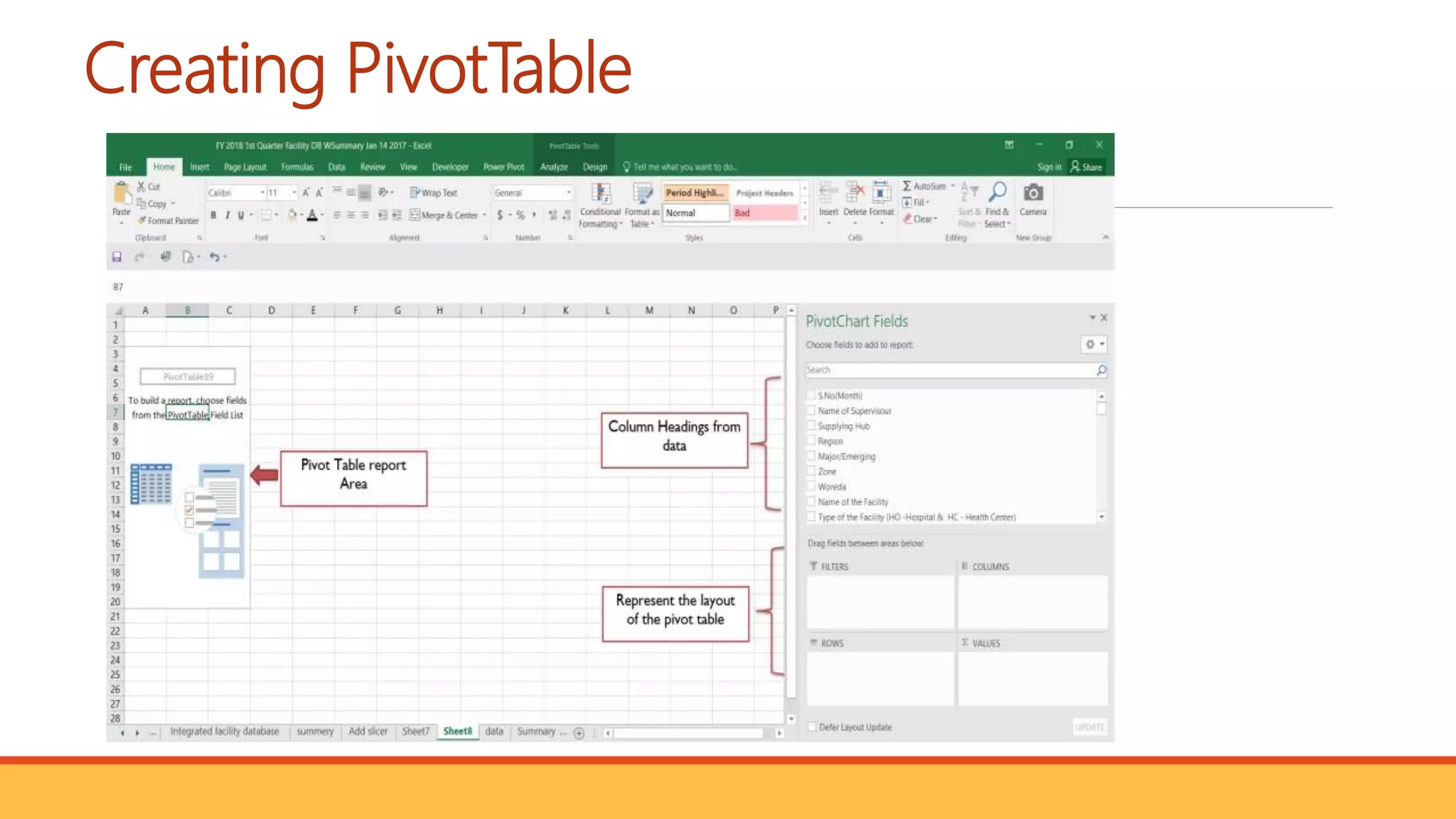
Creating PivotTable
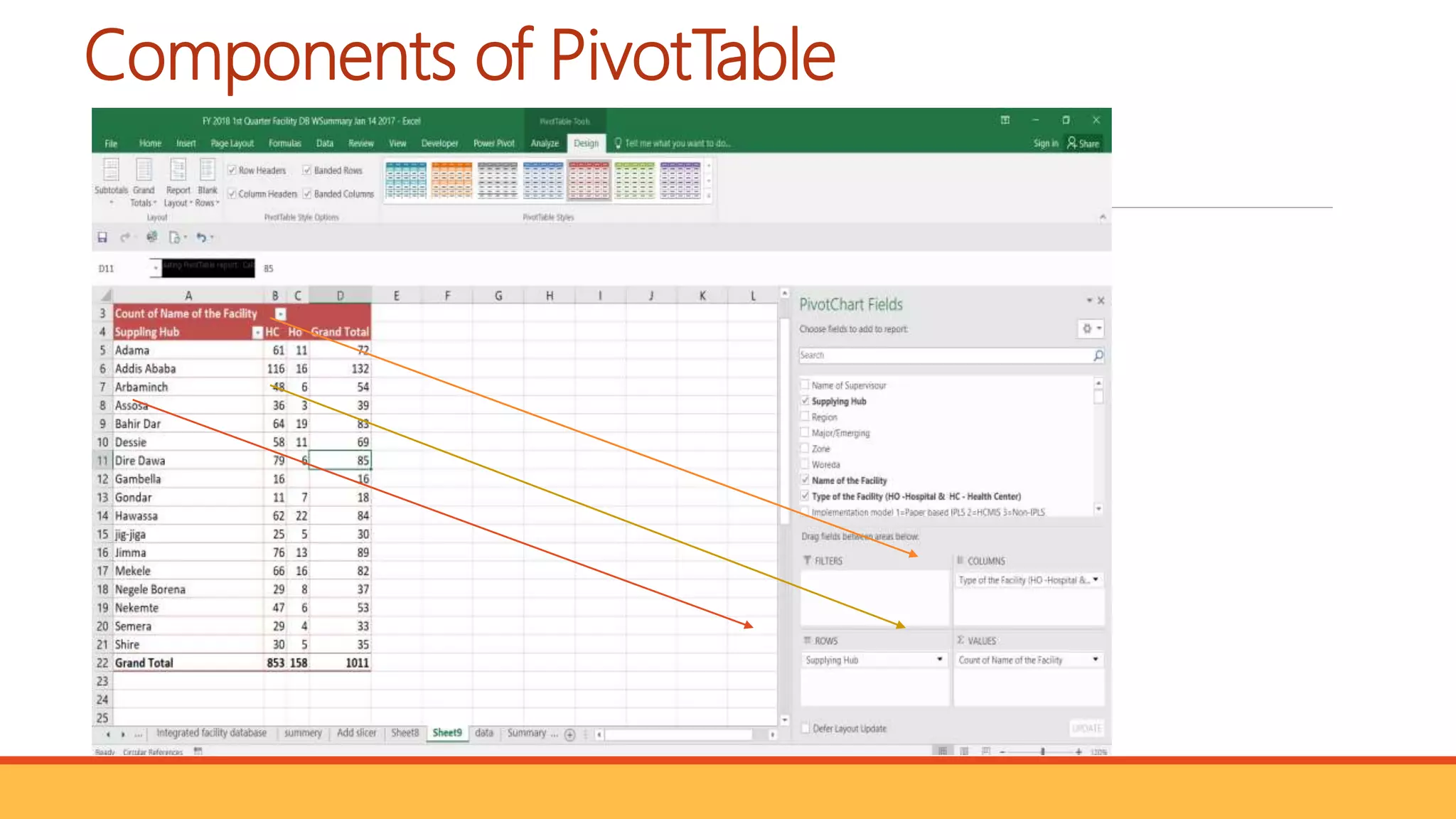
Components of PivotTable
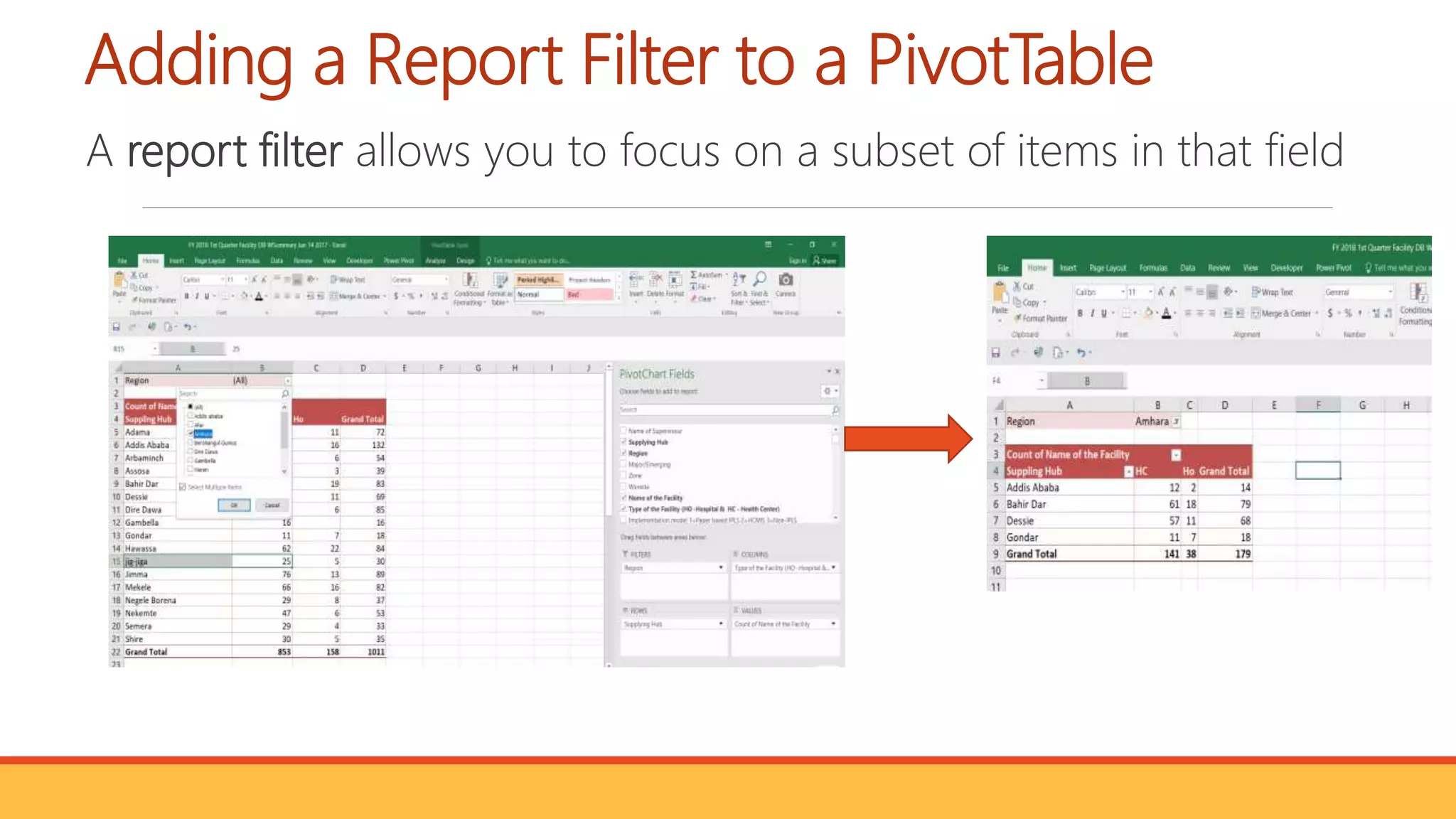
Adding a Report Filter to a PivotTable
A report filter allows you to focus on a subset of items in that field
Analyze Tab
• To add slicer
• To group fields
• To change the data source change
• To show & hide pivot table tab
• To refresh the data
• To create pivot chart
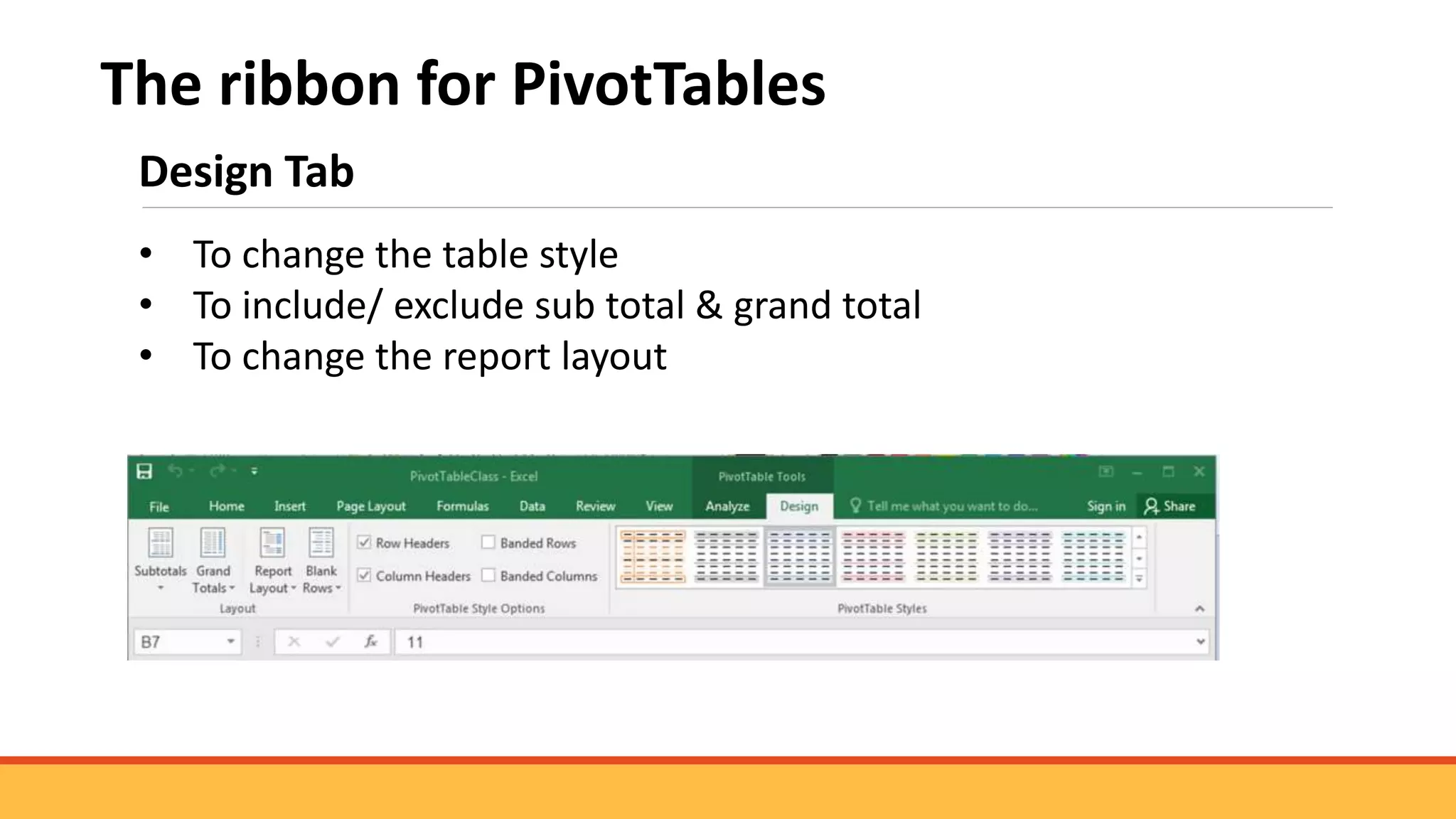
The ribbon for PivotTables
Design Tab
• To change the table style
• To include/ exclude sub total & grand total
• To change the report layout
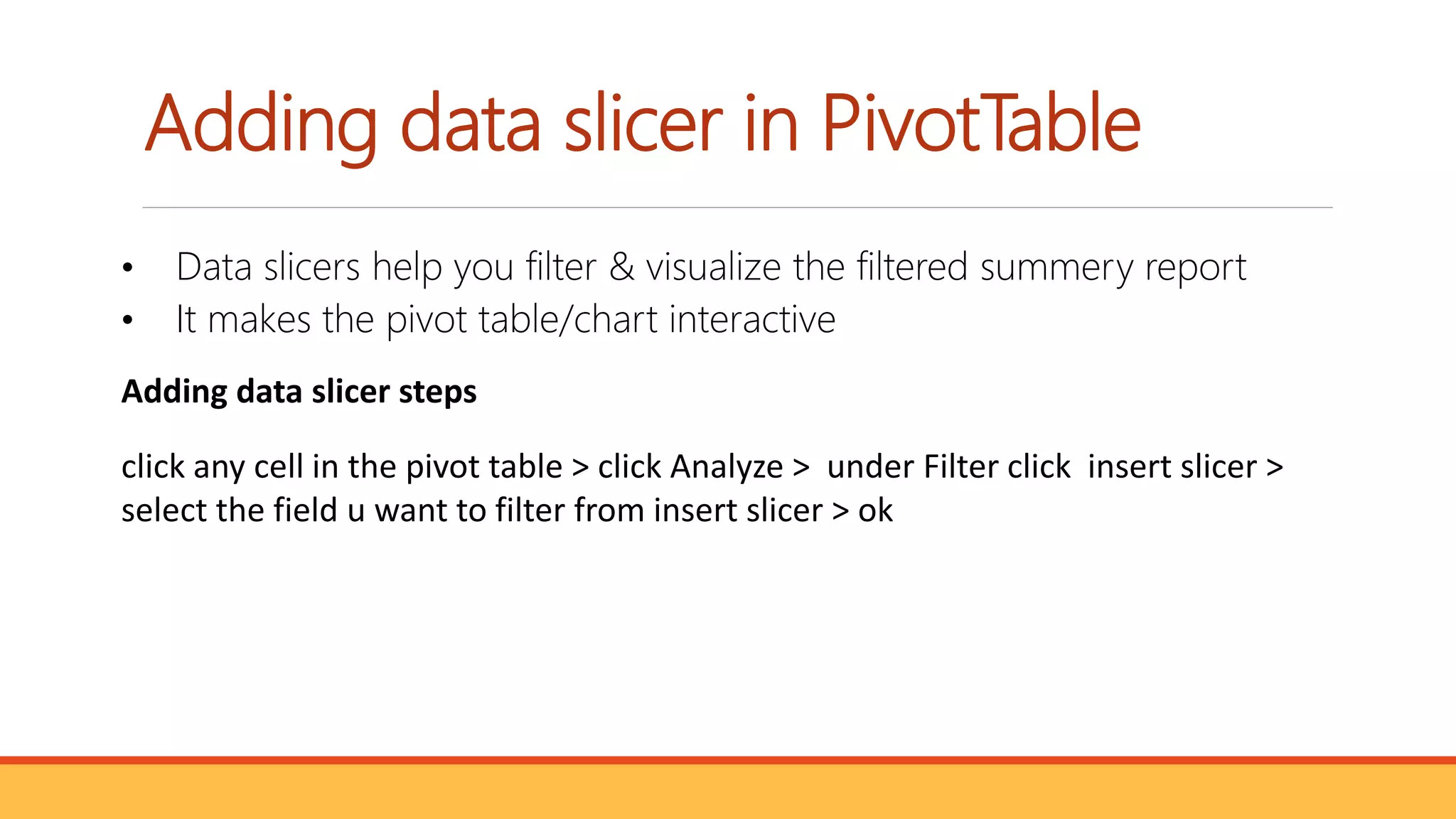
Adding data slicer in PivotTable
• Data slicers help you filter & visualize the filtered summery report
• It makes the pivot table/chart interactive
click any cell in the pivot table > click Analyze > under Filter click insert slicer >
select the field u want to filter from insert slicer > ok
Adding data slicer steps
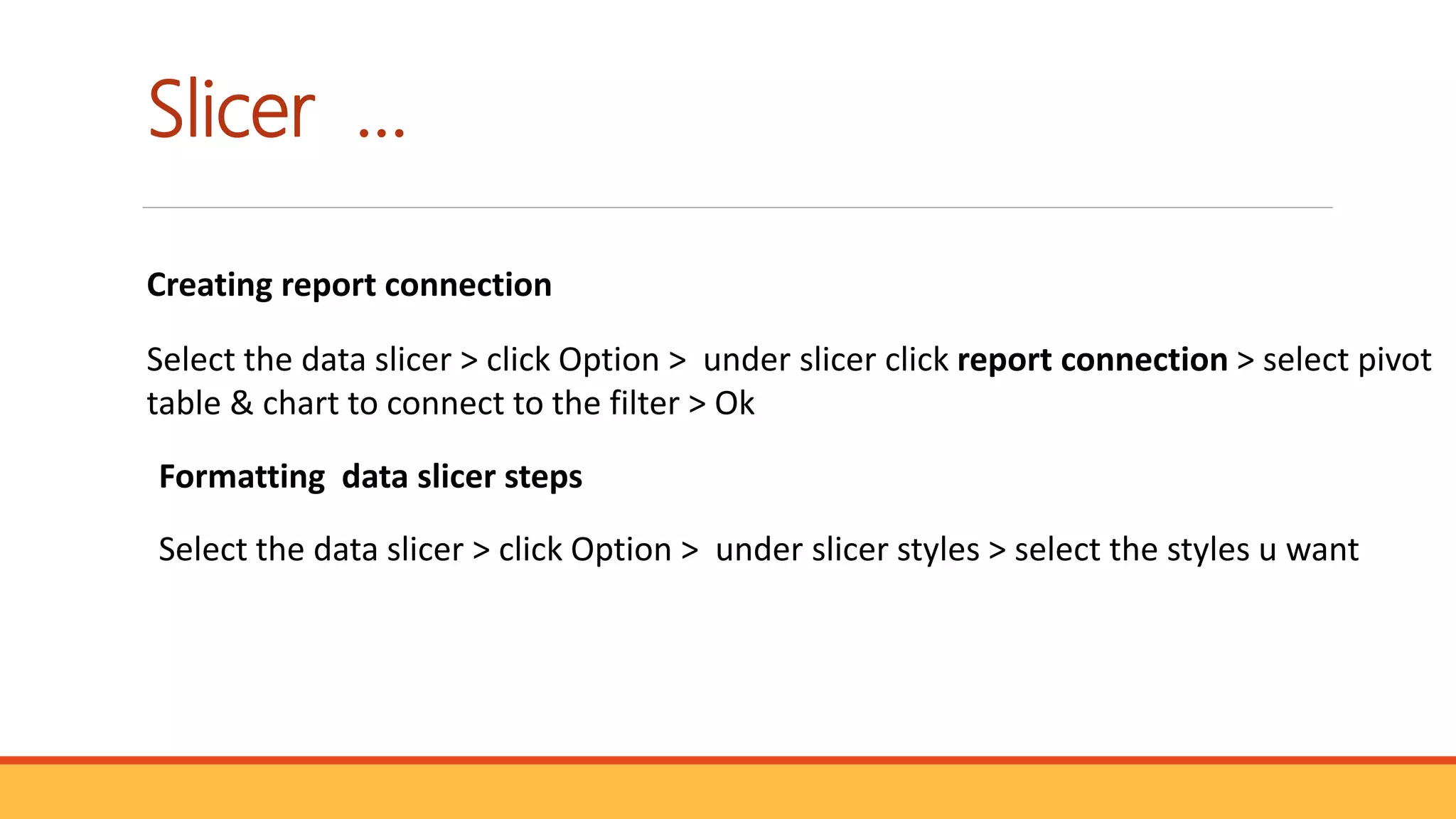
Slicer …
Formatting data slicer steps
Select the data slicer > click Option > under slicer styles > select the styles u want
Creating report connection
Select the data slicer > click Option > under slicer click report connection > select pivot
table & chart to connect to the filter > Ok
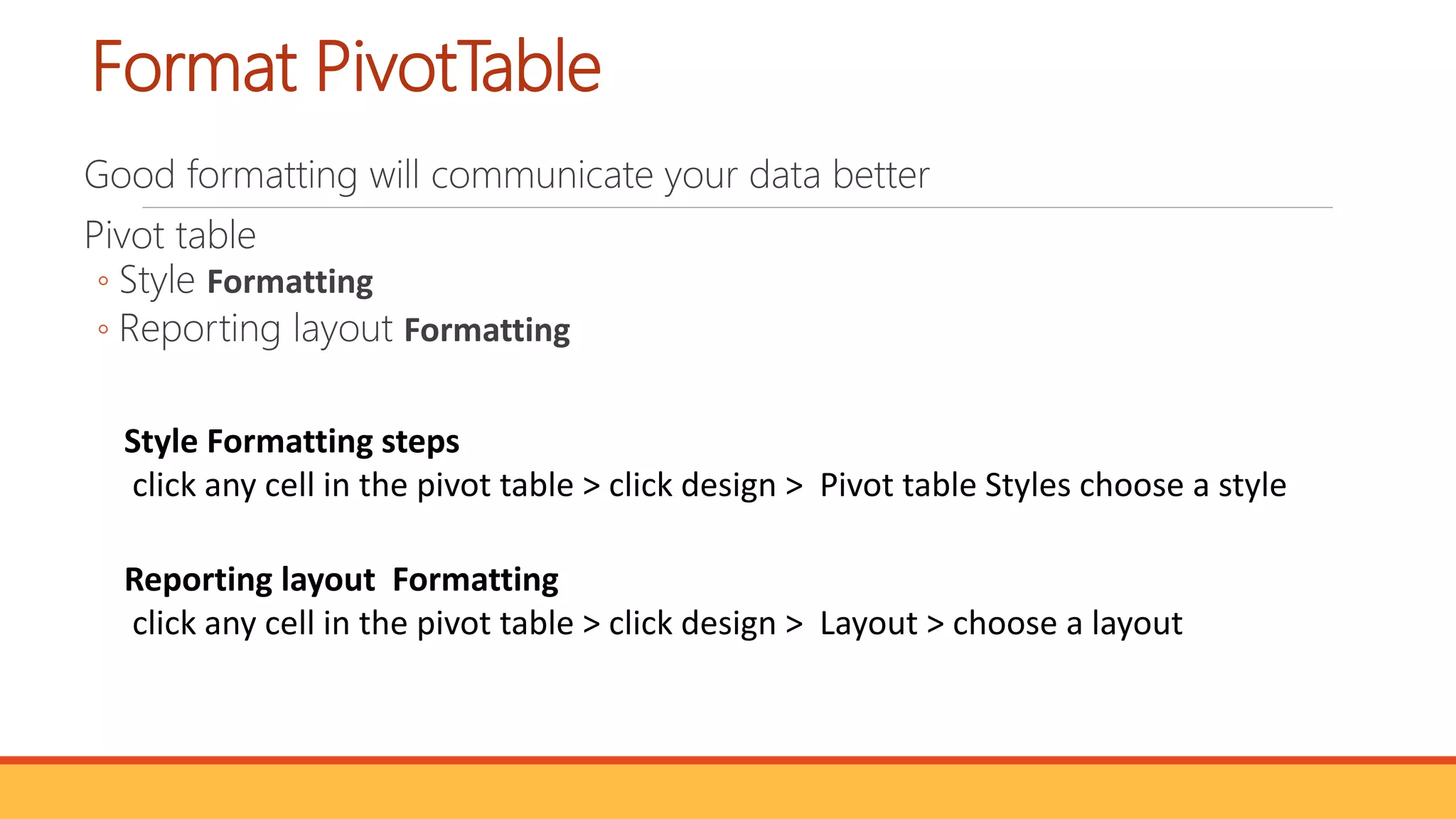
Format PivotTable
Good formatting will communicate your data better
Pivot table
◦ Style Formatting
◦ Reporting layout Formatting
Style Formatting steps
click any cell in the pivot table > click design > Pivot table Styles choose a style
Reporting layout Formatting
click any cell in the pivot table > click design > Layout > choose a layout
Format Fields/data
Number format
Right click the value on pivot table fields > click value field settings>
Number format Button > do the formatting and click ok
Or
Select the data inside the pivot table > home > Number > do the formatting
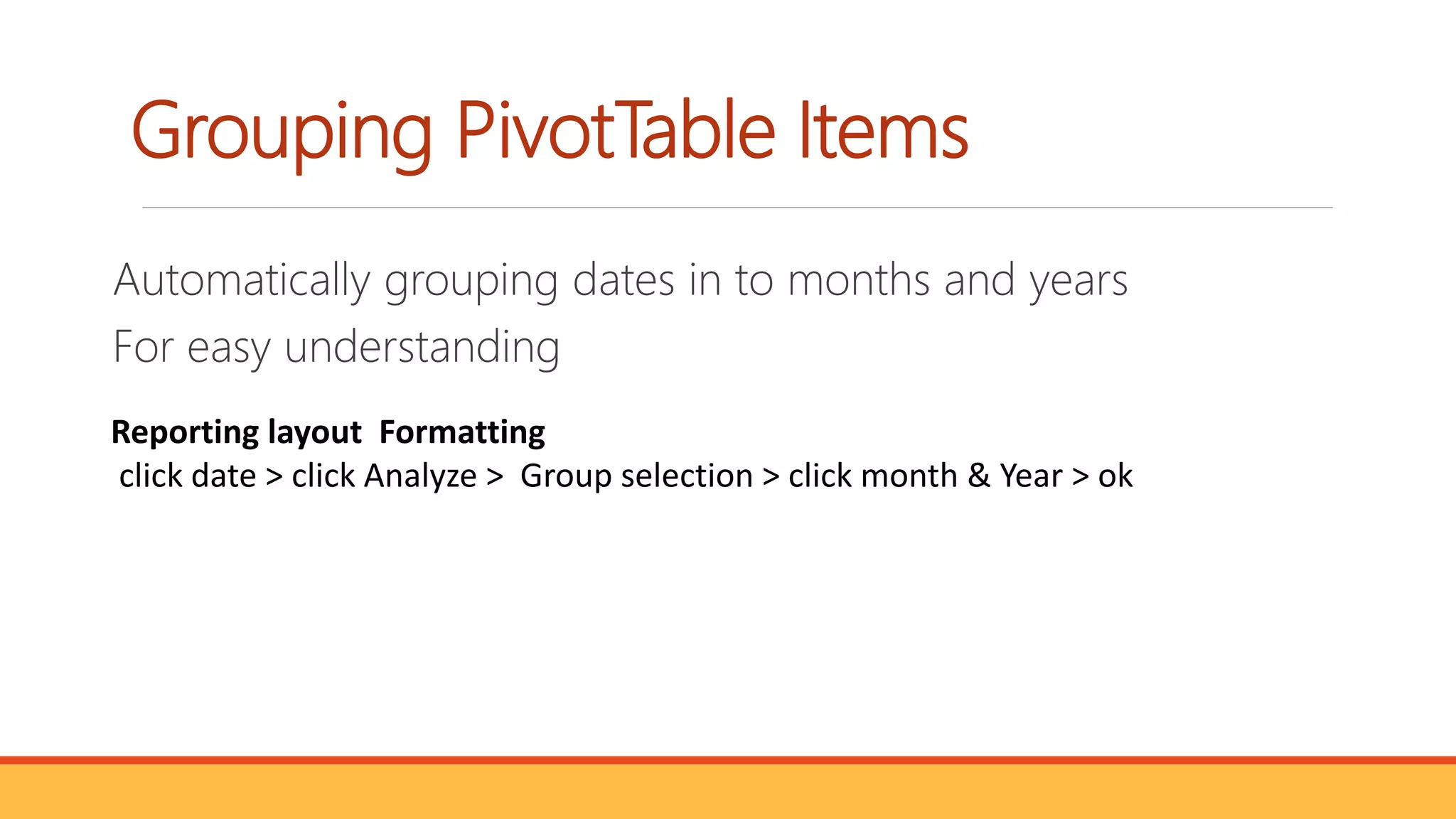
Grouping PivotTable Items
Automatically grouping dates in to months and years
For easy understanding
Reporting layout Formatting
click date > click Analyze > Group selection > click month & Year > ok
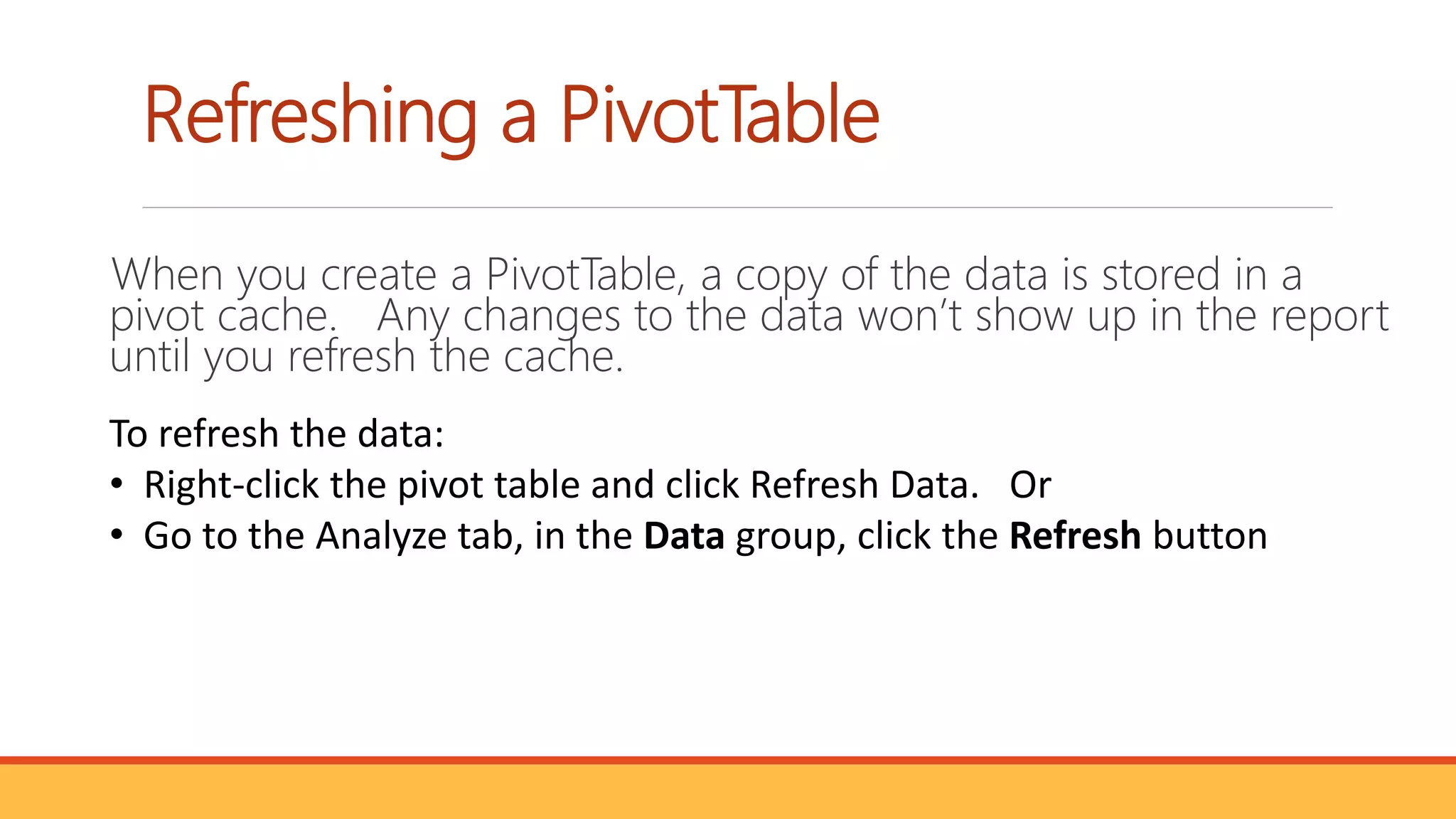
Refreshing a PivotTable
When you create a PivotTable, a copy of the data is stored in a
pivot cache. Any changes to the data won’t show up in the report
until you refresh the cache.
To refresh the data:
• Right-click the pivot table and click Refresh Data. Or
• Go to the Analyze tab, in the Data group, click the Refresh button
◦ Why Visualization
◦ Chart types and their use
◦ Creating dashboards in excel
Part 2 – Visualization
For performance monitoring
To see trends over time
Advantages of visualization
It improves data use & data-driven decision
Chart type and their purpose
BAR CHART They are best used to show change over time, to compare different categories
HORIZONTAL BAR CHART
Best used to compare individual categories
COLUMN BAR CHART
useful for showing data changes over a
period of time or for illustrating
comparisons among individual items
Rules
1. Always start at zero y-axis
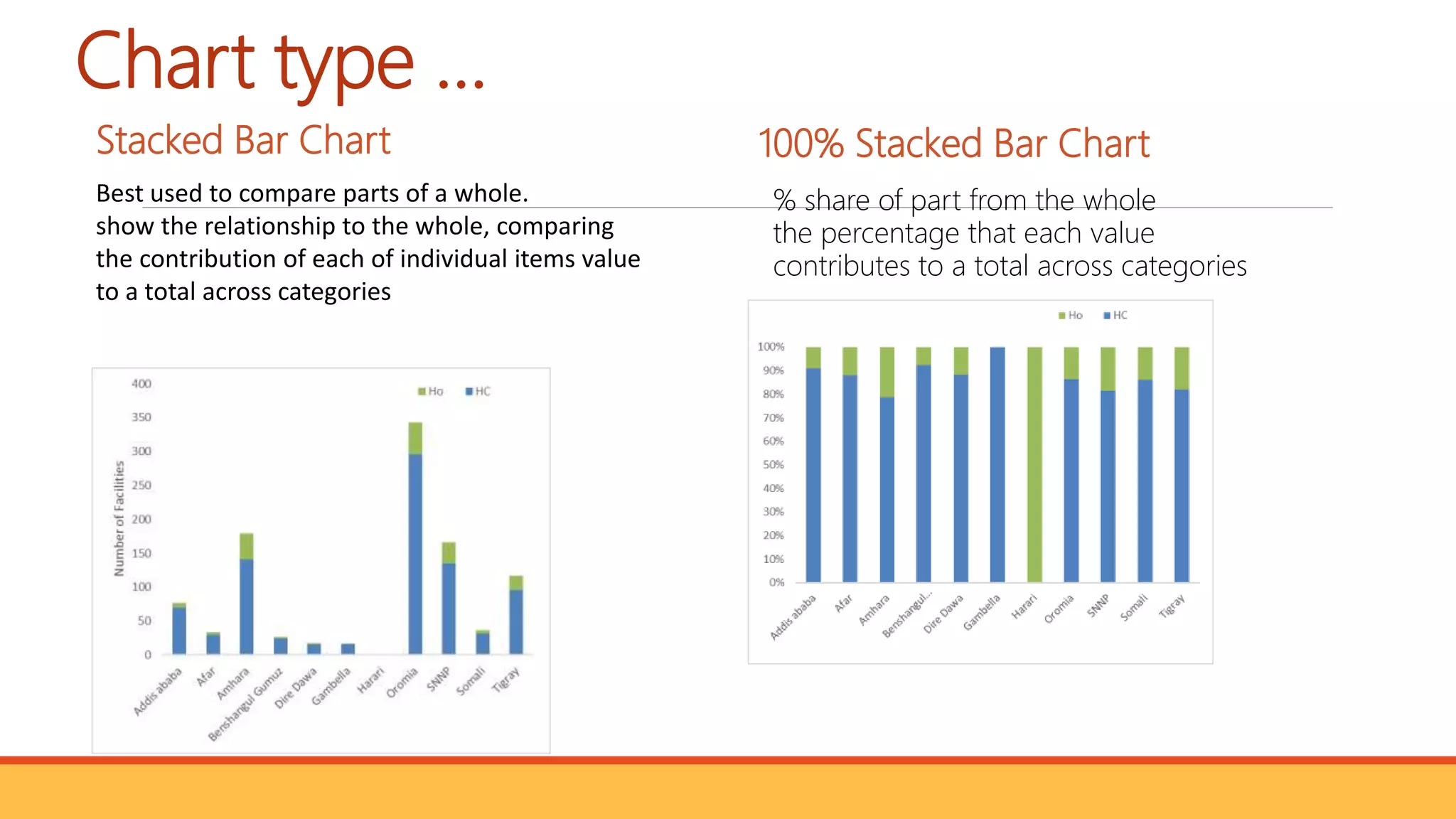
Chart type …
100% Stacked Bar ChartStacked Bar Chart
Best used to compare parts of a whole.
show the relationship to the whole, comparing
the contribution of each of individual items value
to a total across categories
% share of part from the whole
the percentage that each value
contributes to a total across categories
Chart type …
Line Charts
Line charts display continuous data over time and are
good for showing trends in data.
Areal Charts
Depicts a time-series relationship, but they are
different than line charts in that they can
represent volume.
• start y-axis at a zero baseline
• Don’t plot more than 4 lines in one graph
• Label lines to help quickly identify lines
-
50,000
100,000
150,000
200,000
250,000
Oct Nov Dec Oct Nov Dec
2016 2017
Measles Penta
-
20,000
40,000
60,000
80,000
100,000
120,000
140,000
160,000
180,000
Oct Nov Dec Oct Nov Dec
2016 2017
Measles woreda distribution
Measles Penta
Chart type …
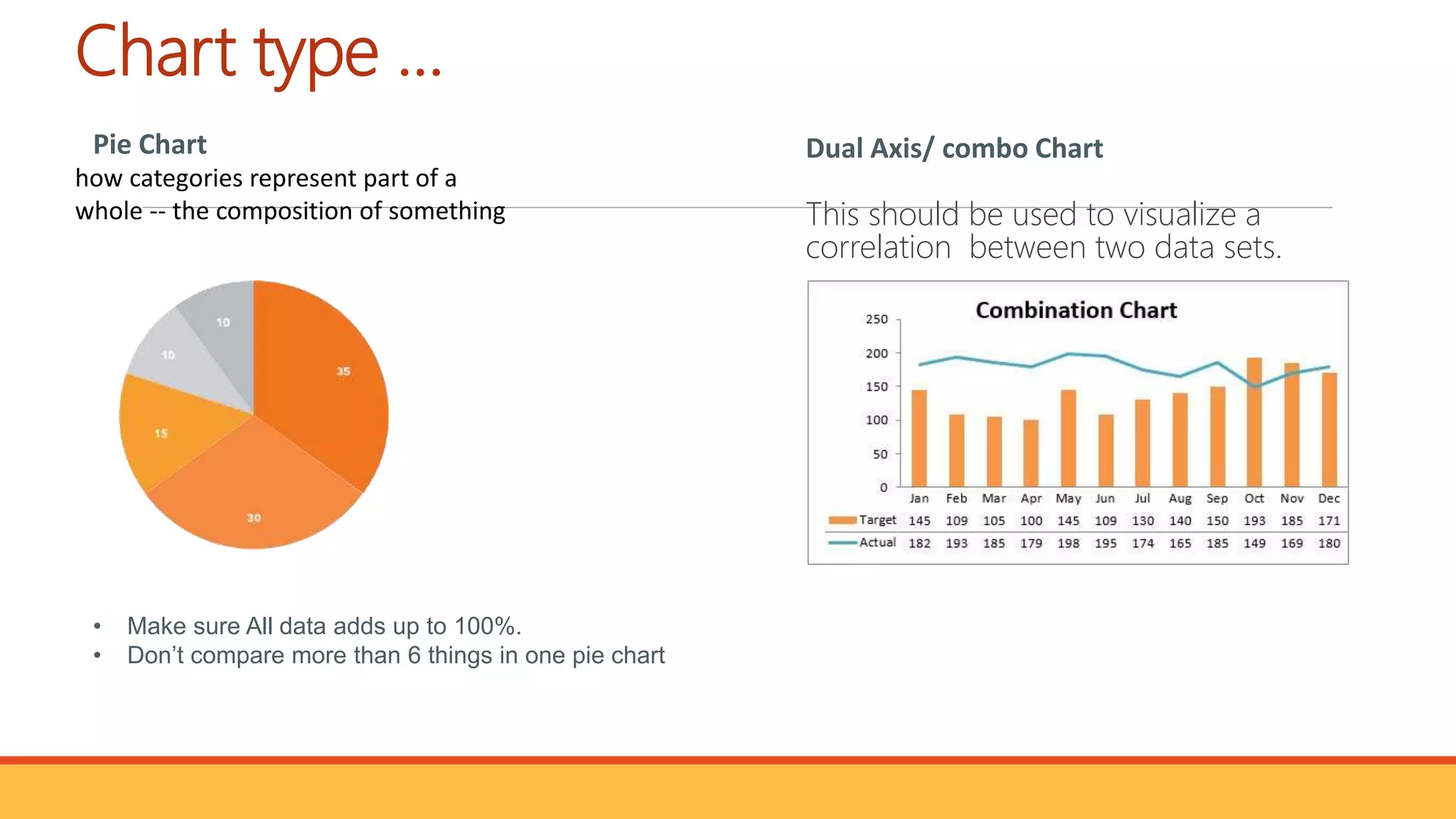
This should be used to visualize a
correlation between two data sets.
Pie Chart
how categories represent part of a
whole -- the composition of something
• Make sure All data adds up to 100%.
• Don’t compare more than 6 things in one pie chart
Dual Axis/ combo Chart
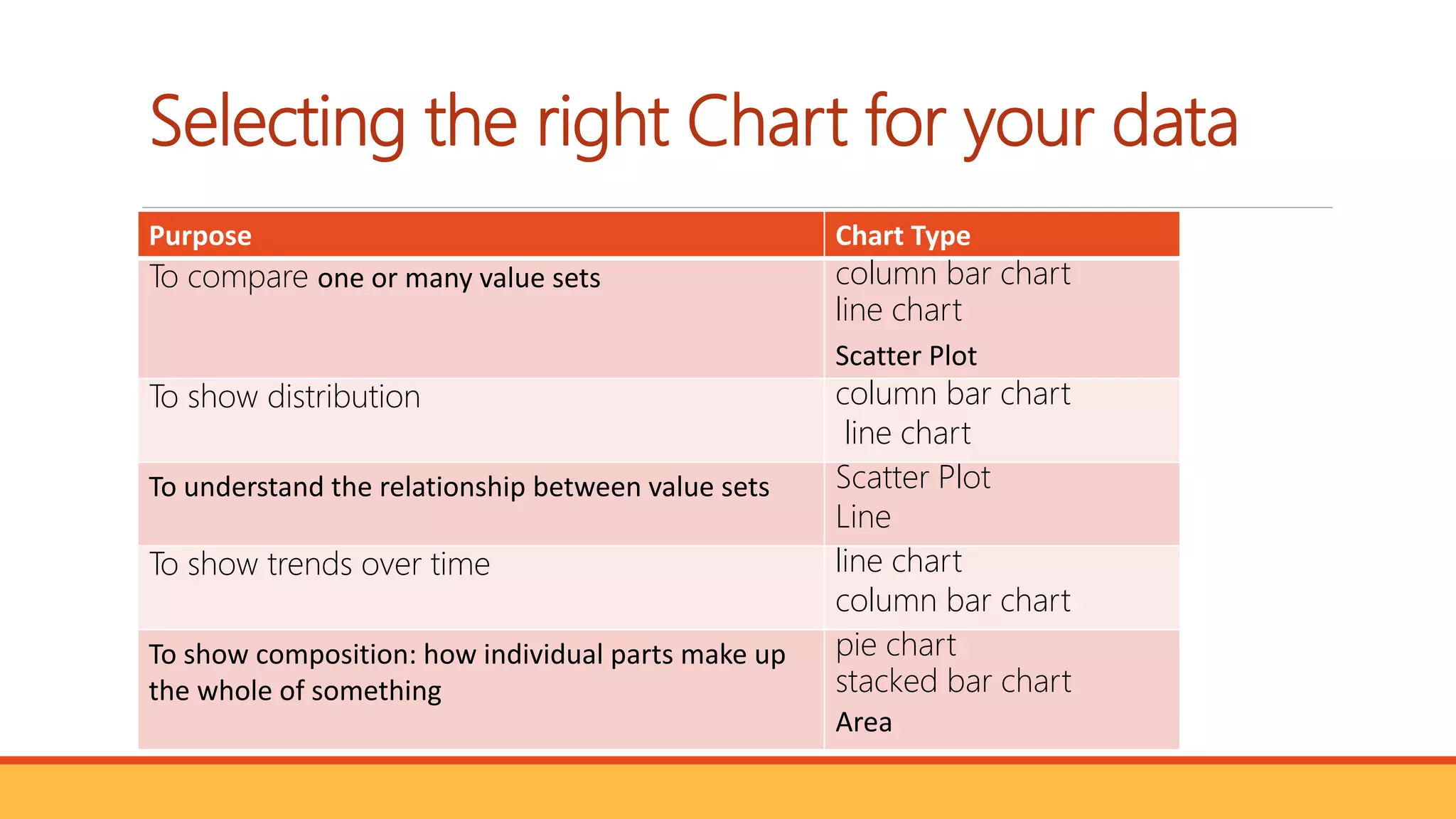
Selecting the right Chart for your data
Purpose Chart Type
To compare one or many value sets column bar chart
line chart
Scatter Plot
To show distribution column bar chart
line chart
To understand the relationship between value sets Scatter Plot
Line
To show trends over time line chart
column bar chart
To show composition: how individual parts make up
the whole of something
pie chart
stacked bar chart
Area
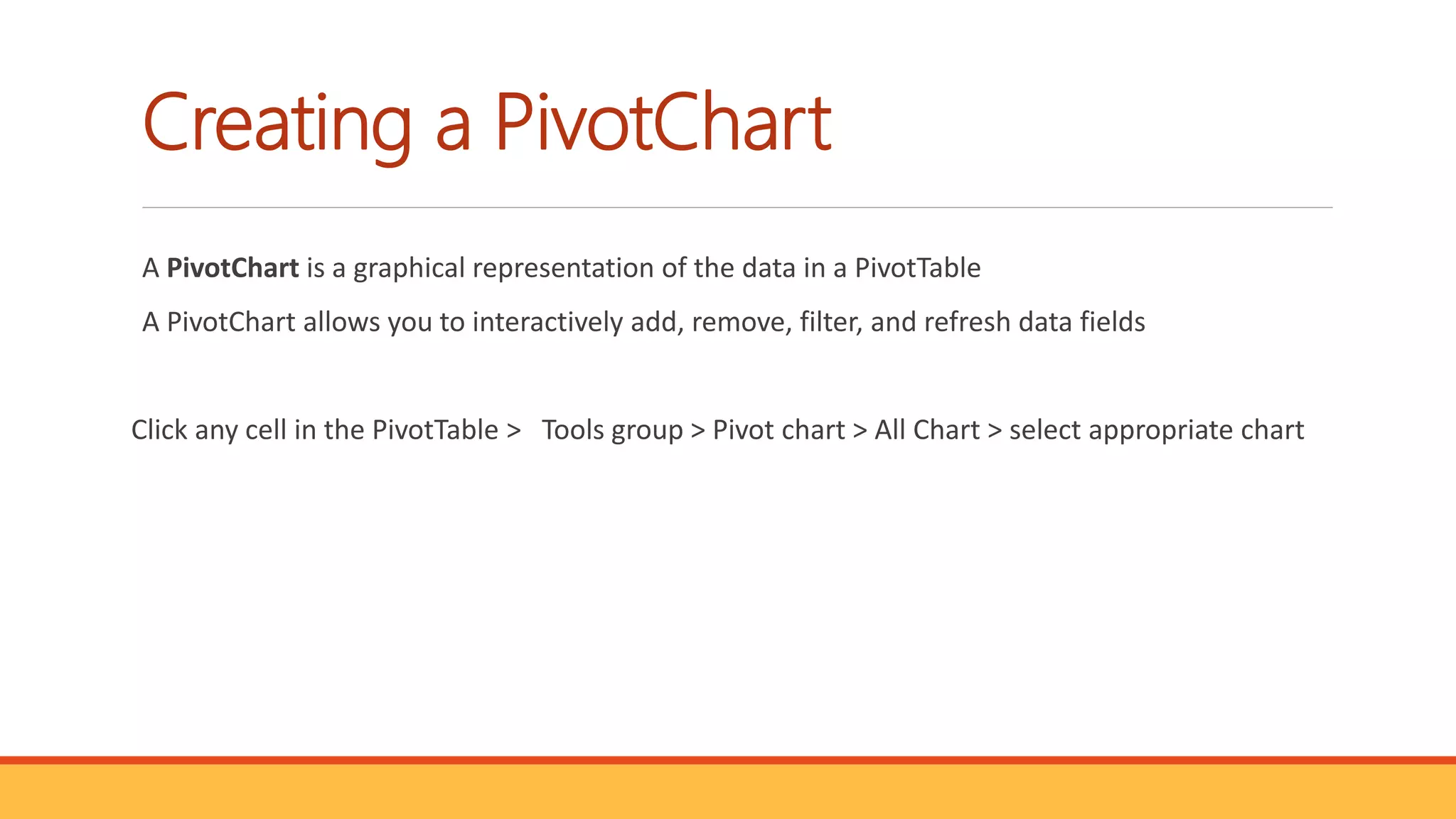
Creating a PivotChart
A PivotChart is a graphical representation of the data in a PivotTable
A PivotChart allows you to interactively add, remove, filter, and refresh data fields
Click any cell in the PivotTable > Tools group > Pivot chart > All Chart > select appropriate chart
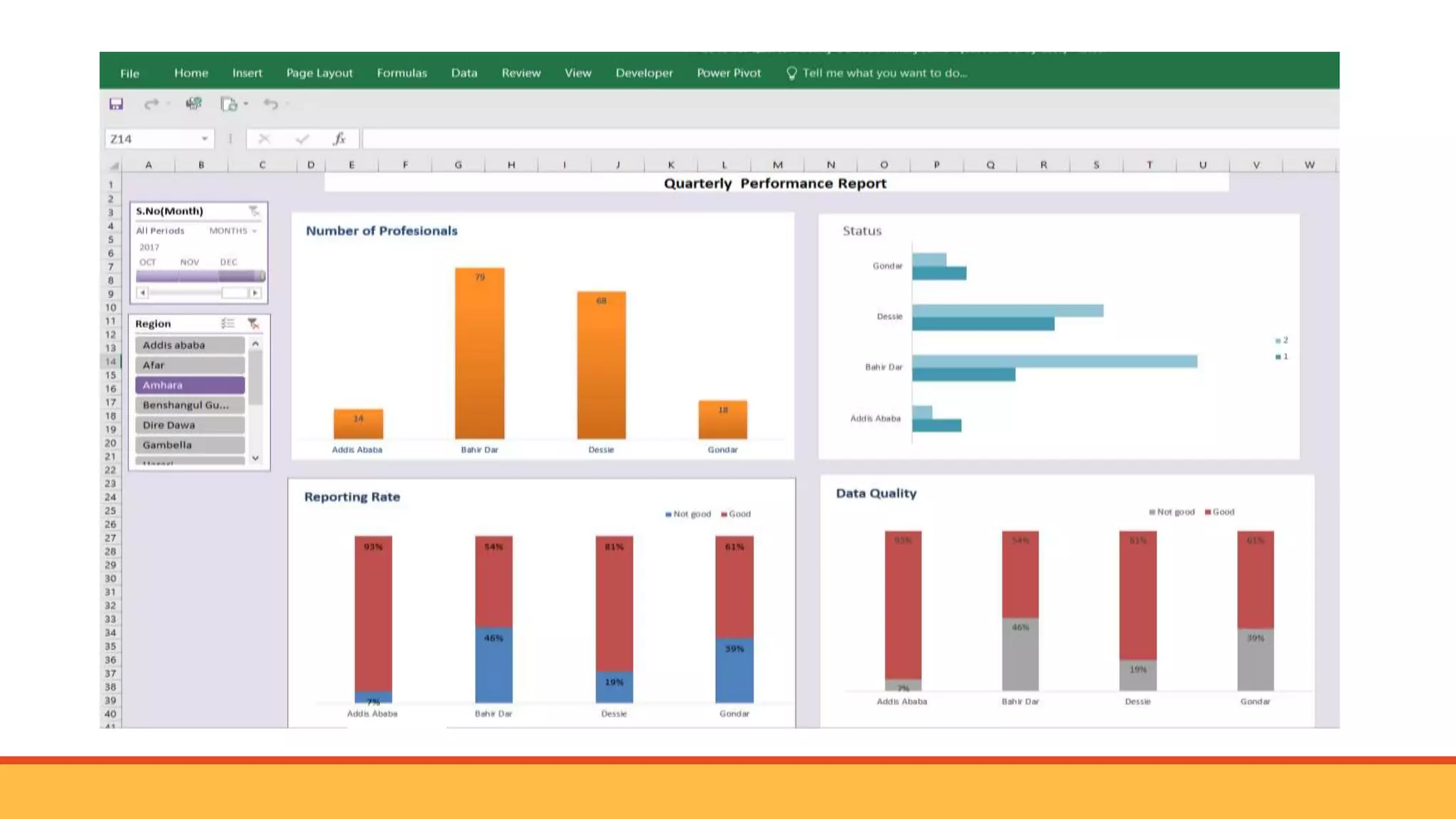
Sample Excel
Dashboard
Pivot table  and Dashboard in microsoft excel

Pivot table and Dashboard in microsoft excel

  • 1.
    Pivot Table &Dashboard using Microsoft Excel Feb. 2, 2018 Frehiwot Mulugeta frehiwotmulu@gmail.com
  • 2.
    Objectives To improve datavisibility, data use and facilitate data driven decision making – To understand and create Pivot Tables – To create interactive dashboard
  • 3.
    Part 1 –Pivot Table – Definition – Overview components of a pivot table – Creating pivot table – Introducing filters and slicers – Formatting
  • 4.
    Definition PivotTables summarize andanalyze large amounts of data into summary reports. nth) Name of Supervisour Supplying Hub Region Major/Emerging Zone W oreda Name of the Facility Type of the Facility (HO -Hospital & HC - Health Center) Implementation model 1=Paper based IPLS 2=HCMIS 3=Non- IPLS Dame Balcha Adama Oromia Major Bale Agarfa Ambentu HC 1 Yehun Telila Addis Ababa Amhara Major N/Shoa D/ Birhan Adm.TownAyer tena HC 1 Mesfin Arega Addis Ababa Addis ababa Major Kirkos Felege Hiwot HC 2 Abdulaziz Kedir Dire Dawa Oromia Major East HarargheBedeno Furda HC 1 Dame Balcha Adama Oromia Major Arsi Shirka Gobessa Ho 2 Mesfin Arega Addis Ababa Addis ababa Major Akaki Kality Kilinto HC 1 Abdulaziz Kedir Dire Dawa Oromia Major East HarargheGoro-Gutu Kobo Welteha HC 1 Abdulaziz Kedir Dire Dawa Oromia Major East HarargheGurewa Oromitu HC 1 Mesfin Arega Addis Ababa Addis ababa Major Akaki Kality Tuludimtu HC 1 Mesfin Arega Addis Ababa Addis ababa Major Lideta Abnet HC 2 Mesfin Arega Addis Ababa Addis ababa Major Addis Ketema5 Addis Ketema HC 2 Mesfin Arega Addis Ababa Addis ababa Major Addis Ketema7 Addis Raey HC 2 Mesfin Arega Addis Ababa Addis ababa Major Gulele 8 Addisu Gebeya HC 2 Redae Gebretsadik Mekele Tigray Major Easten Adigrate townAdigate HC 2 Redae Gebretsadik Mekele Tigray Major Easten Adigrate townAdigate GHP Ho 2 Habtamu Fantaye Mekele Tigray Major Southern Embalage Adishehu Ho 2 MengeshaBelay Dessie Amhara Major south wollo tenta Adjbar HC 2 Mesfin Arega Addis Ababa Addis ababa Major Kolfe 4 Alem Bank HC 2 Mesfin Arega Addis Ababa Addis ababa Major Bole 8 Amoraw HC 2 Number of the Facility supervised HC Ho Grand Total Emerging Region Afar 29 4 33 Benshangul Gumuz 24 2 26 Gambella 16 16 Somali 31 5 36 Emerging Region Total 100 11 111 Major Region Addis ababa 70 7 77 Amhara 141 38 179 Dire Dawa 15 2 17 Harari 1 1 Oromia 296 47 343 SNNP 135 31 166 Tigray 96 21 117 Major Region Total 753 147 900 Grand Total 853 158 1011
  • 5.
    Pivot Table Advantages Interactive: rearrange them by moving, adding, or deleting fields  Easy to update: “refreshable” if the original worksheet data changes
  • 6.
    The data mustbe normalized : ◦ Must have tabular layout ◦ Every column must have column headings in the first row.
  • 7.
    Creating PivotTable 1. Clickin the Excel table or select the range of data for the PivotTable 2. Click Insert tab > click the PivotTable button 3. Click the Select a table or range option button and verify the reference in the Table/Range box 4. Choose where you want to place the pivot table - To place on new sheet Click the New Worksheet option button/ It directed to new sheet/ - click the Existing worksheet option button and specify a cell 5. Click the OK button
  • 8.
  • 9.
  • 10.
    Adding a ReportFilter to a PivotTable A report filter allows you to focus on a subset of items in that field
  • 11.
    Analyze Tab • Toadd slicer • To group fields • To change the data source change • To show & hide pivot table tab • To refresh the data • To create pivot chart The ribbon for PivotTables
  • 12.
    The ribbon forPivotTables Design Tab • To change the table style • To include/ exclude sub total & grand total • To change the report layout
  • 13.
    Adding data slicerin PivotTable • Data slicers help you filter & visualize the filtered summery report • It makes the pivot table/chart interactive click any cell in the pivot table > click Analyze > under Filter click insert slicer > select the field u want to filter from insert slicer > ok Adding data slicer steps
  • 14.
    Slicer … Formatting dataslicer steps Select the data slicer > click Option > under slicer styles > select the styles u want Creating report connection Select the data slicer > click Option > under slicer click report connection > select pivot table & chart to connect to the filter > Ok
  • 15.
    Format PivotTable Good formattingwill communicate your data better Pivot table ◦ Style Formatting ◦ Reporting layout Formatting Style Formatting steps click any cell in the pivot table > click design > Pivot table Styles choose a style Reporting layout Formatting click any cell in the pivot table > click design > Layout > choose a layout
  • 16.
    Format Fields/data Number format Rightclick the value on pivot table fields > click value field settings> Number format Button > do the formatting and click ok Or Select the data inside the pivot table > home > Number > do the formatting
  • 17.
    Grouping PivotTable Items Automaticallygrouping dates in to months and years For easy understanding Reporting layout Formatting click date > click Analyze > Group selection > click month & Year > ok
  • 18.
    Refreshing a PivotTable Whenyou create a PivotTable, a copy of the data is stored in a pivot cache. Any changes to the data won’t show up in the report until you refresh the cache. To refresh the data: • Right-click the pivot table and click Refresh Data. Or • Go to the Analyze tab, in the Data group, click the Refresh button
  • 19.
    ◦ Why Visualization ◦Chart types and their use ◦ Creating dashboards in excel Part 2 – Visualization
  • 20.
    For performance monitoring Tosee trends over time Advantages of visualization It improves data use & data-driven decision
  • 21.
    Chart type andtheir purpose BAR CHART They are best used to show change over time, to compare different categories HORIZONTAL BAR CHART Best used to compare individual categories COLUMN BAR CHART useful for showing data changes over a period of time or for illustrating comparisons among individual items Rules 1. Always start at zero y-axis
  • 22.
    Chart type … 100%Stacked Bar ChartStacked Bar Chart Best used to compare parts of a whole. show the relationship to the whole, comparing the contribution of each of individual items value to a total across categories % share of part from the whole the percentage that each value contributes to a total across categories
  • 23.
    Chart type … LineCharts Line charts display continuous data over time and are good for showing trends in data. Areal Charts Depicts a time-series relationship, but they are different than line charts in that they can represent volume. • start y-axis at a zero baseline • Don’t plot more than 4 lines in one graph • Label lines to help quickly identify lines - 50,000 100,000 150,000 200,000 250,000 Oct Nov Dec Oct Nov Dec 2016 2017 Measles Penta - 20,000 40,000 60,000 80,000 100,000 120,000 140,000 160,000 180,000 Oct Nov Dec Oct Nov Dec 2016 2017 Measles woreda distribution Measles Penta
  • 24.
    Chart type … Thisshould be used to visualize a correlation between two data sets. Pie Chart how categories represent part of a whole -- the composition of something • Make sure All data adds up to 100%. • Don’t compare more than 6 things in one pie chart Dual Axis/ combo Chart
  • 25.
    Selecting the rightChart for your data Purpose Chart Type To compare one or many value sets column bar chart line chart Scatter Plot To show distribution column bar chart line chart To understand the relationship between value sets Scatter Plot Line To show trends over time line chart column bar chart To show composition: how individual parts make up the whole of something pie chart stacked bar chart Area
  • 26.
    Creating a PivotChart APivotChart is a graphical representation of the data in a PivotTable A PivotChart allows you to interactively add, remove, filter, and refresh data fields Click any cell in the PivotTable > Tools group > Pivot chart > All Chart > select appropriate chart
  • 27.

Editor's Notes

  • #5 77 column 1011 rows
  • #16 Pg 24
  • #17 Pg 24
  • #22 The bar chart is also useful when you want to compare values side by side, for example sales compared to forecast for different years, and when the measures (in this case sales and forecast) are calculated using the same unit.
  • #23 stacking bars makes it easy to visualize grouped data.
  • #24 A line chart connects discrete but continuous data points by using straight line segments. It is effective in facilitating trend analysis.
  • #25 the relation of a single value to the total.  The combo chart is the best choice when combining several measures of different value ranges.
  • #26 The scatter plot presents pairs of values from two measures. example, the relationship between Sales and Quantity per Customer.