Let’s learn
Tableau
Data Visualization Software
Version 2019.3.0
Made By: Kanika Nagpal
LinkedIn Id: https://www.linkedin.com/in/kanika-nagpal/
Parameters
A parameter is a global placeholder value such as a number,
date, or string that can replace a constant value in a calculation.
What are Parameters?
Parameters are user-generated values, that
allows user and his audience to choose the
inputs of calculated fields.
Parameters allow user to use aggregated
values that aren’t available in the data and
incorporate these values into dashboard
reports.
After creation, end user can control the input
to see the results of the effect of parameter.
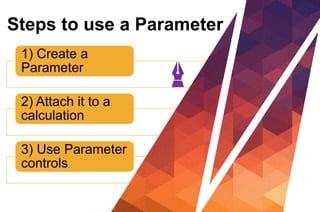
1) Create a
Parameter
2) Attach it to a
calculation
3) Use Parameter
controls
Steps to use a Parameter
Dataset : US_Superstore
Superstores are very large supermarkets
or shops selling household goods
and equipment. Superstores are
usually built outside city centres away from
other shops. The original dataset is
available on Kaggle. List of columns used
are as follows :-
•Sub Category
•Profit
•Sales
TIME TO CREATE
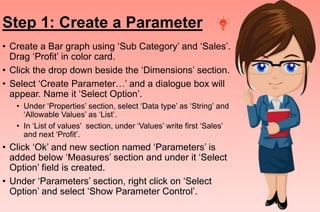
Step 1: Create a Parameter
• Create a Bar graph using ‘Sub Category’ and ‘Sales’.
Drag ‘Profit’ in color card.
• Click the drop down beside the ‘Dimensions’ section.
• Select ‘Create Parameter…’ and a dialogue box will
appear. Name it ‘Select Option’.
• Under ‘Properties’ section, select ‘Data type’ as ‘String’ and
‘Allowable Values’ as ‘List’.
• In ‘List of values’ section, under ‘Values’ write first ‘Sales’
and next ‘Profit’.
• Click ‘Ok’ and new section named ‘Parameters’ is
added below ‘Measures’ section and under it ‘Select
Option’ field is created.
• Under ‘Parameters’ section, right click on ‘Select
Option’ and select ‘Show Parameter Control’.
Step 2: Define action to Parameter
• Click the drop down beside the ‘Dimensions’ section.
• Select ‘Create Calculated Field…’ and a dialogue
box will appear. Name it ‘Choose Option’ and write
the formula as follows:
Case [Select Option]
When ‘Sales’
Then [Sales]
When ‘Profit’
Then [Profit]
End
• Click ‘Ok’ and a ‘Choose Option’ field is created
under ‘Measures’ section.
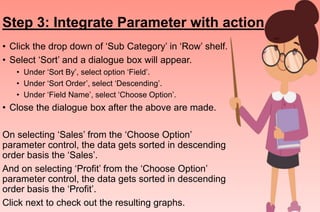
Step 3: Integrate Parameter with action
• Click the drop down of ‘Sub Category’ in ‘Row’ shelf.
• Select ‘Sort’ and a dialogue box will appear.
• Under ‘Sort By’, select option ‘Field’.
• Under ‘Sort Order’, select ‘Descending’.
• Under ‘Field Name’, select ‘Choose Option’.
• Close the dialogue box after the above are made.
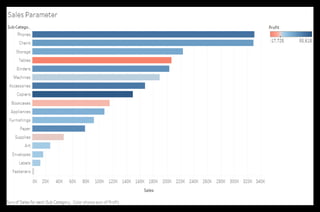
On selecting ‘Sales’ from the ‘Choose Option’
parameter control, the data gets sorted in descending
order basis the ‘Sales’.
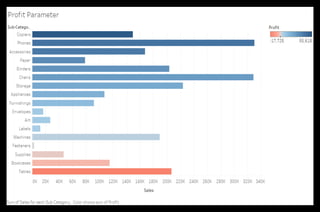
And on selecting ‘Profit’ from the ‘Choose Option’
parameter control, the data gets sorted in descending
order basis the ‘Profit’.
Click next to check out the resulting graphs.
Different ways to
use Parameters
Dynamic X axis or Y axis
• Dynamic X axis or Y axis: Using parameter
user can change the Measure of X axis or Y
axis. This is very helpful in case where user is
unsure about which Measure user wants to see
in any axis. Also, it provides the flexibility to
user to analyze the same chart with different
axis.
• Example: Consider a scatter chart, where X axis is
Sales, but Y axis can be Discount, Profit or
Quantity.
• Filtering with parameter: Parameters can also
be used to filter the data. It provides user the
flexibility to change the filter Dimension
depending upon the selection value of filter.
• Example: Consider the case where the
requirement is to filter the data basis either product
or sub-category or category. So in this case instead
of providing 3 different filter for each type, using
parameter and calculation (based on parameter)
user can provide one filter.
Filtering with Parameter
• Use of Parameter across different data
sources: Filters are specific to data sources
but Parameters are common to all data sources
and can be reused across the Workbook.
• Example: Consider a bar chart across countries
from data source1 and another scatter chart
showing counties across sales and profit from data
source2. Now, if user wants to apply filter which is
common for both charts, then using parameter it
can be done easily.
Parameter across data sources
IMAGE SOURCES
• https://www.remove.bg/
• https://www.free-powerpoint-templates-design.com/free-powerpoint-templates-
design/
• https://www.absentdata.com/how-to-use-a-parameter-in-tableau/
• https://images7.alphacoders.com/949/thumb-1920-949571.jpg
• https://i.pinimg.com/originals/5c/da/17/5cda1769a771466afb68764016d65894.jpg
• https://wallpaperstock.net/sunset_wallpapers_33807_1920x1080_1.html
• https://image.slidesharecdn.com/sentence-writing-strategy-1203634252255769-
4/95/sentence-writing-strategy-8-728.jpg?cb=1203605453
• https://i.pinimg.com/564x/e8/79/28/e87928eefc9637b472ab0cc4be89bf18.jpg
• https://www.spinxdigital.com/blog/wp-content/uploads/2016/12/How-to-Fund-a-
Business-Startup-Via-Crowdfunding-1.jpg
• https://cdn5.vectorstock.com/i/1000x1000/49/44/cute-cartoon-of-a-teacher-vector-
7784944.jpg
• https://cdn5.vectorstock.com/i/1000x1000/16/34/young-kindergarten-teacher-
teaching-class-of-kids-vector-8201634.jpg
• https://cdn5.vectorstock.com/i/1000x1000/84/24/woman-teacher-vector-1478424.jpg
END

Parameters in Tableau

  • 1.
    Let’s learn Tableau Data VisualizationSoftware Version 2019.3.0 Made By: Kanika Nagpal LinkedIn Id: https://www.linkedin.com/in/kanika-nagpal/
  • 2.
    Parameters A parameter isa global placeholder value such as a number, date, or string that can replace a constant value in a calculation.
  • 3.
    What are Parameters? Parametersare user-generated values, that allows user and his audience to choose the inputs of calculated fields. Parameters allow user to use aggregated values that aren’t available in the data and incorporate these values into dashboard reports. After creation, end user can control the input to see the results of the effect of parameter.
  • 4.
    1) Create a Parameter 2)Attach it to a calculation 3) Use Parameter controls Steps to use a Parameter
  • 6.
    Dataset : US_Superstore Superstoresare very large supermarkets or shops selling household goods and equipment. Superstores are usually built outside city centres away from other shops. The original dataset is available on Kaggle. List of columns used are as follows :- •Sub Category •Profit •Sales
  • 7.
  • 8.
    Step 1: Createa Parameter • Create a Bar graph using ‘Sub Category’ and ‘Sales’. Drag ‘Profit’ in color card. • Click the drop down beside the ‘Dimensions’ section. • Select ‘Create Parameter…’ and a dialogue box will appear. Name it ‘Select Option’. • Under ‘Properties’ section, select ‘Data type’ as ‘String’ and ‘Allowable Values’ as ‘List’. • In ‘List of values’ section, under ‘Values’ write first ‘Sales’ and next ‘Profit’. • Click ‘Ok’ and new section named ‘Parameters’ is added below ‘Measures’ section and under it ‘Select Option’ field is created. • Under ‘Parameters’ section, right click on ‘Select Option’ and select ‘Show Parameter Control’.
  • 9.
    Step 2: Defineaction to Parameter • Click the drop down beside the ‘Dimensions’ section. • Select ‘Create Calculated Field…’ and a dialogue box will appear. Name it ‘Choose Option’ and write the formula as follows: Case [Select Option] When ‘Sales’ Then [Sales] When ‘Profit’ Then [Profit] End • Click ‘Ok’ and a ‘Choose Option’ field is created under ‘Measures’ section.
  • 10.
    Step 3: IntegrateParameter with action • Click the drop down of ‘Sub Category’ in ‘Row’ shelf. • Select ‘Sort’ and a dialogue box will appear. • Under ‘Sort By’, select option ‘Field’. • Under ‘Sort Order’, select ‘Descending’. • Under ‘Field Name’, select ‘Choose Option’. • Close the dialogue box after the above are made. On selecting ‘Sales’ from the ‘Choose Option’ parameter control, the data gets sorted in descending order basis the ‘Sales’. And on selecting ‘Profit’ from the ‘Choose Option’ parameter control, the data gets sorted in descending order basis the ‘Profit’. Click next to check out the resulting graphs.
  • 13.
  • 14.
    Dynamic X axisor Y axis • Dynamic X axis or Y axis: Using parameter user can change the Measure of X axis or Y axis. This is very helpful in case where user is unsure about which Measure user wants to see in any axis. Also, it provides the flexibility to user to analyze the same chart with different axis. • Example: Consider a scatter chart, where X axis is Sales, but Y axis can be Discount, Profit or Quantity.
  • 15.
    • Filtering withparameter: Parameters can also be used to filter the data. It provides user the flexibility to change the filter Dimension depending upon the selection value of filter. • Example: Consider the case where the requirement is to filter the data basis either product or sub-category or category. So in this case instead of providing 3 different filter for each type, using parameter and calculation (based on parameter) user can provide one filter. Filtering with Parameter
  • 16.
    • Use ofParameter across different data sources: Filters are specific to data sources but Parameters are common to all data sources and can be reused across the Workbook. • Example: Consider a bar chart across countries from data source1 and another scatter chart showing counties across sales and profit from data source2. Now, if user wants to apply filter which is common for both charts, then using parameter it can be done easily. Parameter across data sources
  • 17.
    IMAGE SOURCES • https://www.remove.bg/ •https://www.free-powerpoint-templates-design.com/free-powerpoint-templates- design/ • https://www.absentdata.com/how-to-use-a-parameter-in-tableau/ • https://images7.alphacoders.com/949/thumb-1920-949571.jpg • https://i.pinimg.com/originals/5c/da/17/5cda1769a771466afb68764016d65894.jpg • https://wallpaperstock.net/sunset_wallpapers_33807_1920x1080_1.html • https://image.slidesharecdn.com/sentence-writing-strategy-1203634252255769- 4/95/sentence-writing-strategy-8-728.jpg?cb=1203605453 • https://i.pinimg.com/564x/e8/79/28/e87928eefc9637b472ab0cc4be89bf18.jpg • https://www.spinxdigital.com/blog/wp-content/uploads/2016/12/How-to-Fund-a- Business-Startup-Via-Crowdfunding-1.jpg • https://cdn5.vectorstock.com/i/1000x1000/49/44/cute-cartoon-of-a-teacher-vector- 7784944.jpg • https://cdn5.vectorstock.com/i/1000x1000/16/34/young-kindergarten-teacher- teaching-class-of-kids-vector-8201634.jpg • https://cdn5.vectorstock.com/i/1000x1000/84/24/woman-teacher-vector-1478424.jpg
  • 18.