The Pitch / Investor
Presentation Template
A slide by slide examination of its content, message and what it says
about you and your company.


                                     David Blumenstein, TechGB
                                            david@techgb.co.uk
04/15/13                   David Blumenstein - david@techgb.co.uk   2


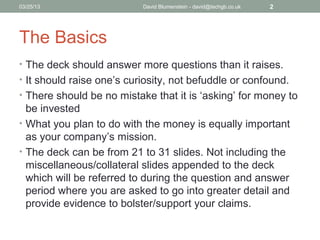
The Basics
• The deck should answer more questions than it raises.
• It should raise one’s curiosity, not befuddle or confound.
• There should be no mistake that it is ‘asking’ for money to
  be invested
• What you plan to do with the money is equally important
  as your company’s mission.
• The deck can be from 21 to 31 slides. Not including the
  miscellaneous/collateral slides appended to the deck
  which will be referred to during the question and answer
  period where you are asked to go into greater detail and
  provide evidence to bolster/support your claims.
04/15/13                  David Blumenstein - david@techgb.co.uk   3


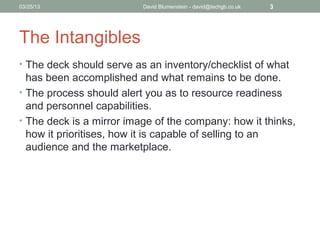
The Intangibles
• The deck should serve as an inventory/checklist of what
  has been accomplished and what remains to be done.
• The process should alert you as to resource readiness
  and personnel capabilities.
• The deck is a mirror image of the company: how it thinks,
  how it prioritises, how it is capable of selling to an
  audience and the marketplace.
04/15/13                   David Blumenstein - david@techgb.co.uk   4


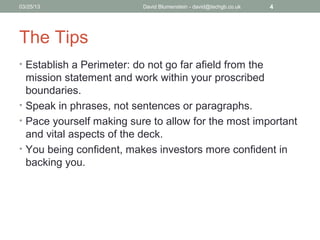
The Tips
• Establish a Perimeter: do not go far afield from the
  mission statement and work within your proscribed
  boundaries.
• Speak in phrases, not sentences or paragraphs.
• Pace yourself making sure to allow for the most important
  and vital aspects of the deck.
• You being confident, makes investors more confident in
  backing you.
04/15/13                           David Blumenstein - david@techgb.co.uk   5


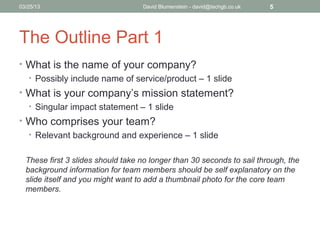
The Outline Part 1
• What is the name of your company?
  • Possibly include name of service/product – 1 slide
• What is your company’s mission statement?
  • Singular impact statement – 1 slide
• Who comprises your team?
  • Relevant background and experience – 1 slide


  These first 3 slides should take no longer than 30 seconds to sail through, the
  background information for team members should be self explanatory on the
  slide itself and you might want to add a thumbnail photo for the core team
  members.
04/15/13                           David Blumenstein - david@techgb.co.uk   6


The Outline Part 2a
• What is the issue/pain that your company is looking to
  address/resolve?
   • Make it painful
   • Make sure that an audience/market exists to embrace/purchase
      the product/service – 1 slide
• What is your solution to this problem?
  • Make use of use cases and scenarios
       • How the solutions works in practice NOT theory
   • Make use of graphical representations:
     • Screenshots, Diagrams, Flow Charts
04/15/13                           David Blumenstein - david@techgb.co.uk   7


The Outline Part 2b
   • This section may take as few as 5 slides and possibly as many as 15
     to demonstrate the solution and its applicability
   • Prodigious use of a presentation remote control to advance slides at a
     rapid pace can provide action to the presentation as the solution
     unfolds.
   • The solution slide set is crucial to the deck. These slides will stay in the
     minds of the audience as you proceed to the following sections:


           • Audience, Market
           • Competition
           • Financials
           • Ask
           • Use of Proceeds
04/15/13                      David Blumenstein - david@techgb.co.uk   8


The Outline Part 3
• What is market size?
• How much of the market is addressable?
• What is the cost of customer acquisition?
• How do you plan to reach out to them?
• Do you know who they are?
• Do you know who they REALLY are?
  • Make the responses truly comprehensive – 2 slides
04/15/13                       David Blumenstein - david@techgb.co.uk   9


The Outline Part 4
• What does the competitive landscape look like?
• Who is your competition?
• Are they really your competitors? or possibly prospective
  customers and/or strategic partners?
   • Make use of a matrix, a chart demonstrating comparison of feature
      sets – 1 slide
04/15/13                        David Blumenstein - david@techgb.co.uk   10


The Outline Part 5
• Is your company presently in revenue?
• Are there existing customers?
• How healthy is the pipeline?
  • Show logos of existing customers as well of those of prospects – 2
    slides
• What is your business model(s)? And note they are
  different from revenue streams? How will you make
  money?
• What are you revenue streams? How do you plan on
  generating revenue from your customers?
   • Distinguish between the two clearly – 1 slide
04/15/13                         David Blumenstein - david@techgb.co.uk   11


The Outline Part 6
• Are there financials? projections?
  • Provide a financial history of the company and a ledger sheet with
    G/L/A, revenue, expenses, operating costs, net income, EBITDA
  • It should not be so granular that it does not fit on 1 slide, endeavor
    to make it readable, & note if there is anywhere investors will trip
    you, this is it.
  • Investors may not understand your product/service, but they do
    understand FINANCE. – 1 slide
04/15/13                             David Blumenstein - david@techgb.co.uk   12


The Outline Part 7
• What is the backup for the financials?
  • Explain the financials, how the numbers were derived
  • Highlight events along the 5 year projection, break-even?
    Profitability point? Sales inflections – 1 slide
• How much money are you asking for?
  • What is the size of the investment? One lump?
  • What are are the milestones and objectives?
       • Speak clearly to milestones and objectives
       • Be precise as to how the money is allocated
       • Breakdown should total 100% (percentage)
       • Funds should be earmarked for: Expansion & Growth, Feature
           Enhancements, Marketing & Sales, Personnel and Operations – 1 slide
04/15/13                       David Blumenstein - david@techgb.co.uk   13


The Outline Part 8

• Thank you
  •You are asking investors for money. They are taking time out of
  their day to meet with you, thank them for their time – 1 slide
• Static Slide – Q&A
  •Leave most comprehensive solution slide on screen while there are
  questions – 1 slide
• Miscellaneous/Collateral
  •Store all of your background data and information in these slides at
  the end of the deck
  •Refer to these slides if necessary to answer questions and
  corroborate your responses.
04/15/13                   David Blumenstein - david@techgb.co.uk   14


The Bottom Line

• This is not the end, but the beginning of your journey.
• There are no absolutes, no guarantees of success.
• Investment in your company is neither a metric or
  measure of success, it is what you do with the money
  which will determine your fate.
• This is a living document and is to be revisited over and
  over again. Never be satisfied.
• In a world where complaints are ubiquitous, listen to them
  noting both their substance and frequency, for therein lies
  the next great start up.

Pitch/Investor Deck Template for Start Ups

  • 1.
    The Pitch /Investor Presentation Template A slide by slide examination of its content, message and what it says about you and your company. David Blumenstein, TechGB david@techgb.co.uk
  • 2.
    04/15/13 David Blumenstein - david@techgb.co.uk 2 The Basics • The deck should answer more questions than it raises. • It should raise one’s curiosity, not befuddle or confound. • There should be no mistake that it is ‘asking’ for money to be invested • What you plan to do with the money is equally important as your company’s mission. • The deck can be from 21 to 31 slides. Not including the miscellaneous/collateral slides appended to the deck which will be referred to during the question and answer period where you are asked to go into greater detail and provide evidence to bolster/support your claims.
  • 3.
    04/15/13 David Blumenstein - david@techgb.co.uk 3 The Intangibles • The deck should serve as an inventory/checklist of what has been accomplished and what remains to be done. • The process should alert you as to resource readiness and personnel capabilities. • The deck is a mirror image of the company: how it thinks, how it prioritises, how it is capable of selling to an audience and the marketplace.
  • 4.
    04/15/13 David Blumenstein - david@techgb.co.uk 4 The Tips • Establish a Perimeter: do not go far afield from the mission statement and work within your proscribed boundaries. • Speak in phrases, not sentences or paragraphs. • Pace yourself making sure to allow for the most important and vital aspects of the deck. • You being confident, makes investors more confident in backing you.
  • 5.
    04/15/13 David Blumenstein - david@techgb.co.uk 5 The Outline Part 1 • What is the name of your company? • Possibly include name of service/product – 1 slide • What is your company’s mission statement? • Singular impact statement – 1 slide • Who comprises your team? • Relevant background and experience – 1 slide These first 3 slides should take no longer than 30 seconds to sail through, the background information for team members should be self explanatory on the slide itself and you might want to add a thumbnail photo for the core team members.
  • 6.
    04/15/13 David Blumenstein - david@techgb.co.uk 6 The Outline Part 2a • What is the issue/pain that your company is looking to address/resolve? • Make it painful • Make sure that an audience/market exists to embrace/purchase the product/service – 1 slide • What is your solution to this problem? • Make use of use cases and scenarios • How the solutions works in practice NOT theory • Make use of graphical representations: • Screenshots, Diagrams, Flow Charts
  • 7.
    04/15/13 David Blumenstein - david@techgb.co.uk 7 The Outline Part 2b • This section may take as few as 5 slides and possibly as many as 15 to demonstrate the solution and its applicability • Prodigious use of a presentation remote control to advance slides at a rapid pace can provide action to the presentation as the solution unfolds. • The solution slide set is crucial to the deck. These slides will stay in the minds of the audience as you proceed to the following sections: • Audience, Market • Competition • Financials • Ask • Use of Proceeds
  • 8.
    04/15/13 David Blumenstein - david@techgb.co.uk 8 The Outline Part 3 • What is market size? • How much of the market is addressable? • What is the cost of customer acquisition? • How do you plan to reach out to them? • Do you know who they are? • Do you know who they REALLY are? • Make the responses truly comprehensive – 2 slides
  • 9.
    04/15/13 David Blumenstein - david@techgb.co.uk 9 The Outline Part 4 • What does the competitive landscape look like? • Who is your competition? • Are they really your competitors? or possibly prospective customers and/or strategic partners? • Make use of a matrix, a chart demonstrating comparison of feature sets – 1 slide
  • 10.
    04/15/13 David Blumenstein - david@techgb.co.uk 10 The Outline Part 5 • Is your company presently in revenue? • Are there existing customers? • How healthy is the pipeline? • Show logos of existing customers as well of those of prospects – 2 slides • What is your business model(s)? And note they are different from revenue streams? How will you make money? • What are you revenue streams? How do you plan on generating revenue from your customers? • Distinguish between the two clearly – 1 slide
  • 11.
    04/15/13 David Blumenstein - david@techgb.co.uk 11 The Outline Part 6 • Are there financials? projections? • Provide a financial history of the company and a ledger sheet with G/L/A, revenue, expenses, operating costs, net income, EBITDA • It should not be so granular that it does not fit on 1 slide, endeavor to make it readable, & note if there is anywhere investors will trip you, this is it. • Investors may not understand your product/service, but they do understand FINANCE. – 1 slide
  • 12.
    04/15/13 David Blumenstein - david@techgb.co.uk 12 The Outline Part 7 • What is the backup for the financials? • Explain the financials, how the numbers were derived • Highlight events along the 5 year projection, break-even? Profitability point? Sales inflections – 1 slide • How much money are you asking for? • What is the size of the investment? One lump? • What are are the milestones and objectives? • Speak clearly to milestones and objectives • Be precise as to how the money is allocated • Breakdown should total 100% (percentage) • Funds should be earmarked for: Expansion & Growth, Feature Enhancements, Marketing & Sales, Personnel and Operations – 1 slide
  • 13.
    04/15/13 David Blumenstein - david@techgb.co.uk 13 The Outline Part 8 • Thank you •You are asking investors for money. They are taking time out of their day to meet with you, thank them for their time – 1 slide • Static Slide – Q&A •Leave most comprehensive solution slide on screen while there are questions – 1 slide • Miscellaneous/Collateral •Store all of your background data and information in these slides at the end of the deck •Refer to these slides if necessary to answer questions and corroborate your responses.
  • 14.
    04/15/13 David Blumenstein - david@techgb.co.uk 14 The Bottom Line • This is not the end, but the beginning of your journey. • There are no absolutes, no guarantees of success. • Investment in your company is neither a metric or measure of success, it is what you do with the money which will determine your fate. • This is a living document and is to be revisited over and over again. Never be satisfied. • In a world where complaints are ubiquitous, listen to them noting both their substance and frequency, for therein lies the next great start up.