Fitango Education
          Health Topics

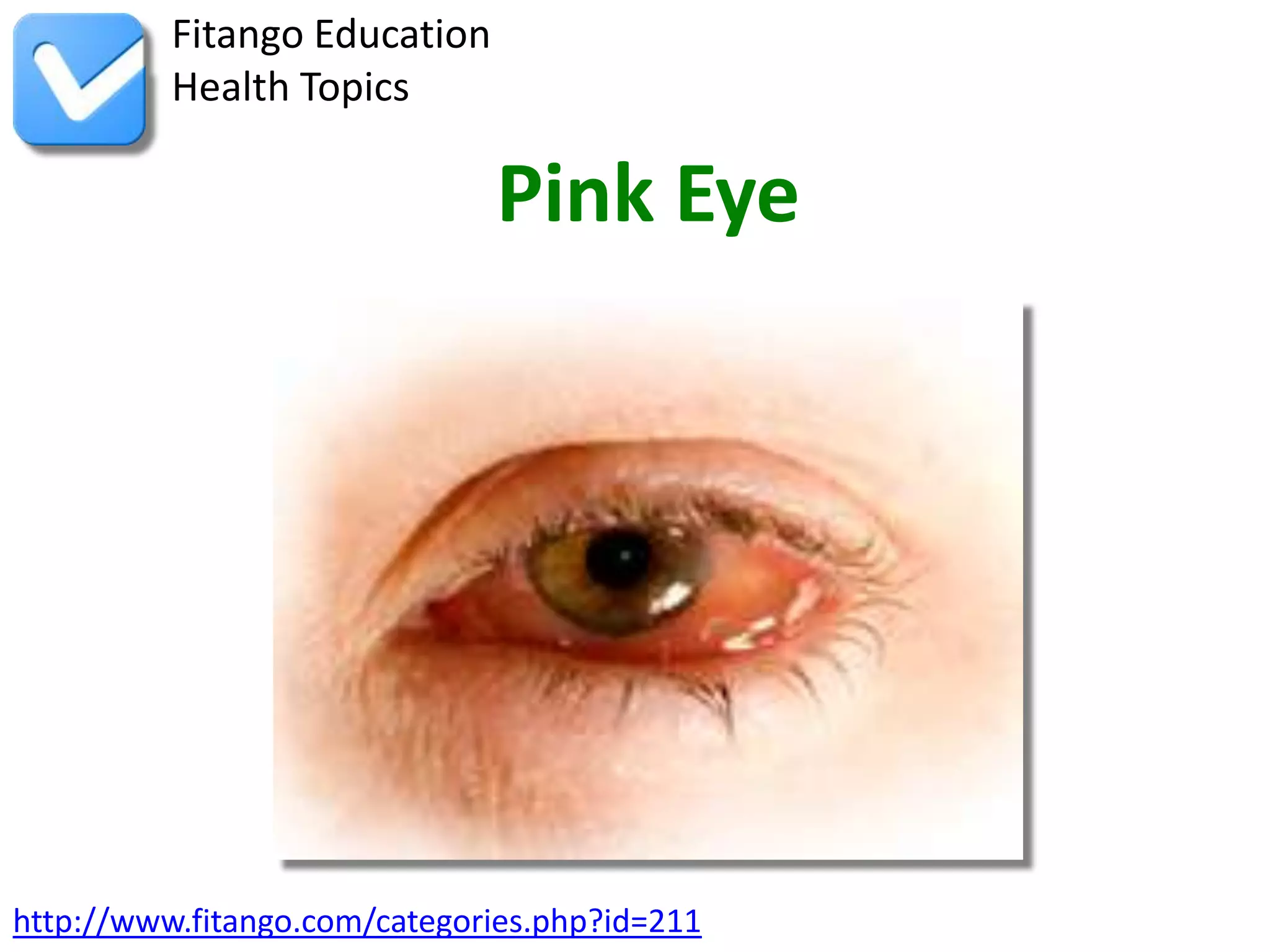
                              Pink Eye


http://www.fitango.com/categories.php?id=211
Overview
Conjunctivitis is the medical name for pinkeye. It
can cause swelling, itching, burning, discharge and
redness of the protective membrane that lines the
eyelids and covers exposed areas of the white of
the eye.


                                                      1
Symptoms
It can be hard to determine the exact cause of
every case of conjunctivitis. This is because some
signs and symptoms of the condition can differ
depending on the cause, and other signs and
symptoms are similar no matter what caused the
conjunctivitis.
Symptoms of conjunctivitis can include:


                                                     2
Symptoms
-- Pink or red color in the white of the eye(s) (often
one eye for bacterial and often both eyes for viral
or allergic conjunctivitis)
-- Swelling of the conjunctiva (the thin layer that
lines the white part of the eye and the inside of the
eyelid) and/or eyelids
-- Increased tearing


                                                         3
Symptoms
-- Discharge of pus, especially yellow-green (more
common in bacterial conjunctivitis)
-- Itching, irritation, and/or burning
-- Feeling like a foreign body is in the eye(s) or an
urge to rub the eye(s)


                                                        4
Symptoms
-- Crusting of eyelids or lashes sometimes occurs,
especially in the morning
-- Symptoms of a cold, flu, or other respiratory
infection may also be present
-- Sensitivity to bright light sometimes occurs


                                                     5
Symptoms
-- Enlargement and/or tenderness, in some cases,
of the lymph node in front of the ear. This
enlargement may feel like a small lump when
touched. (Lymph nodes act as filters in the body,
collecting and destroying viruses and bacteria.)
-- Symptoms of allergy, such as an itchy nose,
sneezing, a scratchy throat, or asthma may be
present in cases of allergic conjunctivitis


                                                    6
Symptoms
Sometimes there are situations that can help your
healthcare provider determine what is causing the
conjunctivitis. For example, if a person with
allergies develops conjunctivitis when the pollen
count increases in the spring, this would be a sign
that he or she might have allergic conjunctivitis.
And if someone develops conjunctivitis during an
outbreak of viral conjunctivitis, this would be a sign
that he or she might have viral conjunctivitis.


                                                         7
Diagnosis
Conjunctivitis has many causes, but in most cases
it results from infection with a virus or bacterium
or from a reaction to an allergen. No matter the
cause, conjunctivitis always involves inflammation
(swelling) of the thin layer that lines the inside of
the eyelid and covers the white part of the eye (the
conjunctiva). But conjunctivitis also has other signs
and symptoms, which may vary, depending on the
cause. These signs and symptoms can be used to
diagnose the type of conjunctivitis.
                                                        8
Diagnosis
             **Viral Conjunctivitis**
Viral conjunctivitis can often be diagnosed from
signs and symptoms, and patient history. For
example, if conjunctivitis accompanies a common
cold or respiratory tract infection and if discharge
from the eye is watery rather than thick, the cause
is likely a virus. The history the patient gives (for
example, having contact with someone with
conjunctivitis or having allergies) and examination
of the eye can also help a doctor make a firm
diagnosis.
                                                        9
Diagnosis
            **Viral Conjunctivitis**
Laboratory tests are not usually needed to
diagnose viral conjunctivitis. However, testing may
be done if a more severe form of viral
conjunctivitis is suspected, such as conjunctivitis
caused by herpes simplex virus or varicella-zoster
virus. This testing is done using a sample of the
discharge from an infected eye.


                                                      10
Diagnosis
            **Viral Conjunctivitis**
Depending on the cause of viral conjunctivitis,
some patients may have additional symptoms or
conditions, such as the following:
-- Common cold, flu, or other respiratory infection
— conjunctivitis often occurs with respiratory
infections; sometimes the lymph node near the
front of the ear is enlarged and painful.


                                                      11
Diagnosis
            **Viral Conjunctivitis**
-- Pharyngoconjunctivial fever — conjunctivitis as
well as a fever and sore throat can occur with this
syndrome, which is most commonly caused by
infection with adenovirus serotypes 3, 4, and 7.
-- Epidemic keratoconjunctivitis — this is a more
severe type of conjunctivitis; it is caused by
infection with adenovirus serotypes 8, 19, and 37.


                                                      12
Diagnosis
             **Viral Conjunctivitis**
-- Acute hemorrhagic conjunctivitis — this type of
conjunctivitis is sometimes accompanied with
nervous system involvement; it is associated with
enterovirus 70 and coxsackievirus A24.
-- Herpetic keratoconjunctivitis — this type of
conjunctivitis is associated with herpes simplex
virus and blister-like lesions on the skin; it may
affect only one eye.


                                                     13
Diagnosis
            **Viral Conjunctivitis**
-- Rubella and rubeola (measles) — conjunctivitis
can occur with these viral rash illnesses, which are
usually accompanied by rash, fever, and cough.
-- Newcastle disease — conjunctivitis can
accompany this disease, which usually occurs
among poultry workers and veterinarians, not the
general population; Newcastle disease is caused by
Newcastle disease virus.


                                                       14
Diagnosis
           **Bacterial Conjunctivitis
Bacterial conjunctivitis can usually be diagnosed by
a doctor, nurse, or other healthcare provider from
signs and symptoms, and patient history. For
example, if conjunctivitis accompanies an ear
infection and if discharge from the eye is thick
rather than watery, the cause may be a bacterium.
Although not routinely done, your healthcare
provider may obtain a sample of eye discharge
from the conjunctiva for laboratory analysis to
determine which form of infection you have and
how best to treat it
                                                       15
Diagnosis
            **Bacterial Conjunctivitis
Depending on the cause of bacterial conjunctivitis,
some patients may have additional symptoms or
conditions, such as the following:
-- Hyperacute bacterial conjunctivitis — this is a
more severe type of conjunctivitis that develops
rapidly and is accompanied by a lot of yellow-
green discharge that returns even after being
wiped away from the eye(s).


                                                      16
Diagnosis
            **Bacterial Conjunctivitis
-- Chronic bacterial conjunctivitis — often develops
along with another inflammatory condition
(blepharitis) that promotes bacteria growing in the
eyelid; flaky debris and warmth along the lid may
also be present.
-- Inclusion (chlamydial) conjunctivitis — more
common in newborns; includes redness of the
eye(s), swelling of the eyelids, and discharge of
pus, usually 5 to 12 days after birth.

                                                       17
Diagnosis
            **Bacterial Conjunctivitis
-- Gonococcal conjunctivitis — more common in
newborns; includes red eyes, thick pus in the eyes,
and swelling of the eyelids, usually 2 to 4 days after
birth.
-- Trachoma — chronic follicular conjunctivitis that
leads to scarring in the conjunctiva and cornea;
repeat infections occur in children less than 10
years of age and is common in developing
countries.

                                                         18
Diagnosis
           **Allergic Conjunctivitis**
Allergic conjunctivitis can be diagnosed from signs
and symptoms, and patient history; for example,
allergic conjunctivitis may occur seasonally when
pollen counts are high, and it can cause the
patient's eyes to itch intensely. This type of
conjunctivitis is a common occurrence in people
who have other signs of allergic disease, such as
hay fever, asthma, or eczema. Allergic
conjunctivitis results from a person's reaction to
substances they are allergic to, such as pollen, dust
mites, animal da
                                                        19
Causes
• Bacterial or viral infection
• Allergies
• Substances that cause irritation
• Contact lens products, eye drops, or eye
ointments


                                             20
Pink Eye

Pink Eye

  • 1.
    Fitango Education Health Topics Pink Eye http://www.fitango.com/categories.php?id=211
  • 2.
    Overview Conjunctivitis is themedical name for pinkeye. It can cause swelling, itching, burning, discharge and redness of the protective membrane that lines the eyelids and covers exposed areas of the white of the eye. 1
  • 3.
    Symptoms It can behard to determine the exact cause of every case of conjunctivitis. This is because some signs and symptoms of the condition can differ depending on the cause, and other signs and symptoms are similar no matter what caused the conjunctivitis. Symptoms of conjunctivitis can include: 2
  • 4.
    Symptoms -- Pink orred color in the white of the eye(s) (often one eye for bacterial and often both eyes for viral or allergic conjunctivitis) -- Swelling of the conjunctiva (the thin layer that lines the white part of the eye and the inside of the eyelid) and/or eyelids -- Increased tearing 3
  • 5.
    Symptoms -- Discharge ofpus, especially yellow-green (more common in bacterial conjunctivitis) -- Itching, irritation, and/or burning -- Feeling like a foreign body is in the eye(s) or an urge to rub the eye(s) 4
  • 6.
    Symptoms -- Crusting ofeyelids or lashes sometimes occurs, especially in the morning -- Symptoms of a cold, flu, or other respiratory infection may also be present -- Sensitivity to bright light sometimes occurs 5
  • 7.
    Symptoms -- Enlargement and/ortenderness, in some cases, of the lymph node in front of the ear. This enlargement may feel like a small lump when touched. (Lymph nodes act as filters in the body, collecting and destroying viruses and bacteria.) -- Symptoms of allergy, such as an itchy nose, sneezing, a scratchy throat, or asthma may be present in cases of allergic conjunctivitis 6
  • 8.
    Symptoms Sometimes there aresituations that can help your healthcare provider determine what is causing the conjunctivitis. For example, if a person with allergies develops conjunctivitis when the pollen count increases in the spring, this would be a sign that he or she might have allergic conjunctivitis. And if someone develops conjunctivitis during an outbreak of viral conjunctivitis, this would be a sign that he or she might have viral conjunctivitis. 7
  • 9.
    Diagnosis Conjunctivitis has manycauses, but in most cases it results from infection with a virus or bacterium or from a reaction to an allergen. No matter the cause, conjunctivitis always involves inflammation (swelling) of the thin layer that lines the inside of the eyelid and covers the white part of the eye (the conjunctiva). But conjunctivitis also has other signs and symptoms, which may vary, depending on the cause. These signs and symptoms can be used to diagnose the type of conjunctivitis. 8
  • 10.
    Diagnosis **Viral Conjunctivitis** Viral conjunctivitis can often be diagnosed from signs and symptoms, and patient history. For example, if conjunctivitis accompanies a common cold or respiratory tract infection and if discharge from the eye is watery rather than thick, the cause is likely a virus. The history the patient gives (for example, having contact with someone with conjunctivitis or having allergies) and examination of the eye can also help a doctor make a firm diagnosis. 9
  • 11.
    Diagnosis **Viral Conjunctivitis** Laboratory tests are not usually needed to diagnose viral conjunctivitis. However, testing may be done if a more severe form of viral conjunctivitis is suspected, such as conjunctivitis caused by herpes simplex virus or varicella-zoster virus. This testing is done using a sample of the discharge from an infected eye. 10
  • 12.
    Diagnosis **Viral Conjunctivitis** Depending on the cause of viral conjunctivitis, some patients may have additional symptoms or conditions, such as the following: -- Common cold, flu, or other respiratory infection — conjunctivitis often occurs with respiratory infections; sometimes the lymph node near the front of the ear is enlarged and painful. 11
  • 13.
    Diagnosis **Viral Conjunctivitis** -- Pharyngoconjunctivial fever — conjunctivitis as well as a fever and sore throat can occur with this syndrome, which is most commonly caused by infection with adenovirus serotypes 3, 4, and 7. -- Epidemic keratoconjunctivitis — this is a more severe type of conjunctivitis; it is caused by infection with adenovirus serotypes 8, 19, and 37. 12
  • 14.
    Diagnosis **Viral Conjunctivitis** -- Acute hemorrhagic conjunctivitis — this type of conjunctivitis is sometimes accompanied with nervous system involvement; it is associated with enterovirus 70 and coxsackievirus A24. -- Herpetic keratoconjunctivitis — this type of conjunctivitis is associated with herpes simplex virus and blister-like lesions on the skin; it may affect only one eye. 13
  • 15.
    Diagnosis **Viral Conjunctivitis** -- Rubella and rubeola (measles) — conjunctivitis can occur with these viral rash illnesses, which are usually accompanied by rash, fever, and cough. -- Newcastle disease — conjunctivitis can accompany this disease, which usually occurs among poultry workers and veterinarians, not the general population; Newcastle disease is caused by Newcastle disease virus. 14
  • 16.
    Diagnosis **Bacterial Conjunctivitis Bacterial conjunctivitis can usually be diagnosed by a doctor, nurse, or other healthcare provider from signs and symptoms, and patient history. For example, if conjunctivitis accompanies an ear infection and if discharge from the eye is thick rather than watery, the cause may be a bacterium. Although not routinely done, your healthcare provider may obtain a sample of eye discharge from the conjunctiva for laboratory analysis to determine which form of infection you have and how best to treat it 15
  • 17.
    Diagnosis **Bacterial Conjunctivitis Depending on the cause of bacterial conjunctivitis, some patients may have additional symptoms or conditions, such as the following: -- Hyperacute bacterial conjunctivitis — this is a more severe type of conjunctivitis that develops rapidly and is accompanied by a lot of yellow- green discharge that returns even after being wiped away from the eye(s). 16
  • 18.
    Diagnosis **Bacterial Conjunctivitis -- Chronic bacterial conjunctivitis — often develops along with another inflammatory condition (blepharitis) that promotes bacteria growing in the eyelid; flaky debris and warmth along the lid may also be present. -- Inclusion (chlamydial) conjunctivitis — more common in newborns; includes redness of the eye(s), swelling of the eyelids, and discharge of pus, usually 5 to 12 days after birth. 17
  • 19.
    Diagnosis **Bacterial Conjunctivitis -- Gonococcal conjunctivitis — more common in newborns; includes red eyes, thick pus in the eyes, and swelling of the eyelids, usually 2 to 4 days after birth. -- Trachoma — chronic follicular conjunctivitis that leads to scarring in the conjunctiva and cornea; repeat infections occur in children less than 10 years of age and is common in developing countries. 18
  • 20.
    Diagnosis **Allergic Conjunctivitis** Allergic conjunctivitis can be diagnosed from signs and symptoms, and patient history; for example, allergic conjunctivitis may occur seasonally when pollen counts are high, and it can cause the patient's eyes to itch intensely. This type of conjunctivitis is a common occurrence in people who have other signs of allergic disease, such as hay fever, asthma, or eczema. Allergic conjunctivitis results from a person's reaction to substances they are allergic to, such as pollen, dust mites, animal da 19
  • 21.
    Causes • Bacterial orviral infection • Allergies • Substances that cause irritation • Contact lens products, eye drops, or eye ointments 20