CONJUNCTIVITIS
SUBMITTED TO:
SATHEESH .S . GOTTIPATI
PRESENTED BY:
P. BHARGAVI
16AB1T0021
CONTENTS:
 INTRODUCTION
 CAUSES OF CONJUNCTIVITIS
 SYMPTOMS
 TYPES OF CONJUNCTIVITIS
 DIAGNOSIS
 TREATMENT OF CONJUNCTIVITIS
 PREVENTIVE MEASURES
INTRODUCTION:
CONJUNCTIVA: It is a thin ,translucent membrane lining
the anterior part of the sclera and inside of eyelids
It consists of two parts:
1.BULBAR PART : It begins at the edge of the cornea
and covers the visible part of the sclera.
2.PALPEBRAL PART: This part lines the inside of eyelids
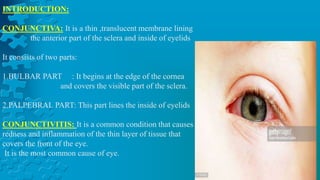
CONJUNCTIVITIS: It is a common condition that causes
redness and inflammation of the thin layer of tissue that
covers the front of the eye.
It is the most common cause of eye.
CAUSES OF CONJUNCTIVITS:
o Bacterial or viral infection
o Infection with a virus that may also cause a fever and sore throat
o Sexually transmitted infections (STIs), including chlamydia and gonorrhea
o Irritants such as chlorine from swimming pools, shampoo, smoke, fumes or a loose eyelash
o Seasonal allergic conjunctivitis and perennial (all year round) allergic conjunctivitis, caused by
pollen, dust mites or pet dander
o Contact dermatoconjunctivitis, from eye drops, chemicals or make-up
o Giant papillary conjunctivitis, from wearing contact lenses, eye surgery stitches or any tubes or
things fitted during eye operations.
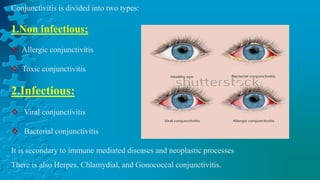
Conjunctivitis is divided into two types:
1.Non infectious;
 Allergic conjunctivitis
 Toxic conjunctivitis
2.Infectious:
 Viral conjunctivitis
 Bacterial conjunctivitis
It is secondary to immune mediated diseases and neoplastic processes
There is also Herpes, Chlamydial, and Gonococcal conjunctivitis.
NON INFECTIOUS CONJUNCTIVITIS:
 ALLERGIC CONJUNCTIVITIS:
Allergic conjunctivitis is caused when your eyes come into contact with allergen .this is known as an allergic conjunctivitis
There are four main types of allergic conjunctivis:
Seasonal allergic conjunctivitis
Perennial allergic conjunctivitis
Contact dermatoconjunctivitis
Giant papillary conjunctivitis
 SEASONALAND PERENNIAL CONJUNCTIVITIS:
These are usually caused by:
pollen from grass ,trees , or flowers , dustmites ,flakes of dead animal skin.
These types of conjunctivitis are more common in people who also have other allergies,suchas asthma,and often occur with allergic
rhiniitis
 CONTACT DERMATOCONJUNCTIVITIS:
Contact dermatoconjunctivitis is usually caused by eye drops ,but it can also be caused by make-up or chemicals
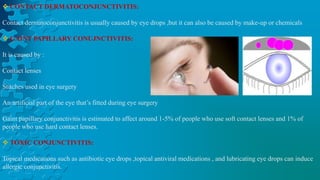
 GAINT PAPILLARY CONUJNCTIVITIS:
It is caused by :
Contact lenses
Stitches used in eye surgery
An artificial part of the eye that’s fitted during eye surgery
Gaint papillary conjunctivitis is estimated to affect around 1-5% of people who use soft contact lenses and 1% of
people who use hard contact lenses.
 TOXIC CONJUNCTIVITIS:
Topical medications such as antibiotic eye drops ,topical antiviral medications , and lubricating eye drops can induce
allergic conjunctivitis.
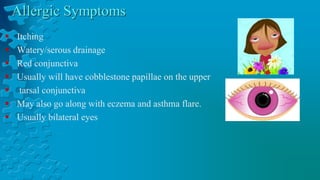
 Itching
 Watery/serous drainage
 Red conjunctiva
 Usually will have cobblestone papillae on the upper
 tarsal conjunctiva
 May also go along with eczema and asthma flare.
 Usually bilateral eyes
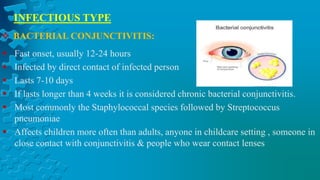
 Fast onset, usually 12-24 hours
 Infected by direct contact of infected person
 Lasts 7-10 days
 If lasts longer than 4 weeks it is considered chronic bacterial conjunctivitis.
 Most commonly the Staphylococcal species followed by Streptococcus
pneumoniae
 Affects children more often than adults, anyone in childcare setting , someone in
close contact with conjunctivitis & people who wear contact lenses
 BACTERIAL CONJUNCTIVITIS:
INFECTIOUS TYPE
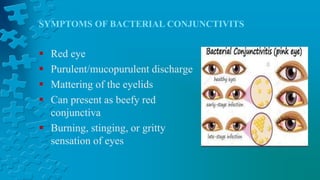
SYMPTOMS OF BACTERIAL CONJUNCTIVITS
 Red eye
 Purulent/mucopurulent discharge
 Mattering of the eyelids
 Can present as beefy red
conjunctiva
 Burning, stinging, or gritty
sensation of eyes
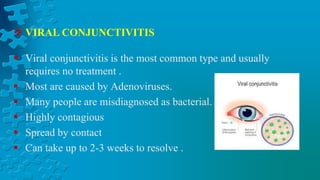
 Viral conjunctivitis is the most common type and usually
requires no treatment .
 Most are caused by Adenoviruses.
 Many people are misdiagnosed as bacterial.
 Highly contagious
 Spread by contact
 Can take up to 2-3 weeks to resolve .
 VIRAL CONJUNCTIVITIS
 Sometimes may caused by herpes viruses mainly of two types:
 Herpes simplex virus:
 Conjunctivitis caused by the virus is usually unilateral.
 The discharge is thin and watery and vesicular eyelid lesions may be present
 Herpes zoster virus:
 It mainly responsible for shingles, can involve ocular tissue
 Especially may be the first and second branches of the trigeminal nerve .
 Corneal complications and uveitis may be present .
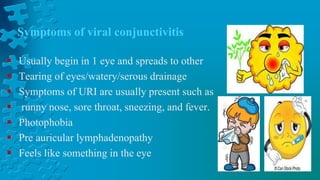
 Usually begin in 1 eye and spreads to other
 Tearing of eyes/watery/serous drainage
 Symptoms of URI are usually present such as
 runny nose, sore throat, sneezing, and fever.
 Photophobia
 Pre auricular lymphadenopathy
 Feels like something in the eye
Symptoms of viral conjunctivitis
DIAGNOSIS:
• Conjunctivitis
• Corneal Abrasion
• Iritis-inflammation of the iris
• A red flag would be if they are not responding to treatment and
suspected of having periorbital cellulitis .
• Follow up and refer to ophthalmologist if not responding to
treatment
• Usually diagnosis is made by physical exam
• Fluorescein staining if suspect ulcer/abrasion
TREATMENT
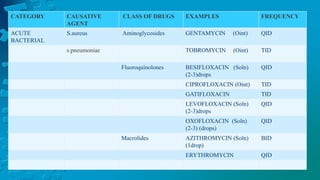
CATEGORY CAUSATIVE
AGENT
CLASS OF DRUGS EXAMPLES FREQUENCY
ACUTE
BACTERIAL
S.aureus Aminoglycosides GENTAMYCIN (Oint) QID
s.pneumoniae TOBROMYCIN (Oint) TID
Fluoroquinolones BESIFLOXACIN (Soln)
(2-3)drops
QID
CIPROFLOXACIN (Oint) TID
GATIFLOXACIN TID
LEVOFLOXACIN (Soln)
(2-3)drops
QID
OXOFLOXACIN (Soln)
(2-3) (drops)
QID
Macrolides AZITHROMYCIN (Soln)
(1drop)
BID
ERYTHROMYCIN QID
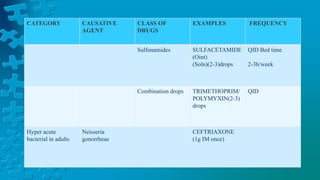
CATEGORY CAUSATIVE
AGENT
CLASS OF
DRUGS
EXAMPLES FREQUENCY
Sulfonamides SULFACETAMIDE
(Oint)
(Soln)(2-3)drops
QID Bed time
2-3h/week
Combination drops TRIMETHOPRIM/
POLYMYXIN(2-3)
drops
QID
Hyper acute
bacterial in adults
Neisseria
gonorrheae
CEFTRIAXONE
(1g IM once)
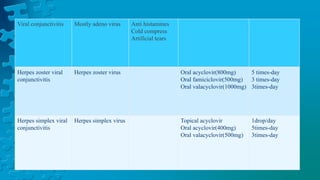
Viral conjunctivitis Mostly adeno virus Anti histamines
Cold compress
Artificial tears
Herpes zoster viral
conjunctivitis
Herpes zoster virus Oral acyclovir(800mg)
Oral famiciclovir(500mg)
Oral valacyclovir(1000mg)
5 times-day
3 times-day
3times-day
Herpes simplex viral
conjunctivitis
Herpes simplex virus Topical acyclovir
Oral acyclovir(400mg)
Oral valacyclovir(500mg)
1drop/day
5times-day
3times-day
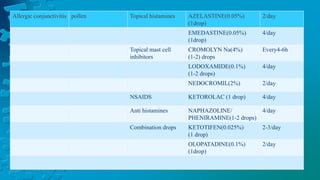
Allergic conjunctivitis pollen Topical histamines AZELASTINE(0.05%)
(1drop)
2/day
EMEDASTINE(0.05%)
(1drop)
4/day
Topical mast cell
inhibitors
CROMOLYN Na(4%)
(1-2) drops
Every4-6h
LODOXAMIDE(0.1%)
(1-2 drops)
4/day
NEDOCROMIL(2%) 2/day
NSAIDS KETOROLAC (1 drop) 4/day
Anti histamines NAPHAZOLINE/
PHENIRAMINE(1-2 drops)
4/day
Combination drops KETOTIFEN(0.025%)
(1 drop)
2-3/day
OLOPATADINE(0.1%)
(1drop)
2/day
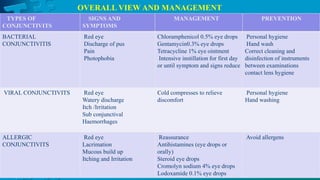
TYPES OF
CONJUNCTIVITS
SIGNS AND
SYMPTOMS
MANAGEMENT PREVENTION
BACTERIAL
CONJUNCTIVITIS
Red eye
Discharge of pus
Pain
Photophobia
Chloramphenicol 0.5% eye drops
Gentamycin0.3% eye drops
Tetracycline 1% eye ointment
Intensive instillation for first day
or until symptom and signs reduce
Personal hygiene
Hand wash
Correct cleaning and
disinfection of instruments
between examinations
contact lens hygiene
VIRAL CONJUNCTIVITS Red eye
Watery discharge
Itch /Irritation
Sub conjunctival
Haemorrhages
Cold compresses to relieve
discomfort
Personal hygiene
Hand washing
ALLERGIC
CONJUNCTIVITS
Red eye
Lacrimation
Mucous build up
Itching and Irritation
Reassurance
Antihistamines (eye drops or
orally)
Steroid eye drops
Cromolyn sodium 4% eye drops
Lodoxamide 0.1% eye drops
Avoid allergens
OVERALL VIEW AND MANAGEMENT
PREVENTIVE MEASURES
• Halloran, L. (2011). Assessment and Treatment of Conjunctivitis.
Journal for Nurse Practitioners, 7(9). 783-784.
doi:10.1016/j.nurpra.2011.08.008
• Papadakis, M. A., McPhee, S, J., and Rabow, M. W. (2015).
Disorders of the eyes and lids. In Current medical diagnosis &
treatment 2015 (pp. 163-198). New York, NY: McGraw-Hill
Educational Medical.
REFERENCES:
Conjunctivitis

Conjunctivitis

  • 1.
    CONJUNCTIVITIS SUBMITTED TO: SATHEESH .S. GOTTIPATI PRESENTED BY: P. BHARGAVI 16AB1T0021
  • 2.
    CONTENTS:  INTRODUCTION  CAUSESOF CONJUNCTIVITIS  SYMPTOMS  TYPES OF CONJUNCTIVITIS  DIAGNOSIS  TREATMENT OF CONJUNCTIVITIS  PREVENTIVE MEASURES
  • 3.
    INTRODUCTION: CONJUNCTIVA: It isa thin ,translucent membrane lining the anterior part of the sclera and inside of eyelids It consists of two parts: 1.BULBAR PART : It begins at the edge of the cornea and covers the visible part of the sclera. 2.PALPEBRAL PART: This part lines the inside of eyelids CONJUNCTIVITIS: It is a common condition that causes redness and inflammation of the thin layer of tissue that covers the front of the eye. It is the most common cause of eye.
  • 4.
    CAUSES OF CONJUNCTIVITS: oBacterial or viral infection o Infection with a virus that may also cause a fever and sore throat o Sexually transmitted infections (STIs), including chlamydia and gonorrhea o Irritants such as chlorine from swimming pools, shampoo, smoke, fumes or a loose eyelash o Seasonal allergic conjunctivitis and perennial (all year round) allergic conjunctivitis, caused by pollen, dust mites or pet dander o Contact dermatoconjunctivitis, from eye drops, chemicals or make-up o Giant papillary conjunctivitis, from wearing contact lenses, eye surgery stitches or any tubes or things fitted during eye operations.
  • 5.
    Conjunctivitis is dividedinto two types: 1.Non infectious;  Allergic conjunctivitis  Toxic conjunctivitis 2.Infectious:  Viral conjunctivitis  Bacterial conjunctivitis It is secondary to immune mediated diseases and neoplastic processes There is also Herpes, Chlamydial, and Gonococcal conjunctivitis.
  • 6.
    NON INFECTIOUS CONJUNCTIVITIS: ALLERGIC CONJUNCTIVITIS: Allergic conjunctivitis is caused when your eyes come into contact with allergen .this is known as an allergic conjunctivitis There are four main types of allergic conjunctivis: Seasonal allergic conjunctivitis Perennial allergic conjunctivitis Contact dermatoconjunctivitis Giant papillary conjunctivitis  SEASONALAND PERENNIAL CONJUNCTIVITIS: These are usually caused by: pollen from grass ,trees , or flowers , dustmites ,flakes of dead animal skin. These types of conjunctivitis are more common in people who also have other allergies,suchas asthma,and often occur with allergic rhiniitis
  • 7.
     CONTACT DERMATOCONJUNCTIVITIS: Contactdermatoconjunctivitis is usually caused by eye drops ,but it can also be caused by make-up or chemicals  GAINT PAPILLARY CONUJNCTIVITIS: It is caused by : Contact lenses Stitches used in eye surgery An artificial part of the eye that’s fitted during eye surgery Gaint papillary conjunctivitis is estimated to affect around 1-5% of people who use soft contact lenses and 1% of people who use hard contact lenses.  TOXIC CONJUNCTIVITIS: Topical medications such as antibiotic eye drops ,topical antiviral medications , and lubricating eye drops can induce allergic conjunctivitis.
  • 8.
     Itching  Watery/serousdrainage  Red conjunctiva  Usually will have cobblestone papillae on the upper  tarsal conjunctiva  May also go along with eczema and asthma flare.  Usually bilateral eyes
  • 9.
     Fast onset,usually 12-24 hours  Infected by direct contact of infected person  Lasts 7-10 days  If lasts longer than 4 weeks it is considered chronic bacterial conjunctivitis.  Most commonly the Staphylococcal species followed by Streptococcus pneumoniae  Affects children more often than adults, anyone in childcare setting , someone in close contact with conjunctivitis & people who wear contact lenses  BACTERIAL CONJUNCTIVITIS: INFECTIOUS TYPE
  • 10.
    SYMPTOMS OF BACTERIALCONJUNCTIVITS  Red eye  Purulent/mucopurulent discharge  Mattering of the eyelids  Can present as beefy red conjunctiva  Burning, stinging, or gritty sensation of eyes
  • 11.
     Viral conjunctivitisis the most common type and usually requires no treatment .  Most are caused by Adenoviruses.  Many people are misdiagnosed as bacterial.  Highly contagious  Spread by contact  Can take up to 2-3 weeks to resolve .  VIRAL CONJUNCTIVITIS
  • 12.
     Sometimes maycaused by herpes viruses mainly of two types:  Herpes simplex virus:  Conjunctivitis caused by the virus is usually unilateral.  The discharge is thin and watery and vesicular eyelid lesions may be present  Herpes zoster virus:  It mainly responsible for shingles, can involve ocular tissue  Especially may be the first and second branches of the trigeminal nerve .  Corneal complications and uveitis may be present .
  • 13.
     Usually beginin 1 eye and spreads to other  Tearing of eyes/watery/serous drainage  Symptoms of URI are usually present such as  runny nose, sore throat, sneezing, and fever.  Photophobia  Pre auricular lymphadenopathy  Feels like something in the eye Symptoms of viral conjunctivitis
  • 14.
    DIAGNOSIS: • Conjunctivitis • CornealAbrasion • Iritis-inflammation of the iris • A red flag would be if they are not responding to treatment and suspected of having periorbital cellulitis . • Follow up and refer to ophthalmologist if not responding to treatment • Usually diagnosis is made by physical exam • Fluorescein staining if suspect ulcer/abrasion
  • 15.
  • 16.
    CATEGORY CAUSATIVE AGENT CLASS OFDRUGS EXAMPLES FREQUENCY ACUTE BACTERIAL S.aureus Aminoglycosides GENTAMYCIN (Oint) QID s.pneumoniae TOBROMYCIN (Oint) TID Fluoroquinolones BESIFLOXACIN (Soln) (2-3)drops QID CIPROFLOXACIN (Oint) TID GATIFLOXACIN TID LEVOFLOXACIN (Soln) (2-3)drops QID OXOFLOXACIN (Soln) (2-3) (drops) QID Macrolides AZITHROMYCIN (Soln) (1drop) BID ERYTHROMYCIN QID
  • 17.
    CATEGORY CAUSATIVE AGENT CLASS OF DRUGS EXAMPLESFREQUENCY Sulfonamides SULFACETAMIDE (Oint) (Soln)(2-3)drops QID Bed time 2-3h/week Combination drops TRIMETHOPRIM/ POLYMYXIN(2-3) drops QID Hyper acute bacterial in adults Neisseria gonorrheae CEFTRIAXONE (1g IM once)
  • 18.
    Viral conjunctivitis Mostlyadeno virus Anti histamines Cold compress Artificial tears Herpes zoster viral conjunctivitis Herpes zoster virus Oral acyclovir(800mg) Oral famiciclovir(500mg) Oral valacyclovir(1000mg) 5 times-day 3 times-day 3times-day Herpes simplex viral conjunctivitis Herpes simplex virus Topical acyclovir Oral acyclovir(400mg) Oral valacyclovir(500mg) 1drop/day 5times-day 3times-day
  • 19.
    Allergic conjunctivitis pollenTopical histamines AZELASTINE(0.05%) (1drop) 2/day EMEDASTINE(0.05%) (1drop) 4/day Topical mast cell inhibitors CROMOLYN Na(4%) (1-2) drops Every4-6h LODOXAMIDE(0.1%) (1-2 drops) 4/day NEDOCROMIL(2%) 2/day NSAIDS KETOROLAC (1 drop) 4/day Anti histamines NAPHAZOLINE/ PHENIRAMINE(1-2 drops) 4/day Combination drops KETOTIFEN(0.025%) (1 drop) 2-3/day OLOPATADINE(0.1%) (1drop) 2/day
  • 20.
    TYPES OF CONJUNCTIVITS SIGNS AND SYMPTOMS MANAGEMENTPREVENTION BACTERIAL CONJUNCTIVITIS Red eye Discharge of pus Pain Photophobia Chloramphenicol 0.5% eye drops Gentamycin0.3% eye drops Tetracycline 1% eye ointment Intensive instillation for first day or until symptom and signs reduce Personal hygiene Hand wash Correct cleaning and disinfection of instruments between examinations contact lens hygiene VIRAL CONJUNCTIVITS Red eye Watery discharge Itch /Irritation Sub conjunctival Haemorrhages Cold compresses to relieve discomfort Personal hygiene Hand washing ALLERGIC CONJUNCTIVITS Red eye Lacrimation Mucous build up Itching and Irritation Reassurance Antihistamines (eye drops or orally) Steroid eye drops Cromolyn sodium 4% eye drops Lodoxamide 0.1% eye drops Avoid allergens OVERALL VIEW AND MANAGEMENT
  • 21.
  • 22.
    • Halloran, L.(2011). Assessment and Treatment of Conjunctivitis. Journal for Nurse Practitioners, 7(9). 783-784. doi:10.1016/j.nurpra.2011.08.008 • Papadakis, M. A., McPhee, S, J., and Rabow, M. W. (2015). Disorders of the eyes and lids. In Current medical diagnosis & treatment 2015 (pp. 163-198). New York, NY: McGraw-Hill Educational Medical. REFERENCES: