4 PILLARS OF QUALITY IN PROJECT.
PREPARE BY: SWAPNIL PATEL
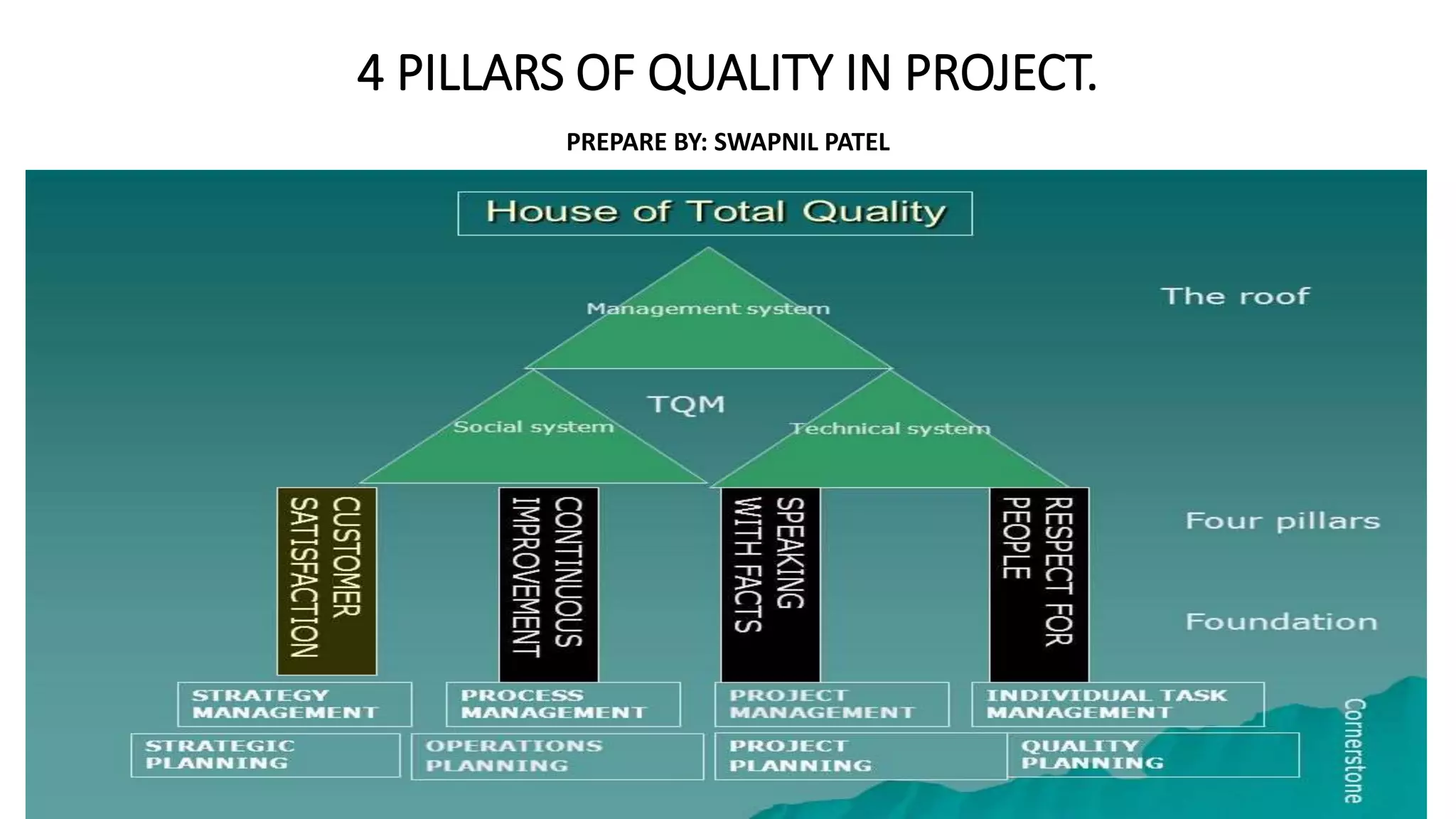
Components of The House of Total Quality
The roof : management, social, technical, educational
subsystems;
The pillars of quality : (1)customer satisfaction,
(2)continuous improvement,(3) speaking with facts,
(4)respect for people;
The foundations : strategy management, process
management, project management, and performance
management;
The cornerstones : strategic planning, process
planning, project planning, and performance
planning;
1ST PILLAR: Stakeholder Satisfaction (customer satisfaction)
• Identify all stakeholders
External stakeholders –customers, suppliers, the public
Internal stakeholders –shareholders and workers at all levels
Determine relevant quality standards
• Prioritize among the stakeholders
• Understand the prioritized stakeholders’ requirements.
• Develop standards to ensure the requirements are met.
• Make tradeoff decisions.
2ND PILLAR: Process Management(continuous
improvement)
•To effectively manage project processes, project
managers need to understand, control, and
improve them
•Process Understanding with a SIPOC Model
•Process Improvement with a PDCA Model
Process Understanding with a SIPOC Model
• All work flows from suppliers, through the project, to customers
• Use a supplier-input-process-output-customer (SIPOC) model to
envision this flow
• Think backward from the project’s customer
• Determine if the process is capable of creating project deliverables
• Design quality into the processes.
Process Improvement with a PDCA Model
• Processes can be improved in a continuous or breakthrough fashion
• Slow and steady improvement is a good foundation
• Substantial improvement requires a breakthrough
• Models exist to guide the improvement process
• Models may be based on the plan-do-check-act (PDCA) improvement cycle
• Some sources say that Walter Shewhart is considered the grandfather of TQM that was
further popularized by Deming.
• Shewhart developed statistical tools to examine when a corrective action must be
applied to a process.
• He invented control chart techniques (control charts are a tool and technique of the
Perform Quality Control process) and was also the inventor of the Plan-Do-Check-Act
cycle
3RD PILLAR: Fact-Based Management(speaking with
facts)
1. Understanding variation
• Common cause vs. special cause
• Something unusual is happening
2. Deciding what to measure
• Avoid not measuring anything
• Avoid measuring many things just to be sure
• A milestone schedule with acceptance criteria can provide useful
measures
• Lessons learned from previous projects
• Agree on what measures, when, and under what circumstances
3RD PILLAR: Fact-Based Management(speaking with
facts) Cont….
3. Working correctly with data
• Data are representations of facts using a measurement process
• The person closest to the situation should collect the data
• Ensure data are complete, accurate, timely
• Turn raw data into information useful to decision makers
4. Using the resulting information appropriately
• Encourage truth and transparency in communications
• Use information to challenge opinions and decisions
4TH PILLAR: Empowered Performance
(respect for people)
• Have capable and willing workers at every level/function within a
company
• Corporate leaders develop the organizational culture
• Project sponsors and managers develop the project culture
• Recognize individuality
• Capitalize on individual strengths
• Emphasize individual responsibilities
• Use appropriate collaboration
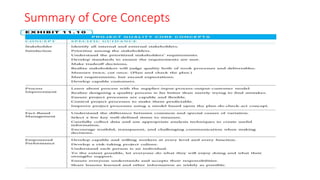
Summary of Core Concepts

Pillars of quality

  • 1.
    4 PILLARS OFQUALITY IN PROJECT. PREPARE BY: SWAPNIL PATEL
  • 2.
    Components of TheHouse of Total Quality The roof : management, social, technical, educational subsystems; The pillars of quality : (1)customer satisfaction, (2)continuous improvement,(3) speaking with facts, (4)respect for people; The foundations : strategy management, process management, project management, and performance management; The cornerstones : strategic planning, process planning, project planning, and performance planning;
  • 3.
    1ST PILLAR: StakeholderSatisfaction (customer satisfaction) • Identify all stakeholders External stakeholders –customers, suppliers, the public Internal stakeholders –shareholders and workers at all levels Determine relevant quality standards • Prioritize among the stakeholders • Understand the prioritized stakeholders’ requirements. • Develop standards to ensure the requirements are met. • Make tradeoff decisions.
  • 4.
    2ND PILLAR: ProcessManagement(continuous improvement) •To effectively manage project processes, project managers need to understand, control, and improve them •Process Understanding with a SIPOC Model •Process Improvement with a PDCA Model
  • 5.
    Process Understanding witha SIPOC Model • All work flows from suppliers, through the project, to customers • Use a supplier-input-process-output-customer (SIPOC) model to envision this flow • Think backward from the project’s customer • Determine if the process is capable of creating project deliverables • Design quality into the processes.
  • 6.
    Process Improvement witha PDCA Model • Processes can be improved in a continuous or breakthrough fashion • Slow and steady improvement is a good foundation • Substantial improvement requires a breakthrough • Models exist to guide the improvement process • Models may be based on the plan-do-check-act (PDCA) improvement cycle • Some sources say that Walter Shewhart is considered the grandfather of TQM that was further popularized by Deming. • Shewhart developed statistical tools to examine when a corrective action must be applied to a process. • He invented control chart techniques (control charts are a tool and technique of the Perform Quality Control process) and was also the inventor of the Plan-Do-Check-Act cycle
  • 7.
    3RD PILLAR: Fact-BasedManagement(speaking with facts) 1. Understanding variation • Common cause vs. special cause • Something unusual is happening 2. Deciding what to measure • Avoid not measuring anything • Avoid measuring many things just to be sure • A milestone schedule with acceptance criteria can provide useful measures • Lessons learned from previous projects • Agree on what measures, when, and under what circumstances
  • 8.
    3RD PILLAR: Fact-BasedManagement(speaking with facts) Cont…. 3. Working correctly with data • Data are representations of facts using a measurement process • The person closest to the situation should collect the data • Ensure data are complete, accurate, timely • Turn raw data into information useful to decision makers 4. Using the resulting information appropriately • Encourage truth and transparency in communications • Use information to challenge opinions and decisions
  • 9.
    4TH PILLAR: EmpoweredPerformance (respect for people) • Have capable and willing workers at every level/function within a company • Corporate leaders develop the organizational culture • Project sponsors and managers develop the project culture • Recognize individuality • Capitalize on individual strengths • Emphasize individual responsibilities • Use appropriate collaboration
  • 10.