Pigments
Mr.Mahmoud Ibrahim Osman
MSc in Histopathology
Pigments
substances occurring in living matter ,
that absorb visible light , they can be
either organic or inorganic that remain
insoluble in most solvents.
Pigment can be classified under the following
heading:
1. Endogenous pigments
2. Exogenous pigments
3. Artifact pigments
Endogenous pigments
• These substances are produced either
within tissues and serve a physiological
function or product of normal metabolic
.
• They can be subdivided into:
1. Hematogenous (blood derived pigments)
2. Non- hematogenous pigments
3. Endogenous minerals
Hematogenous pigments
• This group contains the following
blood-derived pigments:
1. Hemosiderin
2. Hemoglobin
1. Bile pigments
2. Porphyrins
Hemosiderin
• Yellow to brown granules ( intracellularly )
• They contain iron in form of ferric
hydroxide bound to a protein frame work.
Beside hemosiderin iron also occur in :
1 .Hemoglobin 60%
2 .Myoglobin
3 .Certain enzymes e g cytochrome oxide and
peroxides
Iron Metabolism
• Dietary iron is absorbed in the small
intestine and attached to a protein
molecule for transfer to the sites in the
body where it is to be utilized or stored.
• Approximately 30% is stored within the
reticuloendothelial system, especially the
bone marrow. The bone marrow is also
the main site of iron utilization in the
body.
• Iron loss:
1. Epithelial desquamation
2. Hair loss
3. Sweating
1. Hemorrhages
A-chronic bleeding (e.g. a peptic ulcer,
bowel neoplasia)
B-menstruation.
• In iron deficiency, the iron stores in the
bone marrow become depleted,
insufficient hemoglobin is produced
because of the lack of iron, and anemia
develops.
• Iron excess is a much less common condition,
because under normal conditions the
intestine will not absorb iron from the diet
when there is already a surplus within the
body.
• Iron overlapping :
1. iron injection
2. Blood transfusion
3. Impair control of iron absorption in
small intestine
• Hemosidrosis : deposition of excessive
amount of hemosiderin (due to iron
injection or blood transfusion ) in organs
mainly RES.
• Hemochromatosis :large quantities of
hemosiderin ( due to impaired control of
iron absorption ) deposited in many
organs interfering with organs structure
and function.
Demonstration of hemosiderin
• In unfixed tissue hemosiderin is
insoluble in alkalis ,but soluble in acid
solution
• Fixatives contain acids can remove
hemosiderin granules
• Iron occur in tissue in ferric salt (mainly
) and in ferrous salts .
Perl's Prussian Blue for ferric iron
• Treatment with diluted hydrochloric
acid will result in the unmasking of
ferric iron from proteins then ferric
iron then react with a diluted
potassium
• ferrocyanide to produce an insoluble
blue compound (ferric ferrocyanide –
prussian blue ).
• Avoid use of acid fixatives and
chromate fixatives.
Perls Prussian Blue- Hemosidrosis Liver -
Iron stain
Turnballs` blue for ferrous salts
• Interaction of ferrous salts with
potassium ferricyanide is result in
ferrous ferricyanide (insoluble blue
compound)
Quinkes` and Schmeltzer reaction
• Used to demonstrate both ferrous ferric
iron Quinke test is depend upon the
reduction of ferric iron into ferrous iron
by ammonium sulphide .
• Forming green –black ferrous sulphide
which is converted into Turn blue by
Schmeltzer reaction .
• Lillie’s method for ferric and ferrous
iron
• Hukill and Putt’s method for ferrous and
ferric iron .
Bile pigment
• Red blood cells are broken down in RES
after 120 days , hemoglobin convert into
heme and globin , the tetra pyrrole ring
of heme is opened out and iron is
removed result in biliverdin .
• This residue is formed in the phagocytic
cells in RES ,biliverdin is transported to the
liver . Where it is reduced to bilirubin ,
the bilirubin become soluble in water
after conjugation with glucuronic acid.
• Then the conjugated bilirubin pass into
bile canaliculi then gall bladder then to
the duodenum.
• In H&E stained section of liver (bile if
present ) , seen in hepatocytes as yellow
– brown granules and must be
distinguished from lipofuscins .
• In bile canaliculi appear larger (round end
rods ) indicate obstructive jaundice .
• Bile is also seen in H&E-stained
sections in the gallbladder where it can
appear as amorphous, yellow-brown masses .
• adherent to the mucosa or included as
yellow-brown globules within the epithelial-
lined Aschoff-Rokitansky sinuses in the
gallbladder. Bile is also present, together with
cholesterol, in gallstones.
Hematoidin pigment
• Extra cellular yellow-brown crystals
and amorphous masses .
• Heme undergo a chemical change (its`
nature)
• Found in old hemorrhagic areas e g ; old
splenic infarcts , brain.
Demonstration of bile and
hematoidin
• Fouchet technique : it is a routine method
-simple –quick , bile pigment is
converted to green / blue color by the
oxidative action of ferric chloride in the
presence of tri chloracetic acid.
Gmelin technique
• This technique is the only method that
shows an identical result with liver bile,
gallbladder bile, and hematoidin. This
method gives impermanent results.
• Deparaffinized sections of tissue containing bile
pigments are treated with nitric acid, and a
changing color spectrum is produced.
• A popular modification of this technique
is that of Lillie and Pizzolatto in which
bromine in carbon tetrachloride is used
as an oxidant.
Hemoglobin
• Hemoglobin is a basic conjugated
protein that is responsible for the
transportation of oxygen and
carbon dioxide within the bloodstream.
• It is composed of a colorless protein,
globin, and a red pigmented component,
heme.
Demonstration of hemoglobin
• Two types of demonstration methods can
be used to stain hemoglobin in tissue
sections. The first demonstrates the
enzyme (hemoglobin peroxidase )and
Patent blue method.
A section of kidney from a patient with
hemoglobinuria stained for hemoglobin with leuco patent blue
V. Hemoglobin is stained blue.
Porphyrin pigment
• These substances normally occur in
tissues in only small amounts. They are
considered to be precursors of the heme
portion of hemoglobin. The porphyrin
are rare pathological conditions.
Non -Hematogenous Endogenous
pigments
• These are include:
1. Melanin
2. Lipofuscins
3. Chromaffin
4. Pseudo melanosis (melanosis coli)
4. Dubin-Johnson pigment
5. Ceroid-type lipofuscins
6. Hamazaki-Weisenberg bodies
Melanin's pigment
• Group of pigments varies from light brown to
black
• Produced from tyrosine by the action of an
enzyme tyrosinase (DOPA oxidase ). this
enzyme acts on tyrosine to produce DOPA
(dihydroxy phenylalanine ).
• and by the same enzyme DOPA convert
to melanin.
• Tyrosine (amino acid) tyrosinase enzyme=DOPA(3,4
dihydoxyphenylalanine)
• DPOA Tyrosinase enzyme===Melanin
Melanin Demonstration
1. Reducing methods
2. Enzyme method
3. Solubility and bleaching
4. Fluorescent method
5. Immunocytochemistry
Reducing methods
• Melanin is a powerful reducing agent
and this property is used to demonstrate
melanin in two ways.
• 1. The reduction of ammoniacal silver
solutions to form metallic silver without
the use of an extraneous reducer is
known as the argentaffin reaction.
Masson’s Fontana method.
• 2. Melanin will reduce ferricyanide to
ferrocyanide with the production of
Prussian blue in the presence of ferric
salts the Schmorl reaction.
Masson Fontana method for
melanin
Melanin pigment in cells of malignant melanoma ,
Fontana-Masson stain.
Enzyme method
• Cells that are capable of producing
melanin can be demonstrated by adding
DOPA , the enzyme that localized in
these cells will oxidize DOPA to form
brown pigment.
• The best results are obtained when using
post fixed cryostat sections.
Solubility and Bleaching
• Melanin are insoluble in most solvents ,
but can be bleached (decolorize ) by use
strong oxidizing agents e g
permanganate , chlorate , chromic acid ,
peroxide , peracetic acid .
Fluorescent method( Formalin-induced
fluorescence (FIF)
• Certain aromatic amines such as 5-
hydroxy tryptamine, dopamine,
epinephrine when exposed to
formaldehyde, show a yellow primary
fluorescence.
• This is particularly useful when
demonstrating amelanotic melanoma,
because these tumors can be difficult to
diagnose using conventional methods
due to their lack of pigment.
Immunohistochemistry
• Use of melanocyte selective antibodies to
highlight melanocytic lesions. The large
majority of these antibodies recognize an
antigen associated with melanocyte
activation, gp100 (HMB 45) or Mart-1
(Melan A).
Lipofuscin pigment
• Yellow –brown to reddish pigment
produced by an oxidation process of
lipids and lipoprotein , occur in
hepatocytes , cardiac muscles , adrenal
cortex , testis , ovary , neurons
• Lipofuscin is auto fluorescent
• The oxidation process occurs slowly and
progressively, and therefore the pigments
exhibit variable staining reactions, different
colors, and variation in shape and size,
which appears to be dependent upon their
situation
• Lipofuscins can be found in the following
sites:
• Hepatocytes.
• Cardiac muscles particularly around the
nucleus.
• Inner reticular layer of the normal adrenal
cortex.
• Testis.
• Ovary.
• Cytoplasmic inclusions in the neurons of the
brain.
• Some lipid storage disorders e.g. Batten's
disease.
• Other tissues such as bone marrow,
involuntary muscles, cervix and kidney.
Demonstration of Lipofuscin
1. Periodic acid –Schiff method
2. Schomrl`s reducing method
3. Long Z-N method
4. Sudan black B method
5. Masson –Fontana silver technique
6. Basophilia – using methyl green
• 7. Churukian’s silver method
• 8.Lillie’s Nile blue sulfate method
• 9. Gomori’s aldehyde fuchsin technique
A section of liver stained with Gomori’s
aldehyde fuchsin .Lipofuscin is stained
purple.
Chromaffin
• This pigment is normally found in the
cells of the adrenal medulla as dark
brown, granular material.
• It may occur in tumors of the adrenal
medulla (pheochromocytomas).
• Fixation in formalin is not
recommended, and fixatives
containing alcohol, mercury
bichloride, or acetic acid should be
avoided.
• Orth’s or other dichromate-containing
fixatives are recommended.
Demonstration of Chromaffin
• Chromaffin may be demonstrated by
Schmorl’s reaction, Lillie’s Nile blue A, the
Masson-Fontana, Churukian’s microwave
ammoniacal silver method, and the periodic
acid-Schiff (PAS) technique
Pseudomelanosis pigment (melanosis
coli)
• This pigment is sometimes seen in
macrophages in the lamina propria of the
large intestine and appendix.
• .It appears to be strongly associated with
anthraquinone purgatives (‘cascara sagrada’).
• Pseudomelanosis will, in general, stain
with those methods that are used to
demonstrate lipofuscin, such as Masson-
Fontana and Schmorl.
Dubin-Johnson pigment
• This pigment is found in the liver of
patients with Dubin-Johnson syndrome
and is due to defective canalicular
transport of bilirubin.
It is characterized by the presence of a
brownish-black, granular, intracellular
pigment histochemically it is similar to
lipofuscin, though there are
ultrastructural differences.
Ceroid-type lipofuscins
• Different from lipofuscin because it failed to
stain with the ferric-ferrocyanide reaction.
States that ceroid is in fact a lipofuscin at an
early stage of oxidation. Further oxidation
would produce lipofuscin proper.
Hamazaki-Weisenberg bodies
• These small, yellow-brown, spindle-
shaped structures are found mainly in
the sinuses of lymph nodes, either lying
free or as cytoplasmic inclusions and
their significance is unknown.
• Histochemically they are similar to
lipofuscin, and at ultrastructural level
have an appearance that suggests that
they are probably giant lysosomal
residual bodies
Endogenous minerals
• Calcium:
• Insoluble inorganic calcium salts are a
normal constituent of bones and teeth.
• Abnormal depositions of calcium can be
found in necrotic areas of tissue associated
with tuberculosis,
• infarction(Gandy-Gamna bodies),
atheroma in blood vessels, and
malakoplakia of the bladder (Michaelis-
Gutman bodies)
• Calcium usually stains purple blue with H&E.
• The classic method is von Kossa which uses
silver nitrate, is generally preferred for
routine demonstration.
• Alizarin red S,
Section of kidney stain with von
kossa
A section of kidney with calcium oxalate
crystals as seen with polarization
microscopy
Copper
• Many enzymes in the body would fail to
function without the presence of copper.
although copper deficiency is extremely rare.
Copper accumulation is associated with
Wilson’s disease.
• The rhodanine method has also been
used to demonstrate copper and copper-
associated protein (CAP).
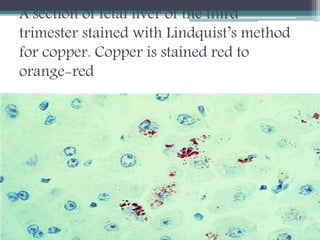
A section of fetal liver of the third
trimester stained with Lindquist’s method
for copper. Copper is stained red to
orange-red
Uric acid and urates
• Uric acid is a breakdown product of the
body’s purine (nucleic acid) metabolism,
although a small proportion is obtained
from the diet.
• The uric acid circulating in the blood is in the
form of monosodium urate, which in patients
with gout may be high, forming a
supersaturated solution. These high levels
may result in urate depositions,
• Which are water soluble in tissues, causing
subcutaneous nodular deposits of urate
crystals (known as ‘tophi’).
• synovitis and arthritis
• renal disease and calculi
• Another condition that occasionally can
mimic Gout is known as pseudogout or
chondrocalcinosis. This results in
calcium pyrophosphate crystals being
deposited in joint cartilage.
• The cause of this deposition is unknown
and is more common in the elderly,
affecting mainly the large joints, such as
the knee.
• To aid the diagnosis, a polarizing
microscope is used.
• Whilst pyrophosphate crystals exhibit a
positive birefringence urate crystals
show a negative birefringence.
• Urates can be extracted by saturated
aqueous lithium carbonate solution
while pyrophosphate crystals are
unaffected.
Artifact pigments
• This group of pigments comprises:
1. Formalin pigment
2. Malaria pigment
3. Mercury pigment
4. Chromic oxide pigment
5. Starch pigment
6. Stain precipitates
7. Schistosome pigment
Formalin pigment
• Brown to black (formaldehyde acid hematin ) ,
microcrystalline , extra cellular , birefringent
pigment. Deposit in tissues (blood rich
tissue such as spleen , hemorrhagic lesions
and large blood vessel) that have been fixed
in acid formalin .
• It is best avoided by the use of neutral
or buffered formalin
• Removal of formalin pigment:
1. Treating unstained section with
saturated alcoholic picric acid
2. Alcoholic solution of both sodium and
potassium hydroxide (have effect on
staining )
3. Treatment with 10% ammonium
hydroxide in 70% alcohol
Malaria pigment
• Morphologically similar to formalin pigment
, but malaria pigment is intra cellular ,
formed within red blood cells that contain the
malaria parasite , also may present in
phagocytic cells which ingest infected red cell
• It is birefringence and can be removed with
alcoholic picric acid
Mercury pigment
• This pigment is seen in tissues that have
been fixed in mercury-containing
fixatives, although it is rarely seen in
tissue fixed in Heidenhain’s Susa.
Mercury pigment varies in its appearance but it
is usually seen as a brown-black, extracellular
crystal. Treatment of sections with iodine
solutions, such as Lugol’s iodine, is the classical
method of removing the pigment.
• Subsequent bleaching with a weak
sodium thiosulfate (hypo) solution
completes the treatment.
Schistosome pigment
• This pigment is occasionally seen in tissue
sections where infestation with Schistosoma
is ‘present’. The pigment, which tends to be
chunky, shows similar properties to those of
both formalin and malaria pigments.
Chromic oxide pigment
• Fine brown to black granules , occur after
dichromate fixation (e g zenker )
• Can be removed by several washing in water
after fixation and from section by 1% acid
alcohol
• It is monorefringence and extra cellular
Starch pigment
• Introduced by powder from the gloves
• It is PAS positive
• Stain precipitates :
• Amorphous and granular and sometime
crystalline
• These follow over oxidation or in evaporation
of saturated alcoholic solution
Exognous Pigments
• Although often listed as being exogenous
pigments, the majority of the following
substances are, in fact, colorless.
• Some of these substances are inert and
unreactive.
Exognous Pigments entering the organism via
 traumatic lesions
 gastrointestinal tract
 respiratory tract
traumatic origin
mechanic instilation of inert dyes into
the deep dermis.
Tattoo Pigment
• This is associated with skin and any adjacent
lymphoid areas. If viewed using reflected
light, the various colors of the dye pigments
used to create the tattoo can be see.
A section of skin demonstrating exogenous tattoo
pigment in a tattoo granuloma stained with hematoxylin
and eosin
Amalgam tattoo
• Brown-black areas of pigmentation in the
mouth may result from traumatic
introduction of mercury and silver from
dental amalgam during dental procedures.
Exogenous Pigmentation through Airways
• Carbon:
• This exogenous substance is the most
commonly seen mineral in tissues and is
easily recognized in stained tissue sections.
• Commonly found in the lung and adjacent
lymph nodes of urban dwellers and tobacco
smoker, the main sources of this material are
car exhausts.
• Carbon particles will be seen in
macrophage
• Heavy black pigmentation of the lung
(anthracosis)may be seen as a result of
massive deposition of carbonaceous matter in
coal workers.
• The lung disorder known as coal
workers’ pneumoconiosis is caused by
the inhalation of silica, coal dust, and
many other particulates.
• The carbonaceous material is relatively inert
and fails to be demonstrated with
conventional histological stains and
histochemical methods. The site and nature of
the carbon deposits make identification
relatively easy.
Silica
• Silica is un reactive –it is birefringence when
examined using polarized light . Mine
workers can inhale large quantities of silica,
which can give rise to the disease silicosis.
• This disease may present as a progressive
pulmonary fibrotic condition which gives rise
to impaired lung capacity and in some cases
extreme disability. Silica is unreactive, and
is thus not demonstrated by histological
stains and histochemical methods.
Asbestos
• Special form of silica , cause pulmonary
disease , yellow – brown dumb-bell shape.
Asbestos has been used for many years as a
fire- resistant and insulating material.
Lead
• Lead in paint, batteries ,and gasoline has been
reduced by the various manufacturers. Cases
of lead poisoning are rare and are usually
diagnosed biochemically using the serum from
suspected cases.
• The most popular method is the rhodizonate
method
Beryllium and aluminum
• The same methods are used to demonstrate both
of these metal.
• Solochrome azurine method for beryllium and
• aluminum
Silver
• Silver is occasionally found in the skin of
silver workers as a result of industrial
exposure. Rhodanine method for silver
Pigments
Pigments

Pigments

  • 1.
  • 2.
    Pigments substances occurring inliving matter , that absorb visible light , they can be either organic or inorganic that remain insoluble in most solvents.
  • 3.
    Pigment can beclassified under the following heading: 1. Endogenous pigments 2. Exogenous pigments 3. Artifact pigments
  • 4.
    Endogenous pigments • Thesesubstances are produced either within tissues and serve a physiological function or product of normal metabolic .
  • 5.
    • They canbe subdivided into: 1. Hematogenous (blood derived pigments) 2. Non- hematogenous pigments 3. Endogenous minerals
  • 6.
    Hematogenous pigments • Thisgroup contains the following blood-derived pigments: 1. Hemosiderin 2. Hemoglobin
  • 7.
  • 8.
    Hemosiderin • Yellow tobrown granules ( intracellularly ) • They contain iron in form of ferric hydroxide bound to a protein frame work. Beside hemosiderin iron also occur in : 1 .Hemoglobin 60%
  • 9.
    2 .Myoglobin 3 .Certainenzymes e g cytochrome oxide and peroxides
  • 10.
    Iron Metabolism • Dietaryiron is absorbed in the small intestine and attached to a protein molecule for transfer to the sites in the body where it is to be utilized or stored.
  • 11.
    • Approximately 30%is stored within the reticuloendothelial system, especially the bone marrow. The bone marrow is also the main site of iron utilization in the body.
  • 12.
    • Iron loss: 1.Epithelial desquamation 2. Hair loss 3. Sweating
  • 13.
    1. Hemorrhages A-chronic bleeding(e.g. a peptic ulcer, bowel neoplasia) B-menstruation.
  • 14.
    • In irondeficiency, the iron stores in the bone marrow become depleted, insufficient hemoglobin is produced because of the lack of iron, and anemia develops.
  • 15.
    • Iron excessis a much less common condition, because under normal conditions the intestine will not absorb iron from the diet when there is already a surplus within the body.
  • 16.
    • Iron overlapping: 1. iron injection 2. Blood transfusion 3. Impair control of iron absorption in small intestine
  • 17.
    • Hemosidrosis :deposition of excessive amount of hemosiderin (due to iron injection or blood transfusion ) in organs mainly RES.
  • 18.
    • Hemochromatosis :largequantities of hemosiderin ( due to impaired control of iron absorption ) deposited in many organs interfering with organs structure and function.
  • 19.
    Demonstration of hemosiderin •In unfixed tissue hemosiderin is insoluble in alkalis ,but soluble in acid solution • Fixatives contain acids can remove hemosiderin granules
  • 20.
    • Iron occurin tissue in ferric salt (mainly ) and in ferrous salts .
  • 21.
    Perl's Prussian Bluefor ferric iron • Treatment with diluted hydrochloric acid will result in the unmasking of ferric iron from proteins then ferric iron then react with a diluted potassium
  • 22.
    • ferrocyanide toproduce an insoluble blue compound (ferric ferrocyanide – prussian blue ). • Avoid use of acid fixatives and chromate fixatives.
  • 23.
    Perls Prussian Blue-Hemosidrosis Liver - Iron stain
  • 24.
    Turnballs` blue forferrous salts • Interaction of ferrous salts with potassium ferricyanide is result in ferrous ferricyanide (insoluble blue compound)
  • 25.
    Quinkes` and Schmeltzerreaction • Used to demonstrate both ferrous ferric iron Quinke test is depend upon the reduction of ferric iron into ferrous iron by ammonium sulphide .
  • 26.
    • Forming green–black ferrous sulphide which is converted into Turn blue by Schmeltzer reaction . • Lillie’s method for ferric and ferrous iron
  • 27.
    • Hukill andPutt’s method for ferrous and ferric iron .
  • 28.
    Bile pigment • Redblood cells are broken down in RES after 120 days , hemoglobin convert into heme and globin , the tetra pyrrole ring of heme is opened out and iron is removed result in biliverdin .
  • 29.
    • This residueis formed in the phagocytic cells in RES ,biliverdin is transported to the liver . Where it is reduced to bilirubin , the bilirubin become soluble in water after conjugation with glucuronic acid.
  • 30.
    • Then theconjugated bilirubin pass into bile canaliculi then gall bladder then to the duodenum.
  • 31.
    • In H&Estained section of liver (bile if present ) , seen in hepatocytes as yellow – brown granules and must be distinguished from lipofuscins .
  • 32.
    • In bilecanaliculi appear larger (round end rods ) indicate obstructive jaundice . • Bile is also seen in H&E-stained sections in the gallbladder where it can appear as amorphous, yellow-brown masses .
  • 33.
    • adherent tothe mucosa or included as yellow-brown globules within the epithelial- lined Aschoff-Rokitansky sinuses in the gallbladder. Bile is also present, together with cholesterol, in gallstones.
  • 34.
    Hematoidin pigment • Extracellular yellow-brown crystals and amorphous masses . • Heme undergo a chemical change (its` nature) • Found in old hemorrhagic areas e g ; old splenic infarcts , brain.
  • 35.
    Demonstration of bileand hematoidin • Fouchet technique : it is a routine method -simple –quick , bile pigment is converted to green / blue color by the oxidative action of ferric chloride in the presence of tri chloracetic acid.
  • 36.
    Gmelin technique • Thistechnique is the only method that shows an identical result with liver bile, gallbladder bile, and hematoidin. This method gives impermanent results.
  • 37.
    • Deparaffinized sectionsof tissue containing bile pigments are treated with nitric acid, and a changing color spectrum is produced.
  • 38.
    • A popularmodification of this technique is that of Lillie and Pizzolatto in which bromine in carbon tetrachloride is used as an oxidant.
  • 39.
    Hemoglobin • Hemoglobin isa basic conjugated protein that is responsible for the transportation of oxygen and carbon dioxide within the bloodstream.
  • 40.
    • It iscomposed of a colorless protein, globin, and a red pigmented component, heme.
  • 41.
    Demonstration of hemoglobin •Two types of demonstration methods can be used to stain hemoglobin in tissue sections. The first demonstrates the enzyme (hemoglobin peroxidase )and Patent blue method.
  • 42.
    A section ofkidney from a patient with hemoglobinuria stained for hemoglobin with leuco patent blue V. Hemoglobin is stained blue.
  • 43.
    Porphyrin pigment • Thesesubstances normally occur in tissues in only small amounts. They are considered to be precursors of the heme portion of hemoglobin. The porphyrin are rare pathological conditions.
  • 44.
    Non -Hematogenous Endogenous pigments •These are include: 1. Melanin 2. Lipofuscins 3. Chromaffin 4. Pseudo melanosis (melanosis coli)
  • 45.
    4. Dubin-Johnson pigment 5.Ceroid-type lipofuscins 6. Hamazaki-Weisenberg bodies
  • 46.
    Melanin's pigment • Groupof pigments varies from light brown to black • Produced from tyrosine by the action of an enzyme tyrosinase (DOPA oxidase ). this enzyme acts on tyrosine to produce DOPA (dihydroxy phenylalanine ).
  • 47.
    • and bythe same enzyme DOPA convert to melanin. • Tyrosine (amino acid) tyrosinase enzyme=DOPA(3,4 dihydoxyphenylalanine) • DPOA Tyrosinase enzyme===Melanin
  • 48.
    Melanin Demonstration 1. Reducingmethods 2. Enzyme method 3. Solubility and bleaching 4. Fluorescent method 5. Immunocytochemistry
  • 49.
    Reducing methods • Melaninis a powerful reducing agent and this property is used to demonstrate melanin in two ways.
  • 50.
    • 1. Thereduction of ammoniacal silver solutions to form metallic silver without the use of an extraneous reducer is known as the argentaffin reaction. Masson’s Fontana method.
  • 51.
    • 2. Melaninwill reduce ferricyanide to ferrocyanide with the production of Prussian blue in the presence of ferric salts the Schmorl reaction.
  • 52.
  • 53.
    Melanin pigment incells of malignant melanoma , Fontana-Masson stain.
  • 54.
    Enzyme method • Cellsthat are capable of producing melanin can be demonstrated by adding DOPA , the enzyme that localized in these cells will oxidize DOPA to form brown pigment.
  • 55.
    • The bestresults are obtained when using post fixed cryostat sections.
  • 56.
    Solubility and Bleaching •Melanin are insoluble in most solvents , but can be bleached (decolorize ) by use strong oxidizing agents e g permanganate , chlorate , chromic acid , peroxide , peracetic acid .
  • 57.
    Fluorescent method( Formalin-induced fluorescence(FIF) • Certain aromatic amines such as 5- hydroxy tryptamine, dopamine, epinephrine when exposed to formaldehyde, show a yellow primary fluorescence.
  • 58.
    • This isparticularly useful when demonstrating amelanotic melanoma, because these tumors can be difficult to diagnose using conventional methods due to their lack of pigment.
  • 59.
    Immunohistochemistry • Use ofmelanocyte selective antibodies to highlight melanocytic lesions. The large majority of these antibodies recognize an antigen associated with melanocyte activation, gp100 (HMB 45) or Mart-1 (Melan A).
  • 60.
    Lipofuscin pigment • Yellow–brown to reddish pigment produced by an oxidation process of lipids and lipoprotein , occur in hepatocytes , cardiac muscles , adrenal cortex , testis , ovary , neurons • Lipofuscin is auto fluorescent
  • 61.
    • The oxidationprocess occurs slowly and progressively, and therefore the pigments exhibit variable staining reactions, different colors, and variation in shape and size, which appears to be dependent upon their situation
  • 62.
    • Lipofuscins canbe found in the following sites: • Hepatocytes. • Cardiac muscles particularly around the nucleus. • Inner reticular layer of the normal adrenal cortex. • Testis. • Ovary.
  • 63.
    • Cytoplasmic inclusionsin the neurons of the brain. • Some lipid storage disorders e.g. Batten's disease. • Other tissues such as bone marrow, involuntary muscles, cervix and kidney.
  • 64.
    Demonstration of Lipofuscin 1.Periodic acid –Schiff method 2. Schomrl`s reducing method 3. Long Z-N method 4. Sudan black B method 5. Masson –Fontana silver technique 6. Basophilia – using methyl green
  • 65.
    • 7. Churukian’ssilver method • 8.Lillie’s Nile blue sulfate method • 9. Gomori’s aldehyde fuchsin technique
  • 66.
    A section ofliver stained with Gomori’s aldehyde fuchsin .Lipofuscin is stained purple.
  • 67.
    Chromaffin • This pigmentis normally found in the cells of the adrenal medulla as dark brown, granular material. • It may occur in tumors of the adrenal medulla (pheochromocytomas).
  • 68.
    • Fixation informalin is not recommended, and fixatives containing alcohol, mercury bichloride, or acetic acid should be avoided.
  • 69.
    • Orth’s orother dichromate-containing fixatives are recommended.
  • 70.
    Demonstration of Chromaffin •Chromaffin may be demonstrated by Schmorl’s reaction, Lillie’s Nile blue A, the Masson-Fontana, Churukian’s microwave ammoniacal silver method, and the periodic acid-Schiff (PAS) technique
  • 71.
    Pseudomelanosis pigment (melanosis coli) •This pigment is sometimes seen in macrophages in the lamina propria of the large intestine and appendix. • .It appears to be strongly associated with anthraquinone purgatives (‘cascara sagrada’).
  • 72.
    • Pseudomelanosis will,in general, stain with those methods that are used to demonstrate lipofuscin, such as Masson- Fontana and Schmorl.
  • 73.
    Dubin-Johnson pigment • Thispigment is found in the liver of patients with Dubin-Johnson syndrome and is due to defective canalicular transport of bilirubin.
  • 74.
    It is characterizedby the presence of a brownish-black, granular, intracellular pigment histochemically it is similar to lipofuscin, though there are ultrastructural differences.
  • 75.
    Ceroid-type lipofuscins • Differentfrom lipofuscin because it failed to stain with the ferric-ferrocyanide reaction. States that ceroid is in fact a lipofuscin at an early stage of oxidation. Further oxidation would produce lipofuscin proper.
  • 76.
    Hamazaki-Weisenberg bodies • Thesesmall, yellow-brown, spindle- shaped structures are found mainly in the sinuses of lymph nodes, either lying free or as cytoplasmic inclusions and their significance is unknown.
  • 77.
    • Histochemically theyare similar to lipofuscin, and at ultrastructural level have an appearance that suggests that they are probably giant lysosomal residual bodies
  • 78.
    Endogenous minerals • Calcium: •Insoluble inorganic calcium salts are a normal constituent of bones and teeth. • Abnormal depositions of calcium can be found in necrotic areas of tissue associated with tuberculosis,
  • 79.
    • infarction(Gandy-Gamna bodies), atheromain blood vessels, and malakoplakia of the bladder (Michaelis- Gutman bodies)
  • 80.
    • Calcium usuallystains purple blue with H&E. • The classic method is von Kossa which uses silver nitrate, is generally preferred for routine demonstration. • Alizarin red S,
  • 81.
    Section of kidneystain with von kossa
  • 82.
    A section ofkidney with calcium oxalate crystals as seen with polarization microscopy
  • 83.
    Copper • Many enzymesin the body would fail to function without the presence of copper. although copper deficiency is extremely rare. Copper accumulation is associated with Wilson’s disease.
  • 84.
    • The rhodaninemethod has also been used to demonstrate copper and copper- associated protein (CAP).
  • 85.
    A section offetal liver of the third trimester stained with Lindquist’s method for copper. Copper is stained red to orange-red
  • 86.
    Uric acid andurates • Uric acid is a breakdown product of the body’s purine (nucleic acid) metabolism, although a small proportion is obtained from the diet.
  • 87.
    • The uricacid circulating in the blood is in the form of monosodium urate, which in patients with gout may be high, forming a supersaturated solution. These high levels may result in urate depositions,
  • 88.
    • Which arewater soluble in tissues, causing subcutaneous nodular deposits of urate crystals (known as ‘tophi’). • synovitis and arthritis • renal disease and calculi
  • 89.
    • Another conditionthat occasionally can mimic Gout is known as pseudogout or chondrocalcinosis. This results in calcium pyrophosphate crystals being deposited in joint cartilage.
  • 90.
    • The causeof this deposition is unknown and is more common in the elderly, affecting mainly the large joints, such as the knee.
  • 91.
    • To aidthe diagnosis, a polarizing microscope is used. • Whilst pyrophosphate crystals exhibit a positive birefringence urate crystals show a negative birefringence.
  • 92.
    • Urates canbe extracted by saturated aqueous lithium carbonate solution while pyrophosphate crystals are unaffected.
  • 93.
    Artifact pigments • Thisgroup of pigments comprises: 1. Formalin pigment 2. Malaria pigment 3. Mercury pigment
  • 94.
    4. Chromic oxidepigment 5. Starch pigment 6. Stain precipitates 7. Schistosome pigment
  • 95.
    Formalin pigment • Brownto black (formaldehyde acid hematin ) , microcrystalline , extra cellular , birefringent pigment. Deposit in tissues (blood rich tissue such as spleen , hemorrhagic lesions and large blood vessel) that have been fixed in acid formalin .
  • 96.
    • It isbest avoided by the use of neutral or buffered formalin • Removal of formalin pigment: 1. Treating unstained section with saturated alcoholic picric acid
  • 97.
    2. Alcoholic solutionof both sodium and potassium hydroxide (have effect on staining ) 3. Treatment with 10% ammonium hydroxide in 70% alcohol
  • 98.
    Malaria pigment • Morphologicallysimilar to formalin pigment , but malaria pigment is intra cellular , formed within red blood cells that contain the malaria parasite , also may present in phagocytic cells which ingest infected red cell
  • 99.
    • It isbirefringence and can be removed with alcoholic picric acid
  • 100.
    Mercury pigment • Thispigment is seen in tissues that have been fixed in mercury-containing fixatives, although it is rarely seen in tissue fixed in Heidenhain’s Susa.
  • 101.
    Mercury pigment variesin its appearance but it is usually seen as a brown-black, extracellular crystal. Treatment of sections with iodine solutions, such as Lugol’s iodine, is the classical method of removing the pigment.
  • 102.
    • Subsequent bleachingwith a weak sodium thiosulfate (hypo) solution completes the treatment.
  • 103.
    Schistosome pigment • Thispigment is occasionally seen in tissue sections where infestation with Schistosoma is ‘present’. The pigment, which tends to be chunky, shows similar properties to those of both formalin and malaria pigments.
  • 104.
    Chromic oxide pigment •Fine brown to black granules , occur after dichromate fixation (e g zenker ) • Can be removed by several washing in water after fixation and from section by 1% acid alcohol • It is monorefringence and extra cellular
  • 105.
    Starch pigment • Introducedby powder from the gloves • It is PAS positive
  • 106.
    • Stain precipitates: • Amorphous and granular and sometime crystalline • These follow over oxidation or in evaporation of saturated alcoholic solution
  • 107.
    Exognous Pigments • Althoughoften listed as being exogenous pigments, the majority of the following substances are, in fact, colorless. • Some of these substances are inert and unreactive.
  • 108.
    Exognous Pigments enteringthe organism via  traumatic lesions  gastrointestinal tract  respiratory tract
  • 109.
    traumatic origin mechanic instilationof inert dyes into the deep dermis.
  • 110.
    Tattoo Pigment • Thisis associated with skin and any adjacent lymphoid areas. If viewed using reflected light, the various colors of the dye pigments used to create the tattoo can be see.
  • 111.
    A section ofskin demonstrating exogenous tattoo pigment in a tattoo granuloma stained with hematoxylin and eosin
  • 112.
    Amalgam tattoo • Brown-blackareas of pigmentation in the mouth may result from traumatic introduction of mercury and silver from dental amalgam during dental procedures.
  • 113.
    Exogenous Pigmentation throughAirways • Carbon: • This exogenous substance is the most commonly seen mineral in tissues and is easily recognized in stained tissue sections.
  • 114.
    • Commonly foundin the lung and adjacent lymph nodes of urban dwellers and tobacco smoker, the main sources of this material are car exhausts. • Carbon particles will be seen in macrophage
  • 115.
    • Heavy blackpigmentation of the lung (anthracosis)may be seen as a result of massive deposition of carbonaceous matter in coal workers.
  • 116.
    • The lungdisorder known as coal workers’ pneumoconiosis is caused by the inhalation of silica, coal dust, and many other particulates.
  • 117.
    • The carbonaceousmaterial is relatively inert and fails to be demonstrated with conventional histological stains and histochemical methods. The site and nature of the carbon deposits make identification relatively easy.
  • 118.
    Silica • Silica isun reactive –it is birefringence when examined using polarized light . Mine workers can inhale large quantities of silica, which can give rise to the disease silicosis.
  • 119.
    • This diseasemay present as a progressive pulmonary fibrotic condition which gives rise to impaired lung capacity and in some cases extreme disability. Silica is unreactive, and is thus not demonstrated by histological stains and histochemical methods.
  • 120.
    Asbestos • Special formof silica , cause pulmonary disease , yellow – brown dumb-bell shape. Asbestos has been used for many years as a fire- resistant and insulating material.
  • 121.
    Lead • Lead inpaint, batteries ,and gasoline has been reduced by the various manufacturers. Cases of lead poisoning are rare and are usually diagnosed biochemically using the serum from suspected cases.
  • 122.
    • The mostpopular method is the rhodizonate method
  • 123.
    Beryllium and aluminum •The same methods are used to demonstrate both of these metal. • Solochrome azurine method for beryllium and • aluminum
  • 124.
    Silver • Silver isoccasionally found in the skin of silver workers as a result of industrial exposure. Rhodanine method for silver