Pigments and Minerals
BY DR SUNITA PATHAK
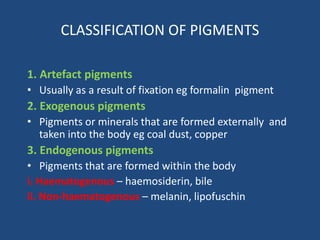
CLASSIFICATION OF PIGMENTS
1. Artefact pigments
• Usually as a result of fixation eg formalin pigment
2. Exogenous pigments
• Pigments or minerals that are formed externally and
taken into the body eg coal dust, copper
3. Endogenous pigments
• Pigments that are formed within the body
i. Haematogenous – haemosiderin, bile
ii. Non-haematogenous – melanin, lipofuschin
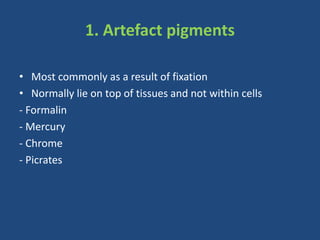
1. Artefact pigments
• Most commonly as a result of fixation
• Normally lie on top of tissues and not within cells
- Formalin
- Mercury
- Chrome
- Picrates
FORMALIN PIGMENT
• Pigment appears as a brown/ brownish black deposit in
tissues fixed in any formalin fixative with an acid pH & is more
likely to occur in blood rich tissues.
• Can be removed by treating with
 Saturated alcoholic picric acid for some hours.
 Alcoholic solution of Sod. & Pot. Hydroxide.
 10% ammonium hydroxide in 70% alcohol for 5-15 min.
4
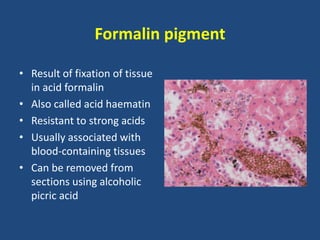
Formalin pigment
• Result of fixation of tissue
in acid formalin
• Also called acid haematin
• Resistant to strong acids
• Usually associated with
blood-containing tissues
• Can be removed from
sections using alcoholic
picric acid
MERCURY PIGMENT
• Tissues fixed in fixative mixtures containing mercury have
been found to develop a uniform granular black deposit
known as mercury pigment.
• This can be removed by treatment with Lugol’s iodine and
sodium thiosulphate.
6
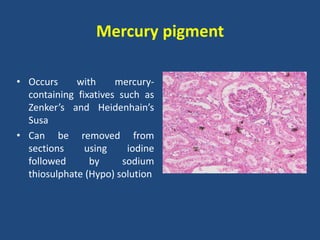
Mercury pigment
• Occurs with mercury-
containing fixatives such as
Zenker’s and Heidenhain’s
Susa
• Can be removed from
sections using iodine
followed by sodium
thiosulphate (Hypo) solution
• .
Chrome and picric acid pigments
CHROME PIGMENT
• Consequence of fixation
in solutions containing
potassium dichromate eg
Zenker’s fixative
• Can be removed from
sections by thoroughly
washing in water prior to
dehydration
PICRATE PIGMENT
• Consequence of fixation
in solutions containing
picric acid eg Bouin’s
fixative
• Can be removed with
saturated aqueous
lithium carbonate
DICHROMATE DEPOSIT
• Tissues fixed in potassium dichromate containing fixatives
show an insoluble yellow-brown oxide precipitated if
transferred directly to alcohol without proper washing in
water.
• Precipitate is difficult to eradicate completely but much of it
can be removed by immersing in an acid alcohol solution for
30 minutes.
9
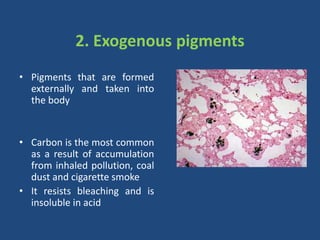
2. Exogenous pigments
• Pigments that are formed
externally and taken into
the body
• Carbon is the most common
as a result of accumulation
from inhaled pollution, coal
dust and cigarette smoke
• It resists bleaching and is
insoluble in acid
• .
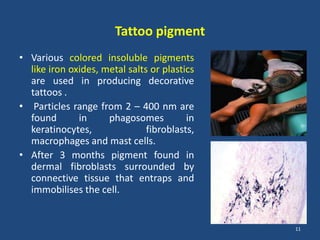
Tattoo pigment
• Various colored insoluble pigments
like iron oxides, metal salts or plastics
are used in producing decorative
tattoos .
• Particles range from 2 – 400 nm are
found in phagosomes in
keratinocytes, fibroblasts,
macrophages and mast cells.
• After 3 months pigment found in
dermal fibroblasts surrounded by
connective tissue that entraps and
immobilises the cell.
11
Exogenous pigments
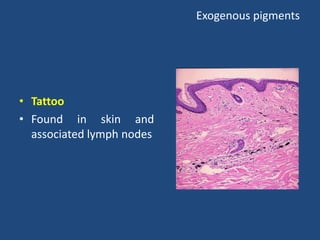
• Tattoo
• Found in skin and
associated lymph nodes
• .
Exogenous pigments
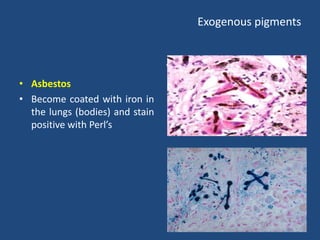
• Asbestos
• Become coated with iron in
the lungs (bodies) and stain
positive with Perl’s
• .
Minerals
• Metallic and non-metallic ions necessary for growth and other
bodily functions
• Calcium, ferrous and ferric iron, copper, phosphate and
carbonate are the most common
• Some can be deposited pathologically in tissue eg gold, silver,
copper and lead
• Minerals in tissue can be studied using the technique of
microincineration
Microincineration
• Study inorganic substances found in tissue
• Cut paraffin sections as usual and mount on high temperature
glass slides
• Slides are incinerated up to 650oC and then allowed to cool
• Slides are removed from oven and coverslipped with glycerol
mountant
• Slides are examined under the microscope
Minerals
• Calcium
• Abnormal deposits can be
associated with atherosclerosis,
sarcoid, TB and some tumours
• Also found in joints in
chondrocalcinosis
• Demonstrate with von Kossa
silver method
• .
Stain chemistry
• Von Kossa method (calcium)- This is an indirect way of
detecting calcium where silver nitrate replaces the carbonate
anions of calcium salts (silver substitution method). Sunlight
reduces the silver salt to visible metallic silver, and unreduced
silver is removed by sodium thiosulphate
• Rhodanine method (copper)- Rhodanine demonstrates the
protein to which the copper binds rather than the copper
itself. Therefore, although considered more sensitive,
rhodanine may be less specific and false-positive results may
be obtained
Minerals
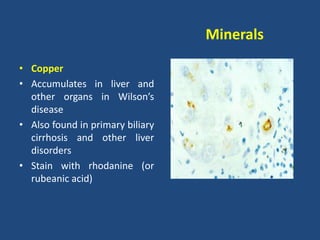
• Copper
• Accumulates in liver and
other organs in Wilson’s
disease
• Also found in primary biliary
cirrhosis and other liver
disorders
• Stain with rhodanine (or
rubeanic acid)
• .
Stain chemistry
• Von Kossa method (calcium)
• This is an indirect way of detecting calcium where silver
nitrate replaces the carbonate anions of calcium salts (silver
substitution method). Sunlight reduces the silver salt to visible
metallic silver, and unreduced silver is removed by sodium
thiosulphate
• Rhodanine method (copper)
• Rhodanine demonstrates the protein to which the copper
binds rather than the copper itself. Therefore, although
considered more sensitive, rhodanine may be less specific and
false-positive results may be obtained
3. Endogenous pigments
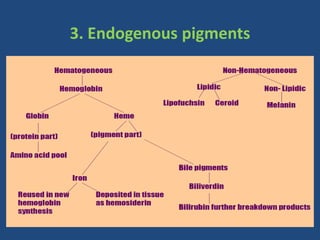
Haematogenous pigments
• Endogenous pigments derived from blood
• Main ones are haemoglobin, iron, haemosiderin, haematoidin
and bile pigments
• Haemoglobin breaks down into two parts: globin and haem
(iron-containing pigment part)
• The haem portion further splits into iron (haemosiderin) and
bile pigments (biliverdin)
• Haematoidin (similar to bilirubin) is formed in tissue as a
result of haemorrhage
Haematogenous
pigments
• Haemosiderin
• Stored as ferric iron in bone
marrow and spleen
• Can be demonstrated using
Perl’s prussian blue stain
which detects ferric iron
• Excessive absorption of
dietary iron causes
haemochromatosis
• Ferrous iron is demonstrated
by Turnbull’s blue
• .
Stain chemistry
• Perl’s stain – ferric iron Ferric iron is released from
haemosiderin with hydrochloric acid, forming ferric chloride.
The iron reacts with potassium ferrocyanide to form ferric
ferrocyanide (Prussian blue)
• Turnbull’s blue stain – ferrous iron Treatment with acid
solution of potassium ferricyanide. Any ferrous iron present
reacts to form an insoluble bright blue pigment called
Turnbull’s blue (ferrous ferricyanide)
• Schmorl’s technique- Reducing substances present in
tissue reduce the ferric ions (Fe3+) present in the staining
solution to ferrous ions (Fe2+) which immediately combine
with ferricyanide present in the staining solution to form an
insoluble precipitate of ferrous ferricyanide (Turnbull’s blue)
Haematogenous
pigments
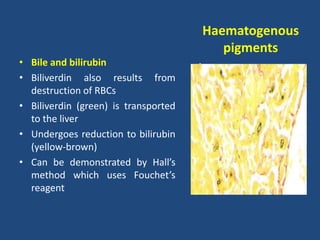
• Bile and bilirubin
• Biliverdin also results from
destruction of RBCs
• Biliverdin (green) is transported
to the liver
• Undergoes reduction to bilirubin
(yellow-brown)
• Can be demonstrated by Hall’s
method which uses Fouchet’s
reagent
• .
Stain chemistry
• Hall’s method (bile and bilirubin)
• A specific and easily identifiable green colour develops when
bilirubin is oxidized to biliverdin in an acid medium.
• This oxidation reaction is rapidly accomplished by ferric
chloride in trichloroacetic acid medium (Fouchet’s reagent).
• Biliverdin is then stained emerald green by acid fuchsin in van
Gieson solution
Non-haematogenous pigments
• Endogenous pigments not derived from blood
• There are two types of non-haematogenous pigment
- Lipidic (lipofuschin and ceroid)
- Non-lipidic (melanin)
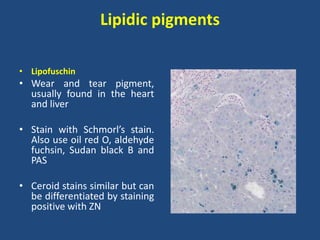
Lipidic pigments
• Lipofuschin
• Wear and tear pigment,
usually found in the heart
and liver
• Stain with Schmorl’s stain.
Also use oil red O, aldehyde
fuchsin, Sudan black B and
PAS
• Ceroid stains similar but can
be differentiated by staining
positive with ZN
• .
Stain chemistry
• Perl’s stain – ferric iron Ferric iron is released from
haemosiderin with hydrochloric acid, forming ferric chloride.
The iron reacts with potassium ferrocyanide to form ferric
ferrocyanide (Prussian blue)
• Turnbull’s blue stain – ferrous iron Treatment with acid
solution of potassium ferricyanide. Any ferrous iron present
reacts to form an insoluble bright blue pigment called
Turnbull’s blue (ferrous ferricyanide)
• Schmorl’s technique- Reducing substances present in tissue
reduce the ferric ions (Fe3+) present in the staining solution
to ferrous ions (Fe2+) which immediately combine with
ferricyanide present in the staining solution to form an
insoluble precipitate of ferrous ferricyanide (Turnbull’s blue)
Non-lipidic pigments
• Melanin is the most important and is found in skin, hair,
retina and parts of the CNS
• Melanin can be bleached in the tissue section by treatment
with hydrogen peroxide or potassium permanganate and
oxalic acid
• Pathologically, melanin is found in the cells of malignant
melanomas and various benign naevi
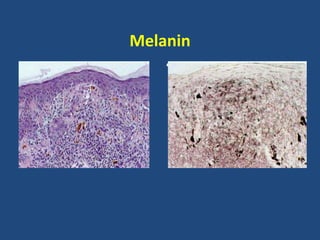
• Melanin reduces silver nitrate to metallic silver in the Masson
Fontana method (argentaffin)
Stain chemistry
Masson Fontana and Methenamine silver (argentaffin)
• Certain tissue components such as melanin possess the ability
to bind silver ions from a silver solution and to reduce it to
visible metallic silver without the need for a separate reducing
agent
Grimelius stain (argyrophil)
• Certain tissue components such as reticulin have the ability to
bind silver ions from solution but no inherent ability to reduce
the silver to its visible metallic form.
• An external or chemical reducer is used for this purpose.
These tissue components are referred to as argyrophil
Melanin
• . • .
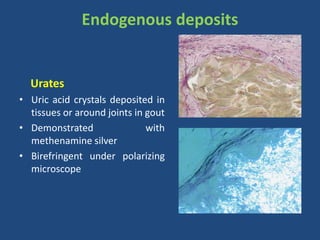
Endogenous deposits
Urates
• Uric acid crystals deposited in
tissues or around joints in gout
• Demonstrated with
methenamine silver
• Birefringent under polarizing
microscope
• .
REFERENCES
• Bancroft JD & Gamble M. Theory and Practice of Histological
Techniques. 6th ed. Churchill Livingstone.
• Culling CFA, Allison RT, Barr WT. Cellular pathology
Techniques. 2 nd ed.
34

PIGMENT AND MINERALS.pptx

  • 1.
    Pigments and Minerals BYDR SUNITA PATHAK
  • 2.
    CLASSIFICATION OF PIGMENTS 1.Artefact pigments • Usually as a result of fixation eg formalin pigment 2. Exogenous pigments • Pigments or minerals that are formed externally and taken into the body eg coal dust, copper 3. Endogenous pigments • Pigments that are formed within the body i. Haematogenous – haemosiderin, bile ii. Non-haematogenous – melanin, lipofuschin
  • 3.
    1. Artefact pigments •Most commonly as a result of fixation • Normally lie on top of tissues and not within cells - Formalin - Mercury - Chrome - Picrates
  • 4.
    FORMALIN PIGMENT • Pigmentappears as a brown/ brownish black deposit in tissues fixed in any formalin fixative with an acid pH & is more likely to occur in blood rich tissues. • Can be removed by treating with  Saturated alcoholic picric acid for some hours.  Alcoholic solution of Sod. & Pot. Hydroxide.  10% ammonium hydroxide in 70% alcohol for 5-15 min. 4
  • 5.
    Formalin pigment • Resultof fixation of tissue in acid formalin • Also called acid haematin • Resistant to strong acids • Usually associated with blood-containing tissues • Can be removed from sections using alcoholic picric acid
  • 6.
    MERCURY PIGMENT • Tissuesfixed in fixative mixtures containing mercury have been found to develop a uniform granular black deposit known as mercury pigment. • This can be removed by treatment with Lugol’s iodine and sodium thiosulphate. 6
  • 7.
    Mercury pigment • Occurswith mercury- containing fixatives such as Zenker’s and Heidenhain’s Susa • Can be removed from sections using iodine followed by sodium thiosulphate (Hypo) solution • .
  • 8.
    Chrome and picricacid pigments CHROME PIGMENT • Consequence of fixation in solutions containing potassium dichromate eg Zenker’s fixative • Can be removed from sections by thoroughly washing in water prior to dehydration PICRATE PIGMENT • Consequence of fixation in solutions containing picric acid eg Bouin’s fixative • Can be removed with saturated aqueous lithium carbonate
  • 9.
    DICHROMATE DEPOSIT • Tissuesfixed in potassium dichromate containing fixatives show an insoluble yellow-brown oxide precipitated if transferred directly to alcohol without proper washing in water. • Precipitate is difficult to eradicate completely but much of it can be removed by immersing in an acid alcohol solution for 30 minutes. 9
  • 10.
    2. Exogenous pigments •Pigments that are formed externally and taken into the body • Carbon is the most common as a result of accumulation from inhaled pollution, coal dust and cigarette smoke • It resists bleaching and is insoluble in acid • .
  • 11.
    Tattoo pigment • Variouscolored insoluble pigments like iron oxides, metal salts or plastics are used in producing decorative tattoos . • Particles range from 2 – 400 nm are found in phagosomes in keratinocytes, fibroblasts, macrophages and mast cells. • After 3 months pigment found in dermal fibroblasts surrounded by connective tissue that entraps and immobilises the cell. 11
  • 12.
    Exogenous pigments • Tattoo •Found in skin and associated lymph nodes • .
  • 13.
    Exogenous pigments • Asbestos •Become coated with iron in the lungs (bodies) and stain positive with Perl’s • .
  • 14.
    Minerals • Metallic andnon-metallic ions necessary for growth and other bodily functions • Calcium, ferrous and ferric iron, copper, phosphate and carbonate are the most common • Some can be deposited pathologically in tissue eg gold, silver, copper and lead • Minerals in tissue can be studied using the technique of microincineration
  • 15.
    Microincineration • Study inorganicsubstances found in tissue • Cut paraffin sections as usual and mount on high temperature glass slides • Slides are incinerated up to 650oC and then allowed to cool • Slides are removed from oven and coverslipped with glycerol mountant • Slides are examined under the microscope
  • 16.
    Minerals • Calcium • Abnormaldeposits can be associated with atherosclerosis, sarcoid, TB and some tumours • Also found in joints in chondrocalcinosis • Demonstrate with von Kossa silver method • .
  • 17.
    Stain chemistry • VonKossa method (calcium)- This is an indirect way of detecting calcium where silver nitrate replaces the carbonate anions of calcium salts (silver substitution method). Sunlight reduces the silver salt to visible metallic silver, and unreduced silver is removed by sodium thiosulphate • Rhodanine method (copper)- Rhodanine demonstrates the protein to which the copper binds rather than the copper itself. Therefore, although considered more sensitive, rhodanine may be less specific and false-positive results may be obtained
  • 18.
    Minerals • Copper • Accumulatesin liver and other organs in Wilson’s disease • Also found in primary biliary cirrhosis and other liver disorders • Stain with rhodanine (or rubeanic acid) • .
  • 19.
    Stain chemistry • VonKossa method (calcium) • This is an indirect way of detecting calcium where silver nitrate replaces the carbonate anions of calcium salts (silver substitution method). Sunlight reduces the silver salt to visible metallic silver, and unreduced silver is removed by sodium thiosulphate • Rhodanine method (copper) • Rhodanine demonstrates the protein to which the copper binds rather than the copper itself. Therefore, although considered more sensitive, rhodanine may be less specific and false-positive results may be obtained
  • 20.
  • 21.
    Haematogenous pigments • Endogenouspigments derived from blood • Main ones are haemoglobin, iron, haemosiderin, haematoidin and bile pigments • Haemoglobin breaks down into two parts: globin and haem (iron-containing pigment part) • The haem portion further splits into iron (haemosiderin) and bile pigments (biliverdin) • Haematoidin (similar to bilirubin) is formed in tissue as a result of haemorrhage
  • 22.
    Haematogenous pigments • Haemosiderin • Storedas ferric iron in bone marrow and spleen • Can be demonstrated using Perl’s prussian blue stain which detects ferric iron • Excessive absorption of dietary iron causes haemochromatosis • Ferrous iron is demonstrated by Turnbull’s blue • .
  • 23.
    Stain chemistry • Perl’sstain – ferric iron Ferric iron is released from haemosiderin with hydrochloric acid, forming ferric chloride. The iron reacts with potassium ferrocyanide to form ferric ferrocyanide (Prussian blue) • Turnbull’s blue stain – ferrous iron Treatment with acid solution of potassium ferricyanide. Any ferrous iron present reacts to form an insoluble bright blue pigment called Turnbull’s blue (ferrous ferricyanide) • Schmorl’s technique- Reducing substances present in tissue reduce the ferric ions (Fe3+) present in the staining solution to ferrous ions (Fe2+) which immediately combine with ferricyanide present in the staining solution to form an insoluble precipitate of ferrous ferricyanide (Turnbull’s blue)
  • 24.
    Haematogenous pigments • Bile andbilirubin • Biliverdin also results from destruction of RBCs • Biliverdin (green) is transported to the liver • Undergoes reduction to bilirubin (yellow-brown) • Can be demonstrated by Hall’s method which uses Fouchet’s reagent • .
  • 25.
    Stain chemistry • Hall’smethod (bile and bilirubin) • A specific and easily identifiable green colour develops when bilirubin is oxidized to biliverdin in an acid medium. • This oxidation reaction is rapidly accomplished by ferric chloride in trichloroacetic acid medium (Fouchet’s reagent). • Biliverdin is then stained emerald green by acid fuchsin in van Gieson solution
  • 26.
    Non-haematogenous pigments • Endogenouspigments not derived from blood • There are two types of non-haematogenous pigment - Lipidic (lipofuschin and ceroid) - Non-lipidic (melanin)
  • 27.
    Lipidic pigments • Lipofuschin •Wear and tear pigment, usually found in the heart and liver • Stain with Schmorl’s stain. Also use oil red O, aldehyde fuchsin, Sudan black B and PAS • Ceroid stains similar but can be differentiated by staining positive with ZN • .
  • 28.
    Stain chemistry • Perl’sstain – ferric iron Ferric iron is released from haemosiderin with hydrochloric acid, forming ferric chloride. The iron reacts with potassium ferrocyanide to form ferric ferrocyanide (Prussian blue) • Turnbull’s blue stain – ferrous iron Treatment with acid solution of potassium ferricyanide. Any ferrous iron present reacts to form an insoluble bright blue pigment called Turnbull’s blue (ferrous ferricyanide) • Schmorl’s technique- Reducing substances present in tissue reduce the ferric ions (Fe3+) present in the staining solution to ferrous ions (Fe2+) which immediately combine with ferricyanide present in the staining solution to form an insoluble precipitate of ferrous ferricyanide (Turnbull’s blue)
  • 29.
    Non-lipidic pigments • Melaninis the most important and is found in skin, hair, retina and parts of the CNS • Melanin can be bleached in the tissue section by treatment with hydrogen peroxide or potassium permanganate and oxalic acid • Pathologically, melanin is found in the cells of malignant melanomas and various benign naevi • Melanin reduces silver nitrate to metallic silver in the Masson Fontana method (argentaffin)
  • 30.
    Stain chemistry Masson Fontanaand Methenamine silver (argentaffin) • Certain tissue components such as melanin possess the ability to bind silver ions from a silver solution and to reduce it to visible metallic silver without the need for a separate reducing agent Grimelius stain (argyrophil) • Certain tissue components such as reticulin have the ability to bind silver ions from solution but no inherent ability to reduce the silver to its visible metallic form. • An external or chemical reducer is used for this purpose. These tissue components are referred to as argyrophil
  • 31.
  • 32.
    Endogenous deposits Urates • Uricacid crystals deposited in tissues or around joints in gout • Demonstrated with methenamine silver • Birefringent under polarizing microscope • .
  • 33.
    REFERENCES • Bancroft JD& Gamble M. Theory and Practice of Histological Techniques. 6th ed. Churchill Livingstone. • Culling CFA, Allison RT, Barr WT. Cellular pathology Techniques. 2 nd ed.
  • 34.