BATAS PAMBANSA BLG. 
232 
AN ACT PROVIDING FOR THE 
ESTABLISHMENT AND MAINTENANCE OF AN 
INTEGRATED SYSTEM OF EDUCATION
I. GENERAL PROVISIONS 
Chapter 1: PRELIMINARY MATTERS 
Section 1. Title. This Act shall be known as the 
“Education Act of 1982.” 
Section 2. Coverage: This Act shall apply to and 
govern both formal and non formal system in public 
and private schools in all levels of the entire 
educational system.
Chapter 2: DECLARATION OF BASIC STATE POLICY 
AND OBJECTIVES 
Section 3. Declaration of Basic Policy – It is the policy of the 
State to establish and maintain a complete, adequate and 
integrated system of education relevant to the goals of the 
national government. 
1. To achieve and maintain an 
accelerating rate of economic 
development and social progress; 
3. To achieve and strengthen national 
unity and consciousness and preserve, 
develop and promote desirable cultural, 
moral and spiritual values in a changing 
2. To assure the maximum participation of 
all the people in the attainment and 
enjoyment of the benefits of such growth; 
world.
The State shall promote the right of every individual to relevant 
quality education, regardless of sex, age, creed, socio-economic 
status, physical and mental condition, racial or ethnic 
origin, political or other affiliation. 
The state shall promote the right of the nation's cultural 
communities in the exercise of their right to develop themselves 
within the context of their cultures, customs, traditions, interest 
and belief, and recognizes education as an instrument for their 
maximum participation in national development and in ensuring 
their involvement in achieving national unity.
Section 4. Declaration of Objectives. – The Educational system 
aims to: 
1. Provide for a general education, to (a) attain his 
potential 3. Develop as a human the professions being (b) enhance that will the provide 
range and 
leadership for the nation in the advancement of 
knowledge for improving the quality of human life; 
quality of individual and group participation (c) 
acquire the essential educational foundation of his 
development into a productive and versatile citizen; 
4. Respond effectively to changing needs and 
conditions of the nation through a system of 
2. Train the nation’s manpower in the middle- level 
skills required for national development; 
educational planning and evaluation.
Towards the realization of this 
objectives and pursuant to the 
constitution, all educational institution 
shal aim to: 
inculcate love of country, teach 
the duties of citizenship, and 
develop moral character, 
discipline and scientific, 
technological and vocational 
efficiency.
I. THE EDUCATIONAL COMMUNITY 
Chapter 1: PRELIMINARY PROVISIONS 
Section 5. Declaration of Policy and Objectives. – It is 
likewise declared government policy to foster, at all times, a 
spirit of shared purposes and cooperation among the members 
and elements of the educational community, and between the 
community and other sectors of society, in the realization that 
only in such an atmosphere can the true goals objectives of 
education be fulfilled. 
MORE OVER, THE STATE SHALL
1. Aid and support the natural right and duty of parents in the 
rearing of the youth through the educational system. 
2. Promote and safeguard the welfare and interest of the 
students by defining their rights and obligations, according 
them privileges, and encouraging the establishment of sound 
relationships between them and the other members of the 
school community. 
3. Promote the social economic status of all school personnel, 
uphold their rights, define their obligations, and improve their 
living and working conditions and career prospects. 
4. Extend support to promote the viability of those institutions 
through which parents, students and school personnel seek to 
attain their educational goals.
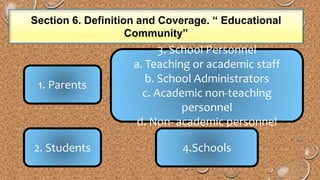
Section 6. Definition and Coverage. “ Educational 
Community” 
1. Parents 
2. Students 
3. School Personnel 
a. Teaching or academic staff 
b. School Administrators 
c. Academic non-teaching 
personnel 
d. Non- academic personnel 
4.Schools
Section 7. Community Participation. Every educational 
institution shall provide for the establishment of 
appropriate bodies through w/c the members of the 
educational community may discuss relevant issues, 
and communicate information and suggestions for 
assistance and support of the school.
Section 8. Rights of Parents – all parents who have children enrolled in a school shall have the ff. 
rights: 
1. The right to organize by themselves and/ or with 
teachers. 
2. The right to access to any official record directly relating 
to the children 
Chapter 1: RIGHTS 
Section 9. Rights of Students in School– students and pupils in all school shall enjoy the ff. rights: 
1.The right to receive, primarily through competent instruction. 
2. The right to freely choose their field of study. 
3. The right to school guidance and counselling services. 
4. The right to access to his own school records. 
5. The right of the issuance of official certificates. 
6. The right to publish a student newspaper. 
7. The right to free expression of opinions and suggestions. 
8. The right to form, establish and join in organization. 
9. The right to be free from involuntary contributions,except those 
approved by their oganizations or societies.
SECTION 10. Rights of all 
School Personnel 
1.The right to free 
expression of opinion 
and suggestions. 
2.The right to be provided 
with legal service. 
3.The right to establish, 
join and maintain labor 
organizations. 
4.The right to be free from 
involuntary contributions 
except those imposed by 
their organizations. 
SECTION 11. SPECIAL 
RIGHTSOF SCHOOLS 
ADMINISTRATORS 
1.The right to be free from 
compulsory assignments not 
related to their duties. 
2. The right to intellectual 
property consistent with 
applicable laws. 
3. Teachers shall be deemed 
persons in authority when in 
discharge of lawful duties 
and responsibilities. 
4. Teachers shall be accorded 
the opportunity to choose 
alternative career lines.
SECTION 12. special Rights of school administrators 
SECTION 13. rights of school 
1. The right of their governing boards or lawful 
authorities to provide proper governance. 
2. The right for institutions of higher learning to 
determine on academic grounds who shall be admitted 
to study, who may teach and what shall be the subjects 
of the study and research.
Chapter 3: DUTIES AND OBLIGATIONS 
1. Parents, individually or collectively, through the school systems, 
shall help carry out the educational objectives in accordance with 
national goals. 
2. Parents shall be obliged to enable their children to obtain 
elementary education and shall strive to enable them to obtain 
secondary and higher education in the pursuance of the right formation 
of the youth. 
3. Parents shall cooperate with the school in the implementation of the 
school program curricular and co-curricular.
1. Exert his utmost to develop his potentialities for service, particularly by 
undergoing an education suited to his abilities, in order that he may become an 
asset to his family and to society. 
2. Uphold the academic integrity of the school, endeavor to achieve academic 
excellence and abide by the rules and regulations governing his academic 
responsibilities and moral integrity. 
3. Promote and maintain the peace and tranquility of the school by observing the 
rules and discipline, and by exerting efforts to attain harmonious relationships with 
fellow students, the teaching and academic staff and other school personnel. 
4. Participate actively in civic affairs and in the promotion of the general welfare, 
particularly in the social, economic and cultural development of his community 
and in the attainment of a just, compassionate and orderly society. 
5. Exercise his rights responsibly in the knowledge that he is answerable for any 
infringement or violation of the public welfare and of the rights of others.
1. Perform his duties to the school by discharging his responsibilities in 
accordance with the philosophy, goals, and objectives of the school. 
2. Be accountable for the efficient and effective attainment of specified learning 
objectives in pursuance of national development goals within the limits of 
available school resources. 
3. Render regular reports on performance of each student and to the latter and 
the latter's parents and guardians with specific suggestions for improvement. 
4. Assume the responsibility to maintain and sustain his professional growth 
and advancement and maintain professionalism in his behavior at all times. 
5. Refrain from making deductions in students' scholastic rating for acts that 
are clearly not manifestations of poor scholarship. 
6. Participate as an agent of constructive social, economic, moral, intellectual, 
cultural and political change in his school and the community within the context 
of national policies.
1. Perform his duties to the school by discharging his responsibilities in accordance with 
the philosophy, goals and objectives of the school. 
2. Be accountable for the efficient and effective administration and management of the 
school. 
3. Develop and maintain a healthy school atmosphere conducive to the promotion and 
preservation of academic freedom and effective teaching and learning, and to 
harmonious and progressive school-personnel relationship. 
4. Assume and maintain professional behavior in his work and in dealing with students, 
teachers, academic non-teaching personnel, administrative staff, and parents or 
guardians. 
5. Render adequate reports to teachers, academic non-teaching personnel and non-academic 
staff on their actual performance in relation to their expected performance and 
counsel them on ways of improving the same. 
6. Observe due process, fairness, promptness, privacy, constructiveness and 
consistency in disciplining his teachers and other personnel. 
7. Maintain adequate records and submit required reports to the Ministry of Education, 
Culture and Sports.
1. Improve himself professionally be keeping abreast of the 
latest trends and techniques in his profession. 
2. Assume, promote and maintain an atmosphere 
conducive to service and learning. 
3. Promote and maintain an atmosphere conducive to 
service and learning.
III. THE EDUCATIONAL SYSTEMS 
Chapter 1: FORMAL EDUCATION 
SECTION 19. Declaration of Policy 
- The State recognizes that formal education, or the school system, and therefore the main 
instrument for the achievement of the country’s educational goals and objectives
SECTION 20. Definition 
- “Formal Education” refers to the hierarchically structured and chronologically graded learnings 
organized and provided by the formal school system. 
ELEMENTARY EDUCATION. – The first stage of compulsory, 
formal education primarily concerned with providing basic 
education. 
SECONDARY EDUCATION. - The stage of formal education 
concerned primarily with continuing basic education and 
expanding it. 
TERTIARY EDUCATION. – Post secondary schooling is 
higher education leading to a degree in a specific 
profession or discipline.
SECTION 21. Objectives of Elementary Education 
1. To provide the knowledge and develop the skills, attitudes and 
values essential to personal development and necessary for 
living in and contributing to a developing and changing social 
milleu; 
2. To provide learning experiences which increase the child’s 
awareness and responsiveness to the changes in and just 
demands of society and to prepare him for constructive and 
effective involvement; 
3. To promote intensify and child’s knowledge of identification 
with, the love for the nation and the people to which he belongs; 
4. To promote work experiences which develops the child’s 
orientation to the world of work and creativity and prepare 
himself to engage in honest and gainful work.
SECTION 22. Objectives of Secondary Education 
1. To continue to promote the objectives of elementary education; 
2. To discover and enhance the different aptitudes and interest of the 
student so as to equip him with skills for productive endeavor 
and/or prepare him for tertiary schooling.
SECTION 23. Objectives of Tertiary Education 
1. To provide a general education program that will promote 
national identify, cultural consciousness, moral integrity and 
spiritual vigor; 
2. To train the nation’s manpower in the skills required for national 
development. 
3. To develop the professionals that will provide leadership for the 
nation; 
4. To advance knowledge through research work and apply new 
knowledge for improving the quality of human life and 
responding effectively to changing societal needs and 
conditions.
Chapter 2: NON FORMAL EDUCATION AND SPECIALIZED 
EDUCATIONAL SYSTEM 
SECTION 24: SPECIALIZED EDUCATIONAL SERVICE.- The State further recognizes its 
responsibility to provide, within the context of the formal education system, services to 
meet special needs of certain clientele. 
OBJECTIVES OF NON- FORMAL EDUCATION: 
3. “Non – formal Education,” any organization school – based 
educational activities undertaken by the Ministry of Education, 
Culture and Sports and other agencies aimed at attaining specific 
learning objectives for a particular clientele, especially the illiterates 
and the out-of-school youth and adults, distinct from and outside 
2. “ Special Education,” the education of persons who 
are physically, mentally, emotionally, socially, or culturally 
different from the so called “normal” individuals that they 
require modification of school practices/services to develop 
1. “Work Education,” or “Practical Arts,” as s program of 
basic education which aims to develop the right atittudes 
towards work; and “technical- vocational education,” post-secondary 
a. To eradicate illiteracy and raise the level of functional literacy of the 
population; 
b. To provide unemployed and underemployed youth and adults with 
appropriate vocational/technical skills to enable them to become more 
but non- degree programs leading to one- two, 
productive and effective citizens; 
the regular offerings of the formal school system. 
them to their maximum capacity; 
or three- year certificates in preparation for group of 
c. To develop among the clientele of non- formal education proper values and 
atittudes necessary for personal, community and national development. 
middle- level occupation.
SECTION 25: Establishment 
of Schools. – All schools 
shall be established in 
accordance with law. The 
establishment of new 
national schools and the 
conversion of existing 
schools from elementary 
to national secondary 
schools or from secondary 
to national secondary 
schools shall be by law. 
SECTION 26: DEFINITION OF 
TERMS. – The term used in the 
Chapter are defined as follows: 
1.“Schools” are duly established 
institutions of learning or 
educational institutions. 
2.“Public Schools” are 
educational institutions 
established and administered 
by the government. 
3.“ Private Schools” are 
educational institutions 
maintained and administered 
by private individuals 
or groups. 
Chapter 3: ESTABLISHMENT OF 
SCHOOLS
SECTION 27: RECOGNITION OF SCHOOLS. – The 
educational operations of schools shall be subject to 
the prior authorization of the government, and shall be 
effected by recognition. 
SECTION 28: EFFECTS OF RECOGNITION; PUNISHABLE 
VIOLATION. – The issuance of a certificate of recognition to a school 
shall have the ff. effects: 
1.It transform the temporary permit to a permanent authority 
to operate; 
2.It entitles the school or college to give the students who 
have completed the course for which recognition is granted, 
a certificate, title or diploma; 
3.It shall entitle the students who have graduated from said 
recognized courses to al the benefits and privileges enjoyed 
by graduates in similar courses of studies in all schools 
recognized by the government.
SECTION 27: VOLUNTARY ACCREDITATION. – The 
Ministry shall encourage programs of voluntary 
accreditation for institution which desire to meet 
standards of quality over and above minimum 
required for State recognition.
Chapter 4: INTERNAL ORGANIZATIONS OF 
SCHOOLS 
SECTION 30. ORGANIZATION OF SCHOOLS. – Each school shall 
establish such internal organization as will best enable it to carry out its 
academic and administrative functions, subject to limitations provided by 
law. 
SECTION 31. GOVERNING BOARD. – Every government college or 
university establish a tertiary institution and every private school shall have 
a governing board pursuant to its Charter or to the Corporation Code of 
the Philippines. 
SECTION 32. PERSONNEL TRANSACTIONS. – The term and conditions 
of employment of personnel in government schools shall be governed by 
the Civil Service, budgetary and compensation laws and rules.
Chapter 5: SCHOOL, FINANCE AND ASSISTANCE 
SECTION 33. DECLARATION OF POLICY. – It is hereby 
declared to be the policy of the State that the national 
government shall contribute to the financial support of 
educational programs pursuant to the goals of education as 
declared in the Constitution. Towards this end, the 
government shall: 
1.Adopt measures to broaden access to education through 
financial assistance and other forms of incentives to 
schools, teachers, fiscal and students 
2.Encourage and stimulate private support to education 
through, fiscal and other assistance measure.
A. FUNDING OF PUBLIC SCHOOL 
Section 34. National Funds - Public school shall continue to be funded from 
national funds: Provided, That local governments shall be encouraged to 
assume operation of local public schools on the basis of national fund 
participation and adequate revenue sources which may be assigned by the 
national government for the purpose. 
Section 35. Financial Aid Assistance to Public Secondary Schools - The national 
government shall extend financial aid and assistance to public 
secondary schools established and maintained by local governments, 
including barangay high schools.
Section 36. Share of Local Government - Provinces, cities and 
municipalities and barangays shall appropriate funds in their 
annual budgets for the operation and maintenance of public 
secondary schools on the basis of national fund participation. 
Section 37. Special Education Fund - The proceeds of the Special 
Education Fund accruing to local governments shall be used 
exclusively for the purposes enumerated in Section 1 of Republic 
Act No. 5447, and in accordance with rules and regulations issued 
by the Ministry of Education, Culture and Sports and the Ministry 
of the Budget. Said proceeds shall be considered a local fund and 
shall be subject to Presidential Decrees No. 477, Presidential 
Decree No. 1375 and other applicable local budget laws and 
regulations.
Section 38. Tuition and other School Fees - Secondary and post-secondary 
schools may charge tuition and other school 
fees, in order to improve facilities or to accommodate 
more students. 
Section 39. Income from other Sources - Government-supported 
educational institution may receive grants, legacies, 
donations and gifts for purposes allowed by existing laws.
B. FUNDING OF PRIVATE SCHOOLS 
Section 40. Funding of Private Schools - Private schools may be funded from 
their capital investment or equity contributions, tuition fees and other 
school charges, grants, loans, subsidies, passive investment income 
and income from other sources. 
Section 41. Government Assistance - The government, in recognition of 
their complementary role in the educational system, may provide 
aid to the programs of private schools in the form of grants or 
scholarships, or loans from government financial institutions: 
Provided, That such programs meet certain defined educational 
requirements and standards and contribute to the attainment of 
national development goals.
Section 42. Tuition and Other Fees - Each private school shall determine 
its rate of tuition and other school fees or charges. The rates and 
charges adopted by schools pursuant to this provision shall be 
collectible, and their application or use authorized, subject to rules 
and regulations promulgated by the Ministry of Education, Culture 
and Sports. 
Section 43. Income from Other Sources - Any private school duly 
recognized by the government, may receive any grant and 
legacy, donation, gift, bequest or devise from any individual, 
institution, corporation, foundation, trust of philanthropic 
organization, or research institution or organization as may be 
authorized by law.
Section 44. Institutional Funds - The proceeds from tuition fees and 
other school charges, as well as other income of schools, 
shall be treated as institutional funds. Schools may pool 
their institutional funds, in whole or in part, under joint 
management for the purpose of generating additional 
financial resources.
c. Incentives to education 
Section 45. Declaration of Policy - It is 
the policy of the State in the 
pursuit of its national 
education development goals 
to provide an incentive 
program to encourage the 
participation of the 
community in the 
development of the 
educational sector. 
section 46. Relating to School Property - 
Real property, such as 
lands, buildings and other 
improvements thereon used 
actually, directly and 
exclusively for educational 
purposes shall be subject to 
the real property tax based 
on an assessment of fifteen 
per cent of the market value 
of such property.
Section 47. Relating to Gifts or Donations to 
Schools - All gifts or donation in 
favor of any school, college or 
university recognized by the 
Government shall not be subject 
to tax; Provided, That such gifts 
or donations shall be for 
improvement of classrooms and 
laboratory of library facilities, and 
shall not inure to the benefit of 
any officer, director, official, or 
owner or owners of the school, or 
paid out as salary, adjustments or 
allowance of any form or nature 
whatsoever, except in support of 
faculty and/or professorial chairs. 
Section 48. Relating to Earnings from Established 
Scholarship Funds - All earnings from the 
investment of any duly established 
scholarship fund of any school 
recognized by the government, 
constituted from gifts to the school, 
and/or from contributions or other 
resources assigned to said fund by 
the school, if said earnings are 
actually used to fund additional 
scholarship grants to financially 
deserving students shall be exempt 
from tax until the scholarship fund 
is fully liquidated, when the 
outstanding balance thereof shall 
be subject to tax.
Section 49. School Dispersal Program - All gains 
realized from the sale, disposition or 
transfer of property, real or personal, of 
any duly established private school, 
college or university, in pursuance of a 
school dispersal program of the 
government or of the educational 
institution as approved by the 
government, shall be considered 
exempt from tax if the total proceeds of 
the sale are reinvested in a new or 
existing duly established school, 
college, or university located in the 
dispersal site, within one (1) year from 
the date of such sale, transfer or 
disposition; otherwise, all taxes due on 
the gains realized from the transaction 
shall immediately become due and 
payable. 
Section 50. Conversion to Educational 
Foundations - An educational 
institution may convert 
itself into a non-stock, 
non-profit educational 
foundation, in accordance 
with the implementing 
rules to be issued jointly 
by the Ministry of 
Education, Culture and 
Sports and the Ministry of 
Finance.
c. Incentives to education 
Section 53. Assistance from the Private Sector - The private sector, 
especially educational institutions, business and industry, 
shall be encouraged to grant financial assistance to students, 
especially those undertaking research in the fields of science 
Section Section 52. 51. Grant Government of Scholarship Assistance Pursuant to Students to Existing - The Laws government - Educational 
shall 
institutions shall be encouraged to grant scholarships 
to students pursuant to the provisions of existing laws 
and such scholarship measures as may hereafter be 
provide financial assistance to financially disadvantaged 
and deserving students. Such assistance may be in the 
form of State scholarships, grants-in-aid, assistance from 
the Educational Loan Fund, or subsidized tuition rates in 
and technology or in such projects as may be necessary 
within the context of national development. 
provided for by law. 
State colleges and universities.

Batas Pambansa Blg. 232

  • 1.
    BATAS PAMBANSA BLG. 232 AN ACT PROVIDING FOR THE ESTABLISHMENT AND MAINTENANCE OF AN INTEGRATED SYSTEM OF EDUCATION
  • 2.
    I. GENERAL PROVISIONS Chapter 1: PRELIMINARY MATTERS Section 1. Title. This Act shall be known as the “Education Act of 1982.” Section 2. Coverage: This Act shall apply to and govern both formal and non formal system in public and private schools in all levels of the entire educational system.
  • 3.
    Chapter 2: DECLARATIONOF BASIC STATE POLICY AND OBJECTIVES Section 3. Declaration of Basic Policy – It is the policy of the State to establish and maintain a complete, adequate and integrated system of education relevant to the goals of the national government. 1. To achieve and maintain an accelerating rate of economic development and social progress; 3. To achieve and strengthen national unity and consciousness and preserve, develop and promote desirable cultural, moral and spiritual values in a changing 2. To assure the maximum participation of all the people in the attainment and enjoyment of the benefits of such growth; world.
  • 4.
    The State shallpromote the right of every individual to relevant quality education, regardless of sex, age, creed, socio-economic status, physical and mental condition, racial or ethnic origin, political or other affiliation. The state shall promote the right of the nation's cultural communities in the exercise of their right to develop themselves within the context of their cultures, customs, traditions, interest and belief, and recognizes education as an instrument for their maximum participation in national development and in ensuring their involvement in achieving national unity.
  • 5.
    Section 4. Declarationof Objectives. – The Educational system aims to: 1. Provide for a general education, to (a) attain his potential 3. Develop as a human the professions being (b) enhance that will the provide range and leadership for the nation in the advancement of knowledge for improving the quality of human life; quality of individual and group participation (c) acquire the essential educational foundation of his development into a productive and versatile citizen; 4. Respond effectively to changing needs and conditions of the nation through a system of 2. Train the nation’s manpower in the middle- level skills required for national development; educational planning and evaluation.
  • 6.
    Towards the realizationof this objectives and pursuant to the constitution, all educational institution shal aim to: inculcate love of country, teach the duties of citizenship, and develop moral character, discipline and scientific, technological and vocational efficiency.
  • 7.
    I. THE EDUCATIONALCOMMUNITY Chapter 1: PRELIMINARY PROVISIONS Section 5. Declaration of Policy and Objectives. – It is likewise declared government policy to foster, at all times, a spirit of shared purposes and cooperation among the members and elements of the educational community, and between the community and other sectors of society, in the realization that only in such an atmosphere can the true goals objectives of education be fulfilled. MORE OVER, THE STATE SHALL
  • 8.
    1. Aid andsupport the natural right and duty of parents in the rearing of the youth through the educational system. 2. Promote and safeguard the welfare and interest of the students by defining their rights and obligations, according them privileges, and encouraging the establishment of sound relationships between them and the other members of the school community. 3. Promote the social economic status of all school personnel, uphold their rights, define their obligations, and improve their living and working conditions and career prospects. 4. Extend support to promote the viability of those institutions through which parents, students and school personnel seek to attain their educational goals.
  • 9.
    Section 6. Definitionand Coverage. “ Educational Community” 1. Parents 2. Students 3. School Personnel a. Teaching or academic staff b. School Administrators c. Academic non-teaching personnel d. Non- academic personnel 4.Schools
  • 10.
    Section 7. CommunityParticipation. Every educational institution shall provide for the establishment of appropriate bodies through w/c the members of the educational community may discuss relevant issues, and communicate information and suggestions for assistance and support of the school.
  • 11.
    Section 8. Rightsof Parents – all parents who have children enrolled in a school shall have the ff. rights: 1. The right to organize by themselves and/ or with teachers. 2. The right to access to any official record directly relating to the children Chapter 1: RIGHTS Section 9. Rights of Students in School– students and pupils in all school shall enjoy the ff. rights: 1.The right to receive, primarily through competent instruction. 2. The right to freely choose their field of study. 3. The right to school guidance and counselling services. 4. The right to access to his own school records. 5. The right of the issuance of official certificates. 6. The right to publish a student newspaper. 7. The right to free expression of opinions and suggestions. 8. The right to form, establish and join in organization. 9. The right to be free from involuntary contributions,except those approved by their oganizations or societies.
  • 12.
    SECTION 10. Rightsof all School Personnel 1.The right to free expression of opinion and suggestions. 2.The right to be provided with legal service. 3.The right to establish, join and maintain labor organizations. 4.The right to be free from involuntary contributions except those imposed by their organizations. SECTION 11. SPECIAL RIGHTSOF SCHOOLS ADMINISTRATORS 1.The right to be free from compulsory assignments not related to their duties. 2. The right to intellectual property consistent with applicable laws. 3. Teachers shall be deemed persons in authority when in discharge of lawful duties and responsibilities. 4. Teachers shall be accorded the opportunity to choose alternative career lines.
  • 13.
    SECTION 12. specialRights of school administrators SECTION 13. rights of school 1. The right of their governing boards or lawful authorities to provide proper governance. 2. The right for institutions of higher learning to determine on academic grounds who shall be admitted to study, who may teach and what shall be the subjects of the study and research.
  • 14.
    Chapter 3: DUTIESAND OBLIGATIONS 1. Parents, individually or collectively, through the school systems, shall help carry out the educational objectives in accordance with national goals. 2. Parents shall be obliged to enable their children to obtain elementary education and shall strive to enable them to obtain secondary and higher education in the pursuance of the right formation of the youth. 3. Parents shall cooperate with the school in the implementation of the school program curricular and co-curricular.
  • 15.
    1. Exert hisutmost to develop his potentialities for service, particularly by undergoing an education suited to his abilities, in order that he may become an asset to his family and to society. 2. Uphold the academic integrity of the school, endeavor to achieve academic excellence and abide by the rules and regulations governing his academic responsibilities and moral integrity. 3. Promote and maintain the peace and tranquility of the school by observing the rules and discipline, and by exerting efforts to attain harmonious relationships with fellow students, the teaching and academic staff and other school personnel. 4. Participate actively in civic affairs and in the promotion of the general welfare, particularly in the social, economic and cultural development of his community and in the attainment of a just, compassionate and orderly society. 5. Exercise his rights responsibly in the knowledge that he is answerable for any infringement or violation of the public welfare and of the rights of others.
  • 16.
    1. Perform hisduties to the school by discharging his responsibilities in accordance with the philosophy, goals, and objectives of the school. 2. Be accountable for the efficient and effective attainment of specified learning objectives in pursuance of national development goals within the limits of available school resources. 3. Render regular reports on performance of each student and to the latter and the latter's parents and guardians with specific suggestions for improvement. 4. Assume the responsibility to maintain and sustain his professional growth and advancement and maintain professionalism in his behavior at all times. 5. Refrain from making deductions in students' scholastic rating for acts that are clearly not manifestations of poor scholarship. 6. Participate as an agent of constructive social, economic, moral, intellectual, cultural and political change in his school and the community within the context of national policies.
  • 17.
    1. Perform hisduties to the school by discharging his responsibilities in accordance with the philosophy, goals and objectives of the school. 2. Be accountable for the efficient and effective administration and management of the school. 3. Develop and maintain a healthy school atmosphere conducive to the promotion and preservation of academic freedom and effective teaching and learning, and to harmonious and progressive school-personnel relationship. 4. Assume and maintain professional behavior in his work and in dealing with students, teachers, academic non-teaching personnel, administrative staff, and parents or guardians. 5. Render adequate reports to teachers, academic non-teaching personnel and non-academic staff on their actual performance in relation to their expected performance and counsel them on ways of improving the same. 6. Observe due process, fairness, promptness, privacy, constructiveness and consistency in disciplining his teachers and other personnel. 7. Maintain adequate records and submit required reports to the Ministry of Education, Culture and Sports.
  • 18.
    1. Improve himselfprofessionally be keeping abreast of the latest trends and techniques in his profession. 2. Assume, promote and maintain an atmosphere conducive to service and learning. 3. Promote and maintain an atmosphere conducive to service and learning.
  • 19.
    III. THE EDUCATIONALSYSTEMS Chapter 1: FORMAL EDUCATION SECTION 19. Declaration of Policy - The State recognizes that formal education, or the school system, and therefore the main instrument for the achievement of the country’s educational goals and objectives
  • 20.
    SECTION 20. Definition - “Formal Education” refers to the hierarchically structured and chronologically graded learnings organized and provided by the formal school system. ELEMENTARY EDUCATION. – The first stage of compulsory, formal education primarily concerned with providing basic education. SECONDARY EDUCATION. - The stage of formal education concerned primarily with continuing basic education and expanding it. TERTIARY EDUCATION. – Post secondary schooling is higher education leading to a degree in a specific profession or discipline.
  • 21.
    SECTION 21. Objectivesof Elementary Education 1. To provide the knowledge and develop the skills, attitudes and values essential to personal development and necessary for living in and contributing to a developing and changing social milleu; 2. To provide learning experiences which increase the child’s awareness and responsiveness to the changes in and just demands of society and to prepare him for constructive and effective involvement; 3. To promote intensify and child’s knowledge of identification with, the love for the nation and the people to which he belongs; 4. To promote work experiences which develops the child’s orientation to the world of work and creativity and prepare himself to engage in honest and gainful work.
  • 22.
    SECTION 22. Objectivesof Secondary Education 1. To continue to promote the objectives of elementary education; 2. To discover and enhance the different aptitudes and interest of the student so as to equip him with skills for productive endeavor and/or prepare him for tertiary schooling.
  • 23.
    SECTION 23. Objectivesof Tertiary Education 1. To provide a general education program that will promote national identify, cultural consciousness, moral integrity and spiritual vigor; 2. To train the nation’s manpower in the skills required for national development. 3. To develop the professionals that will provide leadership for the nation; 4. To advance knowledge through research work and apply new knowledge for improving the quality of human life and responding effectively to changing societal needs and conditions.
  • 24.
    Chapter 2: NONFORMAL EDUCATION AND SPECIALIZED EDUCATIONAL SYSTEM SECTION 24: SPECIALIZED EDUCATIONAL SERVICE.- The State further recognizes its responsibility to provide, within the context of the formal education system, services to meet special needs of certain clientele. OBJECTIVES OF NON- FORMAL EDUCATION: 3. “Non – formal Education,” any organization school – based educational activities undertaken by the Ministry of Education, Culture and Sports and other agencies aimed at attaining specific learning objectives for a particular clientele, especially the illiterates and the out-of-school youth and adults, distinct from and outside 2. “ Special Education,” the education of persons who are physically, mentally, emotionally, socially, or culturally different from the so called “normal” individuals that they require modification of school practices/services to develop 1. “Work Education,” or “Practical Arts,” as s program of basic education which aims to develop the right atittudes towards work; and “technical- vocational education,” post-secondary a. To eradicate illiteracy and raise the level of functional literacy of the population; b. To provide unemployed and underemployed youth and adults with appropriate vocational/technical skills to enable them to become more but non- degree programs leading to one- two, productive and effective citizens; the regular offerings of the formal school system. them to their maximum capacity; or three- year certificates in preparation for group of c. To develop among the clientele of non- formal education proper values and atittudes necessary for personal, community and national development. middle- level occupation.
  • 25.
    SECTION 25: Establishment of Schools. – All schools shall be established in accordance with law. The establishment of new national schools and the conversion of existing schools from elementary to national secondary schools or from secondary to national secondary schools shall be by law. SECTION 26: DEFINITION OF TERMS. – The term used in the Chapter are defined as follows: 1.“Schools” are duly established institutions of learning or educational institutions. 2.“Public Schools” are educational institutions established and administered by the government. 3.“ Private Schools” are educational institutions maintained and administered by private individuals or groups. Chapter 3: ESTABLISHMENT OF SCHOOLS
  • 26.
    SECTION 27: RECOGNITIONOF SCHOOLS. – The educational operations of schools shall be subject to the prior authorization of the government, and shall be effected by recognition. SECTION 28: EFFECTS OF RECOGNITION; PUNISHABLE VIOLATION. – The issuance of a certificate of recognition to a school shall have the ff. effects: 1.It transform the temporary permit to a permanent authority to operate; 2.It entitles the school or college to give the students who have completed the course for which recognition is granted, a certificate, title or diploma; 3.It shall entitle the students who have graduated from said recognized courses to al the benefits and privileges enjoyed by graduates in similar courses of studies in all schools recognized by the government.
  • 27.
    SECTION 27: VOLUNTARYACCREDITATION. – The Ministry shall encourage programs of voluntary accreditation for institution which desire to meet standards of quality over and above minimum required for State recognition.
  • 28.
    Chapter 4: INTERNALORGANIZATIONS OF SCHOOLS SECTION 30. ORGANIZATION OF SCHOOLS. – Each school shall establish such internal organization as will best enable it to carry out its academic and administrative functions, subject to limitations provided by law. SECTION 31. GOVERNING BOARD. – Every government college or university establish a tertiary institution and every private school shall have a governing board pursuant to its Charter or to the Corporation Code of the Philippines. SECTION 32. PERSONNEL TRANSACTIONS. – The term and conditions of employment of personnel in government schools shall be governed by the Civil Service, budgetary and compensation laws and rules.
  • 29.
    Chapter 5: SCHOOL,FINANCE AND ASSISTANCE SECTION 33. DECLARATION OF POLICY. – It is hereby declared to be the policy of the State that the national government shall contribute to the financial support of educational programs pursuant to the goals of education as declared in the Constitution. Towards this end, the government shall: 1.Adopt measures to broaden access to education through financial assistance and other forms of incentives to schools, teachers, fiscal and students 2.Encourage and stimulate private support to education through, fiscal and other assistance measure.
  • 30.
    A. FUNDING OFPUBLIC SCHOOL Section 34. National Funds - Public school shall continue to be funded from national funds: Provided, That local governments shall be encouraged to assume operation of local public schools on the basis of national fund participation and adequate revenue sources which may be assigned by the national government for the purpose. Section 35. Financial Aid Assistance to Public Secondary Schools - The national government shall extend financial aid and assistance to public secondary schools established and maintained by local governments, including barangay high schools.
  • 31.
    Section 36. Shareof Local Government - Provinces, cities and municipalities and barangays shall appropriate funds in their annual budgets for the operation and maintenance of public secondary schools on the basis of national fund participation. Section 37. Special Education Fund - The proceeds of the Special Education Fund accruing to local governments shall be used exclusively for the purposes enumerated in Section 1 of Republic Act No. 5447, and in accordance with rules and regulations issued by the Ministry of Education, Culture and Sports and the Ministry of the Budget. Said proceeds shall be considered a local fund and shall be subject to Presidential Decrees No. 477, Presidential Decree No. 1375 and other applicable local budget laws and regulations.
  • 32.
    Section 38. Tuitionand other School Fees - Secondary and post-secondary schools may charge tuition and other school fees, in order to improve facilities or to accommodate more students. Section 39. Income from other Sources - Government-supported educational institution may receive grants, legacies, donations and gifts for purposes allowed by existing laws.
  • 33.
    B. FUNDING OFPRIVATE SCHOOLS Section 40. Funding of Private Schools - Private schools may be funded from their capital investment or equity contributions, tuition fees and other school charges, grants, loans, subsidies, passive investment income and income from other sources. Section 41. Government Assistance - The government, in recognition of their complementary role in the educational system, may provide aid to the programs of private schools in the form of grants or scholarships, or loans from government financial institutions: Provided, That such programs meet certain defined educational requirements and standards and contribute to the attainment of national development goals.
  • 34.
    Section 42. Tuitionand Other Fees - Each private school shall determine its rate of tuition and other school fees or charges. The rates and charges adopted by schools pursuant to this provision shall be collectible, and their application or use authorized, subject to rules and regulations promulgated by the Ministry of Education, Culture and Sports. Section 43. Income from Other Sources - Any private school duly recognized by the government, may receive any grant and legacy, donation, gift, bequest or devise from any individual, institution, corporation, foundation, trust of philanthropic organization, or research institution or organization as may be authorized by law.
  • 35.
    Section 44. InstitutionalFunds - The proceeds from tuition fees and other school charges, as well as other income of schools, shall be treated as institutional funds. Schools may pool their institutional funds, in whole or in part, under joint management for the purpose of generating additional financial resources.
  • 36.
    c. Incentives toeducation Section 45. Declaration of Policy - It is the policy of the State in the pursuit of its national education development goals to provide an incentive program to encourage the participation of the community in the development of the educational sector. section 46. Relating to School Property - Real property, such as lands, buildings and other improvements thereon used actually, directly and exclusively for educational purposes shall be subject to the real property tax based on an assessment of fifteen per cent of the market value of such property.
  • 37.
    Section 47. Relatingto Gifts or Donations to Schools - All gifts or donation in favor of any school, college or university recognized by the Government shall not be subject to tax; Provided, That such gifts or donations shall be for improvement of classrooms and laboratory of library facilities, and shall not inure to the benefit of any officer, director, official, or owner or owners of the school, or paid out as salary, adjustments or allowance of any form or nature whatsoever, except in support of faculty and/or professorial chairs. Section 48. Relating to Earnings from Established Scholarship Funds - All earnings from the investment of any duly established scholarship fund of any school recognized by the government, constituted from gifts to the school, and/or from contributions or other resources assigned to said fund by the school, if said earnings are actually used to fund additional scholarship grants to financially deserving students shall be exempt from tax until the scholarship fund is fully liquidated, when the outstanding balance thereof shall be subject to tax.
  • 38.
    Section 49. SchoolDispersal Program - All gains realized from the sale, disposition or transfer of property, real or personal, of any duly established private school, college or university, in pursuance of a school dispersal program of the government or of the educational institution as approved by the government, shall be considered exempt from tax if the total proceeds of the sale are reinvested in a new or existing duly established school, college, or university located in the dispersal site, within one (1) year from the date of such sale, transfer or disposition; otherwise, all taxes due on the gains realized from the transaction shall immediately become due and payable. Section 50. Conversion to Educational Foundations - An educational institution may convert itself into a non-stock, non-profit educational foundation, in accordance with the implementing rules to be issued jointly by the Ministry of Education, Culture and Sports and the Ministry of Finance.
  • 39.
    c. Incentives toeducation Section 53. Assistance from the Private Sector - The private sector, especially educational institutions, business and industry, shall be encouraged to grant financial assistance to students, especially those undertaking research in the fields of science Section Section 52. 51. Grant Government of Scholarship Assistance Pursuant to Students to Existing - The Laws government - Educational shall institutions shall be encouraged to grant scholarships to students pursuant to the provisions of existing laws and such scholarship measures as may hereafter be provide financial assistance to financially disadvantaged and deserving students. Such assistance may be in the form of State scholarships, grants-in-aid, assistance from the Educational Loan Fund, or subsidized tuition rates in and technology or in such projects as may be necessary within the context of national development. provided for by law. State colleges and universities.